


Community hub
Recent from talks
Contribute something
Nothing was collected or created yet.
Skjolden
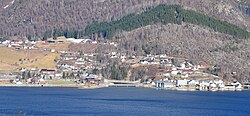
View on WikipediaSkjolden[3] is a village in Luster Municipality in Vestland county, Norway. It is located at the end of the Lustrafjorden, a branch of the Sognefjorden. Skjolden is located at the innermost point of the Sognefjorden (Norway's longest fjord). The length of the Sognefjorden is over 200 kilometres (120 mi) and it is measured from Skjolden to the island of Ytre Sula where the fjord meets the ocean. The valleys of Mørkridsdal and Fortunsdal meet at Skjolden, just west of the Hurrungane mountains.[4]
Key Information


The 0.51-square-kilometre (130-acre) village has a population (2025) of 238 and a population density of 467 inhabitants per square kilometre (1,210/sq mi).[1]
The village is located along the Sognefjellsvegen road, about 20 kilometres (12 mi) west of the lake Prestesteinsvatnet and the mountain Fannaråki. Skjolden is about 25 kilometres (16 mi) northeast of the village of Gaupne and about 35 kilometres (22 mi) northeast of the village of Hafslo. North of the village is Breheimen National Park, home of the glaciers Harbardsbreen and Spørteggbreen and the mountain Tverrådalskyrkja.
Notable people
[edit]The village was home to philosopher Ludwig Wittgenstein who lived here after 1913 during some periods of his life; the longest one was 13 months. Important parts of his works were written here. He had designed a small wooden house that was erected on a remote rock over the Eidsvatnet Lake in 1913 and called "Østerrike" (Austria) by locals. It was broken up in 1958 to be rebuilt in the village. A local foundation collected donations and bought the house in 2014; it was dismantled again and re-erected at its original location; the inauguration took place on 20 June 2019 under international attendance.[5]
Media gallery
[edit]-
 View of the Vassbakken waterfall
 -
 Skjolden village
 -
 View of the village with waterfall behind
 -
 View of Skjolden in February 2024
Credit: Vadim Chuprina -
![The restored house of Ludwig Wittgenstein in Skjolden.[6] Credit: Vadim Chuprina](//upload.wikimedia.org/wikipedia/commons/thumb/8/89/Ludwig_Wittgenstein_Skjolden_Norge_2024_Vadim_Chuprina.jpg/500px-Ludwig_Wittgenstein_Skjolden_Norge_2024_Vadim_Chuprina.jpg)


![The restored house of Ludwig Wittgenstein in Skjolden.[6] Credit: Vadim Chuprina](https://en.wikipedia.org/wiki/File:Ludwig_Wittgenstein_Skjolden_Norge_2024_Vadim_Chuprina.jpg)
References
[edit]- ^ a b c Statistisk sentralbyrå (2025-10-27). "Urban settlements. Population and area, by municipality".
- ^ "Skjolden, Luster". yr.no. Retrieved 2025-11-15.
- ^ "Informasjon om stadnamn". Norgeskart (in Norwegian). Kartverket. Retrieved 2025-11-15.
- ^ Askheim, Svein, ed. (2025-11-05). "Skjolden". Store norske leksikon (in Norwegian). Foreningen Store norske leksikon. Retrieved 2025-11-15.
- ^ Derbyshire, Jonathan (6 September 2019). "A place to think: Wittgenstein's Norwegian retreat opens to visitors". Financial Times. Archived from the original on 2022-12-11. Retrieved 2020-08-01.
- ^ Baggini, Julian (2019). "Secular pilgrimage". Aeon.
External links
[edit] Media related to Skjolden at Wikimedia Commons

Skjolden
View on GrokipediaOverview
Location and administration
Skjolden is a village in Luster Municipality, Vestland county, in Western Norway, located at the eastern end of the Lustrafjorden, a branch of Sognefjorden—Norway's longest and deepest fjord, extending approximately 204 kilometers in length and reaching depths of up to 1,308 meters.[2][12] The village sits at coordinates 61°29′25″N 07°36′02″E and an elevation of 1 meter above sea level.[13] Skjolden is positioned about 20 kilometers west of Prestesteinsvatnet lake and 25 kilometers northeast of Gaupne, functioning as a key gateway to Jotunheimen, Breheimen, and Jostedalsbreen National Parks.[14] It forms part of Luster Municipality, established in 1838 with a population of 5,432 as of 2025; local administration includes the Fjordstova tourist information center, which manages visitor services such as guidance, postal operations, and a café.[15][16][17] Skjolden serves as a cruise port accommodating ships from operators like Royal Caribbean, equipped with facilities for waste management— including reception and disposal of ship-generated waste per Norwegian pollution control regulations—and crew support such as restrooms in the modern terminal building.[18][19][20]Name origin
The name Skjolden derives from Old Norse Skjǫldun, the definite form of skjǫldr, meaning "shield," reflecting its origins as a term related to shelter or protection.[21] This etymology likely alludes to the village's strategic position on a flat terrace or ledge at the end of the Lustrafjorden, offering a natural shield against the surrounding steep mountains.[22] The name evolved from Norse concepts of defense, with skjǫldr denoting both a literal shield and metaphorical protection, fitting the fjord-side topography that provided a sheltered settlement site. Skjolden first appears in historical records around the 14th century as a farmstead name, documented in medieval Norwegian sources as a key location in the Sogn region. No major changes to the name have occurred since the 19th century, preserving its Old Norse roots. As part of the Sogn dialect area (Sognamål), the name embodies local linguistic features influenced by western Norwegian Nynorsk traditions, emphasizing the area's rugged, protective landscape. In regional context, Skjolden's naming aligns with broader Sognefjorden etymology, where the fjord's name stems from Old Norse súg- ("to suck"), referring to tidal surges, highlighting the dynamic environmental influences on local place names.[23]Geography
Topography and environment
Skjolden is situated at the head of the Sognefjord, where the valleys of Mørkridsdalen and Fortunsdalen converge, forming a narrow, flat delta area composed of glacial deposits from post-glacial meltwater rivers.[24] This delta provides a level expanse amid the surrounding rugged terrain, while the village lies just west of the Hurrungane mountain range, characterized by steep peaks rising over 2,000 meters, including Store Skagastølstind at 2,405 meters.[25] The landscape features pronounced relief, with undulating plateaus at around 1,200 meters above sea level dissected by narrow valleys and fjord arms shaped by repeated glaciations.[24] The region's environment is dominated by glacial and alpine features, including proximity to three national parks: Jotunheimen National Park begins approximately 1 kilometer east of Skjolden, while Breheimen and Jostedalsbreen National Parks lie about 65 kilometers to the south.[3] Glaciers such as Nigardsbreen, an accessible outlet of Jostedalsbreen, feed icy rivers that carve through the valleys, alongside waterfalls like Feigefossen, which plunges 218 meters and is located roughly 16 kilometers from the village.[26] Ongoing post-glacial rebound continues to elevate the land at approximately 1 centimeter per year, influencing local hydrology and sediment dynamics.[27] Biodiversity in the area reflects its alpine setting, with diverse flora including over 1,000 plant species adapted to high elevations, such as vascular plants thriving above 2,000 meters in Jotunheimen.[28] Fauna encompasses wild reindeer herds that migrate through the mountains, alongside species like wolverines, lynx, arctic foxes, and lemmings; birdlife includes rock ptarmigan, golden eagles, and ptarmigans in the upland meadows.[29] Human impact remains minimal owing to Skjolden's small population of approximately 240 residents (as of 2024), preserving much of the natural environment, though the Sognefjellet Scenic Route (National Tourist Route 55) introduces a notable infrastructure element.[30] This 108-kilometer road, connecting Skjolden to Lom and opened in 1938, traverses the high pass at 1,434 meters, facilitating access while integrating with the landscape through design features like rest areas overlooking glaciers and peaks.[31][32]Climate and weather patterns
Skjolden features a marine west coast climate, classified as Cfb in the Köppen-Geiger system, with mild winters and cool summers primarily attributable to the warming effects of the North Atlantic Current, an extension of the Gulf Stream that moderates coastal temperatures in western Norway.[33] Annual precipitation totals around 1,500 mm, predominantly falling during the fall and winter seasons due to the region's exposure to moist Atlantic air masses. Average temperatures reflect this oceanic influence, with average summer highs of 14–16°C in July and winter lows dipping to approximately -5°C in January. Snowfall accumulates to about 2–3 meters annually at lower elevations, though this varies with altitude and contributes to heightened avalanche risks in the adjacent mountainous terrain.[34] The fjord's microclimate further tempers temperature extremes by trapping warmer air, while frequent rainfall and fog arise from recurring low-pressure systems originating over the Atlantic Ocean.[35] Seasonal daylight patterns are pronounced at Skjolden's latitude of 61°N, featuring nearly continuous daylight and the midnight sun effect from late May to mid-July, contrasted by short winter days with less than six hours of light from late November to early January. The surrounding topography offers partial shelter from prevailing westerly winds, reducing gustiness compared to more exposed coastal areas. Historical records from the nearby Lom weather station, operational since 1900, document a slight warming trend of about 1.1°C in average annual temperatures across Norway since the early 20th century, consistent with broader regional patterns driven by global climate change. As of 2025, this trend continues, with an approximate total increase of 1.2°C.[36][37] This gradual increase has subtly altered seasonal precipitation distribution, with marginally wetter winters observed in long-term data.[38]History
Early settlement and medieval period
The Sognefjord region, where Skjolden is located, shows evidence of early human habitation dating back to the Mesolithic period around 10,000 years ago, with hunter-gatherer communities exploiting the fjord's shores for resources such as fish and marine mammals.[39] Archaeological findings in western Norway indicate seasonal campsites along fjord edges from approximately 6,000 BCE, supporting small groups through foraging and early fishing practices.[40] During the Viking Age (c. 800–1050 CE), the area around Skjolden featured scattered farms used for seasonal herding and agriculture, with the fjord serving as a key route for local trade in goods like timber and dried fish.[41] These settlements were part of broader Norse patterns in the Sognefjord, where communities balanced fjord-based livelihoods with upland pastoralism.[2] By the early medieval period, permanent settlement in the Luster area, encompassing Skjolden, solidified around 1300 with the establishment of parishes tied to early Christian sites.[42] A prominent landmark is the Urnes Stave Church, constructed around 1130 about 30 km from Skjolden, which stands on the foundations of at least three prior wooden structures and features intricate carvings blending Norse and Romanesque styles.[43] This UNESCO World Heritage Site, designated in 1979, exemplifies the transition from pagan to Christian architecture in the region.[44] The local economy relied on subsistence farming of grains and livestock on terraced slopes, supplemented by fjord fishing for cod and herring, and limited trade along the waterway for salt and iron.[45] By around 1500, small fjord-end communities like Skjolden had low population densities, organized around family farms.[46] The Black Death of 1349 severely impacted the area, causing widespread mortality—estimated at 50–65% across Norway—and leading to abandoned settlements and reduced agricultural output for generations.[47] Christianization accelerated after 1000 CE under King Olaf II, transforming the region's cultural landscape as stave churches like Urnes symbolized the integration of Romanesque influences with lingering Viking motifs.[48] This shift marked the end of pagan practices and the consolidation of ecclesiastical authority in fjord parishes.[49]Modern era and key developments
In the 19th century, Skjolden underwent gradual growth driven by the expansion of farming in the fertile valleys and fjord-side lands of the Luster area, supporting small-scale agriculture focused on fruits, berries, and livestock. The village became part of the newly established Luster municipality in 1838, following Norway's formannskapsdistrikt reforms that formalized local administrative units.[50][15] The 20th century brought significant infrastructure milestones that transformed Skjolden's accessibility and cultural profile. The Sognefjellet road, Norway's highest mountain pass at 1,434 meters, was constructed and opened in 1938, connecting Skjolden to Lom and facilitating year-round access despite seasonal closures due to snow. Philosopher Ludwig Wittgenstein resided intermittently in Skjolden from 1913 to 1926, during which he designed and built his simple wooden house "Østerrike" overlooking Eidsvatnet lake; the structure was restored in 2019 and now serves as a museum highlighting his time there. During World War II, under German occupation from 1940 to 1945, the Sognefjord region played a role in Norway's strategic coastal position, though Skjolden remained relatively remote. Post-war recovery spurred a tourism boom, leveraging the area's natural beauty and improved roads to attract visitors.[51][52] In recent decades, Skjolden has emphasized sustainable development amid growing tourism pressures. The cruise port underwent expansion in the 2000s, with a dedicated terminal completed in 2010 to accommodate larger vessels, boosting the local economy. The population has remained stable at around 200-240 residents, reflecting the village's role as a quiet gateway to Jotunheimen National Park. In the 2020s, efforts have intensified on sustainable tourism practices, including green infrastructure and climate adaptation measures, as part of Norway's national strategy to mitigate environmental impacts from rising visitor numbers and changing weather patterns.[53][54][52]Economy
Primary industries
Skjolden's economy is anchored in small-scale agriculture and freshwater fishing, reflecting the rugged terrain of the Sognefjord region. Agriculture primarily involves dairy farming on limited arable land, with historical reliance on sheep herding in the surrounding valleys such as Mørkrid and Fortun, where traditional practices like sauesanking (gathering sheep from mountain pastures) persist as a cultural and economic staple. Local dairy production contributes to regional specialties, often processed through cooperatives like Tine, emphasizing sustainable, smallholder operations suited to the steep landscapes.[55][56] Freshwater fishing in rivers like the Fortun and Mørkrid provides another key activity, focusing on salmon and trout species, with licenses managed by local landowners to support both subsistence and limited commercial efforts. These rivers, flowing into the inner Sognefjord, offer seasonal opportunities that complement agricultural cycles, though catches are modest due to environmental regulations.[57][58] Other sectors remain limited, with manufacturing exemplified by the historic Safthuset factory in nearby Sørheim, established in 1909 for producing juice and jam from local berries, now preserved as a museum highlighting past local goods production. Forestry occurs sparingly in the surrounding areas, constrained by extensive protected lands including Jotunheimen and Breheimen National Parks, which cover much of the municipality and prioritize conservation over extraction.[59][60] In Luster municipality, which encompasses Skjolden, about 180 individuals were employed in agriculture, forestry, and fishing as of 2020, forming a core alongside services that together account for roughly half the local workforce amid a total of approximately 2,650 employed persons aged 15-74 as of 2020. Unemployment remains low, in line with the national average of approximately 3.6% as of 2023, bolstered by municipal subsidies that support rural primary sectors against seasonal labor shortages. The economy has transitioned from traditional self-sufficiency to greater integration with external markets since the mid-20th century, driven by improved connectivity, though specific post-1950s shifts in Skjolden reflect broader Norwegian rural patterns of modernization.[61][62]Infrastructure and services
Skjolden serves as the eastern terminus of the European route E39, facilitating road access into the inner Sognefjord from western Norway.[63] The village also connects to the Sognefjellet road (Norwegian county road RV55), Northern Europe's highest mountain pass at 1,434 meters, which remains open seasonally from May to October due to heavy snowfall.[64] A modest harbor supports local ferries and accommodates cruise ships, with capacity for up to several thousand passengers daily during peak summer months.[65] No airport operates in Skjolden; the closest facility is Sogndal Airport (SOG), located approximately 100 kilometers southwest.[1] Utilities in Skjolden draw primarily from hydroelectric sources, harnessing the power of nearby rivers like the Fortun, which feeds three power stations including the main facility at Skagen, just 6 kilometers away.[66] Potable water is supplied from pristine mountain sources in the surrounding Jostedalsbreen region, while waste management systems comply with national standards to handle both residential and seasonal visitor loads.[67] Public services include a primary school, Skjolden skole, providing education for local children up to lower secondary level, supplemented by the municipal health clinic offering basic medical care; more specialized or emergency services are routed through Luster's central facilities.[68] Broadband internet coverage, delivered via fiber and mobile networks, has been widely available since the early 2010s, enabling reliable connectivity for residents and remote work.[69] Infrastructure development in recent decades has focused on enhancing accessibility, with road upgrades along RV55 and approach routes completed in the 2010s to better support tourism and local transport needs.[70] In the 2020s, several electric vehicle charging stations were installed at key sites like Skjolden Brygge and local hotels, aligning with Norway's national push for EV adoption.[71] These improvements aid logistics for primary industries such as agriculture by improving goods movement efficiency.[72]Tourism and attractions
Natural attractions
Skjolden serves as an ideal base for exploring the dramatic natural landscapes of the Sognefjord region, with its proximity to national parks and fjord waters enabling a range of outdoor pursuits. The village's location at the head of the world's second-longest fjord provides easy access to rugged mountains, glaciers, and serene valleys, attracting hikers, boaters, and nature enthusiasts year-round.[1] Hiking opportunities abound in the surrounding areas, particularly in Jotunheimen National Park, where trails lead to iconic sites like the Besseggen ridge, a challenging 14-kilometer route renowned for its alpine scenery and elevation changes of up to 700 meters; the trailhead at Gjendesheim is reachable by an approximately 2.5-hour drive from Skjolden. Glacier walks at Nigardsbreen, an arm of Europe's largest glacier in Jostedalsbreen National Park, combine a short boat ride across a turquoise lake with a guided hike on the ice, offering close-up views of crevasses and ice formations; the site is approximately 65 kilometers and a one-hour drive from Skjolden. For shorter excursions, the Sengaberget viewpoint trail provides panoramic vistas of the fjord, village, and surrounding valleys via a 3.2-kilometer out-and-back path that is generally easy but includes some steep sections, taking about an hour to complete.[73][74][75] Water-based activities thrive along the calm inner reaches of Sognefjorden, where visitors can join RIB boat tours that speed through narrow fjord passages, passing waterfalls and steep cliffs at up to 40 knots for an exhilarating 60- to 90-minute adventure. Kayaking is popular in the sheltered waters near Skjolden, allowing paddlers to navigate quietly amid forested shores and wildlife; rentals and guided trips are available from local operators. Fishing spots in Fortunsdalen valley, along the Fortun River, offer opportunities for trout angling in clear mountain streams, with licenses required for the 3-kilometer stretch accessible by a short drive or bike from the village.[76][77][78] Seasonal events enhance the natural appeal, with winter Northern Lights viewing possible from fjord-side spots or guided night hikes, capitalizing on Skjolden's dark skies away from urban light pollution. In summer, extended daylight enables midnight sun hikes on easier valley trails, extending into the late evening with persistent twilight. Guided llama safaris through nearby valleys like Mørkrid or Fortun provide a gentle, family-friendly way to traverse meadows and forests, with walks lasting 1-2 hours led by local farms.[79][80] Most natural sites are accessible within 1-2 hours by car, bus, or bike from Skjolden, supporting day trips without extensive planning. Eco-friendly options, such as electric boat tours and low-impact hiking guidelines, have been promoted by local tourism initiatives since 2015 to preserve the pristine environment.[1][81]Cultural and historical sites
Skjolden is notably associated with the philosopher Ludwig Wittgenstein, who constructed a modest wooden house known as "Østerrike" (meaning "Austria" in Norwegian) on a hillside overlooking Lake Eidsvatnet in 1914 to facilitate focused philosophical work. Wittgenstein first visited Skjolden in 1913, renting local accommodation for philosophical work. He constructed the hut in 1914 and resided there for an extended 13-month period starting in 1914, during which he developed key ideas for his Tractatus Logico-Philosophicus, and made intermittent visits until his last one in 1950, seeking solitude amid the fjord's isolation. The original structure was relocated in 1958 and later dismantled in 2017 before being meticulously rebuilt to its 1914 design between 2018 and 2019 by the Wittgenstein Foundation, which now operates it as a museum featuring exhibits on the philosopher's life, writings, and time in Norway.[82][83][84] Approximately 30 kilometers from Skjolden along the Lustrafjord lies Urnes Stave Church, Norway's oldest surviving stave church, constructed around 1130 and exemplifying the transition from Viking to medieval Christian architecture. Renowned for its intricate dragon-head carvings on the exterior gables and interior elements representing the "Urnes style" of intertwined animal motifs, the church was designated a UNESCO World Heritage Site in 1979 for its outstanding preservation of wooden ecclesiastical heritage. A dedicated visitor center nearby provides interpretive displays on its medieval artifacts, construction techniques, and historical significance to the Sogn region.[85][86][87] Local museums in and around Skjolden preserve the area's industrial and cultural heritage. The Safthuet (Juice House) Museum at Sørheim, established in 1909 as Norway's first juice factory by Nils and Kari Lerum, showcases 20th-century production methods for fruit juices and jams using traditional equipment and recipes that fueled regional industry. Complementing this, the Fjordstova Visitor Centre in Skjolden houses cultural exhibits on fjord life, including displays on local traditions, Breheimen National Park, and historical figures like Wittgenstein, alongside sales of regional handicrafts.[88][17] Cultural events in Skjolden highlight its intellectual ties, with the annual Wittgenstein Seminar held each summer since around 2020, featuring lectures, discussions, and site visits to the philosopher's house organized by the Wittgenstein Foundation and local partners. Traditional Norwegian music performances, often incorporating fiddle and lute traditions from the Sogn area, occur seasonally at venues like Fjordstova, celebrating the region's folk heritage.[89]Demographics and society
Population and demographics
Skjolden, a small village in Luster municipality, Vestland county, Norway, has a population of 238 as of 2025.[30] This figure reflects its status as a compact rural community at the head of the Sognefjord, with a low population density consistent with Norway's fjord-side settlements.[11] Demographically, the village's residents exhibit characteristics typical of rural Norwegian areas, including a gender balance close to 50/50 and an average age of approximately 42 years as of 2019, indicating a slightly older population compared to the national average. About 92% of the population in the encompassing Luster municipality was ethnic Norwegian as of 2019, with a small immigrant community comprising around 8% foreigners, primarily from EU countries. Luster municipality had an estimated population of 5,432 as of 2025.[90][16] Population trends in rural Norway have led to a 0.9% annual decrease nationally as of 2023, partly supported by seasonal influxes of workers tied to the tourism industry, though the permanent resident base in areas like Skjolden remains small. Housing in the village consists predominantly of single-family homes, underscoring its quiet, family-oriented rural character.[91]Community and culture
Skjolden's community is characterized by its close-knit social fabric, where residents frequently gather at Fjordstova, the village's central meeting point that hosts events, conferences, and social activities in its banquet hall accommodating up to 135 people. This multifunctional facility, including amenities like a café, library, and gym, fosters daily interactions and community bonding year-round.[17][92] Local traditions reflect broader Norwegian customs, with Midsummer (Sankthans) celebrations featuring bonfires, outdoor feasts, and gatherings to mark the summer solstice, often emphasizing the region's natural beauty. Folklore in the Sogn area, where Skjolden is located, includes myths tied to the fjords, such as tales of trolls and ancestral spirits that shaped the landscape and influenced daily life, preserving a connection to Norse heritage. The Sogn dialect, known as Sognamål, is commonly spoken in everyday interactions alongside the standard written form of Bokmål, highlighting the village's linguistic distinctiveness within Western Norway.[93][94] Education in Skjolden is provided through Skjolden oppvekstsenter, a local school offering primary education up to grade 7, integrated with the Norwegian emphasis on outdoor learning to leverage the surrounding fjords, mountains, and national parks for experiential activities. Community halls like Fjordstova also serve as venues for educational workshops and youth gatherings, supporting holistic development in a small-scale setting. Health services are accessible via the broader Luster municipality network, with the community's focus on nature-based lifestyles promoting overall well-being.[95][96] Sustainability drives include the Port of Skjolden's 2024 affiliation with the Environmental Port Index (EPI), aimed at minimizing environmental impacts from tourism through emission reductions and eco-innovations, reflecting a commitment to preserving the fjord's pristine ecosystem into the 2020s.[97]References
- https://en.wiktionary.org/wiki/skjold
- https://en.wikivoyage.org/wiki/Road_55_%28Norway%29