Hubbry Logo
Racing slickRacing slickMain
Open search
Racing slick
Community hub
Racing slick
logo
8 pages, 0 posts
0 subscribers
Be the first to start a discussion here.
Racing slick
Racing slick
from Wikipedia
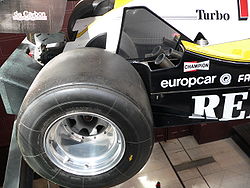
Tyre on Alain Prost's 1983 Renault Formula One racing car

A racing slick or slick tyre is a type of tyre that has a smooth tread[1][2][3][4] used mostly in auto racing. The first production slick tyre was developed by M&H Tires in the early 1950s for use in drag racing. By eliminating any grooves cut into the tread, such tyres provide the largest possible contact patch to the road,[5] and maximize dry traction for any given tyre dimension. Slick tyres are used on race tracks and in road racing, where acceleration, steering and braking require maximum traction from each wheel. Slick tyres are typically used on only the driven (powered) wheels in drag racing, where the only concern is maximum traction to put power to the ground, and are not used in rallying.

Slick tyres are not suitable for use on common road vehicles, which must be able to operate in all weather conditions. They are used in auto racing where competitors can choose different tyres based on the weather conditions and can often change tyres during a race.

Performance

[edit]

Two stress mechanisms produce tyre grip:[6]

  • Indentation of the viscoelastic tyre rubber adapting to the texture of the road surface
  • Molecular adhesion at the interface between the tyre rubber and the road surface

Slick tyres can provide far more traction than grooved tyres on dry roads, but typically have far less traction than grooved tyres under wet conditions. Wet roads severely diminish the traction because of aquaplaning due to water trapped between the tyre contact area and the road surface. Grooved tyres are designed to remove water from the contact area through the grooves, thereby maintaining traction even in wet conditions.

Since there is no tread pattern, slick tyre tread does not deform much under load. The reduced deformation allows the tyre to be constructed of softer compounds without excessive overheating and blistering. Modern day slick tyres have now developed particular performance qualities in a specific window of temperatures, becoming sticky when accumulating enough heat, and thus give much greater adhesion to the road surface,[6] but they also have lower treadwear ratings; i.e. they wear out much more quickly than the harder rubber tyres used for driving on the streets. It is not uncommon for drivers in some auto sports to wear out multiple sets of tyres during a single day's driving.

Drag racing slicks

[edit]
A 1958 Fuel dragster (technically, a rail), on display at the California Automobile Museum

The first drag racing slick was developed by M&H Tires (Marvin & Harry Tires) in the early 1950s. It was the only company in the world that produced and sold original drag racing tyres.

Drag racing slicks vary in size, from slicks used on motorcycles to very wide ones used on "top fuel" dragsters. For "closed wheel" cars, often the car must be modified merely to account for the size of the slick, raising the body on the rear springs for the height of narrower slicks, or replacing the rear wheel housings with very wide "tubs" and narrowing the rear axle to allow room for the wider varieties of tyres. Open-wheel dragsters are freed from any such constraints, and can go to enormous tyre sizes. Some use very low pressures to maximize the tread contact area, producing the typical sidewall appearance which leads to their being termed "wrinkle wall" slicks. Inner tubes are typically used, to ensure that the air does not suddenly leak catastrophically as the tyre deforms under the stress of launching.

"Wrinkle Wall" slicks are now specifically designed for the special requirements of drag racing, being constructed in such a way as to allow the sidewall to be twisted by the torque applied at launch, softening the initial start and thus reducing the chances of breaking traction. As speed builds, the centrifugal force generated by the tyre's rotation "unwraps" the sidewall, returning the energy to the car's acceleration. Additionally, it causes the tyres to expand radially, increasing their diameter and effectively creating a taller gear ratio, allowing a higher top speed with the same transmission gearing.

Cheater slicks

[edit]

Since completely slick tyres are outlawed on most roads due to their inability to handle wet pavement, the "cheater slick" became a popular item in the hot rod world in the 1960s; a typical slick type tyre, but engraved with the absolute minimum amount of tread grooves required to satisfy legal requirements. Since then, however, tyre development has progressed greatly, so that today's hot rod street cars typically use wide, grooved tyres which perform better than the slicks of the past; while the cheater slicks available today, both for nostalgic appearance of street cars and for competition use in classes where legal street tyres are required, have followed their own line of development, diverging from true slick tyre construction to become a distinct tyre design in themselves.

R compound tyres (grooved slicks)

[edit]

The development in cheaper slick technology has affected the development of tyres for racing series other than drag racing as well. When other forms of auto racing similarly instituted classes which require DOT approved street tyres, some manufacturers similarly began to market tyres which superficially resembled their high performance street tyres, but with the least tread pattern permissible and with very soft, sticky rubber, intended specifically for competition because the soft tread would wear too quickly for street use. These became known as R compound tyres. With additional years of progress, this class of tyre has followed its own line of development, to the point where they have little in common with true street tyres of the same brand. This has led to new classes of racing which require not only DOT approval, but also a minimum treadwear rating, in an effort to eliminate the R compound tyres from competition and require "true" street tyres.

Formula One

[edit]
Pirelli ultrasoft slick tyres seen at the 2016 Austrian Grand Prix. The tyre wear is clearly visible.

In Formula One, slick tyres were introduced by Firestone at the 1971 Spanish Grand Prix.[7] They were banned from the 1998 to 2008 seasons. Dry weather tyres with mandatory circumferential grooves intended to reduce total grip and reduce cornering speeds were used, but were still often referred to as "slicks" as the grooves were not intended to disperse water and could not be used effectively in wet conditions.[8] Slick tyres were reintroduced from the 2009 season.[9]

Bicycle tyres

[edit]

In contrast, many bicycle tyres made for street use are slick. Aquaplaning does not present a problem for bicycles tyres due to their narrower width, higher pressure, lower speed, and circular cross section (due to the need to lean the bicycle in turns); the bicycle tyre can penetrate the water layer to contact the road much more easily. In practice, grooved bicycle tyres do not outperform slick tyres on wet roads. However, many low and medium performance bicycle tyres have substantial tread depth, because the bicycles are designed with off-road excursions in mind: in dirt, gravel or sand, the tread pattern provides significantly improved traction. In addition, high-performance bicycle tyres, although designed for road use only, often have a very fine tread pattern, which appears to provide no difference in performance versus a slick tyre and is only there for marketing purposes and as a tyre-wear indicator. This is clear not only from direct testing of tyres, but also from the fact that the texture of the road is itself coarser than the minimal tread pattern on these tyres.[10] Some grooveless designs have small "holes" or dimples embedded in the tread as a tyre-wear indicator. This is similar to automobile tyre-wear indicator bars, which contact the road when the tyre is worn to a low tread amount, making the tyre noisy on the road.

See also

[edit]

References

[edit]
[edit]
Revisions and contributorsEdit on WikipediaRead on Wikipedia
from Grokipedia
A racing slick, also known as a slick , is a type of specialized automobile featuring a smooth, treadless surface designed to maximize contact with the road and provide optimal grip during dry-track conditions. These tires are constructed from soft, sticky rubber compounds that enhance traction through increased , making them essential for high-performance motorsports such as Formula 1, , and circuit events where rapid acceleration, cornering, and braking are critical. Unlike street-legal tires, racing slicks lack grooves or patterns, which would otherwise reduce the and dissipate heat inefficiently under extreme speeds and loads. The development of racing slicks originated in the mid-20th century amid the rise of , where early enthusiasts manually shaved treads from standard tires to improve straight-line traction. In 1957, the M&H Tire Company, founded by Marvin and Harry Rifchin in , introduced the world's first purpose-built racing slick, the M&H Racemaster Dragster, which utilized a soft rubber tread devoid of any pattern to deliver superior hookup on the strip. This innovation quickly spread to other forms of racing; by the 1960s, companies like Goodyear and Firestone followed with their own slick designs, incorporating features such as soft sidewalls for better weight transfer and wrinkle effects to enlarge the contact patch during launches. Slicks became standard in Formula 1 during the late 1960s, with Dunlop producing an early version in 1966, though their widespread adoption in circuit racing solidified in the 1970s as engine power and track demands escalated. Racing slicks are engineered with and techniques to withstand the rigors of while prioritizing over longevity. The tread surface employs specialized rubber compounds blended with resins and polymers for high stickiness, available in varying hardness levels—such as soft for qualifying laps or harder for races—to balance grip and wear. Internally, they feature stiff sidewalls reinforced with or steel belts angled for stability, eliminating unnecessary components like butyl innerliners to reduce weight, and are often inflated with for consistent pressure under heat. These tires typically last only 100 to a few hundred miles, far shorter than road tires, due to their aggressive formulations. In modern racing, slicks are governed by series-specific regulations to ensure fairness and safety, with no requirement for Department of Transportation (DOT) approval since they are not intended for public roads. Organizations like the FIA in Formula 1 mandate single-supplier compounds (e.g., Pirelli's C1 to C5 range, with C6 introduced in 2025 for specific tracks) selected per event based on track characteristics, requiring drivers to use at least two dry compounds per race. Variations include drag-specific slicks with extra-wide profiles for launches and slicks optimized for lean angles, though all share the core principle of maximizing dry-surface to push vehicle limits.

Definition and Design

Core Characteristics

A racing slick is a specialized featuring a completely smooth, treadless rubber surface, engineered exclusively for high-performance applications to deliver maximum grip on dry track surfaces. This design eliminates any patterned grooves, allowing the full tread area to contact the road and optimize under racing loads. Key physical attributes of racing slicks include their smooth outer rubber surface, which promotes uniform ; sidewalls designed for the specific application, such as low-profile for enhanced rigidity and responsiveness during high-speed maneuvers in circuit or softer and taller to allow deformation and increased contact during launches in ; and a maximized that distributes vehicle weight evenly across the tire-road interface for superior load handling. These traits enable slicks to generate higher lateral forces in corners compared to conventional tires. Unlike street-legal tires, which incorporate grooves and sipes to channel water away and mitigate hydroplaning on wet roads, racing slicks lack such features and are unsuitable for all-weather use, focusing instead on peak dry-condition performance. This specialization results in dramatically improved traction on clean, dry asphalt but renders them ineffective in .

Materials and Construction

Racing slicks are primarily composed of compounds, with rubber (SBR) serving as a key base due to its balance of elasticity and resilience under high stress. These compounds incorporate additives such as for improved durability and abrasion resistance, along with resins that enhance stickiness when heated to optimal operating temperatures. The specific formulation varies by manufacturer and application, but the emphasis is on achieving a soft yet robust material that maintains integrity during rapid acceleration and cornering. The internal structure of racing slicks features a multi-ply carcass made from layered fabrics, typically or cords, providing the foundational support for the tire's shape and load-bearing capacity. Reinforcement comes from circumferential belts, often constructed from high-strength materials like for rigidity or for lightweight tensile strength, which wrap around the crown to prevent deformation under extreme forces. Sidewalls are designed to be thin and stiff, incorporating angled fabric inserts known as chippers to minimize flex while ensuring precise handling response. Manufacturing racing slicks involves a of hand-built assembly and automated processes to ensure precision and uniformity. Tire builders manually layer the carcass plies, belts, and uncured rubber components onto a before the assembly is shaped and placed into a high-pressure mold. The then undergoes , a curing process where heat and pressure—often exceeding 150°C and several tons of force—bond the materials into a dense, seamless structure over 10 to 20 minutes, depending on size. The evolution of materials in racing slicks began with in early 20th-century designs, which offered good initial grip but suffered from poor heat resistance and degradation. By the and , the introduction of synthetic rubbers like SBR and butadiene-based polymers marked a significant shift, driven by wartime shortages and advancements in techniques. This transition accelerated in the 1980s with the adoption of advanced synthetic formulations and high-performance reinforcements like , enabling better thermal stability and longevity under racing conditions.

Performance Principles

Grip and Traction Mechanics

Racing slicks achieve superior grip through the viscoelastic properties of their rubber compounds, where primarily arises from loss during deformation in the . As the tire rolls or slides, the rubber undergoes repeated deformation under load, causing internal energy dissipation as due to the material's time-dependent response. This mechanism, which accounts for a significant portion of the tire's on dry surfaces, is maximized in slicks by using soft, high- compounds that promote viscoelastic deformation without tread patterns interfering with the contact area. The coefficient of (μ\mu) for racing slicks typically ranges from 1.5 to 2.0 on dry asphalt, significantly higher than the 0.7 to 1.0 for treaded tires, enabling greater lateral and longitudinal forces. This elevated μ\mu stems from the optimized rubber formulation and full , allowing slicks to generate frictional forces according to the equation F=μNF = \mu N where FF is the frictional force and NN is the normal force. In practice, Formula 1 slicks achieve μ\mu values of 1.55 to 1.60 under optimal conditions, while GT racing slicks operate around 1.30 to 1.35. Traction in racing slicks is influenced by several key factors, including tire pressure, , and vertical load. Optimal tire pressures of 15 to 25 psi help maintain a flat , maximizing adhesion without excessive sidewall flex or reduced footprint area. adjustments, particularly negative camber, optimize the shape during cornering by compensating for body roll, ensuring more even pressure distribution across the tread. Load sensitivity further affects performance, as increasing vertical load does not proportionally increase grip; the decreases nonlinearly with higher loads due to reduced rubber deformation efficiency per unit area, making critical for overall handling. Testing methods for grip and traction include skid pad evaluations, which measure maximum sustained lateral acceleration in g-forces on a constant-radius circular track, typically 200 feet in diameter, to quantify cornering capability. Complementary dyno tests on tire testing machines assess lateral force and slip angle relationships under controlled loads, providing data on μ\mu and hysteresis effects without vehicle variables. These approaches validate slick performance, with top racing tires achieving lateral accelerations exceeding 1.5 g.

Heat Generation and Management

Heat in racing slicks primarily arises from two sources: internal due to the viscoelastic deformation of the rubber as it repeatedly stretches and relaxes during each revolution, and external friction from abrasion at the with the track surface. These processes generate significant , elevating operating temperatures to the range of 80–95°C for some slicks or 90–110°C for Formula 1 under typical race conditions, which is essential for achieving the rubber's optimal viscoelastic properties. To manage this heat buildup, racing slick compounds often incorporate silica fillers, which reduce internal molecular and enhance dissipation, allowing the tire to maintain flexibility and performance under . The inherently grooveless design of slicks further promotes even distribution across the tread surface by ensuring uniform contact and deformation, minimizing localized hotspots that could lead to uneven . Racing slicks exhibit a performance curve where grip peaks within a narrow optimal window of 90–110°C, enabling maximum and ; beyond this, excessive causes rubber degradation, with significant blistering and loss of traction occurring above 120°C. This thermal accumulation can be modeled using the basic equation: Q=mcΔTQ = m c \Delta T where QQ represents the heat added, mm is the tire mass, cc is the of the rubber compound, and ΔT\Delta T is the change, illustrating how frictional inputs drive rapid warming. Cooling strategies for overheating slicks include scheduled track pauses, such as pit stops, to allow natural dissipation through convection and conduction, preventing sustained exposure to degrading temperatures. In series like Formula 1, tire warmers are used to pre-heat tires to the optimal temperature range before sessions. In non-competitive settings like testing or autocross, water sprays may be applied intermittently to the tires to accelerate cooling without altering competitive dynamics. This warmed state enhances grip through increased rubber conformability, as detailed in traction mechanics principles.

Types and Variants

Smooth Slicks

Smooth slicks feature a completely smooth tread pattern, devoid of any grooves or sipes, which maximizes the between the and the road surface for optimal traction. This design principle allows the entire surface to engage with the track, enhancing force transmission during acceleration, braking, and cornering. sizes vary by type and racing series, with common diameters for passenger cars ranging from 18 to 20 inches on the rim to accommodate performance demands. These tires provide the highest levels of dry grip among variants due to their soft rubber compounds and extensive surface area, enabling superior handling and faster times in optimal conditions. Smooth slicks have been a staple in dry-weather since their introduction in the mid-1960s, when they revolutionized performance by prioritizing contact over tread for circuit applications. However, their lack of tread results in zero wet-weather capability, as they cannot disperse effectively and are prone to hydroplaning. Additionally, the soft compounds lead to rapid wear rates, with a typical set lasting a couple of hundred miles under aggressive track use before requiring replacement. In terms of , smooth slicks are widely used in GT racing series, where manufacturers like and supply tires with specific compounds and dimensions tailored to class regulations, such as 18-19 inch rim sizes for GT3 vehicles. These specifications ensure consistency in performance while adhering to safety and competition standards.

Grooved Slicks

Grooved slicks represent a variant of tires that incorporate shallow circumferential grooves to satisfy regulatory mandates for and legality, while aiming to preserve the high dry grip inherent to full slicks. These tires, commonly known as R-compounds in contemporary street-legal applications, feature minimal tread voids—typically shallow longitudinal channels—to comply with standards like those from the (DOT), allowing use on public roads without fully sacrificing track performance. The design balances maximum rubber contact with required water dispersion, making them suitable for both circuit and events where full slicks are prohibited. A pivotal development in this category occurred in , where the FIA introduced grooved dry-weather tires in as part of broader reforms following fatal accidents in prior seasons. The mandate specified molded shallow grooves rather than full tread patterns, to mitigate risks on damp tracks while avoiding the need for dedicated wet tires in light rain. This evolution reversed the prior use of unrestricted slicks, prioritizing by intentionally limiting mechanical grip to curb escalating cornering speeds, which had reached dangerous levels. The standard groove pattern in these F1 tires consisted of three continuous longitudinal channels on front tires and four on rear tires, each at least 2.5 mm deep and spaced approximately 50 mm apart across the tread width, with grooves 14 mm wide. This configuration reduced the effective by about 20% relative to smooth slicks, resulting in trade-offs such as 1-2 seconds slower lap times on dry circuits but enhanced stability and traction in transitional wet conditions. While the diminished rubber surface led to quicker buildup and potential graining under prolonged stress, the grooves facilitated minor management by channeling , though this was not the primary intent. Following their 11-year tenure in —spanning 188 Grands Prix until the —grooved tires were phased out in favor of unrestricted slicks starting in , as the single-supplier allowed better speed control through compound variations rather than geometry. Nonetheless, the grooved slick concept endures in select lower-tier series, such as certain national classes and road-legal track days, where regulations still demand minimal treads for , ensuring continued relevance in compliance-driven environments.

Cheater Slicks

Cheater slicks are a type of tire featuring minimal circumferential grooves or treads added to otherwise smooth slicks to minimally comply with NHRA class regulations requiring some tread for fairness and safety, while providing near-slick traction. Developed in the , they originated as a way for competitors in stock classes to skirt rules by modifying standard slicks with fake treads, leading to high-profile disqualifications and stricter oversight by NHRA, including prohibitions on physical alterations to tires. During the and , cheater slicks gained popularity among competitors in NHRA stock classes, where strict tire regulations required minimum tread or hardness standards to ensure fairness and safety. This era marked a turning point in enforcement, as widespread use of such designs undermined class integrity and resulted in multiple event bans for offending teams. Related cheating tactics, distinct from standard cheater slicks, included soaking tires in acetone to strip surface oils and temporarily soften the compound for increased flexibility and bite, or unauthorized bias-ply constructions to improve sidewall without visible changes. These techniques could reduce elapsed times by up to 0.2-0.3 seconds in quarter-mile runs but risked structural failure if overdone. NHRA detects non-compliant tires through rigorous post-run inspections, employing durometers to measure hardness—ensuring compliance with class-specific limits—and visual examinations for signs of tampering or uneven wear. Tires failing these checks are confiscated for further analysis, with penalties ranging from immediate disqualification to fines, points deductions, and multi-event suspensions to deter rule-breaking. Such measures have significantly reduced the prevalence of cheater slicks and related modifications since the 1980s crackdowns.

Applications in Motorsports

Drag Racing

In drag racing, racing slicks are specialized tires optimized for straight-line acceleration, providing unparalleled rear-wheel traction during launches that can exceed 4 Gs. In the NHRA and classes, these are predominantly bias-ply constructions, featuring wide, low-profile designs such as 36.0x17.5-16, with tread widths up to 17.5 inches to maximize and grip on the starting line for 0-60 mph sprints in under one second. Mounted on 16-inch rims meeting SFI Spec 15.4, the tires' smooth, treadless surface and soft rubber compounds are tailored to deform under load, enhancing hookup without grooves that could reduce traction. Prior to each pass, crews execute controlled burnouts—spinning the rear tires in to generate up to 200°F or more—conditioning the slicks for peak by increasing the rubber's pliability and adhesion to the track surface treated with VHT or similar compounds. This preparation is critical in and applications, where the slicks must withstand over 11,000 horsepower applied instantaneously, enabling elapsed times in the low 3-second range over a quarter-mile. metrics highlight their efficacy: dragsters routinely achieve 60-foot times below 0.85 seconds, with the class record at 0.819 seconds set by in 2025. The extreme demands of limit tire longevity, with a fresh set of slicks typically enduring about eight runs—or roughly 1.5 miles—before replacement due to heat buildup, tread shredding, and loss of optimal grip. Teams carry multiple sets, rotating them to maintain consistency across qualifying and eliminations. Advancements in the 2000s introduced radial slicks for and sportsman classes, featuring radial-ply for superior straight-line stability and reduced sidewall flex compared to bias-ply predecessors, though and remain bias-ply dominant. Certain lower classes occasionally employ cheater slicks with shallow grooves for dual-purpose use.

Formula One

Racing slicks have been integral to since the series' early days, with pure slick tires first appearing in the mid-1960s and becoming standard by the 1970s to maximize dry-track grip. These tires provided superior contact patches compared to earlier treaded designs, enabling higher cornering speeds and faster lap times. However, in 1998, the FIA mandated grooved tires to reduce aerodynamic and overall grip for safety reasons, effectively banning pure slicks until their reintroduction at the start of the 2009 season to promote more overtaking through mechanical grip emphasis. Slicks have remained the standard dry-weather tire since then, with no interruptions in their use. Pirelli has served as the exclusive tire supplier to since 2011, following Bridgestone's withdrawal at the end of , and continues in this role through at least 2027. Under Pirelli's tenure, slicks are designed specifically for F1's demands, featuring low-profile constructions optimized for high lateral loads and thermal management. In 2022, the series transitioned to 18-inch wheels from the previous 13-inch rims, resulting in wider tires with lower sidewalls that enhance handling stability and reduce porpoising effects in the ground-effect era cars. This change, developed through extensive testing, aimed to improve overall performance while maintaining safety margins. Pirelli produces six slick compounds, labeled C1 (hardest) through C6 (softest), each selected for specific race weekends based on track characteristics. The softer compounds, like C5 and C6, offer higher initial grip but faster wear rates, suiting qualifying and short stints, while harder ones like C1 and C2 prioritize durability for longer races, influencing team strategies around pit stops and tire management. For each event, three compounds are nominated—typically one hard, one medium, and one soft—requiring teams to use at least two different types during the Grand Prix to encourage varied racing lines. A notable incident occurred during the at , where multiple high-speed tire failures, including those on cars driven by and , highlighted vulnerabilities in the slicks' construction. Investigations revealed issues like incorrect tire mounting and excessive sidewall stress from car setups, prompting to introduce redesigned tires with Kevlar-belted reinforcements instead of steel for enhanced puncture resistance and structural integrity starting from the . These changes improved sidewall strength without significantly altering overall performance, restoring confidence in the tires for the remainder of the season.

Circuit and Other Racing

Racing slicks play a crucial role in circuit-based motorsports beyond Formula One, providing superior dry-weather traction for road courses in series such as the IMSA WeatherTech SportsCar Championship, the FIA World Endurance Championship (WEC), and the British Touring Car Championship (BTCC). In the IMSA WeatherTech SportsCar Championship, Michelin supplies slick tires exclusively for the GTP prototype, LMP2, and GTD classes, enabling high-performance handling across diverse North American circuits like Watkins Glen and Long Beach. Similarly, in the WEC, Michelin equips the Hypercar class with slicks optimized for global endurance events, while Goodyear provides tires for the LMGT3 category, supporting mixed prototype-GT racing formats. The BTCC relies on Goodyear slicks for its touring car grid, where they facilitate aggressive cornering on tight UK tracks like Brands Hatch and Knockhill. Tire allocations in these series are regulated to promote strategic pit decisions and tire conservation, particularly in endurance formats. For instance, WEC Hypercar teams receive 18 tires for qualifying and a six-hour race, requiring careful compound selection to cover the full distance. At the 24 Hours of Le Mans, allocations expand significantly to accommodate the event's duration, with approximately 4,000 Michelin Pilot Sport tires available for 21 Hypercars across the test day and race weekend. In the BTCC, drivers must use one set of "option" slicks for an entire race, with compounds nominated per event to balance pace and degradation. These limits emphasize slicks' role in balancing speed with longevity on circuits demanding repeated high-load braking and acceleration. Adaptations of racing slicks vary by vehicle class to optimize performance in cornering and braking zones. Prototypes in and WEC use slicks with profiles suited to their aerodynamic designs, focusing on consistent grip under high downforce for sustained corner speeds, while GT cars employ wider slicks to enhance lateral traction during aggressive turns. ’s GTP slicks, for example, incorporate compounds that warm up rapidly in varying track temperatures, ensuring balanced handling without excessive wear during long stints. In BTCC, slicks are tuned for touring cars' weight distribution, providing predictable braking response on mixed surfaces. Major manufacturers supply specification slicks tailored to each series' demands, with compounds adjusted for ambient and track temperatures to maintain optimal operating windows. Michelin offers three slick compounds—soft, medium, and hard—for IMSA's multiclass races, allowing teams to select based on forecast conditions like the extreme heat tested at Watkins Glen. In the WEC, provides similar options for Hypercars, while Goodyear's Eagle slicks for LMGT3 include a new hard compound debuted in 2025 for hotter venues like . Goodyear also equips the BTCC with soft, medium, and hard slicks, nominating pairs per round to heighten competition, such as soft and medium at for enhanced grip in cooler weather. A notable development in the 2020s has been the shift toward sustainable compounds in the FIA WEC, aligning with broader environmental goals in endurance . Michelin’s Pilot Sport slicks for Hypercars now incorporate 30 to 45 percent renewable and recycled materials, reducing environmental impact while preserving performance. For 2026, Michelin plans to introduce the Pilot Sport Endurance range, featuring enhanced durability and even higher sustainable content to support longer stints. Goodyear has followed suit, integrating 33 percent sustainable materials into its LMGT3 slicks, including natural resins and recycled components, as seen in the 2025 Eagle Hard compound. These innovations maintain the slicks' grip characteristics essential for circuit while advancing eco-friendly .

Applications in Cycling

Bicycle Slick Tires

Bicycle slick tires are designed as smooth-treaded, high-pressure rubber casings optimized for and track bicycles to minimize and maximize speed on paved surfaces. These tires feature a uniform, treadless surface that provides a consistent with the , reducing energy loss during pedaling, and are typically inflated to pressures between 100 and 150 psi to enhance and . The origins of bicycle slick tires trace back to the late 19th century, coinciding with the development of pneumatic tires for racing. Invented in 1888 by , these early pneumatic tires were immediately adopted by racers for their superior speed over solid rubber alternatives, and by the 1890s, smooth-surfaced versions were standard in velodrome competitions on dedicated cycling tracks across Europe and the . Modern iterations, produced by brands such as Continental and Vittoria, build on this legacy with advanced compounds and constructions tailored for contemporary non-motorized racing and performance riding. Common specifications for these tires include a 700c (ISO 622mm) diameter for both road and track applications—often referred to as 28-inch wheels—with widths ranging from 19mm to 28mm for optimal aerodynamics and low weight. They are frequently paired with lightweight butyl or latex inner tubes to further reduce mass, resulting in tire weights of 200-300 grams per unit, as seen in models like the Vittoria Corsa Pro (250 grams) and Continental Competition tubular (280 grams). Despite their performance advantages, slick tires have notable limitations, including reduced grip in wet conditions due to the lack of tread channels for water dispersion, making them suitable primarily for dry, paved environments. This design prioritizes speed on clean surfaces but requires caution or alternative tires for rain or unpaved terrain to avoid slippage.

Performance in Track Cycling

In UCI Track Cycling events such as , sprint, and pursuit, racing slick tires are essential for maximizing speed on the smooth surface, where they minimize and aerodynamic drag compared to treaded tires used in other disciplines. These narrow, smooth tires, typically tubular or clincher designs, provide optimal contact with the track, allowing riders to achieve higher velocities without unnecessary energy loss from tread deformation. By eliminating tread patterns, slicks enhance efficiency in short, explosive efforts like the flying 200m sprint start in and individual sprint events, or sustained efforts in the 4km . Optimization of slick tires focuses on high inflation pressures, often exceeding 100 psi and reaching up to 200 in tubular setups, to support speeds of 55-60 km/h common in pursuit races while ensuring supple casings that absorb minor track imperfections without compromising compliance. This tuning reduces tire flex and , enabling precise power transfer and stable handling during high-speed maneuvers. Supple casings, paired with these pressures, contribute to the overall aerodynamic profile of the bike-rider system, critical for events where marginal gains in efficiency translate to competitive edges. Slick tires have played a key role in breaking world records, such as British cyclist Matt Richardson's current of 8.857 seconds in the flying 200m, set on August 15, 2025 (initially broken to 8.941 seconds the previous day as the first sub-nine-second mark), achieved through optimized low-resistance setups on the track. This performance, equivalent to an average speed of approximately 81.3 km/h, highlights how slicks facilitate peak and maintenance in sprint-based events. Maintenance of racing slick tires involves frequent rotations between front and rear wheels to promote even , as uneven usage can degrade quickly under high loads. In , these tires typically last 500-1000 km before requiring replacement, depending on intensity and track conditions, with regular inspections for cuts or loss essential to sustain grip and efficiency.

Regulations and Safety

Motorsport Standards

Racing slicks in professional motorsports are regulated by governing bodies such as the Fédération Internationale de l'Automobile (FIA) and the National Hot Rod Association (NHRA) to ensure safety, performance consistency, and fair competition. The FIA, overseeing international series like Formula 1, mandates that slick tires comply with Article 10.8 of its technical regulations, specifying dimensions such as front tire widths of 345–375 mm and diameters up to 725 mm for dry conditions, and rear widths of 440–470 mm with the same diameter limit, measured at 1.4 bar pressure on new tires. In Formula 1, Pirelli supplies the sole tire compounds, consisting of six dry slick variants (C1 hardest to C6 softest). For each event, three compounds are selected and color-coded with white (hardest), yellow (medium), and red (softest) sidewall bands, with no modifications like grooving permitted. The NHRA, governing drag racing in the United States, requires tires to be manufacturer-specified for racing use, with class-specific dimensions; for example, Top Fuel dragsters mandate Goodyear slicks meeting minimum starting pressures of 6.5 psi and rear tire circumferences between 108 and 118 inches at recommended pressures. Safety markings include mandatory sidewall labeling with manufacturer details, model, size, and for European markets, the E-mark (e) indicating compliance with UN ECE regulations for vehicle components. Testing protocols for racing slicks emphasize durability under extreme conditions, including load and speed validations alongside structural integrity assessments. High-speed tests simulate racing demands, with standards like UN ECE Regulation No. requiring endurance runs at rated speeds for specified durations under load to evaluate heat buildup and stability. Burst resistance is verified through dedicated protocols like Annex 6 of ECE R30, which involves drum testing to assess the tire's ability to withstand internal pressures and impacts without , often up to 300 km/h equivalents in motorsport-adapted validations. FIA incorporates similar evaluations via third-party facilities, including dynamic radial and cornering fatigue tests, while NHRA inspectors visually check tires pre-run for defects, pressure, and compliance before each event. Historical regulatory changes have shaped slick tire standards to prioritize safety amid evolving vehicle performance. In 1998, the FIA introduced the "groove rule" for Formula 1 dry slicks, mandating three longitudinal grooves on front tires and four on rears (each 14 mm wide), reducing contact patch and cornering speeds by about 20% to mitigate crash risks from excessive grip. This persisted until 2009, when full slicks returned. More recently, for the 2022 Formula 1 season, tire rim diameters increased from 13 inches to 18 inches, with sidewall heights reduced to enhance stability, minimize flex under load, and improve aerodynamics by lowering the car's center of gravity. Compliance with these standards is enforced through third-party certification and strict penalties for violations. Bodies like TÜV Rheinland conduct independent durability and high-speed tests to certify tires against international norms, issuing marks that confirm adherence to safety thresholds such as and wet/dry performance. In FIA-sanctioned events, non-conforming tires result in exclusion from competition, as outlined in technical appendices. The NHRA imposes monetary fines (e.g., $5,000) and points deductions (e.g., 100 championship points) for infractions like using unapproved tire liners or non-spec components, as seen in cases involving vehicles. These measures ensure all slicks meet rigorous benchmarks, with ongoing inspections at events to verify markings and condition.

Environmental and Wear Considerations

Racing slicks experience rapid wear due to the intense mechanical and thermal stresses encountered during use, with typical lifespans ranging from 20 to 50 miles per set in circuit applications. This degradation is exacerbated by high lateral and longitudinal loads during cornering and , as well as abrasive track surfaces that grind away the rubber compound. Heat generation further accelerates wear patterns, contributing to blistering and uneven tread loss over repeated laps. Disposal of used racing slicks presents substantial environmental hurdles, as the synthetic rubber compounds are non-biodegradable and accumulate in landfills or incinerators, releasing persistent pollutants. Prior to the 2020s, global and U.S. tire recycling rates often hovered below 50% in earlier decades, with rates starting at just 11% in and gradually improving to around 80% by the late , though racing tires faced additional challenges due to their specialized compositions limiting . To address these lifecycle impacts, the FIA has intensified efforts in 2025 through the Sustainable Innovation Series, promoting bio-based compounds such as dandelion-derived rubber in pilot programs to replace petroleum-dependent materials. These initiatives, including Goodyear's development of tires with 55% sustainable content for FIA-sanctioned series like the , aim to cut the of tire production by 20-30% through reduced reliance on fossil fuels and enhanced material renewability. Suppliers like Continental are also advancing dandelion rubber for potential use in tires, though full integration into Formula 1 slicks remains in development as of November 2025. From a safety perspective, overuse of slicks heightens the risk of , where layers of the separate under prolonged stress, potentially leading to sudden loss of control or failure. To mitigate this, some series enforce single-event usage limits on tire sets, ensuring they are not reused beyond one competitive outing to prevent structural compromise.

References

Add your contribution
Related Hubs
User Avatar
No comments yet.