Hubbry Logo
Uniform Tire Quality GradingUniform Tire Quality GradingMain
Open search
Uniform Tire Quality Grading
Community hub
Uniform Tire Quality Grading
logo
8 pages, 0 posts
0 subscribers
Be the first to start a discussion here.
Uniform Tire Quality Grading
from Wikipedia

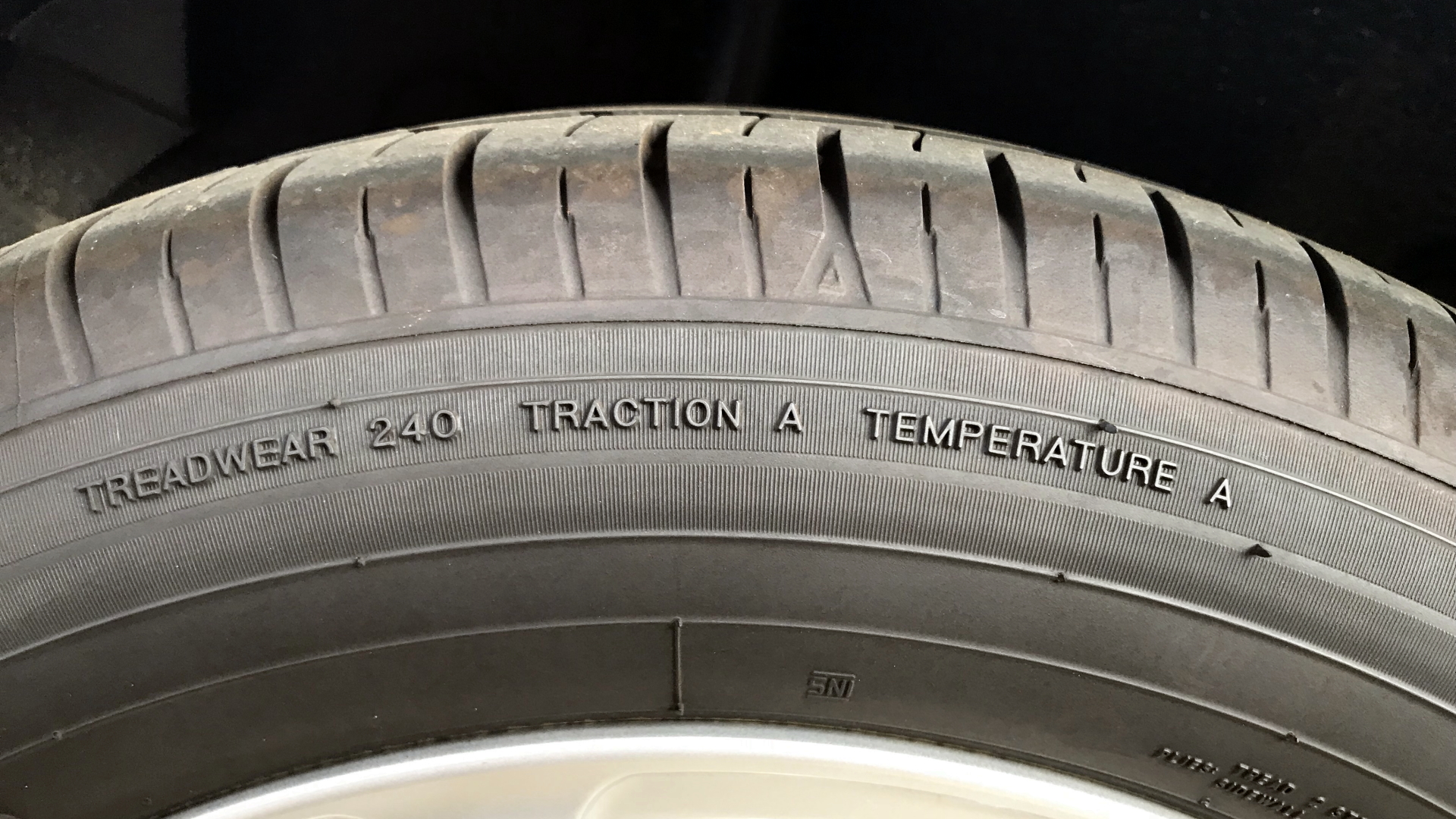
UTQG ratings on sidewall of Toyo Tires Proxes R39 tire
UTQG ratings (top) and tire code (bottom) on sidewall of Continental ContiProContact tire

Uniform Tire Quality Grading, commonly abbreviated as UTQG, is a set of standards for passenger car tires that measures a tire's treadwear, temperature resistance and traction. The UTQG was created by the National Highway Traffic Safety Administration in 1978, a branch of the United States Department of Transportation (DOT).[1] All passenger car tires manufactured for sale in the United States since March 31, 1979 are federally mandated to have the UTQG ratings on their sidewall as part of the DOT approval process, in which non-DOT approved tires are not legal for street use in the United States.[2] Light truck tires are not required to have a UTQG. It is not to be confused with the tire code, a supplemental and global standard measuring tire dimensions, load-bearing ability and maximum speed, maintained by tire industry trade organizations and the International Organization for Standardization.

The National Highway Traffic Safety Administration (NHTSA) established the Uniform Tire Quality Grading Standards (UTQGS) in 49 CFR 575.104.[3] When looking at UTQG ratings it is important to realize that the Department of Transportation does not conduct the tests. The grades are assigned by the tire manufacturers based on their test results or those conducted by an independent testing company they have hired. The NHTSA has the right to inspect tire manufacturers' data, and can fine them if inconsistencies are found.

The NHTSA published DOT HS 812 325 “Consumer Guide to Uniform Tire Quality Grading” August 2016, which provides rating information.[4]

Dedicated winter tires, also known as snow tires, are not required to have a UTQG rating.[5] Non-passenger car tires, such as those for motorcycles, buses, medium trucks and above along with trailers are also not required to have a UTQG rating, although FMVSS Standard 109 requires the following to be listed on the tire's sidewall: speed restriction if less than 55 mph, regroovable if designed for regrooving, and a letter designating load range rating.[6]

Components

[edit]

The UTQG rating is made up of three components, treadwear, traction and temperature.

Treadwear

[edit]

The treadwear grade is a comparative rating based on the wear rate of the tire when tested under controlled conditions on a specified government test track. A tire graded 200 would last twice the distance on the government test course under specified test conditions as one graded 100. In theory, this means that a tire with a 200 grade will wear twice the distance as a tire with a 100 grade. However, tire manufacturers are not under any obligation to grade a tire based on the test results, except to say that they cannot overstate the grade. This is enforced by NHTSA requiring documentation to justify any assignment of a grade on a tire, "These treadwear grades are no guarantee of actual tire mileage; differences in driving habits, service practices, climate, and road characteristics will affect a tire's longevity."

As Course Monitoring Tires have changed, their treadwear grades have changed to numbers considerably higher than 100. As a result, it would be incorrect to say that a tire with a treadwear grade of 200 gets twice the life of the Course Monitoring Tire.

Methodology

[edit]

The wear on tires that are being tested ("candidate tires") is compared to the wear of Course Monitoring Tires (CMT), which are sold by the NHTSA at its UTQG test facility in San Angelo, Texas. Both types of tires are mounted on vehicles that will be driven in a convoy during the test, thus ensuring that the candidate tires and the CMT tires experience the same road conditions. The convoy, typically comprising four or fewer vehicles, will drive 7200 miles on public roads in West Texas. Candidate tire wear will be checked during and after the test, and compared to the wear on the CMT tires from the same convoy.

The first CMTs were commercially available Goodyear Custom Steelguards, and Goodyear Tire and Rubber Company produced all CMT tires from 1975 until 1984. From 1984 to 1991, the CMT tires were produced by Uniroyal. CMT tires are now "specially designed and built to American Society for Testing and Materials (ASTM) standard E1136 to have particularly narrow limits of variability." 1.

Relation to friction coefficient

[edit]

A study has shown a statistical relationship between the average friction coefficient (μ) and the treadwear rating of tires tested. This relationship can be represented by the following formula:[7]
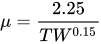
Generally speaking, a lower treadwear rating correlates with a higher friction coefficient and thus provides a shorter braking distance. A softer, more sticky tire, wears off its material faster to provide this performance.

However, this is an average rule, and for the same friction coefficient, the curve in this study shows large variations in treadwear rating, which decrease the significance of this relationship. Thus, depending on production method and tire model, the quality of rubber (thanks to certain additives) can multiply the treadwear rating by more than 3 without lessening the friction coefficient.

Limitations

[edit]

The treadwear grade is a ratio and not a mileage. This is because multiple factors determine treadwear rates and most of them are a function of driving conditions and operating environment, and not the tire itself. As a result, actual tire wear will vary considerably within the same tire line. However, two tires with exactly the same compound should have a treadwear rating that varies in accordance with tread depth.

The assigning of UTQG grades is done solely by the tire manufacturer. In many cases, this has resulted in the UTQG grading system to be more of a marketing tool than was originally intended.

It is legal and permissible for a tire manufacturer to give a particular tire line a lower treadwear grade. For example, if the highest treadwear grade in a manufacturer's lineup is 600, then a tire line with a lower treadwear test result might receive a grade of 400, instead of the 480 it could possibly receive.

Also, it is common for tires whose treadwear grade is of little commercial value, such as racing tires, to be assigned extremely low values – sometimes even zero.

Traction

[edit]

Traction grades, from highest to lowest, are AA, A, B and C. They represent the tire's ability to stop on wet pavement as measured under controlled conditions on specified government test surfaces of asphalt and concrete. The testing does not take into account cornering, hydroplaning, acceleration or stopping on a dry surface. Nor does it account for the significantly different effectiveness of ABS versus non-ABS braking systems on a tire's stopping distance.

The UTQGS traction test procedure measures a tire's coefficient of friction when it is tested on wet asphalt and concrete surfaces. The test tire is installed on an instrumented axle of a traction trailer, which is towed by a truck at 40 miles per hour (mph) over wet asphalt and concrete surfaces. The tow truck is equipped with an on-board water supply system that sprays water in front of the test tire. The brakes, from the test tire only, are momentarily locked, and sensors on the axle measure the longitudinal and vertical forces as it slides in a straight line. The coefficient of friction for the pair, test tire and surface, is then determined as the ratio of the longitudinal and vertical forces.

The UTQGS traction rating procedure specifies that the traction coefficients for asphalt and for concrete are to be calculated using the locked-wheel traction coefficient on the tire, or sliding coefficient of friction. More specifically, upon application of the brakes, the tire is subjected to shear between the wheel and the road surface, and deforms towards the rear of the vehicle. This generates a traction force to oppose the motion of the vehicle. As braking torque increases, the tire deforms more and tread elements near the rear of the contact patch with the road begin to slip rather than grip. The coefficient of friction rapidly reaches a maximum value at about 10-20 percent slip, and then declines as the longitudinal slip values increase to 100 percent, which represents a fully locked tire. The maximum coefficient of friction in the 0-100 percent slip range is termed "peak" coefficient of friction, and the lower coefficient value for the fully locked tire is termed "slide" coefficient of friction.[8]

Traction Grades
Grade Asphalt g force Concrete g force
AA Above 0.54 0.38
A Above 0.47 0.35
B Above 0.38 0.26
C Less Than 0.38 0.26

Temperature

[edit]

The temperature grades, from highest to lowest, are A, B and C. These represent the tire's resistance to the generation of heat at speed. Tires graded A effectively dissipate heat up to a maximum speed that is greater than 115 mph. B rates at a maximum between 100 mph and 115 mph. C rates at a maximum of between 85 mph to 100 mph. Tires that cannot grade up to C or higher cannot be sold in the US.[9]

See also

[edit]

References

[edit]
[edit]
Revisions and contributorsEdit on WikipediaRead on Wikipedia
from Grokipedia
Uniform Tire Quality Grading (UTQG) is a U.S. federal standard that rates the performance of new passenger car tires in three key categories: treadwear, traction, and temperature resistance, enabling consumers to compare tire quality before purchase. Established by the (NHTSA) under the National Traffic and Motor Vehicle Safety Act of 1966, the system was initially issued in 1975 and requires manufacturers to mold or label grades on sidewalls for transparency. It applies to most pneumatic tires for passenger cars but excludes deep-tread winter snow tires, space-saver spares, tires with rim diameters of 12 inches or less, and limited-production tires (fewer than 15,000 units annually per size). The treadwear grade is a numeric value, typically ranging from 80 to over 800, representing the 's projected mileage relative to a reference tire rated at 100; for example, a grade of 200 indicates the tire should last twice as long under controlled test conditions. These grades are determined through tests on a specified 400-mile course using a method, where tires are driven for approximately 6,400 miles total, and wear is measured against high-mileage control tires. Higher numbers signify better durability, but actual lifespan varies based on habits, conditions, and . Traction grades, letter-based from AA (highest) to C (lowest), assess a tire's wet braking performance on asphalt and surfaces through locked-wheel skid tests on specialized pads. An AA rating requires friction coefficients greater than 0.54 on wet asphalt and 0.38 on wet (higher coefficients indicate shorter stopping distances), while C is the minimum legal standard; these do not evaluate dry traction, cornering, or snow/ice performance. Temperature grades, also A (highest) to C (lowest), measure a tire's resistance to heat buildup during high-speed operation, tested on a laboratory drum at speeds up to 115 mph for Grade A (575 rpm) or lower thresholds for B and C. All tires must achieve at least a C rating to meet Federal Motor Vehicle Safety Standard No. 109, assuming proper inflation and load. Manufacturers conduct these tests under NHTSA oversight and must include UTQG information in vehicle owner's manuals, point-of-sale materials, and advertisements. The system has been updated periodically, including revisions to test procedures in to improve reference tire specifications. While the system promotes informed consumer choices, its limitations include reliance on controlled environments that may not reflect real-world variables like alignment issues or , and grades are comparative within similar tire types rather than absolute measures. NHTSA maintains a public database of over 2,400 tire lines with their UTQG ratings to further assist buyers.

Overview

Purpose and Regulatory Basis

The Uniform Tire Quality Grading (UTQG) system is a standardized labeling program for passenger car tires, developed by the (NHTSA) to evaluate and communicate tire performance characteristics. Its primary purposes are to equip consumers with objective, comparative data on tire tread life, wet traction capability, and resistance to heat buildup, thereby facilitating informed purchasing decisions; to foster fair competition among tire manufacturers by establishing uniform performance benchmarks; and to contribute to overall vehicle safety by encouraging the selection of higher-performing tires that may reduce accident risks associated with tire failure. The system focuses on these three core components—treadwear, traction, and temperature grades—without encompassing other tire attributes like handling or noise. The UTQG is mandated by the National Traffic and Motor Vehicle Safety Act of 1966 (Public Law 89-563), which directed the Secretary of Transportation to establish a uniform quality grading system for tires to promote and . It is implemented through 49 CFR 575.104 and integrates with (FMVSS) No. 109 for passenger car tires and No. 139 for light vehicle radial tires, which set minimum performance thresholds that UTQG grades build upon. Under these regulations, UTQG ratings are required to be permanently molded into the sidewall of all new passenger car tires sold , positioned between the tire's maximum section width and shoulder for easy visibility. This mandatory labeling ensures that performance information is accessible at the point of sale, aligning with the Act's goal of reducing traffic accidents through better-informed consumer choices.

Scope and Applicability

The Uniform Tire Quality Grading (UTQG) system applies specifically to new pneumatic passenger car tires (P-metric tires). This includes replacement tires sold aftermarket to consumers, enabling informed comparisons of treadwear, traction, and performance to aid purchasing decisions. The UTQG system does not apply to deep tread winter-type snow tires, space-saver or temporary spare tires, tires with nominal rim diameters of 12 inches or less, and limited production tires. Limited production tires are defined as those meeting all of the following: (i) annual domestic production or importation by the manufacturer does not exceed 15,000 tires of the same design and size; (ii) for brand name tires, annual domestic purchase or importation by the brand name owner does not exceed 15,000 tires of the same design and size; (iii) the tire’s size was not listed as a vehicle manufacturer’s recommended tire size for new motor vehicles produced or imported in quantities greater than 10,000 in the preceding calendar year; and (iv) total annual domestic production or importation by the manufacturer, or purchase by the brand name owner, of tires meeting criteria (i), (ii), and (iii) does not exceed 35,000 tires. Tires for light trucks (LT-metric), medium-duty trucks, motorcycles, racing, or vehicles outside the passenger car scope are not covered. UTQG ratings must be permanently molded onto the sidewall, positioned between the maximum section width and the , in a standardized format: the word "TREADWEAR" followed by a two- or three-digit number indicating the relative tread life, alongside letter grades for traction (AA, A, B, or C) and temperature resistance (A, B, or C). This mandatory labeling ensures consumers can readily access the information at the point of sale. The system is mandated and enforced under U.S. federal regulations by the (NHTSA), applying to all such tires sold or distributed in the United States, including imports that meet passenger car criteria. While informative for consumers in other regions, there is no formal enforcement or requirement outside , though some international tire manufacturers voluntarily include UTQG markings on products for global consistency.

History and Development

Legislative Origins

In the , the faced escalating concerns over safety, driven by a sharp rise in fatalities that reached over 50,000 annually by the late decade, with performance emerging as a key factor in many accidents due to failures like blowouts and tread separation. These issues were exacerbated by inconsistent manufacturing quality and inadequate consumer information, prompting widespread calls for federal intervention to standardize vehicle components. The pivotal response came with the National Traffic and Motor Vehicle Safety Act of 1966, signed into law by President on September 9, which established the (NHTSA) and granted it authority to issue mandatory performance standards for motor vehicles and equipment, including tires. This legislation directly addressed the era's safety crisis by requiring manufacturers to certify compliance with federal standards, aiming to reduce unreasonable risks from defective parts. A direct outcome was the issuance of Federal Motor Vehicle Safety Standard (FMVSS) No. 109 in 1967, which set initial requirements for new pneumatic passenger car , including tests for strength, endurance, and labeling to ensure basic safety performance on vehicles manufactured after that year. These early standards focused on preventing tire failures under normal use, responding to showing tires contributed significantly to crash risks. Concerns intensified in the early with high-profile incidents, such as the problems with Firestone's 500 steel-belted radial tires introduced in , which suffered from adhesion failures leading to tread separations and blowouts, culminating in a massive recall of over 14 million tires in 1978. This event underscored persistent gaps in tire durability and transparency, fueling congressional action. The 1970 amendments to the 1966 Act, enacted on , specifically mandated NHTSA to develop a uniform quality grading system for tires to combat misleading manufacturer claims and empower consumers with comparable performance data on treadwear, traction, and heat resistance. This directive laid the groundwork for the eventual Uniform Tire Quality Grading system, prioritizing objective metrics over subjective advertising.

Establishment and Evolution

The Uniform Tire Quality Grading (UTQG) standards were established by the (NHTSA) through a final rule published in the on May 28, 1975, implementing Section 203 of the National Traffic and Motor Vehicle Safety Act of 1966. This regulation required a uniform system for grading new passenger car tires on treadwear, traction, and temperature resistance to aid consumer decision-making. The standards drew from methods, such as ASTM E501 for tire specifications and ASTM E274-70 for skid resistance in traction testing, adapted into federal requirements for consistency and enforceability. Effective dates were phased by tire construction type: testing and grading obligations began for radial ply tires manufactured after January 1, 1976; bias-belted tires after July 1, 1976; and bias ply tires after January 1, 1977, with mandatory sidewall molding of grades fully required by March 31, 1979. Subsequent milestones refined the system's implementation and protocols. The 1975 rule initially emphasized treadwear evaluation through controlled mileage testing on specified courses, while traction and temperature grades—assessed via wet-surface braking and high-speed endurance runs, respectively—were integrated in the core framework but saw phased rollout aligned with the effective dates. In the 1980s, NHTSA issued minor updates to testing protocols, including a temporary suspension of treadwear grading effective February 8, 1983, to address variability in course monitoring and improve reliability before reinstatement. Evolution in the 1990s focused on enhancing measurement precision, particularly for wet traction, which relies on locked-wheel braking tests on wet asphalt and surfaces. A 1991 final rule amended treadwear testing procedures to better account for environmental factors, and a 1996 revision fixed the base course wear rate in treadwear evaluations to reduce discrepancies across test sites. These changes aimed to make grades more representative without altering the grading categories. In the , adjustments addressed emerging tire technologies, including low-rolling-resistance designs promoted for ; while UTQG itself remained unchanged, NHTSA's 2010 Tire Fuel Efficiency Consumer Information Program complemented it by introducing separate rolling resistance ratings using similar wet traction and treadwear methodologies. As of 2025, the standards have seen no major overhauls in over 50 years of operation, though NHTSA conducts ongoing reviews, including 2022 updates to the standard reference test tire for modern vehicle compatibility, with evaluations extending to tire performance. Compliance is maintained via manufacturer self-certification of grades, supplemented by NHTSA audits, off-the-shelf purchase testing for traction, and verification for temperature resistance.

Rating Components

Treadwear Grade

The treadwear grade in the Uniform Tire Quality Grading (UTQG) system provides a comparative measure of a 's tread longevity relative to a government-specified control tire, which is assigned a baseline rating of 100. This rating reflects the tire's wear rate when tested under controlled conditions on a designated course, allowing for standardized comparisons across car tires. The system, established by the (NHTSA), aims to inform consumers about expected durability without guaranteeing specific outcomes. Grades are numeric values, typically expressed as two- or three-digit numbers in multiples of 20, ranging from 20 to over 800, with larger numbers indicating proportionally longer projected tread life. For instance, a graded 200 is expected to last twice as long as the baseline tire under identical test conditions, while a grade of 400 suggests four times the . The control tire rated at 100 is designed to achieve approximately 30,000 miles before wearing out on the test course, though this serves only as a reference point for relative performance. On the tire sidewall, the treadwear grade appears as a prominent numeric designation (e.g., ), molded between the maximum section width and the , alongside traction and ratings. Consumers can use this information to compare s for anticipated wear resistance when selecting replacements, prioritizing higher grades for extended use in everyday . However, real-world tire life deviates from these projections due to factors such as habits, alignment and , road surfaces, and environmental conditions, often resulting in actual mileage that is 20-50% lower than test estimates. The treadwear grade does not constitute a warranty or endorsement of specific mileage by NHTSA or tire manufacturers, emphasizing its role as an informational tool rather than a performance guarantee. For cases of premature wear, manufacturers may offer pro-rata adjustments through their own policies, often referencing the UTQG grade to determine credit toward replacement tires, provided the wear is even and maintenance records are verified.

Traction Grade

The traction grade in the Uniform Tire Quality Grading (UTQG) system evaluates a tire's ability to stop a on wet pavement, specifically measuring straight-line braking performance under controlled conditions. This grade focuses on the tire's friction with wet asphalt and surfaces, using locked-wheel skid tests conducted at 40 mph to assess from that speed to a complete stop. Traction grades are assigned using letter designations from highest to lowest: AA, A, B, and C, based on the tire's adjusted traction coefficient derived from skid pad tests referenced in ASTM standards such as E 274 for the test apparatus and E 501 for the standard reference tire. An AA-rated tire demonstrates superior wet stopping ability, achieving up to 35% shorter stopping distances compared to a C-rated tire on wet asphalt, while A and B grades indicate progressively lower performance relative to these benchmarks. These grades appear as a single letter on the tire sidewall, allowing consumers to quickly identify wet braking capability without additional numerical details. For consumers, the traction grade is particularly relevant in rainy or wet driving conditions, where higher ratings (AA or A) can enhance vehicle control and reduce stopping distances, potentially improving . However, it does not assess cornering traction, dry road performance, or handling in turns, limiting its applicability to straight-line wet braking scenarios only.

Temperature Grade

The temperature grade in the Uniform Tire Quality Grading (UTQG) system assesses a 's resistance to buildup and its ability to dissipate during sustained high-speed operation, which helps prevent material degradation and potential failure such as tread separation. This rating is particularly relevant for highway driving, where friction and load generate significant on the . The grades are assigned using letters A (highest), B, and C (lowest), based on tests simulating severe conditions. A grade A can withstand sustained speeds of up to 115 mph without , grade B up to 100 mph, and grade C up to 85 mph, with all required to achieve at least grade C to meet minimum safety standards. These thresholds represent the performance under controlled testing, assuming proper inflation and loading. For consumers, the temperature grade provides an indicator of a tire's suitability for prolonged high-speed travel, such as on interstates, though it correlates only loosely with separate tire speed ratings (e.g., those under international standards like "S" for 112 mph). Higher grades like A suggest better thermal management for demanding conditions, but actual performance depends on factors like and road surface. On the tire sidewall, the temperature grade appears as a single letter (e.g., A) following the "" designation, ensuring compliance with Federal Motor Vehicle Safety Standard (FMVSS) No. 109 for all passenger car s. This marking allows quick comparison when selecting replacement s.

Testing Methodology

Treadwear Evaluation Process

The treadwear evaluation process under the Uniform Tire Quality Grading (UTQG) standards is a standardized road test conducted on a specific course near in , utilizing convoys of multiple test vehicles to compare wear performance. This course comprises approximately 400 miles of public roadways divided into three loops—southern, eastern, and northwestern—designed to simulate typical driving conditions encountered by consumers. Testing is performed by manufacturers or their designated laboratories, with the (NHTSA) conducting periodic compliance verifications using the same protocol. The core procedure involves mounting sets of candidate tires (the tires under evaluation) on two to four vehicles, alongside Course Monitoring Tires (CMTs) as control tires standardized to a baseline rating of 100 in accordance with ASTM F2493. After an initial 800-mile break-in period, the convoy completes 16 circuits of the course, totaling around 6,400 miles (with variations up to 10,000 miles possible based on wear rates). Wear is measured periodically by assessing groove depth loss at designated tread points using a nine-point least-squares method or two-point arithmetic average to project total mileage until the tread reaches 2/32 inch (1.6 mm) depth. The treadwear grade is calculated as the candidate tire's projected mileage divided by the base course wear rate of the CMTs, multiplied by 100, and rounded to the nearest multiple of 20; this yields a relative scale where a grade of 200 indicates twice the projected of the baseline CMTs under test conditions. To ensure reliability, the test incorporates lead and chase vehicle configurations, with positions rotated every two circuits and tires rotated every circuit to average out convoy effects. Vehicles operate at posted speed limits, typically under 60 mph, with axle loads maintained at 85% of the maximum specified for the tire size, and inflated to the test pressures specified in Table 1 of 49 CFR 575.104 (e.g., 24 psi for tires with a maximum pressure of 32 psi). The course layout approximates an 80% and 20% driving mix, while NHTSA standardizes , (ideally 70–100°F or 21–38°C), and conditions through quarterly monitoring of CMT performance to adjust for course severity variations. The protocol adapts elements from ASTM standards for tire testing and is outlined in NHTSA's TP-UTQG-W-01 manual, which independent testing organizations must follow for . Manufacturers submit representative samples to NHTSA's Vehicle Research and Test Center for random audits and verification testing to confirm the accuracy of self-reported grades and prevent discrepancies.

Traction Assessment Procedure

The traction assessment procedure for Uniform Tire Quality Grading (UTQG) evaluates a tire's wet braking performance through controlled laboratory tests simulating straight-line stopping on wet surfaces. This testing is conducted using a locked-wheel skid trailer or equivalent setup, which measures the tire's coefficient on wetted asphalt and pads. The procedure focuses on braking traction and does not assess cornering ability. In the test, the is mounted on the skid trailer and accelerated to 40 mph (±1 mph) before the is locked to induce skidding on the prepared surface. A uniform water depth of 0.5 mm is maintained across the test pad to replicate wet road conditions, with water applied immediately ahead of the test via a distribution system. The , or skid number, is recorded during the skid phase, typically 0.5 to 1.5 seconds after lockup, and the stopping distance can also be derived from these measurements. Results are adjusted by subtracting the reference tire's performance to account for test variability: for asphalt, the adjusted is calculated as the candidate tire's measured value plus 0.500 minus the reference tire's value; for , it is the candidate's value plus 0.350 minus the reference. Test surfaces are prepared according to ASTM E501 standards using specified reference test tires to ensure consistency, with asphalt pads measuring approximately 600 ft by 65 ft and concrete pads 600 ft by 60 ft. Ambient and surface temperatures are recorded during testing, with tires cooled between runs as necessary to ensure consistent conditions. At least 10 acceptable skids are performed per tire per surface, with data from valid runs averaged to determine the final coefficient; invalid runs due to issues like uneven water distribution are discarded. The averaged adjusted coefficients are compared against NHTSA-defined thresholds to assign grades, where the overall grade is the lower of the asphalt and results. For example, an AA grade requires coefficients greater than 0.54 on asphalt and greater than 0.38 on , while a C grade corresponds to values of 0.38 or less on asphalt and 0.26 or less on . Reference tires conforming to ASTM E501 and ASTM E1136 are used for normalization, ensuring relative performance comparisons. NHTSA establishes minimum performance criteria under 49 CFR 575.104 to prevent substandard labeling, but manufacturers self-certify their tires' traction grades based on these procedures. To verify compliance, NHTSA conducts random audits at facilities like the San Angelo Proving Ground, where independent tests confirm that assigned grades match measured performance; non-compliance can result in corrective actions or penalties.

Temperature Resistance Testing

The temperature resistance testing under the Uniform Tire Quality Grading (UTQG) standards assesses a tire's ability to resist heat buildup from under load and speed, ensuring structural without degradation such as separation or bursting. This evaluation uses dynamic simulation of operational stresses, aligning with requirements for passenger car and light truck tires under Federal Motor Vehicle Safety Standard (FMVSS) No. 139, which mandates baseline performance to prevent heat-related failures during use. The UTQG temperature grade is determined by the dynamic test described in 49 CFR 575.104. In the dynamic test, a tire is mounted on a specified rim and inflated to a pressure listed in 49 CFR 575.104 Table 1, such as 30 psi for standard passenger tires with a maximum pressure of 32 psi. The assembly is conditioned at 95°F (35°C) for at least three hours, then loaded to 88% of the tire's maximum rated load and pressed against a 67.23-inch (1708 mm) diameter steel test wheel. A break-in phase runs the wheel at 250 revolutions per minute (rpm), equivalent to approximately 50 mph, for two hours to stabilize heat generation. After cooling to 95°F and pressure readjustment, the speed increases incrementally: starting at 375 rpm (about 75 mph) for 30 minutes, then in 25 rpm steps every 30 minutes up to 575 rpm (about 115 mph) or until failure. Ambient temperature is maintained at 95°F, measured 12 inches from the rim flange. Failure occurs if the tire exhibits tread or sidewall separation, chunking, cracking, or if post-test inflation pressure drops below 95% of the initial value after 15-25 minutes of cooling. Grades are assigned based on the highest speed stage completed without failure: A for sustaining 115 mph (575 rpm) for 30 minutes, indicating superior heat dissipation; B for 100 mph (500 rpm); and C as the minimum, for performance between 85 mph and 100 mph, where the tire completes stages up to but fails the 500 rpm phase. All UTQG-rated tires must achieve at least a C grade, requiring sustained operation at equivalent speeds of 85 mph for 30 minutes under load without , as verified through the incremental testing protocol. These ratings reflect relative performance in controlled conditions, with nearly all modern tires rated A or B due to advanced compounding.

Interpretation and Use

Reading Sidewall Markings

The Uniform Tire Quality Grading (UTQG) markings are located on the sidewall of passenger car tires, positioned between the maximum section width and the shoulder, adjacent to the (DOT) code for easy identification. These markings are permanently molded into the tire and must be legible in English, ensuring visibility when the tire is mounted on the vehicle. The standard format consists of three components: a numeric treadwear grade (typically a three- or four-digit number, such as 400), followed by a traction grade letter (AA, A, B, or C), and a grade letter (A, B, or C), often presented as "Treadwear 400 Traction A A" or abbreviated as "400 A A". Certain tires, such as deep-tread, winter-type tires, space-saver spares, or those with rim diameters of 12 inches or less, are exempt from these markings. These requirements have been standardized under federal regulations to provide consistent . To decode the markings, first locate the sequence near the DOT code on the sidewall. Identify the leading numeric value as the treadwear grade, which represents relative wear resistance compared to a baseline . Next, note the following letter as the traction grade, indicating wet pavement stopping capability. Finally, the subsequent letter denotes the temperature grade, signifying resistance to heat buildup. For instance, the sidewall layout typically places these codes in a compact block below the tire size designation and above the DOT serial number, facilitating quick reference during inspection. Representative examples include the Achilles Radial 122 marked as "Treadwear 440 Traction A Temperature A" (440 A A), indicating higher performance ratings, contrasted with a such as certain models rated "300 B C", where the lower treadwear number and traction/temperature grades suggest shorter and reduced wet grip or resistance. The treadwear number provides a relative indicator, the traction letter wet stopping ability, and the temperature letter resistance, as outlined in the rating components.

Comparative Analysis for Consumers

Consumers can effectively use Uniform Tire Quality Grading (UTQG) ratings to compare tires by prioritizing higher treadwear numbers for extended longevity, AA or A traction grades for enhanced wet-road safety, and A temperature grades for better performance at high speeds, while balancing these against factors like cost and vehicle-specific needs. For instance, a tire with a treadwear rating of 500 indicates five times the wear resistance of the baseline 100-rated tire under controlled test conditions, compared to one rated 200 that indicates twice the baseline, though actual mileage varies based on maintenance and habits. Higher grades in traction and temperature offer advantages in safety—such as shorter stopping distances on wet pavement for AA traction tires—but often at the expense of lower treadwear, leading to faster overall wear. Practical tips for selection include using the NHTSA's online tire finder tool to identify options matching vehicle requirements and compare UTQG ratings side-by-side. Average drivers may benefit from tires with treadwear ratings of 400 or higher to achieve reasonable without excessive , while avoiding C-rated traction or tires for highway use due to their reduced grip and heat resistance in demanding conditions. In examples, all-season tires like the AVID H4s (treadwear 500, traction AA, temperature A) emphasize balanced and for everyday commuting, whereas performance tires such as the Goodyear Eagle F1 Asymmetric (treadwear around 300, traction AA) trade some tread life for superior wet handling, making them suitable for sportier vehicles but less ideal for high-mileage fleets. UTQG ratings facilitate direct comparisons during shopping, enabling consumers to evaluate options efficiently, but they should be complemented by other specifications like load index and speed rating to ensure compatibility with the vehicle's demands. This approach helps weigh the pros of premium-rated tires—improved safety and durability—against their higher price, ultimately tailoring choices to individual driving patterns and budgets.

Limitations and Criticisms

Performance Variability Factors

Several external factors can cause significant deviations between Uniform Tire Quality Grading (UTQG) ratings and actual tire performance in real-world use. Driving style, such as aggressive or braking versus conservative habits, road conditions including rough or potholed surfaces, alignment issues, improper tire , and varying conditions like extreme heat or cold, all influence tire wear and handling. The UTQG treadwear rating, derived from controlled highway-like testing, often overestimates in urban or driving scenarios characterized by frequent stops, starts, and lower speeds, where tires experience accelerated due to increased and buildup. Similarly, the traction grade focuses solely on straight-line wet braking on specified asphalt and surfaces, excluding evaluations of (hydroplaning) resistance, dry road grip, or cornering ability, which limits its applicability to diverse situations. The temperature grade assesses resistance during sustained high-speed operation, with a C rating indicating adequacy only up to 100 mph; thus, it holds little relevance for typical below 85 mph, where overheating risks are minimal. Criticisms of the UTQG system highlight its reliance on manufacturer self-certification, where companies assign grades based on their own or hired independent tests without mandatory verification, potentially leading to optimistic ratings that favor marketing over conservative estimates. Additionally, the testing protocols, established in the , have remained largely unchanged despite advancements in tire compounds, construction, and vehicle technologies like electric vehicles (EVs), which impose unique stresses such as higher and that the original tests do not account for. Independent evaluations, such as those conducted by , frequently reveal discrepancies between UTQG projections and observed performance, emphasizing the need for supplementary consumer testing to validate ratings.

Gaps in Coverage

The Uniform Tire Quality Grading (UTQG) system evaluates tires primarily on treadwear, wet traction, and temperature resistance, leaving several critical performance aspects unrated. Notably, it does not provide grades for dry traction, hydroplaning resistance, snow or ice performance, noise levels, , or . This narrow focus means consumers lack standardized information on handling in dry conditions, resistance to during heavy rain, or winter-specific capabilities, which are essential for safe driving in diverse environments. Certain tire types are explicitly exempt from UTQG grading, further widening these coverage gaps. Winter tires with deep treads designed for snow traction, temporary spare tires, and those for rims 12 inches or smaller in diameter are not required to carry UTQG ratings, potentially leading to consumer confusion when selecting tires for seasonal or specialized use. Additionally, the (NHTSA) specifies that UTQG does not apply to heavy-duty tires or those intended for off-road applications, limiting its utility for trucks, trailers, or rugged terrain vehicles. These exclusions have significant implications for tire selection and vehicle performance. Without ratings for snow and ice, UTQG overlooks all-season versatility, forcing drivers in variable climates to rely on manufacturer claims or independent tests rather than federal benchmarks. The absence of noise and rolling resistance metrics ignores aspects of driving comfort and environmental impact, such as reduced cabin noise or improved fuel economy, which can influence long-term ownership costs. Speed ratings, denoted by letters like H (up to 130 mph) or V (up to 149 mph), are provided separately on the sidewall and do not overlap with the temperature grade, which only assesses heat buildup resistance rather than overall high-speed stability. To address these gaps, consumers are advised to supplement UTQG with additional labeling programs. NHTSA's Tire Fuel Efficiency Consumer Information Program provides ratings for to inform choices, using ISO 28580 test methods that complement UTQG's existing wet traction and treadwear data. For broader coverage, including and enhanced wet grip details, the Tire Labelling Regulation offers mandatory labels on , wet braking, and external , helping achieve a more complete performance picture.

International Comparisons

European Union Tire Labelling Regulation

The Tire Labelling Regulation, established under Regulation (EU) 2020/740, mandates labeling for tires to inform consumers about key performance aspects, aiming to promote safer, more fuel-efficient, and quieter vehicles. This regulation replaced the earlier Regulation (EC) No 1222/2009, which had been in effect since November 2012, and introduced updates including an expanded scope and refined grading scales effective from May 1, 2021. The regulation evaluates tires on three primary parameters: (measured by ), wet grip, and external rolling noise. and wet grip are graded on an A-to-E scale, with A indicating the best performance; rolling noise is classified from A to C, accompanied by a value to quantify sound emissions. Unlike the U.S. Uniform Tire Quality Grading (UTQG) system, which focuses on treadwear, traction, and resistance, the regulation emphasizes environmental impacts, such as potential CO2 emission reductions through lower —estimated to have saved approximately 32 terawatt-hours of fuel in 2020, equivalent to significant CO2 cuts. Wet grip in the system aligns conceptually with UTQG's wet traction grade but uses a broader A-to-E categorization for more granular assessment. However, the labels lack a direct equivalent to UTQG's treadwear rating for or its grade for heat resistance. The regulation applies to all new replacement tires for passenger cars (C1), light trucks (C2), and heavy-duty vehicles (C3) placed on the market in the EU, including imports, with exemptions for certain off-road, racing, or vintage tires. Optional symbols for snow and ice grip performance may also appear on labels to indicate specialized winter suitability. Compliance is enforced through EU type approval processes and market surveillance by member states, ensuring standardized testing and a central product database for verification. In comparison to UTQG, the EU regulation provides a more comprehensive framework for by incorporating metrics that directly influence CO2 emissions and , aspects absent from UTQG. Conversely, UTQG offers superior coverage of durability through its treadwear index and high-speed heat resistance via grading, enabling better evaluation of and under extreme conditions.

Other Global Tire Rating Systems

In addition to the ' Uniform Tire Quality Grading (UTQG) system and the European Union's tire labeling regulation, various other countries and international bodies have developed tire rating frameworks that emphasize different performance aspects, often prioritizing , wet traction, or environmental impact over comprehensive treadwear assessments. These systems vary in scope, with some being voluntary and others mandatory, reflecting local climate, regulatory priorities, and infrastructure needs. While they share common goals like enhancing vehicle safety and efficiency, they diverge from UTQG by frequently omitting temperature resistance ratings and focusing more on or performance. Japan's Japan Automobile Tire Manufacturers Association (JATMA) operates a voluntary tire labeling system introduced in 2010, which grades replacement passenger car on (using an AA, A, B scale, where AA indicates the lowest resistance for better ) and wet grip performance (a, b, c scale, with a denoting the highest braking capability on wet surfaces). Unlike UTQG, JATMA does not include a treadwear rating, instead emphasizing environmental benefits through fuel-saving metrics, though it aligns with international traction testing methods for grip evaluation. In , the national GB/T standards outline performance requirements for tires, including specific tests for wet grip (via on wet surfaces), dry handling, and traction, as detailed in GB/T 33829-2017 for passenger car grip and related green tire specifications that mandate thresholds for and wet performance to promote energy efficiency. These standards, part of the compulsory Compulsory (CCC) process, extend to and bus tires with performance metrics. The Rubber Industry Association () provides a voluntary consumer-facing labeling system with A-C grades for , wet grip, and noise, though not mandatory like UTQG. The (ISO) 28580 provides a global method for measuring tire under controlled laboratory conditions, applicable to passenger car, , and bus tires, using a single-point test at constant load, , and speed to enable cross-manufacturer comparisons. This standard serves as a traction-related benchmark by quantifying loss, which indirectly influences overall vehicle efficiency, but it does not grade wet or dry grip directly, contrasting with UTQG's focus on adhesion levels. Brazil's National Institute of Metrology, Quality and Technology (INMETRO) enforces mandatory tire certification under Ordinance 379/2021, which includes performance evaluations for wet traction, alongside and limits, to ensure in tropical conditions. This system integrates wet traction metrics more explicitly than UTQG, though INMETRO does not provide public alphabetic grades. Australia's Australian Design Rules (ADR), particularly ADR 23/03 and ADR 24/05, mandate compliance for tire strength, endurance, and high-speed performance but require wet grip testing aligned with UN ECE standards without incorporating heat resistance ratings, prioritizing adhesion on wet roads over thermal durability. Many of these global systems, including Australia's, lack mandatory treadwear evaluations, relying instead on lifecycle durability tests. The Economic Commission for (UNECE) Regulation No. 117 (UN ECE R117) establishes a harmonized framework adopted by over 50 countries for approval, specifying wet braking performance through a grip index (relative to a reference ) and limits on and noise, promoting global consistency in wet adhesion testing. Amendments in Series 05 (effective 2024) introduced requirements for wet grip on worn tires, including minimum performance thresholds at end-of-life. However, no single universal rating system exists, as adoption varies and R117 focuses primarily on new tires without encompassing treadwear or temperature metrics. In Asia, emerging standards for (EV) tires, driven by China's market leadership, emphasize efficiency ratings for low to extend range, with innovations like silica compounds tested under GB/T protocols to achieve 15-20% better energy savings compared to standard tires. These diverse systems create challenges for international travelers and multinational manufacturers, who must navigate multiple labels for compliance and comparison, with UTQG's influence limited to despite its role in shaping global traction benchmarks.

References

Add your contribution
Related Hubs
User Avatar
No comments yet.