Hubbry Logo
Smith FlyerSmith FlyerMain
Open search
Smith Flyer
Community hub
Smith Flyer
logo
8 pages, 0 posts
0 subscribers
Be the first to start a discussion here.
Smith Flyer
Smith Flyer
from Wikipedia
Smith Flyer
Smith Flyer
Overview
TypeBuckboard automobile, cyclecar
ManufacturerA. O. Smith
Also calledBriggs and Stratton Flyer, Red Bug, Auto Red Bug
Production1916–1920
Body and chassis
ClassCyclecar
Smith Motor Wheel
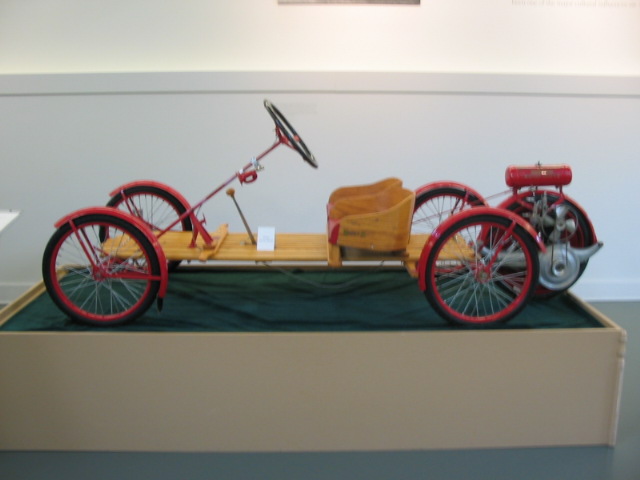
1917 Smith Flyer

The Smith Flyer was an American automobile manufactured by the A.O. Smith Company in Milwaukee from 1915 until about 1919 when the manufacturing rights were sold to Briggs & Stratton and it was renamed the Briggs & Stratton Flyer.[1][2]

History

[edit]

The Smith Flyer is a small, simple, lightweight, two-seat vehicle with a wooden frame that doubles as the body and as the suspension. A small gasoline engine is mounted on a fifth wheel, or motor wheel, to drive the Flyer. The wheelbase was 62 inches (1575 mm), the wheels were 20 inches (508 mm) in diameter, and the width was 30 inches (762 mm). Since the 5th wheel was directly driven by the engine, the engine was started with the driving wheel lifted slightly in the air, and then when the engine was running smoothly, the driver lowered the engine (by means of a lever) gently to start the forward motion.[3]

The direct drive motor wheel was developed by Arthur William Wall of Birmingham, England, around 1910 to power a bicycle. The concept of attaching the motor directly to the wheel was not new; Ferdinand Porsche developed one around 1900, but his motor wheel was electric. The A.O. Smith Corporation of Milwaukee, Wisconsin, acquired the U.S. manufacturing rights to the Wall motorwheel in 1914 and first produced the motor wheel for use on bicycles, but later added the wooden-framed buckboard car that they called the "Smith Motorwheel".[1][2]

Briggs & Stratton Flyer

[edit]

In 1919 the manufacturing rights were purchased by the Briggs & Stratton Company, who produced the Motor Wheel and Flyers. They made several improvements in the engine, increasing the bore size, along with a new, all steel connecting rod and flywheel magneto. These improvements increased the power output to 2 horsepower (1.5 kW). Briggs & Stratton marketed the Flyer nationwide, and even started a publication entitled Motor Wheel Age. In 1925, when they sold the rights to the Flyer to Automotive Electric Services Corporation. The Automotive Electric Services continued to produce the Flyer until the supply of engines ran out, then they substituted an electric motor driven by a battery.[2][1]

Briggs & Stratton kept the motor that had been the heart of the Motor Wheel and adapted it to other applications such as lawn mowers and running small equipment. The Motor Wheel motor was the progenitor of all Briggs & Stratton motors to follow.[3]

Virtually all Flyers were painted red and were known widely as the “Red Bug”. The Flyer is listed in the Guinness Book of Records as the most inexpensive car of all time. The book lists the 1922 Briggs & Stratton Flyer as selling from US$125 to US$150 (equivalent to $2350 to $2820 in 2024) .[3]

A few Smith Flyers still exist in collections, and blueprints for the car are available online.

See also

[edit]

References

[edit]

Additional reading

[edit]
  • David Burgess Wise, The New Illustrated Encyclopedia of Automobiles
  • Altman, Jim, “The Motor Wheel”, Antique Automobile, March–April 1971, pp. 9–24.
  • McFarlan, Donald, Editor, The Guinness Book of Records, Bantam Books, 1992, page 361.
  • Ken W. Purdy, Motorcars of the Golden Past, Galahad Books, NY, pages 98–99.
  • Rodengen, Jeff, The Legend of Briggs & Stratton, Write Stuff Syndicate, 1995, pages 30–39.
[edit]
Revisions and contributorsEdit on WikipediaRead on Wikipedia
from Grokipedia
The Smith Flyer was a pioneering American buckboard-style automobile produced by the Company of , , from 1915 to 1919, renowned for its minimalist design and status as the least expensive production car in history. This lightweight, open-air, two-seat vehicle utilized a simple wooden frame that doubled as both the body and suspension, with a 62-inch , 20-inch wooden wheels, and an overall width of just 30 inches to ensure affordability and ease of assembly. Powered by a compact 1.5-horsepower single-cylinder gasoline integrated into a rear "motor "—a direct-drive fifth wheel innovation developed from earlier concepts—the Smith Flyer achieved top speeds of around 22-25 while weighing under 300 pounds. Priced at approximately $130 (equivalent to about $3,050 in dollars), it targeted budget-conscious buyers and was marketed as accessible even for women and children to operate, with thousands of units produced during its short run. The vehicle's production rights were sold to in 1919, leading to an improved version with a 2-horsepower that continued until around , but the original Smith Flyer exemplified early 20th-century automotive ingenuity in democratizing personal mobility. Its motor wheel design also laid foundational technology for 's later success in small engines, cementing the Smith Flyer's legacy in automotive history.

Design and Specifications

Chassis and Body

The Smith Flyer featured a minimalist buckboard-style constructed from simple wooden , which served as both the structural frame and the seating platform, emphasizing affordability and ease of assembly. This basic wooden framework provided the vehicle's core support without complex engineering, aligning with its design goal of low-cost transportation. The body adopted a spartan two-seat configuration with a basic , offering no , roof, or enclosure to maintain simplicity and reduce weight. This open-air setup exposed occupants to the elements, typical of early vehicles, and prioritized functionality over comfort. Mobility was achieved through four small 20-inch-diameter wheels positioned for and primary support, complemented by a fifth rear traction wheel that integrated directly with the for propulsion. The lacked conventional suspension, , or any enclosing bodywork, contributing to an ultralight total vehicle weight of 135 pounds. These omissions underscored the Flyer's rudimentary nature, with overall dimensions measuring 30 inches in width and 98 inches in length, including the motor wheel.

Engine and Drivetrain

The Smith Flyer featured a single-cylinder, four-stroke, air-cooled rated at 1.5 horsepower, designed for simplicity and minimal manufacturing costs. This compact powerplant was integral to the vehicle's innovative , mounted directly onto the rear motor without intermediary components such as a transmission or driveshaft. The engine drove the rear traction wheel via its camshaft, to which the wheel was bolted, creating a direct-drive system that eliminated the need for axles, differentials, or chains typically found in early automobiles. This rear-wheel-drive configuration relied entirely on the fifth wheel—essentially the motorized rear wheel—for , allowing the lightweight to achieve basic mobility on the wooden . The air-cooling system included a belt-driven fan powered by the , ensuring reliable operation without liquid cooling. Fuel delivery was handled by a straightforward feeding from a half-gallon tank, sufficient for approximately 40 to 50 miles of range under normal conditions. The system prioritized ease of use, with no electrical components present; starting was accomplished by raising the motor wheel off the ground with a and manually starting the , typically by pedaling.

Performance and Dimensions

The Smith Flyer achieved a top speed of approximately 22 to 25 on flat terrain, powered by its single-cylinder, producing 1.5 horsepower. This modest performance was sufficient for short urban commutes, emphasizing the vehicle's role as an economical alternative to walking or horse-drawn transport rather than high-speed travel. With a of 62 inches, the Smith Flyer offered a compact that made it highly maneuverable in city environments. Its overall length, including the rear motor wheel, measured about 98 inches, contributing to a lightweight design that enhanced agility despite the absence of suspension. The configuration further supported this lightweight performance by minimizing mechanical complexity. Fuel efficiency was a standout feature, with the half-gallon tank enabling up to 40 to 50 miles of travel under optimal conditions, translating to roughly 80 to 100 miles per . However, the vehicle had notable limitations: it lacked a reverse gear, requiring manual pushing to back up, and its open design left occupants exposed to the elements, making it unsuitable for inclement weather. Priced at around $125 to $150, the Smith Flyer was among the most affordable automobiles of the early , undercutting competitors like the and appealing to budget-conscious buyers seeking basic mobility.

History

Development by

The Corporation was incorporated in 1904 by Arthur O. Smith in , , evolving from his father Charles Jeremiah Smith's 1874 machine shop that initially produced parts and other metalwork. By the early 1900s, the company had pivoted to automotive innovation, developing the world's first pressed steel automobile frame in 1899, which received its first major order from the Peerless Motor Car Company in 1902. This expertise in lightweight, cost-effective manufacturing positioned to explore further simplifications in personal transportation as automobile ownership surged in the United States during the . Development of the Smith Flyer began around 1910–1915, driven by the era's demand for ultra-affordable vehicles amid the widespread adoption of cars like the , which had lowered the price barrier for personal mobility to around $850 by 1908. In 1914, acquired U.S. manufacturing rights to the motor-wheel concept originally invented by Arthur William Wall in circa 1910 and introduced its own version as a gasoline-powered attachment. A key innovation was the motor-wheel design (U.S. 1,373,918, filed August 20, 1914, by company engineer Reuben C. Smith), which integrated a 1.5-horsepower directly into a 20-inch , eliminating traditional components to reduce complexity, weight, and production costs. Engineers at adapted this motor-wheel for a minimalistic four-wheeled , creating initial prototypes in that emphasized bare-bones construction for easy assembly and low pricing. These prototypes featured a simple wooden frame with bicycle wheels and basic seating, tested locally to refine the direct-drive system's reliability on rudimentary roads while prioritizing mass-producibility through standardized parts. The design's simplicity allowed for straightforward manufacturing, aligning with the company's automated frame production techniques developed earlier. The Smith Flyer launched in as a two-seat runabout, promoted nationwide through advertisements and a dedicated , Motor Wheel Age, targeting budget-conscious consumers seeking an entry-level alternative to established automobiles. Priced at approximately $125–$140, it represented A.O. Smith's vision of democratizing transport via innovative, no-frills engineering.

Production and Market Impact

The Smith Flyer was manufactured by the Corporation at its facilities in , from 1915 to 1919. Production emphasized a straightforward assembly process, utilizing a basic wooden buckboard-style with minimal components such as bicycle wheels, a simple oak-and-metal frame, and an integrated motor wheel for propulsion, which enabled rapid construction and kept labor costs low. An estimated several thousand units were built during this period, supported by strong sales of the underlying Auto Wheel components—approximately 8,333 units sold for $500,000 between 1916 and 1918, many of which were pre-mounted on Flyer . Priced at around $125 to $130, the Smith Flyer undercut major competitors like the , which cost over $400 in the mid-1910s, making it accessible to rural and urban working-class buyers seeking affordable personal mobility. This low-cost strategy targeted everyday consumers, positioning the vehicle as an entry-level alternative during a time of economic expansion and wartime material constraints from 1917 to 1918. The Flyer received attention for its bare-bones design, often nicknamed the "Red Bug" and viewed as a precursor to modern go-karts due to its skateboard-like simplicity and lack of amenities like suspension or weather protection. While it boosted motoring accessibility for budget-conscious users, its rudimentary features limited broader appeal, yet it played a role in democratizing transportation by offering a cheap, functional option amid World War I-era shortages of larger vehicles. Recognized as the least expensive production car in history by Guinness World Records, the Flyer's economic influence lay in its contribution to early mass-market affordability in automobiles.

Briggs & Stratton Flyer Variant

In 1919, the Corporation sold the manufacturing rights and patents for the Smith Flyer to Corporation, an engine manufacturer based in , , allowing production to continue as A.O. Smith shifted focus to other industrial ventures such as body stamping and electrical components. This acquisition occurred amid declining demand for the original model, enabling Briggs & Stratton to leverage their expertise in small engines to sustain the lightweight, affordable vehicle design. Under Briggs & Stratton, production of the Flyer variant ran from 1919 to 1925, with the vehicles assembled at the company's facilities in Milwaukee. The core design, featuring a simple wooden platform chassis with bicycle-style wheels and rear-mounted motor wheel propulsion, was largely retained from the original Smith Flyer. Key modifications included an upgraded single-cylinder engine, bored out for improved reliability with additions like a steel connecting rod and flywheel magneto, boosting output to 2 horsepower from the original's 1.5 horsepower. While aftermarket options like the 3-horsepower Aerothrust dual-fuel (gasoline or kerosene) propeller engine kit were available for installation on Flyers during this era, they were not standard on Briggs & Stratton models. The variant was rebranded as the Flyer, also marketed under names like "Midget Mobile" and "Auto Red Bug," with a focus on hobbyists and budget-conscious buyers seeking a fun, entry-level motorized vehicle. Pricing remained competitive at around $125 to $150, similar to the original, and the company enhanced marketing through nationwide distribution, including ads in their publication Motor Wheel Age and sales in upscale retailers like to appeal to recreational users. This effort extended the Flyer's market presence into the early , bridging the gap to later developments, though total production was limited to a few hundred units due to the niche appeal and rise of more advanced automobiles. By 1925, sold the rights to Automotive Electric Services Corporation, which produced an powered by a 12-volt motor before the design faded.

Legacy

Surviving Examples and Restoration

Due to the vehicle's simple construction and limited production run of approximately 2,500 to 3,000 units, only a handful of original Smith Flyers are known to survive today, with fewer than 10 confirmed examples worldwide. One notable discovery occurred in 2013, when a remarkably preserved 1916 model—serial number 624, the 624th built and shipped to —was found in a barn at Pine Harbour Marina in after decades in private ownership. This example, weighing 135 pounds and featuring its original BA Smith motor wheel, had been maintained in a climate-controlled environment, with the engine cleaned but never fully dismantled prior to the find. Other surviving originals include a 1917 example at the Antique Car Museum of in Coralville, powered by its single-cylinder traction wheel and displayed to illustrate early affordable motoring. The County Historical Society in holds serial number 2129, donated in 1963 and restored by its original owner shortly thereafter; though no longer operational, it serves as a key artifact in their collection. Private collectors also possess rarities, such as a 1916 Smith Flyer C Motorette that appeared at auction in 2019 after prior ownership by the Merrick Auto Museum. Restoring these vehicles is challenging owing to the perishable wooden , body, and suspension components, which degrade over time, combined with the unavailability of original parts like clincher tires and hubs. Restorers frequently resort to custom fabrication, such as machining reproductions of missing hardware or adapting modern equivalents like bicycle tires to 20-inch rims while preserving the design. Dry storage has aided preservation in some cases, but extensive cleaning and refinishing of rusted or weathered elements remain labor-intensive. To address the scarcity of originals, replicas have been constructed for educational and demonstrative purposes. The Lane Motor Museum in , exhibits a 1915 replica fitted with a 3-horsepower Aerothrust opposed-twin , highlighting the Flyer's , fifth-wheel system and low cost of production. Preservation initiatives emphasize public education and careful stewardship. The Milwaukee County Historical Society integrates its Smith Flyer into exhibits on Milwaukee's industrial heritage, focusing on non-operational display to prevent further wear while sharing its story through guided tours and programs. Such efforts ensure these fragile machines remain accessible for study. Collector interest is evident in auction results, including a 1917 Smith Flyer that sold for $8,800 at Bonhams in 2017, reflecting the 's status as a rare emblem of early 20th-century innovation.

Cultural and Historical Significance

The Smith Flyer played a pivotal role in the evolution of U.S. transportation during the , serving as a bridge between bicycle-based mobility and full-fledged automobiles by adapting a small gasoline originally designed for bicycles into a , open-air . This design reflected the era's push toward accessible personal transport, transforming urban and rural movement while contributing to broader societal shifts like and increased employment in manufacturing hubs such as . As one of the earliest examples of fuel-efficient , it weighed just 135 pounds and emphasized simplicity over luxury, predating the widespread adoption of assembly-line production that would later define mass motoring. By offering a two-seat at an unprecedented low cost, the Smith Flyer pioneered affordable motoring for the average American, with approximately 2,500 to 3,000 units produced between and 1919, making motorized travel viable for those unable to afford pricier options like the . Its minimalist wooden frame, bicycle-style wheels, and powered fifth wheel exemplified early 20th-century innovation in simplifying complex technology for mass accessibility, influencing the conceptual foundations of later economy vehicles and microcars that prioritized and low cost. This approach highlighted a democratizing trend in automotive history, where focused on essential functionality to expand ownership beyond the elite. Culturally, the Smith Flyer captured public imagination as a quirky novelty, often portrayed in period promotions and later accounts as a recreational "go-cart" due to its exposed, unsuspended structure and five-wheel configuration, which added to its playful yet precarious appeal. Dealer-organized races, such as those at Palm Beach hotels in the , further embedded it in as a fun, accessible diversion for the emerging , as documented in contemporary automotive magazines. Its enduring perception as the "cheapest car in history" underscores its symbolic status in narratives of American ingenuity and resourcefulness. In , the Smith Flyer endures as a in design minimalism, illustrating principles of and structural simplicity through its buckboard chassis and integrated motor wheel, which stripped vehicles to core essentials without compromising basic mobility. This legacy promotes conceptual understanding of how early constraints in materials and power led to innovative, scalable solutions that resonate in modern discussions of .

References

Add your contribution
Related Hubs
User Avatar
No comments yet.