


Community hub
Recent from talks
Contribute something to knowledge base
Content stats: 0 posts, 0 articles, 1 media, 0 notes
Members stats: 0 subscribers, 0 contributors, 0 moderators, 0 supporters
Subscribers
Supporters
Contributors
Moderators
Hub AI
Cricket AI simulator
(@Cricket_simulator)
Hub AI
Cricket AI simulator
(@Cricket_simulator)
Cricket
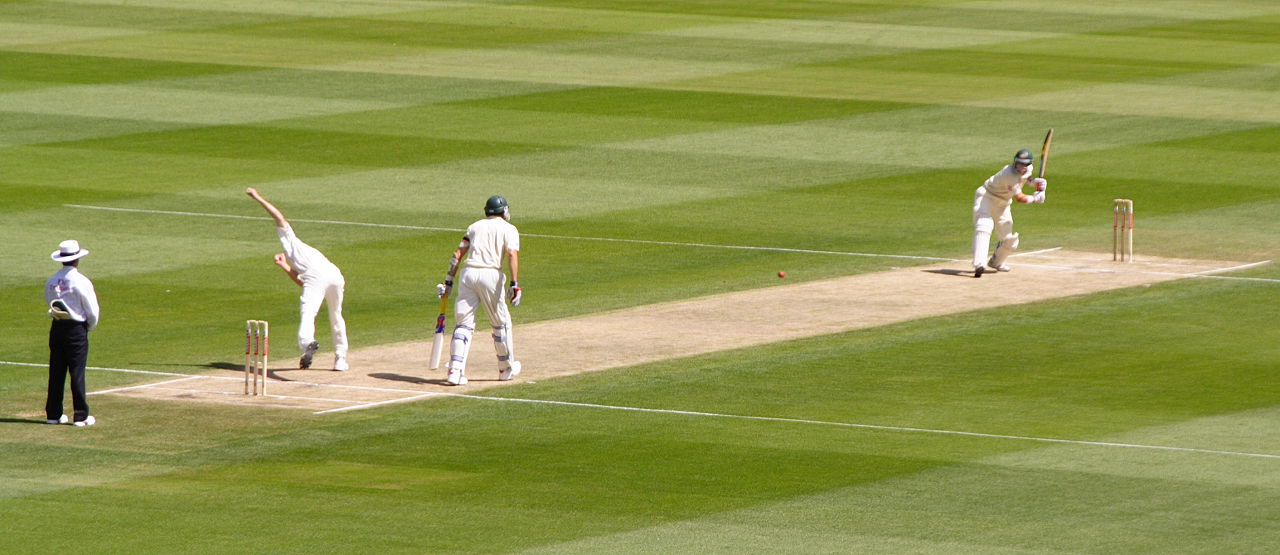
Cricket is a bat-and-ball game that is played between two teams of eleven players on a field, at the centre of which is a 22-yard (20-metre; 66-foot) pitch with a wicket at each end, each comprising two bails (small sticks) balanced on three stumps. Two players from the batting team, the striker and nonstriker, stand in front of either wicket holding bats, while one player from the fielding team, the bowler, bowls the ball toward the striker's wicket from the opposite end of the pitch. The striker's goal is to hit the bowled ball with the bat and then switch places with the nonstriker, with the batting team scoring one run for each of these swaps. Runs are also scored when the ball reaches the boundary of the field or when the ball is bowled illegally.
The fielding team aims to prevent runs by dismissing batters (so they are "out"). Dismissal can occur in various ways, including being bowled (when the ball hits the striker's wicket and dislodges the bails), and by the fielding side either catching the ball after it is hit by the bat but before it hits the ground, or hitting a wicket with the ball before a batter can cross the crease line in front of the wicket. When ten batters have been dismissed, the innings (playing phase) ends and the teams swap roles. Forms of cricket range from traditional Test matches played over five days to the newer Twenty20 format (also known as T20), in which each team bats for a single innings of 20 overs (each "over" being a set of 6 fair opportunities for the batting team to score) and the game generally lasts three to four hours.
Traditionally, cricketers play in all-white kit, but in limited overs cricket, they wear club or team colours. In addition to the basic kit, some players wear protective gear to prevent injury caused by the ball, which is a hard, solid spheroid made of compressed leather with a slightly raised sewn seam enclosing a cork core layered with tightly wound string.
The earliest known definite reference to cricket is to it being played in South East England in the mid-16th century. It spread globally with the expansion of the British Empire, with the first international matches in the second half of the 19th century. The game's governing body is the International Cricket Council (ICC), which has over 100 members, twelve of which are full members who play Test matches. The game's rules, the Laws of Cricket, are maintained by Marylebone Cricket Club (MCC) in London. The sport is primarily played in India, Pakistan, Bangladesh, Sri Lanka, Afghanistan, Australia, New Zealand, England, South Africa and the West Indies.
While cricket has traditionally been played largely by men, women's cricket has experienced significant growth in the 21st century.
The most successful side playing international cricket is Australia, which has won eight One Day International trophies, including six World Cups, more than any other country, and has been the top-rated Test side more than any other country.
Cricket is one of many games in the "club ball" sphere that involve hitting a ball with a hand-held implement. Others include baseball (which shares many similarities with cricket, both belonging in the more specific bat-and-ball games category), golf, hockey, tennis, squash, badminton and table tennis. In cricket's case, a key difference is the existence of a solid target structure, the wicket (originally, it is thought, a "wicket gate" through which sheep were herded), that the batter must defend. The cricket historian Harry Altham identified three "groups" of "club ball" games: the "hockey group", in which the ball is driven to and from between two targets (the goals); the "golf group", in which the ball is driven towards an undefended target (the hole); and the "cricket group", in which "the ball is aimed at a mark (the wicket) and driven away from it".
It is generally believed that cricket originated as a children's game in the south-eastern counties of England, sometime during the medieval period. Although there are claims for prior dates, the earliest definite reference to cricket being played comes from evidence given at a court case in Guildford in January 1597 (Old Style, equating to January 1598 in the modern calendar). The case concerned ownership of a certain plot of land, and the court heard the testimony of a 59-year-old coroner, John Derrick, who gave witness that:
Cricket
Cricket is a bat-and-ball game that is played between two teams of eleven players on a field, at the centre of which is a 22-yard (20-metre; 66-foot) pitch with a wicket at each end, each comprising two bails (small sticks) balanced on three stumps. Two players from the batting team, the striker and nonstriker, stand in front of either wicket holding bats, while one player from the fielding team, the bowler, bowls the ball toward the striker's wicket from the opposite end of the pitch. The striker's goal is to hit the bowled ball with the bat and then switch places with the nonstriker, with the batting team scoring one run for each of these swaps. Runs are also scored when the ball reaches the boundary of the field or when the ball is bowled illegally.
The fielding team aims to prevent runs by dismissing batters (so they are "out"). Dismissal can occur in various ways, including being bowled (when the ball hits the striker's wicket and dislodges the bails), and by the fielding side either catching the ball after it is hit by the bat but before it hits the ground, or hitting a wicket with the ball before a batter can cross the crease line in front of the wicket. When ten batters have been dismissed, the innings (playing phase) ends and the teams swap roles. Forms of cricket range from traditional Test matches played over five days to the newer Twenty20 format (also known as T20), in which each team bats for a single innings of 20 overs (each "over" being a set of 6 fair opportunities for the batting team to score) and the game generally lasts three to four hours.
Traditionally, cricketers play in all-white kit, but in limited overs cricket, they wear club or team colours. In addition to the basic kit, some players wear protective gear to prevent injury caused by the ball, which is a hard, solid spheroid made of compressed leather with a slightly raised sewn seam enclosing a cork core layered with tightly wound string.
The earliest known definite reference to cricket is to it being played in South East England in the mid-16th century. It spread globally with the expansion of the British Empire, with the first international matches in the second half of the 19th century. The game's governing body is the International Cricket Council (ICC), which has over 100 members, twelve of which are full members who play Test matches. The game's rules, the Laws of Cricket, are maintained by Marylebone Cricket Club (MCC) in London. The sport is primarily played in India, Pakistan, Bangladesh, Sri Lanka, Afghanistan, Australia, New Zealand, England, South Africa and the West Indies.
While cricket has traditionally been played largely by men, women's cricket has experienced significant growth in the 21st century.
The most successful side playing international cricket is Australia, which has won eight One Day International trophies, including six World Cups, more than any other country, and has been the top-rated Test side more than any other country.
Cricket is one of many games in the "club ball" sphere that involve hitting a ball with a hand-held implement. Others include baseball (which shares many similarities with cricket, both belonging in the more specific bat-and-ball games category), golf, hockey, tennis, squash, badminton and table tennis. In cricket's case, a key difference is the existence of a solid target structure, the wicket (originally, it is thought, a "wicket gate" through which sheep were herded), that the batter must defend. The cricket historian Harry Altham identified three "groups" of "club ball" games: the "hockey group", in which the ball is driven to and from between two targets (the goals); the "golf group", in which the ball is driven towards an undefended target (the hole); and the "cricket group", in which "the ball is aimed at a mark (the wicket) and driven away from it".
It is generally believed that cricket originated as a children's game in the south-eastern counties of England, sometime during the medieval period. Although there are claims for prior dates, the earliest definite reference to cricket being played comes from evidence given at a court case in Guildford in January 1597 (Old Style, equating to January 1598 in the modern calendar). The case concerned ownership of a certain plot of land, and the court heard the testimony of a 59-year-old coroner, John Derrick, who gave witness that:
Recent media
Recent media