Hubbry Logo
Split Point LighthouseSplit Point LighthouseMain
Open search
Split Point Lighthouse
Community hub
Split Point Lighthouse
logo
8 pages, 0 posts
0 subscribers
Be the first to start a discussion here.
Split Point Lighthouse
from Wikipedia

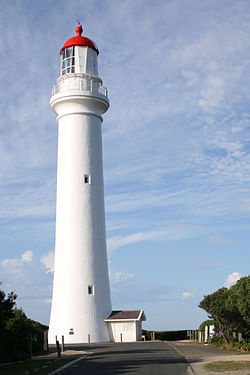
Split Point Lighthouse is a lighthouse located in Aireys Inlet, a small town on the Great Ocean Road, Victoria, Australia.

Key Information

History

[edit]

Originally called Eagles Nest Point, the lighthouse was constructed in 1891. For 27 years, three lighthouse keepers worked at this remote location, ensuring the light was operating well and communicating with ships via a number of code systems. The lighthouse still has its original construction with a wonderful staircase and timber fittings. The lantern still operates having had more than three different light sources over its history. The tower was converted to automatic operation in 1919, using acetylene gas to provide the illumination. It was upgraded to electric operation in 1972. The keepers' cottages and stables form an intrinsic part of the lighthouse precinct.

The original British-made Chance Brothers first order Fresnel lens is still in use.[1] However, the factory near Birmingham, England, where the lens was built, was bombed during war-time and the essential formula for making the unique lens crystal was lost,[citation needed] should a replacement ever be needed. The fixed-light lantern still lights the way for thousands of vessels using a combination of lighting colors. Under standard Australian lighthouse convention, red filters would usually be placed to the extreme left and right of the beam (indicating "danger zones" for a passing ship, in-line with the jagged coastline). For reasons unknown, the Split Point Lighthouse operated for a number of years under the opposite system; although this has now been corrected. The Split Point lighthouse is 34 metres tall and stands 66 metres above sea level.

Today

[edit]
The view from the top of the lighthouse

The Split Point lighthouse is located in Federal Street, Aireys Inlet, and helps to guide ships and other craft along the Victorian coast between Cape Otway and the entrance to Port Philip at Point Lonsdale. The lighthouse is easily accessible from the Great Ocean Road.

Since summer 2005, a commercial operator has been offering regular tours, during which visitors have the chance to climb the staircase and experience the view from the balcony outside the lantern room, offering a 360-degree view of the stunning coast. Four landings on the staircase provide stops along the way up and make for an accessible climb. Old photographs highlight shipwrecks, the lives of the keepers, and the construction of the Great Ocean Road.

The lighthouse is open every day. Tours can be self-guided or led by trained staff (pre-booked) who tell stories of the lighthouse keepers and early shipwrecks, explain the operation of the light and communication systems, and introduce thousands of Round the Twist fans to the filming operations at this lighthouse.

The original lighthouse keepers' quarters, two detached houses adjacent to the tower, are now privately owned residences.[1] The original stables and work room are now a cafe.

[edit]

In the popular children's television series Round the Twist, the Twist family live in the lighthouse; however, the inside of the lighthouse depicted in the show is a set. It features prominently as the scene of a murder in Arthur Upfield's detective novel The New Shoe, featuring his famous detective Napoleon Bonaparte. The lighthouse was also featured in the 2003 film Darkness Falls, and episodes of MasterChef Australia and Travel Guides (2022) were filmed there. The lighthouse is regularly filmed for tourism and advertising purposes, and it is the location for marriage proposals and weddings.

It was also featured in the music video for "Lydia Wears a Cross" by singer Julia Jacklin.[2]

[edit]

See also

[edit]

References

[edit]
Revisions and contributorsEdit on WikipediaRead on Wikipedia
from Grokipedia
The Split Point Lighthouse, also known as the "White Queen," is a heritage-listed, operational situated in on Victoria's , . The 34-metre-tall tower stands on a with its light 66 metres above . Constructed in 1891 from rendered concrete rubble using local limestone, it was designed by the Victorian Public Works Department to guide vessels along the treacherous "Shipwreck Coast" and prevent maritime disasters in the . Originally equipped with a first-order producing a fixed red light with a range of 18 nautical miles and first illuminated in September 1891, the lighthouse's current fixed white light (with red sectors) has a geographic range of approximately 21 nautical miles. Historically, the site—originally called Eagle Nest Point—was selected due to frequent shipwrecks in the region, with construction completed by contractors R. Anderson & Sons at a cost of £2,791 for the and . For its first 28 years, the lighthouse was manned by a head keeper and two assistants living in adjacent cottages, with notable keepers including (1893–1896) and Richard Baker (1915–1919). It was automated in October 1919 using an incandescent mantle lamp, eliminating the need for on-site keepers, and converted to in 1972 with a 1,000-watt bulb; today, it operates unmanned under the Australian Maritime Safety Authority. The lighthouse holds state-level significance for its architectural design, technical innovation in coastal navigation, and role in Victoria's maritime heritage, as recognized on the Victorian Heritage Register since its inclusion for protection. It features a cast-iron spiral staircase with 138 steps leading to the lantern room, offering panoramic views of the coastline, and has become a major tourist attraction with guided and self-guided tours available daily except Christmas. Additionally, its striking white tower has gained cultural prominence as a filming location for the Australian television series Round the Twist, enhancing its local and national recognition.

Location and Geography

Site Overview

The Split Point Lighthouse is situated at 38°28′04.7″S 144°6′16.1″E on Federal Street in Aireys Inlet, Victoria, Australia. At an elevation of 66 meters above sea level, the lighthouse is positioned along the iconic Great Ocean Road and overlooks the Bass Strait coastline. The site occupies a prominent cliffside terrain, providing expansive views of the surrounding Aireys Inlet and the turbulent waters of the ocean beyond. This strategic placement enhances its role as a vital for maritime along the rugged Victorian coast.

Regional Context

The Split Point Lighthouse is strategically positioned along Victoria's , approximately 110 km southwest of , serving as a critical for vessels traversing the treacherous coastline between Cape Otway to the west and Point Lonsdale to the east. Constructed on a prominent headland at , it fills a significant gap in the maritime signaling network, originally spanning about 63 miles between established lighthouses at Cape Otway and Point Lonsdale, thereby enhancing safe passage for ships along this rugged stretch of the Shipwreck Coast. The lighthouse's elevated location, with its tower contributing to a light visibility range of 20 nautical miles, underscores its role in mitigating navigational hazards in an area prone to isolation and poor charting. The site's selection was heavily influenced by the region's environmental challenges, including strong westerly currents, inaccurate historical maps, and patterns characterized by high winds and rough seas that have long imperiled shipping. This coastal zone, part of Bass Strait's notorious waters, has witnessed numerous shipwrecks, such as the Anna in 1872 on the nearby Reef and the Bancooora in 1891 just prior to the lighthouse's commissioning, highlighting the urgent need for a fixed to guide mariners past submerged reefs and shifting sands. These incidents, documented in maritime records, emphasized the area's reputation as a graveyard for vessels during the , particularly under the Age of Sail when fog, gales, and poor visibility amplified risks. Adjacent to the lighthouse reserve lies the Painkalac Inlet, a natural formed by Painkalac Creek that historically divided runs and facilitated early settlement in . The lighthouse's presence not only provided navigational support but also spurred local development, as the keepers' families contributed to the community's growth by supporting the school and economy, transforming the surrounding reserve into a focal point for the town's evolution from a outpost to a hub.

Design and Architecture

Structural Features

The Split Point Lighthouse features a tapered cylindrical tower constructed from concrete rubble, rendered with and painted white, standing 34 metres tall. The structure includes a coved at the top, a cast-iron balustraded gallery, and a cylindrical glazed house topped with a hemispherical copper-clad roof painted red. Inside the tower, an original cast-iron spiral staircase with 134 open-riser steps and rod balustrading provides access to the lantern room, complemented by timber fittings throughout the interior. Associated buildings form a cohesive lightstation complex, including the head keeper's L-shaped weatherboard cottage with a slate roof and verandahs, two semi-detached T-shaped weatherboard cottages for assistant keepers (now private residences), and a single-storey weatherboard stable building with a hipped roof, later converted into a café. The overall design reflects a nineteenth-century lightstation complex developed by the Victorian Department, emphasizing durability in coastal conditions through the use of locally quarried in foundational elements and red brick chimneys in the cottages.

Optical and Technical Components

The Split Point Lighthouse features an original Fresnel lens manufactured by , installed in 1891 and remaining in active use today. This dioptric lens, with a 920 mm focal radius, is housed within a and produces a flashing white light characterized by four flashes every 20 seconds, accompanied by red sectors to indicate navigational hazards. The lens system generates an intensity of 93,000 for the white light, providing a nominal range of 20 nautical miles, while the red sectors emit 9,300 with a nominal range of 14 nautical miles; the geographical range extends to 21 nautical miles under optimal conditions. The elevated focal height of 66 meters, aided by the 34-meter tower, enhances the projection of this light over the surrounding coastal terrain. Historically, the lighthouse operated on vaporized as its initial fuel source from 1891. In 1919, it transitioned to gas, which supported efforts at the time. By 1972, the system converted to , powering a traditional lamp within the . The current light source is a modern LED unit, specifically the Sealite SL-LED-324-W model installed in , integrated into the original optic and powered by to maintain the established light pattern and ranges efficiently. This upgrade preserves the historical lens while improving reliability and use.

Construction and Early History

Development and Building Process

The site for the Split Point Lighthouse, originally known as Eagles Nest Point, was selected in 1890 to address critical navigation hazards along the Victorian coast between Cape Otway and Point Lonsdale, following numerous shipwrecks such as the Anna in 1872 on the nearby Eagles Nest Reef. This decision aligned with recommendations from the 1873 inter-colonial Conference of Principal Marine Officers, which emphasized the need for additional aids to navigation in the treacherous waters prone to fog, reefs, and unpredictable currents. The 6.3-hectare lighthouse reserve was gazetted in 1890, marking a proactive response to maritime safety concerns in an area that had seen wrecks like the Hereford in 1851. Construction was overseen by the Victorian Public Works Department, which called for tenders on May 2, 1890, requiring a £15 deposit and closing on May 22, with the contract awarded to R. Anderson & Sons of Richmond for the tower and staff quarters. Work commenced later in 1890 under the supervision of Mr. Jas Bolton, utilizing local materials to minimize expenses, including concrete rubble for the 34-meter tower, locally quarried stone foundations, and ironbark hardwood for structural elements. The optical apparatus, a first-order from in , had been ordered as early as 1886 at a cost of £2,791, reflecting advance planning for the lighthouse's 66-meter elevation above , which would ensure visibility up to 21 nautical miles. The project drew on standard designs from other Victorian lighthouses, such as those at Cape Nelson and Point Hicks. Building the structure presented significant logistical challenges in the remote, undeveloped coastal region, where the did not yet exist. Initial attempts to transport heavy materials by sea proved unreliable due to rough conditions, prompting a shift to overland haulage from via rudimentary tracks, which was further complicated by harsh winter weather and delays in progress. The Anderson team completed the cement-rendered concrete tower by mid-1891.

Commissioning and Initial Service

The Split Point Lighthouse was first illuminated on 1 September 1891, providing a fixed light with red and white sectors from its first-order to guide vessels along the hazardous Victorian coastline near . This activation followed the completion of construction earlier that year, establishing the structure as a vital aid to in a region prone to shipwrecks due to the nearby reefs and variable weather conditions. From its inception, the lighthouse operated under a three-keeper model, with a head keeper and two assistants rotating duties to maintain the vaporized through 24-hour vigilance in the isolated setting. This arrangement ensured reliable service during the initial decades.

Operational History

Staffing and Daily Operations

The Split Point Lighthouse was staffed by three keepers—a head keeper and two assistants—who operated the station around the clock from its commissioning in 1891 until automation in 1919. These individuals were responsible for maintaining the light, recording daily logs of ship movements and weather conditions, and performing rescue duties using rocket apparatus during shipwrecks. Keepers resided in purpose-built cottages adjacent to the lighthouse, with the head keeper's quarters featuring six rooms and a washhouse, while each assistant's cottage had five rooms, along with shared amenities such as pumps and speaking tubes for communication. Living conditions were isolated yet self-sufficient, with supplies delivered by horse-drawn cart every six months to sustain the keepers and their families. Daily operations centered on the vaporised , introduced in to replace the original six-wick burner, requiring keepers to fuel the light at , clean the lens to ensure optimal reflection, and monitor weather patterns through log entries. Shifts rotated to cover 24-hour vigilance, with keepers extinguishing the light at dawn and conducting routine inspections of the tower and equipment. A notable anecdote from this era involves head keeper Richard Joy Baker, who served from 1915 to 1919 and earned an annual salary of £216; to monitor the rotating light while occasionally visiting the nearby Hotel, he scratched a small hole in the hotel wall aligned with the lighthouse lens, allowing the beam to "wink" through as confirmation of proper operation. Baker's tenure ended with the 1919 installation of an acetylene light, which automated the station and eliminated the need for resident keepers.

Automation and Technological Upgrades

In 1919, following the transfer of control to the Commonwealth Government, the Split Point Lighthouse was automated through the installation of an acetylene gas system, which replaced the manual vaporized burner and eliminated the need for keepers to perform nightly duties. This upgrade marked a significant shift from labor-intensive operations, where keepers previously had to tend the light every evening, to a self-regulating mechanism that flashed every 12 seconds without human intervention. The lighthouse underwent further modernization in with its conversion to , integrating a 1,000-watt tungsten halogen lamp into the existing first-order apparatus. This enhanced reliability and intensity, boosting the white light's range to 21 nautical miles while fully automating rotation and eliminating any remaining manual oversight of power systems. More recently, in 2015, the Australian Maritime Safety Authority (AMSA), which now oversees the lighthouse's operations, commissioned the replacement of the with a Sealite SL-LED-324-W LED light source, improving energy efficiency and longevity while maintaining the characteristic group flash of four white lights every 20 seconds. In May 2024, management responsibility for the surrounding was transferred to the Authority under a arrangement with AMSA, which continues to oversee lighthouse operations. As part of these operational changes, the two assistant keepers' cottages were auctioned in March 2004 and sold for an undisclosed amount exceeding AU$1.5 million, reflecting the site's transition to unmanned status and reduced on-site infrastructure needs.

Heritage and Modern Use

Preservation and Significance

The Split Point Lightstation Complex is listed on the Victorian Heritage Register (VHR H2270) for its architectural and historical value as a representative 19th-century lightstation complex in Victoria. Constructed in , the complex includes the lighthouse tower, keepers' quarters, and associated structures, demonstrating the era's practices and the role of in maritime infrastructure. The site's significance lies in its embodiment of Victoria's maritime heritage, particularly in enhancing navigation safety along the treacherous coastline, where it has guided vessels since commissioning. It holds historical importance through its association with builder Robert Anderson, a key figure in the Eight Hour Movement, and technical merit via the original and assembly. Rare intact features, such as the spiral staircase with elaborate capitals and the external walkway with scrolled brackets, further underscore its architectural integrity as one of the few preserved Victorian lightstations. In May 2024, management responsibility for the Crown land in the precinct was transferred to the Great Ocean Road Coast & Parks Authority from the Surf Coast Shire. Conservation efforts are led by the Heritage Council of Victoria and the Great Ocean Road Coast & Parks Authority, following the transfer of management responsibility from the Surf Coast Shire in May 2024. These include geotechnical assessments and safety measures to mitigate coastal erosion risks, such as cliff instability, alongside path upgrades with improved drainage to prevent sediment runoff and material degradation from weathering. Regular rehabilitation of degraded areas, through revegetation and replacement of worn components with durable materials, ensures the complex's long-term viability while respecting its heritage values.

Tourism and Public Access

Since 2005, the Split Point Lighthouse has been open to the public for tours, managed by Eco-Logic Education and Environment Services under contract with the Great Ocean Road Coast & Parks Authority. Visitors can access the site daily via self-guided entry or pre-booked guided tours for groups, with operations typically running from 10 a.m. to 4 p.m., permitting, and adjusted for seasonal demand such as extended hours in summer. Bookings for guided experiences are available by contacting the operator at 1800 174 045, allowing flexibility for individual or group visits. A highlight of the tours is the climb up the original spiral staircase, consisting of 136 steps to reach the lantern room, where visitors enjoy panoramic 360-degree views of the coastline, including Eagle Rock Marine Sanctuary and the surrounding Shipwreck Coast. The lighthouse grounds remain accessible year-round for casual exploration, providing opportunities to appreciate the site's maritime heritage while adhering to preservation guidelines that protect its historical structures. Affectionately known locally as the "White Queen" for its striking white tower, the lighthouse draws families, history enthusiasts, and nature lovers seeking an iconic experience. On-site facilities enhance the visitor experience, including The Lighthouse Tea Rooms housed in the former stables originally used by lighthouse keepers for their horses, offering coffee, homemade cakes, and light meals with views of the precinct. These amenities, combined with nearby walking trails like the 2.2-kilometer Lighthouse Discovery Trail, make the site a convenient stop for travelers. The lighthouse significantly boosts tourism in , serving as a key draw along the and contributing to the local economy through visitor spending on tours, dining, and accommodations, with the attraction attracting thousands annually since opening to the . This influx supports the broader Surf Coast region's visitor economy, estimated to generate substantial revenue from the iconic coastal route.

Cultural Impact

Media Representations

The Split Point Lighthouse gained prominence in Australian media through its role as the exterior location for the family's home in the children's television series Round the Twist, which aired in the 1990s; however, the interior scenes were recreated in a Melbourne studio. In film, the lighthouse served as the setting for the haunted structure in the 2003 supernatural horror movie Darkness Falls, where exterior and aerial footage was captured to depict the eerie coastal backdrop. More recent television appearances include episodes of the cooking competition , where contestants utilized the site for challenges, and the travel program Travel Guides in 2022, which highlighted its scenic views during a segment on the region. The lighthouse also featured in the music video for Julia Jacklin's single "Lydia Wears a Cross," released in 2022 as the lead track from her album Pre Pleasure, with footage shot at the site to evoke its isolated, windswept atmosphere.

Social and Literary References

The Split Point Lighthouse serves as a prominent setting in Arthur Upfield's 1951 novel The New Shoe, where a murder investigation unfolds around the discovery of a body entombed within its walls, highlighting the structure's isolated and evocative coastal ambiance. In the local community of , the lighthouse stands as an enduring icon, affectionately known as the "White Queen" for its striking white tower, symbolizing the town's maritime heritage and coastal identity. It features prominently in community narratives, including local events and tourism promotions that celebrate 's scenic landscape along the . The lighthouse is intertwined with regional maritime , particularly stories of s on the treacherous Shipwreck Coast, where it was constructed in 1891 following multiple vessel losses to guide ships safely past hazardous reefs and headlands. Local legends include reports of hauntings by shipwreck victims, with ghostly sightings noted near the lighthouse grounds and adjacent Step Beach, contributing to its mystique in oral traditions among coastal residents. On a broader scale, the Split Point Lighthouse enhances the narrative of the , drawing visitors to explore its historical role in maritime safety and the surrounding , thereby supporting local economic and social vitality. Its visibility from and ties to popular media, such as the Australian television series , have further embedded it in collective cultural memory.

References

Add your contribution
Related Hubs
User Avatar
No comments yet.