Hubbry Logo
Spook HillSpook HillMain
Open search
Spook Hill
Community hub
Spook Hill
logo
8 pages, 0 posts
0 subscribers
Be the first to start a discussion here.
Spook Hill
Spook Hill
from Wikipedia

Spook Hill
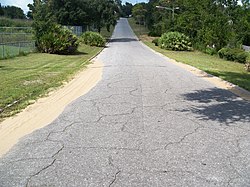
Spook Hill, looking north
Spook Hill is located in Florida
Spook Hill
Location in Florida
Spook Hill is located in the United States
Spook Hill
Location in United States
LocationNorth Wales Dr. between Burns Ave. and Spook Hill Elementary
Lake Wales, Florida
Coordinates27°54′43″N 81°34′55″W / 27.912°N 81.582°W / 27.912; -81.582
Built1960
NRHP reference No.100003585
Added to NRHPApril 5, 2019

Spook Hill is a gravity hill, an optical illusion in Lake Wales, Florida, where cars appear to roll up the spooky hill.

Spook Hill is located on the Lake Wales Ridge, a geologically significant range of sand and limestone hills, which were islands from two to three million years ago, when sea levels were much higher than at present.

The attraction is adjacent to Spook Hill Elementary School, which adopted Casper the Friendly Ghost as their school mascot. The attraction is also close to the Bok Tower.

Spook Hill received national media attention when an article about it appeared on the front page of the Wall Street Journal on October 25, 1990, and it was featured in a segment on CBS Morning News with Charles Osgood on November 5, 1990.[1] It was listed on the National Register of Historic Places in 2019.[2]

Spook Hill in Lake Wales, Florida. One of central Florida's lesser known and older attractions.

See also

[edit]
  • List of gravity hills
  • According to local lore, a Native American chief once battled a giant alligator on this hill; both died in the struggle, and their spirits are said to cause cars to roll uphill.[3] Another tale, spread by a 1950s Lake Wales pamphlet, claims that two retired pirates were buried here and their ghosts push the cars uphill as a prank.[3]

References

[edit]
[edit]
Revisions and contributorsEdit on WikipediaRead on Wikipedia
from Grokipedia
Spook Hill is a and located in , where vehicles placed in neutral at a marked white line appear to roll uphill for approximately 75 to 100 feet due to a perceptual distortion of the landscape. Recognized as one of the oldest known gravity hills in the United States and the only such site in , it has drawn visitors since the mid-20th century as a roadside curiosity. The site's allure stems from local folklore, including a prominent Indian legend in which a warrior chief battled and killed a giant terrorizing the area, with the chief buried atop the hill and the beast beneath nearby ; their restless spirits are said to push cars either uphill (by the chief defending his land) or to resist the pull (by the seeking revenge). An alternative tale involves a buried pirate, Captain Sarsparilla (or Sasparilla), whose supernatural force repels vehicles from his resting place. In reality, the effect arises from an created by the hill's sloping terrain, dense tree cover, and a blocked , which misaligns the viewer's sense of verticality and makes a true downhill appear as an ascent. Spook Hill, situated on North Wales Drive between Burns Avenue and Spook Hill Elementary School, became a formalized around 1950 amid post-World War II enthusiasm for automotive novelties and local myth-making. It was officially listed on the in April 2019 for its cultural and recreational significance, preserving its role as a unique example of American roadside Americana. Accessible as a public road at any time, the site remains a popular, free stop for families and enthusiasts, though visitors are advised to proceed with caution due to traffic.

Description and Location

Geographical Context

Spook Hill is situated in Lake Wales, , specifically along North Wales Drive (also known as 5th Street) at 600 N Wales Drive, approximately a quarter-mile south of the intersection with Burns Avenue (U.S. Highway 17) and near State Road 60, which runs through the town. The site's precise coordinates are 27.912°N 81.582°W, placing it within a suburban neighborhood accessible to visitors and locals alike. Geologically, Spook Hill forms part of the , a prominent north-south trending upland feature composed primarily of ancient sand dunes and deposits. This ridge originated approximately 2.5 million years ago during the Pleistocene epoch, when it emerged as a series of islands amid a shallow prehistoric that covered much of the , with the surrounding flatlands remaining submerged longer. The ridge spans approximately 100 miles from Lake County southward into Highlands County, rising 100 to 200 feet above the adjacent low-lying coastal plains and wetlands, creating a distinct topographic contrast in an otherwise flat region. The site integrates seamlessly into its local environment, bordered by residential areas and natural preserves. It lies adjacent to Spook Hill Elementary School at 321 Dr. J.A. Wiltshire Avenue, reflecting community ties through educational facilities named after the landmark. Approximately one mile to the south is , a renowned botanical and historical site atop Iron Mountain within the same ridge, enhancing the area's appeal as a blend of suburban living and preserved natural landscapes.

The Phenomenon

Spook Hill features a striking known as a , where vehicles appear to roll uphill against the force of gravity. Visitors drive to a designated spot on Fifth Street in , marked by a prominent archway and a painted white line on the pavement, then shift their cars into neutral and release the brake. Upon doing so, the vehicles begin to move backward, seemingly ascending the hill for a distance of 75 to 100 feet. The affected section of road, which spans about 200 feet, creates a visually deceptive incline that enhances the counterintuitive motion observed by both drivers and onlookers. This effect is particularly vivid in low-lying vehicles, where the relative horizon alignment amplifies the perceptual anomaly. No engine or manual propulsion is needed to initiate the movement, allowing the to manifest passively.

History

Early Observations

The phenomenon at Spook Hill was first noted in the early by pioneer mail riders traversing the area near , who observed their horses straining unnaturally as if climbing an uphill slope despite the terrain appearing to descend. These early travelers, using old trails to carry mail between Florida's coasts, documented the eerie behavior in accounts that highlighted the animals' unexpected exertion. The ridge's subtle terrain contours amplified these initial sightings, creating a disorienting visual effect even for those on foot or horseback. By the 1920s and 1930s, as Lake Wales settlers incorporated the route into local travel, oral histories captured similar unexplained occurrences with draft animals pulling wagons, where teams appeared to labor against on what seemed like a downgrade. The term "Spook Hill" originated from early reports of anomalous animal behavior by pioneer mail riders and was preserved in settler narratives and community recollections in Polk County. By the 1930s, prior to any organized promotion, local residents and drivers began sharing anecdotes of early automobiles exhibiting the same uphill drift when placed in neutral, prompting informal experiments along the unpaved or newly surfaced sections of the road to verify the effect. These accounts, drawn from driver testimonials in the Lake Wales area, described vehicles rolling forward up the perceived incline without acceleration, further solidifying the site's reputation among pre-tourist locals.

Formalization and Promotion

Spook Hill was formalized as a in 1954 when Barney's Tavern, a local in Lake Wales, published a promotional describing the site's mysterious and tying it to the pirate to draw post-World War II motorists. This leaflet, titled "The Mystery of Spook Hill," marked the beginning of structured efforts to capitalize on the as entertainment, aligning with the era's boom in automotive tourism near landmarks like . By the early 1960s, the site received a dedicated sign, enhancing its visibility and accessibility for visitors parking along North Wales Drive to experience cars rolling "uphill" in neutral. This installation, amid growing local interest sparked by early 20th-century observations, solidified Spook Hill's role in the community's recreational landscape. National media exposure in the 1990s propelled Spook Hill's popularity, beginning with a front-page feature in on October 25, 1990, which examined the site's baffling effect and drew widespread curiosity. Shortly after, a segment on Morning News aired on November 5, 1990, further amplifying awareness and leading to a surge in visitors seeking to test the firsthand. In 2019, Spook Hill achieved formal historical recognition when it was listed on the on April 5 (reference number 100003585), honoring its status as one of the oldest documented gravity hills in the United States and Florida's sole "magnetic hill." This designation underscored its enduring recreational significance from the mid-20th century onward, preserving the site as a unique example of vernacular tourist promotion.

Legends and Explanations

Native American Folklore

The Native American folklore surrounding Spook Hill originates from traditions, recounting a dramatic confrontation between a Seminole warrior chief and a massive that terrorized a village near Lake Wailes in the Lake area. According to the legend, the chief, empowered by the through tribal rituals, pursued the beast after it repeatedly raided the settlement, culminating in an epic month-long battle in the adjacent waters. The chief ultimately slew the alligator but sustained fatal wounds in the process, with the struggle said to have formed a nearby swampy depression. Following their deaths, the chief was buried on the north slope of the hill, while the 's remains were placed on the south slope, marking the site as a place of eternal conflict. This arrangement is central to the tale's dimension, where the restless spirits of the chief and the continue their rivalry by pushing on vehicles, with one force driving them up the hill and the other resisting. Vehicles positioned on the chief's northern side appear to roll southward toward the 's resting place, interpreted as the chief defending his or the exacting posthumous vengeance. The legend reflects the people's historical presence in during the 18th and early 19th centuries, when they established villages, farms, and sacred sites across the region amid migrations from Creek territories and resistance to colonial encroachment. It may draw from wider Native American motifs involving animistic spirits of nature and animals embodying chaotic forces, adapted to explain local environmental anomalies. This folklore gained wider prominence in the through local promotional efforts that highlighted the site's mystical allure.

Pirate Tale

The pirate legend of Spook Hill was invented in 1954 by the owners of Barney's Tavern, a local in , as part of a promotional pamphlet designed to draw visitors to the site. This fabricated tale drew inspiration from Florida's broader history of 18th-century pirate activity along its coasts, incorporating elements reminiscent of notorious figures like the mythical Jose Gaspar, known from regional as "Gasparilla." The story served as a whimsical, colonial-era narrative to explain the hill's , contrasting with older indigenous explanations and appealing to mid-20th-century tourists seeking entertaining . According to the pamphlet, the legend centers on two Spanish pirates, Teniente —whose full name was Vincento Alfredo Nieto Isidoro Lima Llano Alvarez—and his comrade Gimme Sarsaparilla, who retired to the Lake area after years of plundering on the high seas. Upon their deaths, Teniente Vanilla was buried at the foot of what would become known as Spook Hill, while Sarsaparilla drowned in a nearby pond, now part of Lake Wales. The narrative unfolds when a modern visitor parks his car directly over Vanilla's grave, disturbing the pirate's eternal rest; in response, Vanilla calls out to his old friend Sarsaparilla, whose emerges from the pond to push the vehicle uphill and free Vanilla's grave from the disturbance. This ghostly intervention is said to recur whenever cars stop at the site, with the astonished driver reportedly exclaiming, "Dem's spooks!"—thus naming the hill. The tale's cultural adaptation cleverly merged this invented pirate yarn with the actual of Spook Hill, transforming a natural into a marketable spectacle during the 1950s tourist boom in . By evoking the swashbuckling romance of Florida's pirate past—echoed in events like Tampa's annual Gasparilla festival—the legend encouraged visitors to experience the "haunting" firsthand, boosting local promotion efforts without relying on scientific explanations. This approach highlighted the site's eerie allure, positioning it as a fun, family-friendly mystery amid the era's growing interest in roadside oddities.

Scientific Understanding

Mechanism of the Illusion

Spook Hill exemplifies a , a type of in which a downward-sloping road appears to incline upward due to the surrounding landscape distorting the viewer's sense of horizontal orientation. The phenomenon occurs because nearby terrain, such as ridges or hills, blocks the true horizon and provides misleading visual cues for vertical alignment, causing the brain to interpret the slope incorrectly. In such sites, objects like vehicles in neutral gear roll downhill but seem to defy by moving "uphill." At Spook Hill in , the illusion is amplified by the local topography of the , a narrow elevated spine that runs through and obscures distant reference points, creating a tilted false horizon. Survey measurements using tools like theodolites and spirit levels have confirmed that the road features an actual downhill gradient of approximately 1%, allowing vehicles to roll toward what appears to be an ascent. This subtle slope is disguised by the ridge's contours, which shift visual anchors like trees and ground lines, making the descent indistinguishable from an uphill path without precise instrumentation. From a perspective, the arises from the human visual system's reliance on contextual cues to judge verticality and slope; without a reliable horizon, the defaults to local features, leading to systematic misperception of gravitational direction. This process is akin to distortions in the , where irregular geometry tricks size and motion perception through absent or conflicting depth cues. The effect at Spook Hill remains consistent for most observers, though it can subtly vary with vehicle height, as higher vantage points may reveal more of the surrounding ridge and weaken the slightly. This rational explanation contrasts with legends attributing the motion to forces, highlighting how environmental can fuel .

Comparisons with Similar Sites

Spook Hill shares characteristics with numerous gravity hills found globally, where optical illusions create the appearance of uphill motion on downhill slopes. These sites, often located in hilly or undulating terrains, number in the hundreds worldwide, with examples including in , , , which has drawn tourists since its discovery in the 1930s when drivers noticed vehicles coasting "uphill." Similarly, the near , opened to the public in 1940 after surveyors identified the anomaly in 1939, featuring demonstrations of apparent gravitational defiance amid redwood forests. Another prominent example is the gravitational anomaly in , , where a roughly one-kilometer stretch of road induces the illusion, set against the dramatic mountains. As one of the ' earliest documented gravity hills, with origins predating its formal promotion as a in the 1950s, Spook Hill stands out for its historical precedence among American sites. It is also Florida's sole known magnetic hill, attributable to the unique isolation of the , an ancient sand dune system that enhances the terrain's perceptual distortions. In contrast to larger international counterparts like Poland's site, Spook Hill operates on a more compact scale, with the section where the illusion occurs spanning approximately 75 to 100 feet, which allows for a quick, accessible experience. While all such locations exploit manipulation to mislead the eye—making a subtle decline seem like an ascent—Spook Hill's integration into an urban setting differentiates it from more remote wilderness examples. Positioned adjacent to a local school and the renowned , it blends seamlessly with community life, unlike isolated attractions such as Canada's Magnetic Hill or California's forested . This proximity fosters everyday encounters for residents, turning the illusion into a casual rather than a distant adventure.

Cultural and Touristic Significance

Media Coverage and Recognition

Spook Hill received significant national exposure in 1990, beginning with a front-page article in The Wall Street Journal on October 25 that detailed the site's enigmatic optical illusion and attracted widespread curiosity. This coverage was followed by a segment on CBS Morning News with Charles Osgood on November 5, further amplifying the attraction's allure as a roadside mystery. The publicity led to a surge in visitors, with thousands arriving annually to experience the phenomenon firsthand. In the post-2000 era, expanded Spook Hill's reach globally. A notable example is the video "The Mystery of Spook Hill," produced by , which garnered views by demonstrating the illusion and exploring its legends, contributing to heightened online interest. Similarly, its inclusion in Atlas Obscura's database in introduced the attraction to an international audience of curious travelers, resulting in increased search traffic and . Formal recognitions in the late 2010s underscored Spook Hill's cultural status. In April 2019, it was added to the as a significant cultural landmark, acknowledging its role in Florida's tourism history since the mid-20th century. Visit has since promoted it as a premier quirky attraction, highlighting its unique features in regional guides to draw adventure-seeking tourists.

Local Influence and Visitor Experience

Spook Hill has deeply influenced the local community in , particularly through its namesake educational institution. Spook Hill Elementary School, which opened in 1956 adjacent to the site, adopted as its mascot shortly after its founding, a choice inspired by the attraction's eerie reputation and legends. This connection fosters a sense of local identity, with the school hosting an annual costume day on or around to celebrate Casper's "birthday," allowing students to dress up and engage in themed activities that tie into the spooky folklore without directly observing Halloween. As a free public , Spook Hill offers 24/7 access on North Wales Drive, allowing visitors to experience the at their convenience by parking, shifting into neutral, and observing vehicles appear to roll uphill. For the optimal experience, daytime visits are recommended to ensure clear visibility and safety, while avoiding peak school drop-off and pickup times around 3 p.m. to minimize traffic from nearby Spook Hill Elementary. Visitors should exercise caution by watching for oncoming vehicles on the narrow road and adhering to standard driving etiquette. The site pairs well with a short drive to , just a few miles away, enabling a combined itinerary that blends natural beauty with quirky roadside curiosity. The attraction draws a diverse array of visitors, primarily families with children seeking fun, educational outings and road-trippers exploring Central Florida's hidden gems. Its family-friendly nature, often highlighted in local guides, encourages repeat visits drawn by the illusion's intriguing appeal, while supporting the Lake Wales economy through spending at nearby eateries, shops, and other attractions like .

References

Add your contribution
Related Hubs
User Avatar
No comments yet.