
Hubbry Logo
State variable filterState variable filterMain
Open search
State variable filter
Community hub
State variable filter
logo
7 pages, 0 posts
0 subscribers
Be the first to start a discussion here.
State variable filter
from Wikipedia

A state variable filter is a type of active filter in electronic circuits. It consists of one or more integrators, connected in some feedback configuration. It is essentially used when precise Q factor is required, as other multi-order filters are unable to provide.[1] The most common implementation sums the input signal with its integral and its double integral, another is an MDAC based implementation.

Kerwin–Huelsman–Newcomb (KHN) biquad filter example

[edit]

The example given below can produce simultaneous lowpass, highpass, and bandpass outputs from a single input.[2] This is a second-order (biquad) filter. Its derivation comes from rearranging a high-pass filter's transfer function, which is the ratio of two quadratic functions. The rearrangement reveals that one signal is the sum of integrated copies of another. That is, the rearrangement reveals a state-variable-filter structure. By using different states as outputs, different kinds of filters can be produced. In more general state-variable-filter examples, additional filter orders are possible with more integrators (i.e., more states).

Schematic for a state variable filter

The signal input is marked Vin; the LP, HP and BP outputs give the lowpass, highpass, and bandpass filtered signals respectively.[3][4]

For simplicity, we set:

Then:
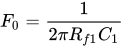
The pass-band gain for the LP and HP outputs is given by:
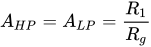
It can be seen that the frequency of operation and the Q factor can be varied independently. This and the ability to switch between different filter responses make the state-variable filter widely used in analogue synthesizers.

Values for a resonance frequency of 1 kHz are Rf1 = Rf2 = 10k, C1 = C2 = 15nF and R1 = R2 = 10k.

Applications

[edit]

State variable filters are frequently used for modifying frequency response in audio signal processing. At low Q settings they are often used in parametric equaliser circuits, and at high or variable Q settings to create resonant filter modules in analog synthesizers. For manual control of frequency, Rf1 and Rf2 in the section above may be replaced by a dual potentiometer; and for voltage control, the devices U2 and U3 may be replaced by voltage controlled amplifiers or operational transconductance amplifiers.

See also

[edit]

References

[edit]
Revisions and contributorsEdit on WikipediaRead on Wikipedia
from Grokipedia
A state variable filter (SVF) is a type of active analog filter circuit that implements a second-order using operational amplifiers, resistors, and capacitors to provide simultaneous low-pass, band-pass, and high-pass outputs from a single input signal. This topology, based on a state-space realization, allows for independent control of key parameters such as the center frequency, quality factor (Q), and gain, making it highly versatile for applications. First formalized by J. Tow in 1968 as an efficient method for realizing active RC filters, the SVF has become a standard building block in due to its multiple outputs and tunable response. The basic structure of an SVF typically consists of three operational amplifiers configured in a cascade: a summing amplifier followed by two , with feedback paths that define the filter's state variables—usually voltage across the integrating capacitors representing position and velocity analogs in a mechanical system. The low-pass output is taken from the second integrator, the band-pass from the first, and the high-pass from the input summing junction after differentiation-like processing; an optional notch output can be derived by summing the low-pass and high-pass signals. The filter's fcf_c is determined by the RC time constants, typically following fc=12πRCf_c = \frac{1}{2\pi RC}, while the , which controls selectivity and , is adjusted via a damping in the feedback loop. This design exhibits a 12 dB/ roll-off for second-order responses and maintains stable phase relationships between outputs, even with component tolerances. SVFs are widely employed in audio , such as in equalizers, crossovers, and modules, where their ability to produce notch and all-pass functions with minimal additional components is advantageous. They also find use in and control systems for precise frequency-domain filtering, offering superior performance over single-output filters like Sallen-Key designs in terms of tunability and output diversity. Despite requiring more op-amps than simpler topologies, the SVF's flexibility has ensured its enduring relevance in both analog and hybrid digital-analog circuits since its practical adoption in the mid-1970s.

Fundamentals

Definition and Characteristics

The state variable filter is a versatile analog topology that utilizes a chain of integrators to produce simultaneous low-pass, high-pass, and band-pass outputs from a single input signal, enabling multiple second-order frequency responses within one circuit. Key characteristics of this filter include independent (orthogonal) adjustment of the quality factor Q (which controls resonance or selectivity) and the center frequency ω₀ without mutual interference, and its modular design that supports cascading of multiple sections to form higher-order filters. It is typically implemented using operational amplifiers, resistors, and capacitors, providing a practical means for analog signal processing. In contrast to traditional single-output filter designs, the state variable filter's provision of multiple outputs from the same topology minimizes component requirements and allows direct access to internal s for monitoring or further processing. This efficiency stems from its foundation in , where outputs correspond to different states of the system. The approach emerged in the 1970s from applying state-space analysis techniques for linear systems to practical filter realizations using integrated circuits.

Historical Development

The concept of state variable filters traces its origins to the development of state-space methods in control systems during the early 1960s, where dynamic systems were modeled using sets of first-order differential equations to represent internal states, enabling analysis of stability and response. This framework, pioneered by Rudolf E. Kalman in his seminal 1960 paper introducing the for linear systems, provided a foundation for extending such techniques beyond control to circuit synthesis, particularly for realizing higher-order transfer functions with low sensitivity to component variations. By the mid-1960s, these methods began influencing analog , shifting from classical frequency-domain approaches to time-domain state-variable formulations that facilitated integrated circuit implementations. A pivotal milestone occurred in 1967 with the publication by W. J. Kerwin, L. P. Huelsman, and R. W. Newcomb, who introduced the Kerwin-Huelsman-Newcomb (KHN) topology as a practical state-variable biquad filter suitable for insensitive transfer functions using operational amplifiers. This design, detailed in their IEEE Journal of Solid-State Circuits paper, demonstrated how state-variable synthesis could achieve low sensitivity to parameter changes, making it ideal for monolithic integration and marking the transition from theoretical control applications to viable electronic filters. The KHN circuit's ability to realize low-pass, high-pass, band-pass, and notch responses from a single structure solidified its role in advancing technology. Building on this, the Tow-Thomas biquad, named after J. Tow's earlier state-space realizations and refined by L. C. , emerged in 1971 in 's IEEE Transactions on Circuit Theory paper, which improved upon the KHN by incorporating a dedicated element for better sensitivity performance and simpler tuning of the quality factor. This variant enhanced ease of design for second-order filters while maintaining the state-variable paradigm's versatility. Throughout the 1970s, state variable filters evolved from discrete-component prototypes to widespread op-amp-based realizations, gaining prominence in audio applications such as voltage-controlled synthesizers; for instance, the SEM module in 1974 employed a state-variable filter topology for its multimode operation, contributing to the boom. By the 1980s, the influence extended to digital domains, where state-variable filter structures inspired emulations in for audio synthesis, allowing software realizations of analog behaviors with adjustable parameters, as seen in early DSP-based polyphonic systems. This period marked the filters' maturation from analog hardware to hybrid and digital adaptations, underscoring their enduring impact on paradigms.

Circuit Topology

Basic Configuration

The basic configuration of a state variable filter employs three operational amplifiers configured as a summer and two integrators, along with resistors and capacitors to realize a second-order capable of producing high-pass, band-pass, and low-pass outputs simultaneously from a single input. This topology, originally proposed for insensitive realizations, uses feedback paths to couple the stages, enabling versatile filtering without requiring multiple independent circuits. The core elements include the op-amp-based integrators for time-constant definition via RC networks and the summer for signal combination and inversion, with resistors setting gains and feedback factors. In a typical , the input signal connects to the inverting input of the first op-amp (the summer), which also receives feedback from the outputs of both through resistors. The summer's output drives the first , whose output in turn feeds the second . Capacitors in the feedback paths of each establish the integration time constants, while resistors at the summer control the and characteristics. This arrangement forms a loop where the summer output serves as the high-pass response, the first integrator's output provides the band-pass response (voltage across its capacitor), and the second integrator's output yields the low-pass response. The role of the summer stage is to combine the input with scaled feedbacks from the integrators, producing a differentiated-like high-pass signal that initiates the filtering process. The first then accumulates this signal to generate the band-pass output, effectively attenuating frequencies outside the center band through its low-pass action on the high-pass input. The second further integrates the band-pass signal to produce the low-pass output, smoothing higher frequencies while preserving the overall second-order response. Component labeling commonly includes R1 and R2 for input scaling and feedback at the summer, C1 and C2 for the ' time constants (often equal for symmetric response), and additional resistors like Rf for Q-related adjustments in the feedback paths.

Signal Flow and Outputs

In the state variable filter, the input signal is directed to a summing junction, where it combines with feedback signals derived from the filter's internal states to initiate the filtering process. This summed signal, which constitutes the high-pass output, is then applied to the first , generating a phase-shifted version that forms the band-pass output at the integrator's output terminal. The band-pass signal proceeds to a second , producing the low-pass output, which represents a further phase shift and cumulative integration of the original input. The outputs are defined based on their frequency-selective properties: the low-pass output, taken from the second integrator, attenuates high-frequency components while passing lower frequencies; the high-pass output, derived from the summing junction (effectively the input minus the low-pass feedback contribution), attenuates low frequencies and emphasizes higher ones; and the band-pass output, from the first integrator, exhibits peak response at the filter's center frequency, isolating a narrow band of frequencies around that point. Feedback mechanisms are integral to the operational dynamics, with from the low-pass output to the summing junction providing control and stability by adjusting the overall gain around the loop, while from the band-pass output to the same junction enhances the quality factor (), sharpening the filter's selectivity without introducing instability. This signal flow can be visualized in a as a chain of two , each denoted as a 1/s block representing integration in the Laplace domain, with the input signal added at the initial summer preceding the first integrator; the band-pass feedback loops positively back to this summer, and the low-pass feedback loops negatively, illustrating the interdependent phase relationships that enable simultaneous multiple-output generation.

Mathematical Modeling

State-Space Representation

The state-space representation of a state variable filter models its dynamics as a using differential equations derived from the circuit's integrator-based . This approach directly realizes the for a second-order , where the states correspond to the internal signals at key nodes. The state variables are defined as the voltages across the two integrating capacitors, typically denoted as v1(t)v_1(t) (intermediate state) and v2(t)v_2(t) (low-pass state). These voltages capture the filter's and evolution over time. The state equations are given by: dv1dt=ω0Qv1ω02v2+u(t)\frac{d v_1}{dt} = -\frac{\omega_0}{Q} v_1 - \omega_0^2 v_2 + u(t) dv2dt=v1\frac{d v_2}{dt} = v_1 In matrix form, these become x˙=Ax+Bu\dot{\mathbf{x}} = A \mathbf{x} + B u, where x=[v1v2]T\mathbf{x} = \begin{bmatrix} v_1 \\ v_2 \end{bmatrix}^T, A=[ω0Qω0210]A = \begin{bmatrix} -\frac{\omega_0}{Q} & -\omega_0^2 \\ 1 & 0 \end{bmatrix}, and B=[10]B = \begin{bmatrix} 1 \\ 0 \end{bmatrix}. Here, ω0\omega_0 is the characteristic , QQ is the quality factor, and u(t)u(t) is the input voltage. This formulation assumes unity gain scaling for the internal states and inverting integrators, as common in operational-amplifier realizations. The output equations provide the filter responses with appropriate scaling for standard unity-gain transfer functions: yLP(t)=ω02v2(t)y_{\text{LP}}(t) = \omega_0^2 v_2(t) yBP(t)=ω0Qv1(t)y_{\text{BP}}(t) = \frac{\omega_0}{Q} v_1(t) yHP(t)=u(t)ω0Qv1(t)ω02v2(t)y_{\text{HP}}(t) = u(t) - \frac{\omega_0}{Q} v_1(t) - \omega_0^2 v_2(t) These relations yield the low-pass, band-pass, and high-pass outputs simultaneously, with the high-pass derived from the summing junction. In matrix notation, y=Cx+Du\mathbf{y} = C \mathbf{x} + D \mathbf{u}, where C=[0ω02ω0Q0ω0Qω02]C = \begin{bmatrix} 0 & \omega_0^2 \\ \frac{\omega_0}{Q} & 0 \\ -\frac{\omega_0}{Q} & -\omega_0^2 \end{bmatrix}
Add your contribution
Related Hubs
User Avatar
No comments yet.