



Community hub
Recent from talks
Contribute something
Nothing was collected or created yet.
Linear filter
View on Wikipedia | This article includes a list of general references, but it lacks sufficient corresponding inline citations. (March 2011) |
Linear filters process time-varying input signals to produce output signals, subject to the constraint of linearity. In most cases these linear filters are also time invariant (or shift invariant) in which case they can be analyzed exactly using LTI ("linear time-invariant") system theory revealing their transfer functions in the frequency domain and their impulse responses in the time domain. Real-time implementations of such linear signal processing filters in the time domain are inevitably causal, an additional constraint on their transfer functions. An analog electronic circuit consisting only of linear components (resistors, capacitors, inductors, and linear amplifiers) will necessarily fall in this category, as will comparable mechanical systems or digital signal processing systems containing only linear elements. Since linear time-invariant filters can be completely characterized by their response to sinusoids of different frequencies (their frequency response), they are sometimes known as frequency filters.
Non real-time implementations of linear time-invariant filters need not be causal. Filters of more than one dimension are also used such as in image processing. The general concept of linear filtering also extends into other fields and technologies such as statistics, data analysis, and mechanical engineering.
Impulse response and transfer function
[edit]A linear time-invariant (LTI) filter can be uniquely specified by its impulse response h, and the output of any filter is mathematically expressed as the convolution of the input with that impulse response. The frequency response, given by the filter's transfer function , is an alternative characterization of the filter. Typical filter design goals are to realize a particular frequency response, that is, the magnitude of the transfer function ; the importance of the phase of the transfer function varies according to the application, inasmuch as the shape of a waveform can be distorted to a greater or lesser extent in the process of achieving a desired (amplitude) response in the frequency domain. The frequency response may be tailored to, for instance, eliminate unwanted frequency components from an input signal, or to limit an amplifier to signals within a particular band of frequencies.


The impulse response h of a linear time-invariant causal filter specifies the output that the filter would produce if it were to receive an input consisting of a single impulse at time 0. An "impulse" in a continuous time filter means a Dirac delta function; in a discrete time filter the Kronecker delta function would apply. The impulse response completely characterizes the response of any such filter, inasmuch as any possible input signal can be expressed as a (possibly infinite) combination of weighted delta functions. Multiplying the impulse response shifted in time according to the arrival of each of these delta functions by the amplitude of each delta function, and summing these responses together (according to the superposition principle, applicable to all linear systems) yields the output waveform.
Mathematically this is described as the convolution of a time-varying input signal x(t) with the filter's impulse response h, defined as:
- or
- .
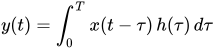
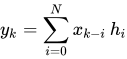
The first form is the continuous-time form, which describes mechanical and analog electronic systems, for instance. The second equation is a discrete-time version used, for example, by digital filters implemented in software, so-called digital signal processing. The impulse response h completely characterizes any linear time-invariant (or shift-invariant in the discrete-time case) filter. The input x is said to be "convolved" with the impulse response h having a (possibly infinite) duration of time T (or of N sampling periods).
Filter design consists of finding a possible transfer function that can be implemented within certain practical constraints dictated by the technology or desired complexity of the system, followed by a practical design that realizes that transfer function using the chosen technology. The complexity of a filter may be specified according to the order of the filter.
Among the time-domain filters we here consider, there are two general classes of filter transfer functions that can approximate a desired frequency response. Very different mathematical treatments apply to the design of filters termed infinite impulse response (IIR) filters, characteristic of mechanical and analog electronics systems, and finite impulse response (FIR) filters, which can be implemented by discrete time systems such as computers (then termed digital signal processing).
Implementation issues
[edit]Classical analog filters are IIR filters, and classical filter theory centers on the determination of transfer functions given by low order rational functions, which can be synthesized using the same small number of reactive components.[1] Using digital computers, on the other hand, both FIR and IIR filters are straightforward to implement in software.
A digital IIR filter can generally approximate a desired filter response using less computing power than a FIR filter, however this advantage is more often unneeded given the increasing power of digital processors. The ease of designing and characterizing FIR filters makes them preferable to the filter designer (programmer) when ample computing power is available. Another advantage of FIR filters is that their impulse response can be made symmetric, which implies a response in the frequency domain that has zero phase at all frequencies (not considering a finite delay), which is absolutely impossible with any IIR filter.[2]
Frequency response
[edit]The frequency response or transfer function of a filter can be obtained if the impulse response is known, or directly through analysis using Laplace transforms, or in discrete-time systems the Z-transform. The frequency response also includes the phase as a function of frequency, however in many cases the phase response is of little or no interest. FIR filters can be made to have zero phase, but with IIR filters that is generally impossible. With most IIR transfer functions there are related transfer functions having a frequency response with the same magnitude but a different phase; in most cases the so-called minimum phase transfer function is preferred.
Filters in the time domain are most often requested to follow a specified frequency response. Then, a mathematical procedure finds a filter transfer function that can be realized (within some constraints), and approximates the desired response to within some criterion. Common filter response specifications are described as follows:
- A low-pass filter passes low frequencies while blocking higher frequencies.
- A high-pass filter passes high frequencies.
- A band-pass filter passes a band (range) of frequencies.
- A band-stop filter passes high and low frequencies outside of a specified band.
- A notch filter has a null response at a particular frequency. This function may be combined with one of the above responses.
- An all-pass filter passes all frequencies equally well, but alters the group delay and phase relationship among them.
- An equalization filter is not designed to fully pass or block any frequency, but instead to gradually vary the amplitude response as a function of frequency: filters used as pre-emphasis filters, equalizers, or tone controls are good examples.
FIR transfer functions
[edit]Meeting a frequency response requirement with an FIR filter uses relatively straightforward procedures. In the most basic form, the desired frequency response itself can be sampled with a resolution of and Fourier transformed to the time domain. This obtains the filter coefficients hi, which implements a zero phase FIR filter that matches the frequency response at the sampled frequencies used. To better match a desired response, must be reduced. However the duration of the filter's impulse response, and the number of terms that must be summed for each output value (according to the above discrete time convolution) is given by where T is the sampling period of the discrete time system (N-1 is also termed the order of an FIR filter). Thus the complexity of a digital filter and the computing time involved, grows inversely with , placing a higher cost on filter functions that better approximate the desired behavior. For the same reason, filter functions whose critical response is at lower frequencies (compared to the sampling frequency 1/T) require a higher order, more computationally intensive FIR filter. An IIR filter can thus be much more efficient in such cases.


Elsewhere the reader may find further discussion of design methods for practical FIR filter design.
IIR transfer functions
[edit]Since classical analog filters are IIR filters, there has been a long history of studying the range of possible transfer functions implementing various of the above desired filter responses in continuous time systems. Using transforms it is possible to convert these continuous time frequency responses to ones that are implemented in discrete time, for use in digital IIR filters. The complexity of any such filter is given by the order N, which describes the order of the rational function describing the frequency response. The order N is of particular importance in analog filters, because an Nth order electronic filter requires N reactive elements (capacitors and/or inductors) to implement. If a filter is implemented using, for instance, biquad stages using op-amps, N/2 stages are needed. In a digital implementation, the number of computations performed per sample is proportional to N. Thus the mathematical problem is to obtain the best approximation (in some sense) to the desired response using a smaller N, as we shall now illustrate.
Below are the frequency responses of several standard filter functions that approximate a desired response, optimized according to some criterion. These are all fifth-order low-pass filters, designed for a cutoff frequency of .5 in normalized units. Frequency responses are shown for the Butterworth, Chebyshev, inverse Chebyshev, and elliptic filters.

As is clear from the image, the elliptic filter is sharper than the others, but at the expense of ripples in both its passband and stopband. The Butterworth filter has the poorest transition but has a more even response, avoiding ripples in either the passband or stopband. A Bessel filter (not shown) has an even poorer transition in the frequency domain, but maintains the best phase fidelity of a waveform. Different applications emphasize different design requirements, leading to different choices among these (and other) optimizations, or requiring a filter of a higher order.

Example implementations
[edit]A popular circuit implementing a second order active R-C filter is the Sallen-Key design, whose schematic diagram is shown here. This topology can be adapted to produce low-pass, band-pass, and high pass filters.

An Nth order FIR filter can be implemented in a discrete time system using a computer program or specialized hardware in which the input signal is subject to N delay stages. The output of the filter is formed as the weighted sum of those delayed signals, as is depicted in the accompanying signal flow diagram. The response of the filter depends on the weighting coefficients denoted b0, b1, .... bN. For instance, if all of the coefficients were equal to unity, a so-called boxcar function, then it would implement a low-pass filter with a low frequency gain of N+1 and a frequency response given by the sinc function. Superior shapes for the frequency response can be obtained using coefficients derived from a more sophisticated design procedure.
Mathematics of filter design
[edit]| Linear analog electronic filters |
|---|
LTI system theory describes linear time-invariant (LTI) filters of all types. LTI filters can be completely described by their frequency response and phase response, the specification of which uniquely defines their impulse response, and vice versa. From a mathematical viewpoint, continuous-time IIR LTI filters may be described in terms of linear differential equations, and their impulse responses considered as Green's functions of the equation. Continuous-time LTI filters may also be described in terms of the Laplace transform of their impulse response, which allows all of the characteristics of the filter to be analyzed by considering the pattern of zeros and poles of their Laplace transform in the complex plane. Similarly, discrete-time LTI filters may be analyzed via the Z-transform of their impulse response.
Before the advent of computer filter synthesis tools, graphical tools such as Bode plots and Nyquist plots were extensively used as design tools. Even today, they are invaluable tools to understanding filter behavior. Reference books[3] had extensive plots of frequency response, phase response, group delay, and impulse response for various types of filters, of various orders. They also contained tables of values showing how to implement such filters as RLC ladders - very useful when amplifying elements were expensive compared to passive components. Such a ladder can also be designed to have minimal sensitivity to component variation a property hard to evaluate without computer tools.
Many different analog filter designs have been developed, each trying to optimise some feature of the system response. For practical filters, a custom design is sometimes desirable, that can offer the best tradeoff between different design criteria, which may include component count and cost, as well as filter response characteristics.
These descriptions refer to the mathematical properties of the filter (that is, the frequency and phase response). These can be implemented as analog circuits (for instance, using a Sallen Key filter topology, a type of active filter), or as algorithms in digital signal processing systems.
Digital filters are much more flexible to synthesize and use than analog filters, where the constraints of the design permits their use. Notably, there is no need to consider component tolerances, and very high Q levels may be obtained.
FIR digital filters may be implemented by the direct convolution of the desired impulse response with the input signal. They can easily be designed to give a matched filter for any arbitrary pulse shape.
IIR digital filters are often more difficult to design, due to problems including dynamic range issues, quantization noise and instability. Typically digital IIR filters are designed as a series of digital biquad filters.
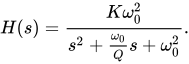
All low-pass second-order continuous-time filters have a transfer function given by
All band-pass second-order continuous-time filters have a transfer function given by
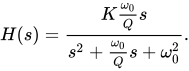
where
- K is the gain (low-pass DC gain, or band-pass mid-band gain) (K is 1 for passive filters)
- Q is the Q factor
- is the center frequency
- is the complex frequency


See also
[edit]Notes and references
[edit]- ^ However, there are a few cases in which FIR filters directly process analog signals, involving non-feedback topologies and analog delay elements. An example is the discrete-time analog sampled filter, implemented using a so-called bucket-brigade device clocked at a certain sampling rate, outputting copies of the input signal at different delays that can be combined with some weighting to realize an FIR filter. Electromechanical filters such as SAW filters can likewise implement FIR filter responses; these operate in continuous time and can thus be designed for higher frequencies.
- ^ Outside of trivial cases, stable IIR filters with zero phase response are possible if they are not causal (and thus are unusable in real-time applications) or implementing transfer functions classified as unstable or "marginally stable" such as a double integrator.
- ^ A. Zverev, Handbook of Filter Synthesis, John Wiley and Sons, 1967, ISBN 0-471-98680-1
Further reading
[edit]- Williams, Arthur B & Taylor, Fred J (1995). Electronic Filter Design Handbook. McGraw-Hill. ISBN 0-07-070441-4.
- National Semiconductor AN-779 application note describing analog filter theory
- Lattice AN6017 application note comparing and contrasting filters (in order of damping coefficient, from lower to higher values): Gaussian, Bessel, linear phase, Butterworth, Chebyshev, Legendre, elliptic. (with graphs).
- USING THE ANALOG DEVICES ACTIVE FILTER DESIGN TOOL: a similar application note from Analog Devices with extensive graphs, active RC filter topologies, and tables for practical design.
- "Design and Analysis of Analog Filters: A Signal Processing Perspective" by L. D. Paarmann
Linear filter
View on GrokipediaFundamentals
Definition and Properties
A linear filter is a system in signal processing that processes an input signal to produce an output signal while satisfying the principle of superposition, which encompasses additivity and homogeneity. Additivity requires that the response to the sum of two inputs equals the sum of the responses to each input individually, while homogeneity ensures that scaling an input by a constant factor scales the corresponding output by the same factor.[7][8] Linear filters are commonly assumed to be time-invariant, meaning that shifting the input signal in time results in an identical shift in the output signal; such systems are known as linear time-invariant (LTI) systems. This time-invariance property simplifies analysis and design in signal processing applications.[7][9] Key properties of linear filters include causality and stability. A causal linear filter produces an output at any time that depends only on the current and past values of the input, not future values, which is essential for real-time processing. Stability, specifically bounded-input bounded-output (BIBO) stability, ensures that every bounded input signal yields a bounded output signal, preventing amplification of noise or unbounded growth in responses. For LTI systems, BIBO stability holds if the impulse response is absolutely integrable (in continuous time) or absolutely summable (in discrete time).[10][8][9] The origins of linear filters trace back to early 20th-century developments in signal processing, with formal mathematical foundations established by Norbert Wiener in the 1940s through his work on optimal filtering for stationary time series.[11] Linear filters can operate in continuous-time or discrete-time domains. In continuous-time, an example is the integrator, which accumulates the input signal over time to produce the output. In discrete-time, a simple moving average filter computes the output as the average of a fixed number of recent input samples, smoothing the signal. The general input-output relationship for LTI filters is given by convolution.[12]Convolution Representation
The convolution representation provides the mathematical foundation for describing the input-output relationship in linear time-invariant (LTI) systems, relying on the principles of superposition and time-shifting.[13] For continuous-time LTI systems, the output is obtained by expressing the input as a superposition of scaled and shifted Dirac delta functions. Specifically, can be represented as where is the unit impulse.[14] Due to linearity, the output is the corresponding superposition of the system's responses to each of these impulses. The response to is the shifted impulse response , by time-invariance. Thus, As , this Riemann sum converges to the convolution integral: or equivalently, .[14] Here, is the impulse response, defined as the output when the input is , fully characterizing the system's filtering behavior for any input.[13] In discrete-time LTI systems, a parallel derivation yields the convolution sum. The input is expressed as using the unit impulse . By linearity and time-invariance, the output is or , where is the discrete impulse response.[15] Again, represents the response to , encapsulating the filter's dynamics. In practical implementations, such as finite impulse response (FIR) filters, the sum is finite, e.g., from to for a causal filter of length .[15] The convolution operation exhibits several algebraic properties that facilitate analysis and computation in LTI systems. These include:- Commutativity: , allowing the order of convolving signals to be swapped.[16]
- Associativity: , enabling grouping of multiple convolutions arbitrarily.[16]
- Distributivity over addition: , and similarly for the other argument.[16]
These properties hold for both continuous and discrete convolutions and mirror those of multiplication in linear algebra.[17]
Time-Domain Characterization
Impulse Response
The impulse response of a linear time-invariant (LTI) system serves as its fundamental time-domain descriptor. In continuous time, it is defined as , the output produced when the input is the Dirac delta function .[19] In discrete time, the impulse response is the output resulting from the Kronecker delta sequence .[8] This response captures the system's inherent behavior to an instantaneous excitation at the origin. The significance of the impulse response lies in its ability to fully characterize an LTI system. Specifically, the output to any arbitrary input can be obtained through the convolution integral , where the asterisk denotes convolution.[20] This property allows the impulse response to encapsulate all temporal dynamics of the system, enabling prediction of responses to diverse inputs without re-solving the underlying system equations.[21] Key properties of the impulse response include causality and duration, which relate directly to the system's physical realizability and memory. For causal systems, which cannot respond before the input is applied, for all (or for in discrete time).[8] The extent of the impulse response also indicates the filter's memory length: a finite-duration or corresponds to a finite impulse response (FIR) filter with no feedback, while an infinite-duration response defines an infinite impulse response (IIR) filter, which retains memory indefinitely.[22] To obtain the impulse response, one approach for simple systems is direct simulation, such as applying the delta input to the system's differential (or difference) equation and solving for the output.[23] Another method involves computing the inverse Fourier transform of the system's frequency response, providing an analytical path from frequency-domain specifications.[24] A representative example is the first-order RC low-pass filter, a classic continuous-time circuit consisting of a resistor in series with a capacitor . Its impulse response is given by where is the time constant determining the decay rate.[25] This exponential form illustrates the filter's causal and infinite-duration nature, typical of IIR systems.Step Response
The unit step response of a linear time-invariant (LTI) filter is the output produced when the input is a unit step function, which is zero for negative time and unity thereafter.[26] In continuous time, this input is the Heaviside step function , defined as for and for , yielding the step response .[26] In discrete time, the unit step is for and for , producing the discrete step response .[27] The step response relates directly to the impulse response of the filter, as for continuous-time systems, representing the cumulative effect of the impulse response up to time .[19] This integration arises from the convolution of the step input with the impulse response, providing a measure of the filter's transient buildup.[19] Key performance metrics derived from the step response characterize the filter's transient behavior, including rise time, settling time, overshoot, and steady-state value. Rise time is the duration for the response to increase from 10% to 90% of its final value.[28] Settling time is the interval after which the response remains within a specified tolerance (typically 2%) of the steady-state value.[28] Overshoot quantifies the maximum deviation above the steady-state value, expressed as a percentage.[28] The steady-state value is the asymptotic output level as time approaches infinity, often equal to the DC gain of the filter for a unit step input.[28] For a first-order system with time constant , the rise time approximates .[28] These metrics assess filter quality by evaluating transient performance, where a monotonic step response (zero overshoot) indicates absence of ringing or oscillations, desirable for applications requiring smooth transitions.[28] In control systems, step response analysis is essential for verifying stability and responsiveness, guiding the selection of filters that meet specifications for rise time and settling without excessive overshoot.[28] A representative example is the step response of a first-order low-pass filter with transfer function and unit DC gain, which yields for .[26] This response approaches the steady-state value of 1 monotonically, with no overshoot, and a rise time of approximately .[26][28]Frequency-Domain Characterization
Transfer Function
In the frequency domain, the transfer function provides an algebraic representation of a linear time-invariant (LTI) filter, relating the Laplace transform of the output signal to that of the input signal for continuous-time systems. For a continuous-time LTI system, the transfer function is defined as the ratio , where and are the Laplace transforms of the output and input , respectively, assuming zero initial conditions.[29][30] This representation facilitates analysis by transforming differential equations into polynomial equations in the complex variable . For discrete-time LTI filters, the transfer function is similarly defined using the Z-transform as , where and are the Z-transforms of the output sequence and input sequence .[31][32] The transfer function can often be expressed in terms of its poles and zeros; for the continuous-time case, a general form is , where is a constant gain, the are the zeros (roots of the numerator), and the are the poles (roots of the denominator).[33][34] System stability in the continuous-time domain requires all poles to lie in the open left half of the complex s-plane, ensuring that the impulse response decays to zero as time approaches infinity.[34] Transfer functions of physical LTI systems are typically rational functions, meaning they are ratios of polynomials in (or ) with real coefficients. For physical realizability, such as in lumped-element circuits, the transfer function must be proper, where the degree of the denominator polynomial exceeds or equals that of the numerator; strictly proper functions (denominator degree strictly greater) correspond to systems with finite high-frequency gain.[35][36] To obtain the time-domain impulse response from the transfer function, one can apply the inverse Laplace transform, often using partial fraction expansion for rational . The method involves decomposing into a sum of simpler fractions, each corresponding to a pole: polynomial terms if improper, where residues are computed as ; the inverse transform then yields for , assuming causality.[37][38] A representative example is the transfer function of a second-order continuous-time bandpass filter, given by where is the center (resonant) frequency and is the quality factor determining the bandwidth; the poles are complex conjugates at , with complex poles when and stability for all .[39]Frequency Response
The frequency response of a linear time-invariant (LTI) system characterizes its steady-state output to sinusoidal inputs at frequency . For continuous-time systems, it is defined as , the Fourier transform of the impulse response , evaluated along the imaginary axis in the complex plane, assuming the system is stable. This complex-valued function specifies the magnitude scaling and phase shift applied to an input sinusoid , yielding output . For discrete-time systems, the frequency response is , the discrete-time Fourier transform of the impulse response , which similarly describes the gain and phase alteration for sinusoidal inputs at normalized frequency .[40][41] Bode plots provide a graphical representation of the frequency response, plotting the log-magnitude in decibels (dB) and phase versus on semi-log axes. These plots are constructed using asymptotic approximations based on the system's poles and zeros: each simple pole contributes a -20 dB/decade slope to the magnitude for frequencies above the pole's corner frequency (decreasing gain at high frequencies relative to the low-frequency flat asymptote), while each simple zero contributes +20 dB/decade; the phase shifts by per pole and per zero, with transitions occurring near the corner frequencies. Actual responses deviate smoothly from these straight-line asymptotes, typically by about 3 dB at the corner for first-order factors, enabling quick stability and performance analysis without full computation.[42][34] Key metrics of the frequency response include the cutoff frequency, defined as the where times the passband gain (corresponding to -3 dB), marking the boundary between passband and stopband. Passband ripple quantifies magnitude variations within the desired frequency band, ideally minimized for flat response, while stopband ripple measures attenuation fluctuations in rejected bands. The group delay, , represents the frequency-dependent time delay of signal envelope propagation, crucial for distortion-free transmission as constant preserves waveform shape.[43][44] In second-order systems, resonance manifests as a magnitude peak near the natural frequency , with peaking severity determined by the damping ratio ; the quality factor quantifies sharpness, where higher yields taller, narrower peaks. The resonant frequency occurs at , amplifying selective frequency response in applications like oscillators. For example, the Butterworth low-pass filter exhibits a maximally flat magnitude in the passband, with for and a -3 dB roll-off at , transitioning smoothly without ripple due to poles equally spaced on a circle in the s-plane.[45]Filter Types
Finite Impulse Response Filters
Finite impulse response (FIR) filters are a class of digital linear filters defined by an impulse response of finite duration, typically spanning from to , where is the filter order. The output is produced as a finite weighted sum of the current and past input samples , expressed through non-recursive convolution: , with no feedback from previous outputs. This structure ensures that the filter's memory is limited to a fixed number of input samples, making it fundamentally feedforward.[46] In the z-transform domain, the transfer function of an FIR filter takes the form where the coefficients correspond directly to the impulse response values . This polynomial expression in contains only zeros as singularities, with all poles located at the origin (), which guarantees unconditional stability regardless of the coefficient values, as the poles lie inside the unit circle. A key property of FIR filters is the potential for exact linear phase response, achieved when the coefficients are symmetric (), preserving the relative timing of signal components across frequencies.[46][47] FIR filters offer inherent stability and the capability for precise linear phase in symmetric designs, which is advantageous for applications like audio processing where phase distortion must be minimized. However, a notable disadvantage is the requirement for higher orders to realize sharp frequency selectivity, leading to increased computational demands compared to recursive alternatives. For instance, a basic FIR low-pass filter can be realized as a moving average over the last samples, with transfer function which attenuates high frequencies by smoothing the input signal.[46][48]Infinite Impulse Response Filters
Infinite impulse response (IIR) filters are a class of digital linear filters defined by their recursive structure, where the output at any time depends on both current and past inputs as well as past outputs, resulting in an impulse response that theoretically extends indefinitely.[49] This feedback mechanism distinguishes IIR filters from non-recursive types and allows them to approximate sharp frequency responses with lower computational complexity.[50] The general form of the difference equation for an IIR filter is where are the feedforward coefficients and are the feedback coefficients, with and denoting the orders of the numerator and denominator, respectively.[50] In the z-domain, the transfer function of an IIR filter is a rational function given by where the poles introduced by the denominator determine the filter's dynamic behavior.[50] For stability in causal IIR filters, all poles must lie strictly inside the unit circle in the z-plane, ensuring bounded-input bounded-output (BIBO) stability.[50] IIR filters offer efficiency advantages, requiring fewer coefficients than equivalent finite impulse response filters to achieve sharp transitions, though they typically exhibit nonlinear phase distortion.[49] A common design approach involves the bilinear transform, which maps continuous-time analog prototypes to discrete-time IIR filters via the substitution , where is the sampling period, preserving stability while introducing frequency warping that must be precompensated.[50] Despite their efficiency, IIR filters face challenges related to stability and implementation. Improper pole placement can push poles outside the unit circle, leading to unbounded outputs and instability.[49] In fixed-point arithmetic, quantization of coefficients and arithmetic operations can shift pole locations, potentially causing instability or performance degradation, such as increased noise or limit cycles.[51] These effects are more pronounced in higher-order filters, often necessitating cascaded second-order sections to mitigate sensitivity.[49] A representative example is the first-order IIR high-pass filter, with transfer function where ensures stability, and the parameter controls the cutoff frequency, for instance, yielding a 3-dB cutoff near radians per sample.[52] This structure places a zero at to attenuate low frequencies while the pole at shapes the roll-off.[52]Design and Implementation
Design Techniques
Linear filter design techniques seek to approximate an ideal frequency response, such as a brick-wall low-pass filter with unity gain in the passband and zero gain in the stopband, subject to practical constraints including filter order, allowable passband ripple, stopband attenuation levels, and transition band width. These approximations balance sharpness of the frequency cutoff against computational complexity and phase distortion, with specifications typically defined in terms of passband edge frequency , stopband edge frequency , maximum passband ripple , and minimum stopband attenuation .[45]FIR Design Methods
Finite impulse response (FIR) filters are designed directly in the digital domain, leveraging their inherent stability and ability to achieve exact linear phase by symmetric coefficients. The window method constructs FIR coefficients by truncating the ideal infinite impulse response—a sinc function for low-pass filters—with a finite-length window to mitigate Gibbs ringing oscillations in the frequency response. The ideal low-pass impulse response is given by for , where is the cutoff frequency and is the filter length minus one; the actual coefficients are then , with a window function. Common windows include the rectangular window, which provides the narrowest main lobe but highest sidelobes ( dB attenuation); the Hamming window, offering improved sidelobe suppression at dB with a wider main lobe; and the Blackman window, achieving dB sidelobes at the cost of further broadened transition width. The Hamming window was introduced by R. W. Hamming for spectral analysis applications.[53][54] The frequency sampling method specifies the desired frequency response at equally spaced points around the unit circle (where is the filter order), sets unspecified points to zero, and computes the impulse response coefficients via the inverse discrete Fourier transform (IDFT): , for . This approach is computationally efficient for filters with simple frequency responses but can produce large interpolation errors between samples unless the sampling grid aligns well with transition bands. For optimal FIR design minimizing the maximum deviation from the ideal response (minimax or equiripple error), the Parks-McClellan algorithm employs the Remez exchange principle to iteratively adjust coefficients, yielding a weighted Chebyshev approximation with equal ripple in passband and stopband errors. This method, originally formulated for linear-phase FIR filters, outperforms windowing in achieving the lowest order for given specifications and is implemented in tools like MATLAB'sfirpm function. The algorithm was developed by T. W. Parks and J. H. McClellan in their 1972 paper on Chebyshev approximation for nonrecursive digital filters.[55]
As an example of windowed FIR low-pass design, first determine the required order based on transition width and attenuation needs (e.g., via empirical formulas like Kaiser's for the parameter in a Kaiser window: for stopband attenuation dB). Compute the ideal sinc-based as above, apply the chosen window (e.g., Hamming: ), and obtain coefficients via direct multiplication, which implicitly uses the IDFT relationship for the frequency-domain interpretation.[53]
IIR Design Methods
Infinite impulse response (IIR) filters are typically designed by transforming analog prototypes to digital equivalents, exploiting well-established analog approximations for efficiency. Analog prototypes are classified by their magnitude response characteristics: Butterworth filters provide maximally flat passband response without ripple, ideal for applications requiring smooth gain; Chebyshev Type I filters introduce equiripple in the passband for steeper roll-off at the expense of ripple; and elliptic (Cauer) filters add equiripple in both passband and stopband, achieving the sharpest transition for a given order but with finite stopband attenuation zeros. The Butterworth approximation was introduced by S. Butterworth in 1930 for filter amplifiers with uniform passband response.[56] Chebyshev filters leverage polynomial approximations for minimized maximum deviation, with electrical filter realizations developed in the 1950s. Elliptic filters, providing the most efficient approximation, were synthesized by W. Cauer using elliptic function theory for network realization.[55] Digital conversion from these prototypes uses either the impulse invariance or bilinear transform method. Impulse invariance preserves the analog impulse response shape by sampling: the digital transfer function is , where and are analog partial fraction residues and poles, and is the sampling period; this maintains time-domain similarity but introduces aliasing for high-frequency content. The method suits bandlimited signals but requires anti-aliasing pre-filtering.[57] The bilinear transform, preferred for its aliasing-free mapping of the entire j-axis to the unit circle, substitutes into the analog transfer function , ensuring stability preservation since the left-half s-plane maps inside the unit circle. Prewarping adjusts critical frequencies (e.g., ) to match analog and digital cutoffs exactly. This transform, adapted from control theory by A. Tustin, is standard for audio and communications filters.[58] Filter order estimation guides prototype selection; for Butterworth low-pass, the minimum order satisfies , where and are passband and stopband attenuations in dB, ensuring the response meets specifications.[45] FIR designs excel in linear phase, avoiding group delay distortion critical for waveform preservation, but demand higher orders (often 10-100 times IIR) for comparable sharpness, increasing computational load. Conversely, IIR filters offer efficiency with lower orders (e.g., order 4-8 vs. 50+ for FIR in sharp cutoffs) due to feedback, but risk instability from pole placement and exhibit nonlinear phase unless all-pass equalizers are added. Trade-offs favor FIR for high-fidelity audio and IIR for real-time systems like control loops.Practical Implementations
Linear filters are realized in digital and analog domains, each presenting distinct computational and hardware considerations for practical deployment. In digital implementations, infinite impulse response (IIR) filters are commonly realized using difference equations in structures such as Direct Form I and Direct Form II. Direct Form I implements the filter by first applying the non-recursive (FIR) part to the input signal and then the recursive part to the result, requiring separate delay lines for input and output samples.[59] In contrast, Direct Form II combines the delay lines, reducing the number of memory elements to the filter order, which enhances efficiency in hardware-constrained environments like digital signal processors (DSPs).[59] Transposed forms of these structures, such as the transposed Direct Form II, further optimize for reduced roundoff noise and improved parallelism in pipelined architectures.[60] For finite impulse response (FIR) filters, fast convolution via the fast Fourier transform (FFT) enables efficient computation for long impulse responses by transforming the linear convolution into circular convolution in the frequency domain, significantly lowering the computational complexity from to for filter length .[61] Analog implementations rely on passive and active circuit topologies to approximate the desired frequency response. Passive filters use RC or RLC ladder networks, where series and shunt elements form cascaded sections that inherently provide attenuation without amplification, suitable for low-frequency applications but limited by component parasitics and insertion loss.[39] Active filters employ operational amplifiers (op-amps) to overcome these limitations; the Sallen-Key topology, for instance, realizes second-order low-pass or high-pass filters using an op-amp with two resistors and two capacitors, offering unity gain configurations that minimize sensitivity to component tolerances.[62] Practical challenges in these implementations include coefficient quantization and arithmetic overflow. In fixed-point arithmetic, prevalent in resource-limited DSPs, filter coefficients are quantized to finite precision, leading to deviations from the ideal response; floating-point arithmetic mitigates this by preserving relative accuracy but at higher computational cost.[63] Overflow occurs when intermediate results exceed the word length, potentially causing signal distortion or instability in recursive filters, necessitating scaling or saturation techniques to bound outputs.[64] Additionally, latency arises in real-time systems due to processing delays, particularly in block-based methods like FFT convolution, impacting applications requiring low-delay feedback.[65] Stability, ensured by poles of the transfer function lying inside the unit circle for digital filters, must be verified post-quantization to prevent divergence.[59] To address computational demands, multirate techniques such as decimation and interpolation reduce processing rates. Decimation involves low-pass anti-aliasing filtering followed by downsampling to lower the sampling rate, minimizing aliasing while cutting computation by the decimation factor. Interpolation upsamples the signal with zeros and applies a low-pass filter to remove imaging artifacts, enabling efficient rate conversion in systems like subband processing. A representative example is the IIR biquad section, a second-order building block for higher-order filters, implemented via the difference equation: In pseudocode for DSP execution:double y = 0;
double x_prev1 = 0, x_prev2 = 0;
double y_prev1 = 0, y_prev2 = 0;
for each sample x[n]:
y = b0 * x[n] + b1 * x_prev1 + b2 * x_prev2 - a1 * y_prev1 - a2 * y_prev2;
// Apply scaling or saturation if needed to prevent overflow
x_prev2 = x_prev1;
x_prev1 = x[n];
y_prev2 = y_prev1;
y_prev1 = y;
output y;
double y = 0;
double x_prev1 = 0, x_prev2 = 0;
double y_prev1 = 0, y_prev2 = 0;

for each sample x[n]:
    y = b0 * x[n] + b1 * x_prev1 + b2 * x_prev2 - a1 * y_prev1 - a2 * y_prev2;
    // Apply scaling or saturation if needed to prevent overflow
    x_prev2 = x_prev1;
    x_prev1 = x[n];
    y_prev2 = y_prev1;
    y_prev1 = y;
    output y;