Hubbry Logo
Steam clockSteam clockMain
Open search
Steam clock
Community hub
Steam clock
logo
8 pages, 0 posts
0 subscribers
Be the first to start a discussion here.
Steam clock
Steam clock
from Wikipedia
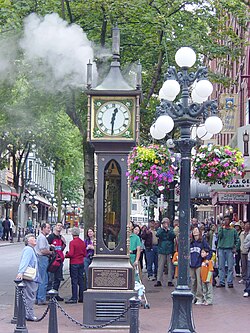
Tourists entertained by the Gastown steam clock in Vancouver

A steam clock is a clock which is fully or partially powered by a steam engine. Only a few functioning steam clocks exist, most designed and built by Canadian horologist Raymond Saunders for display in urban public spaces. Steam clocks built by Saunders are located in Otaru, Japan; Indianapolis, Indiana; and the Canadian cities of Vancouver, Whistler and Port Coquitlam, all in British Columbia. Steam clocks by other makers are installed in St Helier, Jersey and at the Chelsea Farmers' Market in London, England.

Although they are often styled to appear as 19th-century antiques, steam clocks are a more recent phenomenon inspired by the Gastown steam clock built by Saunders in 1977. One exception is the steam clock built in the 19th century by Birmingham engineer John Inshaw to demonstrate the versatility of steam power.

Steam Clock Tavern

[edit]

In 1859, engineer and businessman John Inshaw took over the public house on the corner of Morville Street and Sherborne Street in Ladywood, Birmingham, UK. In a bid to make the establishment a talking point in the area, as well as furnishing it with various working models, Inshaw applied his interest in steam power to construct a steam-powered clock as a feature.[1]

A small boiler made steam; the steam condensed into droplets of water that fell on a plate at regular intervals, and the plate then drove the mechanism. The clock was installed above the door, and the pub became known as the Steam Clock Tavern. The establishment was sufficiently successful that it became a music hall in the 1880s.[2]

Gastown steam clock

[edit]
A video showing the Gastown steam clock in operation

Raymond Saunders' first steam clock was built in 1977 at the corner of Cambie and Water streets[3] in Vancouver's Gastown neighbourhood at 49°17′04″N 123°06′32″W / 49.28444°N 123.10889°W / 49.28444; -123.10889.[4][5] It was built to cover a steam grate, part of Vancouver's distributed steam heating system, as a way to harness the steam and a means of masking Central Heat's sidewalk steam vent at the corner of Water Street and Cambie Street.[6]

Although the clock is now owned by the City of Vancouver, funding for the project, estimated to be about $58,000 CAD,[7] was provided by contributions from local merchants, property owners, and private donors. Incorporating a steam engine and electric motors, the clock displays the time on four faces and announces the quarter hours with a whistle chime that plays the Westminster Quarters.[8] The clock produces a puff of steam from its top on the hour.[3]

The steam used is from a low pressure downtown-wide steam heating network, from a plant adjacent to the Georgia Viaduct, that powers a miniature steam engine in its base, driving a chain lift. The chain lift moves steel balls upward, where they are unloaded and roll to a descending chain. The weight of the balls on the descending chain drives a conventional pendulum clock escapement, geared to the hands on the four faces. The steam also powers the clock's sound production, with whistles being used instead of bells to produce the Westminster "chime" and to signal the time.

The steam engine that originally ran the clock is a Stuart #4 single-expansion double-acting 1" piston engine.[9] This engine is still visible through the glass sides of the clock. However, owing to the clock's high noise levels and inability to keep accurate time, since 1986 the clock has been powered by an electric motor that was originally intended solely as a back-up system.[10]

In October 2014, the clock was temporarily removed for major repairs by its original builder, and was reinstalled January 2015.[11][12]

The clock appears on the cover of the Nickelback album Here and Now and is also featured in a scene from the 1991 Chuck Norris action film The Hitman. It also appears in the 2019 mobile game Mario Kart Tour and the Nintendo Switch game Mario Kart 8 Deluxe as part of the "Vancouver Velocity" race course.

Other steam clocks

[edit]

Indiana Steam Clock

[edit]

The 17-foot (5.2 m)–tall Indiana State Museum steam clock in Indianapolis, Indiana, is located on the sidewalk on the north side of the museum near the canal.[13] It has four 24-inch (61 cm) diameter dials that are backlit by neon. The clock’s eight brass whistles play a few notes of "Back Home Again in Indiana" every 15 minutes. A more complete rendition is played at the top of every hour.[14]

Chelsea Farmers' Market steam clock

[edit]

The towering and quirky steam clock located at the Chelsea Farmers' Market was constructed in 1984 by Tim Hunkin.[15] Although still standing, the clock is no longer in operation.

Jersey waterfront steamboat clock

[edit]
Jersey Steam Clock

The Jersey steam clock is a full-scale replica of the centre section of a paddle steamboat named the Ariadne. The clock was commissioned by the Jersey Waterfront Board in 1996, and built by Smith of Derby Group. Although once powered by steam, according to a Jersey government document "the steam workings have been replaced with electrical fittings designed to provide the same functionality including the blowing of 'steam' at the appropriate times of the day."

The clock is sited on the North Quay of the harbour at St Helier, Jersey, and also incorporates a fountain. It is listed in the Guinness Book of Records as the World's largest steam clock.

Berwick steam clock

[edit]

Located at Berwick, Australia, 38°1′43.74″S 145°20′53.12″E / 38.0288167°S 145.3480889°E / -38.0288167; 145.3480889 (Berwick steam clock). Designed and built by Peter Weare at his own expense, it is a half-scale prototype for a larger clock proposed for Melbourne.[16] The clock was dismantled in December 2010 due to vandalism.[17] In December 2011, the city council agreed to find a new site for the clock.[18]

References

[edit]
[edit]
Revisions and contributorsEdit on WikipediaRead on Wikipedia
from Grokipedia
A steam clock is a timekeeping device that harnesses steam power—either from a dedicated or municipal steam lines—to drive its mechanism, raise weights, or generate chimes and visual steam emissions, blending horological engineering with industrial aesthetics. The concept originated in the mid-19th century, with the world's first known steam clock constructed in 1859 by Birmingham engineer John Inshaw above his Steam Clock Tavern on Morville Street to showcase 's versatility and draw patrons to the pub in the semi-rural area. Inshaw's design featured a small producing that condensed into droplets to propel the clock's plates, though it was rudimentary and imprecise compared to modern iterations. The modern revival of steam clocks began in the late 20th century, largely through the efforts of Canadian horologist Raymond Saunders (1940–2024), who pioneered functional designs incorporating Victorian-era styling. Saunders' breakthrough came with the Steam Clock in , , unveiled in 1977 as part of a neighborhood revitalization effort to cover an unsightly steam vent and commemorate the area's historic roots. Standing 16 feet (4.9 meters) tall at the intersection of Cambie and Water Streets, this iconic timepiece—commissioned by local merchants for $58,000—uses piped steam from the city's downtown heating system to power whistles that play the every 15 minutes and a sequence of toots on the hour, while descending weights (assisted by an via a rubber belt) drive the clockworks. Though often mistaken for a relic from the , the Gastown clock's mechanism was originally partially steam-driven but transitioned to primarily electric operation after the initial steam motor lasted about a decade, with steam retained for auditory and visual effects. Saunders went on to create several more steam clocks, contributing to their rarity—only about seven functional examples exist worldwide, most in North America. Notable among them is the Indiana Steam Clock outside the Indiana State Museum in Indianapolis, installed in 2002, which features eight brass whistles playing "Back Home Again in Indiana" on the hour using low-pressure steam. These clocks not only serve as tourist attractions but also highlight the fusion of 19th-century steam technology with contemporary engineering, evoking nostalgia for the steam age while operating reliably in urban settings.

Overview

Definition

A steam clock is a timekeeping device that is fully or partially powered by a , utilizing steam pressure to drive its mechanical components and regulate the passage of time. Unlike traditional clocks that rely on gravity-driven weights, coiled springs, or electrical motors for energy, a steam clock harnesses the expansive force of heated steam to propel , escapements, and other elements, often resulting in a distinctive auditory and visual display during operation. Key characteristics of steam clocks include prominent visible elements such as steam pipes, exhaust vents, and integrated whistles or bells that emit chimes or melodies at regular intervals, enhancing their aesthetic and functional appeal. These devices are typically designed as ornamental installations in public spaces, where their elaborate Victorian-inspired architecture draws attention and serves both practical and decorative purposes. In contrast to self-contained conventional timepieces, steam clocks depend on an external steam supply, commonly sourced from nearby boilers or urban systems, which provides the continuous low-pressure necessary for sustained operation. Steam clocks vary in their degree of steam integration: some employ steam solely for auxiliary functions, such as powering chimes or bells to announce the hour, while others incorporate it more comprehensively into the primary timekeeping mechanism, for instance, by using steam-driven pistons to wind weights or directly actuate the for precise time regulation. This partial or full reliance on steam distinguishes them as hybrid marvels, blending 19th-century steam with classical horology to create reliable yet visually dramatic timepieces.

Rarity and cultural significance

Steam clocks remain exceedingly rare, with only about six to eight functioning or historically significant examples known worldwide. This scarcity stems primarily from the high maintenance costs associated with their operation, such as the $50,000 restoration required for Vancouver's steam clock in 2014, nearly equivalent to its original expense of $58,000 in 1977. Additionally, the need for dedicated steam —often reliant on systems or on-site boilers—poses logistical challenges in modern urban environments, where such setups are uncommon and require constant monitoring to prevent failures like insulation degradation affecting gears. The widespread shift to reliable sources since the early has further diminished the practicality of maintaining fully steam-driven timepieces, rendering them novelties rather than everyday devices. Culturally, steam clocks function as prominent landmarks that attract tourists through interactive features like steam emissions, whistle chimes on the quarter-hour, and photogenic Victorian facades, drawing crowds eager for a glimpse of mechanical spectacle. They symbolize the ingenuity of 19th-century , evoking the era's steam-powered innovations while aligning with contemporary aesthetics that romanticize gears, pistons, and retro-futurism as emblems of historical progress and craftsmanship. Often commissioned as part of urban revitalization efforts, such as the Gastown clock's role in boosting local commerce following 1970s community protests against development, these installations enhance public spaces and preserve industrial heritage. A common modern misconception portrays steam clocks as purely steam-operated, yet many are hybrid systems that use for core functions while employing solely for winding mechanisms or auditory effects, fueling public fascination with their blend of old and new technologies. This hybrid nature has not diminished their allure. Such distinctions highlight steam clocks' enduring appeal as accessible icons of mechanical wonder in an electrified age.

History

Early inventions

The steam clock emerged during the height of the Industrial Revolution in the 19th century, a period marked by the widespread adoption of steam power following James Watt's pivotal improvements to the steam engine in the late 18th century. These enhancements, including the separate condenser introduced in 1769, dramatically increased efficiency and enabled steam engines to power factories, locomotives, and machinery on an unprecedented scale, transforming industrial production and transportation across Britain and beyond. Inventors and engineers sought to showcase steam's versatility in novel applications, extending its use beyond heavy industry to demonstrate its potential in everyday mechanisms like timekeeping devices. A pioneering example was the steam clock constructed by Birmingham engineer and businessman John Inshaw in 1859. Installed above the entrance of his newly acquired public house at the corner of Morville Street and Sherborne Street in the district of Birmingham, , the device served primarily as an advertising attraction to draw patrons to the Steam Clock Tavern. Inshaw, a skilled hobbyist known for creating working models powered by , gas, and —including locomotives, carriages, and boats—designed the clock as a compact demonstration of steam's adaptability. The mechanism featured a small that generated , which was then condensed into droplets; these droplets fell at regular intervals onto a plate, driving the clock's hands and basic face display. Despite its innovative appeal, Inshaw's steam clock was small and very inaccurate as a compared to established pendulum-based clocks, which offered greater stability through gravitational . These technical challenges, combined with the complexity of maintaining steady steam output in a small-scale device, prevented widespread adoption of steam clocks during the era, confining them to experimental or promotional novelties rather than standard timepieces.

Modern developments

The revival of steam clocks in the late 20th century began with the construction of the steam clock in , , in 1977 by horologist Raymond Saunders. Commissioned by local merchants as part of urban revitalization efforts, this ornamental timepiece utilized low-pressure steam from the city's system to power its whistles and demonstrate mechanical ingenuity, igniting public fascination and inspiring subsequent installations as features. Key innovators drove the limited proliferation of modern steam clocks. Saunders, recognized as a pioneer, designed and built at least seven such devices worldwide, including the Indiana State Museum clock in 2002, which features brass whistles playing "Back Home Again in Indiana," and another in , . Saunders died on November 23, 2024. Other notable contributors include British artist , who collaborated with Andy Plant to create the Chelsea steam clock in in 1984 as a kinetic sculpture emphasizing whimsy over precision, and Australian engineer Peter Weare, who constructed a half-scale steam clock in Berwick in 2007 to advocate for a larger public installation in . Technological adaptations enhanced reliability and aesthetic appeal in these designs. To address steam's inherent inaccuracy, many incorporated electric motors as primary drivers for the clock faces, with steam engines linked via belts for auxiliary functions like chime activation, ensuring consistent operation. Integration with urban district steam networks, as in , minimized on-site boiler needs while producing visible vapor effects. Emphasis shifted toward visual and auditory spectacle, with whistles often programmed to perform tunes such as the every quarter-hour, prioritizing cultural allure over utilitarian timekeeping. Despite these innovations, high maintenance demands and operational costs have contributed to the decline of steam clocks since the . For instance, Jersey's waterfront steamboat clock converted its steam mechanism to electric in 2005 to save approximately £16,000 annually in upkeep, while the Chelsea clock ceased functioning around due to repair challenges. Today, fewer than ten functional examples remain globally, underscoring their rarity amid escalating expenses for specialized servicing and parts.

Mechanism

Steam engine components

Steam clocks employ a compact steam engine to generate the motive power required for operation, typically utilizing a connection to an urban district steam heating network. In systems connected to district networks, low-pressure steam, often at 15-20 psi (103-138 kPa), is supplied from centralized plants designed for building heating, providing a reliable vapor source without the need for an independent boiler. This steam source delivers the thermal energy necessary to create the pressure differential that drives the engine. The core of the in a steam clock is the and assembly, where high-pressure is admitted alternately to each side of the within a sealed , causing reciprocal that is converted to rotational force via a and . This double-acting configuration maximizes efficiency in small-scale applications by utilizing steam expansion on both strokes of the , transforming from the into mechanical work. To ensure operational , the assembly incorporates pressure relief valves, often spring-loaded, which automatically vent excess if pressure exceeds safe limits, typically set around 25-30 psi to prevent structural failure or . Auxiliary features enhance the functionality and auditory appeal of steam clocks, with steam bursts directed to whistles or bells that produce chimes or signals at hourly intervals, activated by valves synchronized with the engine's cycle. The overall conversion relies on fundamental thermodynamic principles, wherein the expansion of within the performs work on the , governed by relationships such as the PV=nRTPV = nRT, where (PP) and volume (VV) changes drive the mechanical output without requiring complex derivations.

Power transmission to clockwork

In steam clocks, power transmission begins with a winding mechanism powered by the , where drives a to lift a series of weights or steel balls connected by a over pulleys, effectively mimicking the action of manually winding a traditional -driven clock. As these weights descend under , they pull the , providing continuous to the clock's main gear barrel and initiating the motion of the internal . This setup converts the intermittent force from into a steady gravitational pull, avoiding direct application to the delicate timekeeping components. The descending weights drive a —a series of interconnected wheels and pinions—that reduces the speed and increases the , transmitting rotational motion to the mechanism at the heart of the clock. Typically employing a conventional paired with a , this system releases energy in precise, regulated "ticks," allowing the pendulum to swing isochronously while controlling the gear train's advance and ensuring the hands move at a uniform rate. Many steam clocks feature hybrid systems where steam primarily handles periodic winding of the weights, while auxiliary electric motors provide the constant drive to the or assist in regulating the , compensating for steam's variability. This combination enhances overall reliability without relying solely on steam for fine timekeeping. Accuracy in steam clocks faces challenges from inconsistent steam supply, which can cause irregular winding and disrupt the pendulum's rhythm, leading to cumulative time drift. These issues are addressed through mechanical buffers, such as weighted dampers in the , and electric overrides that fine-tune the or directly adjust the hands when needed; regular , including refits to the steam valves and motors, has demonstrably improved precision in operational examples.

Notable steam clocks

Gastown steam clock

The Gastown steam clock is located at the corner of Cambie and Water Streets in 's , at coordinates 49°17′04″N 123°06′32″W. It was designed by horologist Raymond Saunders (who died on November 25, 2024), in collaboration with metalwork specialist Doug Smith and constructed by the Horological Co. of Vancouver in 1977. The project, which cost approximately $58,000 CAD, was funded through contributions from local merchants, businesses, and private donors as part of efforts to revitalize the aging neighborhood. Unveiled on September 24, 1977, the clock was donated to the City of and strategically placed over an unsightly steam vent from the city's system to enhance the area's Victorian-era aesthetic. The clock stands 16 feet (4.9 meters) tall in a Victorian-style design, featuring four illuminated dials that display the time using a traditional clockwork mechanism powered initially by from Vancouver's underground heating network. Every quarter hour, it plays the melody through a series of steam-activated whistles, accompanied by bursts of steam; on the hour, a larger puff of steam is released from the top along with a single whistle note. Originally fully steam-wound, the mechanism was converted to an in 1986 to improve reliability amid inconsistent steam pressure, though the whistles and steam effects remain steam-powered. This hybrid operation ensures precise timekeeping while preserving the clock's signature auditory and visual displays. Owned and maintained by the City of Vancouver, the clock receives regular upkeep, including annual cleaning, repairs, and electrical servicing budgeted at around $3,000 from the city, with additional support from the Business Improvement Society. It has become a major , drawing crowds for its unique operation and photogenic presence in the heritage district, and has been featured in media such as the cover of Nickelback's 2011 album , where it is depicted at 11:21 to match the release date. Despite occasional vandalism, such as a 1998 incident causing $11,000 in damage that was covered by insurance, the clock remains a enduring symbol of 's renewal.

Indiana Steam Clock

The Indiana Steam Clock is located outside the Indiana State Museum at 650 West Washington Street in , along the Downtown . Standing 17 feet tall and weighing 1.5 tons, it features four 24-inch diameter dials back-lit by for visibility. Designed by Canadian horologist Raymond L. Saunders (who died on November 25, 2024), the clock draws inspiration from his earlier Gastown Steam Clock in . At the top of every hour, the clock's eight brass whistles, powered by steam at 20 PSI, play a full rendition of the anthem "," while shorter verses sound every quarter hour. This steam is supplied via an underground line that also heats the , with electric components assisting the operation. The chimes celebrate Indiana's heritage, evoking regional pride and connecting visitors to the state's cultural identity. Constructed primarily of with ornate trim, the clock incorporates a weight-driven mechanism and pinwheel , topped by a rotating model illuminated by a miniature sun lamp spinning at 3 RPM. It integrates seamlessly into the museum's plaza, serving as an educational exhibit on steam power and horology amid the institution's broader displays on history. Fully operational since repairs in 2019 addressed corrosion issues that silenced it for seven years, the clock is maintained by the State Museum and Smith's Bell and Clock. It continues to draw crowds of visitors fascinated by this rare steam-powered timepiece and its ties to Midwestern innovation and tradition.

Chelsea Farmers' Market steam clock

The Chelsea Farmers' Market steam clock, located at the bottom of Sydney Street in , was designed and built in 1984 by engineer and cartoonist in collaboration with Andy Plant. Commissioned for a shop associated with , the oversized structure incorporates cartoonish elements, such as two figures that swing out to cover their ears just before an hourly whistle blows, emphasizing whimsy and artistic flair over precise timekeeping. The clock's visible features include a at the base powering a that drives exposed gears to wind the mechanism, with the steam-driven operation showcased through glass panels for public viewing. An hourly chime is produced by a sourced from a 19th-century American , accompanied by a practical saucepan to catch the hot water expelled during operation, adding to its playful, theatrical design. Installed as a novel attraction to draw visitors to the market, the clock operated until the early , when it ceased functioning due to ongoing challenges with the system and changes following Neal's Yard's departure from the associated shop. Though non-operational today, it remains in place as a preserved piece of , exemplifying Hunkin's series of inventive engineering installations that humorously underscore the impracticalities of technology in contemporary settings.

Jersey waterfront steamboat clock

The waterfront clock, officially known as the Ariadne Steam Clock, is a full-scale replica of the central section of the historic paddle steamboat Ariadne, one of the first steamships to operate regular services between and the in the . Commissioned in 1996 by the Jersey Waterfront Board as part of the St waterfront regeneration project, it was designed by sculptor Gordon Young in collaboration with clockmakers Smith of Derby Group and installed the following year to celebrate the island's maritime heritage. Located on the New North Quay near the , the structure evokes the era of steam navigation that connected Jersey to the British mainland, standing as a prominent landmark amid converted warehouses and harbor views. At approximately 30 feet tall, the clock was recognized by the Guinness Book of Records upon installation as the world's largest steam clock, surpassing other examples in scale and thematic ambition. Its original steam-powered mechanism drove the rotation of oversized paddle wheels every hour, which were mechanically linked to the clock hands to synchronize the display with timekeeping, while bells chimed the quarters and steam vented from funnels for dramatic effect. Additional features included a central fountain that bubbled and squirted water, enhancing the nautical spectacle and drawing crowds to witness the synchronized motions at set intervals. The design integrated functional clock faces with steamboat elements like a mock bridge and port/starboard lights, creating an immersive tribute to Victorian engineering. For practical reasons, including maintenance challenges with , the power system was converted to in the post-2000s period, simulating the original effects through electrical actuators while preserving the reliability—a common adaptation in modern steam clock installations. This hybrid setup ensured continued operation without the hazards of boilers, though it sparked local over authenticity and cost, with the project costing £250,000. Despite intermittent downtime, such as a four-year hiatus ending in 2020 when engineers repaired the electrical clock faces, the attraction remains functional and draws tourists as a symbol of Jersey's seafaring past. Its proximity to the Maritime Museum amplifies its role in educating visitors on steam-era navigation innovations.

Berwick steam clock

The Berwick steam clock was a half-scale experimental model constructed by Peter Weare in Berwick, Victoria, , serving as a to test mechanisms for potential larger installations. Installed permanently at Pioneers Park in late July 2008 with approval from the Casey Council, the clock featured a basic steam-powered system that automatically switched to operation from midnight until morning to reduce energy use and maintenance needs. Its visible mechanics, mounted on clear perspex panels, allowed partial public viewing of the internal components, including a magnetic escape mechanism for the , though no advanced chimes were incorporated at the time of installation. The clock operated until December 2010, when it was dismantled due to repeated that damaged its delicate structure. Although the agreed in December 2011 to find a new site, there is no record of reinstallation. Funding shortages for repairs and ongoing protection further contributed to the decision, highlighting the practical challenges of deploying outdoor steam clocks in semi-rural public spaces like parks. This short-lived project underscored the vulnerabilities of such devices to environmental and human factors, influencing caution in subsequent prototype developments amid the global scarcity of functional steam clocks.

Steam Clock Tavern

The Steam Clock Tavern, situated at 23 Morville Street in the district of Birmingham, , at the corner with Sherborne Street, was established by engineer John Inshaw in 1859 when he converted his former home into a public house. Inshaw installed a pioneering steam-powered clock above the entrance to draw crowds and boost business, transforming the venue into a local spectacle that highlighted technology's potential in everyday applications. This commercial strategy capitalized on the era's fascination with industrial innovation, positioning the tavern as a unique destination in a then-semi-rural area. The clock featured a straightforward with a simple dial and hands, driven by a dedicated small that generated , which then condensed into water droplets falling at intended regular intervals onto a metal plate to propel the mechanism. Despite its ingenuity, the device suffered from significant technical shortcomings, including highly inconsistent timekeeping due to fluctuations in that disrupted the droplet rhythm, rendering it unreliable and prone to variations of hours per day. As a result, it functioned primarily as an entertaining novelty rather than a practical timepiece, underscoring the challenges of early applications in precision devices. The and its clock operated until 1886, after which closed amid urban changes, with the site later evolving into a before disappearing from records by the century's end. This installation exemplified 19th-century experimentation with steam in daily life, serving as an early precursor that influenced subsequent steam clock designs, such as the more refined Gastown steam clock in .

References

Add your contribution
Related Hubs
User Avatar
No comments yet.