


Community hub
Recent from talks
Contribute something
Nothing was collected or created yet.
Steglitz
View on Wikipedia
Steglitz (German: [ˈʃteːɡˌlɪt͡s] ⓘ) is a locality of the Steglitz-Zehlendorf borough in Southwestern Berlin, the capital of Germany. Steglitz is derived from the Slavic name for the European goldfinch, similar to the German Stieglitz.
Key Information


Steglitz was also a borough from 1920 to 2000. It contained the localities Steglitz, Südende, Lichterfelde and Lankwitz. In 1960, Südende became a neighborhood within Steglitz.
History
[edit]
While one Knight Henricus of Steglitz was already mentioned in an 1197 deed, the village of Steglitz was first mentioned in the 1375 Landbuch of Emperor Charles IV, at this time also ruler of the Electorate of Brandenburg.

Steglitz witnessed the construction of the first paved Prussian country road, in 1792. The former village profited largely from its location on the Imperial Highway Reichsstraße 1, today Bundesstraße 1, which follows a trading route that dates back to the Middle Ages. The old Reichsstraße stretched from the far west of Germany through Aachen and Cologne to Berlin, then continued on eastward to end some two hundred miles northeast of Königsberg in East Prussia. The village of Steglitz was also boosted significantly with the construction of the Stammbahn line of the Prussian state railways in 1838. This was the first railroad in Prussia and ran between Berlin and Potsdam. The Steglitz area was included in the southern line of Berlin's rail and transit systems from around 1850.
The southwestern surroundings of Berlin saw considerable change in the second half of the 19th century when luxurious residential areas were developed in the neighboring villages of Lichterfelde and later Dahlem. Lichterfelde West and East, founded by the entrepreneur Johann von Carstenn were developed as so called Villenkolonien, settlements made up entirely of mansions or villas. In the east the settlement of Südende ('South End') was founded in 1873. In Steglitz proper a major shopping area developed around the Schloßstraße, catering also to the wealthy villages of Lichterfelde and Dahlem. In 1901 the first Wandervogel youth group was founded in the basement of the Steglitz town hall.
Steglitz was incorporated into the city of Greater Berlin in 1920 together with neighboring villages. From 1920 to 2000, the administrative district IX was called Bezirk Steglitz. During the time of the Berlin Wall, Steglitz formed part of the American Sector of West Berlin. In Berlin's 2001 administrative reform, the Berlin southwestern area became part of the newly created borough of Steglitz-Zehlendorf, with its expensive residential developments today the most affluent of the twelve Berlin boroughs.
Points of interest
[edit]- Gutshaus Steglitz (Steglitz Manor), a Neoclassical building designed by David Gilly in 1801, which since 1921 housed the small Schlossparktheater, one of the former Berlin state theaters, that nevertheless finally closed in 2006 [1]
- The Schloßstraße, the second largest shopping area in West Berlin after Kurfürstendamm and Tauentzienstraße, including Forum Steglitz, one of Germany's first shopping malls opened in 1970
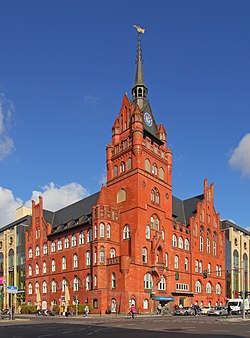
- Neo-Gothic Steglitz town hall, erected in 1898 [2]
- Lutheran Matthew Church, built in 1880
- Catholic Rosary church from 1900, which received the title of a basilica in 1950
- The notorious Steglitzer Kreisel, a 119 m (390 ft) highrise erected between 1968 and 1980, designed by architect Sigrid Kressmann-Zschach. Before the construction was finished, the developing company became insolvent in 1974, leaving a ruin in the middle of Steglitz until the works were resumed in 1977. To avoid further vacancy the borough's administration moved in but had to leave the building in 2007 due to a contamination with asbestos. The building includes the Berlin U-Bahn station Rathaus Steglitz, a bus station, and a parking garage.
- The Bierpinsel ("Beer Brush"), a tavern in a tower on Schlossstraße with an interesting architectural style built in 1976
- Titania-Palast, a large cinema erected in 1928 in the New Objectivity style. On 26 May 1945, it was the site of the first concert of the Berlin Philharmonic orchestra after World War II. On 6 June 1951, it saw the opening ceremony of the first Berlin International Film Festival
- The Fichtenberg hill, highest point in Steglitz, 68 m (223 ft).
- The Grundschule am Insulaner is an elementary and middle school near Südende.
- Die Spiegelwand – Mirrored Wall – is a Holocaust Memorial with the names and addresses of 1700 Jews in the Steglitz area who were deported and murdered in Nazi concentration camps. Take either U-Bahn or S-Bahn to Rathaus-Steglitz. The Memorial is right across the street from the Station.
Transport
[edit]Steglitz is served by the Berlin S-Bahn line S1 at the stations Feuerbachstraße and Rathaus Steglitz as well as by the S25 at Südende. U-Bahn connection to the inner city is provided by the U9 line with the stations Walther-Schreiber-Platz, Schloßstraße and Rathaus Steglitz.
Notable people
[edit]- Walter Fritzsche (1895–1956), football player
- Wolfgang Krause (1895–1970), philologist
- Kurt Aland (1915–1994), theologian and biblical scholar
- Maria Sebaldt (1930–2023), actress
- Nils Seethaler (born 1981), anthropologist
References
[edit]External links
[edit] Media related to Berlin-Steglitz at Wikimedia Commons
 Steglitz travel guide from Wikivoyage


 Charlottenburg-Wilmersdorf (4) Charlottenburg-Wilmersdorf (4) | |
|---|---|
 Friedrichshain-Kreuzberg (2) Friedrichshain-Kreuzberg (2) | |
 Lichtenberg (11) Lichtenberg (11) | |
 Marzahn-Hellersdorf (10) Marzahn-Hellersdorf (10) | |
 Mitte (1) Mitte (1) | |
 Neukölln (8) Neukölln (8) | |
 Pankow (3) Pankow (3) | |
 Reinickendorf (12) Reinickendorf (12) | |
 Spandau (5) Spandau (5) | |
 Steglitz-Zehlendorf (6) Steglitz-Zehlendorf (6) | |
 Tempelhof-Schöneberg (7) Tempelhof-Schöneberg (7) | |
 Treptow-Köpenick (9) Treptow-Köpenick (9) | |
| West boroughs (1920–2000) |  | |
|---|---|---|
| East boroughs (1920–2000) |
| |
| International | |
|---|---|
| National | |
| Other | |

![[1]](http://www.suedwestweb-berlin.de/struktur/b_indiv/steglitz_gutshaus_02.jpg)
![[2]](https://web.archive.org/web/20060327084409/http://www.berlin.de/ba-steglitz-zehlendorf/rathaus_stg.jpg)
Steglitz
View on GrokipediaGeography and Environment
Location and Topography
Steglitz is a locality (Ortsteil) within the Steglitz-Zehlendorf borough in southwestern Berlin, Germany, positioned at approximately 52.46° N latitude and 13.32° E longitude.[3] The area covers part of the borough's central-western extent, bordering the Tempelhof-Schöneberg borough to the north and east, while adjoining fellow localities Lichterfelde to the south and Zehlendorf to the southeast.[4] Its southwestern limits approach the boundary with the state of Brandenburg. The topography of Steglitz reflects the characteristics of the Teltow Plateau, a glacial ground moraine landscape formed during the Weichselian glaciation, featuring gently rolling terrain with minimal steep gradients.[5] Elevations typically range from 32 to 72 meters above sea level, averaging around 51 meters, contributing to a relatively flat urban setting interspersed with subtle hills and valleys.[6] This plateau position places Steglitz at a higher elevation than central Berlin's lowlands but lower than some northern moraine heights, facilitating drainage toward nearby watercourses like the Teltow Canal to the south.[7]Green Spaces and Urban Development
Steglitz maintains a high proportion of green spaces relative to its built environment, reflecting deliberate urban planning that integrates natural areas into residential and commercial zones. In the encompassing Steglitz-Zehlendorf borough, vegetation and bodies of water account for 35.5% of the total land area, exceeding the Berlin average and supporting biodiversity, recreation, and climate regulation.[8] This abundance stems from historical suburban expansion in the late 19th and early 20th centuries, when Steglitz transitioned from a rural village to a villa district favored by affluent residents for its proximity to Berlin's center and ample green plots.[9] The Berlin Botanical Garden, bordering Steglitz to the south along Königin-Luise-Straße, exemplifies this green heritage as one of Europe's largest botanical collections, covering 43 hectares with approximately 20,000 plant species across outdoor beds and 15 glasshouses. Established between 1897 and 1910 under botanist Adolf Engler and architect Alfred Brodersen, it originated as a scientific repository of living specimens relocated from earlier sites to accommodate growing collections from global expeditions.[10] Today, managed by the Freie Universität Berlin, it functions as a public oasis amid urban density, drawing over 800,000 visitors annually and enhancing local air quality and urban cooling.[10] Urban development in Steglitz has emphasized low-density construction to preserve these greens, with post-1945 West Berlin policies under the Main Department of Green Space and Horticulture prioritizing the expansion and maintenance of parks amid reconstruction.[11] While mid-20th-century projects like the Steglitzer Kreisel shopping complex (completed 1980, costing 323 million DM) introduced higher-density commercial nodes, borough planning restricts infill to protect adjacent woodlands and allotments, aligning with Berlin's broader 2030 strategy for multifunctional green infrastructure.[12] Local parks, including Stadtpark Steglitz (approximately 2 hectares), further buffer residential areas, offering pathways and sports facilities while limiting impervious surfaces to sustain groundwater recharge.[13] This approach has sustained Steglitz's per capita green space above city averages, at roughly 50 square meters per resident in core areas.[14]History
Origins and Medieval Period
Archaeological finds attest to human activity in the Steglitz area during the younger Neolithic period, indicating early prehistoric settlement.[15] After the Migration Period, during which Germanic tribes departed, Slavic groups established themselves in the sparsely populated region around 500 AD.[15] The name Steglitz derives from Slavic roots, with "-itz" signifying a settlement and "Stygl-" likely referring to a slope or hillside, consistent with the village's location at the base of the Fichtenberg hill.[15] The first historical reference to Steglitz occurs in 1242, in a donation charter where Heinrich von Stegelitze transferred the estate of Arnestrop (present-day Ahrensdorf) to Lehnin Monastery.[15] The von Stegelitz family, possibly originating from the Altmark region, owned the village from 1232 to 1369.[16] The settlement proper is documented in 1375 within Emperor Charles IV's land register, marking its recognition as a rural village in the Margraviate of Brandenburg.[16] In the medieval era, Steglitz functioned as a modest agrarian community under noble patronage, with ownership passing to the von Torgow zu Zossen family from 1375 to 1478, followed by the Schum family until 1542.[16] A fieldstone church, constructed in the 14th century, served as the village's primary religious and communal structure until its decay and demolition in 1881, with remnants of the associated cemetery enduring.[16] The area remained peripheral to central Berlin's development, characterized by linear street-village layout along the Bäke stream source.[16]19th-Century Growth and Industrialization
During the early 19th century, Steglitz functioned primarily as a rural village with limited economic activity dominated by agriculture, though initial steps toward industrialization emerged with Johann Adolf Heese's establishment of a silk manufactory in 1822, which he fully owned by 1827.[17] Heese expanded operations in 1840 with silk reeling and spinning workshops, supported by a mulberry plantation of 36,000 trees across 7.5 hectares planted between 1840 and 1843, enabling annual production of up to 750 kg of raw silk by the mid-1840s.[17] [18] However, the industry peaked around 1845 before collapsing in the 1860s due to silkworm diseases, marking an early but ultimately unsuccessful foray into manufacturing that did not significantly alter the village's agrarian character.[18] Population growth remained modest until mid-century, reaching over 700 residents by 1858, nearly half in the emerging Neu-Steglitz colony on estate lands settled by newcomers.[18] The pivotal catalyst for expansion arrived in 1864 with the opening of a railway stop on Prussia's first intercity line, connecting Steglitz to Berlin and facilitating commuter access that transformed it into a burgeoning suburb amid Berlin's outward sprawl.[18] This infrastructure development, coupled with the 1870 merger of the original village with Neu-Steglitz under the unified name Steglitz, accelerated urbanization; by 1887, the population had risen to approximately 8,500, prompting Prussia's recognition of its advanced civic status through the granting of a municipal coat of arms—the first for any rural community outside Berlin proper.[17] [18] Late-19th-century industrialization in Steglitz emphasized small-scale, specialized enterprises rather than heavy industry, aligning with its role as a residential extension of Berlin. In 1890, Carl Paul Goerz founded the Goerz Works, specializing in optical lenses and cameras, which grew to employ 2,500 workers by 1911 and included a dedicated narrow-gauge railway (Goerzbahn) for internal transport.[17] Similarly, the New Photographic Society (NPG) relocated to Steglitz in 1897, becoming a leading publisher of photography with 1,200 employees by 1900.[17] These firms, alongside craft workshops, contributed to economic diversification during the era's broader industrial revolution, though Steglitz's development prioritized villa colonies and Gründerzeit apartments over factory-dominated landscapes, reflecting its appeal to Berlin's middle-class commuters rather than proletarian labor pools.[17] [18] By the century's close, such growth had positioned Steglitz as a semi-urban enclave, with agricultural lands increasingly subdivided for housing to meet demand from the capital's expansion.[18]20th Century: Wars and Division
During World War I, Steglitz contributed to the German war effort through local industries, including optical equipment manufacturing for military use by firms such as Zeiss Ikon, which employed around 2,500 workers by 1911 and focused exclusively on wartime production during the conflict.[17] A memorial at the Steglitz cemetery honors victims from both world wars, reflecting the district's share of casualties amid Berlin's broader mobilization.[19] Following the war and the Treaty of Versailles, Steglitz experienced economic strain typical of the Weimar Republic but remained a growing suburban area until the Nazi regime's rise on January 30, 1933, which imposed centralized control over Berlin's districts, including Steglitz, redirecting local resources toward rearmament and ideology enforcement.[20] In World War II, Steglitz endured repeated Allied bombing raids due to its position in western Berlin, making it one of the city's most heavily targeted residential districts.[21] Early strikes included March 1, 1943, when bombers hit Steglitz alongside adjacent areas like Friedenau and Lankwitz.[22] A major assault on April 29, 1944, involving 679 U.S. B-17 and B-24 bombers, severely damaged the Steglitz train station and surrounding infrastructure.[23] As Soviet forces approached in April 1945, the district saw the chaos of Berlin's fall, with post-war footage capturing rubble-strewn streets and partial resumption of trams and buses near the Rathaus Steglitz.[24] On August 2, 1945, Steglitz was incorporated into the U.S. occupation sector amid the Allied division of Berlin.[23] The post-war division entrenched Steglitz in West Berlin's American Sector, where it hosted U.S. military installations, including three infantry battalions in former Telefunken buildings by the late 1940s.[25] The 1948–1949 Soviet blockade isolated West Berlin, including Steglitz, prompting the Berlin Airlift to sustain the population with supplies via Tempelhof Airport and allied corridors.[26] The Berlin Wall's erection on August 13, 1961, further enclosed Steglitz within the Western enclave, restricting cross-sector movement and embedding the district in Cold War tensions, though its southwestern location spared it direct adjacency to the barrier.[27] This isolation persisted until the Wall's opening on November 9, 1989, enabling reunification processes.[27]Post-Reunification Developments
Following the reunification of Germany on October 3, 1990, Steglitz, formerly part of West Berlin's American sector, transitioned into the unified city's administrative framework with minimal immediate disruption compared to eastern districts. The district retained its status as a primarily residential and educational area, benefiting from its established infrastructure and proximity to institutions like the Free University of Berlin in neighboring Dahlem. Cultural enhancements included the opening of a music pavilion in Stadtpark Steglitz in 1990, providing a new venue for public events.[28] The end of the Cold War led to the withdrawal of Allied forces from Berlin, with American troops departing Steglitz in 1994 amid a ceremonial parade along the prominent Schloßstraße to honor their nearly five-decade presence. Memorial and restoration projects advanced historical reckoning and preservation: in 1995, the "Spiegelwand" monument was installed on Hermann-Ehlers-Platz to commemorate Steglitz's Jewish residents deported and murdered under National Socialism, while the Gutshaus Steglitz manor and Schwartzsche Villa were renovated and reopened as cultural centers. Educational infrastructure expanded with the 1999 inauguration of the Deutsch-Griechische Europaschule in Lichterfelde, reflecting growing international ties.[28][29] Urban development remained restrained, focusing on infill construction such as compact residential buildings on former ruderal lands and allotment gardens, preserving the area's green character amid Berlin's broader post-reunification economic adjustments. The most significant structural change occurred on January 1, 2001, when Steglitz merged with the adjacent Zehlendorf district under Berlin's administrative reform, which consolidated the city's 23 boroughs into 12 to streamline governance and reduce costs; the new entity, Steglitz-Zehlendorf, encompassed approximately 102.5 square kilometers and maintained Steglitz's core as a key locality. This reform, enacted via the Gebietsreformgesetz, integrated administrative services without major territorial alterations but shifted local decision-making to a larger framework.[30][28][31]Demographics and Social Structure
Population Trends and Statistics
As of the latest available data, Steglitz, a locality within Berlin's Steglitz-Zehlendorf borough, has a population of 76,193 residents, occupying an area of 678 hectares, which yields a population density of approximately 11,240 inhabitants per square kilometer.[32] This figure reflects relative stability in recent years, consistent with broader trends in the borough, where the population edged downward from 311,040 in 2022 to 310,446 in 2023 and further to around 295,786 by December 2024, driven by net out-migration exceeding natural population change (births minus deaths).[33] [34] Historically, Steglitz underwent rapid urbanization in the late 19th and early 20th centuries, transforming from a rural village first documented in 1375 into Prussia's largest rural municipality by 1920, with over 80,000 inhabitants fueled by industrial expansion, rail infrastructure, and influxes from surrounding areas seeking suburban housing.[32] Incorporation into Greater Berlin on October 1, 1920, integrated it into the expanding metropolis, but World War II destruction and the subsequent division of Berlin led to a sharp postwar decline, with West Berlin localities like Steglitz experiencing depopulation due to bombing losses, evacuations, and economic disruptions in the divided city. By the mid-20th century, recovery in West Berlin stabilized numbers, though Steglitz never regained prewar peaks amid ongoing suburbanization and limited industrial rebound. Demographic indicators point to an aging population in Steglitz, mirroring the Steglitz-Zehlendorf borough's highest average age in Berlin at 46.6 years as of mid-2025, compared to the citywide 42.9 years, attributable to lower birth rates, longer life expectancies, and selective in-migration of families and professionals drawn to established residential areas rather than high-growth central districts.[34] Migration patterns contribute minimally to growth, with the borough's foreign national share at around 18-20%, below Berlin's average, reflecting a preference for more affordable or central locales among recent arrivals. Projections suggest continued modest decline or stasis without policy interventions, as aging demographics strain local services while housing stock—predominantly pre-1945 buildings—limits densification.[34]Ethnic Composition and Migration Patterns
As of December 31, 2023, approximately 18% of the population in Steglitz-Zehlendorf borough, which encompasses Steglitz, held foreign citizenship, totaling around 56,000 individuals out of 311,040 residents.[35] This proportion is notably lower than Berlin's citywide average of about 24-25% foreign nationals.[36] Among those with a migration background—defined as individuals who migrated to Germany after 1949 or whose parents did—the share stood at 32%, or roughly 100,000 people, comprising 14% German citizens with such background and the 18% foreigners.[35] This places Steglitz-Zehlendorf among Berlin's less diverse districts, with a 33% migration background rate ranking fourth lowest citywide.[37] The largest foreign nationality groups in the borough as of December 31, 2020, were Polish (9,581 persons, 11% of foreigners), Turkish (7,532, 8%), and Russian (3,664, 4%), reflecting patterns of EU labor mobility and post-Soviet resettlement rather than mass low-skilled inflows seen elsewhere in Berlin.[35] Steglitz itself, as the borough's urban core, mirrors this composition but with slightly higher concentrations of established communities due to its commercial and residential density compared to greener outskirts like Zehlendorf. Germans without migration background constitute the ethnic majority, supported by the area's appeal to middle-class families prioritizing proximity to quality schools and green spaces over urban centrality. Migration patterns in Steglitz have historically emphasized selective inflows tied to economic stability and suburban appeal, dating to 19th-century industrialization when it drew internal German migrants for villa developments and later post-World War II expellees from eastern territories. Unlike central Berlin districts with heavy 1960s-1970s Turkish guest worker settlement, Steglitz saw limited such recruitment, maintaining lower non-EU shares; net immigration from 2007 to 2023 remained modest, driven post-reunification by eastern German and EU-8/10 country arrivals in professional sectors.[35] Recent trends include upticks from Ukrainian displacement since 2022, though integration data indicate these migrants often favor established districts like Steglitz for family-oriented amenities, contributing to gradual diversification without altering the predominantly native composition.[38] Overall, causal factors such as higher property values and educational selectivity have sustained lower migration pressures relative to Berlin's more affordable, high-density areas.Politics and Governance
Local Administration Structure
Steglitz functions as a locality (Ortsteil) within Berlin's Steglitz-Zehlendorf borough, lacking autonomous administrative bodies and instead integrated into the borough's governance framework established under Berlin's 2001 administrative reform.[39] The legislative arm consists of the Bezirksverordnetenversammlung (BVV), an elected assembly that deliberates and decides on local matters such as budgeting, planning, and services, with members chosen every five years in district-wide elections.[40] Executive responsibilities fall to the Bezirksamt Steglitz-Zehlendorf, the administrative office headquartered at Zehlendorf Town Hall (Kirchstraße 1/3), which implements policies across all localities including Steglitz. The Bezirksbürgermeisterin, Maren Schellenberg, has led the office since December 8, 2021, overseeing departments for finance, personnel, and facility management while coordinating with deputy Tim Richter (CDU) and Bezirksstadträte such as Urban Aykal (Greens) for citizen services and social affairs.[41][42] As of July 1, 2025, the Bezirksamt's structure includes specialized departments handling urban development (Stadtentwicklungsamt), public order (Ordnungsamt), citizen services (Amt für Bürgerdienste), education and culture, youth and health, and environmental protection, with sub-units like the Straßen- und Grünflächenamt for infrastructure maintenance.[42] Steglitz-specific services, such as resident registration and civil registry, are accessible via local Bürgerämter, including facilities at the historic Rathaus Steglitz (Schloßstraße 34), ensuring decentralized delivery within the centralized borough system.Electoral History and Political Orientation
Steglitz, as part of the Steglitz-Zehlendorf borough, aligns with a political landscape dominated by center-right conservatism, driven by its middle-class, family-oriented electorate prioritizing stability, security, and traditional values. The Christian Democratic Union (CDU) has governed the borough assembly since its formation in 2001, reflecting consistent voter preference for policies emphasizing law enforcement, urban maintenance, and resistance to rapid demographic shifts seen elsewhere in Berlin.[43] [44] This orientation contrasts with Berlin's overall left-leaning tendencies, where CDU support in Steglitz-Zehlendorf remains notably higher due to the area's prosperity and lower reliance on state welfare programs.[45] In borough assembly (Bezirksverordnetenversammlung, BVV) elections, the CDU has maintained plurality or majority support across cycles. The 2016 election yielded 17 seats for the CDU out of 55, making it the largest faction ahead of the SPD (13 seats) and Greens (11 seats), with smaller shares for the FDP (5), AfD (6), and Left (3).[46] The 2021 vote, invalidated due to administrative irregularities citywide, was superseded by the February 12, 2023, repeat election, where second-vote results underscored CDU strength at 36.1%, enabling continued governance.[47]| Party | Second Votes (%) – 2023 BVV |
|---|---|
| CDU | 36.1 |
| Greens | 21.6 |
| SPD | 18.9 |
| FDP | 6.5 |
| AfD | 5.6 |
| Left | 4.7 |
| Others | 6.6 (distributed) |