Hubbry Logo
Steve BaileySteve BaileyMain
Open search
Steve Bailey
Community hub
Steve Bailey
logo
8 pages, 0 posts
0 subscribers
Be the first to start a discussion here.
Steve Bailey
Steve Bailey
from Wikipedia

Key Information

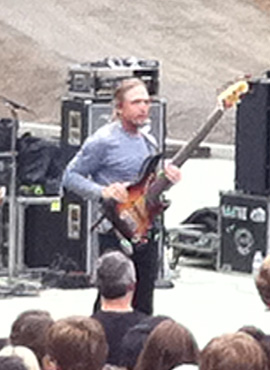
Steve Bailey performing at the New York Bass Collective

Steve Bailey is an American bassist. He is the chair of the bass department at Berklee College of Music.[1]

Career

[edit]

Bailey began playing bass guitar at age 12 and started playing fretless bass after he ran over his fretted Stuart Spector with his car. He started playing double bass after hearing Stanley Clarke playing with Return to Forever. He has been a faculty member at Coastal Carolina University and the University of North Carolina Wilmington. He was also a faculty member at Hollywood's BIT for 10 years. He is a co-founder of Victor Wooten's Bass/Nature Camp, which helps to teach bassists of all ranges. Thebassvault.com is also a joint project by Bailey and Wooten.

Bailey has worked with Ernestine Anderson, Bass Extremes, David Benoit, Tab Benoit, Michel Camilo, Larry Carlton, Paquito D'Rivera, Chris Duarte, Bryan Duncan, Brandon Fields, Dave Liebman, Dizzy Gillespie, Scott Henderson, Carol Kaye, Kitaro, T Lavitz, James Moody, Mark Murphy, Willie Nelson, John Patitucci, Ray Price, Toni Price, Emily Remler, The Rippingtons, Claudio Roditi, Billy Joe Shaver, Billy Sheehan, Lynyrd Skynyrd, Mel Tormé, and Jethro Tull.

His latest Album, CAROLINA, is a collection of 17 duets (one track of bass and another person doing what they do) featuring 17 different guests including Willie Nelson, Ian Anderson, Ron Carter, Victor Wooten, Mike Stern, Becca Stevens, Dennis Chambers and much more.

Bailey has "authored" 3 different signature bass models.

  • Aria AVBSB 1992-2002
  • Fender SRB Jazz BASS 6 2008-2010
  • Warwick Signature Steve Bailey models, 4, 5, & 6 string 2010–present

Discography

[edit]

As leader

[edit]
  • Dichotomy (Victor, 1991)
  • Evolution (Victor, 1993)
  • Bass Extremes "Cookbook" with Victor Wooten (Tone Center, 1995)
  • Bass Extremes Vol. 2 with Victor Wooten (Tone Center, 1998)
  • Bass Extremes Just Add Water with Victor Wooten (Tone Center, 2001)
  • So Low...Solo (BATB, 2007)
  • Carolina (Treehouse, 2020)
  • Bass Extremes S'low Down (Vix Records, 2022)

As sideman

[edit]

Books

[edit]
  • Advanced Rock Bass (1991)
  • Five String Bass (1991)
  • Fretless Bass
  • Rock Bass (1991)
  • Six String Bass (1991)
  • Bass Extremes (1993) by Steve Bailey and Victor Wooten

Videos

[edit]
  • Fretless Bass REH (1992)
  • Bass Extremes: Live (1994)
  • The Day Bass Players Took Over the World, Victor Wooten, Oteil Burbridge (2006)
  • Warwick: Fuss on the Buss 1, featuring Larry Graham, Bootsy, TM Stevens, etc. (2009)
  • Warwick: Fuss on the Buss II, featuring Bootsy, Robert Trujillo, Lee Sklar, Verdine White, etc. (2011)
  • Warwick: Fuss on the Buss III, featuring Ralph Armstrong, Larry Graham, Jonas Hellborg, Ryan Martini, TM Stevens, etc. (2012)

References

[edit]
[edit]
Revisions and contributorsEdit on WikipediaRead on Wikipedia
from Grokipedia
Steve Bailey (born February 10, 1960) is an American , educator, and renowned for pioneering the use of the six-string in and . As the chair of the Bass Department at since 2012, he has shaped generations of musicians through his teaching, instructional materials, and collaborations with artists including , Jethro Tull, , and . Born in Myrtle Beach, South Carolina, Bailey began playing bass guitar at age 12 after being inspired by Chick Corea's album Light as a Feather. He earned a Bachelor of Music in Studio Music and Jazz from the University of Miami and pursued additional studies at the University of North Texas. Over more than four decades, Bailey has built a prolific career as a session musician and performer, contributing to recordings and live performances across jazz, rock, and fusion genres while also serving as a columnist for Bass Player magazine. Bailey's innovations on the fretless bass have earned him recognition as a virtuoso, including being named runner-up for Bass Player of the Year twice by Bass Player magazine. He co-founded the instructional duo Bass Extremes with Victor Wooten, producing educational content that has influenced bassists worldwide, and has authored six books and DVDs on bass techniques, such as Rock Bass and Fretless Bass. His solo discography includes albums like Dichotomy (1997) and So Low . . . Solo (2003), alongside collaborative works including the 2022 album S'Low Down with Bass Extremes. Prior to Berklee, he taught for over 25 years at institutions including Musicians Institute, the University of North Carolina Wilmington, and Coastal Carolina University, where he expanded bass programs and mentored emerging talent.

Early life and career beginnings

Early years

Steve Bailey was born on February 10, 1960, in . Raised as a native of Myrtle Beach, Bailey grew up in the coastal Southern environment of the Grand Strand region, characterized by its beaches and relaxed seaside lifestyle. Details on his family background remain limited in public records. In his formative childhood years, Bailey pursued non-musical interests such as , which aligned with the beach-centric culture of his hometown and interrupted only later by other pursuits. This coastal upbringing in provided a foundational context for his early life, emphasizing outdoor activities and regional influences that shaped his personal development prior to his entry into music.

Musical start and influences

Steve Bailey began playing the at the age of 12, inspired by Chick Corea's Light as a Feather (1973), which featured Stanley Clarke's prominent bass lines and prompted his initial interest in the instrument. Growing up in , he quickly immersed himself in practice, dedicating up to 12 hours a day after being further influenced by the playing of and . This self-directed approach allowed him to develop foundational skills without formal instruction early on. At age 14, Bailey accidentally damaged his first fretted bass—a Stuart Spector model—by running it over with his , an incident that necessitated switching to a to continue practicing. This unexpected event shaped his early technique, as the fretless instrument demanded greater precision in intonation and expression, aligning with the smooth, vocal-like styles of his influences. Bailey's exposure to Stanley Clarke's work, particularly Clarke's upright bass performances with , inspired him to pursue the alongside electric bass. In the late 1970s, while still in his teens, he honed his self-taught techniques through local playing experiences in the Myrtle Beach area. His early gigs at age 12 included performances with a junior high school band, where he covered songs like Bob Dylan's "." These experiences provided practical opportunities to apply his growing skills in a regional music scene dominated by rock and fusion influences.

Professional career

Performances and collaborations

Steve Bailey began his professional career in the early , making his first nationally released recording in 1983 on Paquito D'Rivera's live album Live at Keystone Korner. His early work established him as a versatile bassist capable of spanning , and rock genres, with subsequent tours and recordings alongside luminaries such as , where he contributed to live performances and studio sessions that highlighted his technique in and contexts. By the late , Bailey had expanded into broader collaborations, including work with the group , David Benoit's piano-driven ensembles, Jethro Tull's outings, and Lynyrd Skynyrd's revival tours, showcasing his adaptability across stylistic boundaries. A pivotal milestone came in 1993 with the formation of Bass Extremes, Bailey's long-standing duo (later expanded to a trio) with fellow bassist Victor Wooten, focused on innovative dual-bass performances that blended improvisation, harmony, and technical virtuosity. The project debuted with the self-titled album Bass Extremes, followed by Cookbook in 1998 and Just Add Water in 2001, each featuring intricate bass dialogues and guest appearances that pushed the instrument's expressive limits in fusion and jazz settings. After a two-decade hiatus, Bass Extremes released S'Low Down in 2022, incorporating drummer Gregg Bissonette and additional guest bassists, which prompted a worldwide tour in 2022–2023 celebrating 30 years of the collaboration through live shows emphasizing synchronized bass lines and rhythmic interplay. Bailey's solo releases provided further platforms for performance exploration, with his debut album Dichotomy (1992) featuring high-profile guests like and in a fusion-oriented showcase of his six-string work, marking a career turning point in blending with rock energy. His 2020 album Carolina shifted toward intimate duets, including a notable collaboration with on a reimagined "Angels Flying Too Close to the Ground," recorded in an acoustic setting that underscored Bailey's melodic phrasing in country-jazz hybrids and supported live promotions across the U.S. In 2025, Bailey continued his active performance schedule, joining and for a guest spot at the 20th Annual WesFest concert in on July 21, delivering an excerpted set of bass-driven improvisation that highlighted Berklee faculty synergies. Later that year, he performed with and Tool's at the Bass Magazine Awards on January 23 in , presenting the Lifetime Achievement Award to Chancellor before a collaborative stage appearance with Tool members, blending progressive rock and elements. Bailey also guested on bass for Lukas Nelson's American Romance Tour, appearing for two shows in October, including and Madison, where his contributions infused the country-rock sets with nuanced fretless lines. These engagements reflect Bailey's ongoing evolution as a bassist bridging roots with contemporary rock and collaborative innovation.

Teaching and academic roles

Bailey began transitioning from a performance-focused career to education in the , drawing on his professional experience to instruct aspiring bassists. He served as faculty at the Bass Institute of Technology (BIT) in Hollywood for ten years, where he taught core bass techniques to students in a specialized program. Additionally, Bailey held positions as at and faculty member at the , contributing to university-level bass instruction during this period. In 2012, Bailey was appointed chair of the Bass Department at , a role he maintains today, overseeing curriculum and faculty in one of the world's largest institutions. In this capacity, he fosters an open-door mentorship policy, emphasizing the development of well-rounded "Millennium Musicians" skilled in , technology, and communication to prepare them for professional demands. His approach at Berklee prioritizes foundational bass playing alongside advanced soloing, influencing how bass pedagogy integrates practical and innovative elements. Bailey co-founded Victor Wooten's Bass/Nature Camp in 2000, collaborating with fellow bassist to create an immersive program blending bass instruction with nature-based learning experiences. The camp, initially focused on bassists, has expanded its ongoing programs to include all instruments while maintaining its core emphasis on holistic musical growth through environmental immersion and group collaboration. Through his involvement, Bailey has mentored generations of students, shaping bass education by promoting creative, nature-inspired methods that extend beyond traditional classroom settings.

Musical style and equipment

Technique and innovations

Steve Bailey is renowned for his pioneering application of the six-string extended-range in and fusion genres, where he expanded the instrument's harmonic and melodic possibilities beyond traditional four-string limitations. Owning Anthony Jackson's original six-string crafted by Carl Thompson, Bailey leveraged the extended range to execute complex 13th chords with precise intonation, a feat that highlighted the fretless design's expressive potential. His work in this area, documented in instructional materials like his book Six-String Bass, established him as a trailblazer, influencing subsequent bassists in fusion contexts by demonstrating how the additional strings enabled fuller chord voicings and seamless integration of bass lines with improvisational leads. Bailey's advanced techniques include masterful use of artificial harmonics, tapping, and integration of double bass elements into electric performance. Drawing from classical guitar methods, he produces melodic overtones and rich harmonic textures on the fretless bass by lightly touching strings while fretting fundamentals, as showcased in his collaborations with Dizzy Gillespie, where harmonics filled harmonic roles typically handled by piano or guitar. Tapping techniques appear prominently in his duo Bass Extremes with Victor Wooten, allowing rapid scalar passages and polyphonic lines that blend electric agility with acoustic depth. Additionally, Bailey emphasizes blending acoustic and electric bass sounds, incorporating upright bass training from institutions like the University of North Texas and University of Miami to achieve nuanced expression; this involves precise intonation control on fretless instruments to mimic the upright's natural sustain and warmth, often using acoustic bass guitars like the Alien model for hybrid timbres in live settings. His stylistic evolution traces from rock roots—initially inspired by guitar-driven rock like Jimi Hendrix's "All Along the Watchtower"—to sophisticated jazz improvisation, catalyzed by fretless pioneers Jaco Pastorius and Stanley Clarke, whom he emulated through intensive 12-hour daily practice sessions starting after he began playing at age 12. This progression culminated in bebop and Latin jazz explorations, evident in performances that prioritize expressive microtonal bends and dynamic phrasing over rigid rock structures. Bailey's innovations earned him recognition as runner-up for Bass Player of the Year by Bass Player magazine in both 1994 and 1996, underscoring his impact on elevating bass technique across genres.

Signature instruments

Throughout his career, Steve Bailey has collaborated with several manufacturers to develop bass models tailored to his preference for extended-range instruments, particularly six-string designs that facilitate his chordal and melodic approaches inspired by playing. These basses often feature fretless configurations to support his emphasis on intonation and expressiveness, evolving from early custom designs to more refined production models. Bailey's first signature model was the Aria AVB-SB, a six-string produced from 1992 to 2002. This Korean-made instrument incorporated design elements Bailey specified, including an neck for enhanced sustain and tone, "Basslines" soapbar pickups, and a custom preamp he helped design for active electronics. The model, often in a flamed finish with clear , was built to accommodate his growing focus on fretless technique and extended range, bridging electric and acoustic bass timbres. From 2009 to 2011, Bailey endorsed the Fender SRB Jazz Bass VI, his first signature with the American manufacturer and Fender's inaugural production six-string . Crafted from select with a nitrocellulose finish, it featured an asymmetrical neck for improved , HiMass bridge, and active/passive with stacked concentric knobs for volume, blend, treble, and bass controls. Available in fretted and fretless versions, this model reflected Bailey's shift toward versatile, high-output instruments suitable for both studio and live settings, emphasizing clarity across its extended range. Since 2011, Bailey has been endorsed by (as of November 2025), leading to the development of his current signature six-string models, including custom fretless variants built in the Custom Shop. The Warwick Steve Bailey Signature features a bolt-on ovangkol , snakewood fretboard with a 47" radius and jumbo bronze frets (or fretless epoxy-lined options), body, soapbar pickups, and active two-way electronics with a slap preset. With a 34" scale, bridge, and Graph Tech machine heads, these basses prioritize stability and tonal warmth, aligning with Bailey's ongoing integration of double bass-like phrasing on electric instruments through extended-range fretless play. Recent performances, such as at the 2025 Bass Magazine Awards, continue to showcase these models.

Discography

As leader

Bailey's debut solo album, Dichotomy, released in 1992 on Victor Records, showcased his prowess on the six-string through a series of fusion-oriented tracks blending , rock, and pop elements. The album featured guest appearances by notable musicians including trumpeter on "Dizzy's Tizzy," guitarist on several tracks such as "Key West Sunset," drummer , and saxophonist Bob Berg, highlighting Bailey's ability to integrate his innovative bass lines with established and fusion artists. Critics praised its energetic compositions and technical display, marking it as a strong introduction to Bailey's leadership style. Following , Bailey released in 1994, also on Victor Records, which continued his fusion explorations with tracks like "Chad's Place" and "Black Diamond," emphasizing melodic bass solos and rhythmic complexity. The album featured Bailey's as the central instrument, supported by a rotating cast of session musicians, and received positive reception for advancing his signature sound beyond the debut. In 2007, he issued So Low...Solo on his own BATB Records, a fully unaccompanied effort demonstrating his solo bass technique across 12 original and standard pieces, including "Waltz for Leeann" and a cover of " from the Apple." The album was lauded for its intimate showcase of harmonic and percussive innovations on the six-string bass, earning high marks for musicianship. Bailey's most recent solo project, Carolina, released in 2020 on Treehouse Records, consists of 17 duets that reflect his Southern roots through a mix of , folk, and influences, with each track pairing his bass against a different guest artist's instrument. Notable collaborators include bassist on upright bass, guitarist , bassist Anthony Jackson, and percussionist , creating dialogues that span global styles while centering Bailey's fretless lines. Reviewers hailed it as a masterful collection essential for bass enthusiasts, appreciating its emotional depth and collaborative breadth. As co-leader of the duo Bass Extremes with , Bailey has produced several albums focused on dual-bass interplay, pushing technical boundaries across genres from to . Their debut full-length, Just Add Water (2001, Tone Center), included drummer and explored intricate grooves and harmonies, earning acclaim for its innovative bass-centric arrangements. This was followed by (2002, Tone Center), which delved into recipe-like structured improvisations, maintaining the duo's core personnel and receiving praise for its educational yet entertaining approach to bass techniques. The 2022 release S'Low Down (Vix Records), marking 30 years of collaboration, featured slowed-down tempos to highlight nuance and texture, with the duo again at the forefront, and was described as a satisfying modern bass showcase. Bailey also appeared on the collaborative live DVD Warwick: Fuss on the Buss 2 (2012), featuring jams with bassists including , , and .

As sideman

Steve Bailey has made significant contributions as a sideman on numerous recordings, providing bass support across , and genres from the late onward. His versatile playing on both electric and acoustic bass enhanced the rhythmic foundation of various artists' projects, often blending technical precision with stylistic adaptability. In the realm of contemporary jazz and fusion, Bailey collaborated with pianist David Benoit on the album Inner Motion (GRP, 1990), where he performed fretless and acoustic bass duties throughout the record. His contributions extended to Benoit's later works, including Letter to Evan (GRP, 1992) and (GRP, 1994), showcasing his ability to complement smooth jazz arrangements with nuanced bass lines. Bailey's work with the fusion group The Rippingtons, led by guitarist Russ Freeman, highlighted his role in high-energy ensemble settings. He provided additional fretless and fretted bass on Welcome to the St. James' Club (GRP, 1990), particularly on tracks like the title song. These sessions underscored his integration into the band's polished fusion sound, bridging acoustic warmth and electric drive. Bailey also explored blues and rock-inflected territory with guitarist . On Nice & Warm (Justice, 1992), he handled all bass parts, providing a solid groove for Benoit's guitar-driven tracks like "Runnin' Train." He reprised this role on What I Live For (Justice, 1994), contributing bass to songs such as "Blues Come Walkin' In" and "Who's Been Talkin'," where his lines added depth to the album's raw, rootsy energy. Through these recordings, Bailey's sideman appearances demonstrate a broad stylistic range, from the sophisticated fusion of to the gritty of , while maintaining a focus on supportive, genre-spanning musicianship.

Educational contributions

Books

Steve Bailey has authored several instructional books on techniques, primarily targeting intermediate to advanced players seeking to expand their technical and musical capabilities. These works emphasize practical exercises, notated examples in standard notation and , and progressive pedagogical methods to build proficiency in specific styles and innovations. His first major publication, Advanced Rock Bass (1991), focuses on advanced rock techniques for bassists, including string crossing exercises, double stops, odd meters, harmonics, artificial harmonics, arpeggios, chords in harmonics, thumb position, and solo bass playing. Designed for players ready for serious challenges, the book uses a structured approach with 54 pages of exercises to develop precision and versatility in rock contexts. Bailey also published Rock Bass (1991), Five-String Bass (1991), and Six-String Bass (1991), each providing targeted techniques for specific bass configurations and rock applications, building foundational to advanced skills in extended-range playing and groove development. Co-authored with , Bass Extremes (1993) explores advanced improvisation and extreme bass playing across styles like , , and heavy metal. The 136-page volume includes eight complete album tracks featuring Bailey, Wooten, and drummer Greg Bissonette, followed by eight instructional tracks with transcriptions to demonstrate innovative fingerings, harmonics, and rhythmic complexities. Its pedagogical method integrates performance examples with targeted exercises to push technical boundaries for advanced musicians. Other titles in Bailey's oeuvre include Steve Bailey's , which addresses techniques for transitioning to and mastering the fretless instrument, such as intonation, sliding, string blending, and fretless effects through interval and triad exercises, etudes, and songs. Aimed at intermediate to advanced players, this 40-page book prioritizes and left-hand development via progressive drills and practical applications.

Instructional videos

Steve Bailey has produced several instructional videos that emphasize visual demonstrations of advanced bass techniques, particularly on the , allowing learners to observe finger placement, intonation, and expressive nuances in real-time. His earliest video, Fretless Bass (REH series, 1992), originally released as a tape, provides a foundational guide to transitioning from fretted to playing. In this 60-minute production, Bailey covers essential topics such as intonation control, development, and harmonics, using shots to illustrate left-hand positioning and right-hand plucking with three fingers for clarity and speed. Published by CPP Media (now part of ), the video includes practical exercises with notated examples, making it a seminal resource for bassists seeking melodic freedom on the instrument. A later iteration, Steve Bailey's Fretless Bass: The Ultimate Fretless Bass Workout (Alfred Music, 2008), updates the original content into a book-and-DVD , expanding on visual instruction with over 80 minutes of footage. Here, Bailey demonstrates complex scalar runs, chordal voicings, and thumb-assisted techniques, highlighting how can emulate horn-like lines or timbres. The DVD's multi-angle views and slow-motion breakdowns emphasize conceptual mastery over rote memorization, aiding intermediate players in applying these methods to and composition. This release, distributed by , has been praised for its rigorous approach to alongside technical drills. Bailey's collaboration with in Bass Extremes: Live (Warner Bros. Publications, 1994; DVD reissue 2004) shifts focus to performance-based learning, blending live duo concerts with interspersed instructional segments. Clocking in at 107 minutes, the video captures their interplay on tracks like "B.I.T. Blues," where viewers see demonstrations of comping, soloing, and percussive elements on both fretted and fretless basses. Bailey's sections spotlight his signature three-finger style and harmonic command, while Wooten's contributions add slap and tap contrasts, offering visual insights into duo dynamics and advanced phrasing. Produced under the REH banner and later by Alfred Music, it serves as an extension of their Bass Extremes series, prioritizing real-world application through unscripted excerpts. Bailey also collaborated on The Day Bass Players Took Over the World (2006) with and , a performance-based instructional DVD that showcases advanced bass techniques through live demonstrations and discussions on groove, , and playing.

References

Add your contribution
Related Hubs
User Avatar
No comments yet.