Hubbry Logo
Emily RemlerEmily RemlerMain
Open search
Emily Remler
Community hub
Emily Remler
logo
8 pages, 0 posts
0 subscribers
Be the first to start a discussion here.
Emily Remler
Emily Remler
from Wikipedia

Key Information

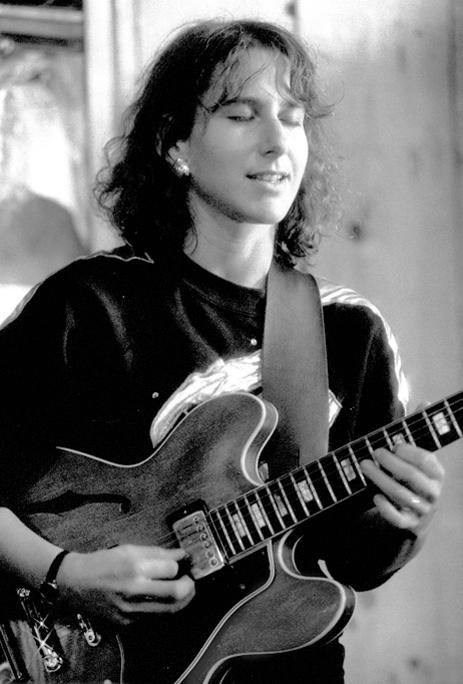
Emily Remler (September 18, 1957 – May 4, 1990)[1] was an American jazz guitarist, active from the late 1970s until her death in 1990.

Early life and influences

[edit]

Born in Englewood Cliffs, New Jersey,[2] Remler began playing guitar at age ten. She listened to pop and rock guitarists like Jimi Hendrix and Johnny Winter. At the Berklee College of Music in the 1970s, she listened to jazz guitarists Charlie Christian, Wes Montgomery, Herb Ellis, Pat Martino, and Joe Pass.

Career

[edit]

Remler settled in New Orleans, where she played in blues and jazz clubs, working with bands such as Four Play and Little Queenie and the Percolators[3] before beginning her recording career in 1981. She was praised by jazz guitarist Herb Ellis, who referred to her as "the new superstar of guitar" and introduced her at the Concord Jazz Festival in 1978.

In a 1982 interview with People magazine, she said: "I may look like a nice Jewish girl from New Jersey, but inside I'm a 50-year-old, heavy-set black man with a big thumb, like Wes Montgomery."

Her first album as a band leader, Firefly, gained positive reviews,[3] as did Take Two and Catwalk. She recorded Together with guitarist Larry Coryell. She participated in the Los Angeles version of Sophisticated Ladies from 1981 to 1982 and toured for several years with Astrud Gilberto. She also made two guitar instruction videos.

In 1985, she won Guitarist of the Year in Down Beat magazine's international poll, and performed in that year's guitar festival at Carnegie Hall.[4] In 1988, she was artist in residence at Duquesne University and the next year received the Distinguished Alumni award from Berklee. Bob Moses, the drummer on Transitions and Catwalk, said, "Emily had that loose, relaxed feel. She swung harder and simpler. She didn't have to let you know that she was a virtuoso in the first five seconds."[5]

Remler married Jamaican jazz pianist Monty Alexander in 1981; the marriage ended in 1984. Thereafter, she had a brief relationship with Coryell following her first divorce.[6]

Her first guitar was her brother's Gibson ES-330. She played a Borys[7] B120 hollow-body electric towards the end of the 1980s. Her acoustic guitars included a 1984 Collectors Series Ovation and a nylon-string Korocusci classical guitar that she used for bossa nova.

When asked how she wanted to be remembered she remarked, "Good compositions, memorable guitar playing and my contributions as a woman in music...but the music is everything, and it has nothing to do with politics or the women's liberation movement."[8]

Death

[edit]

Remler bore the scars of her longstanding opioid use disorder,[5] which is believed to have contributed to her death.[9][5] In May, 1990, she died of heart failure at the age of 32 while on tour in Australia.[2]

Remler is buried in Block 4, Row 2, Grave 18 (Section 2, Field of Ephron) at New Montefiore Cemetery, New York.[10]

Tributes

[edit]

The album Just Friends: A Gathering in Tribute to Emily Remler, Volume 1 (Justice Records JR 0502-2) was released in 1990, and Volume 2 (JR 0503-2) followed in 1991. Performers from these two albums included guitarists Herb Ellis, Leni Stern, Marty Ashby, and Steve Masakowski; bassists Eddie Gómez, Lincoln Goines, and Steve Bailey; drummer Marvin "Smitty" Smith; pianists Bill O'Connell and David Benoit; and saxophonist Nelson Rangell, among others.

David Benoit wrote the song "6-String Poet", from his album Inner Motion (GRP, 1990), as a tribute to Remler.[11]

The 1995 book Madame Jazz: Contemporary Women Instrumentalists by Leslie Gourse includes a posthumous chapter on Remler, based on interviews conducted while she was alive.[12]

In 2002, West Coast guitarist Skip Heller recorded with his quartet a song called "Emily Remler" in her memory,[13] released as track No. 5 on his record Homegoing (Innova Recordings).

Jazz guitarist Sheryl Bailey's 2010 album A New Promise was a tribute to Emily Remler. Aged 18, Bailey first saw Remler perform, at the University of Pittsburgh Jazz Festival in 1984 - she was inspired to take her own guitar studies. Bailey said "She paved the way for me. ... I really wanted to hear Emily's person in me when I played. It meant a lot to me to do this tribute and pay homage to her and to say thank you."[14] On the album, Bailey collaborated with Pittsburgh's Three Rivers Jazz Orchestra and producer Marty Ashby on eight tracks, including three composed by Remler ("East to Wes", "Mocha Spice", and "Carenia").

Discography

[edit]

As leader/co-leader

[edit]
Year released Title Label Personnel/Notes
1981 Firefly Concord With Hank Jones (piano), Bob Maize (bass) and Jake Hanna (drums)
1982 Take Two Concord With James Williams (piano), Don Thomson (bass) and Terry Clarke (drums).
1983 Transitions Concord With John D'earth (trumpet), Eddie Gomez (bass) and Bob Moses (drums).
1985 Catwalk Concord With John D'earth (trumpet), Eddie Gomez (bass) and Bob Moses (percussion).
1985 Together Concord With Larry Coryell.
1988 East to Wes Concord With Hank Jones (piano), Buster Williams (bass) and Marvin "Smitty" Smith (drums).
1990 This Is Me Justice With David Benoit (keyboards), Jimmy Johnson and Lincoln Goines (bass), Luis Conte, Edson Aparecido da Silva "Café" and Jeffrey Weber (percussion), Jay Ashby (percussion and trombone), Jeff Porcaro, Ricky Sebastian and Duduka Da Fonseca (drums), Romero Lubambo (acoustic guitar), Maúcha Adnet (vocals).
2024 Cookin' at the Queens: Live in Las Vegas 1984 & 1988 Resonance With Cocho Arbe (piano), Carson Smith (bass), Tom Montgomery and John Pisci (drums).

As guest

[edit]
Year
recorded
Leader Title Label
1981 The Clayton Brothers It's All In The Family Concord
1985 Ray Brown Soular Energy Concord
1986 John Colianni John Colianni Concord
1986 Rosemary Clooney Rosemary Clooney Sings the Music of Jimmy Van Heusen Concord
1989 David Benoit Waiting for Spring GRP
1989 Susannah McCorkle No More Blues Concord
1990 Susannah McCorkle Sabia Concord
1990 Richie Cole Bossa International Milestone

Videos

[edit]
  • 1990: Bebop and Swing Guitar (VHS, reissued on DVD in 2008)
  • 1990: Advanced Jazz and Latin Improvisation (VHS, reissued on DVD in 2008)
  • 2005: Sal Salvador, Joe Pass, Mundell Lowe, Charlie Byrd, Emily Remler, Tal Farlow – Learn Jazz Guitar Chords With 6 Great Masters! (DVD, DVD-Video)
  • 2005: Emily Remler, Joe Pass, Tuck Andress, Brian Setzer, Joe Beck, Duke Robillard – Learn Jazz Guitar With 6 Great Masters! (DVD, DVD-Video)

References

[edit]
[edit]
Revisions and contributorsEdit on WikipediaRead on Wikipedia
from Grokipedia
Emily Remler (September 18, 1957 – May 4, 1990) was an American jazz guitarist renowned for her virtuosic technique, melodic improvisations, and contributions to and styles during the 1980s. A self-taught prodigy who began playing guitar at age 10, she rose rapidly from local gigs in New Orleans to international acclaim, recording seven albums as a leader and collaborating with jazz luminaries before her death from at age 32. Born in , in a non-musical family, Remler drew early inspiration from before discovering through artists like , , and . She graduated high school early at 16 and enrolled at in , graduating at age 18 and honing her skills under influences including Pat Martino and . After Berklee, Remler relocated to New Orleans, where she performed in clubs, taught guitar, and built her reputation through steady gigs that refined her improvisational style. Her breakthrough came in 1978 with a debut at the Concord Jazz Festival, leading to a contract with Concord Jazz Records; her first album, Firefly (1981), showcased her swinging phrasing and octave playing, earning critical praise and establishing her as a rising star. Subsequent releases like Take Two (1982), Transition (1983), Catwalk (1985), East to Wes (1988, a tribute to Wes Montgomery), and This Is Me (1989) highlighted her growth, blending standards with originals and featuring collaborations with figures such as Hank Jones, Larry Coryell, John Scofield, Ray Brown, and Sonny Rollins. Remler's career milestones included headlining major festivals like the and Newport Jazz Festivals, receiving the 1981 "Talent Deserving Wider Recognition" award from magazine, and being named "Woman of the Year" by jazz critic Leonard Feather. Endorsed by guitarists like as a "super star of the guitar" and influenced by Jim Hall, she also appeared on 11 albums as a , contributing to projects with , , and . Despite personal struggles with and dilaudid addiction, which contributed to her declining health, Remler maintained a rigorous touring schedule until her sudden death in Sydney, Australia, from during an Australian tour.

Early life

Childhood and family

Emily Remler was born on September 18, 1957, in , New York, and was raised in . She grew up in a middle-class, non-musical household consisting of her parents and a brother. Her father worked as a meat broker, and her mother was a who later became a psychological social worker; neither parent had professional ties to music, though the family provided a supportive environment that encouraged personal exploration. The Remlers resided in a quiet suburban neighborhood, typical of 1950s and 1960s middle-class life in , where daily routines revolved around local schools and community stability. Up to the age of 10, Remler's early experiences included standard childhood activities such as attending elementary school and engaging in play common to suburban children of the era, all within the nurturing dynamics of her family. Her brother's extensive record collection marked the initial bridge to music in this otherwise non-musical home.

Musical beginnings and education

Emily Remler began playing the guitar at the age of 10 in 1967, picking up her older brother's cherry-red to learn folk-oriented tunes inspired by popular acts such as and . Initially self-taught through radio music and simple songs, she developed basic skills without formal instruction during her early years in . Around age 14, Remler's musical interests shifted toward after discovering recordings by guitarist in her brother's collection, an encounter that profoundly influenced her and marked the beginning of her dedication to the genre. She continued her self-taught journey through intensive practice routines, including work with a to address timing issues, and began performing locally in during her high school years, honing her abilities in informal settings before graduating early at age 16 in 1973. Remler enrolled at the shortly thereafter, attending from approximately 1974 to 1976, where she immersed herself in , , and coursework as part of an accelerated program that compressed a four-year degree into two years. Initially shy, she avoided demonstrating her playing for her guitar instructor during her first six months but eventually overcame this hesitation, receiving crucial feedback on her sense of time that shaped her technical growth. Upon graduating at age 18 in 1976, she relocated to New Orleans before moving to in 1978 to seek professional opportunities in the scene.

Career

Early professional work

After graduating from Berklee around 1978, Remler relocated to New Orleans, where she performed in local clubs and built her skills before moving to around 1979 to immerse herself in the vibrant jazz scene and launch her professional career. Her formal training at Berklee provided a strong foundation in and technique, equipping her for the demands of the city's competitive club circuit. Upon arrival, her persistence paid off with her debut at the 1978 Concord Jazz Festival, where veteran guitarist proclaimed her "the new superstar of ," providing a pivotal breakthrough that caught the attention of record labels. This led directly to her signing with Concord Jazz Records in 1981. Remler's first major exposure came through her commanding guitar work alongside established artists, solidifying interest from industry figures. Later that year, she released her debut album as a leader, Firefly, on Concord Jazz, featuring pianist , bassist Bob Maize, and drummer Jake Hanna on a set of standards and originals that blended with fluid . Critics praised the recording for its assured execution, hailing Remler as a promising young talent with a fresh voice on the instrument. As one of the few women navigating the male-dominated jazz guitar landscape, Remler encountered early challenges, including outright during auditions where bandleaders rejected her citing her despite strong performances. She described having to "prove herself every single time," facing resentment and skepticism from some male musicians, yet her determination and skill gradually earned respect in the scene.

Rise to prominence

Remler's rise to prominence accelerated in the early to mid-1980s through a series of acclaimed albums on Concord Jazz that showcased her technical prowess and interpretive depth. Her second album, Take Two (1982), featured standards like "Cannonball" and "In Your Own Sweet Way," earning praise for her fluid phrasing and rhythmic drive, which helped establish her as a formidable presence in the New York jazz scene. This was followed by Transitions (1984) and Catwalk (1985), the latter marking her debut as a of all-original material with tracks such as "Mocha Spice" and "Antonio," incorporating diverse influences from Latin and Brazilian rhythms. These releases solidified her reputation, with Catwalk highlighting her innovative approach to polyrhythms and melodic invention. Critical acclaim peaked with magazine awards, including the Talent Deserving Wider Recognition in the 1981 Critics Poll and Guitarist of the Year in the 1985 international poll, recognizing her as a standout talent amid a male-dominated field. These honors, coupled with features in jazz publications like and the —which named her 1981's ""—positioned Remler as a leading female , celebrated for breaking barriers with her bebop-rooted style. Her performances at prestigious venues, including the Village Vanguard, further amplified her visibility, drawing audiences to her commanding stage presence and improvisational flair. By the late 1980s, Remler expanded her compositional scope on East to Wes (1988), a tribute to featuring her originals like "Blues for Herb" and the title track, alongside standards such as "Hot House," where her agile single-note lines and chordal work shone. This album, recorded with , bassist , and drummer Marvin "Smitty" Smith, underscored her maturation as a leader and composer, contributing to her status as a innovator before her career's untimely halt. Building on early New York gigs that served as crucial stepping stones, these achievements marked her transition from roles to a prominent solo artist.

Major collaborations and tours

Remler's rising profile following her early solo albums paved the way for significant partnerships that expanded her reach in the jazz scene. In 1985, she collaborated with veteran guitarist on the duet album Together, released by Concord Jazz, where the two traded intricate lines on standards and originals like "Arubian Nights" and "Joy Spring," showcasing their complementary styles in a direct-to-two-track recording process. This partnership extended to joint tours across the U.S. and , including a duo performance at Bimhuis in in October 1985 and appearances at international festivals, where their interplay highlighted Remler's bebop precision alongside Coryell's fusion edge. Beyond the Coryell project, Remler made notable guest appearances with prominent jazz figures, contributing her guitar work to both recordings and live settings. She gigged alongside vocalist Bobby McFerrin in the mid-1980s, including performances that blended her instrumental prowess with his improvisational scatting during New York club dates and festival slots. Although specific joint recordings with Stanley Jordan and Grover Washington Jr. remain elusive in documented sessions, Remler shared stages with Jordan at jazz events. From 1985 to 1989, Remler undertook extensive tours in the U.S. and Europe, solidifying her reputation as a dynamic live performer. These included headline sets at major venues and festivals, such as her appearance at the 1986 Nice Jazz Festival in and a 1986 performance in , where she delivered swinging renditions of tunes like George Benson's "My Latin Brother" alongside organist and saxophonist . Her European itinerary often featured duo and quartet formats, drawing crowds eager for her fluid phrasing and harmonic sophistication, while U.S. legs encompassed club residencies in New York and that showcased her evolving quartet sound. Remler's final studio effort, This Is Me (1990, Justice Records), reflected her collaborative spirit through a diverse ensemble blending , pop, and world influences. The album featured pianist David Benoit on tracks like the title cut, saxophonist providing rich tenor lines on "Daahoud," and Brazilian guitarist Lubambo adding acoustic textures to "," marking her exploration of electric jazz-pop rhythms with longtime associates. These tours significantly boosted Remler's international visibility, introducing her bebop-rooted style to broader audiences and fostering exchanges. Her early 1990 Australian tour, including memorable concerts in and , further amplified her global presence just before its abrupt end, cementing her as a trailblazing figure in abroad.

Musical style and technique

Key influences

Emily Remler's primary musical influences were rooted in the tradition, particularly the melodic and rhythmic innovations of , whose octave playing and single-note lines profoundly shaped her approach to and phrasing. She frequently cited Montgomery as her idol, absorbing his style through meticulous study of his recordings during her time at , where she transcribed solos to internalize his swing and harmonic sensibility. Herb Ellis also played a pivotal role, inspiring her swing feel and sense of groove; Remler boldly approached Ellis during his 1978 visit to New Orleans, leading to mentorship and her composition "Blues for Herb" as a tribute to him. Pat Metheny's fusion elements further influenced her, introducing contemporary harmonic textures and expansive soundscapes that blended seamlessly with her foundation. Secondary inspirations drew from earlier bebop pioneers, including for his pioneering techniques and rhythmic drive, which Remler encountered during her Berklee immersion in jazz history. Barney Kessel's bebop-rooted chordal work provided additional roots, contributing to her fluid single-line vocabulary and ensemble interplay. Remler's influences evolved significantly over time, shifting from early folk and rock interests—such as and —toward upon entering Berklee in 1976. Later in her career, she incorporated Brazilian rhythms, inspired by collaborations with vocalist and explorations of and , which added syncopated polyrhythms to her compositions and improvisations. In a 1985 interview, Remler emphasized avoiding direct imitation, describing her process as transformative: "My brain is like a computer... You put information in and it comes out in a different form," highlighting her commitment to blending diverse sources into a personal voice.

Approach to jazz guitar

Emily Remler's mastery of the language was evident in her sophisticated use of chromatic passing tones, enclosures, and ii-V-I progressions during solos, allowing her to navigate complex harmonic terrain with precision and fluency. Her lines often incorporated these elements to create seamless connections between chord tones, as demonstrated in her improvisations over standards where she employed enclosures to approach target notes from above and below chromatically. This approach rooted her playing firmly in the tradition while enabling fluid, melodic expressions that prioritized harmonic accuracy over mere speed. Technically, Remler was renowned for her exceptional time feel and clean single-note lines, which conveyed an unshakeable sense of swing and rhythmic drive. She achieved a pure, warm tone without relying on effects pedals, emphasizing the natural of her amplified through a simple setup that highlighted clarity and expressiveness. Critics praised this purity, noting how her impeccable phrasing and avoidance of allowed every note to breathe, creating a lyrical quality even in fast-paced contexts. One of Remler's key innovations was her blending of traditional swing rhythms with modern phrasing, infusing classics with contemporary flair as heard in her live recording of "Limehouse Blues," where she layered polyrhythmic accents over the standard's structure. Building on foundational influences like Wes Montgomery's techniques and thumb-picking style, she expanded these into hybrid forms that incorporated Latin and Brazilian elements, resulting in solos that swung "" yet felt forward-looking. This synthesis produced what reviewers described as an "" yet deeply lyrical style, balancing power with melodic . As a pioneer in , Remler overcame entrenched gender barriers through sheer virtuosity, proving that technical excellence transcended societal biases and paving the way for subsequent generations of women instrumentalists. She rejected diminished expectations, insisting that her playing be evaluated on par with male peers, which inspired a shift in perceptions and encouraged others to pursue the instrument without compromise. Her trailblazing presence highlighted the instrument's accessibility to women, fostering greater diversity in jazz guitar traditions.

Personal struggles

Relationships and lifestyle

Emily Remler maintained a close-knit social circle within the New York jazz community during the early , where she formed lasting friendships with musicians such as bassist Eddie Gomez and drummer Bob Moses, who became key members of her trio and provided support amid the competitive scene. Based primarily in New York after moving there from New Orleans, she navigated the city's vibrant but challenging milieu, often socializing in clubs and informal gatherings that fostered camaraderie among peers. In her personal relationships, Remler married Jamaican jazz pianist Monty Alexander in 1981, a union that lasted approximately two and a half years before ending in divorce. Later, in the mid-1980s, she shared a brief romantic involvement with guitarist , overlapping with their collaborative tours and duets album Together, during which they developed a mutual respect highlighted by Coryell's later praise of her "creativity and time feel" in his 2007 memoir. These partnerships reflected the intertwined nature of her romantic and social life within the jazz world, though frequent international touring introduced instability to her personal stability. As a touring musician, Remler's lifestyle in the 1980s was marked by relentless travel to festivals and clubs across the globe, which she described as demanding yet exhilarating, often returning to her New York base—initially in and later, after a stint in from 1986 to 1988, to an apartment in Brooklyn's Sheepshead Bay neighborhood. This peripatetic existence shaped her daily routines, blending high-energy performances with the isolation of hotel stays and flights, while her immersion in the community provided a sense of belonging. Remler encountered in social settings beyond the stage, where critical audiences and fellow musicians often viewed her as a barrier, with fans adopting skeptical postures during her sets as if anticipating errors to validate doubts about her place in the male-dominated field. In personal interactions, she confided to associates that being a felt like an inherent "mark against her," a sentiment echoed in her 1985 reflection to author Julie Coryell: "I still have to prove myself every single time." These experiences underscored the dynamics she navigated in informal circles, where casual conversations and networking could turn exclusionary.

Addiction issues

Remler's struggles with addiction emerged in the early 1980s, coinciding with her rapid rise to fame and the intense touring schedule that exposed her to New York's vibrant but hedonistic scene. Initially influenced by the era's party culture, her substance use escalated following personal turmoil, particularly after her 1984 divorce from pianist , which plunged her into a phase of self-loathing and . By the mid-1980s, she had developed dependencies on and Dilaudid, an painkiller, amid broader pressures including the stress of navigating a male-dominated industry as one of the few prominent female jazz guitarists. In a 1987 interview with critic Gene Lees, Remler candidly reflected on her downward spiral, stating, "After Monty and I were divorced, I ... tried to destroy myself as fast as I could," and noting that drugs provided a temporary escape from audience disapproval: "The drug fix 'makes you not care if the guy in the front row doesn’t like you.'" This addiction was not isolated; it mirrored a pervasive issue in the New York jazz community during the period, where use was common among musicians grappling with career demands and lifestyle strains. The effects on her professional life became evident by late , when low self-confidence linked to her substance use led to dubbed guitar parts on her album . Rumors circulated of canceled concerts attributed to drug-related unreliability, further compounding her isolation. Seeking recovery, Remler relocated to at the end of for intensive targeting both her and underlying emotional issues. She returned to New York in 1988, continuing treatment and displaying initial signs of progress, though the cycle of dependency persisted amid ongoing scene stresses.

Death and legacy

Circumstances of death

Emily Remler died on May 4, 1990, at the age of 32, while on tour in , . She was found deceased in her hotel room following recent performances across the country, including a concert in the previous day. The official was , attributed to complications from chronic drug use, though a overdose was widely suspected in the community but not confirmed in reports. Remler had been grappling with addiction issues throughout her late career, which had visibly impacted her health during the Australian tour. details from the were not publicly detailed, and no criminal charges resulted from the . Prior to her death, Remler had completed recording sessions for her final album, This Is Me, which was released posthumously later that year. Her body was repatriated to the United States and buried at New Montefiore Cemetery in West Babylon, New York.

Tributes and enduring impact

Following her sudden death on May 4, 1990, at the age of 32, Emily Remler received immediate tributes from the jazz community, including two all-star tribute albums organized by her peers. A Gathering in Tribute to Emily Remler, Volume 1 and Volume 2, recorded in 1990 by musicians such as Stanley Jordan, Larry Coryell, and Herb Ellis, honored her legacy through performances of standards she loved, emphasizing her bebop prowess and swing feel. Contemporaries like guitarist Herb Ellis, who had mentored her, praised her as his "unqualified choice" to carry on the jazz guitar tradition in a 1982 People magazine interview that was widely recirculated in obituaries, while bassist John Clayton highlighted her mature swing in post-death reflections. Remler's long-term legacy endures as a trailblazer for female jazz guitarists, breaking stereotypes in a male-dominated field and inspiring subsequent generations. Drummer , in a 2018 interview, sought the "next Emily Remler" to describe emerging talents, underscoring her role as a benchmark for . Guitarist Sheryl Bailey has cited Remler's time feel and creativity as direct influences on her own style, while broader recognition positions Remler as a pioneer whose technical equality with male peers, as noted in analyses of her live performances, encouraged modern players like Mimi Fox and to pursue guitar. Her work continues to shape contemporary by demonstrating how thumb-picking technique and Coltrane-inspired could blend with personal voice. Archival releases have sustained interest in Remler's catalog, with Concord Jazz issuing Retrospective, Volume One: Standards in 1991, compiling key tracks from her early albums to showcase her interpretive depth on classics like "Hot House." More recently, Resonance Records released Cookin' at the : Live in Las Vegas (1984 & 1988) in 2024, featuring previously unreleased tapes from her residencies that capture her quartet's energy on tunes like "Stolen Moments," revitalizing her presence on streaming platforms and vinyl. Scholarly attention has grown, with Steven Kovalcheck's 2023 dissertation This Is Me: The Life and Music of Emily Remler providing the first comprehensive biography, drawing on new interviews to analyze her improvisational evolution across seven leader albums and collaborations with figures like Sonny Rollins. The 291-page work examines her solos for bebop phrasing and Wes Montgomery influences, arguing that her distinct voice warrants greater historical placement in jazz guitar studies. Annual remembrances in jazz media keep Remler's impact alive, such as Jazzwise's 2025 feature "Emily Remler: The Queen of the Strings," which reflects on her as a "pioneering guitar maestra" whose death robbed of a major star, and DownBeat's February 2025 article "The Essence of Emily," quoting peers on her stereotype-breaking role for women. These pieces, tied to her birth and death anniversaries, highlight her enduring cultural remembrance through live footage revivals and educational discussions.

Discography

As leader

Emily Remler's recordings as a leader, primarily released on the Concord Jazz label, showcased her evolving style from standards to tributes and fusion explorations, earning critical praise for her technical prowess and interpretive depth. Her debut , Firefly (1981), featured a selection of standards alongside two originals, highlighting Remler's command of bop phrasing and swing in the vein of . The quartet included pianist , bassist Bob Maize, and drummer Jake Hanna, whose seasoned interplay provided a solid foundation for Remler's fluid single-note lines and chordal work. Critics lauded the for its accessibility and Remler's mature tone at age 23, with noting its blend of Ellington, Jobim, and original material as a promising introduction to her voice. Take Two (1982), credited to the Emily Remler Quartet, marked a step forward with more original compositions, including the lyrical "," alongside standards like "Hot House." The ensemble comprised pianist James Williams, bassist Don Thompson, and drummer Terry Clarke, allowing Remler to explore richer harmonic textures and rhythmic drive. The album received strong critical acclaim for its energy and Remler's growing confidence, with reviewers praising her ability to balance tradition and innovation while maintaining a Montgomery-inspired warmth. Transitions (1983) continued Remler's development, featuring a mix of standards and originals with Fred Hersch, Red Mitchell, and drummer Billy Hart. The album emphasized her lyrical phrasing and harmonic sophistication, receiving praise for its intimate sound and Remler's emerging compositional voice. Catwalk (1985) showcased Remler with a stellar lineup including trumpeter Eddie Henderson, Mike LeDonne, Benjamin Brown, and drummer Al Harewood. Blending standards and originals like "," the album highlighted her virtuosic single-note runs and interactive ensemble playing, earning acclaim for its energetic swing and modern edge. Together (1985), co-led with guitarist Larry Coryell on Concord Jazz, featured duo and quartet performances on standards such as "Joy Spring" and "'Round Midnight." The collaboration bridged generations, with Remler's bebop precision complementing Coryell's fusion flair, and was praised for its spirited guitar dialogues and mutual respect. East to Wes (1988) served as a heartfelt tribute to Wes Montgomery, reimagining nine of his signature tunes such as "Jingles," "Four on Six," and "West Coast Blues" with fresh quartet interpretations that honored his octave playing and soulful phrasing while injecting Remler's own bebop precision. Accompanied by pianist Hank Jones (reuniting from her debut), bassist Buster Williams, and drummer Marvin "Smitty" Smith, the album was hailed as one of her finest, earning four stars in The Penguin Guide to Jazz Recordings for its impeccable execution and emotional resonance. It exemplified Remler's maturation, blending reverence with personal expression in a way that solidified her status among jazz guitarists. Remler's final studio album, This Is Me (1990), ventured into electric jazz-pop fusion, incorporating synthesizers and Latin rhythms across diverse tracks co-written with collaborators. Guests included vibraphonist on "Majestic Dance," alongside core personnel like keyboardists David Benoit and Bill O'Connell, bassist Eddie Gomez, drummer , and percussionist Sammy Figueroa. The album reflected her experimental side, though some critics noted its departure from her bop core; it remains significant as her last release before her death, capturing a broader stylistic range with tracks like "Deep in a " showcasing her electric tone and melodic invention.

As sideman

Emily Remler contributed her distinctive guitar playing to a number of recordings as a , often enhancing ensemble dynamics with her blend of precision and swing feel. She appeared on 11 albums as a , collaborating with artists including , , and . The 1985 album Together (Concord Jazz), co-billed with veteran guitarist , featured Remler in a sideman-like role within the guitar-led ensemble, where she traded solos and harmonies on tracks like "Joy Spring" and "'Round Midnight," highlighting their generational dialogue.

Video and instructional recordings

Emily Remler produced instructional videos that have become staples in jazz guitar education, focusing on her signature blend of , swing, and Latin influences. In Bebop and Swing Guitar (1990, Hot Licks series, originally VHS and reissued on DVD in 2008), she demonstrates techniques for developing swing feel, comping patterns, guide tones, and improvisation, including exercises on arpeggios and chromatic approaches over standards. Her companion video, Advanced Jazz and Latin Improvisation (1990, Hot Licks series, reissued on DVD in 2008), covers comping, rhythms, alternating bass lines, and V-I resolution licks, emphasizing practical application for intermediate players. Archival live footage captures Remler's dynamic stage presence during her peak years, such as clips from the 1986 Montreux Jazz Festival where she performed "My Latin Brother" alongside Barbara Dennerlein on organ and Sonny Fortune on flute; these segments, showcasing her fluid phrasing and interaction with ensembles, are accessible on YouTube and included in DVD reissues of festival highlights. Earlier live recordings from her 1985 tours, including energetic renditions of standards like "All the Things You Are," preserve her early professional style, though specific Japanese tour videos remain rare and are primarily documented through audio releases tied to her international performances. Following her death, Remler's video legacy expanded through posthumous digitization efforts in the 1990s, converting tapes to accessible formats, and compilations such as The Best of Emily Remler collections that aggregate live clips and instructional excerpts for broader distribution. The 2008 DVD reissues by Hot Licks further ensured availability, bundling her lessons with enhanced audio and notation. Remler's videos continue to influence pedagogy, with educators analyzing her exercises—such as her bebop scale runs and Latin rhythm comping—in contemporary tutorials and masterclasses, highlighting their role in teaching harmonic navigation and rhythmic precision to aspiring guitarists. For instance, her breakdown of guide-tone lines in swing contexts is frequently referenced in online lessons for building vocabulary over ii-V-I progressions.

References

Add your contribution
Related Hubs
User Avatar
No comments yet.