Hubbry Logo
Stone sheepStone sheepMain
Open search
Stone sheep
Community hub
Stone sheep
logo
8 pages, 0 posts
0 subscribers
Be the first to start a discussion here.
Stone sheep
Stone sheep
from Wikipedia

Stone sheep
Scientific classification Edit this classification
Kingdom: Animalia
Phylum: Chordata
Class: Mammalia
Order: Artiodactyla
Family: Bovidae
Subfamily: Caprinae
Genus: Ovis
Species:
Subspecies:
O. d. stonei
Trinomial name
Ovis dalli stonei
J. A. Allen, 1897

The Stone's sheep (Ovis dalli stonei) or stone sheep is the more southern subspecies of thinhorn sheep, Ovis dalli.

Distribution

[edit]

The global population of Stone's sheep is primarily found in Northern British Columbia and can often be seen licking minerals along the side of the Alaska Highway in areas such as Summit Lake, Stone Mountain Provincial Park, and Muncho Lake Provincial Park.

Description

[edit]

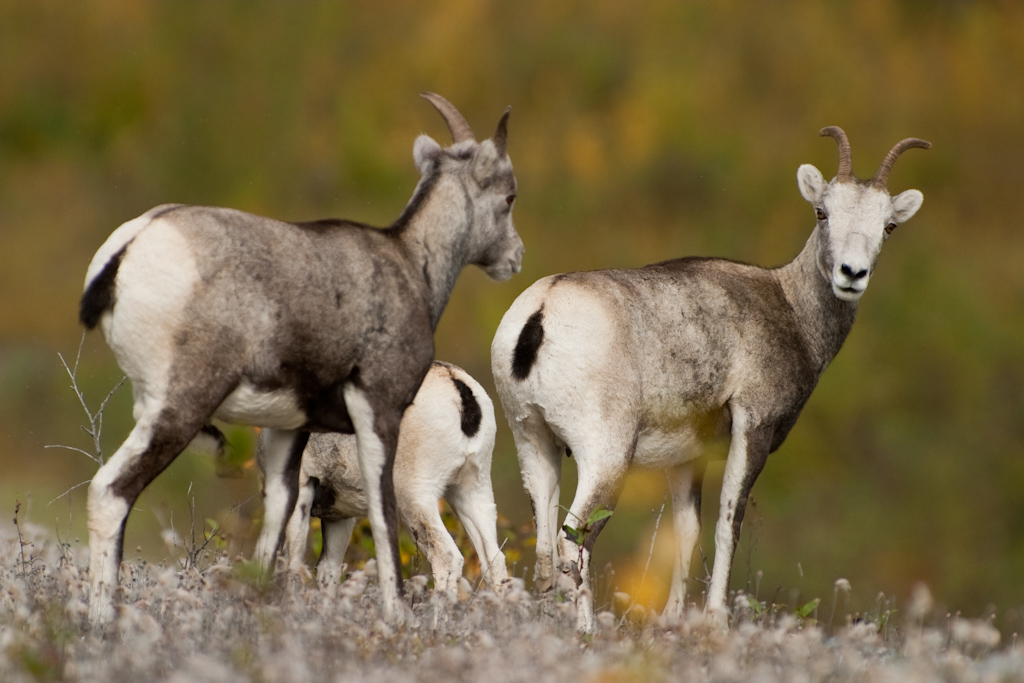
Pelage colour variations range widely, from slate grey-brown with a white rump patch, dark tail and white on the inside of the hind legs, to an almost completely white/grey-white coat with a dark or black dorsal surface on the tail. Horns are curved in form and vary in colour from a yellowish-brown to dark brown horns.

[edit]
Revisions and contributorsEdit on WikipediaRead on Wikipedia
from Grokipedia
The Stone sheep (Ovis dalli stonei), a of thinhorn sheep, is a North American wild sheep endemic to the alpine and subalpine regions of northern and southern in . It is distinguished from the paler subspecies by its darker slate-gray to black pelage, often with white patches on the muzzle, belly, rump, and inner legs, as well as a coarse, woolly coat that provides insulation in harsh mountainous environments. Males possess large, flaring, spiral horns that can exceed 100 cm in length along the curl, used for display and combat, while females and young have shorter, more slender horns; adults typically weigh 60–110 kg and measure 1.3–1.6 m in body length. Stone sheep inhabit rugged, steep terrain in the Cassiar, Stikine, and Omineca mountain ranges, preferring elevations between 1,000 and 2,500 m where open grasslands and rocky outcrops provide opportunities and escape routes from predators such as wolves, bears, and mountain lions. They exhibit seasonal migrations, moving to higher elevations in summer for cooler temperatures and abundant vegetation, and descending to lower slopes in winter to access windswept ridges free of deep snow. Socially, they form bands of females and young year-round, with males joining during the rut in late fall to establish dominance hierarchies through horn-clashing displays; are born in after a of about 175 days. Their diet is primarily graminoids like sedges and grasses (over 50% in summer), supplemented by forbs, shrubs, and lichens, with focused on nutrient-rich sites including mineral licks essential for sodium intake. Conservation efforts for Stone sheep emphasize habitat protection and regulated hunting, as they face threats from , climate change impacts on availability, and predation; populations have shown recovery in some areas due to , though recent assessments indicate but potentially declining numbers in parts of their range due to and other factors. Globally ranked as apparently secure (G5T4), they are provincially listed as S3S4 in , reflecting vulnerability at regional scales, with an estimated 12,000 individuals as of 2024 sustained through sustainable harvest quotas. continues on migration patterns and fire's role in enhancing , informing strategies to maintain this iconic of northwestern Canada's wild sheep.

Taxonomy and etymology

Classification

The Stone sheep is scientifically classified as Ovis dalli stonei, a subspecies within the genus Ovis of the family Bovidae and subfamily Caprinae. It represents one of two primary subspecies of the Dall sheep (Ovis dalli), alongside Ovis dalli dalli, with distinctions based on genetic and morphological characteristics; intergrades occur in regions of distributional overlap. Recent genetic studies, including revisions by the B.C. Ministry of Forests (2022) and Sims et al. (2019), have refined subspecies boundaries, recognizing hybrid zones such as former Fannin's sheep populations as admixtures between the subspecies. Phylogenetically, Stone sheep belong to the thinhorn sheep group (Ovis dalli), which forms a monophyletic closely related to the (Ovis canadensis), with divergence estimated at approximately 2.5 million years ago during the based on whole-genome analyses and records. Genetic studies employing sequencing and markers have confirmed the distinct status of O. d. stonei, revealing pronounced genetic structuring between subspecies populations and hybridization confined to natural overlap zones, with no evidence of beyond these areas.

Naming history

The common name "Stone sheep" honors Andrew Jackson Stone, an American hunter, explorer, and early conservationist who first collected specimens of the darker-pelted thinhorn sheep during expeditions in northern and the in the , bringing the subspecies to scientific attention. The species Ovis dalli was originally described as Ovis montana dalli in 1884 by Edward William Nelson, who named it after William Healey Dall, a prominent American naturalist and explorer known for his work on Alaskan fauna and geology. The Ovis dalli stonei was formally designated in 1897 by mammalogist Joel Asaph Allen in the Bulletin of the , based on Stone's type specimen—a male collected in the Che-on-nee Mountains, headwaters of the , (then British Northwest Territory), —recognizing its distinct darker gray-to-black pelage compared to the white O. d. dalli. Commonly referred to as Stone's sheep (with the possessive form reflecting its eponymous origin) or black Dall sheep due to the contrasting coloration with the paler subspecies, the has historically been conflated with O. dalli under the umbrella term "thinhorn sheep," emphasizing the slender horns shared across the species. Early 20th-century taxonomic efforts, including the 1909 Catalogue of Type Specimens of Mammals in the United States National Museum by Marcus Ward Lyon Jr. and Wilfred H. Osgood, referenced description and cataloged relevant type specimens, reinforcing the distinction amid ongoing revisions of North American bovid .

Physical description

Appearance and morphology

Stone sheep (Ovis dalli stonei) exhibit a stocky build adapted for in rugged alpine terrain, with adult typically measuring 130-180 cm in total body length and standing 95-105 cm at the shoulder, while ewes are slightly smaller at 132-162 cm in length and 90-100 cm at the shoulder. weigh 73-113 kg, and ewes 46-60 kg, reflecting their robust yet lightweight frame relative to other North American wild sheep species. The pelage of Stone sheep consists of a dense, woolly undercoat for insulation topped by coarser, hollow guard hairs, forming a winter exceeding 5 cm in thickness that molts seasonally from late through , with rams molting earlier than ewes. Unlike the creamy white of (O. d. dalli), Stone sheep display darker pigmentation ranging from dark grey to black across the body, accented by white patches on the belly, rump, and backs of the legs, as well as white interiors contrasting the grey exteriors of the ears and a black tail. Horns are a prominent feature, curving outward in a yellowish-brown to dark brown coloration; possess massive, flaring horns that form full curls and measure up to 100 cm or more along the outer curve, while ewes have shorter, more slender horns of 25-40 cm. Stone sheep lack facial glands present in (O. canadensis), a trait shared with other thinhorn . Physical adaptations include hooves with rough, edged soles that provide traction for navigating steep cliffs and rocky slopes, enabling precise footing on uneven surfaces. Their keen eyesight further supports predator detection across vast distances in open terrain.

Sexual dimorphism

Stone sheep (Ovis dalli stonei) display marked sexual dimorphism, particularly in body size and horn morphology, which influences their survival strategies and reproductive roles. Adult rams are substantially larger than ewes, with males weighing 73–113 kg compared to 46–60 kg for females, representing a size disparity of approximately 50–100%. This greater body mass in rams supports dominance displays and physical confrontations during the breeding season but imposes higher energetic demands for foraging and movement in rugged terrain. Horn dimorphism is especially pronounced, with rams developing massive, flaring horns that curl outward and backward, often reaching lengths of up to 100 cm or more and base circumferences of around 33 cm along the outer curve; these structures function primarily in intrasexual combat to establish . In contrast, ewes bear smaller, more slender, lyre-shaped horns measuring about 25-40 cm in length and 20 cm in circumference, which serve mainly for defense against predators. Horn growth accelerates during in both sexes, adding annual layers (annuli) that enable age estimation, though male horns continue expanding significantly beyond female maturity at around 4 years. Intense selective harvesting has led to declines in horn length over decades, altering dimorphism trends in some populations. Rams exhibit additional body variations, including thicker necks for withstanding impacts and intensified darker markings during the rut, enhancing visual signals of status, while ewes maintain a slimmer build with subtler secondary traits. These morphological differences contribute to sex-specific risks, as the bulkier face elevated vulnerability from intraspecific fights and harvest, whereas lighter ewes may incur higher predation pressure in open habitats. The evolution of this dimorphism in stone sheep stems from sexual selection pressures favoring male-male competition in a polygynous mating system, akin to other Ovis species but less exaggerated than in bighorn sheep (O. canadensis), where horn size correlates more intensely with reproductive success.

Distribution and habitat

Geographic range

The Stone sheep (Ovis dalli stonei), a subspecies of thinhorn sheep, primarily inhabits mountainous regions of northern British Columbia and southern Yukon Territory in Canada. Its core range encompasses the Cassiar Mountains, Stikine Plateau, Omineca Mountains (from the Pine River to the Liard River), Skeena Mountains, and the Yukon Plateau, extending from the British Columbia-Yukon border northward. Unlike the closely related Dall sheep (O. d. dalli), Stone sheep have no established presence in Alaska. The overall extent of the Stone sheep's range is estimated at 20,000–200,000 km², with the southern limit around 58°N (near the Peace Arm of Williston Reservoir in ) and the northern limit extending to about 62°N in southern . In alone, the occupied suitable habitat spans roughly 42,000 km², primarily in the Northern Boreal Mountains and Muskwa Foothills ecosections. Transboundary populations between and the are minimal for this subspecies, confined to small areas near the border without significant cross-border movement. In central , Stone sheep intergrade with , resulting in hybrid phenotypes known as Fannin sheep (O. d. fannini), which exhibit intermediate coat colors and occur in overlap zones along a transitional boundary. Genetic studies confirm these hybrids arise from ancient and ongoing hybridization events between the darker Stone sheep and whiter . Regarding movements, Stone sheep exhibit seasonal altitudinal migrations, descending to lower-elevation winter ranges (typically 1,500–2,200 m on wind-blown ridges and south-facing slopes) and ascending to higher summer ranges (above 1,800 m in alpine areas), with elevation shifts reaching up to 1,000 m in some individuals to track forage availability and snowmelt patterns. These migrations often follow traditional routes, with median distances of about 16 km between seasonal ranges in the Cassiar Mountains.

Habitat preferences

Stone sheep primarily inhabit alpine environments at elevations ranging from 1,000 to 2,500 meters, with a strong preference for steep terrain including slopes greater than 60 degrees, cliffs, talus slopes, and ridges that provide escape opportunities from predators. These animals select areas in proximity to precipitous escape features, such as vertical rock faces, to facilitate rapid evasion, while avoiding dense forests and flat wetlands that limit visibility and mobility. In terms of vegetation, Stone sheep favor open grassy meadows, sedge flats, and forb-rich areas dominated by grasses like Calamagrostis and Hierochloe, as well as dry alpine tundra and burn-regenerated grasslands for foraging. During winter, they shift to wind-exposed slopes supporting lichens, shrubs such as Betula and Dryas, and sparse graminoids like Elymus and Festuca, which remain accessible beneath shallow snow. Seasonally, Stone sheep utilize higher elevations above 1,800 meters in summer, moving to open for and predator detection, while descending to 1,500–2,200 meters in winter on south-facing slopes that intercept less . Year-round, they frequent mineral licks for essential salts, particularly from to when nutritional demands peak. Microhabitat selection emphasizes proximity to rugged escape terrain, with ewes and lambs preferring steep, rocky nurseries on southwest-facing slopes at mid-elevations around 1,600–1,700 meters to balance protection and access. Adapted to climates with heavy snowfall, Stone sheep exploit wind-blown areas with average snow depths of 16.5 cm, but they are vulnerable to encroachment driven by warming temperatures, which reduces open foraging habitats.

Behavior and ecology

Social structure and behavior

Stone sheep (Ovis dalli stonei) maintain a marked by sexual segregation throughout most of the year, with ewes forming stable, matrilineal herds of 5–15 individuals that include , yearlings, and immature . These ewe-lamb groups, often called nursery herds, provide protection and social continuity, with young males typically departing at around two years of age to join ram groups. Adult are largely solitary or aggregate in groups of 2–7 individuals outside the breeding season, allowing them to focus on in optimal habitats without the demands of units. During lambing in late May or early June, nursery subgroups emerge where one or two ewes vigilantly guard multiple while others feed or rest nearby. Dominance hierarchies within ram groups are established primarily through assessments of horn size, with subordinates yielding to larger-horned individuals to avoid costly confrontations; challenges occur via staring contests or horn clashes when horn lengths are similar, producing collisions audible up to 1 km away. These hierarchies stabilize by summer and influence access to resources and, later, opportunities. Among ewes, is infrequent and milder, typically involving displacement at feeding or bedding sites rather than physical combat, with older females or those with larger horns prevailing in disputes. Stone sheep are diurnal, exhibiting peak activity at dawn and dusk for and movement across alpine terrains, often traveling several kilometers daily between food-rich areas, licks, and water sources while prioritizing proximity to steep escape cliffs. High vigilance is a core behavior, particularly in ewe groups, where individuals alternate scanning for predators such as wolves (Canis lupus), grizzly bears (Ursus arctos), and golden eagles (Aquila chrysaetos), with vigilance rates influenced by group size, distance to cover, and perceived predation risk. Communication relies on visual and tactile cues, including postures, horn displays, and physical contacts like nudges or clashes to maintain order and resolve conflicts, supplemented by chemical signals such as urine investigation during social assessments. Seasonal shifts in are pronounced, with intensifying in summer and fall as establish groups on separate ranges; this separation breaks down pre-rut, leading to temporary mixed-sex aggregations during the breeding period from late to early December. Ewe herds remain cohesive year-round, adapting their ranges to seasonal availability while upholding matrilineal bonds.

Diet and foraging

Stone sheep primarily consume graminoids, such as grasses and sedges, which constitute 57% of their summer diet and up to 87.6% in winter, with annual intake averaging around 81.5% from these sources. Forbs and shrubs supplement this base, comprising about 3% forbs and 8.5% shrubs in winter diets, while lichens and mosses are occasionally ingested, particularly at higher elevations during summer. In winter, on willows becomes more prominent as cover limits access to other . Seasonal dietary shifts reflect forage availability and nutritional demands, with summer emphasizing nutrient-rich greens like young graminoids (e.g., , , ) and forbs (e.g., Astragalus, ) to support growth and . In winter, sheep rely on exposed dry grasses and, to a lesser extent, dig through shallow for and residual in wind-blown areas, adapting to reduced forage quality by selecting whatever is accessible at lower elevations. These patterns align with elevational migrations, moving to higher slopes in summer as recedes to access emerging high-quality plants. Foraging strategies involve selective in nutrient-dense patches, targeting plants at optimal phenological stages (e.g., unfurled leaves) for maximum crude protein content, which enhances intake efficiency. Sheep spend 67-69% of their active time , totaling 5 hours daily in winter's short daylight and up to 11.9 hours for lactating ewes in summer, with daily intake estimated at 2-3% of body weight—higher for larger due to energetic needs. Group foraging, while aiding vigilance against predators, allows coordinated movement to prime feeding areas. Nutritional requirements include high intake, fulfilled at natural licks during spring and summer, and adaptations in the that facilitate of fibrous graminoids, enabling efficient nutrient extraction from tough plant material. quality profoundly affects Stone sheep, as preferences for nitrogen-rich plants drive selection toward alpine meadows and burned ranges with superior regrowth, directly influencing body condition, horn growth, and overall fitness.

Reproduction and life cycle

The rutting season of Stone sheep (Ovis dalli stonei) takes place from mid-November to early December, when in prime condition gather with ewes and compete intensely for opportunities. Competition involves ritualized displays, such as horn curling and posturing, escalating to physical clashes where charge and butt heads to establish dominance. Ewes enter estrus and become receptive for approximately 1-2 days during this period, allowing breeding primarily by dominant . Gestation lasts 5-6 months, typically 170-180 days, after which ewes give birth to a single lamb—twins are rare—in late May to early June. Lambs are born in secluded nurseries that provide from predators, weighing 3-4 kg at birth and capable of standing and following their mother within hours. These birth sites align with the species' preference for steep, rugged terrain during lambing. Lamb development is rapid; they are weaned at 4-6 months, transitioning to solid forage while remaining dependent on maternal groups. occurs at 1.5-2 years for ewes and 2-3 years for rams, after which ewes breed annually and yearlings may occasionally participate in the rut, though older rams dominate. In the wild, Stone sheep have a of 10-14 years, though first-year mortality is high at 30-50%, primarily from predation by wolves and bears or exposure during harsh winters. Parental care is provided almost exclusively by ewes, who form nursery groups post-lambing to collectively protect and nurse offspring. play no role in rearing after the rut, rejoining bachelor groups, while females exhibit alloparenting behaviors, such as shared vigilance among related ewes to enhance survival.

Conservation

Status and population

The Stone sheep (Ovis dalli stonei), a subspecies of thinhorn sheep (O. dalli), is assessed as Least Concern at the species level by the , reflecting a stable overall population without imminent extinction risk. NatureServe ranks the subspecies as T4 (Apparently Secure), indicating it is uncommon but not imperiled, with a global population estimated at approximately 12,000 individuals, almost entirely in northern . This estimate accounts for ongoing genetic reassessments that have refined subspecies boundaries, reducing prior overcounts of Stone sheep in hybrid zones. In northern British Columbia, the core of the range, population estimates range from 10,000–16,000 based on 2014–2015 surveys, with a 2024 figure of approximately 10,000, though only 35% of the known range has been inventoried. Yukon supports a small population of Stone sheep in southern regions (estimated at fewer than 1,000 pure individuals), following genetic studies that reclassified some previously identified Stone sheep as Dall sheep or hybrids, resulting in substantial downward adjustments from earlier estimates. Population trends were relatively stable from 2000 to around 2010, but recent surveys indicate declines in British Columbia, with 13–50% fewer individuals in some areas compared to pre-2010 levels, while protected zones show variable results, and no major range contraction has been documented since the 1950s. Additional aerial surveys are planned for early 2025 in British Columbia to refine population estimates and monitor trends amid ongoing climate impacts. Monitoring relies on helicopter-based aerial counts for abundance and composition, GPS collaring to estimate densities of 0.1–0.5 sheep/km² in core habitats, and genetic analyses to confirm subspecies purity and track isolation. As a , Stone sheep maintain a smaller population than Dall sheep, which number over across their broader range, making isolated herds particularly vulnerable to events like outbreaks or severe weather. These dynamics underscore the need for targeted surveys in remote areas to refine estimates and support conservation.

Threats and management

Stone sheep face several major threats to their survival, primarily from human activities and environmental changes. Trophy and subsistence hunting, which selectively targets mature rams, has historically pressured populations, though regulated harvests aim to maintain sustainability. Habitat fragmentation caused by road construction and mining operations disrupts migration routes and winter ranges, increasing vulnerability to disturbance and reducing access to foraging areas. Predation by wolves, grizzly and black bears, and golden eagles, particularly on lambs, further limits recruitment in some regions. Climate change exacerbates these issues by causing forage loss through altered snow patterns and promoting the spread of diseases and parasites. Emerging threats include the proliferation of access via new roads and trails in and , which facilitates and illegal harvest. Respiratory diseases, such as those caused by ovipneumoniae, pose a significant risk from spillover events involving domestic sheep and goats, leading to outbreaks with high mortality in naïve wild populations. Additionally, shrub expansion into alpine meadows due to warming temperatures reduces open habitats essential for and predator evasion. Management actions in focus on quota systems, such as limited-entry hunts and restrictions on non-resident permits, to control harvest rates at sustainable levels (typically 3-4% of the population). Protected areas, including Stone Sheep in and in , safeguard key habitats and limit development. Translocations are rarely employed but have been used sparingly to enhance in isolated herds. Conservation efforts involve initiatives by the Wild Sheep Foundation, which supports predator control programs and habitat restoration projects to bolster population resilience. In , Indigenous co-management through groups like the Aklavik Hunters and Trappers Committee integrates into monitoring and decision-making. Ongoing research targets disease vectors, with surveillance and test-and-remove strategies to mitigate spillover risks. The future outlook for Stone sheep remains sustainable provided access is strictly regulated and climate adaptation measures are implemented; however, intensification of threats like disease outbreaks or habitat loss could necessitate upgrades in conservation status.

References

Add your contribution
Related Hubs
User Avatar
No comments yet.