Hubbry Logo
Strawberry FieldStrawberry FieldMain
Open search
Strawberry Field
Community hub
Strawberry Field
logo
8 pages, 0 posts
0 subscribers
Be the first to start a discussion here.
Strawberry Field
Strawberry Field
from Wikipedia

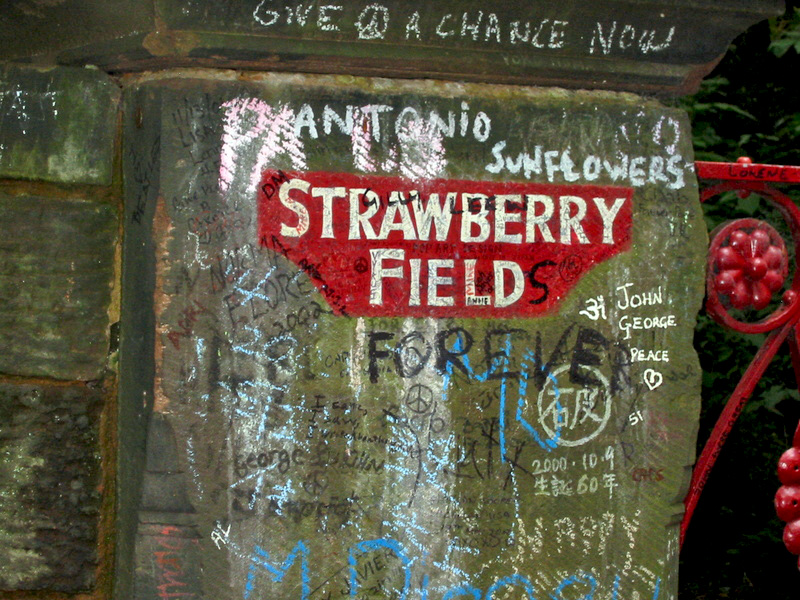
A 2002 image of the gatepost, with graffiti from Beatles fans

Strawberry Field is a visitor attraction and training centre in the Liverpool suburb of Woolton that is owned and operated by the Salvation Army. It operated as a children's home between 1936 and 2005. The house and grounds had originally been built as a private residence in the Victorian era, before being acquired by the Salvation Army in the 1930s. The house was demolished in 1973 due to structural problems and replaced with purpose-built units. After being closed as a children's home, the site has continued to be used by the Salvation Army for other purposes.

The location gained worldwide fame following the release of the Beatles' 1967 single "Strawberry Fields Forever". The song's writer, John Lennon, had grown up nearby and played in the grounds of the home as a child. In time, the old red-painted entrance gates on Beaconsfield Road became a place of pilgrimage for Beatles fans. In 2019, Strawberry Field was opened to the public for the first time, with an exhibition on its history, cafe, and shop, alongside a training centre for young people with special educational needs.

The gates were stolen on 11 May 2000, allegedly by two men in a transit van. The gates were sold to an unsuspecting antiques dealer who never realised they were the actual gates from Strawberry Field. He returned them to the police upon request, and they now stand in the grounds of Strawberry Field.

History

[edit]

The earliest reference to the Gothic Revival mansion Strawberry Field dates from 1870, when it was owned by wealthy shipping magnate George Warren. On an 1891 Ordnance Survey map, the building and its grounds appear as the plural Strawberry Fields, although this had changed by the 1905 survey. In 1912, it was transferred to another wealthy merchant whose widow sold the estate to the Salvation Army in 1934. It was opened as a children's home on 7 July 1936 by Lady Bates in the presence of General Evangeline Booth, daughter of Salvation Army founders William Booth and Catherine Booth. It initially housed up to 40 girls; boys under the age of five were introduced in the 1950s. Later, older boys also became resident.

The Beatles

[edit]
The gates of Strawberry Field

The name of the home became famous in 1967 with the release of the Beatles' single "Strawberry Fields Forever", written by John Lennon, who had grown up at nearby 251 Menlove Avenue. Beaconsfield Road, where Strawberry Field is located, is a side street from Menlove Avenue. One of Lennon's childhood treats was the garden party that took place each summer, on the grounds of Strawberry Field. Lennon's Aunt Mimi recalled, "As soon as we could hear the Salvation Army Band starting, John would jump up and down shouting, 'Mimi, come on. We're going to be late.'"[1]

Legacy

[edit]
Strawberry Fields as it was shown on the 25-inch Ordnance Survey of 1891

Strawberry Field was recognised by Nikolaus Pevsner in his 1969 survey of the buildings of South Lancashire.[2] However, by then, the building was increasingly unfit for purpose. By 1973, structural problems such as dry rot meant that it was more cost-effective to demolish the building and replace it with a purpose-built children's home. This new home provided three family units, each accommodating 12 children.[3] The driveway entrance to the building was moved further west along Beaconsfield Road so the gateposts bearing the name of Strawberry Field were no longer used. Throughout the 1970s and beyond, the disused entrance and its gates became a mecca for Beatles fans from around the world. As a result, the gates continued to be painted bright red; the painted nameplates were also maintained.

21st century

[edit]

The children's home closed in January 2005, and the building was used by the Salvation Army as a church and prayer centre. The gates marking its entrance were removed and replaced with replicas in May 2011.[4]

The Salvation Army opened Strawberry Field to the public for the first time in September 2019, allowing visitors to explore the grounds. Incorporated in the grounds is a training centre for young people with special educational needs and a new exhibition space dedicated to the story of the place, John Lennon, the writing and recording of The Beatles “Strawberry Fields Forever” and The Salvation Army, together with a cafe and gift shop.[5]

The visitor exhibition contains a tour which tells stories of the formation of The Salvation Army and its work at the original children’s home, John Lennon's childhood and early inspiration, and the song 'Strawberry Fields Forever' through multimedia and interviews including an introduction by Paul McCartney and memorabilia relating to Lennon's inspiration. The media guide has commentary by John Lennon’s half-sister Julia Baird, who is Honorary President of Strawberry Field.[5]

In the exhibition is the Steinway piano on which Lennon composed and recorded "Imagine" which is on loan from the estate of George Michael.[6] The gardens where John Lennon once found sanctuary now house the original red gates which were returned to Strawberry Field after being stolen in 2000.[7]

In May 2023 the Strawberry Field Bandstand opened. Donated by Cliff Cooper, founder and CEO of Orange Amps, the bandstand features an "Imagine" mosaic floor which references the mosaic in the Central Park, New York Strawberry Fields memorial, and the back wall features a mural depicting the history of John Lennon and The Salvation Army at the Strawberry Field site, designed by artist James Wilkinson.[8]

The Ukrainian Peace Monument was unveiled at Strawberry Field in May 2023. It will remain in Liverpool until it is safe to move it to a permanent home in Ukraine.[9]

References

[edit]
[edit]
Revisions and contributorsEdit on WikipediaRead on Wikipedia
from Grokipedia
Strawberry Field is a in , , consisting of a Victorian-era house and grounds that served as a children's home from 1936 until its closure around 2005, and which inspired John Lennon's 1967 song "" due to his childhood visits to the property. Originally constructed in the late as a residence for a wealthy shipping magnate, the property was gifted to in 1934 and repurposed as a refuge initially for girls and later boys from vulnerable families, operating for nearly seven decades to provide care amid social challenges. , raised nearby by his Aunt Mimi, attended the adjacent Quarry Bank High School and frequently entered the Strawberry Field grounds to play, particularly during annual summer fetes, experiences that evoked nostalgic and introspective themes in his songwriting during a period of personal reflection in 1966. Following the home's closure, redeveloped the site, reopening it in 2019 as a public visitor attraction featuring gardens, an on its and Beatles connection, a , and a training facility offering employment opportunities for young people facing learning difficulties or employment barriers.

Site Overview

Location and Physical Description

Strawberry Field is located at 16 Beaconsfield Road in the suburb of , , , situated on a side off Menlove Avenue and approximately 7 miles southeast of city center. The site's geographic coordinates are approximately 53°26′44″N 2°55′58″W. Originally developed as a private Victorian-era residence around 1870, the property featured a large constructed in Gothic Revival style, characterized by arched windows, pointed architectural elements, and a rectangular plan designed to maximize daylight and views. The house was set amid extensive wooded gardens spanning about 7 acres, which included areas historically used for strawberry cultivation, contributing to the site's name. The original mansion was demolished in the owing to structural deterioration and replaced with purpose-built facilities. Today, the site retains its wooded parkland setting and incorporates a modern 1,360 m² visitor designed as a low-profile structure integrated into the landscape to preserve views of the surrounding mature trees and gardens.

Historical Naming and Etymology

The Gothic Revival mansion at Strawberry Field was constructed around 1870 on approximately seven acres of former farmland in the suburb of by George Warren, a prosperous shipping . The property received its name, "Strawberry Field," in 1876, reflecting the site's probable prior association with cultivation. Prior owner William Chidson, an avid gardener, likely grew strawberries there, supported by local records such as a 1867 Liverpool Daily Post report of strawberries exhibited at the Woolton Horticultural Show and evidence of wild strawberries in adjacent gardens. An early map from 1891 erroneously rendered the name as the plural "Strawberry Fields," possibly due to colloquial usage or mapping error, despite the singular form being the official designation established by Warren. This was corrected to "Strawberry Field" on maps by 1905, though the plural variant persisted in some local references and media, such as reports in the Liverpool Daily Post. retained the singular name upon acquiring the property in 1934 from Warren's heirs, preserving the historical nomenclature tied to the site's agricultural roots rather than inventing a new one.

Historical Development

Establishment as Salvation Army Children's Home

In 1934, The Salvation Army purchased the Strawberry Field estate—a Victorian-era house and surrounding grounds in the suburb of —from the widow of a wealthy merchant who had acquired the property in 1912. The acquisition aligned with the organization's mission to provide for disadvantaged youth, transforming the site from a private residence into a dedicated facility for 's most vulnerable children, who often came from impoverished or disrupted family backgrounds. Following necessary adaptations to the buildings and grounds, the home opened on 7 1936 as a residential facility initially for girls only, with capacity for up to 40 residents. The opening ceremony featured Lady Bates and was attended by Evangeline Booth, daughter of Salvation Army founder , underscoring the event's significance within the denomination. Over time, the home expanded its intake to include boys, maintaining its focus on supportive care rather than strictly housing.

Operations as an Orphanage (1936–2005)

Strawberry Field was formally opened as a children's home on 7 July 1936 by Lady Bates, in the presence of General , daughter of the organization's founder . The facility, housed in a Victorian acquired by the in 1934, initially accommodated up to 40 girls from Liverpool's most vulnerable families, providing a structured environment amid economic hardship and family disruptions prevalent in the . Unlike traditional orphanages, it served as a temporary or longer-term refuge for children facing domestic instability, abuse, or parental incapacity, rather than exclusively housing orphans without living relatives. Operations emphasized a stable, spiritually oriented routine under Salvation Army principles, aiming to offer respite from urban poverty and family turmoil, with stays varying from short-term placements to more extended care depending on individual circumstances. From the onward, the home expanded to admit boys, initially those under age 5 and later older children, reflecting broader shifts in child welfare practices toward family-like groupings. By the early , the original structure had deteriorated beyond repair, leading to its demolition in 1973 and replacement with a modern building comprising three family units, each designed for 12 children, to facilitate smaller, more homely living arrangements. The home continued to support hundreds of children over its tenure, prioritizing care within a faith-based framework that included moral and practical guidance, though specific educational or disciplinary protocols aligned with standards of the era, such as communal activities and vocational preparation. Operations persisted until 2005, when the ceased residential child care at the site, influenced by evolving national policies favoring foster placements over institutional homes to better replicate family dynamics. This closure marked the end of nearly 70 years of service, during which the facility had adapted to welfare reforms while maintaining its core mission of aiding Liverpool's disadvantaged youth.

Connection to The Beatles

John Lennon's Childhood Experiences

John Lennon, raised by his aunt at Mendips (251 Menlove Avenue, , ), frequently visited the nearby Strawberry Field Salvation Army children's home during his childhood in the 1940s and 1950s, drawn to its wooded grounds as a place for play and escape from the austere post-war environment of suburban . The site, located approximately 800 meters from his home, offered seclusion amid its orchards and gardens, where Lennon and his friends, including lifelong companion , would climb over boundary walls to explore and loiter without permission. Annual summer garden parties at Strawberry Field provided structured occasions for local children like Lennon to attend, featuring games, music, and social gatherings organized by , which Mimi Smith later described as a cherished treat for her nephew amid his otherwise routine upbringing. These events, held on the home's grounds, exposed Lennon to performances and communal activities, contrasting with the stricter domestic life at Mendips. Lennon himself recalled the site's role as a "" in later reflections, though accounts emphasize informal trespassing and imaginative play over formal involvement with the orphanage's residents or programs. No evidence indicates Lennon resided at or was institutionalized in Strawberry Field; his visits were those of a neighboring seeking , often with Shotton, who lived at 83 Vale Road nearby and shared school years at Quarry Bank High School. These experiences, rooted in unsupervised exploration rather than charity care, informed Lennon's nostalgic associations with the location, free from direct familial trauma but evocative of youthful freedom in a disciplined era.

Inspiration for "Strawberry Fields Forever"

"," a 1967 single by primarily written by , derives its title from , the children's home in , , situated near the residence of Lennon's aunt, , where he lived from age five onward. frequently visited and played in the home's wooded gardens and grounds during his childhood in the late 1940s and 1950s, often sneaking into the area to explore or listen covertly to the band practicing nearby. His aunt recalled Lennon's enthusiasm for the band's music, noting that he would eagerly urge her to join him upon hearing it start, highlighting the site's auditory and recreational draw for the young . The song's lyrics evoke nostalgic introspection tied to these early experiences, portraying a dreamlike state of childhood amid personal uncertainty, as in the lines "Living is easy with eyes closed / Misunderstanding all you see," which Lennon later described as reflecting his lifelong tendency toward daydreaming and as coping mechanisms. Composed in late 1966 during a break from filming in , , Lennon drew on these Liverpool memories to convey themes of innocence lost and perceptual ambiguity, crediting the site's sensory associations—such as its strawberry-named fields and hidden nooks—with shaping the track's psychedelic, autobiographical essence. Unlike more literal tributes, the inspiration manifests psychologically, symbolizing Lennon's "nowhere state of mind" rather than direct events at the home, which operated as a refuge for disadvantaged children but was not an where Lennon resided. While some interpretive accounts, such as those in Francis Kenny's Understanding John Lennon, propose alternative childhood incidents like a juvenile detention escape influencing the , the predominant and directly attested linkage remains Lennon's documented affinity for Strawberry Field's locale as a formative escape and memory anchor. The track's release on February 1, 1967, as a double A-side with ""—another Liverpool reminiscence—underscored this phase of output focused on personal heritage, with Lennon viewing it as one of his most honest works.

Transformation and Modernization

Closure, Demolition, and Site Redevelopment

The 's Strawberry Field children's home in ceased operations in May 2005, after nearly 70 years of service, primarily due to a decline in the number of children requiring residential care and a shift toward community-based support models. Following closure, the site—comprising purpose-built structures erected in the 1970s after the original was demolished due to fire damage and structural issues—was repurposed as a church and , while also hosting community groups and projects. In January 2018, demolition commenced on the 1970s-era buildings to facilitate site clearance for redevelopment, with salvage efforts prioritizing historical elements like bricks from the original structure, which were later offered for sale to fund preservation. entrance , removed in 2011 for safekeeping amid concerns over vandalism and deterioration, were restored and incorporated into the plans. Redevelopment plans, announced by in February 2017, aimed to transform the 10-acre site into a visitor attraction emphasizing its charitable history and connection, including a new 1,360 m² designed as a " in the " to integrate with the surrounding woodland. The project, funded by approximately $5 million from plus additional fundraising, preserved the site's memorial garden and gates while creating spaces for education on youth rehabilitation and music heritage; the revamped facilities opened to the public on September 13, 2019.

Establishment as a Visitor Attraction

Following the closure of the children's home in 2005, the organization retained ownership of the Strawberry Field site in , , while initially limiting public access to the exterior gates, which had become a pilgrimage site for fans. In February 2017, the announced a £6.5 million redevelopment plan to convert the 6.5-acre grounds into a visitor attraction, explicitly aiming to capitalize on the site's cultural significance from John Lennon's "" to generate revenue for employment training programs targeting disadvantaged youth aged 18–24 facing barriers such as unemployment or learning disabilities. The project encompassed restoration of the Victorian-era gardens—originally featuring strawberry fields and orchards—construction of a modern two-story with interactive exhibits on the site's orphanage history and Beatles connection, a café, and a , alongside replica wrought-iron gates installed after the originals were removed for preservation in May 2011 to prevent deterioration from constant fan contact. Funding combined Salvation Army investment of approximately £5 million with additional fundraising, reflecting a commitment to blending with social mission rather than pure commercialization. Strawberry Field opened as a on September 14, 2019, marking the first public entry to the grounds since their establishment as a private residence in the , with initial daily visitors exceeding 500 and annual attendance surpassing 250,000 by 2024. Admission to the gardens remains free, while the charges £14.50 for adults (as of 2024), with proceeds directed toward the Salvation Army's "social " model that integrates heritage storytelling with on-site vocational training in and retail for program participants. This establishment positioned Strawberry Field as a key draw, complementing nearby -related sites while prioritizing the organization's charitable objectives over entertainment alone.

Current Operations and Programs

Facilities and Visitor Amenities

The Strawberry Field visitor attraction features an interactive detailing John Lennon's early life and connection to the site, including display of the 'Imagine' piano on loan from George Michael's estate. Admission tickets grant access to this , a self-guided garden tour with lyric-inscribed signage, and audio headsets for narrated experiences. On-site amenities include the Imagine More Café serving refreshments, with proceeds funding local community programs, and a offering Beatles-inspired merchandise, where sales similarly support charitable initiatives. The gardens provide outdoor space for visitors to explore the historical grounds where Lennon played as a child. Accessibility features encompass designated parking in an open-air lot off Beaconsfield Road, level access to public areas, a lift for multi-level navigation, accessible toilets, and full compatibility throughout the exhibition, café, shop, and gardens. The site operates daily from 10:00 a.m. to 4:00 p.m. during winter months and until 5:00 p.m. in summer, with online ticket bookings providing a 10% discount and free entry for children under 16 accompanying a paying adult.

Charitable Training and Community Initiatives

The Steps at Strawberry Field programmes, operated by , provide tailored vocational training for individuals aged 18 and above facing barriers to , such as learning disabilities or neurodivergence, primarily drawn from the . These initiatives encompass five distinct schemes, including the flagship Steps to Work, a 12- to 18-month course targeting young adults aged 18-25, which delivers hands-on work experience, skill-building in areas like , retail, , and visitor services, and opportunities for and placements. Participants receive individualized support from dedicated coaches to develop formal qualifications through partnerships with local colleges, enhance employability, and build CVs, with capacity to accommodate up to 40 trainees annually. Shorter variants, such as Steps to Work Lite and Steps for Students, offer condensed training focused on immediate skill acquisition and career aspirations. Funding for these training efforts derives directly from revenues generated by the site's visitor exhibition, , and , ensuring that all profits sustain the programmes without reliance on external grants. Outcomes emphasize practical , with graduates gaining certified credentials and real-world experience to overcome employment obstacles, aligning with the Salvation Army's mission to support vulnerable youth through educational, cultural, and spiritual development. Community initiatives complement the training by fostering local engagement, including annual events like the Summer Fete held on July 5, 2025, which features live music, family activities, and local makers to raise additional funds and promote awareness of the site's charitable work. These gatherings integrate trainees into public-facing roles, enhancing their confidence while strengthening ties with the Woolton and visitors, thereby extending the site's impact beyond individual beneficiaries to broader social cohesion.

Cultural and Charitable Legacy

The song "Strawberry Fields Forever," primarily written by and released by on February 1, 1967, as a double A-side single with "," introduced groundbreaking production elements such as tape loops, varispeed manipulation, and seamless splicing of two distinct takes played at different speeds, which expanded the sonic possibilities of and influenced psychedelic experimentation in the late . These techniques, developed during November and December 1966 sessions at , elevated pop recording standards and inspired producers in genres from to . Lennon described the track—evoking nostalgic yet alienated memories of the Strawberry Field orphanage grounds—as his finest Beatles composition, reflecting a shift toward introspective that contrasted with the band's earlier melodic hits and contributed to their critical evolution amid the 1967 . Its release propelled the site's name into global consciousness, embedding Strawberry Field in mid-1960s countercultural and fostering enduring references in music and fan discourse as a symbol of Lennon's roots. Beyond music, the song's legacy amplified Strawberry Field's status in , positioning it as a cornerstone of in , where it draws annual visitors alongside sites like and , sustaining economic and cultural value through guided experiences and memorabilia. The site's 2011–2019 redevelopment into a visitor attraction, including multimedia exhibits on the song's origins, reinforced its role in commemorative events, such as the 2017 50th-anniversary celebrations and a 2025 memorial rose garden for producer , underscoring its ongoing influence on fan pilgrimages and historiography.

Salvation Army's Ongoing Role and Achievements

The Salvation Army maintains operational oversight of Strawberry Field as a multifaceted site combining visitor access with charitable programs aimed at for disadvantaged youth. Following the 2018 redevelopment, the organization shifted focus from its historical role as a children's home—established in 1936—to contemporary initiatives supporting young adults with learning disabilities and employment barriers. Central to this is the Steps to Work program, a 12-to-18-month scheme providing vocational training, skills development, work experience, and opportunities to foster and career readiness. Participants engage in practical activities such as , , retail, and music-based mentoring, drawing on the site's gardens and facilities to simulate real-world scenarios. The program emphasizes personal growth, confidence-building, and , with trainees exploring strengths in a supportive environment. As of 2024, it accommodates up to 40 individuals annually, continuing the Salvation Army's legacy of rehabilitation through structured, faith-informed support. Achievements include measurable employment outcomes and recognitions for program efficacy. In 2025, 38 graduates were celebrated for completing the Steps initiative, with participants securing roles in inclusive workforces and reporting enhanced skills and aspirations. Earlier cohorts, such as the inaugural 15-month group in 2019, saw at least one trainee receive a job offer upon completion, demonstrating tangible progression from training to . The site's dual role has earned accolades, including the Tourism Awards' "Small Visitor Attraction of the Year" in recent years, reflecting successful integration of charitable impact with public engagement. Broader contributions encompass community partnerships and efforts, such as the 2024 installation of additional solar panels under the Salvation Army's carbon management plan, aligning training with . These initiatives underscore the organization's commitment to long-term social outcomes, with evidence from submissions highlighting specialized support for adults with special educational needs and disabilities.

References

Add your contribution
Related Hubs
User Avatar
No comments yet.