Hubbry Logo
Electronic tunerElectronic tunerMain
Open search
Electronic tuner
Community hub
Electronic tuner
logo
8 pages, 0 posts
0 subscribers
Be the first to start a discussion here.
Electronic tuner
Electronic tuner
from Wikipedia
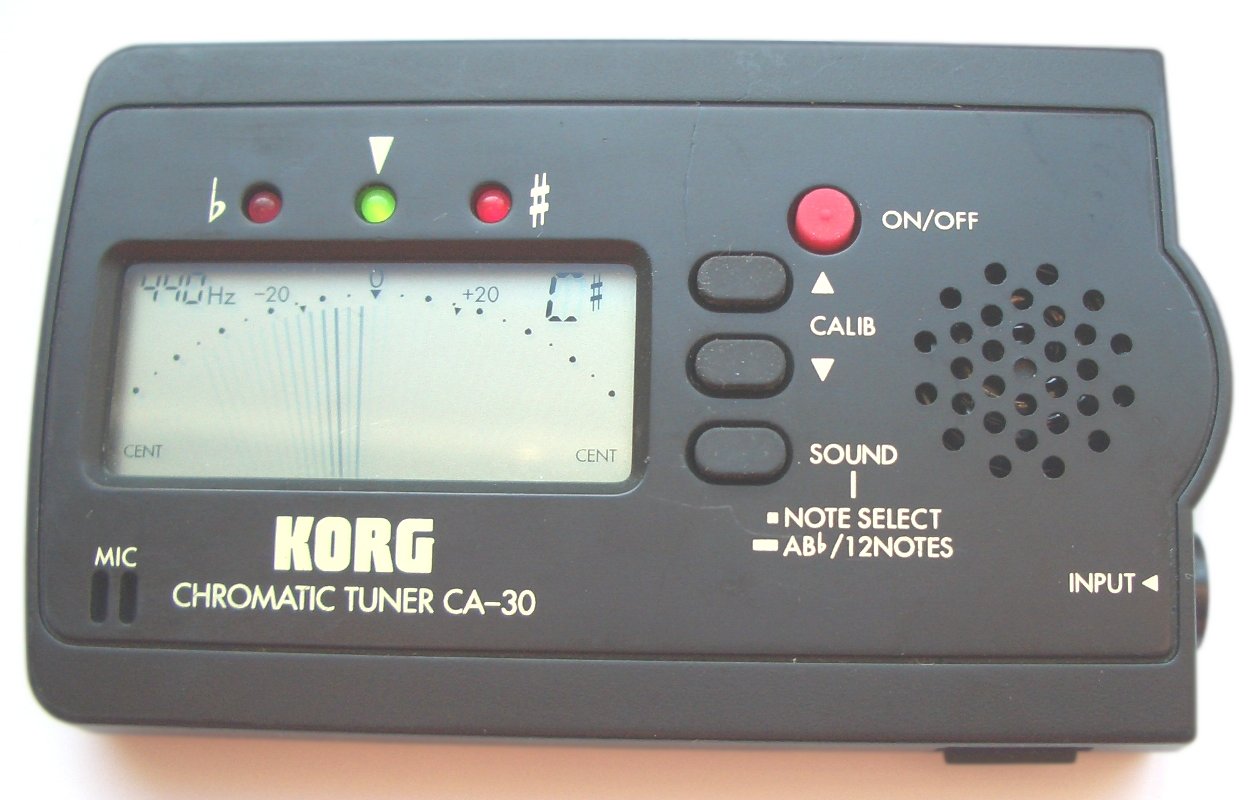
Pocket-sized Korg chromatic LCD tuner, with simulated analog indicator needle
Guitar tuner showing that the "E" string is too sharp and needs to be tuned down

In music, an electronic tuner is a device that detects and displays the pitch of musical notes played on a musical instrument. "Pitch" is the perceived fundamental frequency of a musical note, which is typically measured in hertz. Simple tuners indicate—typically with an analog needle or dial, LEDs, or an LCD screen—whether a pitch is lower, higher, or equal to the desired pitch. Since the early 2010s, software applications can turn a smartphone, tablet, or personal computer into a tuner.[1] More complex and expensive tuners indicate pitch more precisely. Tuners vary in size from units that fit in a pocket to 19" rack-mount units. Instrument technicians and piano tuners typically use more expensive, accurate tuners.[2]

The simplest tuners detect and display tuning only for a single pitch—often "A" or "E"—or for a small number of pitches, such as the six used in the standard tuning of a guitar (E, A, D, G, B, E). More complex tuners offer chromatic tuning for all 12 pitches of the equally tempered octave. Some electronic tuners offer additional features, such as pitch calibration, temperament options, the sounding of a desired pitch through an amplifier plus speaker, and adjustable "read-time" settings that affect how long the tuner takes to measure the pitch of the note.

Among the most accurate tuning devices, strobe tuners work differently than regular electronic tuners. They are stroboscopes that flicker a light at the same frequency as the note. The light shines on a wheel that spins at a precise speed. The interaction of the light and regularly-spaced marks on the wheel creates a stroboscopic effect that makes the marks for a particular pitch appear to stand still when the pitch is in tune. These can tune instruments and audio devices more accurately than most non-strobe tuners. However, mechanical strobe units are expensive and delicate, and their moving parts require periodic servicing, so they are used mainly in applications that require higher precision, such as by professional instrument makers and repair experts.

Regular types

[edit]

Regular electronic tuners contain either an input jack for electric instruments (usually a 14-inch patch cord input), a microphone, or a clip-on sensor (e.g., a piezoelectric pickup) or some combination of these inputs. Pitch detection circuitry drives some type of display (an analog needle, an LCD simulated image of a needle, LED lights, or a spinning translucent disk illuminated by a strobing backlight). Some tuners have an output, or through-put, so the tuner can connect 'in-line' from an electric instrument to an instrument amplifier or mixing console. Small tuners are usually battery powered. Many battery-powered tuners also have a jack for an optional AC power supply.

Some rock and pop guitarists and bassists use "stompbox" format electronic tuners that route the electric signal for the instrument through the unit via a 14-inch patch cable. These pedal-style tuners usually have an output so that the signal can be plugged into an amplifier.

Most musical instruments generate a fairly complex waveform with multiple related frequency components. The fundamental frequency is the pitch of the note. Additional "harmonics" (also called "partials" or "overtones") give each instrument its characteristic timbre. As well, this waveform changes during the duration of a note. This means that for non-strobe tuners to be accurate, the tuner must process a number of cycles and use the pitch average to drive its display. Background noise from other musicians or harmonic overtones from the musical instrument can impede the electronic tuner from "locking" onto the input frequency. This is why the needle or display on regular electronic tuners tends to waver when a pitch is played. Small movements of the needle, or LED, usually represent a tuning error of 1 cent. The typical accuracy of these types of tuners is around ±3 cents. Some inexpensive LED tuners may drift by as much as ±9 cents.

"Clip-on" tuners typically attach to instruments with a spring-loaded clip that has a built-in contact microphone. Clipped onto a guitar headstock or violin scroll, these sense pitch even in loud environments, for example when other people are tuning.

Some guitar tuners fit into the instrument itself. Typical of these are the Sabine AX3000 and the "NTune" device. The NTune consists of a switching potentiometer, a wiring harness, illuminated plastic display disc, a circuit board and a battery holder. The unit installs in place of an electric guitar's existing volume knob control. The unit functions as a regular volume knob when not in tuner mode. To operate the tuner, the player pulls the volume knob up. The tuner disconnects the guitar's output so the tuning process is not amplified. The lights on the illuminated ring, under the volume knob, indicate the note being tuned. When the note is in tune a green "in tune" indicator light illuminates. After tuning is complete the musician pushes the volume knob back down, disconnecting the tuner from the circuit and re-connecting the pickups to the output jack.

Gibson guitars released a guitar model in 2008 called the Robot Guitar—a customized version of either the Les Paul or SG model. The guitar is fitted with a special tailpiece with in-built sensors that pick up the frequency of the strings. An illuminated control knob selects different tunings. Motorized tuning machines on the headstock automatically tune the guitar. In "intonation" mode, the device displays how much adjustment the bridge requires with a system of flashing LEDs on the control knob.

Regular needle, LCD and LED display tuners

[edit]

A needle, LCD or regular LED type tuner uses a microprocessor to measure the average period of the waveform. It uses that information to drive the needle or array of lights. When the musician plays a single note, the tuner senses the pitch. The tuner then displays the pitch in relation to the desired pitch, and indicates whether the input pitch is lower, higher, or equal to the desired pitch. With needle displays, the note is in tune when the needle is in a 90° vertical position, with leftward or rightward deviations indicating that the note is flat or sharp, respectively. Tuners with a needle are often supplied with a backlight, so that the display can be read on a darkened stage.

For block LED or LCD display tuners, markings on the readout drift left if the note is flat and right if the note is sharp from the desired pitch. If the input frequency is matched to the desired pitch frequency the LEDs are steady in the middle and an 'in tune' reading is given.

Some LCDs mimic needle tuners with a needle graphic that moves in the same way as a genuine needle tuner. Somewhat misleadingly, many LED displays have a 'strobe mode' that mimics strobe tuners by scrolling the flashing of the LEDs cyclically to simulate the display of a true strobe. However, these are all just display options. The way a regular tuner 'hears' and compares the input note to a desired pitch is exactly the same, with no change in accuracy.

The least expensive models only detect and display a small number of pitches, often those pitches that are required to tune a given instrument (e.g., E, A, D, G, B, E of standard guitar tuning). While this type of tuner is useful for bands that only use stringed instruments such as guitar and electric bass, it is not that useful for tuning brass or woodwind instruments. Tuners at the next price point offer chromatic tuning, the ability to detect and assess all the pitches in the chromatic scale (e.g., C, C, D, D, etc.). Chromatic tuners can be used for B and E brass instruments, such as saxophones and horns. Many models have circuitry that automatically detects which pitch is being played, and then compares it against the correct pitch. Less expensive models require the musician to specify the target pitch via a switch or slider. Most low- and mid-priced electronic tuners only allow tuning to an equal temperament scale.

Electric guitar and bass players who perform concerts may use electronic tuners built into an effects pedal, often called a stomp box. These tuners have a rugged metal or heavy-duty plastic housing and a foot-operated switch to toggle between the tuner and a bypass mode. Professional guitarists may use a more expensive version of the LED tuner mounted in a rack-mount case with a larger range of LEDs for more accurate pitch display. On many electronic tuners, the user can select a different note—useful for, for example, dropping a guitar's tuning to a lower pitch (e.g., Dropped tuning). Many models also let the user select reference pitches other than A440. This is useful to some Baroque musicians who play period instruments at lower reference pitches—such as A=435. Some higher-priced electronic tuners support tuning to a range of different temperaments—a feature useful to some guitarists and harpsichord players.

Some expensive tuners also include an on-board speaker that can sound notes, either to facilitate tuning by ear or to act as a pitch reference point for intonation practice. Some of these tuners also provide an adjustable read time that controls at what time interval the circuitry assesses pitch. The combination of all the above features makes some tuners preferable for tuning instruments in an orchestra. These are sometimes called "orchestral tuners".

Clip-on

[edit]
A common LCD clip-on guitar tuner, clipped onto the back of a Fender Telecaster headstock so that the guitarist can tune easily while wearing the guitar. A clip-on tuner attaches to the instrument and senses the vibrations from the instrument, even in a noisy environment.

A clip-on tuner clips onto an instrument—such as onto the headstock of a guitar or the bell of a trombone. A vibration sensor built into the clip transmits the instrument vibrations to the tuning circuitry. The absence of a microphone makes these tuners immune to background noise, so musicians can tune in noisy environments, including while other musicians are tuning. The first clip-on tuner was made by Mark Wilson from the OnBoard Research Corporation, and was marketed as Intellitouch PT1.[3]

Apps

[edit]

Since the early 2010s,[4] many chromatic and guitar tuner apps are available for Android and iOS smartphones.

Strobe tuners

[edit]

Strobe tuners (the popular term for stroboscopic tuners) are the most accurate type of tuner [citation needed]. There are three types of strobe tuners: the mechanical rotating disk strobe tuner, an LED array strobe in place of the rotating disk, and "virtual strobe" tuners with LCDs or ones that work on personal computers. A strobe tuner shows the difference between a reference frequency and the musical note being played. Even the slightest difference between the two shows up as a rotating motion in the strobe display. The accuracy of the tuner is only limited by the internal frequency generator. The strobe tuner detects the pitch from either a TRS input jack or a built-in or external microphone connected to the tuner.

The first strobe tuner was produced in 1936 by Conn. It was at first sold as Conn's "Chromatic Stroboscope."[5] then, beginning in the 1940s, as the Stroboconn. It was manufactured into the 1960s but is mainly a collector piece at present. The front panel had 12 strobe discs, driven by one motor.[6] The gearing between discs was a very close approximation to the 12th root of two ratio. This tuner had an electrically driven temperature-compensated tuning fork; the electrical output of this fork was amplified to run the motor. The fork had sliding weights, an adjustment knob, and a dial to show the position of the weights. These weights permitted setting it to different reference frequencies (such as A4 = 435 Hz), although over a relatively narrow range, perhaps a whole tone. When set at A4 = 440 Hz the tuning fork produced a 55 Hz signal, which drove the four-pole 1650 RPM synchronous motor to which the A disc was mounted. (The other discs were all gear-driven off of this one.) Incoming audio was amplified to feed a long neon tube common to all 12 discs. Wind instrument players and repair people liked this tuner because it needed no adjustment to show different notes; though portable, its total weight was 68 pounds.

Peterson Tuners Model 400, 1967

The best-known brand in strobe tuner technology is Peterson Tuners who in 1967 marketed their first strobe tuner, the Model 400. Other companies, such as Sonic Research, TC Electronic, and Planet Waves, sell highly accurate LED-based true strobe tuners. Other LED tuners have a 'strobe mode' that emulates the appearance of a strobe. However, the accuracy of these tuners in strobe mode, while sufficient for most tuning, is no better than in any other mode, as they use the same technique as any basic tuner to measure frequency, only displaying it in a way that imitates a strobe tuner.

How it works

[edit]

Mechanical strobe tuners have a series of lamps or LEDs powered by amplified audio from the instrument; they flash (or strobe) at the same frequency as the input signal. For instance, an 'A' played on a guitar's 6th string at the 5th fret has the frequency of 110 Hz when in tune. An 'A' played on the 1st string at the 5th fret vibrates at 440 Hz. As such, the lamps would flash either 110 or 440 times per second in the above examples. In front of these flashing lights is a motor-driven, translucent printed disc with rings of alternating transparent and opaque sectors.

This disc rotates at a fixed specific speed, set by the user. Each disc rotation speed is set to a particular frequency of the desired note. If the note being played (and making the lamps behind the disc flash) is at exactly the same frequency as the spinning of the disc, then the disc appears to be static from the strobing effect. If the note is out of tune then the pattern appears to be moving as the light flashing and the disc rotation are out of sync from each other. The more out of tune the played note is, the faster the pattern seems to be moving, although in reality it always spins at the same speed for a given note. Many good turntables for vinyl disc records have stroboscopic patterns lit by the incoming AC power (mains). The power frequency, either 50 or 60 Hz, serves as the reference, although commercial power frequency sometimes changes slightly (a few tenths of a percent) with varying load. Unless reference and measured quantity are interchanged, the operating principle is the same; the turntable speed is adjusted to stop drifting of the pattern.

Pattern of a mechanical strobe tuner disc

As the disc has multiple bands, each with different spacings, each band can be read for different partials within one note. As such, extremely fine tuning can be obtained, because the user can tune to a particular partial within a given note. This is impossible on regular needle, LCD or LED tuners. The strobe system is about 30 times more accurate than a quality electronic tuner [citation needed], being accurate to 110 of a cent. Advertisements for the Sonic Research LED strobe claim that it is calibrated to ± 0.0017 cents and guaranteed to maintain an accuracy of ± 0.02 cents or 150 of a cent.

Tuning a steelpan with a Peterson 590 AutoStrobe disc strobe tuner

Strobe units can often be calibrated for many tunings and preset temperaments and allow for custom temperament programming, stretched tuning, "sweetened" temperament tunings and Buzz Feiten tuning modifications. Due to their accuracy and ability to display partials even on instruments with a very short "voice" (e.g., notes of short duration), strobe tuners can perform tuning tasks that would be very difficult, if not impossible, for needle-type tuners. For instance, needle/LED display type tuners cannot track the signal to identify a tone of the Caribbean steelpan (often nicknamed the "steeldrum") due to its very short "voice". A tuner needs to be able to detect the first few partials for tuning such an instrument, which means that only a strobe tuner can be used for steelpan tuning. This is also true of the comb teeth used in mechanical musical instruments like Music Boxes and the like. In such cases, a technician has to physically remove metal from the tooth to reach the desired note. The metal teeth only resonate briefly when plucked. Great accuracy is required as once the metal is cut or filed away, the lost material cannot be replaced. As such, the strobe-type tuners are the unit of choice for such tasks. Tuners with an accuracy of better than 0.2 cent are required for guitar intonation tuning.

One of the most expensive strobe tuners is the Peterson Strobe Center, which has twelve separate mechanical strobe displays; one for each pitch of the equally tempered octave. This unit (about US$3,500) can tune multiple notes of a sound or chord, displaying each note's overtone sub-structure simultaneously. This gives an overall picture of tuning within a sound, note or chord that is not possible with most other tuning devices. (The TC Electronic Polytune can display the pitch accuracy of up to six pre-selected notes.) It is often used for tuning complex instruments and sound sources, or difficult-to-tune instruments where the technician requires a very accurate and complete aural picture of an instrument's output. For instance, when tuning musical bells, this model displays several of the bell's partials (hum, second partial, tierce, quint and nominal/naming note) as well as the prime, and each of their partials, on separate displays. The unit is heavy and fragile, and requires a regular maintenance schedule. Each of the twelve displays requires periodic re-calibration. It can be used to teach students about note substructures, which show on the separate strobing displays.

Strobe developments

[edit]
Peterson StroboStomp

Mechanical disc strobe tuners are expensive, bulky, delicate, and require periodic maintenance (keeping the motor that spins the disc at the correct speed, replacing the strobing LED backlight, etc.). For many, a mechanical strobe tuner is simply not practical for one or all of the above reasons. To address these issues, in 2001 Peterson Tuners added a line of non-mechanical electronic strobe tuners that have LCD dot-matrix displays mimicking a mechanical strobe disc display, giving a stroboscopic effect. In 2004 Peterson made a model of LCD strobe in a sturdy floor based "stomp box" for live on-stage use. Virtual strobe tuners are as accurate as standard mechanical disc strobe tuners. However, there are limitations to the virtual system compared to the disc strobes. Virtual strobes display fewer bands to read note information, and do not pick up harmonic partials like a disc strobe. Rather, each band on a virtual strobe represents octaves of the fundamental. A disc strobe provides "one band correspondence"—each band displays a particular frequency of the note being played. On the virtual strobe system, each band combines a few close frequencies for easier reading on the LCD. This is still extremely accurate for intoning and tuning most instruments—but, as of this writing, no virtual strobe tuner provides detailed information on partials.

Sonic Research and Planet Waves both released a true-strobe with a bank of LEDs arranged in a circle that gives a strobing effect based upon the frequency of the input note. Both LCD and LED display true strobes do not require mechanical servicing and are much cheaper than the mechanical types. As such, they are a popular option for musicians who want the accuracy of a strobe without the high cost and the maintenance requirements. However, LED strobe displays offer no information about the harmonic structure of a note, unlike LCD types, which do offer four bands of consolidated information.

The tuning screen from Peterson's StroboSoft v1

Peterson released a PC-based virtual strobe tuner in 2008 called "StroboSoft". This computer software package has all the features of a virtual strobe, such as user-programmable temperaments and tunings. To use this tuner, a musician must have a computer next to the instrument to be tuned. An alternative is the PC-based strobe tuner TB Strobe Tuner with fewer functions.

Peterson VirtualStrobe application on iPod Touch

In 2009 Peterson Tuners released a VirtualStrobe tuner as an application add-on for Apple's iPhone and iPod Touch.

As both mechanical and electronic strobes are still more expensive and arguably more difficult to use in order to achieve the desired results than ordinary tuners, their use is usually limited to those whose business it is accurately to intone and tune pianos, harps, and early instruments (such as harpsichords) on a regular basis: luthiers, instrument restorers and technicians – and instrument enthusiasts. These tuners make the intonation process more precise.

Uses

[edit]

Classical music

[edit]
Tuning of Sébastien Érard harp using Korg OT-120 Wide 8 Octave Orchestral Digital Tuner

In classical music, there is a longstanding tradition to tune "by ear", by adjusting the pitch of instruments to a reference pitch. In an orchestra, the oboe player gives an "A4", and the different instrument sections tune to this note. In chamber music, either one of the woodwind players gives an "A", or if none is present, one of the string players, usually the first violinist, bows their open "A" string. If an orchestra is accompanying a piano concerto, the first oboist takes the "A" from the piano and then plays this pitch for the rest of the orchestra.

Despite this tradition of tuning by ear, electronic tuners are still widely used in classical music. In orchestras the oboist often uses a high-end electronic tuner to ensure that their "A" is correct. As well, other brass or woodwind players may use electronic tuners to ensure that their instruments are correctly tuned. Classical performers also use tuners off-stage for practice purposes or to check their tuning (or, with the further aid of a speaker, to practice ear training). Electronic tuners are also used in opera orchestras for offstage trumpet effects. In offstage trumpet effects, trumpet players performs a melody from the backstage or from a hallway behind the stage, creating a haunting, muted effect. Since trumpet players cannot hear the orchestra, they cannot know whether or not their notes are in tune with the rest of the ensemble; to resolve this problem, some trumpet players use a high-end, sensitive tuner so that they can monitor the pitch of their notes.

Piano tuners, harp makers and the builders and restorers of early instruments, e.g. harpsichords, use high-end tuners to assist with their tuning and instrument building. Even piano tuners who work mostly "by ear" may use an electronic tuner to tune just a first key on the piano, e. g. the a' to 440 Hz, after which they proceed by means of octaves, approximate fifths and approximate fourths to tune the others. (In the twelve-tone equal temperament system dominant in classical and Western music, all intervals except the octave are slightly "mistuned" or compromised compared to more consonant just intervals.) They may also use electronic tuners to get a very out-of-tune piano roughly in pitch, after which point they tune by ear. Electronic tuning devices for keyboard instruments are for various reasons generally much more complex and therefore expensive than in the case of other widely used instruments.

[edit]

In popular music, amateur and professional bands from styles as varied as country and heavy metal use electronic tuners to ensure that the guitars and electric bass are correctly tuned. In popular music genres such as rock music, there is a great deal of stage volume due to the use of drums and guitar amplifiers, so it can be difficult to tune "by ear". Electronic tuners are helpful aids at jam sessions where a number of players are sharing the stage, because it helps all of the players to have their instruments tuned to the same pitch, even if they have come to the session halfway through. Tuners are helpful with acoustic instruments, because they are more affected by temperature and humidity changes. An acoustic guitar or upright bass that is perfectly in tune backstage can change in pitch under the heat of the stage lights and from the humidity from thousands of audience members.

Tuners are used by guitar technicians who are hired by rock and pop bands to ensure that all of the band's instruments are ready to play at all times. Guitar technicians (often called guitar techs) tune all of the instruments (electric guitars, electric basses, acoustic guitars, mandolins, etc.) before the show, after they are played, and before they are used onstage. Guitar techs also retune instruments throughout the show. Whereas amateur musicians typically use a relatively inexpensive quartz tuner, guitar technicians typically use expensive, high-end tuners such as strobe tuners. Most strobe tuners, counter-intuitively, also use quartz crystal oscillators as time references, although the responses are processed differently by the different units.

Bell tuning

[edit]

Strobe tuners are used in the tuning of bells, which require accurate tuning of many partials. The removal of metal from various parts of the bell shape is by a tuning lathe, and once too much metal has been removed it cannot be reversed. Hence accurate approach to the desired tuning partial is essential to prevent overshoot.

See also

[edit]
  • Microtuner – Device to test musical instrument tuning
  • Synchronization – Coordination of events to operate a system in unison
  • Tuning fork – Device that generates sounds of constant pitch when struck
  • Autotune – Audio processor that alters pitch

References

[edit]
Revisions and contributorsEdit on WikipediaRead on Wikipedia
from Grokipedia
An electronic tuner is a device that measures the pitch of a musical note produced by an instrument, typically through acoustic or vibrational input, and displays whether the note is in tune, sharp, or flat relative to a reference pitch, enabling musicians to adjust tuning accurately without relying solely on ear training. These devices have evolved from early mechanical strobe models to modern digital versions, offering high precision often down to 0.5 cents deviation, far surpassing human auditory perception limits of about 5 cents. The core technology involves converting sound waves into electrical signals, analyzing their frequency via methods like fast Fourier transform in digital models, and providing visual feedback through needles, LEDs, or strobe patterns. Key types include chromatic tuners, which detect any note across the musical scale and are versatile for various instruments; polyphonic tuners, which simultaneously tune all strings of multi-string instruments like guitars; and strobe tuners, known for exceptional accuracy using rotating disk patterns that appear stationary when in tune. Clip-on models attach to the instrument to vibrations, while pedal tuners integrate into effects chains for live performances, often featuring mute functions to silence output during tuning. The origins trace back to with the development of strobe-based tuners by Ltd., exemplified by the Stroboconn, which utilized a stroboscopic mechanism driven by patterned disks to visually indicate pitch accuracy against frequencies derived from a . This innovation, patented in 1942 by inventors Robert W. Young and Allen Loomis (filed 1938), marked the first electronic approach to visual tuning, primarily for pianos, organs, and orchestral instruments. By the 1960s, solid-state versions like Peterson's Model improved portability and reliability, while the 1980s saw the rise of compact digital tuners, such as BOSS's TU-12 in 1983, the first automatic chromatic pedal tuner with built-in microphone and input jack. Today, electronic tuners are indispensable for professional and amateur musicians across genres, supporting alternate tunings and integrating with apps for broader accessibility.

Overview

Definition and purpose

An electronic tuner is a device that detects and measures the pitch of musical notes produced by instruments or voices, displaying whether the pitch is sharp, flat, or in tune relative to a target , often through visual indicators like needles, LEDs, or strobe patterns, or auditory feedback such as tones. These devices typically reference standard tuning systems, such as , where the is divided into 12 equal semitones. The primary purpose of an electronic tuner is to facilitate precise intonation adjustments for musicians, luthiers, and instrument technicians, accurate tuning across a wide range of pitches without relying solely on auditory . Unlike mechanical tuners, which depend on physical like tuning forks, electronic tuners use sensors such as to capture acoustic or electromagnetic pickups to detect string oscillations, converting them into measurable frequencies for immediate feedback. Key benefits include superior accuracy—often resolving to within 1 cent of deviation, compared to the human ear's typical threshold of about 5 cents—faster tuning times, and support for various temperaments beyond just , enhancing overall musical performance consistency. This precision aids in pitch detection by analyzing fundamental frequencies, though detailed methods vary by design.

Basic principles of pitch detection

Pitch in music is primarily determined by the fundamental frequency of a sound wave, measured in hertz (Hz), which corresponds to the number of cycles per second. In Western music, the standard reference pitch is A4 at 440 Hz within the equal temperament tuning system, where the octave is divided into 12 equal semitones. This frequency defines the pitch baseline, with higher frequencies producing higher pitches and lower frequencies producing lower pitches, following a logarithmic perception in human hearing. Electronic tuners detect pitch by analyzing the periodicity of the input to estimate its ff, calculated as f=1Tf = \frac{1}{T}, where TT is the period of the . Common algorithms include zero-crossing, which counts the signal's transitions through zero to approximate ; (FFT), which decomposes the signal into components to identify the strongest fundamental; and , which measures self-similarity to find periodic repeats. These time-domain and frequency-domain methods are selected based on computational efficiency and accuracy for real-time musical signals, often combining approaches for robustness against noise or harmonics. Input signals for pitch detection come from various sources tailored to the instrument type. Acoustic instruments typically use to capture airborne waves, converting them into electrical signals for . For stringed instruments, piezoelectric pickups attach directly to the body or bridge to sense mechanical , providing a cleaner signal less affected by ambient . Amplified electric instruments supply direct electrical signals from their output jacks, bypassing acoustic conversion for precise waveform capture. Once the is estimated, tuners provide feedback on deviation from the target pitch, expressed in cents, where 1 cent equals 1/100 of a . The deviation is computed as: Deviation in cents=1200×log2(fmeasuredftarget)\text{Deviation in cents} = 1200 \times \log_2 \left( \frac{f_{\text{measured}}}{f_{\text{target}}} \right) This logarithmic scale reflects the system's division of an (doubling of ) into 1200 cents. Visual feedback often appears as a needle, LED bar graph, or strobe indicating sharpness (positive cents) or flatness (negative cents), while auditory feedback may include trill tones that increase in pitch as tuning improves.

History

Early developments

Before the development of electronic tuners, musicians depended on mechanical aids such as tuning forks and pitch pipes to establish reference pitches. The tuning fork, invented in 1711 by English musician and lutenist John Shore, provided a stable tone for calibrating instruments, while pitch pipes offered portable multi-note references for quick tuning. The era of electronic tuners began in the 1930s with analog prototypes designed for precise visual feedback. In 1936, C.G. Conn Ltd. introduced the Stroboconn, the first commercially available electronic tuner, which utilized vacuum tubes and neon lamps to generate strobe patterns that visually indicated pitch accuracy by showing whether rotating discs appeared stationary. This device marked a significant innovation for professional musicians, enabling more reliable tuning than mechanical methods alone, and was particularly valued in studio and orchestral settings for standardizing to A=440 Hz, the international concert pitch recommended by an international conference in 1939 and adopted by the International Organization for Standardization (ISO) in 1955. During the , refinements to strobe continued with models like the Conn Strobotuner ST-6, which retained vacuum tube circuitry and neon lamp displays for high-precision applications, though these early units were bulky and power-intensive, limiting portability to fixed studio or use. The shift from vacuum tubes to transistors in the , mirroring broader trends, reduced and power consumption while improving reliability, paving the way for more practical designs. In the 1970s, analog needle tuners emerged as a portable alternative to strobe models, with Korg leading innovations through the WT-10, released in 1975 as the world's first handheld, battery-powered electronic tuner featuring a meter-style needle for pitch deviation. However, these analog devices faced challenges including pitch drift from temperature-sensitive components, often limiting accuracy to within a few cents, and their relatively large footprints made them better suited for studio environments than on-the-fly performance.

Modern advancements

The integration of microprocessors in the 1980s marked a digital revolution in electronic tuners, enabling precise and shifting from analog to digital designs for improved accuracy in consumer music equipment. In 1983, BOSS released the TU-12, the first automatic chromatic pedal tuner with a built-in and input jack. By the late , early pedal tuners like Arion's models emerged, incorporating digital displays for guitarists, while the saw widespread of LCD and LED screens in compact units, enhancing portability and readability for stage use. In the 2000s, innovations focused on multi-string detection, with TC Electronic's PolyTune, introduced in , pioneering polyphonic tuning for guitars by simultaneously analyzing all strings via advanced algorithms, reducing tuning time significantly. connectivity began appearing in clip-on tuners around the mid-, allowing integration with mobile devices for remote monitoring and customization. The and brought AI-enhanced tuner apps, such as the AI Tuner, which use for automatic pitch detection and support for various alternate tunings. High-precision hardware models, like Peterson's StroboClip HD series, achieved ±0.1 cent accuracy, favored by luthiers for fine intonation adjustments during instrument building. Key innovations include USB interfaces in software-based tuners, such as Peterson's StroboSoft , precise and integration with digital audio workstations for setups. Some advanced systems incorporate environmental compensation, adjusting pitch readings for temperature and humidity effects, as seen in tuning software like TuneLab for organs, which applies real-time corrections to maintain stability. Portable tuner options under $50 have become widely accessible due to integration with apps.

Types

Conventional display tuners

Conventional display tuners are standalone electronic devices designed primarily as handheld units or pedalboard-mounted pedals for musicians, featuring a built-in for acoustic instruments or a 1/4-inch input jack for direct connection from electric guitars, basses, or amplifiers. These tuners utilize visual displays such as analog-style needle indicators, multi-segment LED bars, or LCD graphs to show pitch deviation, allowing users to center the note on the reference pitch by observing the alignment or centering of the visual element. The displays typically provide real-time feedback on whether the input pitch is sharp, flat, or in tune, with color-coded or segmented indicators for quick readability during performance. Key features include transposition modes that adjust the reference pitch for transposing instruments, such as shifting down a major second for Bb clarinets or a for French horns, enabling accurate tuning without mental recalculation. Most models are battery-powered, often using 9V batteries, with many incorporating an auto-shutoff function after a period of inactivity to conserve power and extend battery life. Additional conveniences may include adjustable for reference pitch (typically A=440 Hz) and modes for flat tuning in dropped configurations. Popular examples include the DT-10, a pedal-style chromatic tuner with a 13-point LED meter simulating a needle display for precise pitch centering, and the Boss TU-3, a compact pedal tuner featuring a 21-segment LED bar graph for visual tuning feedback. Both models offer tuning accuracy of ±1 cent across a wide detection range, from low bass notes to high guitar harmonics, making them suitable for professional applications. Polyphonic tuners, a subset of these, allow simultaneous tuning of all strings on multi-string instruments like guitars by displaying individual string deviations at once, improving efficiency for quick setups. These tuners excel in durability, with rugged metal designed to withstand conditions like drops and vibrations, ensuring reliability during live without reliance on external devices such as smartphones. However, their fixed display sizes can limit visibility in bright environments compared to larger screens, and they are generally less portable than clip-on variants that attach directly to the instrument.

Clip-on tuners

Clip-on tuners are compact electronic devices designed to attach directly to the or body of stringed instruments, providing musicians with a portable solution for precise pitch detection through physical contact rather than acoustic input. These tuners revolutionized on-the-go tuning by eliminating the need for microphones or cables, allowing users to tune quickly in various environments without external interference. Commonly used for guitars, basses, violins, ukuleles, and bouzoukis, they prioritize ease of attachment and minimal visual obstruction during performance. The core mechanism of clip-on tuners relies on a piezoelectric embedded in the clip, which converts mechanical vibrations from the instrument's strings into electrical signals for pitch analysis. This vibration-sensing approach isolates the instrument's , effectively ignoring ambient noise from surroundings such as crowded stages or rehearsals. By clamping onto the —where vibrations are most prominent—the transducer captures subtle oscillations with high sensitivity, enabling accurate detection even at low volumes. In terms of , clip-on tuners emphasize , often weighing under 50 grams, to avoid adding noticeable bulk to the instrument. Many feature or rotatable screens, typically offering 360-degree adjustability, for optimal visibility from different angles during play. This portability makes them ideal for travel, with battery-powered operation (usually CR2032 cells) providing extended use without recharging in basic models. Their universal or instrument-specific clips ensure secure, scratch-free attachment across various neck sizes. Key features include adjustable calibration for the reference pitch A4, typically ranging from 430 Hz to 450 Hz to accommodate ensemble preferences or historical tunings. Transposition modes allow users to display notes as if tuned in standard pitch while accommodating capos or alternate setups. Popular models illustrate this versatility: the Snark ST-8, tailored for guitars with its chromatic display and vibration isolation, supports transposition for capo use. In contrast, the D'Addario NS Micro offers universal compatibility for multiple instruments, featuring a compact form and precise calibration adjustments. For instruments like the bouzouki, clip-on tuners such as the Stagg Clip Tuner provide an effective solution by clipping onto the headstock and using a built-in piezoelectric vibration sensor to detect string vibrations, allowing accurate tuning even in noisy environments without requiring a microphone. The device features automatic activation and a chromatic mode that supports complex tunings, such as the Irish bouzouki standard Dd-Aa-dd with unison or octave courses, displaying whether the note is sharp, flat, or in tune on its color LCD screen with an accuracy of ±1 cent. Advantages of clip-on tuners include their discreet profile for onstage use, where they remain unobtrusive and do not require setup time between songs. The vibration-based detection facilitates faster tuning checks, often within seconds, making them suitable for live performances or practice sessions in noisy settings. This direct attachment enhances reliability over microphone-dependent alternatives, reducing errors from external sounds. The evolution of clip-on tuners traces back to the late 1980s, when inventor Mark Wilson and engineer Earl Born at OnBoard Research Corporation developed prototypes using vibration sensing, leading to the first commercial model, the Intellitouch PT1, in 1997. This marked a shift from earlier cable-connected or microphone-based tuners of the to fully , clip-attached designs that prioritized portability. By the , advancements introduced rechargeable batteries and enhanced displays.

Smartphone and software tuners

and software tuners represent a category of digital tuning tools that leverage mobile devices and computers for pitch detection, making them highly accessible for musicians without requiring dedicated hardware. These applications and programs utilize built-in or audio inputs to analyze sound in real-time, providing visual feedback on pitch accuracy through interfaces like needle displays or color-coded indicators. Popular platforms include and Android apps such as GuitarTuna and Pano Tuner, which cater to a wide range of users from beginners to professionals. GuitarTuna, developed by Yousician, supports guitar tuning with over 100 million downloads and extends to other string instruments via chromatic modes. Apps like GuitarTuna and Cleartune offer free alternatives that can be used in chromatic mode for tuning instruments such as the bouzouki, although they may not have dedicated bouzouki presets. Pano Tuner functions as a chromatic tuner suitable for various instruments, detecting pitches across a broad range and displaying offsets for precise adjustments. In terms of functionality, these tools primarily rely on the device's for acoustic input or headphone jacks for direct connections, enabling hands-free operation. They offer chromatic modes for general use alongside instrument-specific presets, such as standard in GuitarTuna, often incorporating gamified elements like interactive lessons or visual animations to engage users during tuning sessions. Key features enhance their utility beyond basic tuning; for instance, GuitarTuna includes recording capabilities and temperament options like alternate tunings, while some apps support for specialized acoustic needs. Pano Tuner emphasizes sensitive pitch response for quick feedback. Many operate on a freemium model, with core tuning free and premium upgrades via in-app purchases unlocking pro tools like advanced generation or ad-free experiences. Advantages of smartphone and software tuners include their ubiquitous availability on personal devices, eliminating the need for extra purchases and allowing instant access during practice or performance. They often integrate additional utilities, such as built-in metronomes or chord libraries, streamlining workflows for musicians. However, limitations persist, including significant battery drain from continuous use during extended sessions. Variability in microphone quality across devices can affect accuracy, particularly in noisy environments where ambient sounds interfere with pitch detection.

Strobe tuners

Strobe tuners represent a high-precision category of electronic tuners that employ a visual stroboscopic display to indicate pitch accuracy, using rotating patterns or LED-based wheels to show stability when the note is in tune. These devices originated in the 1930s with the Conn Stroboconn, the first commercially available strobe tuner developed in 1936 by the company. While early models relied on mechanical components, modern strobe tuners have been refined through digital technology, incorporating virtual strobe simulations via LCD displays for enhanced reliability and portability. In terms of design, strobe tuners are typically larger units suited for stationary or semi-portable use, such as the Peterson StroboStomp HD pedal tuner or rack-mountable models like the StroboRack, which connect via input, direct instrument jack, or pickup for accurate signal capture. These hardware-focused devices prioritize durability and visibility, often featuring high-definition screens with adjustable backlighting to perform effectively in various lighting conditions, distinguishing them from more compact alternatives. Strobe tuners achieve exceptional precision, detecting deviations as small as 0.1 cent (1/1000 of a ), making them particularly valuable for demanding applications like orchestral instrument tuning and luthier repair work where minute adjustments are critical. Descendants of the original Conn Strobotuner, such as Peterson's VS-II and AutoStrobe series, continue this legacy, with contemporary models incorporating hybrid features like connectivity to companion apps for expanded tuning presets and remote monitoring. A key advantage of strobe tuners lies in their ability to provide real-time visualization of not only the fundamental pitch but also complex and harmonics, allowing users to observe and correct interactions across multiple frequencies simultaneously for superior intonation in polyphonic instruments. This harmonic insight enables finer control over consonance, especially in ensemble settings or when addressing instrument-specific temperaments, outperforming simpler needle or LED displays in scenarios requiring overtone analysis.

Operation

Signal processing in conventional tuners

In conventional electronic tuners, the input stage begins with capturing the acoustic or electrical signal from the instrument via a microphone or direct pickup connection, which is then amplified through a pre-amplifier to ensure sufficient signal strength for processing. This analog signal undergoes analog-to-digital conversion (ADC) using a codec, typically sampled at rates between 4,000 Hz and 8,000 Hz to capture the fundamental frequencies and relevant harmonics of musical notes without aliasing. Initial filtering, often implemented as finite impulse response (FIR) filters with 50-100 taps, isolates the fundamental frequency by attenuating noise and higher harmonics, improving pitch detection accuracy in noisy environments. The core processing stage employs either (FFT) for frequency-domain analysis or phase-locked loops (PLLs) for time-domain tracking to determine the input pitch. In FFT-based systems, the digitized signal is windowed (e.g., with a Hamming window) and transformed into the frequency spectrum using a 512- or 1024-point FFT, where the peak frequency corresponds to the fundamental pitch, offering high resolution (e.g., ~2 Hz at 4 kHz sampling). Alternatively, PLLs generate a reference oscillator that locks to the input signal's phase, enabling real-time tracking suitable for varying pitches without computing the full spectrum. Once the frequency ff is estimated, the deviation in cents from the reference frequency freff_{\text{ref}} (e.g., A4 = 440 Hz) is calculated using the cents=1200×log2(f/fref)\text{cents} = 1200 \times \log_2(f / f_{\text{ref}}), quantifying sharpness or flatness in 1/100th of a . In simpler PLL models, the phase difference Δϕ=2πft\Delta \phi = 2\pi f t between the input and reference signals directly computes this deviation over time tt, bypassing FFT for lower computational overhead. Feedback generation translates the processed pitch deviation into visual indicators, such as a servo-driven analog needle that deflects proportionally to cents offset or an LED matrix displaying a bar graph of sharpness/flatness. Many designs incorporate a mute function, which interrupts the audio output signal during tuning to enable silent practice without audible feedback, activated via a footswitch or automatic detection. Digital enhancements in modern conventional tuners leverage microcontrollers for processing. Polyphonic modes, common in guitar tuners, extend processing to detect multiple simultaneous notes by analyzing harmonic patterns across strings via advanced FFT or multi-PLL arrays, displaying individual string deviations on the interface.

Strobe mechanism and patterns

The strobe mechanism in electronic tuners operates on stroboscopic principles to provide a visual representation of pitch accuracy. A patterned disk, typically featuring radial lines or segments, rotates at the exact of the target note, driven by a oscillator. The audio input from the instrument is converted into a source—such as a in early models or LEDs in modern ones—that flashes at the of the detected pitch. Synchronization occurs when the input matches the disk's rotation rate, causing the pattern to appear stationary, confirming the note is in tune. This leverages , where the flashing "freezes" the motion, allowing tuners to discern deviations as small as 0.1 cents. Distinct patterns emerge based on the pitch deviation, offering immediate feedback without numerical readouts. If the note is sharp, the pattern rotates counterclockwise (or , depending on the model), with faster indicating greater sharpness; a flat note produces the opposite directional "running" motion. When perfectly tuned, the lines halt completely, appearing as fixed spokes. For sub-cent adjustments, a subtle wobble or in the pattern becomes visible, revealing fine discrepancies or tonal instabilities. These patterns enable precise manual correction, as the visual speed and direction intuitively guide the to adjust tension or . Early implementations relied on mechanical components, including a servo motor to drive the rotating disk and neon lamps for illumination, as seen in the 1936 Conn Stroboconn, the first commercial strobe tuner. By the 1960s, solid-state electronics replaced vacuum tubes, with Peterson's 1967 Model 400 introducing transistor-based operation for greater reliability. The 1980s brought LED arrays that electronically simulated disk rotation without physical movement, enhancing portability and reducing wear. Digital versions from the 1990s onward incorporate microprocessors for sampled strobe effects, while contemporary hybrid smartphone apps replicate these patterns via software algorithms on screens, maintaining the visual fidelity of traditional designs. This mechanism excels in intuitive visualization of , where uneven content manifests as irregular wobbles or asymmetric patterns, aiding luthiers and performers in achieving balanced timbres. In specialized contexts like bell tuning, strobe tuners facilitate adjustment of inharmonic partials—such as , prime, or quint—by isolating and stabilizing specific overtones through the stroboscopic display, a practice dating to mechanical disc systems.

Applications

Tuning in classical music

In classical music, electronic tuners are essential for establishing the standard of A=440 Hz, particularly during the initial tuning of orchestral ensembles, where the principal oboist relies on a tuner to produce a precise reference note for the entire group. This practice ensures unified intonation across diverse instruments, with the oboe's stable tone serving as the auditory cue while the tuner verifies accuracy. For wind and brass instruments, which require transposition to , electronic tuners equipped with modes allow musicians to tune their written notes directly, accommodating key differences like those in B-flat clarinets or French horns without mental recalculation. In contrast, string players in settings use tuners to approximate , tuning intervals such as perfect fifths to simple harmonic ratios (e.g., 3:2 frequency) for enhanced consonance in small ensembles, though final adjustments prioritize aural blending over strict electronic readings. Since the 1970s, professional symphony orchestras have integrated electronic tuners into rehearsals and performances to support precise ensemble intonation, marking a shift from tuning forks toward reliable digital verification. Strobe tuners, with their ability to visualize pitch deviations through rotating patterns, are favored by violinists for detecting subtle overtones and harmonics during solo or sectional tuning. A key challenge in orchestral environments is the reverberation of acoustic concert halls, which can distort microphone inputs on sound-based tuners by blending echoes with the direct tone; vibration-sensing clip-on models mitigate this by capturing only the instrument's mechanical signal. Classical performers maintain a strong preference for ear training and collective listening to adapt intonation dynamically during performance, viewing tuners as supplementary tools rather than replacements for musical judgment. The exemplifies rigorous standards, tuning to approximately A=443 Hz for a brighter while employing electronic tuners in preparation to align their renowned precision. Similarly, luthiers preparing replicas use electronic tuners during setup to calibrate string tension and bridge placement, optimizing to historical specifications. In popular and , electronic tuners facilitate rapid onstage adjustments for guitars and basses, enabling musicians to maintain pitch during live performances without interrupting the flow. Pedal tuners, integrated into effects chains as the first or last device, allow for silent tuning by muting the signal output, which is essential in noisy rock and pop environments where quick checks prevent feedback or tonal issues. These devices, such as the Boss TU-3, provide high-visibility displays and buffered to preserve across the pedalboard. Instrument-specific applications include support for alternate tunings common in these genres, such as drop D or for folk guitar, where chromatic modes detect non-standard pitches like the lowered high E string in (D2-A2-D3-G3-A3-D4). This tuning, rooted in Celtic and folk traditions, produces open drone effects ideal for fingerstyle and acoustic performances, with electronic tuners ensuring precise intonation across the altered string set. For pop vocals, auto-chromatic tuners or apps detect any note in real-time, helping singers match keys during rehearsals or live sets without scale restrictions. Adoption of electronic tuners surged in the 1990s with the introduction of clip-on models like the Intellitouch PT1, invented by Mark Wilson and first shipped in 1997 after prototypes debuted at NAMM shows, making them portable for touring rock and folk artists. By the early 2000s, over 2 million units had sold, becoming staples at bluegrass and folk festivals for their vibration-based detection without cables. apps, such as Guitar Tuna or TonalEnergy, further expanded access for busking folk musicians, offering chromatic tuning via built-in microphones for impromptu street performances. Advanced techniques in these genres leverage polyphonic tuners, which analyze all six guitar strings simultaneously via a single , speeding up full-chord tuning for complex rock arrangements or folk progressions. Devices like the PolyTune 3 enable this with 0.02-cent accuracy, ideal for efficiency. In for , tuners integrate with digital audio workstations (DAWs) through plugins or built-in tools, allowing precise pitch correction during tracking and mixing to achieve polished tracks. Examples of practical use include rock bands like AFI, where guitarist employs pedal tuners onstage for reliable tuning amid high-energy sets. In folk contexts, clip-on tuners support rapid setups at festivals, as seen in bluegrass events where musicians quickly adjust for ensemble play.

Specialized uses

Luthiers utilize electronic tuners during instrument construction and repair to achieve accurate placement and optimal relief, ensuring intonation across the fretboard remains consistent under tension. For instance, chromatic tuners such as the Polytune3 or Boss TU-3 are employed to measure pitch deviations after leveling and crowning, allowing adjustments to saddle position and for precise setup. Strobe tuners, prized for their visual precision, are particularly valuable in , displaying waveform patterns that reveal overtones and help builders assess and balance in stringed instruments like guitars. In bell and tuning, electronic tuners address the inherent of cast bronze bells by independently adjusting partials—such as the hum tone, which is typically tuned to a 2:1 ratio below the strike note—to approximate for a harmonious series. This process involves filing specific areas of the bell's interior to alter frequencies of upper partials like the tierce and quint, creating a balanced suitable for ensembles. Electronic strobe tuners have been used since the mid-20th century to visualize and correct partial deviations in bells. Modern foundries, such as Paccard, continue this tradition with specialized tuners that precisely target harmonics during casting and finishing. Beyond traditional instruments, electronic tuners support vocal training in choral settings by providing real-time pitch feedback to singers, helping ensembles achieve and harmonic accuracy during rehearsals. Devices like the VPT-1 Vocal Pitch Trainer display note names on a staff and offer adjustable difficulty levels, enabling choristers to practice intonation exercises. Similarly, for calibrating electronic instruments such as synthesizers, tuners connect directly to audio outputs to fine-tune oscillators against a reference pitch like A440 Hz, compensating for analog drift and ensuring polyphonic stability across octaves. Advanced applications include research on non-Western scales, where electronic tuners facilitate analysis of microtonal intervals in systems like , allowing scholars to map variable tunings such as neutral seconds and quarters beyond . Environmental testing employs tuners to evaluate pitch stability in instruments exposed to humidity and temperature fluctuations; for example, studies on stringed instruments like the use them to quantify detuning from environmental stress, informing material choices and maintenance protocols. In church bell foundries, tuners guide the tonal refinement of peals and carillons, while for pipe organ voicing, software like TuneLab measures pipe harmonics to balance and blend ranks during installation and regulation.

References

Add your contribution
Related Hubs
User Avatar
No comments yet.