Hubbry Logo
Plinian eruptionPlinian eruptionMain
Open search
Plinian eruption
Community hub
Plinian eruption
logo
8 pages, 0 posts
0 subscribers
Be the first to start a discussion here.
Plinian eruption
Plinian eruption
from Wikipedia
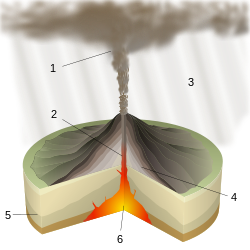
Plinian eruption: 1: ash plume; 2: magma conduit; 3: volcanic ash fall; 4: layers of lava and ash; 5: stratum; 6: magma chamber
1822 artist's impression of the eruption of Mount Vesuvius in 79, depicting what the AD 79 eruption may have looked like, by the English geologist George Julius Poulett Scrope. Lightning is depicted around the rising column of ash and gas.

Plinian eruptions or Vesuvian eruptions are volcanic eruptions characterized by their similarity to the eruption of Mount Vesuvius in 79 AD, which destroyed the ancient Roman cities of Herculaneum and Pompeii. The eruption was described in a letter[1] written by Pliny the Younger, after the death of his uncle Pliny the Elder.

Plinian eruptions eject columns of volcanic debris and hot gases high into the stratosphere, the second layer of Earth's atmosphere. They eject a large amount of pumice and have powerful, continuous gas-driven eruptions.

Eruptions can end in less than a day, or continue for days or months. The longer eruptions begin with production of clouds of volcanic ash, sometimes with pyroclastic surges. The amount of magma ejected can be so large that it depletes the magma chamber below, causing the top of the volcano to collapse, resulting in a caldera. Fine ash and pulverized pumice can be deposited over large areas. Plinian eruptions are often accompanied by loud sounds. The sudden discharge of electrical charges accumulated in the air around the ascending column of volcanic ashes also often causes lightning strikes, as depicted by the English geologist George Julius Poulett Scrope in his painting of 1822 or observed during 2022 Hunga Tonga–Hunga Ha'apai eruption and tsunami.[2]

The lava is usually dacitic or rhyolitic, rich in silica. Basaltic, low-silica lavas rarely produce Plinian eruptions unless specific conditions are met (low magma water content <2%, moderate temperature, and rapid crystallization);[3] a recent basaltic example is the 1886 eruption of Mount Tarawera on New Zealand's North Island.[4]

Pliny's description

[edit]
A stone pine, the type of tree used by Pliny the Younger to describe the eruption

Pliny the Younger described the initial observations of his uncle, Pliny the Elder, of the 79 AD eruption of Mount Vesuvius:[5]

On August 24th, about one in the afternoon, my mother desired him to observe a cloud which appeared of a very unusual size and shape. He had just taken a turn in the sun and, after bathing himself in cold water, and making a light luncheon, gone back to his books: he immediately arose and went out upon a rising ground from whence he might get a better sight of this very uncommon appearance. A cloud, from which mountain was uncertain, at this distance (but it was found afterwards to come from Mount Vesuvius), was ascending, the appearance of which I cannot give you a more exact description of than by likening it to that of a pine tree, for it shot up to a great height in the form of a very tall trunk, which spread itself out at the top into a sort of branches; occasioned, I imagine, either by a sudden gust of air that impelled it, the force of which decreased as it advanced upwards, or the cloud itself being pressed back again by its own weight, expanded in the manner I have mentioned; it appeared sometimes bright and sometimes dark and spotted, according as it was either more or less impregnated with earth and cinders. This phenomenon seemed to a man of such learning and research as my uncle extraordinary and worth further looking into.

— Sixth Book of Letters, Letter 16, translation by William Melmoth

Pliny the Elder set out to rescue the victims from their perilous position on the shore of the Bay of Naples, and launched his galleys, crossing the bay to Stabiae (near the modern town of Castellammare di Stabia). Pliny the Younger provided an account of his death, and suggested that he collapsed and died through inhaling poisonous gases emitted from the volcano. His body was found buried under the ashes of the eruption with no apparent injuries on 26 August, after the plume had dispersed, which would be consistent with asphyxiation or poisoning, but also with a heart attack, asthma attack, or stroke.

Examples

[edit]
April 21, 1990, eruption cloud from Redoubt Volcano as viewed to the west from the Kenai Peninsula (more than 60 km from the volcano's summit)
April 2015, subplinian eruption of Calbuco

Ultra-Plinian

[edit]

In 1980, the volcanologist George P. L. Walker proposed the Hatepe eruption as the representative of a new class called ultra-Plinian deposits, based on its exceptional dispersive power and eruptive column height.[8] A dispersal index of 50,000 square kilometres (19,000 sq mi) has been proposed as a cutoff for an ultra-Plinian eruption.[8] In the criteria of Volcanic Explosivity Index, recognizing an eruption as ultra-Plinian would make it at least VEI-5.[9]

The threshold for ultra-Plinian eruptions is an eruptive column height of 45 km (28 mi),[10] or 41 km (25 mi) more recently.[11] The few instances of eruptions that lie at the transition between Plinian and ultra-Plinian include the P3 phase of 1257 Samalas eruption,[12] 1991 eruption of Mount Pinatubo,[11] the Plinian phase of the Campanian Ignimbrite,[13] Tsankawi Pumice Bed of Tshirege Member of Bandelier Tuff,[14] and the 1902 eruption of Santa María.[15]

The once unequivocal ultra-Plinian classification of the Hatepe eruption has been called into question, with recent evidence showing that it is an artifact of an unrecognized shift in the wind field rather than extreme eruptive vigor.[16][17]

See also

[edit]

References

[edit]
[edit]
Revisions and contributorsEdit on WikipediaRead on Wikipedia
from Grokipedia
A Plinian eruption is a large, highly explosive volcanic event characterized by the formation of enormous columns of , ash, and gas that rise into the , typically exceeding 11 km in height. Named after , the Roman author who witnessed and described the 79 CE eruption of , these eruptions involve the rapid fragmentation of viscous, silica-rich magmas such as or rhyolite, driven by the expansion of dissolved volatiles. They eject substantial volumes of material—ranging from 0.5 to 50 cubic kilometers—and can persist for hours to days, producing widespread fallout, pyroclastic flows, and lahars. These eruptions feature sustained plumes with exit velocities of several hundred meters per second, often reaching heights of 25–45 km, which can inject aerosols into the upper atmosphere and influence global climate. The high vesicularity of clasts (65–85 vol%) reflects intense fragmentation near the vent. Plume collapse frequently generates fast-moving pyroclastic density currents, traveling at speeds up to 700 km/h and extending tens of kilometers from the , while ash dispersal can affect areas exceeding 400,000 square kilometers. Associated hazards include lethal surges, extensive deposits that bury landscapes, and secondary lahars from melting snow or rain mixing with ash. Historically, Plinian eruptions have caused significant devastation, such as the 79 CE Vesuvius event that buried the cities of Pompeii and under up to 2 meters of and killed around 2,000 people. More recent examples include the 1980 eruption in the United States, which produced a 31 km plume and lateral blast that devastated an area nearly 30 km across, reaching up to 28 km, and the 1991 eruption in the , with a record 45 km column that led to temporary . Though rarer for basaltic compositions, Plinian-style activity has also occurred at volcanoes like in in 1947–1948.

Overview

Definition

A Plinian eruption is defined as a highly volcanic event characterized by the sustained ascent of a turbulent column of gas, , and to altitudes typically ranging from 20 to 45 km, driven by the rapid release of magmatic volatiles from an open vent. These eruptions typically eject bulk volumes exceeding 1 km³ (corresponding to dense-rock equivalent volumes of about 0.1 km³ or more), distinguishing them from less intense styles through their capacity for widespread atmospheric injection and fallout. The term "Plinian" originates from the detailed eyewitness accounts provided by the Roman author in his letters describing the catastrophic 79 CE eruption of , which destroyed Pompeii and . This naming convention, adopted in modern , highlights the eruption's hallmark of a high-velocity, gas-thrust plume without preceding effusive phases like lava flows, setting it apart from milder Hawaiian (effusive) or Strombolian (mildly explosive) eruptions that produce lower fountains and smaller ejecta volumes. These eruptions involve the rapid fragmentation of viscous, silica-rich magmas such as or rhyolite. In the Volcanic Explosivity Index (VEI), Plinian eruptions are classified primarily as VEI 4 to 6, corresponding to mass eruption rates on the order of 10⁶ to 10⁸ kg/s and plume heights that enable stratospheric dispersal. This places them as a key in volcanic typologies, emphasizing conduit-clearing dynamics where volatile exsolution propels fragmented in a steady, high-energy stream, often transitioning to pyroclastic flows if the column collapses.

Characteristics

Plinian eruptions are characterized by the generation of exceptionally high eruption columns that rise tens of kilometers into the atmosphere, often sustained by convective processes for hours or days. These columns typically begin with an initial magmatic phase dominated by the ejection of fine and , resulting in widespread fallout deposits that blanket large areas. As the eruption progresses, the column may transition to co-ignimbrite clouds if partial occurs, producing additional fine-grained that disperses even farther. Maximum column heights can reach up to 45 km, as observed in models of sustained plumes in standard atmospheric conditions. The depositional products of Plinian eruptions consist primarily of layers comprising and , which exhibit relatively uniform grain sizes across proximal to medial distances due to the homogeneous nature of the erupted material. These deposits form widespread, elliptical patterns in isopach maps, reflecting the radial dispersal from the vent influenced by . Distal fine can travel hundreds of kilometers, sometimes encircling the globe within days, as evidenced by the global reach of ash from major events. High exit velocities exceeding 100 m/s at the vent propel the fragments into the atmosphere, forming distinctive umbrella-shaped plumes that spread laterally at the level. This contrasts sharply with lower-energy eruptions, where columns collapse more readily without achieving such heights or dispersal. While the eruption is fundamentally non-effusive and sustained, column instability can lead to associated pyroclastic surges and flows if collapse occurs, generating ground-hugging density currents.

Historical Context

Pliny the Younger's Description

Traditionally dated to August 24, 79 AD, per Pliny's account—a date reaffirmed by a 2024 study—though earlier debated in favor of October based on archaeological finds, during the catastrophic eruption of Mount Vesuvius, Pliny the Younger, then an 18-year-old Roman magistrate, was residing with his uncle, Pliny the Elder, at the naval base of Misenum on the Bay of Naples. The elder Pliny, commander of the fleet, observed the initial signs of the eruption around the seventh hour (approximately 1 PM) on August 24 and set out by ship to investigate and aid those in peril, ultimately perishing in the process. The younger Pliny remained at Misenum, where he documented the unfolding events in two letters written years later to the historian Tacitus, who sought details for his historical work. These letters, comprising Epistulae 6.16 and 6.20, provide the earliest surviving eyewitness account of a major volcanic eruption, spanning observations from the first day through the second. The letters begin with preliminary tremors that had rattled the region for days, commonplace in Campania but intensifying dramatically the night before into violent earthquakes that shook buildings and induced widespread fear. In the afternoon of August 24, a massive column of smoke and ash erupted from Vesuvius, rising to great height before spreading laterally; Pliny described it vividly as resembling "an umbrella pine," with a tall trunk that branched out, appearing white at times and mottled with earth and cinders at others. As the plume towered over the landscape, it cast flames visible from afar, accompanied by a deafening roar likened to bellows or thunder, and lightning flashes within the cloud. Ash and pumice began falling lightly at first, then in heavier showers resembling snow, accumulating to depths that threatened to bury structures and people; Pliny noted how the material grew hotter and thicker nearer the source, with blackened stones and debris littering the shores. By midday on the second day (), an oppressive descended upon Misenum and surrounding areas, blacker than any night and thick enough to obscure vision entirely, forcing reliance on torches for light; Pliny compared it to the gloom of a closed room, persisting until a dim dawn broke. Amid this, panic gripped the populace: screams echoed as families lamented lost loved ones, some invoked the gods in vain prayers, others falsely rumored that Misenum itself was collapsing or ablaze, heightening the terror. Pliny and his mother joined a fleeing outdoors, using pillows tied to their heads for protection against falling debris, before halting at a safer spot; the air grew heavy with sulfurous fumes, causing choking and flight among many. Though Pliny did not witness the directly from Misenum, his account alludes to the rapid engulfment of coastal villas by the advancing peril, including the burial under ash that spared his uncle's body but smothered him near . These epistles hold profound literary and as the first detailed record of an volcanic event, capturing not only but also human responses to catastrophe. Key passages, such as the pine-tree for the eruption column—"a of unusual size and shape... more closely resembled a pine-tree than anything else"—have enduringly shaped descriptions of such phenomena, directly inspiring the modern term "Plinian eruption" for highly styles. The letters emphasize the plume's sustained height and the extensive fallout, evoking societal chaos through depictions of noise, fear, and desperate evacuations, though lacking precise measurements or durations typical of ancient . While qualitative rather than quantitative, these observations align closely with criteria for Plinian events, such as prolonged eruptive columns and widespread dispersal, rendering Vesuvius the archetypal example.

Recognition in Volcanology

The scientific recognition of Plinian eruptions emerged in the early 20th century through detailed observations of major explosive events that echoed the ancient account of Vesuvius in 79 AD. The 1902 eruption of Santa María volcano in Guatemala marked a key milestone, as it was the largest explosive eruption documented in modern times up to that point, featuring a sustained column exceeding 28 km in height and widespread tephra fallout covering thousands of square kilometers, prompting comparisons to Vesuvian-style activity. Italian volcanologist Giuseppe Mercalli contributed to early understandings of eruption styles during this period, building on observations of Vesuvius and other Italian volcanoes to classify explosive phenomena, though formal linkage to the Plinian archetype solidified later. The term "Plinian" gained formal traction in the 1970s through the work of G.P.L. Walker, who defined it based on empirical data from historic and prehistoric deposits, emphasizing sustained eruption columns over 25 km high and volumes greater than 10 km³ as diagnostic features. Walker's scheme distinguished Plinian from lesser explosive types, including the newly proposed sub-Plinian category for events with dispersal areas around 500 km² and intermediate column heights. This framework was further refined in subsequent studies, integrating plume dynamics and deposit characteristics to quantify eruption intensity. By 1982, the concept was incorporated into the (VEI) by Newhall and Self, assigning Plinian eruptions to VEI levels 4–6 based on volume, height, and duration, enabling standardized comparisons across global . In contemporary , Plinian recognition supports hazard assessment, with agencies like the U.S. Geological Survey (USGS) applying these criteria to monitor volcanoes prone to large explosive events through seismic, gas, and deformation data. Refinements distinguish Plinian from sub-Plinian phases via mass eruption rates exceeding 10^7 kg/s, which sustain buoyant columns without early collapse, as modeled in plume dynamics studies. The nomenclature has been embraced internationally, including by the International Association of Volcanology and Chemistry of the Earth's Interior (IAVCEI), enhancing reconstructions of prehistoric Plinian events via tephrochronology, where isopach and isopleth mapping of distal ash layers provides precise stratigraphic markers for dating and correlation across regions.

Classification and Types

Plinian Eruptions

Plinian eruptions represent a class of highly volcanic events within the broader spectrum of eruptive styles, typically assigned a (VEI) of 4 to 6. These eruptions are defined by sustained, high-intensity discharge that sustains eruption columns reaching heights of 20 to 40 km, with mass eruption rates ranging from 10710^7 to 10810^8 kg/s. They commonly last from hours to days and produce total ejecta volumes of 0.1 to 50 km³ in dense rock equivalent (DRE). Sub-variations include sub-Plinian eruptions, which exhibit lower flux rates—often an order of magnitude below standard Plinian levels—and are classified as VEI 3 to 4, with column heights generally under 25 km. In comparison, Plinian eruptions differ markedly from Vulcanian styles, which involve discrete, pulsed explosions yielding lower volumes and column heights typically below 15 km, or from Pelean eruptions characterized by the formation of viscous lava domes with limited explosive components and minimal column development. The stratigraphic record of Plinian eruptions features layered pyroclastic fall deposits that display sorting gradients, with coarser, less sorted material near the vent transitioning to finer, better-sorted ash in distal regions; these patterns enable reconstruction of eruption progression from proximal to far-field sites. Such events occur at intervals of every few centuries at active silicic volcanoes, making them less frequent than effusive eruption types. The 79 AD eruption of Vesuvius exemplifies a benchmark Plinian event, while ultra-Plinian eruptions mark the more extreme end of this spectrum.

Ultra-Plinian Eruptions

Ultra-Plinian eruptions constitute the most intense subcategory of Plinian-style events, distinguished by their unparalleled magnitude and capacity for widespread geological and atmospheric disruption. The term is not strictly defined but typically refers to VEI 8 events (with VEI 7 as very large Plinian), featuring eruption columns that rise beyond 45 km into the , mass discharge rates exceeding 10910^9 kg/s, and total volumes surpassing 1000 km³ dense rock equivalent (DRE). Such events typically unfold over durations of days to weeks, sustained by continuous fragmentation and ascent. The extreme scale often results in the collapse of vast overlying structures, forming large calderas tens of kilometers in diameter above depleted reservoirs. The superior explosivity of ultra-Plinian eruptions arises from extraordinarily elevated volatile concentrations—often 5-7 wt% and significant CO₂—in the underlying rhyolitic or dacitic magmas, which generate overpressures sufficient to propel material at velocities exceeding 100 m/s through conduits up to several kilometers wide. This contrasts sharply with standard Plinian eruptions, which exhibit lower mass rates (typically 10710^7 to 10810^8 kg/s) and more localized impacts; ultra-Plinian dynamics enable plume overshoot into the , promoting hemispheric or global ash dispersal via stratospheric winds and inducing short-term cooling through veils lasting years. formation is nearly ubiquitous, as the rapid evacuation of >1000 km³ DRE destabilizes the edifice, unlike the sub-caldera or no-collapse outcomes in less voluminous Plinian cases. Such eruptions, almost exclusively linked to supervolcanic centers where long-lived silicic systems accumulate, have global recurrence intervals of 10^4 to 10^5 years. Their stratigraphic signatures include voluminous, welded blankets covering thousands of square kilometers and distal fine (silt-sized) layers traceable across continents, reflecting the dual Plinian fallout and co-ignimbrite phases. These features provide critical for paleovolcanic reconstructions and highlight the rarity of such cataclysmic activity. See the "Notable Examples" section for specific cases. In modern hazard assessment, ultra-Plinian parameters guide probabilistic modeling of super-eruption scenarios, such as those evaluated for the Yellowstone system, where potential events could inject >1,000 km³ DRE and disrupt , , and for decades. This framework underscores their role in quantifying existential risks from volcanic unrest at caldera complexes.

Eruption Mechanisms

Magma Composition and Volatiles

Plinian eruptions are characteristically fed by magmas ranging from intermediate to compositions, specifically to rhyolite, with silica contents typically between 60 and 75 wt% SiO₂. This high silica content imparts a high to the , on the order of 10⁴ to 10⁷ Pa·s, which inhibits the efficient escape of dissolved gases and promotes the buildup of necessary for fragmentation. The viscous nature arises from the polymerized melt structure in these compositions, contrasting with less viscous magmas that tend toward effusive eruptions. The explosivity of Plinian eruptions is fundamentally driven by the high concentrations of dissolved volatiles in the , primarily (H₂O at 4–6 wt%) along with (CO₂ at 0.1–1 wt%), (S), and (Cl). During ascent-induced decompression, these volatiles exsolve to form bubbles, dramatically expanding the volume by factors of 10 to 100 times as the gas pressure drops from magmatic depths to atmospheric conditions. This rapid bubble and growth enhances and fragmentation, converting the initially dense melt into a highly porous, pyroclastic mixture. Pre-eruptive magma storage occurs in shallow chambers at depths of 5–10 km, where pressures (150–300 MPa) allow of volatiles without significant prior . Rapid ascent rates, often exceeding 10 m/s (equivalent to over 36 km/hr in the shallow conduit), minimize diffusive gas loss and preserve the volatile budget during transit to the surface. The typically contains 20–50 vol% crystals, such as , , and , which increase effective and promote shear-induced fragmentation upon bubble expansion. Eruptions are often triggered by magma replenishment from deeper, mafic sources, which introduces hotter, volatile-rich material that destabilizes the resident chamber and generates overpressure through convection and volatile influx. Alternatively, tectonic stress can fracture the chamber roof, facilitating sudden decompression and volatile release. These processes ensure the rapid mobilization of the primed system toward Plinian-style explosivity.

Dynamics of Eruption Column

During the ascent phase of a Plinian eruption, undergoes rapid decompression as it rises through the conduit, leading to vesiculation where dissolved volatiles exsolve to form bubbles. This process accelerates bubble growth, increasing the 's until it reaches a critical threshold, resulting in fragmentation into pyroclasts typically at depths of 1-5 km below the surface. The fragmentation is driven by the interplay of and shear stresses, producing a high-velocity of gas and particles that exits the vent. Conduit models indicate exit velocities of 400-600 m/s for typical Plinian conditions, influenced by the volatile content and conduit . The eruption column transitions through distinct regimes as it propagates upward. In the initial gas-thrust region, near the vent, the column's ascent is dominated by the of the exiting mixture, extending several kilometers where remains higher than the surrounding atmosphere but is sufficient to prevent immediate . This gives way to the convective at heights of approximately 10-20 km, where from heated entrained air sustains upward motion. Column stability depends on the balance between the plume's and atmospheric ; if the plume exceeds ambient values due to insufficient entrainment, partial or full can occur, generating pyroclastic currents. Entrainment of ambient air, parameterized by an entrainment ratio λ of about 0.2-0.3 in the gas-thrust region and lower values (~0.1) in the convective region, is crucial for diluting the plume and promoting . Key mathematical descriptions underpin these dynamics. The eruption power is quantified by the mass flux ṁ = ρ A v, where ρ is the of the gas-particle , A is the conduit cross-sectional area, and v is the exit velocity; this determines the initial input to the column. A simplified expression for the maximum plume H in the convective is given by H8.2Q1/4,H \approx 8.2 Q^{1/4}, where Q is the steady rate of thermal release in watts (e.g., Q \approx \dot{m} s (T - T_a) F, with s the specific heat of the , T the eruption , T_a the ambient , and F an efficiency factor); this arises from integrating the with constant entrainment assumptions in a stratified atmosphere. Plinian eruptions often exhibit unsteady flow, manifesting as pulsing in the column due to variations in conduit conditions such as or intermittent fragmentation. These pulses can produce multiple discrete phases within a prolonged event, with each characterized by fluctuating and column height, as observed in stratigraphic records of ancient eruptions.

Notable Examples

Ancient and Prehistoric

One of the most significant prehistoric Plinian eruptions occurred during the Late Bronze Age with the Minoan eruption of Thera (Santorini) around 1600 BCE, classified as a VEI 6-7 event that ejected tens of cubic kilometers of material. Geological evidence includes thick pyroclastic deposits on the island and distal ash layers distributed across the eastern Mediterranean, identified through sediment cores and archaeological sites in Crete and beyond, confirming widespread fallout from the explosive column. Tsunami deposits, such as chaotic sediment layers with marine microfossils up to several meters thick, have been documented on Crete's northern coast, linking the eruption's caldera collapse to coastal inundation. This event has been implicated in debates over the Minoan civilization's decline and broader Bronze Age disruptions in the Aegean, though direct causation remains contested based on stratigraphic correlations with cultural layers. Far earlier, the ultra-Plinian eruption at in approximately 74,000 years ago represents one of the largest known volcanic events, with a VEI 8 magnitude and an ejecta volume exceeding 2,800 km³ of rhyolitic material. layers from this eruption, chemically matched to the source via glass shard analysis, appear in marine sediments across the , extending thousands of kilometers and providing key markers for global dispersal. The event's potential to induce a , inferred from modeled sulfate aerosol loading and paleoclimate proxies like ice cores, has been hypothesized to influence early human populations, though recent studies emphasize regional variability in impacts. In , the from Campi Flegrei around 39,000 years ago produced a VEI 7 Plinian phase followed by extensive flows, covering over 30,000 km² with and . Welded and non-welded sheets, up to hundreds of meters thick near the source, have been mapped across and traced distally via , revealing a complex pyroclastic density current sequence. Links to have been proposed through correlations of layers with archaeological sites showing population disruptions during a subsequent cold period, though multi-factorial causes including climate and competition are supported by of affected strata. Reconstruction of these prehistoric eruptions relies on integrated geological methods, including of organic materials interlayered with for chronological constraints and tephrostratigraphy to correlate layers across sites using compositional fingerprinting of and minerals. Volume estimates are derived from isopach maps, which contour thickness variations to model dispersal patterns and integrate with deposit density for total calculations, providing robust proxies where direct observations are absent.

Historical Eruptions

The eruption of in 79 AD is the archetypal Plinian event, lasting approximately 18-36 hours in its main explosive phase and ejecting approximately 4 km³ of dense rock equivalent (DRE) . It featured multiple Plinian phases characterized by sustained eruption columns exceeding 30 km in height, interspersed with pyroclastic surges that devastated surrounding areas. The event buried the Roman cities of Pompeii and under layers of and up to 20 m thick, preserving them as archaeological sites. In 1875, volcano in produced a VEI 5 Plinian eruption with a bulk volume of about 2 km³, beginning with phreatomagmatic activity on and transitioning to a dry Plinian phase by April 1. The eruption column reached over 20 km, dispersing fine ash across and contributing to widespread agricultural failure and famine in , which prompted significant . The 1902 eruption of Santa María in was a VEI 6 Plinian event that ejected approximately 8.5 km³ of dacitic and ash over several days starting , forming a large on the volcano's SW flank. Pyroclastic flows and surges traveled up to 20 km, causing around 5,000 deaths primarily from direct impacts and subsequent disease outbreaks in affected communities. Novarupta's 1912 eruption in , the largest of the 20th century with a VEI 6 rating, explosively discharged about 13 km³ DRE of rhyolitic over roughly 60 hours from 6-8. Three Plinian phases generated widespread ashfall and pyroclastic flows that filled the Valley of Ten Thousand Smokes, a 13-km-long feature named for its fumarolic vents. Mount Pinatubo's 1991 eruption in the reached VEI 6, releasing approximately 5 km³ DRE (bulk volume of 8-10 km³) of andesitic during its climactic phase on 15, following precursory explosions from March onward. The event injected over 20 million tons of into the , leading to measurable of about 0.5°C for 1-2 years. Advance warnings enabled the successful evacuation of over 60,000 people from high-risk zones, minimizing direct fatalities. More recently, the 2015 eruption of Calbuco in was classified as sub-Plinian with a VEI 4, featuring two major explosive pulses on April 22-23 that produced ash plumes exceeding 15 km and pyroclastic flows extending 7 km. The eruption in the in January 2020 also qualified as sub-Plinian at VEI 4, with a 90-minute phreatomagmatic phase on January 12 generating a 15-km plume and ashfall affecting 60 km away.

Hazards and Impacts

Immediate Hazards

Plinian eruptions pose severe immediate hazards primarily through the generation of pyroclastic flows and surges, which form when the tall eruption column collapses under its own weight. Pyroclastic flows are dense, high-velocity avalanches of hot volcanic debris, gas, and ash that hug the ground and follow , typically traveling at speeds of 50 to over 150 km/h with temperatures exceeding 800°C. These flows can extend 10 to 50 km from the vent, incinerating, burying, or mechanically destroying everything in their path within a radius that devastates proximal areas. For instance, during the 79 CE eruption of Vesuvius, multiple pyroclastic surges—more dilute, ground-hugging versions of flows—propagated up to 20 km, with dynamic pressures reaching 10 to 100 kPa sufficient to demolish structures and cause lethal thermal and impact injuries. Tephra fallout represents another proximal to distal threat, as fine and larger fragments are ejected high into the atmosphere and settle over vast areas, often blanketing regions 100 to 1,000 km downwind depending on wind patterns and eruption intensity. Particle sizes decrease with distance, from coarse lapilli near the vent to fine (<2 mm) farther afield, leading to hazards such as abrasion of skin and eyes, respiratory issues from inhalation, and mechanical damage to vehicles and infrastructure. Accumulations as thin as 20 cm can close roads due to reduced visibility and traction loss, while thicknesses exceeding 30-50 cm—common within 10-20 km—often cause roof collapses on poorly constructed buildings, as observed during the 1991 Pinatubo eruption where ash loads led to widespread structural failures. Ballistic projectiles, consisting of large rock fragments ejected directly from the vent, pose a concentrated near-vent hazard, impacting areas within 5 km and occasionally farther. These bombs and blocks, typically less than 1 m in diameter but up to several meters in major explosions, follow parabolic trajectories influenced by launch velocity (often 100-300 m/s) and can strike with sufficient kinetic energy to crater the ground, damage buildings, or cause fatalities upon impact. In Plinian events, such projectiles are most dangerous in the immediate 1-2 km radius but have been documented up to 5 km from the vent in historical cases like Vesuvius. Post-eruption lahars, or volcanic mudflows, emerge as a secondary but persistent immediate hazard when heavy rainfall remobilizes loose pyroclastic deposits in river valleys, forming fast-moving slurries of water, ash, and debris confined to channels. These flows can travel tens of kilometers at speeds of 5-25 m/s with depths up to several meters, eroding banks, burying communities, and destroying bridges for weeks to months following the eruption, particularly during rainy seasons. At Pinatubo, post-1991 lahars persisted for years, mobilizing up to 10^7 m³ of material annually and posing ongoing threats to downstream areas. Effective monitoring and mitigation of these hazards rely on detecting precursors and real-time indicators to estimate eruption scale and warn populations. Seismic networks identify precursors such as long-period earthquakes and tremor signaling magma ascent, often days to weeks before climax. Sulfur dioxide (SO₂) plumes, measured via satellite or ground-based spectrometers, provide estimates of volcanic explosivity index (VEI) by correlating emission rates (e.g., >0.1 Tg for sub-Plinian events) with mass eruption rates, enabling forecasts of column height and fallout extent. includes evacuation zones mapped to 10-50 km for flows and surges, reinforced roofs in tephra-prone areas, and lahar detection systems like acoustic gauges in drainages.

Long-term Effects

Plinian eruptions inject significant amounts of (SO₂) into the , typically ranging from 1 to 20 teragrams (Tg), which oxidizes to form aerosols that reflect incoming solar radiation and induce of 0.5–5°C lasting 1–10 years. For instance, the 1991 eruption released approximately 20 Tg of SO₂, resulting in a global temperature drop of about 0.5°C for roughly two years. Similarly, the 1815 eruption emitted 53–58 Tg of SO₂, contributing to the "" in 1816, with cooling of 0.4–0.7°C and widespread frost and snowfall in summer months. These climatic perturbations arise from the aerosols' , which can persist due to stratospheric residence times of 1–3 years. Ecologically, Plinian eruptions cause extensive disruption through ash deposition, leading to , infertility, and , with recovery timelines spanning 10–100 years depending on ash thickness, climate, and proximity to the source. Heavy ash loads compact , reduce permeability, and strip nutrients, rendering landscapes barren and inhibiting seed for decades; for example, post-eruption sites like those from (a comparable explosive event) showed vascular plant colonization within 16 years but full forest recovery requiring over a century in severely affected areas. declines sharply in the initial years due to and pioneer species dominance, though resilient ecosystems may rebound faster in humid regions, with increasing gradually over 50–100 years as accumulates. Societally, these eruptions trigger crop failures, forced migrations, and economic burdens, compounded by long-term issues such as chronic respiratory problems from inhaled ash particles. The Tambora eruption's cooling led to global famines, with crop yields in and dropping by up to 90% in 1816, prompting mass migrations and social unrest. For Pinatubo, economic costs exceeded $700 million, including $250 million in agricultural losses and disruptions, alongside potential ongoing impacts such as chronic respiratory problems and the risk of from inhaled ash particles in exposed populations. Ultra-Plinian events, with emissions exceeding 50 Tg SO₂, can induce hemispheric or global "volcanic winters" affecting distant , whereas standard Plinian eruptions often result in more regional famines and localized economic strain. Paleoclimate records from ice cores provide evidence of past Plinian events through prominent sulfate spikes, enabling reconstruction of eruption timing and climatic forcing over millennia. For example, and ice cores reveal sulfate depositions corresponding to major eruptions like Tambora, with peak concentrations reflecting stratospheric injections of 10–60 Tg SO₂ and associated cooling episodes. These proxies highlight the recurrent nature of such impacts, informing models of volcanic influence on historical variability.

References

Add your contribution
Related Hubs
User Avatar
No comments yet.