Hubbry Logo
Gaius Suetonius PaulinusGaius Suetonius PaulinusMain
Open search
Gaius Suetonius Paulinus
Community hub
Gaius Suetonius Paulinus
logo
8 pages, 0 posts
0 subscribers
Be the first to start a discussion here.
Gaius Suetonius Paulinus
from Wikipedia

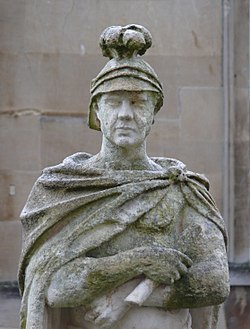
Gaius Suetonius Paulinus[a] (fl. AD 40–69) was a Roman general best known as the commander who defeated Boudica and her army during the Boudican revolt.

Key Information

Early life

[edit]

Little is known of Suetonius' family, but it likely came from Pisaurum (modern Pesaro), a town on the Adriatic coast of Italy.

Mauretanian campaign

[edit]

Having served as praetor in 40 AD, Suetonius was appointed governor of Mauretania (modern northern Morocco) the following year. In collaboration with Gnaeus Hosidius Geta, he suppressed the revolt led by Aedemon in the mountainous province that arose from the execution of the local ruler by Caligula.[1] In 41 AD Suetonius was the first Roman commander to lead troops across the Atlas Mountains,[2] and Pliny the Elder quotes his description of the area in his Natural History.[3]

Governor of Britain

[edit]

In 58 AD, before being consul,[4] he was appointed governor of Britain, replacing Quintus Veranius, who had died in office.[5] He continued Veranius's policy of aggressively subduing the tribes of modern Wales, and was successful for his first two years in the post. His reputation as a general came to rival that of Gnaeus Domitius Corbulo.[6] Two future governors served under him: Quintus Petillius Cerialis as legate of Legio IX Hispana,[7] and Gnaeus Julius Agricola[8] as a military tribune attached to II Augusta, but seconded to Suetonius's staff.

Around 60 or 61 AD Suetonius made an assault on the island of Mona (Anglesey), a refuge for British fugitives and a stronghold of the druids. The tribes of the south-east took advantage of his absence and staged a revolt, led by queen Boudica of the Iceni. The colonia of Camulodunum (Colchester) was destroyed, its inhabitants tortured, raped, and slaughtered, and Petillius Cerialis's legion routed. Suetonius brought Mona to terms[vague] and marched along the Roman road of Watling Street to Londinium (London), the rebels' next target, but judged he did not have the numbers to defend the city and ordered it evacuated. The Britons duly destroyed it, the citizens of Londinium suffering the same fate as those of Camulodunum, and then did the same to Verulamium (St Albans).[9]

Suetonius regrouped with the XIV Gemina, some detachments of the XX Valeria Victrix, and all available auxiliaries. The II Augusta, based at Exeter, was available, but its prefect, Poenius Postumus, declined to heed the call. Nonetheless, Suetonius was able to assemble a force of about ten thousand men. Heavily outnumbered (the Britons numbered 230,000 according to Cassius Dio),[10] the Romans stood their ground. The resulting battle took place at an unidentified location in a defile with a wood behind him, probably in the West Midlands somewhere along Watling Street – at Cuttle Mill, 2 miles southeast of Towcester in Northamptonshire, in front of a narrow defile which answers the topographical description of Tacitus, human bones have been found over a large area;[11] High Cross in Leicestershire and Manduessedum near the modern day town of Atherstone in Warwickshire have also been suggested - where Roman tactics and discipline triumphed over British numbers. The Britons' flight was impeded by the presence of their own families, whom they had stationed in a ring of wagons at the edge of the battlefield, and defeat turned into slaughter. Tacitus heard reports that almost eighty thousand Britons were killed, compared to only four hundred Romans. Boudica poisoned herself, and Postumus, having denied his men a share in the victory, fell on his sword.[12]

Suetonius reinforced his army with legionaries and auxiliaries from Germania and conducted punitive operations against any remaining pockets of resistance, but this proved counterproductive. The new procurator, Gaius Julius Alpinus Classicianus, expressed concern to the Emperor Nero that Suetonius's activities would only lead to continued hostilities. An inquiry was set up under Nero's freedman, Polyclitus, and an excuse, that Suetonius had lost some ships, was found to relieve him of his command. He was replaced by the more conciliatory Publius Petronius Turpilianus.[13] But Suetonius was not disgraced: a lead tessera found in Rome features both his and Nero's names and symbols of victory, and a man named Gaius Suetonius Paulinus was consul in 66 AD, either a son of the same name [4] or the general himself[14] appointed for a second time.[15]

Year of Four Emperors

[edit]

In 69, during the year of civil wars that followed the death of Nero (see Year of Four Emperors), Suetonius was one of Otho's senior generals and military advisors.[16] He and Aulus Marius Celsus defeated Aulus Caecina Alienus, one of Vitellius's generals, near Cremona, but Suetonius would not allow his men to follow up their advantage and was accused of treachery as a result.[17] When Caecina joined his forces with those of Fabius Valens, Suetonius advised Otho not to risk a battle but was overruled, leading to Otho's decisive defeat at Bedriacum.[18] Suetonius was captured by Vitellius and obtained a pardon by claiming that he had deliberately lost the battle for Otho, although this was almost certainly untrue.[19] His eventual fate remains unknown.

Notes

[edit]

References

[edit]
Revisions and contributorsEdit on WikipediaRead on Wikipedia
from Grokipedia
Gaius Suetonius Paulinus (fl. c. AD 40–69) was a Roman senator and general distinguished for his suppression of tribal revolts in and his governance of , where he orchestrated the crushing of Boudica's despite its near-catastrophic initial success against Roman settlements. Paulinus first gained prominence under Emperor by commanding a legion in , where he quelled a widespread uprising led by local kings, earning imperial commendation for his tactical acumen in naval and land operations across the region. Later appointed as imperial legate of Lower Germany, he maintained stability along the frontier before assuming the governorship of Britain in AD 59. There, records his methodical advance against the druidic stronghold of Mona (modern ), involving the construction of a bridge of boats to ferry troops across the , only for news of Boudica's revolt to interrupt the campaign. The , sparked by Roman fiscal exactions and atrocities against the royalty, saw the destruction of , , and , with up to Britons slain in the ensuing carnage before Paulinus regrouped his forces—numbering perhaps legionaries and auxiliaries—and inflicted a devastating defeat on a rebel host estimated at 230,000 near , employing disciplined Roman formations to exploit the rebels' numerical disadvantage through superior tactics and terrain selection. , drawing on senatorial records and possibly familial connections, portrays Paulinus as a of proven valor whose strategic restraint post-victory helped restore Roman control, though his absence during the revolt's onset drew later scrutiny for overextending resources. He departed Britain around AD 62 amid policy shifts under , subsequently holding the consulship in AD 66 alongside Gaius Telesinus and navigating the by initially backing Otho's bid against before withdrawing from active command.

Origins and Early Career

Family Background and Initial Positions

Gaius Suetonius Paulinus hailed from an obscure family background, with limited details surviving in historical records. His origins are tentatively linked to Pisaurum (modern ) on Italy's Adriatic coast, though primary evidence for this association remains sparse and unconfirmed by inscriptions or contemporary accounts. Suetonius entered the senatorial , achieving the praetorship by around 40 CE during the reign of Emperor . This office marked his initial prominent position, qualifying him for subsequent military commands as an ex-praetor. In 41–42 CE, Suetonius was dispatched to to suppress a local revolt led by figures such as Aedemon, collaborating with the legate Gnaeus Hosidius Geta. During this campaign, he demonstrated aggressive tactics, advancing Roman forces beyond established frontiers and becoming the first Roman commander to traverse the , extending control into previously unexplored Berber territories. These actions earned him recognition for military prowess, setting the stage for higher provincial governorships.

Mauretanian Campaigns

Suppression of Rebellions and Atlas Expedition

Following the execution of , king of , by Caligula in late 40 AD, the region erupted in revolt led by Aedemon, a former slave loyal to Ptolemy who sought vengeance against Roman rule. , ascending in January 41 AD, dispatched Gaius Suetonius Paulinus—recently in 40 AD—as legate to to suppress the uprising alongside Cn. Hosidius Geta, who targeted rebel leader Sabalus. Paulinus's forces engaged Moorish rebels in sustained campaigning, achieving victories that restored Roman control and prompted the to vote a triumph, which the emperor declined in favor of lesser honors. During these operations in 41 AD, Paulinus led the first recorded Roman military expedition across the in southern , advancing several miles beyond the range to explore and secure the hinterlands. , drawing on Paulinus's own account in Natural History (5.14), describes the crossing: the summits were snow-covered even in summer, followed by dense forests of unusually tall trees, then a barren desert, and finally encounters with Gaetulian peoples resembling Ethiopians who dwelt in scattered huts amid fertile valleys with remnants of ancient habitations like vineyards and palm groves. This incursion not only subdued potential rebel refuges but yielded geographical insights later cited by Roman writers, marking Paulinus's promotion to legatus legionis for his effectiveness in rugged terrain. The campaigns concluded by 42 AD, paving the way for 's formal annexation into provinces under .

Governorship of Britannia

Appointment and Welsh Conquests

Gaius Suetonius Paulinus was appointed governor of by Emperor in AD 58, succeeding Veranius, who had died shortly after assuming the post earlier that year. His tenure marked a shift toward aggressive expansion in the province's western frontiers, aiming to suppress remaining tribal resistance and eradicate Druidic influence, which Roman authorities viewed as a source of rebellion. Paulinus, drawing on his prior experience in , commanded approximately three legions—likely the II Augusta, XIV Gemina, and XX Valeria Victrix—along with auxiliary forces totaling around 20,000-30,000 men for operations in the region. Upon arrival, Paulinus prioritized subduing unconquered tribes in what is now , including campaigns against the in the northeast during AD 58-59, where Roman forces constructed forts to secure territory amid guerrilla opposition. These efforts extended Roman control over mineral-rich areas and disrupted tribal alliances, building on prior governorships that had focused on southern tribes like the . By AD 60, with mainland largely pacified, Paulinus targeted the island of Mona (modern ), a Druidic stronghold and refuge for rebels from the mainland, separated by the . Paulinus assembled a naval and force to cross the , employing pontoon bridges or shallow-draft vessels to overcome tidal currents and tidal sands. According to in 14.29-30, the Roman advance encountered fanatical resistance: Druids, clad in white robes, invoked curses from the shore, while armed bands and garments rushed forward with torches, creating an aura of terror that briefly unnerved the troops before they recovered and charged. Legionaries subsequently slaughtered the defenders, destroyed sacred groves adorned with human trophies, and razed Druidic sanctuaries, effectively dismantling the island's religious and rebellious center. The conquest of Mona, however, proved temporary; as Paulinus fortified beachheads and pursued fugitives, urgent dispatches arrived detailing Boudica's revolt in southeastern , compelling him to abandon the island and march eastward with his legions, leaving vulnerable to later reoccupation by natives. This interruption highlighted the risks of overextended campaigns, as the focus on diverted forces from vulnerable client kingdoms in the east.

The Boudican Revolt

In AD 60, while Suetonius Paulinus was engaged in suppressing druidic resistance on the island of Mona (modern Anglesey), a major revolt erupted among the Iceni tribe in eastern Britain. The uprising was triggered by the death of King Prasutagus, who had sought to secure his family's status through a will bequeathing half his estate to Rome; instead, the imperial procurator Catus Decianus seized the entire kingdom, leading to the flogging of Boudica, Prasutagus's widow, and the rape of their daughters by Roman creditors. This provoked the Iceni, allied with the Trinovantes, to rebel openly, overrunning the veteran colony at Camulodunum (Colchester) and massacring its inhabitants, including the temple to divine Claudius. The rebels, led by , then advanced on (London), which they sacked after the Roman authorities evacuated it, followed by (St Albans); reports approximately 70,000 Roman citizens and allies slain across these three settlements. An attempt by the legate of the IX Hispana legion, , to intercept the rebels en route to resulted in his cohort being ambushed and annihilated, with the legion's eagle standard captured. , upon receiving news of the disturbances, abandoned the Mona campaign and hastened southward with his available auxiliaries, evading the widespread unrest to link up with the XIV Gemina and elements of the XX Valeria Victrix legions, mustering roughly 10,000 disciplined troops including . Emperor , alarmed by the scale of the crisis and distrustful of 's capacity to recover the province, considered replacing him with Vettius Bolanus but relented after Suetonius insisted on confronting the rebels directly. In summer AD 61, Suetonius positioned his forces in a narrow defile along , advantageous for Roman infantry tactics and limiting the Britons' numerical superiority; 's host, described by as an immense multitude encumbered by families and wagons blocking their rear, launched a but faltered against the Romans' coordinated advance and fire. The ensuing battle saw the Britons routed, with Tacitus estimating 80,000 enemy dead—including many non-combatants—against 400 Roman losses, attributed to the legions' discipline and the rebels' tactical errors. subsequently poisoned herself, and the revolt collapsed, though the province remained unstable.

Post-Revolt Pacification and Recall

Following his decisive victory over Boudican forces at the Battle of Watling Street in AD 61, Suetonius Paulinus accepted the submissions of surviving Britons, but pursued a policy of severe retribution against rebels and their supporters. This included widespread confiscations of property, executions of ringleaders, and punitive taxation to replenish Roman losses, exacerbating among the native population who had neglected in anticipation of expelling the Romans. reports that Paulinus's legions restored order through these measures, yet the governor's emphasis on vengeance over reconstruction alienated provincial administrators and prolonged unrest in pacified areas. Tensions escalated with the appointment of Julius Classicianus as imperial procurator, succeeding the disgraced . Classicianus, prioritizing fiscal recovery and loyalty restoration, publicly blamed Paulinus for exacerbating divisions by favoring retaliation over clemency, arguing that the province's welfare required conciliatory governance rather than continued military coercion. He communicated these views directly to Emperor , advocating delay in further aid until a successor arrived, which undermined Paulinus's and highlighted administrative discord between military and financial officials. Alarmed by reports of instability, Nero dispatched his freedman Polyclitus in AD 62 to investigate and mediate between Paulinus and Classicianus. Polyclitus's inquiry, conducted amid ongoing submissions from tribes, ostensibly confirmed harmony but exposed Paulinus's mishandling of logistics, including the loss of supply ships, prompting his relief from command. He was replaced by Publius Turpilianus, whose tenure shifted toward balanced pacification—neither aggressive nor undue leniency—fostering peace between Romans and subdued Britons without major campaigns. , drawing from senatorial perspectives sympathetic to Paulinus, portrays the recall as influenced by court freedmen like Polyclitus, though archaeological evidence of rebuilt forts and reduced unrest under Turpilianus supports a policy pivot toward stabilization.

Later Honors and Civil War Involvement

Consulship and Return to Italy

Suetonius Paulinus was succeeded as governor of by Publius Petronius Turpilianus around AD 62, after overseeing the province's pacification following the , which prompted his return to . Tacitus notes that Paulinus lingered briefly post-revolt but was replaced amid Nero's preference for a successor balancing clemency and firmness, reflecting the emperor's dissatisfaction with Paulinus's reportedly harsh measures during the suppression. In AD 66, Paulinus held the office of suffect consul, serving alongside Luccius Telesinus from approximately onward, as attested in consular and Tacitus's reference to events under their . This honor, typical for distinguished imperial officials, marked a restoration of favor under despite prior provincial setbacks, positioning Paulinus for further prominence amid emerging imperial instability.

Role in the

Following the assassination of Emperor on 15 January 69 AD, Marcus Salvius seized power and appointed Suetonius Paulinus, alongside Annius Gallus and Marius , as one of his principal generals to confront the forces of Aulus advancing from . Paulinus, esteemed for his prior military achievements including the suppression of the , commanded the Othonian in the initial clashes near . Prior to the decisive engagement, Paulinus urged Otho to delay battle, reasoning that Vitellius's troops held the advantage in swift action while Otho's position would strengthen with arriving reinforcements from the legions in Pannonia, Moesia, and Dalmatia, supplemented by eastern forces under Mucianus; he proposed fortifying the Po River as a defensive barrier to exploit this temporal edge. This counsel aligned with a strategy of attrition, leveraging Otho's control over Italy's resources against the Vitellians' extended supply lines, though it drew criticism from impatient legionaries who favored immediate confrontation. Otho, swayed by the praetorian prefect Licinius Proculus and consul-elect Publius Marius Celsus's successor Orfidius Benignus Titianus—who lacked Paulinus's experience—rejected the delay and ordered an assault, culminating in the Othonian defeat at the First on 14 April 69 AD. Paulinus's forces suffered heavy losses amid tactical disarray, including failed maneuvers and the collapse of allied contingents; he and Proculus fled the field post-rout to rejoin . After Otho's on 16 April 69 AD, Paulinus, experiencing initial detention and uncertainty under Vitellian commanders Aulus Caecina Alienus and Fabius Valens, ultimately submitted and secured clemency, avoiding execution or as consolidated power in by late April. He took no recorded active part in the ensuing Flavian revolt or the Second in October 69 AD that elevated , retiring from prominence thereafter with his life and property intact under the new regime.

Historical Sources and Assessment

Primary Accounts

The principal ancient accounts of Gaius Suetonius Paulinus derive from the Roman historians Tacitus and Cassius Dio, with Tacitus providing the most detailed narrative. In his Annals (Book 14, chapters 29–39), Tacitus describes Paulinus's governorship of Britannia from AD 58 to 62, emphasizing his strategic march to subdue the druids on Mona (Anglesey) in AD 60, which inadvertently left southern Britain vulnerable to the Iceni-led revolt under Boudica. Tacitus portrays Paulinus as a disciplined commander who, upon learning of the uprising, rapidly regrouped his forces—including the XIV Legion, detachments from the XX Legion, and auxiliaries—totaling about 10,000 men, to confront the Britons in a narrow defile, where he delivered a pre-battle speech exhorting his troops to valor against a numerically superior foe estimated by later sources at up to 230,000. The account credits Paulinus with a decisive victory, attributing Roman success to disciplined infantry tactics and the rebels' disorder, resulting in heavy British casualties while minimizing Roman losses. Tacitus further references Paulinus in his Histories (Book 2), depicting his role during the in AD 69, where, as a respected consular, he advised caution amid Otho's failed bid against , critiquing the emperor's overconfidence and the army's exhaustion after prior campaigns. , writing in the early AD as the son-in-law of the British governor Agricola, generally presents Paulinus favorably as a capable, if severe, leader whose post-revolt pacification stabilized , though he notes the procurator Catus Decianus's fiscal exactions as a revolt trigger, implicitly critiquing administrative overreach rather than Paulinus's conduct. Cassius Dio's Roman History offers briefer, episodic coverage, primarily in Books 60 and 62 (as preserved in epitomes). In Book 60 (chapter 9), Dio records Paulinus's praetorian command in around AD 41–42, where he overran rebel territories to Mount Atlas, marking the first Roman traversal of those heights, though Dio attributes subsequent advances to Gnaeus Hosidius Geta. For , Book 62 details the Boudican revolt's scale, claiming 70,000–80,000 Roman civilian deaths and Boudica's forces swelling to 230,000, with Paulinus's victory at a wooded gorge site inflicting massive losses (up to 80,000 Britons slain per Dio's figures) through superior Roman arms and discipline. Dio, compiling in the AD from earlier sources, emphasizes the revolt's ferocity and Paulinus's consulship in AD 66 alongside Telesinus, framing it amid Nero's era of "glory and disgrace." His accounts, less granular than Tacitus's, prioritize imperial context over personal , potentially exaggerating casualty numbers for dramatic effect. No substantial accounts survive from contemporary writers like or , and Suetonius's imperial biographies omit Paulinus. Epigraphic evidence, such as inscriptions attesting his , supplements but does not narrate events. Tacitus's proximity to the era (drawing possibly from senatorial records or ) lends his depiction greater reliability for Paulinus's British campaigns, while Dio's later synthesis reflects selective abbreviation, underscoring the scarcity of independent primary testimony.

Modern Interpretations and Debates

Modern historians generally portray Gaius Suetonius Paulinus as a highly competent and professional Roman commander, emphasizing his prior successes in and his effective leadership in stabilizing amid crisis. His governorship is assessed as aggressively expansionist, prioritizing the subjugation of resistant tribes and druidic centers to consolidate Roman control, rather than passive administration. Scholars note that Paulinus' campaigns reflect standard imperial strategy of eliminating ideological threats, such as the druids on (Mona), whose influence fomented anti-Roman sentiment across the province. A key debate centers on the timing of Paulinus' Anglesey expedition in 60 CE, which diverted legionary forces northward just as grievances against the procurator Catus Decianus ignited the Iceni revolt. Some analyses argue this focus on peripheral conquests exposed core settlements like Londinium to vulnerability, exacerbating the uprising's initial successes, though primary triggers—such as the seizure of Iceni assets following Prasutagus' death—stemmed from fiscal policies beyond Paulinus' direct control. Others contend the campaign was causally necessary to neutralize druidic coordination of resistance, preventing broader provincial instability, and that Paulinus' rapid withdrawal and regrouping demonstrated adaptive command rather than negligence. Tacitus' account, while rhetorically dramatized to critique Nero's regime, is deemed credible by modern historiographers for its tactical details, though subject to senatorial bias favoring military figures like Paulinus. Paulinus' handling of the , culminating in the Battle of Watling Street circa 61 CE, is widely interpreted as a example of Roman tactical superiority, where his selection of a narrow, defensible position neutralized the rebels' numerical advantage (estimated at 230,000 against 10,000 Romans) and trapped their wagon-bound families, leading to a decisive rout with massive British casualties. This victory is credited with preserving Roman , underscoring discipline, close-order combat, and auxiliary cavalry over tribal horde tactics. Debates persist on the battle's precise location, with proposals ranging from sites near Mancetter to Paulerspury, informed by ' description of a defile and Dio Cassius' topography, but consensus holds Paulinus' restraint in pursuit—allowing fleeing rebels to spread terror of Roman vengeance—as a calculated pacification measure. Post-revolt policies under Paulinus are evaluated as pragmatically blending severity with to avert further unrest, evidenced by selective clemency toward surrendering tribes and fiscal adjustments to mitigate procuratorial excesses, which contrasts with modern romanticizations of as a proto-nationalist icon that often overlook the revolt's roots in elite opportunism and its failure due to logistical disarray. Scholarly assessments highlight tensions with the new procurator Julius Classicianus, who accused Paulinus of excessive harshness, prompting Nero's envoy Polyclitus to investigate in 61–62 CE; however, Paulinus' retention until 62 CE and subsequent consulship under affirm his reputation for efficacy over controversy. Overall, interpretations privilege Paulinus' causal role in imperial resilience, cautioning against anachronistic projections of as moral resistance absent empirical support for sustained native unity.

References

Add your contribution
Related Hubs
User Avatar
No comments yet.