


Community hub
Recent from talks
Contribute something
Nothing was collected or created yet.
Super VGA
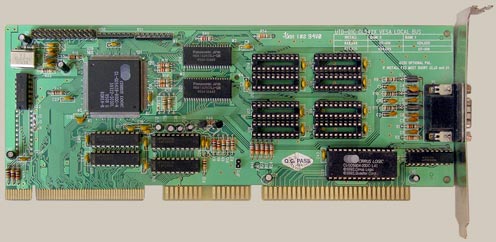
View on Wikipedia Typical VLB SVGA card | |
| Release date | August 31, 1987 |
|---|---|
| Architecture | Chips and Technologies 82c441, ET3000 |
| History | |
| Predecessor | Video Graphics Array |
| Successor | XGA |
Super VGA (SVGA) or Extended VGA is a broad term that covers a wide range of computer display standards that extended IBM's VGA specification.[1][2]
When used as shorthand for a resolution, as VGA and XGA often are, SVGA refers to a resolution of 800 × 600.[3]
History
[edit]
In the late 1980s, after the release of IBM's VGA, third-party manufacturers began making graphics cards based on its specifications with extended capabilities. As these cards grew in popularity, they began to be referred to as "Super VGA".
This term was not an official standard, but a shorthand for enhanced VGA cards which had become common by 1988.[4] The first cards that explicitly used the term were Genoa Systems's SuperVGA and SuperVGA HiRes in 1987.[5]
In November 1988, NEC Home Electronics announced its creation of the Video Electronics Standards Association (VESA) to develop and promote a Super VGA computer display standard as a successor to IBM's proprietary VGA display standard. Super VGA enabled graphics display resolutions up to 800×600 pixels, compared to VGA's maximum resolution of 640×480 pixels—a 56% increase.[6]
Super VGA cards broke compatibility with the IBM VGA standard, requiring software developers to provide specific display drivers and implementations for each card their software could operate on. Initially, the heavy restrictions this placed on software developers slowed the uptake of Super VGA cards, which motivated VESA to produce a unifying standard, the VESA BIOS Extensions (VBE), first introduced in 1989,[7] to provide a common software interface to all cards implementing the VBE specification.[8]
Eventually, Super VGA graphics adapters supported innumerable modes.
Specifications
[edit]

The Super VGA standardized the following resolutions:[7]
- 640 × 400 or 640 × 480 with 256 colors
- 800 × 600 with 256 colors
- 1024 × 768 with 256 colors
- 1280 × 1024 with 256 colors
SVGA uses the same DE-15 VGA connector as the original standard, and otherwise operates over the same cabling and interfaces as VGA.
Early manufacturers
[edit]Some early Super VGA manufacturers and some of their models, where available:
- Ahead Technologies (Not related to Nero AG, formerly Ahead Software)
- Amdek: VGA ADAPTER/132 (Tseng Labs chipset)[9]
- AST Research, Inc.: VGA Plus[10] (rebranded Paradise)
- ATI Technologies: VIP (82C451),[11] VGA Wonder
- Chips and Technologies: 82C451[11]
- Cirrus Logic: CL-GD410/420[12]
- Compaq: VGC Board (Paradise chipset)
- Everex
- Genoa Systems: Genoa VGA 5100-5400[13] (ET3000)[14]
- Orchid Technology: Designer VGA[15] (ET3000), Pro Designer Plus
- Western Digital's Paradise Inc.: VGA Plus[16] (PVGA1), VGA Plus 16, VGA Pro
- Sigma Designs: SigmaVGA (ET3000)
- STB Systems: VGA Extra/EM (ET3000),[17][18]
- Video Seven: V-RAM VGA[19]
- Willow Peripherals: VGA-TV/Publisher's, VGA-TV + Genlock[20]
- Trident Microsystems: TVGA8800, TVGA8900, and TVGA9000 series
Gallery
[edit]-
 ALiCat M3147V SVGA video card
 -
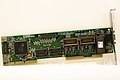 Cirrus Logic GD5429 VLB SVGA video card
 -
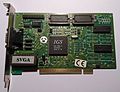 Early 1996 IGS IGA1682_A PCI SVGA video card
 -
 S3 805 VLB SVGA video card
 -
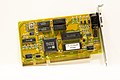 WDC ISA SVGA video card


References
[edit]- ^
Ferraro, Richard F. (1990). Programmer's Guide to the EGA and VGA Cards (2nd ed.). Addison-Wesley. p. 596. ISBN 0-201-57025-4.
Nearly all VGA cards manufactured today exceed the VGA standard [...] in some significant way. These new and improved VGAs have been labeled Super VGAs, Extended VGAs or Advanced VGAs.
- ^ "Graphics Cards". DOS Days. Retrieved 2025-02-16.
VGA was the last IBM graphics standard to which the majority of PC clone manufacturers conformed, [...] It was officially followed by IBM's Extended Graphics Array (XGA) standard, but was effectively superseded by numerous slightly different extensions to VGA made by clone manufacturers, collectively known as Super VGA.
- ^ "Projector Guide - Resolution | Epson US". epson.com. Retrieved 2020-08-17.
- ^ Richter, Jake (1990-07-16). "High-Resolution Video Boards". InfoWorld. 12 (29). InfoWorld Media Group, Inc.: 55. ISSN 0199-6649.
- ^ Gabel, David (December 1, 1987). "Plug-compatible vendors take aim at VGA card". PC Week. 4 (48). Ziff-Davis: 148 – via Gale.
- ^ Brownstein, Mark (November 14, 1988). "NEC Forms Video Standards Group". InfoWorld. Vol. 10, no. 46. p. 3. ISSN 0199-6649. Retrieved May 27, 2016.
- ^ a b "SUPER VGA BIOS EXTENSION Standard # VS891001 › Gemixtes". 2013-12-11. Archived from the original on 2013-12-11. Retrieved 2022-12-27.
- ^ VESA BIOS Extension (VBE) Core Functions Standard 3.0 (PDF). Milpitas, CA: Video Electronics Standards Association. 16 September 1998. p. 3.
- ^ Juris, Robbin; Miller, Catherine; Ricciardi, Salvatore; Tate-Austin, Priscilla (1988-11-15). "Small-Footprint 386 PCs". PC Mag. 7 (2). Ziff Davis, Inc.: 98. ISSN 0888-8507.
- ^ stason.org, Stas Bekman: stas (at). "AST VGA PLUS (202262-001, 002, 003) video card Settings and Configuration". stason.org. Retrieved 2022-12-27.
- ^ a b Unknown ATI 8-bit videocard, Google Groups
- ^ Need info on old Video Seven VGA card, Google Groups
- ^ stason.org, Stas Bekman: stas (at). "SUPERVGA HIRES-10 5200-10, SUPERVGA 5100 video card Settings and Configuration". stason.org. Retrieved 2022-12-27.
- ^ "Motherboards/Laptops built-in graphics".
- ^ stason.org, Stas Bekman: stas (at). "DESIGNER VGA video card Settings and Configuration". stason.org. Retrieved 2022-12-27.
- ^ stason.org, Stas Bekman: stas (at). "PARADISE VGA PLUS 16 video card Settings and Configuration". stason.org. Retrieved 2022-12-27.
- ^ VGA, or what to do with my tax return!, Google Groups
- ^ VGA monitor and adapter choices, Google Groups
- ^ IBM's EGA and VGA, Google Groups
- ^ Poor, Alfred (July 1989). "VGA and NTSC: Putting your Program on TV". PC Mag. 8 (13). Ziff Davis, Inc.: 158. ISSN 0888-8507.

Super VGA
View on GrokipediaIntroduction
Definition and Scope
Super VGA (SVGA) is an informal, non-official term used to describe video adapters and display technologies that extend beyond the limitations of IBM's original Video Graphics Array (VGA) standard, which was limited to a maximum resolution of 640×480 pixels.[4] Introduced as a way to achieve higher resolutions and improved color support on personal computers, SVGA emerged as a flexible category rather than a rigidly defined specification, enabling manufacturers to innovate with enhanced graphics capabilities compatible with the existing VGA infrastructure.[5] The term was coined by Genoa Systems, whose SuperVGA card in 1987 provided the first implementation, supporting resolutions like 800×600.[6] This extension built upon VGA, the predecessor standard released by IBM in 1987, by providing greater pixel density for sharper images and more detailed visuals in applications like desktop publishing and early multimedia software.[7] The term SVGA is most commonly associated with the 800×600 resolution mode operating at 256 colors, which represented a significant step up from VGA's capabilities and became a de facto benchmark for mid-1990s displays.[5] However, the scope of SVGA broadly encompasses a variety of higher resolutions, typically ranging from 800×600 up to 1280×1024 pixels, depending on the specific hardware implementation and available video memory.[8][9] Initial implementations of SVGA technology appeared in 1987 with proprietary advancements by companies like Genoa Systems, marking the beginning of extensions that pushed PC graphics beyond IBM's baseline, with standardization efforts following in 1989.[10] Unlike official standards such as VGA, SVGA functioned primarily as an open extension framework, allowing graphics card manufacturers like Genoa Systems to introduce proprietary modes and features without a unified specification until later efforts by organizations like VESA.[6] This lack of a single fixed standard fostered rapid innovation but also led to compatibility challenges, as SVGA modes varied across vendors while maintaining backward compatibility with VGA signals and connectors.[4] The overall scope of SVGA thus defined a transitional era in PC display technology, bridging basic raster graphics to more advanced resolutions that supported emerging demands for productivity and entertainment.[8]Relation to VGA
Super VGA (SVGA) builds directly upon the Video Graphics Array (VGA) standard introduced by IBM in 1987, which established a baseline for personal computer graphics with a maximum resolution of 640×480 pixels in its primary graphics mode supporting 16 colors from a palette, or 256 colors in lower-resolution modes such as 320×200 pixels.[11] This VGA foundation provided a fixed set of display modes optimized for the IBM PS/2 computers, using an analog RGB signal format transmitted through a 15-pin DE-15 (D-subminiature) connector to deliver horizontal and vertical sync signals alongside red, green, and blue color components.[1] The hardware infrastructure of VGA, including its analog signaling and connector standard, served as a prerequisite for SVGA, allowing extensions without requiring new cabling or incompatible interfaces, thus ensuring seamless integration with existing monitors and systems.[11] SVGA represents a series of enhancements developed by third-party manufacturers starting in 1987, primarily increasing resolution capabilities to entry-level standards like 800×600 pixels while maintaining support for 256 colors at these higher resolutions, a significant leap from VGA's limitations in combining high resolution with rich color palettes.[10] Crucially, SVGA implementations are designed for full backward compatibility with VGA modes, enabling software and hardware to fall back to the original 640×480 resolution and color schemes when needed, which facilitated widespread adoption without disrupting legacy applications.[12] This compatibility is achieved through extensions to the VGA BIOS interrupt services, preserving the core timing and signal parameters while adding support for additional modes.[12] The relation between SVGA and VGA also marks a conceptual shift from IBM's proprietary, rigidly defined standard to a more flexible ecosystem of vendor-specific enhancements, where clone manufacturers leveraged the open aspects of VGA's analog framework to innovate beyond IBM's control, paving the way for diverse graphics accelerators and higher-performance displays.[11] This evolution relied on the VGA's established analog RGB signaling via the DE-15 connector, which provided sufficient bandwidth for SVGA's improved resolutions without necessitating a complete overhaul of physical connections.[1]History
Early Development
Super VGA (SVGA) emerged as an extension of the IBM Video Graphics Array (VGA) standard, with Genoa Systems introducing the first commercial implementation in late 1987 through its SuperVGA and SuperVGA HiRes cards, which supported resolutions up to 800x600 with 16 colors, surpassing VGA's 640x480 limit.[6] These boards marked the initial push by third-party vendors to address the limitations of VGA shortly after its debut in IBM's PS/2 computers earlier that year.[10] In the PC graphics market of 1987-1988, demand for higher resolutions grew rapidly as users sought improved clarity for DOS-based applications, such as spreadsheets and word processors, and the nascent graphical user interface of early Windows versions, which benefited from expanded color palettes and screen real estate beyond VGA's capabilities.[10] This period saw a surge in add-in graphics cards for IBM PC compatibles, driven by the transition from monochrome and low-resolution displays to color graphics in business and professional environments.[13] Key early SVGA architectures included the Chips and Technologies 82C441 chipset, a single-chip VGA controller released in 1987 that enabled resolutions up to 800x560 in 16 colors through flexible timing and memory configurations.[14] Similarly, Tseng Labs' ET3000 chipset, launched in late 1987, provided full VGA compatibility while extending to Super VGA modes like 800x600, making it a popular foundation for third-party cards.[15] The proprietary implementations of these early SVGA solutions, developed independently by vendors without a unified specification, resulted in significant compatibility challenges, as software often required custom drivers for specific hardware, hindering widespread adoption until later standardization efforts.[10]Standardization Efforts
The Video Electronics Standards Association (VESA) was established in November 1988 by NEC Home Electronics to develop and promote an industry-wide Super VGA standard, responding to the rapid emergence of incompatible proprietary graphics enhancements beyond IBM's VGA specification.[16] This initiative united key industry players, including Genoa Systems as one of the founding members, to foster collaboration and prevent market fragmentation.[6] Early SVGA development suffered from significant fragmentation, as vendors like ATI Technologies and Video Seven introduced their own unique display modes and hardware implementations, complicating software compatibility and user adoption.[10] VESA addressed these challenges through a cooperative approach, convening manufacturers to define shared protocols that ensured interoperability across diverse SVGA systems without favoring any single vendor's technology.[17] In 1989, VESA released its inaugural SVGA standard, which specified common resolutions and operational modes to enable consistent performance and ease of integration for graphics hardware and software developers.[18] This effort marked a pivotal milestone by promoting enhanced compatibility in SVGA hardware, laying the groundwork for plug-and-play capabilities that simplified device configuration and expanded the standard's adoption in personal computing.[10]Technical Specifications
Resolutions and Color Support
Super VGA (SVGA) extended the resolution capabilities of the original VGA standard, introducing higher pixel counts while maintaining compatibility with the VGA signal format. The core SVGA resolutions include 640×400, 640×480 (an extension of VGA's maximum), 800×600, 1024×768, and 1280×1024, all primarily supporting 256 colors through an 8-bit indexed palette mode.[12] These resolutions allowed for sharper images on compatible displays, with 800×600 providing approximately 50% more pixels than VGA's 640×480, enabling better detail in graphics and text.[19] In the standard 256-color mode, each pixel is represented by an 8-bit index referencing a 256-entry color lookup table (CLUT), where each entry specifies a 18-bit RGB color value (6 bits per channel), allowing selection from up to 262,144 possible colors but displaying only 256 simultaneously.[20] This indexed approach optimized memory usage for the era's limited video RAM, typically requiring 1 MB or more for higher resolutions like 1024×768 in 256 colors. Some SVGA implementations extended beyond 8-bit to 16-bit color depths (15-bit high color, or 65,536 colors) in modes such as 800×600, using direct RGB encoding without a palette for smoother gradients, though this was not part of the initial baseline standard and varied by hardware.[21] SVGA resolutions require specific pixel clock frequencies to achieve standard refresh rates, ensuring stable display output over analog connections. For example, 800×600 at 60 Hz uses a 40 MHz pixel clock, while 1024×768 at 60 Hz requires 65 MHz, and 1280×1024 at 60 Hz demands 108 MHz; these timings adhere to VESA-defined standards for horizontal and vertical sync pulses. SVGA modes are identified by hexadecimal mode numbers and can be switched via BIOS interrupt 10h ([INT 10h](/page/INT 10h), AH=00h, AL=mode number), extending VGA's mode selection for software control without hardware reconfiguration. Representative mode numbers for 256-color resolutions include 100h for 640×400, 101h for 640×480, 103h for 800×600, 105h for 1024×768, and 107h for 1280×1024, as standardized by VESA for consistent BIOS implementation across compatible cards.[12][21]| Resolution | Mode Number (256 colors) | Typical Pixel Clock (60 Hz) |
|---|---|---|
| 640×400 | 100h | 25.18 MHz |
| 640×480 | 101h | 25.18 MHz |
| 800×600 | 103h | 40 MHz |
| 1024×768 | 105h | 65 MHz |
| 1280×1024 | 107h | 108 MHz |