
Hubbry Logo
Cardinal point (optics)Cardinal point (optics)Main
Open search
Cardinal point (optics)
Community hub
Cardinal point (optics)
logo
7 pages, 0 posts
0 subscribers
Be the first to start a discussion here.
Cardinal point (optics)
from Wikipedia

In Gaussian optics, the cardinal points consist of three pairs of points located on the optical axis of a rotationally symmetric, focal, optical system. These are the focal points, the principal points, and the nodal points; there are two of each.[1] For ideal systems, the basic imaging properties such as image size, location, and orientation are completely determined by the locations of the cardinal points. For simple cases where the medium on both sides of an optical system is air or vacuum four cardinal points are sufficient: the two focal points and either the principal points or the nodal points. The only ideal system that has been achieved in practice is a plane mirror,[2] however the cardinal points are widely used to approximate the behavior of real optical systems. Cardinal points provide a way to analytically simplify an optical system with many components, allowing the imaging characteristics of the system to be approximately determined with simple calculations.

Explanation

[edit]
The cardinal points of a thick lens in air. F, F front and rear focal points; P, P front and rear principal points; V, V front and rear surface vertices.

The cardinal points lie on the optical axis of an optical system. Each point is defined by the effect the optical system has on rays that pass through that point, in the paraxial approximation. The paraxial approximation assumes that rays travel at shallow angles with respect to the optical axis, so that , , and .[3] Aperture effects are ignored: rays that do not pass through the aperture stop of the system are not considered in the discussion below.

Focal points and planes

[edit]

The front focal point of an optical system, by definition, has the property that any ray that passes through it will emerge from the system parallel to the optical axis. The rear (or back) focal point of the system has the reverse property: rays that enter the system parallel to the optical axis are focused such that they pass through the rear focal point.

Rays that leave the object with the same angle cross at the back focal plane.

The front and rear (or back) focal planes are defined as the planes, perpendicular to the optic axis, which pass through the front and rear focal points. An object infinitely far from the optical system forms an image at the rear focal plane. For an object at a finite distance, the image is formed at a different location, but rays that leave the object parallel to one another cross at the rear focal plane.

Angle filtering with an aperture at the rear focal plane.

A diaphragm or "stop" at the rear focal plane of a lens can be used to filter rays by angle, since an aperture centred on the optical axis there will only pass rays that were emitted from the object at a sufficiently small angle from the optical axis. Using a sufficiently small aperture in the rear focal plane will make the lens object-space telecentric.

Similarly, the allowed range of angles on the output side of the lens can be filtered by putting an aperture at the front focal plane of the lens (or a lens group within the overall lens), and a sufficiently small aperture will make the lens image-space telecentric. This is important for DSLR cameras having CCD sensors. The pixels in these sensors are more sensitive to rays that hit them straight on than to those that strike at an angle. A lens that does not control the angle of incidence at the detector will produce pixel vignetting in the images.

Principal planes and points

[edit]
Principal planes of a thick lens. The principal points H and H and front and rear focal points F and F are marked.
Various lens shapes, and the location of the principal planes for each. The radii of curvature of the lens surfaces are indicated as r1 and r2.

The two principal planes of a lens have the property that a ray emerging from the lens appears to have crossed the rear principal plane at the same distance from the optical axis that the ray appeared to have crossed the front principal plane, as viewed from the front of the lens. This means that the lens can be treated as if all of the refraction happened at the principal planes, and rays travel parallel to the optical axis between the planes. (Linear magnification between the principal planes is +1.) The principal planes are crucial in defining the properties of an optical system, since the magnification of the system is determined by the distance from an object to the front principal plane and the distance from the rear principal plane to the object's image. The principal points are the points where the principal planes cross the optical axis.

If the medium surrounding an optical system has a refractive index of 1 (e.g., air or vacuum), then the distance from each principal plane to the corresponding focal point is just the focal length of the system. In the more general case, the distance to the foci is the focal length multiplied by the index of refraction of the medium.

For a single lens surrounded by a medium of refractive index n = 1, the locations of the principal points H and H with respect to the respective lens vertices are given by the formulas where f is the focal length of the lens, d is its thickness, and r1 and r2 are the radii of curvature of its surfaces. Positive signs indicate distances to the right of the corresponding vertex, and negative to the left.[4]
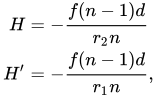
For a thin lens in air, the principal planes both lie at the location of the lens. The point where they cross the optical axis is sometimes misleadingly called the optical centre of the lens. For a real lens the principal planes do not necessarily pass through the centre of the lens and can even be outside the lens.

Nodal points

[edit]
N, N The front and rear nodal points of a thick lens.

The front and rear nodal points of a lens have the property that a ray aimed at one of them will be refracted by the lens such that it appears to have come from the other with the same angle to the optical axis. (Angular magnification between nodal points is +1.) The nodal points therefore do for angles what the principal planes do for transverse distance. If the medium on both sides of an optical system is the same (e.g., air or vacuum), then the front and rear nodal points coincide with the front and rear principal points, respectively.

Gauss's original 1841 paper only discussed the main rays through the focal points. A colleague, Johann Listing, was the first to describe the nodal points in 1845 to evaluate the human eye, where the image is in fluid.[5] The cardinal points were all included in a single diagram as early as 1864 (Donders), with the object in air and the image in a different medium.

Cardinal point diagram for an optical system with different media on each side. F for Focal point, P for Principal point, NP for Nodal Point, and efl for effective focal length. The chief ray is shown in purple

The nodal points characterize a ray that goes through the centre of a lens without any angular deviation. For a lens in air with the aperture stop at the principal planes, this would be a chief ray since the nodal points and principal points coincide in this case. This is a valuable addition in its own right to what has come to be called "Gaussian optics", and if the image was in fluid instead, then that same ray would refract into the new medium, as it does in the diagram to the right. A ray through the nodal points has parallel input and output portions (blue). A simple method to find the rear nodal point for a lens with air on one side and fluid on the other is to take the rear focal length f and divide it by the image medium index, which gives the effective focal length (EFL) of the lens. The EFL is the distance from the rear nodal point to the rear focal point.

The power of a lens is equal to 1/EFL or n/f. For collimated light, a lens could be placed in air at the second nodal point of an optical system to give the same paraxial properties as an original lens system with an image in fluid.[5][6] The power of the entire eye is about 60 dioptres, for example. Similarly, a lens used totally in fluid, like an intraocular lens, has the same definition for power, with an average value of about 21 dioptres.

Nodal points and the eye

[edit]
Use of the nodal point in analysis of the eye

The eye itself has a second special use of the nodal point that tends to be obscured by paraxial discussions. The cornea and retina are highly curved, unlike most imaging systems, and the optical design of the eye has the property that a "direction line" that is parallel to the input rays can be used to find the magnification or to scale retinal locations. This line passes approximately through the 2nd nodal point, but rather than being an actual paraxial ray, it identifies the image formed by ray bundles that pass through the centre of the pupil. The terminology comes from Volkmann in 1836,[7] but most discussions incorrectly imply that paraxial properties of rays extend to very large angles, rather than recognizing this as a unique property of the eye's design. This scaling property is well-known, very useful, and very simple: angles drawn with a ruler centred on the posterior pole of the lens on a cross-section of the eye can approximately scale the retina over more than an entire hemisphere. It is only in the 2000s that the limitations of this approximation have become apparent, with an exploration into why some intraocular lens (IOL) patients see dark shadows in the far periphery (negative dysphotopsia, which is probably due to the IOL being much smaller than the natural lens.)[citation needed]

Optical center

[edit]
A diagram showing how to find the optical center O of a spherical lens. N and N' are the lens's nodal points.

The optical center of a spherical lens is a point such that if a ray passes through it, the ray's path after leaving the lens will be parallel to its path before it entered.

In the figure at right,[8] the points A and B are where parallel lines of radii of curvature R1 and R2 meet the lens surfaces. As a result, dashed lines tangent to the surfaces at A and B are also parallel. Because two triangles OBC2 and OAC1 are similar (i.e., their angles are same), . In whatever choice of A and B, the radii of curvatures and are same and the curvature center locations and are also same. As a result, the optical center location O, defined by the ratio on the optical axis, is fixed for a given lens.

Photography

[edit]

The nodal points are widely misunderstood in photography, where it is commonly asserted that the light rays "intersect" at "the nodal point", that the iris diaphragm of the lens is located there, and that this is the correct pivot point for panoramic photography, so as to avoid parallax error.[9][10][11] These claims generally arise from confusion about the optics of camera lenses, as well as confusion between the nodal points and the other cardinal points of the system. A better choice of the point about which to pivot a camera for panoramic photography can be shown to be the centre of the system's entrance pupil.[9][10][11] On the other hand, swing-lens cameras with fixed film position rotate the lens about the rear nodal point to stabilize the image on the film.[11][12]

Surface vertices

[edit]

In optics, surface vertices are the points where each optical surface crosses the optical axis. They are important primarily because they are physically measurable parameters for the optical element positions, and so the positions of the cardinal points of the optical system must be known with respect to the surface vertices to describe the system.

In anatomy, the surface vertices of the eye's lens are called the anterior and posterior poles of the lens.[13]

Modeling optical systems as mathematical transformations

[edit]

In geometrical optics, for each object ray entering an optical system, a single and unique image ray exits from the system. In mathematical terms, the optical system performs a transformation that maps every object ray to an image ray.[1] The object ray and its associated image ray are said to be conjugate to each other. This term also applies to corresponding pairs of object and image points and planes. The object and image rays, points, and planes are considered to be in two distinct optical spaces, object space and image space; additional intermediate optical spaces may be used as well.

Rotationally symmetric optical systems; optical axis, axial points, and meridional planes

[edit]

An optical system is rotationally symmetric if its imaging properties are unchanged by any rotation about some axis. This (unique) axis of rotational symmetry is the optical axis of the system. Optical systems can be folded using plane mirrors; the system is still considered to be rotationally symmetric if it possesses rotational symmetry when unfolded. Any point on the optical axis (in any space) is an axial point.

Rotational symmetry greatly simplifies the analysis of optical systems, which otherwise must be analyzed in three dimensions. Rotational symmetry allows the system to be analyzed by considering only rays confined to a single transverse plane containing the optical axis. Such a plane is called a meridional plane; it is a cross-section through the system.

Ideal, rotationally symmetric, optical imaging system

[edit]

An ideal, rotationally symmetric, optical imaging system must meet three criteria:

  1. All rays "originating" from each object point converge to a single and unique image point; imaging is stigmatic.
  2. Object planes perpendicular to the optical axis are conjugate to image planes perpendicular to the axis.
  3. The image of an object confined to a plane normal to the axis is geometrically similar to the object.

In some optical systems imaging is stigmatic for one or perhaps a few object points, but to be an ideal system imaging must be stigmatic for every object point. In an ideal system, every object point maps to a different image point.

Unlike rays in mathematics, optical rays extend to infinity in both directions. Rays are real when they are in the part of the optical system to which they apply, and are virtual elsewhere. For example, object rays are real on the object side of the optical system, while image rays are real on the image side of the system. In stigmatic imaging, an object ray intersecting any specific point in object space must be conjugate to an image ray intersecting the conjugate point in image space. A consequence is that every point on an object ray is conjugate to some point on the conjugate image ray.

Geometrical similarity implies the image is a scale model of the object. There is no restriction on the image's orientation; the image may be inverted or otherwise rotated with respect to the object.

Focal and afocal systems, focal points

[edit]

Afocal systems have no focal points, principal points, or nodal points. In such systems an object ray parallel to the optical axis is conjugate to an image ray parallel to the optical axis. A system is focal if an object ray parallel to the axis is conjugate to an image ray that intersects the optical axis. The intersection of the image ray with the optical axis is the focal point F in image space. Focal systems also have an axial object point F such that any ray through F is conjugate to an image ray parallel to the optical axis. F is the object space focal point of the system.

Transformation

[edit]

The transformation between object space and image space is completely defined by the cardinal points of the system, and these points can be used to map any point on the object to its conjugate image point.

See also

[edit]

Notes and references

[edit]
Revisions and contributorsEdit on WikipediaRead on Wikipedia
from Grokipedia
In , cardinal points are a set of six reference points along the of a lens or optical that define its paraxial properties, enabling the prediction of without tracing every ray through the . These points consist of two focal points, two principal points, and two nodal points, each associated with corresponding planes perpendicular to the axis. Introduced by in 1841 for focal and principal points, and later by in 1845 for nodal points, they simplify the analysis of thick lenses and complex systems by reducing them to equivalent thin-lens models. The focal points—one on the object side (front focal point, F₁) and one on the image side (rear focal point, F₂)—are the locations where parallel incident rays converge after (for F₂) or appear to diverge from before (for F₁). The distance between the principal points and the respective focal points equals the effective f, which quantifies the system's converging or diverging power. For a system in air, the front and rear focal lengths are equal in magnitude but may differ if the surrounding media have different refractive indices. The principal points (H₁ and H₂) lie at the intersections of the principal planes with the and serve as the reference origins for measuring object and image distances in the Gaussian lens formula (1/s + 1/s' = 1/f). These planes are conjugate pairs where the transverse is unity (M = +1), effectively positioning the "optical center" of the system, which may shift outside the physical lens for thick or compound . The nodal points (N₁ and N₂) are conjugate axial points exhibiting unit angular , meaning a ray entering at one nodal point directed toward the other emerges parallel to its incident direction. In systems surrounded by the same medium (e.g., air, with n = 1), the nodal points coincide exactly with the principal points. Cardinal points are determined through ray-tracing methods, such as analyzing marginal and chief rays, or using the ABCD matrix formalism for paraxial systems, where their positions are calculated from system parameters like refractive indices and surface curvatures. They are fundamental in optical design, telescope and microscope analysis, and alignment techniques, as they allow effective focal length, magnification, and image orientation to be computed efficiently. For instance, in a thick lens, the positions of H₁ and H₂ depend on lens thickness d, refractive index n, and radii of curvature R₁ and R₂, often requiring experimental methods like the nodal slide or two-magnification technique for verification.

Fundamental Concepts

Paraxial optics and the optical axis

In paraxial optics, also known as , the analysis of light propagation through systems is simplified by considering only rays that are close to the and make small angles with it. This paraxial approximation replaces the sine of the angle of incidence or with the angle itself in radians, such that sinθθ\sin \theta \approx \theta, and the cosine is approximated as unity, enabling a linear treatment of ray paths without higher-order aberrations. These assumptions hold for rotationally symmetric systems with spherical surfaces, where the small-angle condition minimizes deviations from ideal imaging, allowing straightforward calculations of ray heights and angles. The foundations of paraxial optics were established by in his 1841 treatise Dioptrische Untersuchungen, where he developed methods to simplify lens calculations by focusing on these first-order approximations, building on earlier principles. This approach revolutionized optical design by reducing complex systems to manageable linear equations, facilitating the prediction of without exhaustive numerical integration. The serves as the central reference line in such systems, defined as the axis of that passes through the centers of curvature of all lens surfaces in a centered, symmetric configuration. In a thick lens, for instance, this axis aligns the vertices and curvatures, ensuring that paraxial rays propagate symmetrically around it. Analysis often occurs within a meridional plane, which contains both the and the specific ray under consideration, reducing the problem to two-dimensional tracing for meridional rays that lie in this plane. Axial points are locations along this optical axis where incoming paraxial rays intersect after or reflection, providing key reference positions for system behavior. In illustrations of a thick lens, the is depicted as a straight horizontal line traversing the lens from left to right, with paraxial rays shown as nearly parallel lines entering from an object side, bending slightly at each surface according to under the , and converging or diverging symmetrically to highlight the axis's role in maintaining rotational invariance. Cardinal points emerge as specific axial locations derived from these paraxial ray intersections.

Definition and role of cardinal points

In , the cardinal points are a set of reference points that characterize the (paraxial) properties of a rotationally symmetric optical system, enabling the prediction of image location, size, and orientation without knowledge of the system's internal structure. The focal and principal points were introduced by in his 1841 treatise Dioptrische Untersuchungen, while the nodal points were first described by in 1845. These points form the foundation for systematic analysis of lens systems and their behavior with respect to paraxial rays. The three pairs of cardinal points—focal, principal, and nodal—collectively define the system's equivalent optical behavior. The primary role of cardinal points is to simplify the modeling of complex optical systems by reducing them to an equivalent positioned at the principal points, where the system's , effective , and image positioning can be directly determined from the relative locations of these points. This abstraction allows optical engineers to focus on overall performance metrics rather than individual component interactions, facilitating the design and optimization of instruments like microscopes and telescopes. By defining how incoming rays parallel to the axis converge or diverge at the focal points, and how rays through the nodal points emerge undeviated, the cardinal points provide a complete geometric framework for first-order ray tracing and . In rotationally symmetric systems, all cardinal points lie on the , ensuring consistent behavior for rays propagating along this central line. A key parameter derived from these points is the effective ff, defined as the distance from the principal plane to the corresponding focal point, which quantifies the system's converging or diverging power. In modern computational , cardinal points play a crucial role in ray tracing software such as OpticStudio, where they are automatically calculated to verify system performance, align components, and simulate imaging under paraxial approximations.

Types of Cardinal Points

Focal points and planes

In optical systems analyzed under paraxial approximation, the object-side focal point FF is the point on the from which diverging rays emerge parallel to the axis after through the system. Conversely, the image-side focal point FF' is the point where parallel rays incident from along the axis converge following . These points define the system's focusing behavior for distant objects or sources. The focal planes are the planes perpendicular to the passing through the respective focal points FF and FF'. Objects located at in a direction parallel to the axis form sharp images in the corresponding focal plane, enabling the system to resolve extended sources from afar without in the paraxial regime. The ff is the axial distance from the object-side principal plane to FF, while the image-side ff' is the distance from the image-side principal plane to FF'; in air, these lengths are equal for symmetric media. For a thick lens with nn, first surface radius R1R_1, second surface radius R2R_2, and thickness dd, the effective ff satisfies the lensmaker's equation: 1f=(n1)(1R11R2+(n1)dnR1R2).\frac{1}{f} = (n-1)\left( \frac{1}{R_1} - \frac{1}{R_2} + \frac{(n-1)d}{n R_1 R_2} \right). This formula derives from applying Snell's law sequentially at each surface and combining the resulting power terms, accounting for the lens thickness. For objects at infinity, the image forms in the focal plane with transverse dimension h=fθh' = f' \cdot \theta, where θ\theta is the angular size of the object in radians. The linear transverse magnification is not defined in the conventional sense for infinite object distances. In practical applications, such as systems, the back focal length—the distance from the rear lens vertex to the image-side focal plane—must align precisely with the plane to ensure that focused rays fall correctly on the pixel array, preventing aberrations or defocus in compact camera modules.

Principal points and planes

In , the principal points, denoted as H and H', are the intersections of the principal planes with the in an optical system. The principal planes are hypothetical transverse planes perpendicular to the passing through these points, where all the bending or of rays for the entire system can be considered to occur as if the system were reduced to a single located between them. This conceptualization simplifies the analysis of complex lens systems by localizing the effective . A defining property of the principal planes is that a ray parallel to the entering the system maintains the same height relative to the axis when it crosses from the first principal plane to the second; the transverse magnification across these planes is unity. The ϕ\phi of the system, measured in diopters (m1^{-1}), is determined with respect to the principal points, enabling the effective f=1/ϕf = 1/\phi to be referenced from H' to the rear focal point and from H to the front focal point. For lens systems, the power combines individual surface powers, as in Gullstrand's equation for a thick lens: ϕ=P1+P2(d/n)P1P2\phi = P_1 + P_2 - (d/n) P_1 P_2, where P1P_1 and P2P_2 are the powers of the first and second surfaces, dd is the thickness, and nn is the of the lens material. The locations of the principal points are determined by the system's and material properties. For a thick lens in air (nm=1n_m = 1), the distance hh from the first vertex to the first principal point H is h=df(n1)nR1h = \frac{d f (n-1)}{n R_1}, where dd is the lens thickness, ff is the effective , nn is the , and R1R_1 is the of the first surface; similarly, the distance hh' from the second vertex to the second principal point H' is h=df(n1)nR2h' = \frac{d f (n-1)}{n R_2}, with R2R_2 the second radius (sign conventions apply such that positive values indicate positions to the right of the vertex for traveling left to right). The back focal length (bfl), which is the distance from the last vertex to the image-side focal point, is then bfl = fhf' - h', where ff' is the image-side effective ; this adjustment accounts for the internal shift due to thickness, ensuring accurate prediction of positions in lens systems. In imaging applications, object and image distances in the Gaussian lens 1/s+1/s=1/f1/s + 1/s' = 1/f are measured from the principal points H and H', respectively, extending the thin lens maker's to accommodate thick lenses and multi-element systems without recalculating each interface. This reference framework preserves the simplicity of thin-lens equations while incorporating real-world offsets. In modern designs, such as zoom systems employing aspheric lenses, principal point positions shift dynamically with changes—for instance, in an 8× four-group zoom using focus-tunable aspheres, these shifts are modeled to minimize size and aberration, enabling compact, high-performance .

Nodal points

Nodal points, denoted as NN and NN', are a pair of cardinal points in an optical system where an incident ray directed toward the front nodal point NN emerges from the rear nodal point NN' in the same direction, without angular deviation. This property ensures unit angular magnification between the object and spaces, making nodal points essential for analyzing ray directions in paraxial . Unlike principal points, which reference transverse heights, nodal points specifically preserve the angle of rays passing through them, providing a reference for angular imaging properties. In optical systems immersed in the same medium on both sides (where the refractive indices n=n=1n = n' = 1 for air), the nodal points coincide with the principal points, simplifying the system's black-box model. However, in systems with different refractive indices nn on the input side and nn' on the output side, the nodal points separate from the principal points; the exact positions can be determined using the ABCD ray transfer matrix method. The nodal points play a key role in determining the field angle and the position of the , particularly in wide-angle optical designs where precise angular mapping is critical. For instance, in , rotating the camera around the nodal point allows without errors, as rays from a common viewpoint maintain consistent directions across overlapping fields. In telecentric systems, where chief rays are parallel to the , the nodal points are located at , ensuring uniform imaging across the field without .

Vertex points (reference points)

The vertex points represent the physical locations where the intersects the outer surfaces of a lens or multi-element optical system. The front vertex, denoted as VV, is the point of intersection with the first refracting surface, while the rear vertex, denoted as VV', is the intersection with the last refracting surface. Vertex points are mechanical reference points used to locate the cardinal points but are not themselves cardinal points. These vertices function as mechanical datums, providing reference points for mounting, alignment, and assembly of optical components in instruments and devices. The distances from the vertices to the cardinal points establish the geometric configuration of the system, enabling precise specification of element positions relative to functional optical properties. Cardinal points are conventionally measured with respect to these vertices to standardize system descriptions across designs. In multi-element systems, the vertices determine key mechanical parameters, such as the , which is measured from the rear vertex to the image-side focal plane and ensures compatibility with mounting hardware like lens barrels or sensor mounts. The vertex-to-principal point distances are calculated using standard thick lens formulas derived from the Gullstrand and surface powers. For thin lenses, where the thickness is negligible, the front and rear vertices coincide at a single point along the optical axis, which simplifies mechanical referencing and system analysis. In precision optics manufacturing, vertex positioning plays a vital role in tolerance analysis, as small deviations in vertex locations—such as variations in center thickness between consecutive vertices—affect airspace, alignment, and overall system performance, including wavefront error and modulation transfer function (MTF). Manufacturers apply sensitivity analyses to these parameters, assigning tolerances (e.g., ±0.01 mm for tight control on thickness) to balance fabrication feasibility with optical quality.

System Modeling and Transformations

Black-box representation of optical systems

The black-box representation of optical systems conceptualizes the entire optical assembly as an opaque entity whose behavior is fully defined by its six cardinal points: the two principal points, two focal points, and two nodal points (with principal and nodal points coinciding in systems surrounded by the same medium). This model abstracts away the internal details of lenses, mirrors, or other elements, focusing instead on external input-output relationships, such as how incident rays from an object are transformed into emergent rays forming an . By specifying the positions and properties of these cardinal points along the , the system's paraxial imaging characteristics—image location, size, and orientation—can be predicted without tracing rays through individual components. This approach originated with Carl Friedrich Gauss's seminal 1841 publication Dioptrische Untersuchungen, which formalized the treatment of compound coaxial refracting systems as equivalent to a single unit characterized by these cardinal points, enabling simplified analysis of complex optics. The advantages of the black-box model are particularly evident in optical engineering, where it streamlines system design, alignment procedures, and modular integration—for instance, combining a simple lens with a telescope—by reducing the need for exhaustive internal simulations during preliminary stages. In this representation, the fundamental imaging relation is the Gaussian lens equation: 1u+1v=1f,\frac{1}{u} + \frac{1}{v} = \frac{1}{f}, where uu denotes the object distance (negative for real objects to the left) measured from the front principal point, vv is the image distance (positive for real images to the right) from the rear principal point, and ff is the effective determined by the focal points. The transverse follows directly from the principal points as m=hh=vum = \frac{h'}{h} = \frac{v}{u}, relating the image height hh' to the object height hh (negative for inverted images). Contemporary applications extend this model to computational tools, such as CODE V software, where black-box modules represent subsystems (e.g., pre-designed lens groups) to facilitate the optimization of intricate designs like optics without requiring full ray-trace details for each module.

Ray transfer matrix analysis

, also known as ABCD matrix analysis, provides a linear algebraic framework for tracing paraxial rays through optical systems, relating the position and angle of a ray at the input to those at the output. In this approach, a ray is characterized by its height yy (transverse distance from the optical axis) and angle θ\theta (with respect to the axis), and the transformation is given by the 2×2 system matrix: (yθ)=(ABCD)(yθ),\begin{pmatrix} y' \\ \theta' \end{pmatrix} = \begin{pmatrix} A & B \\ C & D \end{pmatrix} \begin{pmatrix} y \\ \theta \end{pmatrix}, where (y,θ)(y', \theta') are the output height and angle, and the matrix elements A,B,C,DA, B, C, D depend on the system's properties, assuming the paraxial approximation and refractive indices equal at input and output (yielding ADBC=1AD - BC = 1). This enables efficient computation of ray propagation without explicit ray tracing for each element. The system matrix for a composite optical system is obtained by multiplying the individual matrices of its components in the reverse order of ray traversal (from output to input), as each matrix transforms the ray state sequentially. For example, free-space propagation over distance dd has the matrix (1d01),\begin{pmatrix} 1 & d \\ 0 & 1 \end{pmatrix}, which leaves the angle unchanged but shifts the height by dθd \theta, while a thin lens of focal length ff uses (101f1),\begin{pmatrix} 1 & 0 \\ -\frac{1}{f} & 1 \end{pmatrix}, altering the angle by yf-\frac{y}{f} without changing the height at the lens plane. For a thick lens or multi-element system, the overall matrix combines refraction matrices at surfaces with propagation matrices between them via multiplication, yielding the net A,B,C,DA, B, C, D that describe the equivalent single-element behavior. Cardinal points can be directly computed from the ABCD matrix elements when referenced to the system's entrance and exit vertices. The effective focal length ff (equal for object and image sides in symmetric media) is f=1Cf = -\frac{1}{C}, corresponding to the power of the system. The distance from the entrance vertex to the first principal plane is H1=D1CH_1 = \frac{D - 1}{C}, and from the exit vertex to the second principal plane is H2=A1CH_2 = \frac{A - 1}{C} (with signs indicating direction along the axis). The nodal points coincide with the principal points in isotropic media, but their positions follow similar derivations: the first nodal point distance from input is D1C\frac{D - 1}{C}, and the second from output is 1AC\frac{1 - A}{C}. A special case arises when B=0B = 0, indicating an afocal system where the output ray height is independent of the input angle, and the nodal points coincide with the principal points, simplifying imaging to angular magnification DD (or 1/A1/A for the inverse). This condition is common in objectives or beam expanders. Recent advancements since 2020 have extended beyond pure by integrating it with wave optics simulations for diffraction-limited systems, enabling hybrid models that capture both ray and phase effects in complex structures like metalenses. For instance, differentiable frameworks combine ABCD matrices with wave solvers to optimize end-to-end optical performance, accounting for aberrations and diffractive phenomena in simulations of nanostructured devices. Such methods have been applied in modeling, where transfer matrices interface with for accurate light management.

Afocal and focal systems

Optical systems are classified into focal and afocal categories based on the configuration of their cardinal points and their response to parallel incident rays, which determines whether they converge or maintain collimation. Focal systems possess finite focal lengths, with the rear focal point F' and front focal point F located at specific positions along the optical axis; a bundle of parallel rays entering parallel to the axis will converge to F' in converging systems (positive focal length f > 0) or appear to diverge from F in diverging systems (negative f < 0). This behavior is fundamental to applications, such as in camera lenses where parallel rays from distant objects focus onto a sensor plane at F'. Afocal systems, by contrast, exhibit infinite focal lengths, with both focal points at infinity, such that bundles of parallel input rays emerge as parallel output rays without convergence or divergence at finite distances; the system's is zero (C = 0 in the ray transfer matrix). Common examples include astronomical telescopes, which magnify distant objects without forming an intermediate image, and beam expanders, which alter the diameter of collimated beams while preserving collimation. In afocal systems, traditional cardinal points like focal and principal points are undefined due to the absence of finite power and position-independent magnification, but the nodal points remain relevant as the loci where incident rays pass undeviated in direction relative to the . These nodal points define the angular magnification M between object and space as M = f_\text{obj} / f_\text{eyepiece}, where f_\text{obj} and f_\text{eyepiece} are the focal lengths of and elements, respectively; the sign of M is negative for inverted images in Keplerian configurations. The ray transfer matrix for an afocal system takes the form (A00D),\begin{pmatrix} A & 0 \\ 0 & D \end{pmatrix}, with B = C = 0 and AD = 1, where the signed angular magnification = D. This matrix structure ensures that input height and angle transform to scaled output values without introducing . Zoom lenses can transition between focal and afocal states by axially shifting internal lens groups, which modifies the relative positions of the cardinal points and drives the effective to infinity at specific zoom ratios, enabling versatile operation from imaging to collimated viewing. In virtual and (VR/AR) headsets, afocal configurations have emerged since 2020 to simulate infinite focus by placing virtual images at optical infinity, mitigating and reducing eye fatigue through compact, zero-power optical stacks integrated with tunable elements.

Applications in

Human eye and vision

The is modeled optically as a system comprising the and crystalline lens, with cardinal points defining its overall behavior for emmetropic vision. In Gullstrand's schematic eye model (1909), the principal points are positioned approximately 1.6 mm and 1.9 mm behind the corneal vertex for the anterior and posterior planes, respectively, while the effective of the relaxed eye is about 17 mm in air, yielding a total refractive power of approximately 60 D. This configuration places the at the posterior focal point, ensuring parallel incident rays converge sharply on it; the eye's power PP satisfies P=nl60P = \frac{n'}{l'} \approx 60 D, where n=1.336n' = 1.336 (vitreous index) and l22l' \approx 22 mm is the physical posterior focal distance, equivalent to a reduced vergence focusing at an air-adjusted 17 mm. The nodal points in this model coincide nearly with the principal points due to similar media on both sides of the lens, but a single effective nodal point is often used approximately 7 mm anterior to the (or about 17 mm posterior nodal distance overall) for mapping angular object sizes to retinal heights via undeviated chief rays. Gullstrand's model employs these cardinal points to analyze by evaluating differential in principal meridians, accounting for corneal and lenticular asymmetries that shift focal lines anterior or posterior to the . Accommodation occurs through ciliary muscle contraction, causing the crystalline lens to thicken and increase its curvature, thereby boosting its power by 2 to 10 depending on age (e.g., up to 10 in young adults). This process shifts the principal planes anteriorly, altering the effective positions of other cardinal points and moving the forward to maintain focus on closer objects. In modern like , corneal ablation modifies the anterior surface curvature to adjust the system's total power and cardinal points, effectively repositioning the principal planes to relocate the focal point onto the for corrected in previously myopic or hyperopic eyes.

Photographic and camera lenses

In the design of photographic and camera lenses, which typically consist of multiple elements to correct aberrations and achieve desired image quality, the principal points are virtual locations along the where is considered to occur for analysis. These points often lie within the lens barrel rather than at a physical surface, allowing designers to model the system's effective behavior without detailing every element. For instance, in a multi-element , the rear principal point may be positioned internally to optimize the back (BFL), defined as the distance from the rear vertex of the lens to the rear focal point where parallel rays converge. This BFL is critical in camera systems, as it determines the spacing between the lens's last element and the sensor plane to ensure sharp focus, particularly when imaging objects at where the focal plane aligns directly with the . The nodal points, closely related to the principal points in symmetric systems, play a key role in applications like panorama photography. By rotating the camera around the rear nodal point—approximated as the no-parallax point or —photographers can minimize errors, where nearby objects appear to shift relative to distant ones across stitched images. This alignment ensures that rays from foreground and background elements maintain consistent angular relationships, enabling seamless multi-frame composites without distortions at overlaps. A practical consideration in lens mounting is the , which for systems like the mount is fixed at 44 mm from the flange to the plane. The is the distance from the to the plane, which must accommodate the back focal length from the lens's rear vertex to ensure proper focus. Deviations can lead to focus inaccuracies, making this parameter essential for interchangeable lens compatibility. In zoom lenses, the cardinal points shift positions as internal element groups move to vary the effective focal length, often resulting in focus shift or breathing—subtle changes in field of view that require mechanical compensation to maintain sharp focus during zooming. This movement alters the relative positions of principal and nodal points, impacting the system's paraxial properties and necessitating design features like floating elements for stability. Wide-angle lenses frequently employ retrofocus designs, where the front and rear nodal points are separated, with the front principal plane positioned ahead of the lens to achieve a short overall while providing a longer BFL for clearance in single-lens reflex cameras. This separation reduces by minimizing obstructions to off-axis light rays, allowing more uniform illumination across the image field compared to symmetric wide-angle configurations. Post-2020 advancements in multi-camera arrays, such as those fusing wide, ultra-wide, and telephoto modules, incorporate computational corrections for cardinal point shifts and discrepancies between lenses. These algorithms align images by estimating and compensating for differences in principal points and entrance pupils, enabling all-in-focus composites and reduced occlusions without mechanical adjustments.

Optical instruments like telescopes

Optical instruments such as telescopes and microscopes rely on cardinal points to model and analyze the performance of their compound lens systems, enabling precise predictions of location, , and orientation without detailed ray tracing for paraxial rays. In telescopes, the system is typically afocal, consisting of an objective lens that collects from distant objects and forms an intermediate , combined with an that views this at for relaxed-eye . The cardinal points, particularly the nodal points, are located at the principal planes of the objective and interfaces in the thin-lens approximation, allowing undeviated rays to define the angular . The angular magnification MM of a is determined by the ratio of the focal lengths of the objective (fobjf_\text{obj}) and (feyepiecef_\text{eyepiece}), given by M=fobj/feyepieceM = -f_\text{obj} / f_\text{eyepiece} for systems producing an inverted . For compound systems formed by two thin lenses separated by dd, the effective FF of the combination is calculated using the equation: 1F=1f1+1f2df1f2\frac{1}{F} = \frac{1}{f_1} + \frac{1}{f_2} - \frac{d}{f_1 f_2} This formula, derived from paraxial , helps position the lenses to achieve afocality when d=f1+f2d = f_1 + f_2, placing the cardinal points such that the overall power is zero. In Keplerian telescopes, both the objective and are converging lenses, resulting in a real intermediate and inverted final , with nodal points coinciding at the lens centers for symmetric configurations. In contrast, telescopes employ a converging objective and diverging , producing a virtual intermediate image and erect final image, with the exit nodal point appearing virtual and positioned behind the to maintain ray orientation without inversion. This configuration shortens the physical length compared to Keplerian designs while preserving afocal properties, though at the cost of a narrower . The location of nodal points in these setups directly influences image erectness and the effective position. Microscopes, unlike telescopes, incorporate focal elements such as the tube lens to form real images from close objects, where principal planes critically determine the working distance—the clearance between the and the specimen. In infinity-corrected microscope designs, the produces parallel rays, and the tube lens, with its principal planes often shifted outside the physical lens, focuses these rays onto the , optimizing the working distance for high objectives. The position of these planes relative to the ensures aberration-free imaging over the specified tube length, typically 160–200 mm, allowing interchangeability of components without recalibration. Recent advances in telescope instrumentation, particularly since 2020, integrate systems that dynamically adjust deformable mirrors to correct atmospheric turbulence, effectively modifying the positions of cardinal points in the overall . These adjustments alter the effective principal and nodal planes in real time, enhancing resolution and beyond static designs, as demonstrated in multi-conjugate adaptive optics implementations on large-aperture s. This capability extends the utility of cardinal point modeling to time-varying systems, improving performance for high-contrast imaging of exoplanets and faint astronomical sources.

References

Add your contribution
Related Hubs
User Avatar
No comments yet.