Hubbry Logo
search
logo

Symplectomorphism

logo
Community Hub0 Subscribers
Read side by side
from Wikipedia

In mathematics, a symplectomorphism or symplectic map is an isomorphism in the category of symplectic manifolds. In classical mechanics, a symplectomorphism represents a transformation of phase space that is volume-preserving and preserves the symplectic structure of phase space, and is called a canonical transformation.[1]

Formal definition

[edit]

A diffeomorphism between two symplectic manifolds is called a symplectomorphism if

where is the pullback of . The symplectic diffeomorphisms from to are a (pseudo-)group, called the symplectomorphism group (see below).

The infinitesimal version of symplectomorphisms gives the symplectic vector fields. A vector field is called symplectic if
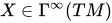
Also, is symplectic if the flow of is a symplectomorphism for every . These vector fields build a Lie subalgebra of . Here, is the set of smooth vector fields on , and is the Lie derivative along the vector field


Examples of symplectomorphisms include the canonical transformations of classical mechanics and theoretical physics, the flow associated to any Hamiltonian function, the map on cotangent bundles induced by any diffeomorphism of manifolds, and the coadjoint action of an element of a Lie group on a coadjoint orbit.

Flows

[edit]

Any smooth function on a symplectic manifold gives rise, by definition, to a Hamiltonian vector field and the set of all such vector fields form a subalgebra of the Lie algebra of symplectic vector fields. The integration of the flow of a symplectic vector field is a symplectomorphism. Since symplectomorphisms preserve the symplectic 2-form and hence the symplectic volume form, Liouville's theorem in Hamiltonian mechanics follows. Symplectomorphisms that arise from Hamiltonian vector fields are known as Hamiltonian symplectomorphisms.

Since {H, H} = XH(H) = 0, the flow of a Hamiltonian vector field also preserves H. In physics this is interpreted as the law of conservation of energy.

If the first Betti number of a connected symplectic manifold is zero, symplectic and Hamiltonian vector fields coincide, so the notions of Hamiltonian isotopy and symplectic isotopy of symplectomorphisms coincide.

It can be shown that the equations for a geodesic may be formulated as a Hamiltonian flow, see Geodesics as Hamiltonian flows.

The group of (Hamiltonian) symplectomorphisms

[edit]

The symplectomorphisms from a manifold back onto itself form an infinite-dimensional pseudogroup. The corresponding Lie algebra consists of symplectic vector fields. The Hamiltonian symplectomorphisms form a subgroup, whose Lie algebra is given by the Hamiltonian vector fields. The latter is isomorphic to the Lie algebra of smooth functions on the manifold with respect to the Poisson bracket, modulo the constants.

The group of Hamiltonian symplectomorphisms of usually denoted as .

Groups of Hamiltonian diffeomorphisms are simple, by a theorem of Banyaga.[2] They have natural geometry given by the Hofer norm. The homotopy type of the symplectomorphism group for certain simple symplectic four-manifolds, such as the product of spheres, can be computed using Gromov's theory of pseudoholomorphic curves.

Comparison with Riemannian geometry

[edit]

Unlike Riemannian manifolds, symplectic manifolds are not very rigid: Darboux's theorem shows that all symplectic manifolds of the same dimension are locally isomorphic. In contrast, isometries in Riemannian geometry must preserve the Riemann curvature tensor, which is thus a local invariant of the Riemannian manifold. Moreover, every function H on a symplectic manifold defines a Hamiltonian vector field XH, which exponentiates to a one-parameter group of Hamiltonian diffeomorphisms. It follows that the group of symplectomorphisms is always very large, and in particular, infinite-dimensional. On the other hand, the group of isometries of a Riemannian manifold is always a (finite-dimensional) Lie group. Moreover, Riemannian manifolds with large symmetry groups are very special, and a generic Riemannian manifold has no nontrivial symmetries.

Quantizations

[edit]

Representations of finite-dimensional subgroups of the group of symplectomorphisms (after ħ-deformations, in general) on Hilbert spaces are called quantizations. When the Lie group is the one defined by a Hamiltonian, it is called a "quantization by energy". The corresponding operator from the Lie algebra to the Lie algebra of continuous linear operators is also sometimes called the quantization; this is a more common way of looking at it in physics.

Arnold conjecture

[edit]

A celebrated conjecture of Vladimir Arnold relates the minimum number of fixed points for a Hamiltonian symplectomorphism , in case is a compact symplectic manifold, to Morse theory (see [3]). More precisely, the conjecture states that has at least as many fixed points as the number of critical points that a smooth function on must have. Certain weaker version of this conjecture has been proved: when is "nondegenerate", the number of fixed points is bounded from below by the sum of Betti numbers of (see,[4][5]). The most important development in symplectic geometry triggered by this famous conjecture is the birth of Floer homology (see [6]), named after Andreas Floer.

See also

[edit]

References

[edit]
Revisions and contributorsEdit on WikipediaRead on Wikipedia
from Grokipedia
A symplectomorphism is a diffeomorphism ϕ:(M1,ω1)(M2,ω2)\phi: (M_1, \omega_1) \to (M_2, \omega_2) between two symplectic manifolds that preserves the symplectic forms, meaning ϕω2=ω1\phi^*\omega_2 = \omega_1.[1] This preservation ensures that the nondegenerate, closed 2-form structure defining the symplectic geometry is maintained under the map.[2] In symplectic geometry, symplectomorphisms serve as the structure-preserving maps between symplectic manifolds, analogous to isometries in Riemannian geometry, and they form the symplectomorphism group Symp(M,ω)\mathrm{Symp}(M, \omega) on a given manifold.[1] A key property is that every symplectic manifold is locally symplectomorphic to the standard symplectic space (R2n,ω0=i=1ndxidyi)(\mathbb{R}^{2n}, \omega_0 = \sum_{i=1}^n dx_i \wedge dy_i) by the Darboux theorem, highlighting the uniformity of local structure despite global variations.[1] The graphs of symplectomorphisms are Lagrangian submanifolds, which are maximal isotropic subspaces with respect to the symplectic form, underscoring their role in studying intersections and fixed points.[1] On compact manifolds with vanishing first de Rham cohomology, symplectomorphisms close to the identity possess at least two fixed points, as per extensions of the Arnold conjecture.[1] Symplectomorphisms are fundamental in Hamiltonian mechanics, where they correspond to canonical transformations that preserve the phase space structure and Poisson brackets {f,g}=ω(Xf,Xg)\{f, g\} = \omega(X_f, X_g).[2] The time evolution of a Hamiltonian system generates a one-parameter group of symplectomorphisms via the flow of the Hamiltonian vector field XHX_H, defined by ω(XH,)=dH\omega(X_H, \cdot) = -dH, ensuring conservation of the symplectic volume and Liouville's theorem.[1] In broader applications, they facilitate symplectic reduction and moment maps for symmetries, enabling the analysis of conserved quantities and equivariant structures in dynamical systems.[1]

Definition and Basics

Formal Definition

A symplectic manifold is an even-dimensional smooth manifold MM equipped with a symplectic form ω\omega, which is a closed non-degenerate 2-form on MM.[1] The closedness condition requires that the exterior derivative vanishes, dω=0d\omega = 0, ensuring that ω\omega defines a presymplectic structure that is compatible with the manifold's topology.[1] Non-degeneracy means that for every point pMp \in M, the map ω~p:TpMTpM\tilde{\omega}_p: T_p M \to T_p^* M given by ω~p(v)(u)=ωp(v,u)\tilde{\omega}_p(v)(u) = \omega_p(v, u) is a linear isomorphism, implying that ωp\omega_p pairs tangent vectors with cotangent vectors bijectively.[1] A symplectomorphism is a diffeomorphism f:(M,ω)(N,ω)f: (M, \omega) \to (N, \omega') between two symplectic manifolds that preserves the symplectic structure, satisfying fω=ωf^* \omega' = \omega.[1] The pullback operation fωf^* \omega' is defined pointwise by (fω)p(u,v)=ωf(p)(dfp(u),dfp(v))(f^* \omega')_p(u, v) = \omega'_{f(p)}(df_p(u), df_p(v)) for pMp \in M and tangent vectors u,vTpMu, v \in T_p M, which ensures that the symplectic form on NN is transported back to match ω\omega on MM.[1] In local Darboux coordinates (q1,,qn,p1,,pn)(q_1, \dots, q_n, p_1, \dots, p_n) on MM and similar coordinates on NN, where ω=i=1ndqidpi\omega = \sum_{i=1}^n dq_i \wedge dp_i and ω=i=1ndqidpi\omega' = \sum_{i=1}^n dq_i' \wedge dp_i', the condition fω=ωf^* \omega' = \omega translates to the Jacobian matrix J=dfpJ = df_p satisfying JTΩJ=ΩJ^T \Omega J = \Omega, with Ω=(0InIn0)\Omega = \begin{pmatrix} 0 & I_n \\ -I_n & 0 \end{pmatrix} the standard symplectic matrix.[3] Symplectomorphisms are distinguished as global or local depending on their domain: a global symplectomorphism is defined on the entire manifolds MM and NN, while a local symplectomorphism is a diffeomorphism between open subsets UMU \subset M and VNV \subset N satisfying the pullback condition on those sets, though it may not extend to the whole manifolds due to topological obstructions.[1]

Examples

In classical mechanics, symplectomorphisms appear as canonical transformations on the phase space $ \mathbb{R}^{2n} $, endowed with the standard symplectic form $ \omega = \sum_{i=1}^n dq_i \wedge dp_i $. These transformations map old canonical coordinates $ (q_i, p_i) $ to new ones $ (Q_i, P_i) $ while preserving the structure of Hamilton's equations, meaning the transformed Hamiltonian system retains the same form. Equivalently, a diffeomorphism $ \phi: \mathbb{R}^{2n} \to \mathbb{R}^{2n} $ is canonical if it satisfies $ \phi^* \omega = \omega $, ensuring the symplectic structure is invariant.[4] Linear symplectomorphisms on $ \mathbb{R}^{2n} $ form the symplectic group $ Sp(2n, \mathbb{R}) $, consisting of all $ 2n \times 2n $ invertible real matrices $ A $ that preserve the standard symplectic form, satisfying $ A^T J A = J $ where $ J = \begin{pmatrix} 0 & I_n \ -I_n & 0 \end{pmatrix} $. These matrices represent linear changes of coordinates in phase space that maintain the symplectic structure, such as rotations in the $ (q_i, p_i) $-planes combined with appropriate adjustments in conjugate variables. For instance, in $ n=1 $, elements of $ Sp(2, \mathbb{R}) $ include matrices like $ \begin{pmatrix} a & b \ c & d \end{pmatrix} $ with $ ad - bc = 1 $, preserving areas in the $ (q, p) $-plane.[1] In two dimensions, symplectomorphisms simplify to area-preserving diffeomorphisms. On $ \mathbb{R}^2 $ with $ \omega = dq \wedge dp $, any diffeomorphism preserving this form locally preserves areas, as $ \omega $ defines the standard area measure. Similarly, on the two-dimensional torus $ T^2 $, equipped with a compatible area form, symplectomorphisms are orientation-preserving diffeomorphisms that conserve the total area, playing a key role in studies of dynamical systems like twist maps. Examples include the standard map on $ T^2 $, which models chirikov's standard map in Hamiltonian chaos while preserving the symplectic area. A concrete example of a nonlinear symplectomorphism on $ \mathbb{R}^{2n} $ arises from coordinate changes that preserve the symplectic structure, such as the transformation $ (q_i, p_i) \mapsto (q_i + f_i(p), p_i) $ for smooth functions $ f_i: \mathbb{R}^n \to \mathbb{R} $. For $ n=1 $, the map $ (q, p) \mapsto (q + f(p), p) $ satisfies $ \phi^* \omega = dq \wedge dp + df \wedge dp = dq \wedge dp $, since $ df \wedge dp = f'(p) , dp \wedge dp = 0 $, thus preserving the form. This type of shear transformation is canonical and can simplify Hamiltonians, for example, in action-angle variables.[5]

Dynamical Properties

Hamiltonian Flows

In symplectic geometry, the Hamiltonian vector field XHX_H associated to a smooth function H:(M,ω)RH: (M, \omega) \to \mathbb{R} on a symplectic manifold (M,ω)(M, \omega) is defined by the equation ω(XH,)=dH\omega(X_H, \cdot) = -dH. This vector field encodes the dynamics of the classical mechanical system governed by the Hamiltonian HH, where ω\omega is the symplectic form. The integral curves of XHX_H generate a one-parameter group of diffeomorphisms ϕt:MM\phi_t: M \to M, known as the Hamiltonian flow, satisfying ddtϕt(p)=XH(ϕt(p))\frac{d}{dt} \phi_t(p) = X_H(\phi_t(p)) with ϕ0=id\phi_0 = \mathrm{id}. This flow preserves the symplectic structure, meaning ϕtω=ω\phi_t^* \omega = \omega for all tt, establishing that each ϕt\phi_t is a symplectomorphism. The preservation arises because the Lie derivative of the symplectic form along XHX_H vanishes: LXHω=0\mathcal{L}_{X_H} \omega = 0. To see this, note that LXHω=d(iXHω)+iXHdω=d(dH)+0=0\mathcal{L}_{X_H} \omega = d(i_{X_H} \omega) + i_{X_H} d\omega = d(-dH) + 0 = 0, since dω=0d\omega = 0 by the closedness of ω\omega.[6] Additionally, the flow conserves energy levels, satisfying Hϕt=HH \circ \phi_t = H for all tt. This follows from the fact that along trajectories, ddt(Hϕt)=dH(XH)=[ω](/page/Omega)(XH,XH)=0\frac{d}{dt} (H \circ \phi_t) = dH(X_H) = -[\omega](/page/Omega)(X_H, X_H) = 0, as [ω](/page/Omega)[\omega](/page/Omega) is skew-symmetric. A key consequence is Liouville's theorem, which states that the Hamiltonian flow preserves the symplectic volume form ωnn!\frac{\omega^n}{n!} on the 2n2n-dimensional manifold MM, where nn is the dimension of the underlying real vector space.[7] This volume preservation ensures that phase space volumes remain invariant under time evolution, reflecting the incompressibility of Hamiltonian dynamics.[7]

Group of Symplectomorphisms

The group of symplectomorphisms of a symplectic manifold (M,ω)(M, \omega), denoted Symp(M,ω)\mathrm{Symp}(M, \omega), consists of all diffeomorphisms ϕ:MM\phi: M \to M satisfying ϕω=ω\phi^*\omega = \omega. This group is equipped with the CC^\infty-topology and forms an infinite-dimensional Lie pseudogroup. Within Symp(M,ω)\mathrm{Symp}(M, \omega), the subgroup Ham(M,ω)\mathrm{Ham}(M, \omega) comprises the Hamiltonian symplectomorphisms, which are the time-1 maps of flows generated by Hamiltonian vector fields. This subgroup is normal and path-connected.[8][9] For compact connected symplectic manifolds, Banyaga's theorem asserts that Ham(M,ω)\mathrm{Ham}(M, \omega) is a simple group, meaning it has no nontrivial normal subgroups.[8] The Hofer metric on Ham(M,ω)\mathrm{Ham}(M, \omega) is defined as the infimum over all Hamiltonians generating a path from the identity to a given element, yielding a complete bi-invariant metric that induces a Finsler geometry on the group.[10] Not all elements of Symp(M,ω)\mathrm{Symp}(M, \omega) belong to Ham(M,ω)\mathrm{Ham}(M, \omega), particularly on non-compact manifolds where the flux homomorphism detects non-Hamiltonian symplectomorphisms; for instance, on the cylinder S1×RS^1 \times \mathbb{R} with the standard symplectic form, certain area-preserving maps isotopic to the identity through symplectomorphisms are not Hamiltonian.[9][11]

Geometric Comparisons

With Riemannian Geometry

In Riemannian geometry, an isometry is a diffeomorphism ϕ:(M,g)(M,g)\phi: (M, g) \to (M', g') that preserves the metric tensor, satisfying g(dϕ(X),dϕ(Y))=g(X,Y)g'(\mathrm{d}\phi(X), \mathrm{d}\phi(Y)) = g(X, Y) for all vector fields X,YX, Y. The group of isometries Isom(M,g)\mathrm{Isom}(M, g) of a compact Riemannian manifold is a finite-dimensional Lie group, typically of dimension at most 12dim(M)(dim(M)+1)\frac{1}{2} \dim(M) (\dim(M) + 1). In contrast, symplectomorphisms preserve only the symplectic form ω\omega, satisfying ϕω=ω\phi^* \omega' = \omega, and the group Symp(M,ω)\mathrm{Symp}(M, \omega) of symplectomorphisms of a symplectic manifold is an infinite-dimensional Fréchet Lie group, exhibiting significantly less rigidity than the isometry group.[12] A representative example illustrates this difference on the 2-sphere S2S^2. Equipped with the standard round metric, the isometry group is the orthogonal group O(3)O(3), a compact 3-dimensional Lie group consisting of rotations and reflections. However, with the standard area form as symplectic structure, the symplectomorphism group is larger, comprising all area-preserving diffeomorphisms, and is infinite-dimensional.[13][12] These structural disparities have profound implications for classification. Riemannian manifolds are locally determined by their curvature tensor, allowing distinction via local invariants like sectional curvature. Symplectic manifolds, however, admit Darboux coordinates locally, with no nontrivial local invariants beyond the dimension, underscoring the greater flexibility in symplectic geometry.

Rigidity and Local Structure

One of the fundamental results in symplectic geometry is the Darboux theorem, which asserts that every symplectic manifold (M,ω)(M, \omega) of dimension 2n2n is locally symplectomorphic to the standard symplectic space (R2n,ω0)(\mathbb{R}^{2n}, \omega_0), where ω0=i=1ndqidpi\omega_0 = \sum_{i=1}^n dq_i \wedge dp_i. This means that around any point in MM, there exist local coordinates (q1,,qn,p1,,pn)(q_1, \dots, q_n, p_1, \dots, p_n) such that the symplectic form ω\omega takes the canonical form ω0\omega_0 in these coordinates. The theorem highlights the local flexibility of symplectic structures, as it implies that symplectic manifolds possess no local invariants analogous to curvature in Riemannian geometry. A related local normalization result is the Moser theorem, which addresses the stability of symplectic forms under deformations. Specifically, if two symplectic forms ω0\omega_0 and ω1\omega_1 on a compact manifold MM are isotopic through a smooth path ωt\omega_t (with t[0,1]t \in [0,1]) such that [ωt]=[ω0][\omega_t] = [\omega_0] in the de Rham cohomology (i.e., they lie in the same cohomology class), then there exists a diffeomorphism ϕ:MM\phi: M \to M isotopic to the identity such that ϕω1=ω0\phi^* \omega_1 = \omega_0. This theorem, often proved using Moser's trick of solving a certain homotopy equation for vector fields, demonstrates that symplectic forms within the same cohomology class are equivalent up to symplectomorphism on compact manifolds. These local theorems have profound implications for the classification of symplectic manifolds. Unlike Riemannian manifolds, where local invariants like sectional curvature provide obstructions to isometry, symplectic manifolds lack such local invariants due to the Darboux theorem, making local classification trivial. However, global topological features, such as the fundamental group or homology, play a crucial role in distinguishing symplectic structures, as the Moser theorem preserves cohomology classes but does not address global embedding or topological obstructions. Despite this local flexibility, symplectic geometry exhibits remarkable global rigidity phenomena, as exemplified by the Gromov width, a symplectic capacity that measures the largest standard ball embeddable into a symplectic manifold while respecting the symplectic structure. The Gromov nonsqueezing theorem establishes that the Gromov width of a symplectic manifold provides a rigid obstruction to embeddings, preventing "squeezing" of higher-dimensional balls into lower-dimensional cylinders symplectically. This rigidity contrasts sharply with the local triviality from Darboux and Moser theorems, underscoring how symplectic invariants emerge globally through techniques like pseudoholomorphic curves.

Advanced Topics

Quantizations

Quantization procedures in symplectic geometry provide a bridge between classical mechanics on symplectic manifolds and quantum mechanics on Hilbert spaces, where symplectomorphisms play a central role by inducing unitary operators that preserve the quantum structure. In this framework, a classical phase space (M,ω)(M, \omega) is quantized to a Hilbert space H\mathcal{H}, and a symplectomorphism ϕ:MM\phi: M \to M lifts to a unitary operator Uϕ:HHU_\phi: \mathcal{H} \to \mathcal{H} such that the quantization map intertwines the classical and quantum actions, ensuring that quantum observables evolve according to the classical symplectic dynamics. This correspondence is foundational in geometric quantization, as developed by Kostant and Souriau, where the symplectic form ω\omega dictates the commutation relations in the quantum algebra.[14] Prequantization is the initial step, associating to the symplectic manifold (M,ω)(M, \omega) a complex line bundle LML \to M equipped with a Hermitian connection whose curvature form equals ω/\omega / \hbar, where \hbar is the reduced Planck's constant. Symplectomorphisms on MM that preserve the cohomology class of ω\omega lift to automorphisms of the prequantum bundle LL, preserving the connection and thus the parallel transport, which corresponds to the classical flow in the quantum setting. For Hamiltonian symplectomorphisms generated by a function HH, the lift is explicitly given by multiplication by the phase factor exp(iH/)\exp(i H / \hbar) on sections of LL, ensuring a unitary representation. However, the prequantum Hilbert space L2(M,L)L^2(M, L) is typically infinite-dimensional and overcomplete, necessitating further refinement.[15] Geometric quantization refines prequantization by incorporating a choice of polarization—a maximal positive Lagrangian subbundle of the complexified tangent bundle—and half-forms to correct for the transformation properties under symplectomorphisms. The quantum Hilbert space consists of square-integrable sections of LK1/2L \otimes K^{1/2}, where KK is the canonical bundle, that are holomorphic along the polarization; symplectomorphisms act on these sections via the metaplectic representation, which ensures unitarity up to a phase determined by the Maslov index. This representation arises from the action on half-densities and captures the quantum evolution, with observables quantized as operators on the polarized sections.[16] A concrete example occurs on the standard symplectic space R2n\mathbb{R}^{2n} with the canonical form ω=dqidpi\omega = \sum dq_i \wedge dp_i, where the group of linear symplectomorphisms is Sp(2n,R)\mathrm{Sp}(2n, \mathbb{R}), and its double cover is the metaplectic group Mp(2n,R)\mathrm{Mp}(2n, \mathbb{R}). The metaplectic representation provides unitary operators on the quantum Hilbert space L2(Rn)L^2(\mathbb{R}^n), faithfully realizing Mp(2n,R)\mathrm{Mp}(2n, \mathbb{R}) and thus Sp(2n,R)\mathrm{Sp}(2n, \mathbb{R}) projectively; for the quantum harmonic oscillator, this action rotates the phase space coordinates while preserving the energy levels, illustrating how classical symplectic transformations quantize to ladder operators.[17][18] Challenges arise because not all symplectomorphisms quantize to unitary operators without anomalies; topological obstructions, such as the non-vanishing of the Maslov class or the failure to lift to the prequantum bundle, prevent a consistent unitary lift for general symplectomorphisms, particularly those not isotopic to the identity on non-simply connected manifolds. These anomalies manifest as phase inconsistencies in the representation, requiring the double cover to resolve them in linear cases but leading to projective rather than true unitary representations in general.[19]

Arnold Conjecture

The Arnold conjecture, proposed by Vladimir Arnold in 1965, asserts that for a non-degenerate Hamiltonian symplectomorphism ϕ\phi on a compact symplectic manifold (M,ω)(M, \omega) of dimension 2n2n, the number of fixed points of ϕ\phi is at least the sum of the Betti numbers of MM, that is, #Fix(ϕ)i=02nbi(M)\# \operatorname{Fix}(\phi) \geq \sum_{i=0}^{2n} b_i(M).[20] This lower bound exceeds the Euler characteristic χ(M)\chi(M) in general and provides a sharp homological estimate for the minimal number of fixed points. The conjecture applies specifically to the Hamiltonian subgroup of the symplectomorphism group, where ϕ\phi is the time-1 map of a Hamiltonian flow generated by some smooth time-dependent Hamiltonian H:S1×MRH: S^1 \times M \to \mathbb{R}.[21] The motivation for the conjecture draws from Morse theory, viewing Hamiltonian diffeomorphisms as analogous to gradient flows of Morse functions on MM. Fixed points of ϕ\phi correspond to critical points of the symplectic action functional on the loop space of MM, whose Morse inequalities would imply the desired bound if a suitable infinite-dimensional Morse theory could be developed.[22] Partial results toward the conjecture include weaker estimates from the Lusternik–Schnirelmann category: for a Hamiltonian symplectomorphism homotopic to the identity, the number of fixed points is at least the LS category of MM plus one, which is bounded above by bi(M)\sum b_i(M) but often strictly smaller. Full proofs exist in low dimensions, such as for surfaces (where the bound is bi=2+2g\sum b_i = 2 + 2g for genus gg) and tori, using variational methods or holomorphic curve techniques.[23] A major breakthrough came with the introduction of Hamiltonian Floer homology by Andreas Floer in 1986, which defines a chain complex generated by non-degenerate 1-periodic orbits (fixed points of ϕ\phi) and differentials via moduli spaces of pseudoholomorphic cylinders; this yields an isomorphism with the ordinary cohomology of MM over suitable Novikov rings, proving the conjecture for semi-positive (including monotone) symplectic manifolds. The theory was later extended to all closed symplectic manifolds without positivity assumptions, using virtual techniques to handle bubbling issues.[24] The conjecture has profound implications for symplectic topology, establishing minimal numbers of periodic orbits for generic Hamiltonians and, through symplectization, linking to the existence of closed Reeb orbits on associated contact manifolds, as in analogs of the Weinstein conjecture.[25] As of 2025, the conjecture is proven in many cases, including all monotone symplectic manifolds via Floer homology and its refinements, and fully for general closed symplectic manifolds over the rationals using AA_\infty-structures and Gromov–Witten invariants, as independently shown by Fukaya–Ono and LiuTian.[26] Extensions to relative or singular settings continue to leverage these tools, though the conjecture remains open over the integers in full generality.[27]

References

User Avatar
No comments yet.