


Community hub
Recent from talks
Contribute something
Nothing was collected or created yet.
Zeitz
View on Wikipedia
 | You can help expand this article with text translated from the corresponding article in German. (February 2024) Click [show] for important translation instructions.
|
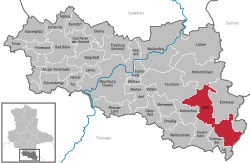
Zeitz (German pronunciation: [ˈtsaɪts] ⓘ; Upper Sorbian: Žič, pronounced [ˈʒitʃ]) is a town in the Burgenlandkreis district, in Saxony-Anhalt, Germany. It is situated on the river White Elster, in the triangle of the federal states Saxony-Anhalt, Thuringia, and Saxony.
Key Information




History
[edit]First a Slavic pagan settlement later Christianized, Zeitz was first recorded under the Medieval Latin name Cici in the Synod of Ravenna in 967. Between 965 and 982, it was the chief fortress of the March of Zeitz. Zeitz was a bishop's residence between 968 and 1028, when it was moved to Naumburg. Beginning at the end of the 13th century, the bishops again resided in their castle at Zeitz. The Herrmannsschacht (built in 1889) is one of the oldest brown coal brickette factories in the world. The city was captured by Swedish troops during the Thirty Years' War and was given to Electorate of Saxony in 1644. It was the centre of Saxe-Zeitz between 1657 and 1718, before returning to the Electorate (which became the Kingdom of Saxony in 1806). In 1815, it was given to the Kingdom of Prussia, becoming district (kreis) centre of the Merseburg region (regierungsbezirk) of the Province of Saxony until 1944, when it became part of the Province of Halle-Merseburg. It became a county free city between 1901 and 1950. It was occupied by U.S. troops on 27 April 1945 and was transferred to Soviet control on 1 July 1945. It was a district centre in the Halle region of Saxony-Anhalt state in 1945–1952 and again in 1990–1994, and in Bezirk Halle between 1952 and 1990. It lost its status as county centre and became part of the Burgenlandkreis on 1 July 1994.
A bombing target of the Oil Campaign of World War II, the Brabag plant northeast of Zeitz used lignite coal for the production of synthetic fuels[3] – forced labor was provided by the nearby Wille subcamp of Buchenwald in Rehmsdorf and Gleina.[citation needed] In the middle of the 1960s work started on the "Zeitz-Ost" residential area, and in the mid-1980s, housing estates such as the "Völkerfreundschaft" (English: International Friendship) were built.
On 18 August 1976, the Protestant clergyman Oskar Brüsewitz from Rippicha burnt himself to death in front of the Michaeliskirche. This was a protest against the DDR system. The town was an industrial centre until German Reunification made many companies in eastern Germany uncompetitive, and 20,000 people lost jobs or moved to other employment. The town still has a large sugar factory, and the nearby lignite mines (Profen and Schleenhain) and Lippendorf Power Station, together employing 2,000 people from Zeitz.[4]
On 1 July 2009 Zeitz absorbed the former municipalities Döbris, Geußnitz, Kayna, Nonnewitz and Würchwitz.[5] On 1 January 2010 it absorbed Luckenau and Theißen.[6]
Geography
[edit]The town Zeitz consists of Zeitz proper and the following Ortschaften or municipal divisions:[7]
Climate
[edit]Zeitz has an oceanic climate (Köppen: Cfb; Trewartha: Dobk). The annual precipitation is 601.7 mm (23.69 in), and the precipitation in summer is about twice that in winter.
The Zeitz weather station has recorded the following extreme values:[8]
- Highest Temperature 39.0 °C (102.2 °F) on 13 August 2003.
- Lowest Temperature −26.8 °C (−16.2 °F) on 14 January 1987.
- Wettest Year 880.5 mm (34.67 in) in 2002.
- Driest Year 302.5 mm (11.91 in) in 1982.
- Highest Daily Precipitation: 84.0 mm (3.31 in) on 21 July 1992.
- Earliest Snowfall: 14 October 2015.
- Latest Snowfall: 28 April 1985.
| Climate data for Zeitz, 1991–2020 normals, extremes 1952–present | |||||||||||||
|---|---|---|---|---|---|---|---|---|---|---|---|---|---|
| Month | Jan | Feb | Mar | Apr | May | Jun | Jul | Aug | Sep | Oct | Nov | Dec | Year |
| Record high °C (°F) | 15.1 (59.2) |
19.8 (67.6) |
26.0 (78.8) |
31.2 (88.2) |
32.5 (90.5) |
37.9 (100.2) |
38.0 (100.4) |
39.0 (102.2) |
34.0 (93.2) |
29.0 (84.2) |
20.9 (69.6) |
18.3 (64.9) |
39.0 (102.2) |
| Mean maximum °C (°F) | 11.2 (52.2) |
13.3 (55.9) |
18.3 (64.9) |
23.6 (74.5) |
27.8 (82.0) |
31.1 (88.0) |
32.9 (91.2) |
33.0 (91.4) |
27.5 (81.5) |
22.3 (72.1) |
15.3 (59.5) |
11.7 (53.1) |
35.0 (95.0) |
| Mean daily maximum °C (°F) | 3.5 (38.3) |
4.9 (40.8) |
9.0 (48.2) |
14.6 (58.3) |
19.1 (66.4) |
22.3 (72.1) |
24.8 (76.6) |
24.7 (76.5) |
19.6 (67.3) |
14.0 (57.2) |
7.9 (46.2) |
4.4 (39.9) |
14.1 (57.4) |
| Daily mean °C (°F) | 1.1 (34.0) |
1.8 (35.2) |
5.0 (41.0) |
9.6 (49.3) |
13.8 (56.8) |
17.0 (62.6) |
19.3 (66.7) |
19.0 (66.2) |
14.6 (58.3) |
9.9 (49.8) |
5.2 (41.4) |
2.0 (35.6) |
9.8 (49.6) |
| Mean daily minimum °C (°F) | −1.4 (29.5) |
−1.0 (30.2) |
1.5 (34.7) |
4.8 (40.6) |
8.6 (47.5) |
12.0 (53.6) |
14.1 (57.4) |
14.0 (57.2) |
10.4 (50.7) |
6.6 (43.9) |
2.7 (36.9) |
−0.2 (31.6) |
6.0 (42.8) |
| Mean minimum °C (°F) | −11.0 (12.2) |
−9.1 (15.6) |
−4.6 (23.7) |
−1.4 (29.5) |
2.7 (36.9) |
6.8 (44.2) |
9.4 (48.9) |
8.7 (47.7) |
4.9 (40.8) |
−0.9 (30.4) |
−3.8 (25.2) |
−8.4 (16.9) |
−13.0 (8.6) |
| Record low °C (°F) | −26.8 (−16.2) |
−23.7 (−10.7) |
−17.0 (1.4) |
−7.0 (19.4) |
−3.2 (26.2) |
1.8 (35.2) |
5.2 (41.4) |
2.8 (37.0) |
−1.6 (29.1) |
−6.8 (19.8) |
−13.0 (8.6) |
−25.2 (−13.4) |
−26.8 (−16.2) |
| Average precipitation mm (inches) | 34.4 (1.35) |
30.7 (1.21) |
40.7 (1.60) |
34.3 (1.35) |
61.9 (2.44) |
66.2 (2.61) |
84.8 (3.34) |
64.0 (2.52) |
53.6 (2.11) |
43.0 (1.69) |
46.7 (1.84) |
41.4 (1.63) |
601.7 (23.69) |
| Average extreme snow depth cm (inches) | 7.8 (3.1) |
6.3 (2.5) |
4.3 (1.7) |
0.5 (0.2) |
0 (0) |
0 (0) |
0 (0) |
0 (0) |
0 (0) |
0.4 (0.2) |
2.4 (0.9) |
6.4 (2.5) |
12.6 (5.0) |
| Average precipitation days (≥ 0.1 mm) | 18.2 | 15.8 | 17.0 | 12.5 | 14.2 | 14.5 | 15.2 | 14.0 | 12.9 | 15.0 | 16.7 | 18.4 | 184.4 |
| Average relative humidity (%) | 81.2 | 78.6 | 74.2 | 68.3 | 69.5 | 70.1 | 68.3 | 68.8 | 75.0 | 80.1 | 83.7 | 82.9 | 75.0 |
| Source: Deutscher Wetterdienst / SKlima.de[8] | |||||||||||||
Main sights
[edit]Zeitz's sights are predominantly situated along the Romanesque Road (point 52).
- Schloss Moritzburg, a baroque-style castle with the cathedral of St. Peter and Paul. The 10th-century crypt displays 17th-century tin coffins including that of Maurice, Duke of Saxe-Zeitz.[9]
- Michaeliskirche (1154), originally a Romanesque basilica and contains a 1517 original of Martin Luther's 95 Theses.
- Town Hall (1509, rebuilt in 1909). It is a Gothic structure that, together with restored houses and three marketplaces, provides Zeitz's medieval appearance.
- Herrmannsschacht, a technical monument in a former brick factory.
Twin towns – sister cities
[edit] Darkhan, Mongolia (1989)
 Detmold, Germany (1990)
 Kaliningrad, Russia (1995)
 Tosu, Japan (1998)
 Prescott, United States (2014)


Notable people
[edit]- Christian August of Saxe-Zeitz (1666–1725), Archbishop of Esztergom
- Anna Magdalena Bach (1701–1760), second wife of J. S. Bach
- Clemens Denhardt (1852–1929), Africa explorer
- Gustav Denhardt (1856–1917), African explorer
- Kurt Floericke (1869–1934), natural scientist, naturalist and author
- Ewald André Dupont (1891–1956), film director and screenwriter
- Walter Krüger (1892-1973), general
- Heinrich Troeger (1901–1975), jurist and SPD politician
- Ewald Riebschläger (1904–1993), water jumper, European Champion
- Karl Walther (1905–1981), painter
- Gotthard Handrick (1908–1978), fighter pilot and athlete, Olympic champion
- Fritz Gödicke (1919–2009), football coach
- Horst Wende (1919–1996), bandleader, arranger and composer
- Heinz-Günther Lehmann (1923–2006), swimmer, European champion
- Manfred Kaiser (1929–2017), footballer and coach
- Rudolf Drößler (1934 – 2022), author and science journalist
- Bernd Bauchspiess (born 1939), footballer
- Hans Zierold (born 1938), swimmer
- Klaus Trummer (born 1945), canoeist
- Jürgen Kretschmer (born 1947), canoeist
- Martina Falke (born 1951), canoeist
See also
[edit]References
[edit]- ^ Bürgermeisterwahlen in den Gemeinden, Endgültige Ergebnisse, Statistisches Landesamt Sachsen-Anhalt. Retrieved 6 July 2023.
- ^ "Alle politisch selbständigen Gemeinden mit ausgewählten Merkmalen am 31.12.2023" (in German). Federal Statistical Office of Germany. 28 October 2024. Retrieved 16 November 2024.
- ^ Becker, Peter W. (1981). "The Role of Synthetic Fuel in World War II Germany: implications for today?". Air University Review. Maxwell AFB.
- ^ Wecker, Katharina (1 June 2018). "Germany's mining communities brace themselves for post-coal era | DW | 01.06.2018". DW.COM. Archived from the original on 19 June 2018.
- ^ Gebietsänderungen vom 02. Januar bis 31. Dezember 2009, Statistisches Bundesamt
- ^ Gebietsänderungen vom 01. Januar bis 31. Dezember 2010, Statistisches Bundesamt
- ^ Hauptsatzung der Stadt Zeitz, October 2019.
- ^ a b "Monatsauswertung". sklima.de (in German). SKlima. Retrieved 18 October 2024.
- ^ Die Krypta des Domes, Kath. Pfarrgemeinde St. Peter und Paul Zeitz.
- ^ "Partnerstädte". zeitz.de (in German). Zeitz. Archived from the original on 25 March 2020. Retrieved 18 February 2021.
External links
[edit]
- . Encyclopædia Britannica (11th ed.). 1911.

| International | |
|---|---|
| National | |
| Geographic | |
| Other | |

Zeitz
View on GrokipediaHistory
Origins and early settlement
The region encompassing modern Zeitz exhibits evidence of continuous human occupation since the Bronze Age, with archaeological indications of dense settlement patterns along the middle Elbe valley, facilitated by fertile floodplains and strategic river access.[7] These early inhabitants likely engaged in agriculture and trade, though specific sites directly attributable to Zeitz remain sparse compared to broader regional findings. Following the Migration Period and the withdrawal of Germanic tribes eastward in the 6th–7th centuries, Slavic groups repopulated the depopulated landscapes of central Germany, establishing agrarian communities in areas like the Saale-Unstrut region.[8] Zeitz emerged as one such Slavic settlement, characterized by fortified villages and pagan practices, with its name deriving from the Slavic root cětь (meaning "assembly" or "gathering place"), reflecting communal functions.[9] The first documented reference to Zeitz appears in 967 AD as Cici in records of the Synod of Ravenna, convened under Emperor Otto I, marking its transition from a Slavic pagan outpost to a site of Christian influence within the Holy Roman Empire.[10] In 968, Otto I elevated it to a bishopric, installing Bishop Tilo as the first prelate, which spurred early ecclesiastical construction and administrative centralization, though the see relocated to Naumburg in 1028 amid regional power shifts. This period laid the foundation for Zeitz's role as a regional hub, blending Slavic substrate with Frankish-Ottonian governance.Medieval period and princely rule
Zeitz emerged as a significant settlement in the early Middle Ages amid the Christianization of Slavic territories east of the Saale River. The town was first documented in 967 during a synod in Ravenna, reflecting its role as a center of a Slavic tribal duchy annexed to the Holy Roman Empire under Emperor Otto I.[5] In 968, Otto I established the Diocese of Zeitz as a suffragan of Mainz, appointing Bishop Unger to oversee the conversion of the region, with the episcopal see initially housed in a modest fortress.[11][12] The bishops of Zeitz wielded considerable temporal authority as prince-bishops, governing lands that extended influence over Thuringia and parts of Saxony. By 1028, through an unprecedented family foundation by the Ekkehardiner dynasty, the episcopal seat transferred to Naumburg, though Zeitz retained a collegiate chapter and remained tied to the diocese, now known as Naumburg-Zeitz.[13] The bishopric endured challenges, including conflicts with local nobility and the Investiture Controversy, but maintained ecclesiastical and secular power until the Reformation. In 1542, Nicolaus von Amsdorf became the first Protestant bishop, marking the diocese's shift to Lutheranism; the last Catholic bishop, Julius Pflug, ruled until his death in 1564, after which the prince-bishopric was effectively secularized under Saxon oversight.[14][15] Princely rule in Zeitz proper began in the mid-17th century with the creation of the Duchy of Saxe-Zeitz as a secundogeniture of the House of Wettin. In 1656, Elector John George I of Saxony granted the duchy—comprising territories around Zeitz—to his youngest son, Maurice (1619–1681), who constructed Moritzburg Castle (1657–1664) as the ducal residence, transforming the former bishop's palace into a Baroque hunting lodge and administrative center.[16][17] Maurice's son, Moritz Wilhelm (1664–1718), succeeded in 1681 and sought imperial recognition of Saxe-Zeitz's sovereignty, leveraging precedents from the former bishopric's privileges, though without full success.[16] The ducal line extinguished upon Moritz Wilhelm's death in 1718 without male heirs, reverting the territories to the Electorate of Saxony under the Albertine Wettins.[18][17]Industrialization and 19th-century growth
The onset of industrialization in Zeitz occurred in the mid-19th century, coinciding with the broader Industrial Revolution in Germany, as the town transitioned from agrarian and princely economies to manufacturing. Early factories emerged around 1846 with Ernst Albert Naether's establishment of a workshop for wheelchairs and baby carriages, which laid the groundwork for what became a leading export industry by the century's end, shipping products to the United States, Russia, South America, West Africa, and Australia.[19][20] Key sectors included textiles, machinery, and sugar processing. In 1850, Scheuble & Brehme founded a textile printing and calico works, marking one of the earliest industrial ventures and evolving into a major linen and fabric producer. The Zeitzer Eisengießerei und Maschinenfabrik AG (Zemag), established in 1855, specialized in iron casting and heavy machinery such as cranes and excavators, contributing to infrastructure development across the region. Sugar production began with a factory in 1858, leveraging local agriculture and later linking to brown coal processing for energy needs. Piano manufacturing also took root, alongside metalworking and woodworking, diversifying the local economy.[21] Infrastructure advancements accelerated growth, particularly the railway network. Zeitz station opened on February 9, 1859, connecting to Gera and facilitating coal and goods transport; subsequent lines to Altenburg in 1872, Leipzig in 1873, and Camburg in 1879 transformed the town into a vital junction, boosting trade and factory expansion. Toward the late 19th century, brown coal briquette production commenced with the Herrmannschacht factory in 1889, founded by Richard Herrmann—a former sugar factory manager—exploiting regional lignite deposits for fuel and chemicals, which shaped Zeitz's industrial landscape into the 20th century.[22][21][23] This period saw Zeitz evolve into a prominent industrial center, with factories imprinting the urban fabric through new buildings and workforce influx, though specific population figures reflect steady urban expansion typical of Prussian Saxony's manufacturing hubs.[10][24]World War II and Nazi-era impacts
During the Nazi era, Zeitz's economy was reoriented toward armaments production, with significant expansion of the Brabag synthetic oil plant, which produced aviation fuel and other petroleum substitutes critical to the German war machine using coal liquefaction processes.[25] The plant, operational since the 1930s but scaled up under the Four-Year Plan for autarky, employed thousands and contributed to Germany's synthetic fuel output, which peaked at over 300,000 tons monthly in early 1944 before Allied interdiction.[26] To meet labor demands, subcamps of Buchenwald concentration camp were established in the Zeitz area, including the Wille subcamp in Rehmsdorf (a Zeitz district) from June 1944 to April 1945, where prisoners—primarily political detainees, Jews, and Soviet POWs—performed forced labor in hazardous synthetic fuel production and construction amid severe malnutrition and brutality.[27] A tent camp in nearby Tröglitz held Jewish forced laborers for similar refinery work, with documented deaths from exhaustion, disease, and executions; post-liberation exhumations revealed mass graves east of Zeitz containing Buchenwald victims.[28] Local Jewish residents, numbering around 100 pre-1933, faced escalating persecution including Kristallnacht pogroms in 1938, property confiscations, and deportations to camps like Theresienstadt and Auschwitz by 1942, leaving no organized Jewish community by war's end.[29] The plant became a priority target in the Allied oil campaign, subjected to multiple U.S. Eighth Air Force raids: on May 12 and 28, 1944, causing initial disruptions; August 10, 1944, further degrading capacity; January 16, 1945, severely damaging infrastructure; and March 31, 1945, amid the war's final weeks, contributing to the collapse of German synthetic production to negligible levels by April 1945.[30] [31] These precision strikes, though aimed at military-industrial sites, inflicted civilian casualties and widespread destruction in Zeitz, with reconnaissance photos showing craters, wrecked pipelines, and halted operations that accelerated fuel shortages crippling Luftwaffe and Wehrmacht mobility.[32] By May 1945, Soviet forces liberated the area, inheriting a devastated industrial base amid the subcamps' grim aftermath.[33]East German socialist period
During the existence of the German Democratic Republic (GDR) from 1949 to 1990, Zeitz functioned as an industrial center within the socialist planned economy, emphasizing state-owned enterprises (Volkseigene Betriebe or VEB) under the control of the Socialist Unity Party (SED). The local economy prioritized heavy industry, including chemical production and machinery manufacturing, aligned with national goals of rapid industrialization and import substitution.[34] Full employment was achieved through these sectors, though productivity was constrained by central directives, material shortages, and inefficiencies inherent to the command system.[35] Key facilities included the Hydrierwerk Zeitz, a chemical complex originally established for synthetic fuel production, which by the 1970s shifted toward consumer chemicals and employed approximately 4,000 workers, producing goods like detergents under the Hyzet brand.[35] VEB Zemag, specializing in machinery for chemical and mining industries, maintained a workforce of about 2,500.[35] VEB Zekiwa emerged as Europe's largest producer of baby carriages, exemplifying the GDR's focus on basic consumer durables amid broader shortages of advanced goods.[36] The chemical sector around Zeitz and nearby Weißenfels formed part of a concentrated industrial corridor, supporting lignite-based energy and synthetic materials central to the GDR's autarkic strategy.[34] Social life reflected typical GDR patterns, with SED-directed organizations shaping education, youth groups, and labor unions, while the Stasi monitored dissent. A notable act of protest occurred on August 18, 1976, when Pastor Oskar Brüsewitz self-immolated in Zeitz's town square, displaying a banner denouncing the "anti-Christ" SED regime and church complicity; he died shortly after, highlighting tensions between evangelical clergy and state atheism.[37] Housing construction expanded via prefabricated panel blocks (Plattenbauten) to address wartime destruction and population growth, though quality and maintenance lagged due to resource prioritization for industry.[35] By 1989, economic stagnation and environmental degradation from lignite mining and emissions eroded living standards, contributing to the regime's collapse.[34]Reunification and post-1990 transformations
Following German reunification in 1990, Zeitz underwent rapid deindustrialization as state-owned enterprises from the German Democratic Republic era proved uncompetitive in a market economy, leading to the closure of major facilities in mechanical engineering, piano manufacturing, and chemicals.[3] Unemployment rates exceeded 30% by the mid-1990s, with the number of industrial enterprises halving from 52 in 1995 to 25 by 2001.[38] Surviving sectors included sugar processing and bioethanol production at Südzucker, food manufacturing at Goldeck/Zetti, and lignite mining by MIBRAG, which employed around 2,000 workers but faces phase-out by 2035 amid Germany's coal exit policy.[3] The economic upheaval triggered significant demographic shifts, with Zeitz's population falling from 47,732 in 1990 to 27,003 by 2021, driven primarily by outmigration of working-age residents to western Germany and aging demographics where one-third of inhabitants exceeded 65 years old.[38] Net positive migration emerged since 2012, yet overall decline persisted due to low birth rates and limited job creation in services and handicrafts, which gradually supplanted heavy industry.[3] Administrative changes compounded local challenges; Zeitz lost its district capital status in 1994 during Saxony-Anhalt's territorial reforms, merging into the Burgenlandkreis with Naumburg as the new center.[3] Revitalization efforts began in the early 2000s, including urban renewal programs from 2002, the hosting of the Landesgartenschau garden exhibition in 2004 to boost tourism, and repurposing sites like the Posa monastery in 2013 for cultural uses.[3] These initiatives shifted focus toward heritage preservation, creative industries, and biochemistry in the Elsteraue area, fostering narratives of regeneration amid persistent structural weaknesses.[38]Geography and environment
Location and physical features
Zeitz lies in the Burgenlandkreis district of Saxony-Anhalt, in eastern Germany, at geographic coordinates 51°2′52″N 12°8′18″E.[39] The town is positioned along the White Elster river, within a border region adjacent to Thuringia to the southwest and Saxony to the southeast.[40] This location places Zeitz approximately 40 kilometers south of Leipzig and 120 kilometers southwest of Berlin, in a transitional zone between the central German lowlands and uplands.[39] The municipality covers an area of 87.16 square kilometers, with elevations averaging around 160 meters above sea level, though surrounding terrain rises to about 210 meters in higher areas.[39] [41] The physical features are dominated by the floodplain and meanders of the White Elster, flanked by gently rolling hills and expansive agricultural plains characteristic of the Saale-Elster river system.[40] The landscape supports arable farming and forestry, with minimal steep gradients, as evidenced by local elevation variations of less than 100 meters across the municipal boundaries.[41]Climate and weather patterns
Zeitz features a temperate climate influenced by its central European location, with mild summers, cold winters, and precipitation distributed relatively evenly across the year, though slightly higher in summer months. The region exhibits characteristics of a humid continental climate with oceanic influences, marked by moderate temperature swings and occasional snowfall in winter. Annual precipitation averages 755 mm, with the wettest periods occurring from May to September, when the probability of wet days exceeds 26%.[42] Average temperatures range from a January low of -2°C and high of 3°C to a July low of 14°C and high of 23°C, yielding an annual mean around 9°C. Winters from November to March are cold and windy, with average highs below 7°C and frequent overcast conditions peaking at 67% in December; snow is common, contributing to occasional ground cover. Summers from late June to early September bring highs above 20°C, though muggy conditions remain rare, with less than 1% of days feeling humid annually.[42] Wind speeds average 10-12 mph year-round, strongest in January at 20 km/h from the west, while cloud cover decreases to a clearer 56% in August. Extreme temperatures include a recorded high of 39°C on 13 August 2003, reflecting occasional heatwaves driven by continental air masses. Precipitation extremes show variability, with the wettest month typically July at about 58 mm and the driest February at 20 mm.[42][43]Environmental legacy and remediation
The former Hydrierwerk Zeitz, a synthetic fuel production facility operational during the Nazi era and continued under East German administration, left extensive soil and groundwater contamination across approximately 2.3 km², primarily with hydrocarbons, benzene, toluene, ethylbenzene, and xylenes (BTEX compounds).[44][45] Benzene concentrations in the lower aquifer reached up to 20 mg/L, posing risks to water resources due to multiple pollutant sources from decades of coal hydrogenation processes.[46] The site's classification as a contaminated megasite stems from its large scale, historical industrial layering, and persistent subsurface plumes, complicating delineation via geophysical methods like spectral induced polarization.[47][48] Open-cast lignite mining in the adjacent Zeitz-Weißenfelser Revier further degraded the regional landscape through excavation of vast areas, overburden dumping, and hydrological disruption, though site-specific contamination in Zeitz proper was dominated by chemical effluents rather than mine tailings.[49] Post-reunification assessments identified these legacies as part of broader East German altlasten (legacy burdens), with mining recultivation focusing on stabilizing spoil heaps and mitigating acidification, but chemical site remediation prioritized due to acute toxicity.[50] Remediation under the Ökologisches Großprojekt (ÖGP) Zeitz, initiated in the 1990s, encompassed source removal, hydraulic containment, and monitored natural attenuation (MNA), enabling partial reuse as the Chemie- und Industriepark Zeitz.[44][45] MNA studies confirmed biodegradation as the primary attenuation mechanism for BTEX, with first-order rate constants derived from isotopic and hydrogeochemical data supporting regulatory approval for passive management over active extraction in low-risk zones.[51] Innovative pilots, such as in situ radio-frequency heating, targeted dense non-aqueous phase liquids (DNAPLs) in pilot phases from 2013, enhancing desorption and degradation without full-scale excavation.[52] Ongoing efforts integrate these with broader structural change funding for Saxony-Anhalt, though complete restoration remains challenged by residual subsurface migration.[53]Demographics
Population dynamics and trends
The population of Zeitz grew substantially during the late 19th and early 20th centuries amid industrialization, reaching 27,558 residents by 1900.[10] In the German Democratic Republic era, it expanded further to exceed 50,000 inhabitants by the late 1980s, driven by state-directed industrial employment and urban development.[54][55] Post-reunification economic disruptions triggered a prolonged decline, with out-migration to western Germany outweighing low birth rates and contributing to a reduction from over 50,000 in 1989 to 32,863 by 2008.[56] The downward trend continued to a low of 27,601 in 2019, reflecting broader depopulation in eastern German industrial towns due to factory closures and limited job opportunities.[56] Natural population change remained negative, with deaths exceeding births amid an aging demographic—median age around 49.9 years—and net migration losses dominating the dynamics.[57] Since approximately 2020, Zeitz has exhibited modest recovery, reaching 28,687 residents by December 31, 2022, a roughly 1.4% increase over the prior five years, partly attributed to targeted urban revitalization and inflows of foreign workers totaling 3,946 (about 13.8% of the population).[58][59] This stabilization contrasts with Saxony-Anhalt's ongoing regional shrinkage but underscores localized efforts to counter structural vacancy and demographic pressures through economic incentives and housing initiatives.[60]| Year | Population |
|---|---|
| 1900 | 27,558 |
| ca. 1989 | >50,000 [54] |
| 2008 | 32,863 [56] |
| 2019 | 27,601 [56] |
| 2022 | 28,687 [58] |
Ethnic and social composition
As of December 31, 2022, Zeitz's population totaled 28,687, of which 3,946 were foreigners, comprising approximately 13.8% of residents—a figure notably higher than the Saxony-Anhalt state average of under 7% in recent years.[58] This foreign share has contributed to offsetting native population decline, with trends persisting into 2024 amid broader East German demographic contraction. The ethnic majority remains German, reflecting Saxony-Anhalt's overall composition of nearly exclusive ethnic Germans with minimal indigenous minorities, though local industry historically drew guest workers from Vietnam and Africa during the GDR era, and post-1990 inflows include EU labor migrants, Ukrainians fleeing war, and asylum seekers from Syria and Afghanistan.[61] In the encompassing Burgenlandkreis district, roughly two-thirds of foreigners hail from EU states like Poland and Romania as of 2018 data, with the remainder predominantly third-country nationals, including elevated Ukrainian numbers by 2023.[62] Persons with migration background—defined as those or whose parents born abroad—constitute a minority in East Germany at 11.7% as of recent federal estimates, lower than West Germany's 30%+, underscoring Zeitz's limited historical diversity outside targeted labor recruitment.[63] This aligns with causal factors like GDR isolation policies and post-reunification out-migration of younger natives, concentrating ethnic Germans while recent immigration introduces pockets of non-European origins, though integration challenges persist in low-density rural districts.[63] Socially, Zeitz embodies the socioeconomic profile of deindustrialized East German locales, with roots in proletarian chemical and lignite sectors fostering a working-class base; post-1990 restructuring amplified income disparities and reliance on social transfers, though specific class metrics remain underdocumented beyond district-level indicators of below-average education attainment and employment in low-skill trades.[38] Religiously, the populace is overwhelmingly secular, mirroring Saxony-Anhalt's profile where Protestants number about 11% (231,061 adherents), Catholics around 3% (64,841), and the remainder—over 85%—unaffiliated or unspecified, a legacy of state atheism under socialism suppressing affiliation rates to historic lows.[64] Immigrant subgroups introduce modest Muslim (e.g., Syrian) and Orthodox (e.g., Ukrainian) presences, but these do not alter the dominant irreligiosity.Economy
Industrial heritage and key sectors
Zeitz's industrial heritage traces back to the 19th century, when its position as a railroad junction facilitated rapid development into a manufacturing hub. Factories produced sugar from local beets, pianos, and notably baby carriages, with Zeitz emerging as the origin of the German pram industry through firms like Zekiwa, which by the mid-20th century dominated stroller production regionally.[65][19] Mechanical engineering and sugar processing also formed core sectors, leveraging abundant lignite resources and agricultural inputs.[3] The chemical industry took root in the 1930s with the establishment of a hydrogenation plant by BRAGAG (Braunkohlen-Benzin AG), converting lignite into fuels and petrochemical precursors amid Nazi-era synthetic fuel efforts. During the German Democratic Republic (GDR) period from 1949 to 1990, this facility expanded into a cornerstone of the state's petrochemical sector, producing diesel fuels, two-stroke oils, and other basics for East Germany's industry, supported by state-directed lignite mining.[66] Post-reunification deindustrialization dismantled much of the heavy machinery and consumer goods output, but the chemical site's remediation preserved its infrastructure.[3] Today, key sectors center on the Chemical and Industrial Park Zeitz, which hosts sustainable chemistry operations utilizing renewable feedstocks and biorefinery processes. The park emphasizes green chemistry, including bio-based production, and serves as a model for soil decontamination from legacy pollution.[67] Südzucker's Zeitz biorefinery, the group's largest site, processes sugar beets and grains into sugar, ethanol, and starch, contributing to the bioeconomy with annual outputs exceeding traditional sugar refining.[68] Energy-intensive activities persist via MIBRAG's lignite operations, though transitioning toward resource efficiency amid regional phase-out pressures.[69]Post-reunification economic restructuring
Following German reunification in 1990, Zeitz experienced a profound economic shock as state-owned enterprises from the German Democratic Republic (GDR) era, including major manufacturers of pianos, strollers, and machinery, proved uncompetitive in a market economy and faced rapid privatization or closure under the Treuhandanstalt agency.[70][71] This deindustrialization process eliminated tens of thousands of jobs in the region, transforming Zeitz from an industrial hub employing over 20,000 in manufacturing pre-1990 to a town grappling with structural collapse by the mid-1990s.[71][3] Unemployment in Zeitz surged, reaching approximately 27% by 1997 amid a population of around 37,000, with rates exceeding 30% in the mid-1990s as nearly all large enterprises shut down.[72][3] The town lost nearly half its roughly 50,000 residents since 1989 due to out-migration driven by job scarcity, while half of local businesses closed by 2001, exacerbating demographic and fiscal strain on municipal services.[73] Federal and European Union structural funds supported short-term relief, including retraining programs and infrastructure upgrades, but initial recovery lagged behind western Germany's productivity levels, with per capita GDP in Saxony-Anhalt remaining about 75% of the national average by the early 2000s.[74] Restructuring efforts shifted focus to small and medium-sized enterprises (SMEs), logistics leveraging Zeitz's central location near the A9 autobahn, and nascent sectors like creative industries and cultural tourism by the 2010s.[75] Local initiatives, such as the Zeitz 2035 urban development plan, aimed to foster knowledge-based economies and attract investment through site redevelopment of brownfield industrial areas, though persistent challenges like skill mismatches and proximity to Leipzig's stronger growth hub limited full revival.[71][75] By 2020, unemployment had declined to around 8-10% through these adaptations and broader eastern German convergence, yet Zeitz remained classified as a "Wendeverlierer" town with below-average wage growth and reliance on subsidies.[76][77]Current challenges and development initiatives
Zeitz contends with structural economic challenges stemming from the coal phase-out in the Central German coalfield, including job losses in traditional industries and a shrinking tax base. The town's population has declined from nearly 50,000 inhabitants, driven by out-migration and limited new employment opportunities, which intensifies fiscal pressures and hampers local investment.[3][78] Regional unemployment in East Germany, reflective of Zeitz's context, stood at 7.5% in 2024 and is projected to reach 7.8% in 2025, with local skepticism about replacing lost coal-related positions amid slower-than-expected diversification.[79][80] In response, the city adopted a Masterplan for structural transformation on March 12, 2025, emphasizing strategies for economic revitalization, civic participation, and sustainable urban development to foster innovation and resilience.[81] This includes expanding the Chemie- und Industriepark Zeitz, which offers pre-existing infrastructure and building rights tailored for water-intensive manufacturing and small-to-medium enterprises to attract investment in non-coal sectors.[75] Parallel efforts promote a cultural and creative economy via repurposed sites such as the Nudelfabrik and Kloster Posa, aiming to build production facilities and presentation spaces that position Zeitz as a regional hub for artists and innovators.[75] Digitalization initiatives form a core component, with the Digitalisierungszentrum Zeitz developing pilot projects in electromobility, digitally enhanced elderly care, and virtual reality applications to seed new industries. Complementary ventures include the LoRaPark in Schlosspark Zeitz for testing sensor-based technologies and deployment of smart solar benches to enhance public infrastructure and energy efficiency.[82][83] These align with Saxony-Anhalt's broader structural funding, which allocated initial annual investments of 42 million euros starting in 2020 for affected regions like Zeitz, supporting renovations such as converting vacant heritage buildings into multi-generational housing to combat demographic decline.[84][85]Government and politics
Administrative structure
Zeitz is administered as a municipal corporation (Gemeinde) within the Burgenlandkreis district of Saxony-Anhalt, with governance centered on a directly elected Oberbürgermeister and a 36-member Stadtrat. The Oberbürgermeister, responsible for executive functions including budget execution and representation, serves an eight-year term; Christian Thieme (CDU), a jurist born in 1972, has held the position since May 2016 and was re-elected on March 5, 2023, with 53.5% of the vote in the second round.[86] The Stadtrat, elected proportionally every five years, handles legislative matters such as ordinances and policy; the most recent election occurred on June 9, 2024, confirming results on June 12, 2024, with major parties including CDU securing the largest bloc.[87] The council elects a chairperson and deputies; as of July 2024, it was reconstituted under interim leadership by senior member Helfried Adam. Zeitz comprises the central urban area and incorporated Ortschaften—rural localities with advisory Ortschaftsräte elected concurrently with the Stadtrat—providing localized input on matters like infrastructure and community affairs. These include Geußnitz, Kayna, Luckenau, Nonnewitz, Theißen, and others such as Döbris and Würchwitz, reflecting post-reunification consolidations.[88] The municipal administration operates from the Rathaus at Altmarkt 1, overseeing departments for finance, urban planning, and social services under the Oberbürgermeister's oversight.[89]Political history and recent elections
Zeitz functioned as the residence of the Duchy of Saxony-Zeitz from 1652 until 1718, serving as the seat of a branch line of the House of Wettin under Duke Moritz.[90] Following the Congress of Vienna, the town was annexed by Prussia in 1815 and designated as the administrative center of the Zeitz district within the Province of Saxony.[9] After World War II, Zeitz was placed in the Soviet occupation zone, becoming part of the state of Saxony-Anhalt established in 1945 before its dissolution into districts in 1952, after which it fell under the Leipzig District (Bezirk Leipzig) in the German Democratic Republic (GDR), where governance was dominated by the Socialist Unity Party (SED) until the fall of the Berlin Wall in 1989.[33] Post-reunification in 1990, Saxony-Anhalt was reconstituted as a federal state, and Zeitz integrated into its democratic framework with the Christian Democratic Union (CDU) historically prominent in local and state politics amid economic transitions from heavy industry. The town experienced the broader East German trend of political realignment, including rising support for the Alternative for Germany (AfD) in response to deindustrialization and migration concerns, as evidenced by the AfD securing a direct mandate in the bordering Zeitz area during the 2021 state election.[91] In the March 5, 2023, mayoral election, incumbent Christian Thieme of the CDU won re-election in the first round with 57.59% of the vote (5,356 votes), defeating challengers including Andreas Huke (independent) at 16.2%. [92] The June 9, 2024, municipal elections saw the AfD emerge as the strongest party in the Zeitz city council, gaining the most seats amid statewide gains for the party in Saxony-Anhalt's communal vote.[93] [94]Infrastructure and transport
Transportation networks
Zeitz is primarily connected to regional and national transportation via rail and bus networks, with road access supporting local and intercity travel. The town's main railway station, Bahnhof Zeitz, serves as a hub for regional trains on lines linking to Leipzig (approximately 50 km northwest) and Weißenfels (about 20 km southwest), with services operated by Deutsche Bahn.[95] Renovation works completed in 2023 enhanced the station's facilities, including platform upgrades and accessibility improvements to support increased passenger traffic.[95] Ongoing planning for an S-Bahn extension from Leipzig to Zeitz, part of the broader Central Germany network, aims to integrate the route by late 2024 or later, though delays were announced in August 2025 due to infrastructure challenges; this would add frequent suburban services with stops at reactivated halts like Bornitz and Reuden.[96][97] Public bus services form the backbone of local and regional mobility, coordinated under Saxony-Anhalt's state-wide network managed by entities like Landesnetz Sachsen-Anhalt and the regional PVG Burgenlandkreis. The Zeitz bus station, adjacent to the railway forecourt, dispatches multiple lines including urban routes (Stadtverkehr Zeitz) covering intra-town connections and regional services to nearby municipalities such as Naumburg and Gera.[98] Specific lines like Bus 500 and Sev provide scheduled operations, with real-time tracking available through state apps; these integrate with the MDV tariff zones for seamless transfers across Central Germany.[99] Recent tariff zone adjustments in 2023 reduced barriers for trips between Zeitz, Weißenfels, and Naumburg, previously spanning up to five zones.[100] Road infrastructure includes federal highways such as the B180, which traverses Zeitz and facilitates connections to the A9 motorway (about 30 km east near Leipzig) for longer-distance travel. Local roads link to surrounding villages like Tröglitz and Droyßig, supporting freight and commuter traffic amid the region's industrial legacy. Zeitz lacks a local airport, with the nearest major facility being Leipzig/Halle Airport (LEJ), reachable in about 1 hour 33 minutes by train, including transfers; direct bus options are limited, emphasizing rail dependence for air access.[101] No tram or light rail systems operate within the town, aligning with Saxony-Anhalt's focus on bus-rail integration over urban trams outside larger cities.[102]Urban development and housing
Zeitz has faced significant urban development challenges stemming from post-reunification industrial decline and demographic shrinkage, resulting in high housing vacancy rates and dilapidated structures, particularly in the inner city. As of 2020, the core city recorded approximately 23% vacancy among its roughly 20,800 apartments, equating to about 4,800 empty units, driven by population loss from economic restructuring after German reunification in 1990.[103] [55] These issues have prompted targeted redevelopment to stabilize the housing stock and enhance livability, focusing on preserving historical half-timbered architecture while addressing structural decay.[104] The city's Integrated Urban Development Concept 2035 (ISEK 2035), approved by the Zeitz city council on June 4, 2020, serves as a strategic framework for addressing these pressures over a 15-year horizon. It emphasizes improving quality of life, housing conditions, cultural assets, and economic viability amid demographic decline, immigration patterns, digitalization, and evolving mobility needs, with recommendations for administrative and political actions to counteract shrinkage effects.[105] [106] Complementary initiatives, such as the "Altstadtsanierung Burgenlandkreis" funding program, prioritize old town preservation and inner-city revitalization to foster attractive residential areas, including conversions of vacant buildings into modern apartments.[3] For instance, projects have transformed derelict structures into multi-unit housing, with local examples demonstrating adaptive reuse to reduce vacancies and integrate sustainable materials like wood and earth in areas such as Der Brühl.[54] [107] The housing market reflects these dynamics, characterized by affordability that appeals to commuters from nearby Leipzig, located about 40 minutes away by train, amid a broader regional "overflow effect" for cheaper urban fringe living. Purchase prices for apartments averaged 1,330 € per square meter and houses 1,298 € per square meter as of September 2025, with rental rates at approximately 6.37 € per square meter, showing modest annual increases of 0.47%.[108] [109] [110] Despite persistent high vacancies, local housing associations like WBG Wohnungsbaugesellschaft Zeitz mbH manage rentals and guest apartments, supporting efforts to maintain occupancy in a shrinking context where speculation risks coexist with revitalization goals.[111] [112]Culture and landmarks
Architectural and historical sites
Schloss Moritzburg stands as Zeitz's premier architectural landmark, constructed between 1657 and 1678 in early Baroque style by Duke Moritz of Saxony on the foundations of a medieval episcopal fortress destroyed during the Thirty Years' War.[113] [17] The three-winged complex, enclosing a courtyard with a central tower, exemplifies the transition from fortified residences to palatial structures in the region, surrounded by an English-style landscape park developed in the 18th century.[114] Today, the castle functions as a museum showcasing local ducal history and industrial artifacts, including pram collections from Zeitz's manufacturing era.[115] The Cathedral of St. Peter and Paul, adjacent to the castle on Schlossberg hill, represents Zeitz's medieval ecclesiastical heritage, originating as a Romanesque basilica over 1,000 years old and serving as the original seat of the Bishopric of Zeitz founded in 968 by Emperor Otto I.[116] Its robust stone architecture, featuring a nave and apse from the 12th century with later Gothic modifications, underscores the town's role in early German bishoprics before the see transferred to Naumburg in 1028.[5] St. Michaeliskirche, located in the town center, is a Gothic parish church dating to the 15th century, characterized by its brick construction typical of northern German sacred architecture and serving as a focal point for local religious and communal activities.[117] The Rathaus (town hall) on the historic Marktplatz embodies Renaissance influences from the 16th century, with its gabled facade and clock tower reflecting municipal governance evolution amid Zeitz's growth as a ducal seat.[118] The Franciscan Monastery, established in the 13th century, preserves remnants of Gothic cloister architecture and highlights Zeitz's mendicant order presence, though partially altered over centuries due to secularization and wartime damage.[118] These sites collectively illustrate Zeitz's layered history from Ottonian foundations through Baroque princely patronage, preserved amid industrial overlays.Museums and cultural institutions
The Museum Schloss Moritzburg, situated in the Baroque castle constructed between 1657 and 1678 on the banks of the White Elster River, functions as Zeitz's principal museum. Established in 1932, it preserves the city's historical artifacts and hosts temporary exhibitions on regional history, art, and culture.[119][120] A key permanent exhibit is the Deutsches Kinderwagenmuseum, which traces the evolution of baby carriages from the 1840s onward, reflecting Zeitz's historical prominence in their production. The collection features over 100 historical prams, perambulators, and related items, highlighting industrial developments in childcare mobility.[121][122] Complementing the museum, the Theater im Capitol serves as Zeitz's main venue for performing arts, accommodating 468 seats across orchestra and balcony levels. Operational from October to April, it presents diverse events including theater productions, concerts, and cabaret performances.[123]Local traditions and events
Zeitz hosts the annual Zeitzer Zuckerfest in early October, commemorating the town's role in the region's sugar industry, which featured prominent refineries until the mid-20th century. The event spans three days across the town's market squares, offering stalls with confectionery, live entertainment, and interactive activities for visitors of all ages.[124][125] The Heinrich Schütz Music Festival takes place in September, featuring around 40 performances including concerts, musical theater, exhibitions, and guided tours that highlight the Baroque composer's legacy in the context of regional musical history.[126] Schütz, born in nearby Köthen in 1585, influences the festival's program, which draws on sacred and secular works from his era.[127] The Zeitzer Lichterfest occurs on May 4 in the Schlosspark Moritzburg, transforming the grounds with illuminations and drawing crowds for its evening light displays amid the historic landscape.[128] Seasonal markets, such as the Herbstmarkt on the first Sunday of October in the same park, include market drives, music, and culinary offerings rooted in local agriculture.[129] The Adventsmarkt from December 6 to 15 provides mulled wine, live music, and baked goods, aligning with central European pre-Christmas customs.[130] A distinctive local tradition involves the production of Milbenkäse, a cheese ripened with cheese mites, practiced commercially in Zeitz until World War II but nearly discontinued during the GDR era due to centralized food policies; small-scale revival efforts persist today.[131] These events and customs reflect Zeitz's industrial heritage, Baroque cultural ties, and seasonal agrarian rhythms without overt political framing.Education and society
Educational institutions
Zeitz maintains a comprehensive network of public educational institutions spanning primary, secondary, and vocational levels, administered primarily by the city and the Burgenlandkreis district. Primary education for children aged 6 to 10 is offered at eight Grundschulen, including the Evangelische Grundschule Zeitz at Badstubenvorstadt 12–13, Grundschule Bergsiedlung at Platanenweg 32, and Grundschule Zeitz-Rasberg at Karl-Marx-Straße 31.[132] These schools focus on foundational skills in literacy, numeracy, and social development, with class sizes typically adhering to Saxony-Anhalt state standards of around 20-25 pupils per class.[132] Secondary education comprises two Sekundarschulen for general lower secondary levels (ages 10-16), such as the Sekundarschule "Am Schwanenteich" at Rasberger Straße 2 and Sekundarschule III at Schillerstraße, which prepare students for vocational paths or further academic study through curricula emphasizing practical skills and basic qualifications like the Hauptschulabschluss or Realschulabschluss.[132] The town's single Gymnasium, Geschwister-Scholl-Gymnasium at Humboldtstraße 7, serves upper secondary students (ages 10-18) pursuing the Abitur for university entrance, with recent renovations completed between 2021 and 2023 to enhance energy efficiency across 1,700 m² of facilities.[132][133] Special needs education is supported by two Förderschulen: the Pestalozzischule, a Basisförderschule focusing on learning disabilities, and the Johann-Traugott-Weise-Schule, addressing intellectual development needs.[132] Vocational training occurs at the Berufsbildende Schulen Burgenlandkreis (BBS) at Alte Werkstraße 1, offering tuition-free dual-system programs in fields like economics, health, and technical trades, integrating classroom instruction with apprenticeships; enrollment supports regional industries in the Burgenlandkreis.[132][134] Adult continuing education is available through the local Volkshochschule, providing courses in languages, professional skills, and general interest topics.[132] No institutions of higher education, such as universities, are located within Zeitz; students typically commute to facilities in nearby Halle or Leipzig.[132]Social services and community life
Zeitz maintains social services through its municipal Sachgebiet Soziales und Wohngeld, which administers welfare benefits, housing allowances, and counseling for residents facing economic or personal challenges, contactable at +49 3441 83-450 or [email protected].[135] The Burgenlandkreis Sozialamt supplements these with regional programs including social assistance (Sozialhilfe), integration aid for disabled individuals (Eingliederungshilfe), nursing care support (Hilfe zur Pflege), and education/participation initiatives (Bildung und Teilhabe).[136] Ambulatory and stationary care services are prevalent, with approximately 155 nursing providers operating in and around Zeitz; 24% of care recipients receive home-based ambulatory support, while 20% utilize full stationary facilities.[137] Elderly representation occurs via the district's Seniorenbeirat, led by figures such as Andreas Huhnstock, advocating for seniors' interests.[138] Counseling centers (Beratungsstellen) provide targeted advice on overcoming social difficulties, including financial aid and integration support.[139] Community life centers on extensive associational activity, with 138 registered organizations fostering social bonds through sports, culture, and heritage preservation. Sports engagement is robust, involving nearly 4,000 residents—about one in seven—in over 90 clubs and sections, such as 1. FC Zeitz e.V. for football and 1. Tischtennisclub Zeitz e.V. for table tennis.[140][141] Religious communities play a key role, with the Evangelische Region Zeitz under the Kirchenkreis Naumburg-Zeitz organizing parish activities and the Pfarrbereich Zeitz at Michaeliskirchhof 11A serving local Protestant needs.[142][143] The Katholische Pfarrgemeinde St. Peter & Paul operates a Caritas social station and kindergarten, contributing to welfare and youth programs.[144] Civic groups like the Heimatverein Zeitz-Weißenfelser-Braunkohlenrevier e.V., founded in 1990, preserve industrial history and engage residents in educational initiatives, while the Aktionsbündnis Zeitz promotes cross-partisan community action.[145][146] Social missionary efforts, such as the 20-year-old Leuchtturm Zeitz program by the local Protestant community, emphasize outreach and support.[147]International relations
Twin towns and partnerships
Zeitz maintains formal partnerships with five cities, fostering cultural, educational, and economic exchanges where feasible. These relationships emphasize mutual understanding and cooperation, though activities with Kaliningrad have been limited since Russia's invasion of Ukraine in 2022 due to broader suspensions of ties between German and Russian municipalities.[148] The partnerships are as follows:| Partner City | Country | Year Established | Key Focus |
|---|---|---|---|
| Darkhan | Mongolia | 1989 | Cultural and developmental cooperation; Darkhan is Mongolia's second-largest city. |
| Detmold | Germany | 1990 | Intensive exchanges involving civic groups, with over 30 joint projects; marked 35 years in 2025.[149] |
| Kaliningrad | Russia | 2010 | Economic promotion and local authority collaboration; formalized on September 11, 2010, after 15 years of prior agreements, but currently dormant amid geopolitical tensions. |
| Tosu | Japan | 2012 | Cultural ties, including maintenance of a Japanese garden in Zeitz's Moritzburg Castle Park; initiated through shared musical heritage.[150] |
| Prescott | United States | 2013 | Primarily student and youth exchanges, popular among school groups. |
Notable individuals
Historical figures
David Herlitz (1557–1636), born in Zeitz, was a German scholar renowned as a mathematician, physician, historian, and poet; he studied at the University of Wittenberg and later practiced medicine while contributing to astronomical and literary works.[152] Hieronymus Kromayer (1610–1670), also born in Zeitz, emerged as a prominent Lutheran theologian, serving as a professor at the University of Leipzig from 1656 and authoring influential treatises on ecclesiastical law and orthodoxy.[153] Maurice, Duke of Saxe-Zeitz (1619–1681), though born in Dresden, established his residence at Moritzburg Castle in Zeitz upon receiving the duchy in 1652 as part of the Albertine Wettin line's partition; he governed until his death, fostering local administration and culture amid the post-Thirty Years' War recovery.) His son, Moritz Wilhelm, Duke of Saxe-Zeitz (1664–1718), was born in Zeitz and succeeded in 1681, ruling until the duchy's extinction upon his death without male heirs; his reign saw continued patronage of the arts and maintenance of the court's Baroque splendor. Christian August of Saxe-Zeitz (1666–1725), another son of Maurice born in Zeitz, pursued an ecclesiastical career, becoming Archbishop of Esztergom in Hungary from 1703 and playing a role in Habsburg religious politics.[154] Earlier associations include Otto I (912–973), Holy Roman Emperor, who founded the Bishopric of Zeitz in 968 to advance Christianization and imperial control over Slavic territories, with the collegiate church serving as a key institution.[12] Henry I (c. 876–936), King of East Francia, ordered the construction of a fortress in Zeitz around 929 to secure borders against Slavic incursions, laying groundwork for the region's medieval development.[8]Modern contributors
Bernd Bauchspieß (1939–2024), born in Zeitz, was a prominent East German footballer who began his career with local club BSG Dynamo Zeitz before transferring to SC Dynamo Berlin and later BSG Chemie Leipzig, where he played in the Oberliga, East Germany's top division. Over his professional tenure from 1961 to 1973, he appeared in 264 matches and scored 120 goals, establishing himself as a prolific striker.[155][156] Tissy Bruns (1951–2013), born Christiane Bruns in Zeitz, advanced to become a leading German investigative journalist, serving as chairwoman of the Association of Investigative Journalists (VVO) from 1999 to 2003. Her career focused on in-depth reporting, contributing to standards in German journalism during the post-reunification era.[157] Matthias Böhlert (1956–2023), a native of Zeitz, emerged as a respected German church musician and organist, receiving early training in his hometown before establishing a long-term role at the Katharinenkirche in Salzwedel, where he served for over 40 years until his death. Böhlert performed internationally, including in St. Petersburg, and contributed to Lutheran musical traditions through concerts and educational efforts.[158][159] Werner Osenberg (1900–1974), born in Zeitz, was a materials scientist and engineer who headed the German Defense Research Association during World War II, compiling a comprehensive list of approximately 15,000 scientists and engineers that influenced Allied recruitment efforts post-war, including Operation Paperclip. His work facilitated the preservation and transfer of German technical expertise amid the conflict's collapse.[160][161]References
- https://www.wikidata.org/wiki/Q22691259