
Recent from talks
Clove
Knowledge base stats:
Talk channels stats:
Members stats:
Clove
Cloves are the aromatic flower buds of a tree in the family Myrtaceae, Syzygium aromaticum (/sɪˈzɪdʒiːəm ˌærəˈmætɪkəm/). They are native to the Maluku Islands, or Moluccas, in Indonesia, and are commonly used as a spice, flavoring, or fragrance in consumer products, such as toothpaste, soaps, or cosmetics. Cloves are available throughout the year owing to different harvest seasons across various countries.
The word clove, first used in English in the 15th century, derives via Middle English clow of gilofer, Anglo-French clowes de gilofre and Old French clou de girofle, from the Latin word clavus "nail". The related English word gillyflower, originally meaning "clove", derives via said Old French girofle and Latin caryophyllon, from the Greek karyophyllon "clove", literally "nut leaf".
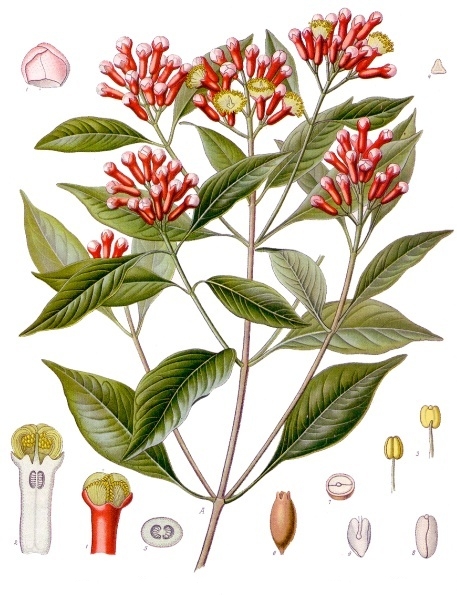
The clove tree is an evergreen that grows up to 8–12 metres (26–39 ft) tall, with large leaves and crimson flowers grouped in terminal clusters. The flower buds initially have a pale hue, gradually turn green, then transition to a bright red when ready for harvest. Cloves are harvested at 1.5–2 centimetres (5⁄8–3⁄4 in) long, and consist of a long calyx that terminates in four spreading sepals, and four unopened petals that form a small central ball.
Clove stalks are slender stems of the inflorescence axis that show opposite decussate branching. Externally, they are brownish, rough, and irregularly wrinkled longitudinally with short fracture and dry, woody texture. Mother cloves (anthophylli) are the ripe fruits of cloves that are ovoid, brown berries, unilocular and one-seeded. Blown cloves are expanded flowers from which both corollae and stamens have been detached. Exhausted cloves have most or all the oil removed by distillation.[citation needed]
Cloves are used in the cuisine of Asian, African, Mediterranean, and the Near and Middle East countries, lending flavor to meats (such as baked ham), curries, and marinades, as well as fruit (such as apples, pears, and rhubarb). Cloves may be used to give aromatic and flavor qualities to hot beverages, often combined with other ingredients such as lemon and sugar. They are a common element in spice blends (as part of the Malay rempah empat beradik –"four sibling spices"– besides cinnamon, cardamom and star anise for example), including pumpkin pie spice and speculaas spices.
In Mexican cuisine, cloves are best known as clavos de olor, and often accompany cumin and cinnamon. They are also used in Peruvian cuisine, in a wide variety of dishes such as carapulcra and arroz con leche.
A major component of clove's taste is imparted by the chemical eugenol, and the quantity of the spice required is typically small. It pairs well with cinnamon, allspice, vanilla, red wine, basil, onion, citrus peel, star anise, and peppercorns.
It is often added to betel quids to enhance aroma while chewing. The spice is used in a type of cigarette called kretek in Indonesia. Clove cigarettes were smoked throughout Europe, Asia, and the United States. Clove cigarettes are currently classified in the United States as cigars, the result of a ban on flavored cigarettes in September 2009.
Hub AI
Clove AI simulator
(@Clove_simulator)
Clove
Cloves are the aromatic flower buds of a tree in the family Myrtaceae, Syzygium aromaticum (/sɪˈzɪdʒiːəm ˌærəˈmætɪkəm/). They are native to the Maluku Islands, or Moluccas, in Indonesia, and are commonly used as a spice, flavoring, or fragrance in consumer products, such as toothpaste, soaps, or cosmetics. Cloves are available throughout the year owing to different harvest seasons across various countries.
The word clove, first used in English in the 15th century, derives via Middle English clow of gilofer, Anglo-French clowes de gilofre and Old French clou de girofle, from the Latin word clavus "nail". The related English word gillyflower, originally meaning "clove", derives via said Old French girofle and Latin caryophyllon, from the Greek karyophyllon "clove", literally "nut leaf".
The clove tree is an evergreen that grows up to 8–12 metres (26–39 ft) tall, with large leaves and crimson flowers grouped in terminal clusters. The flower buds initially have a pale hue, gradually turn green, then transition to a bright red when ready for harvest. Cloves are harvested at 1.5–2 centimetres (5⁄8–3⁄4 in) long, and consist of a long calyx that terminates in four spreading sepals, and four unopened petals that form a small central ball.
Clove stalks are slender stems of the inflorescence axis that show opposite decussate branching. Externally, they are brownish, rough, and irregularly wrinkled longitudinally with short fracture and dry, woody texture. Mother cloves (anthophylli) are the ripe fruits of cloves that are ovoid, brown berries, unilocular and one-seeded. Blown cloves are expanded flowers from which both corollae and stamens have been detached. Exhausted cloves have most or all the oil removed by distillation.[citation needed]
Cloves are used in the cuisine of Asian, African, Mediterranean, and the Near and Middle East countries, lending flavor to meats (such as baked ham), curries, and marinades, as well as fruit (such as apples, pears, and rhubarb). Cloves may be used to give aromatic and flavor qualities to hot beverages, often combined with other ingredients such as lemon and sugar. They are a common element in spice blends (as part of the Malay rempah empat beradik –"four sibling spices"– besides cinnamon, cardamom and star anise for example), including pumpkin pie spice and speculaas spices.
In Mexican cuisine, cloves are best known as clavos de olor, and often accompany cumin and cinnamon. They are also used in Peruvian cuisine, in a wide variety of dishes such as carapulcra and arroz con leche.
A major component of clove's taste is imparted by the chemical eugenol, and the quantity of the spice required is typically small. It pairs well with cinnamon, allspice, vanilla, red wine, basil, onion, citrus peel, star anise, and peppercorns.
It is often added to betel quids to enhance aroma while chewing. The spice is used in a type of cigarette called kretek in Indonesia. Clove cigarettes were smoked throughout Europe, Asia, and the United States. Clove cigarettes are currently classified in the United States as cigars, the result of a ban on flavored cigarettes in September 2009.
Recent media