Hubbry Logo
TechniscopeTechniscopeMain
Open search
Techniscope
Community hub
Techniscope
logo
8 pages, 0 posts
0 subscribers
Be the first to start a discussion here.
Techniscope
Techniscope
from Wikipedia

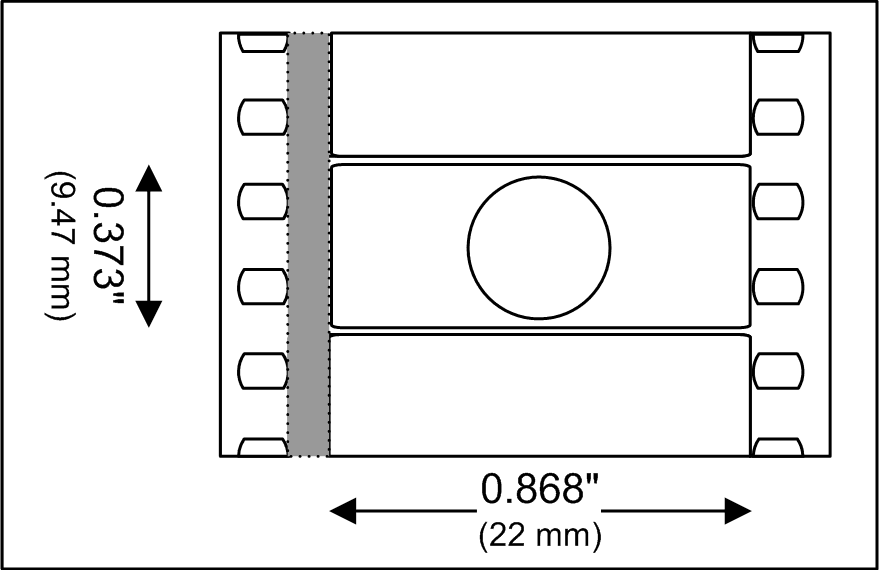
A Techniscope camera film frame

Techniscope or 2-perf is a 35 mm motion picture camera film format introduced by Technicolor Italia in 1960.[1] The Techniscope format uses a two film-perforation negative pulldown per frame, instead of the standard four-perforation frame usually exposed in 35 mm film photography. Techniscope's 2.33:1 aspect ratio is easily enlarged to the 2.39:1 widescreen ratio,[2] because it uses half the amount of 35 mm film stock and standard spherical lenses. Thus, Techniscope release prints are made by anamorphosing, enlarging each frame vertically by a factor of two.

Techniscope-photographed films

[edit]

During its primary reign of 1960–1980, more than 350 films were photographed in Techniscope,[3] the first of which was The Pharaoh's Woman, released 10 December 1960.[4] Given its considerable savings in production cost but lower image quality, Techniscope was primarily an alternative format used for the production of lower-budgeted films, mainly those in the horror and western genres. It also is useful for films using many miniatures such as the Gerry Anderson puppet production Thunderbirds Are Go as this format gives increased depth of focus without requiring huge amounts of light required when the aperture is made very small. Since the format originated in Italy, most Techniscope format films were European productions.[vague]

In the U.S., Techniscope was used in the low-budget A.C. Lyles Westerns for Paramount Pictures, as well as in a few Metro-Goldwyn-Mayer pictures, and Universal Studios briefly used it extensively in the mid-to-late 1960's. The Sergio LeoneDollars Trilogy” films used Techniscope, (Fistful of Dollars, For a Few Dollars More and The Good, the Bad, and the Ugly) and were released through United Artists.[5] Producer Sid Pink recalled that unlike Europe, the American film studios were charged by the Technicolor company for using Techniscope in their film prints.[6] George Lucas shot his first two features, THX 1138 and American Graffiti, in Techniscope in order to give them a gritty, documentary-like feel.[7]

Regarding the diminished image quality, film reviewer Roger Ebert wrote about the film Counterpoint (1968): "The movie is shot in Techniscope, a process designed to give a wide-screen picture while saving film and avoiding payment of royalties to the patented processes like Panavision. In this film, as in Harry Frigg, Techniscope causes washed-out color and a loss of detail. Universal shouldn't be so cheap."[8]

Films shot with 2-perf 35 mm "Techniscope" since 2010 include I'm Yours (2012), Silver Linings Playbook (2012), Argo (2012), and Too Late (2015).

Techniscope's commercial revival

[edit]

Techniscope employs standard 35 mm camera films, which are suitable for 2-perf (Techniscope), 3-perf, conventional 4-perf (spherical or CinemaScope), and even 6-perf (Cinerama) and 8-perf (VistaVision), as all of those processes listed employ the same width negative and intermediate films, and positive print films intended for direct projection (although 2-, 3- and 8-perfs are not distribution formats).

In 1999, in Australia, MovieLab film laboratory owner Kelvin Crumplin revived the Techniscope format renamed as MultiVision 235, attempting to commercialise it as a cinematography format alternative to the Super 16 mm format. His proposition was that it yielded a 35 mm-quality image (from which could be derived natural 2.35:1 and 1.85:1 aspect ratio images) for the same cost as Super 16 mm cinematography.

Mr Crumplin established MovieLab to provide telecine and film processing and printing services, and, with engineer Bruce McNaughton of The Aranda Group, Victoria, Australia, engineered and produced Arriflex BL1 and Arriflex IIC 35 mm cameras for the Techniscope 2-perf format.[3]

Aaton, Panavision, and Arriflex have modern 2-perf cameras. Aranda in Australia is also currently converting cameras like Arriflex 2A/B/C Arri 3, Arri BL, Mitchell, Eclair, Moviecam. The Russian cameras, Kinor and Konvas, are also converted.

Factory-made kits for certain Mitchell and Mitchell-derived cameras are occasionally available on auction sites. In the specific case of a Mitchell, the kit includes a replacement aperture plate and cam for the film movement, a replacement gear for the camera body, and, for a reflex camera, a replacement focusing screen. As all Mitchell cameras incorporate the provision for a "hard mask" within the movement itself, it is often possible to keep the 4-perf aperture plate, and insert a 2-perf mask in the mask slot, as an economy measure.

In 2011, Lomography released a movie camera, the Lomokino, capable of making short movies on standard 35 mm still photography film which uses a frame format similar to Techniscope, with two perforations for each exposure, though with no space or capabilities for the sound track, taking 144 frames on a 36 exposure roll. The camera is erroneously labeled as being "Super 35", Super 35 having four perforations per frame. Movies made with the Lomokino may not show properly without modifications on Techniscope projectors, the Lomokino is hand cranked and the frame rate is controlled manually, usually being around 2-6 FPS.

Techniscope vs. anamorphic: advantages and disadvantages

[edit]

Techniscope's advantages over anamorphic CinemaScope are:

  • More economical: half the film stock used in 4-perforation frame cinematography; half the stock, same running time, less negative to develop.
  • Cinematography uses simpler, but technically superior, spherical lenses.
  • Film stock loads last twice as long; 2-perf stock shoots at 45 feet per minute, while 4-perf stock shoots at 90 feet per minute.
  • (may be seen aesthetically as either an advantage or disadvantage:) The circle of confusion of Techniscope is circular (due to its spherical lenses), whereas that of CinemaScope is elliptical (due to its anamorphic lenses).

Techniscope's disadvantages against CinemaScope:

  • Two-perf 35 mm is a production-only format, that must be converted to other formats for distribution. For distribution prints for theatrical venues, the frame is enlarged from a 2-perf flat ratio to a 4-perf anamorphic ratio. Enlarging the image to the 35 mm print subsequently enlarges the negative's film grain. (Although some cineastes sought this visual feel for the story; e.g. westerns photographed to appear unpolished, thereby enhancing the period settings' verisimilitude.) This step is also an additional production expense. If the enlargement process is done optically, the generation loss will add even more grain and reduce the image sharpness. Alternatively, the enlargement can be done as part of the digital intermediate (DI) process. This involves digitally scanning the 2-perf film negative. Output to film is done with a film recorder, such as the Arrilaser.
  • Two-perforation cameras and telecine installations are rare. (Note: As of early 2008 Aaton is coming out with their newly designed 2-perf-native (3-perf user-switchable) Aaton Penelope camera. Konvas cameras have been available in 2-perf for a while, and Arri is making 2-perf gates for their Arricams soon, available only through the rental dealers though. And more and more telecine suites have 2-perf gates for their film scanners.)
  • The narrower frame line (between frames) emphasises imperfections (e.g. hairs in the gate, lens flares).[clarification needed]

Note: When transferring a Techniscope film to a digital video format, the 2-perf negative or 2-perf interpositive A/B rolls can be used (the original film negative from the camera, or the first-generation film elements prepared for the making of the anamorphic 4-frame 35 mm release print negative), thus bypassing any blown-up 4-perf element. Many DVD editions have been transferred this way and the results have frequently been stunning, e.g. Blue Underground's The Bird with the Crystal Plumage and MGM's special editions of Sergio Leone's Westerns.

Specifications

[edit]
  • Film: 35 mm film running vertically using two perforations per frame, running at 24 frames per second.
  • Film area: 0.868 in × 0.373 in (22.0 mm × 9.5 mm)
  • Film aspect ratio: 2.33:1
  • Print aspect ratio 2.39:1 (2.35:1 prior to 1970 SMPTE revision)

See also

[edit]

References

[edit]
[edit]
Revisions and contributorsEdit on WikipediaRead on Wikipedia
from Grokipedia
Techniscope is a motion picture format developed by Italia in 1960, utilizing standard stock with a two-perforation pull-down per frame—half the standard four perforations—to capture images in a reduced vertical height, enabling an of approximately 2.35:1 after optical expansion during printing. This innovation addressed the demand for economical widescreen production in the post-war era, particularly in Italy, where it became the dominant format for low- to mid-budget films by halving the amount of camera negative required compared to traditional 35 mm anamorphic processes, thus reducing costs for raw stock and processing by up to 50 percent. Techniscope employed spherical lenses in the camera to record a native approximately 2.35:1 aspect ratio image, which was then vertically stretched optically or digitally to full-frame height for printing on standard four-perforation 35 mm positive stock, often combined with horizontal anamorphic expansion for projection. While this approach offered advantages such as greater depth of field from shorter focal-length lenses and compatibility with modified standard cameras from manufacturers like Mitchell and Panavision, it sacrificed vertical resolution, resulting in slightly grainier images on large screens compared to full-frame formats. The format gained prominence in Italian cinema during the 1960s, powering the "" genre through directors like , whose films such as (1964) showcased its widescreen vistas on limited budgets, and extended to Hollywood productions by studios including Paramount and Universal for titles in horror, action, and genres. Over hundreds of films were shot in Techniscope until the late , when it declined due to the rise of more versatile formats like and the discontinuation of Technicolor's dye-transfer printing process, though it saw a minor revival in the 2010s for select digital-era productions like (2012) and (2012).

History and Development

Invention and Introduction

Techniscope emerged amid the revolution of the 1950s and early 1960s, a period when Hollywood and international cinema responded to the threat of television by developing expansive formats such as and to enhance the theatrical experience. These systems, introduced in the mid-1950s, popularized aspect ratios wider than the standard 1.33:1 , but their reliance on anamorphic lenses and larger film stocks increased production costs significantly. In 1960, Technicolor Italia developed Techniscope as a cost-effective alternative tailored for the growing demand for filmmaking, particularly in where budgets were often constrained. The format aimed to halve the amount of 35mm negative required per frame compared to traditional 4-perforation systems, thereby reducing stock and processing expenses without sacrificing the visual width desired by audiences. This was motivated by the need to make accessible to low-budget productions, contrasting with the premium pricing of anamorphic processes like . The core technical concept of Techniscope utilized a 2-perforation (2-perf) vertical pull-down on standard 35mm film, capturing a image in a half-height frame using spherical lenses, which avoided the optical distortions and rental fees associated with anamorphic squeezing. This approach allowed for a native of approximately 2.35:1 when printed and projected conventionally. The first film photographed in Techniscope was the Italian historical drama La donna del faraone (English: The Pharaoh's Woman), directed by Victor Tourjansky and released on December 10, 1960. Targeted at economical European filmmaking, Techniscope quickly found a niche among producers seeking high-impact visuals on limited resources.

Adoption and Peak Usage

Techniscope saw rapid adoption in following its introduction in 1960 by Technicolor Italia, particularly in and , where it became a staple for low-budget productions due to its cost-saving design that halved the negative film usage compared to standard 35mm formats. This economic appeal attracted independent producers, enabling with spherical lenses at studios like Rome's , without the expense of anamorphic equipment. By 1963, the format was widely used across European cinema, with over 350 films produced between 1960 and 1980, predominantly in genres such as Spaghetti Westerns, peplum epics, and horror films that prioritized affordability over premium visual fidelity. The peak usage of Techniscope occurred during the , when it facilitated the production of hundreds of B-movies and , allowing European filmmakers to compete in the era with minimal investment—saving an estimated $15,000 to $20,000 per on stock alone. Its integration with standard 35mm cameras, modified for two-perforation pull-down, simplified workflows for directors in and , contributing to a cultural shift where low-cost became accessible for independent ventures. Databases as of 2011 cataloged over 1,200 Techniscope-shot titles, underscoring its dominance in European output during this decade. Usage began to decline in the as the discontinuation of Technicolor's dye-transfer printing process in the mid- increased conversion costs for exhibition prints, making the format less viable for blow-up to standard 35mm. By the , the rise of video distribution and digital alternatives further eroded its relevance, rendering the specialized negative-to-positive enlargement process obsolete amid falling print orders and evolving industry standards.

Technical Specifications

Format Details

Techniscope is a 35mm motion picture format that employs a two-perforation (2-perf) horizontal pull-down mechanism, utilizing standard 35mm film stock running at 24 frames per second. The exposed frame area measures 22.0 mm in width by 9.5 mm in height, capturing a widescreen image directly without optical compression. This configuration yields a native aspect ratio of approximately 2.33:1 in the camera negative. Following a 1970 revision by the Society of Motion Picture and Television Engineers (SMPTE), the format was standardized to a 2.39:1 aspect ratio for release prints to align with evolving projection standards. Techniscope relies on spherical lenses throughout capture and projection, avoiding the anamorphic squeezing and unsqueezing required by formats like CinemaScope. The 2-perf design halves the negative film consumption relative to conventional 4-perf 35mm formats, effectively doubling the footage capacity in a given —for instance, a standard 1,000-foot provides twice the runtime compared to a 4-perf setup for the same . Cameras such as the Mitchell BNC or Arriflex 35 were modified for this format by adjusting the pull-down mechanism and to accommodate the reduced frame , with these alterations being reversible for standard use. In , the negative undergoes vertical enlargement by a 2:1 to produce a full-height 35mm print compatible with standard projectors.

Printing and Exhibition Process

The Techniscope printing process begins with the camera negative, which captures images using a two-perforation pulldown, and involves enlarging this negative vertically by a factor of two onto standard four-perforation 35mm positive print stock. This enlargement is achieved using an that doubles the image height while maintaining the original horizontal width, resulting in a full-frame positive compatible with the 2.39:1 . The process typically incorporates a 2x1 anamorphic squeeze during printing to align the format with anamorphic distribution standards, producing release prints that require no special handling beyond standard projection. Distribution prints from Techniscope negatives are made on conventional 35mm stock and are fully compatible with standard 35mm projectors, eliminating the need for specialized lenses or equipment during exhibition. These prints project the widescreen image directly, as the optical enlargement fills the four-perforation frame while preserving the intended aspect ratio without further optical distortion. In transfers and digital scanning of Techniscope's two-perforation negatives, challenges arise due to the non-standard pulldown, often requiring custom film gates or setups to maintain proper registration and prevent distortion during the conversion process. Historically, Techniscope printing was managed by laboratories, particularly the facility opened in 1960, which utilized specialized optical printers to handle the enlargement and produce dye-transfer positives. This process introduced some additional from the generational loss of enlargement but maintained notable horizontal sharpness compared to contemporary anamorphic formats. The Society of Motion Picture and Television Engineers (SMPTE) revised the standard projection aperture in 1970 (PH22.106-1971) to establish the 2.39:1 , ensuring consistency between Techniscope prints and anamorphic releases by slightly adjusting the frame dimensions to reduce visible splice lines.

Comparison to Other Formats

Advantages Over Anamorphic

Techniscope offered notable cost efficiencies over anamorphic systems like by consuming 50% less through its two-perforation pull-down format, which halved the amount of negative material and processing required for a typical color motion picture. These savings amounted to approximately $15,000–$20,000 per , rendering the process highly attractive for low-budget productions that sought to adopt without prohibitive expenses. The reduced film load also permitted longer continuous takes, as standard 1,000-foot magazines could run for roughly twice as long—enabling extended shooting periods and fewer interruptions for reloading compared to 4-perforation anamorphic setups. A fundamental difference lies in the capture and processing methods: 2-perf formats like Techniscope use spherical lenses with a 2-perforation pulldown, capturing a half-height frame that requires optical enlargement—often including an anamorphic squeeze during printing—to produce widescreen release prints compatible with standard 4-perf projectors; in contrast, 4-perf anamorphic formats employ anamorphic lenses to compress the full-height image onto a standard 4-perf frame during shooting, which is then de-squeezed for projection. In terms of , Techniscope relied on conventional spherical lenses, which were cheaper and simpler to manufacture and use than the complex anamorphic lenses needed for formats like . This approach avoided common anamorphic artifacts, including distortion in close-ups and barreling in wider shots, while eliminating the horizontal lens flares often produced by anamorphic elements. Spherical lenses further enhanced image sharpness and , particularly with shorter focal lengths, contributing to a cleaner overall visual quality. Camera portability was another key benefit, as the lighter magazines resulting from half the film made Techniscope less cumbersome and quieter during operation. This facilitated easier handling for , especially in demanding outdoor genres such as Westerns, where mobility was essential. Overall, these advantages had a profound economic impact, allowing European independent filmmakers in the —who typically lacked the resources for costly anamorphic rigs—to produce competitive cinema affordably.

Disadvantages and Limitations

One significant limitation of Techniscope was the amplification of during the printing process. The 2-perforation negative frame, with half the vertical height of a standard 4-perforation 35mm frame, required a 2:1 vertical enlargement to produce full-aperture prints, which doubled the visible grain and reduced overall image sharpness compared to native 4-perf formats. This effect was particularly evident on large screens, where Techniscope images appeared grainier than those from anamorphic processes using the full negative area. The format also suffered from lower vertical resolution, approximately half that of 4-perf 35mm, due to the reduced exposure area of 9.35mm in height versus 18.7mm. This trade-off became noticeable in close-ups or scenes with high detail, where the smaller frame size limited clarity and fidelity, exacerbating grain prominence. Equipment availability posed another challenge, with few dedicated 2-perf cameras produced; most were modified versions of standard 35mm models like the Mitchell BNC or Arriflex, available only through limited conversions costing around $1,300–$1,400 per unit in the 1960s. By the 1970s, these modifications were rare, complicating rentals and maintenance as support for the format waned. Post-production introduced additional hidden costs that often offset the savings in raw film stock. Custom optical printing to enlarge the 2-perf negative to 4-perf matrices required specialized equipment, with only one such printer available initially, and laboratory work was slightly more expensive than standard processes. transfers similarly demanded custom handling, increasing expenses for producers despite halved negative usage. While Techniscope prints were compatible with standard 35mm projectors, the original 2-perf negatives required specialized storage and handling to prevent issues like flash frames, mis-lites, and sync problems, leading to archival degradation over time. The abandonment of Technicolor's dye-transfer printing process further compounded these problems, resulting in high-contrast, soft images with heavy optical grain in surviving materials. Compared to later formats like , Techniscope's reduced frame height limited vertical resolution, whereas used the full 4-perforation height with spherical lenses to achieve similar aspect ratios without optical enlargement, providing sharper images and easier workflows. Techniscope's usage primarily declined in the late 1970s with the end of Technicolor's dye-transfer printing and the adoption of more versatile formats like . The emergence of workflows in the 1990s and 2000s further diminished the need for analog processes like Techniscope's optical conversions.

Usage in Cinema

Notable Films (1960s-1980s)

Techniscope found widespread application in Italian cinema during the 1960s, particularly in the peplum genre of sword-and-sandal adventure films, which emphasized epic spectacles on limited budgets. The format's debut came with The Pharaoh's Woman (1960), directed by Victor Tourjansky, marking the first feature-length production to utilize Techniscope for its widescreen presentation of ancient Egyptian intrigue and romance starring Linda Cristal and John Drew Barrymore. This early adoption paved the way for numerous peplum titles throughout the decade, enabling producers to achieve a grand visual scale without the expense of traditional anamorphic systems, thus sustaining the genre's popularity in Europe amid over 1,200 total Techniscope productions, including more than 350 confirmed European entries. The format's economic advantages propelled its use in the emerging spaghetti western subgenre, where director Sergio Leone's Dollars Trilogy—A Fistful of Dollars (1964), For a Few Dollars More (1965), and The Good, the Bad and the Ugly (1966)—exemplified Techniscope's ability to capture expansive desert landscapes and dynamic action sequences in a 2.39:1 . Photographed by , these films starred as the iconic and featured Ennio Morricone's groundbreaking scores, blending operatic tension with visual grit to redefine the western for international audiences. Leone's innovative framing and long takes, such as the climactic standoff in The Good, the Bad and the Ugly, highlighted Techniscope's suitability for low-to-mid-budget Italian productions, influencing the stylistic hallmarks of exploitation cinema by prioritizing atmospheric depth over high-cost optics. In horror and , Techniscope supported auteur-driven narratives in the , as seen in Dario Argento's thriller Deep Red (1975), where cinematographer Luigi Kuveiller employed the format to craft shadowy, expressionistic visuals that amplified the film's psychological terror and elaborate murder set pieces. Similarly, utilized Techniscope for his debut feature (1971), a dystopian sci-fi shot by to evoke a stark, futuristic sterility on a modest budget, followed by the nostalgic (1973), captured by Jan D'Alquen and Ron Eveslage with as consultant to deliver vibrant nocturnal drives in . These examples underscore Techniscope's role in democratizing for non-Hollywood creators, allowing innovative visual in B-movies and exploitation fare that shaped genre aesthetics through the 1980s.

Revival and Modern Applications

In 1999, Australian film laboratory owner Kelvin Crumplin revived the Techniscope format under the name MultiVision 235, adapting modern 35mm cameras to expose two perforations per frame for cost-effective production. This initiative involved engineering modifications by McNaughton at The Aranda Group to enable commercial use of the 2-perf system on contemporary equipment. Equipment advancements continued into the 2000s, with the Aaton Penelope camera released in 2008 as the first purpose-built model switchable between Techniscope (2-perf) and 3-perf formats, facilitating flexible shooting without extensive conversions. and Arriflex offered modifications to their cameras, such as converting Arri 2C and BL series models to 2-perf pulldown mechanisms, allowing filmmakers to achieve Techniscope's using standard 35mm stocks. In 2009, endorsed a "renaissance" of the format during a Cine Gear Expo seminar, highlighting how newer Vision3 emulsions reduced visible grain when printing 2-perf negatives to 4-perf positives, addressing historical quality concerns. Notable modern films include (2012), shot partially in Techniscope using LT and ST cameras for a gritty aesthetic, and (2012), which incorporated 2-perf alongside on Vision3 stock to evoke period authenticity. Post-2015 usage remained limited to independent projects, such as Too Late (2015), a noir thriller captured in five long takes on 35mm Techniscope for its raw, filmic texture, and (2022), which used 2-perf 35mm to deliver visual grit. No major studio releases employed the format between 2020 and 2025, reflecting the dominance of . Digital intermediates introduced after 2000 have mitigated Techniscope's original grain issues by enabling high-resolution scans and during , preserving the format's economic benefits for workflows. In , Lomography launched the Lomokino, a hand-cranked consumer camera using standard 35mm still film to expose frames approximating Techniscope's 2.33:1 (24 x 8.5mm), allowing hobbyists to create short analog movies. As of 2025, Techniscope persists in a niche role for retro aesthetics in short films and experimental works, with no evidence of widespread revival amid digital alternatives. The format's legacy extends to influencing , which adopted similar 2-perf horizontal exposure concepts in the 1980s under names like Super Techniscope to achieve 2.39:1 ratios without anamorphic lenses, paving the way for modern digital shoots.

References

Add your contribution
Related Hubs
User Avatar
No comments yet.