Hubbry Logo
search
logo

The Normal Heart

logo
Community Hub0 Subscribers
Read side by side
from Wikipedia

The Normal Heart
Cover of the paperback edition released by Plume in October 1985
Written byLarry Kramer
Date premieredApril 21, 1985
April 19, 2011 (revival)
Place premieredThe Public Theater
New York City, New York, United States
Original languageEnglish
SubjectAIDS in New York City
GenreDrama
SettingNew York City, New York, United States

The Normal Heart is a largely autobiographical play by Larry Kramer. It focuses on the rise of the HIV/AIDS epidemic in New York City between 1981 and 1984, as seen through the eyes of writer/activist Ned Weeks, the gay founder of a prominent HIV advocacy group. The play's title comes from W. H. Auden's poem, "September 1, 1939".[1]

After a successful 1985 off-Broadway production at The Public Theater, the play was staged in Los Angeles and London. It was revived off-Broadway in 2004, and finally made its Broadway debut in 2011. The play was first published by Plume in the US, and by Drama Editor Nick Hern for Methuen in the UK to coincide with the 1986 British première at London's Royal Court Theatre. He then reissued it in his own imprint Nick Hern Books in 2011 when first staged on Broadway, and again in a tie-in edition alongside the National Theatre revival in 2021.

Characters

[edit]

[2]

  • Craig Donner
  • Mickey Marcus
  • Ned Weeks
  • Dr. Emma Brookner
  • Bruce Niles
  • Felix Turner
  • Ben Weeks
  • Tommy Boatwright
  • Hiram Keebler

Synopsis

[edit]

During the early 1980s, Jewish-American writer and gay activist Ned Weeks struggles to pull together an organization focused on raising awareness about the fact that an unidentified disease is killing off a specific group of people: gay men, largely in New York City. Dr. Emma Brookner, a physician and survivor of polio (as a consequence of which she is using a wheelchair), has the most experience with this strange new disease. She bemoans the lack of medical knowledge about the illness, and encourages gay men to practice abstinence for their own safety, since it is still unknown how the disease is spread. Ned, a patient and friend of Brookner's, calls upon his lawyer brother, Ben, to help fund his crisis organization; however, Ben's attitude toward his brother is one of merely passive support, which ultimately exposes his homophobia. For the first time in his life, meanwhile, Ned falls in love, beginning a relationship with New York Times writer Felix Turner.

The increasing death toll raises the unknown illness, by this time correctly believed to be caused by a virus, to the status of an epidemic, though the press remains largely silent on the issue. A sense of urgency guides Ned, who realizes that Ben is more interested in buying a two-million-dollar house than in backing Ned's activism. Ned explosively breaks off ties with his brother, not wanting further interaction until Ben can fully accept Ned's homosexuality. Ned next looks to Mayor Ed Koch's administration for help in financing research about the epidemic, which has now killed hundreds of gay men, including some of Ned's personal friends.

Ned's organization elects as its president Bruce Niles, who is described as the "good cop" of gay activism in implicit comparison to Ned: while Bruce is cautious, polite, deferential, and closeted, Ned is vociferous, confrontational, incendiary, openly gay, and supportive only of direct action. Tensions between the two are clear, though they must work together to effectively promote their organization. Felix, meanwhile, reveals to Ned his belief that he is now infected with the mysterious virus.

Although he continues to try to strengthen interactions with the mayor, Ned ruins his chances when his relentless and fiery personality appalls a representative sent by the mayor. Dr. Brookner gradually takes on the role of activist herself, and notes the epidemic's appearance in other countries and among heterosexuals. Although she desperately seeks government funding for further research, her request is denied; the rejection prompts her to unleash a passionate tirade against those who allow the persistence of an epidemic that is taking the lives of homosexuals, who are already marginalized by the government. In the meantime, Ned's conflict with Bruce comes to a head, and their organization's board of directors ultimately expels Ned from the group, believing his unstable vehemence to be a threat to the group's attempts to engage in calmer diplomacy.

As Felix's condition worsens, he visits Ben in order to make his will, and in the hope of effecting a reconciliation between Ben and his brother. All of them, along with Emma, meet at Felix's deathbed. Emma unofficially weds Felix and Ned, and Felix dies immediately after. Ned blames himself for his lover's death, lamenting that he did not fight hard enough to make his voice heard. The play ends with Ned and Ben embracing. As the stage fades to black, the rate of mortality from HIV/AIDS is shown to be continuing to increase.

Autobiographical parallels

[edit]

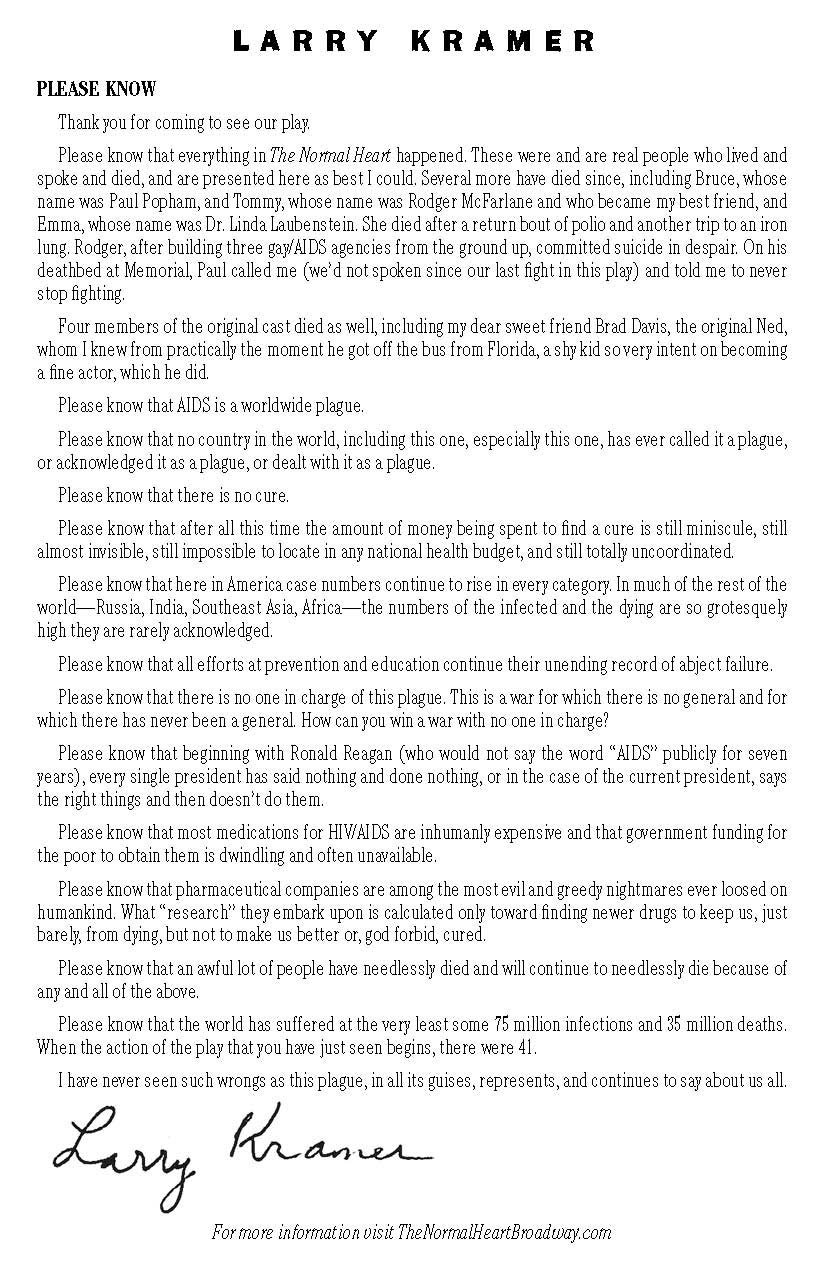
After most performances of the 2011 revival of The Normal Heart, Kramer personally passed out a dramaturgical flyer detailing some of the real stories behind the play's characters.[3] Kramer wrote that the character "Bruce" was based on Paul Popham, the president of the GMHC from 1981 until 1985; "Tommy" was based on Rodger McFarlane, who was executive director of GMHC and a founding member of ACT UP and Broadway Cares; and "Emma" was modeled after Dr. Linda Laubenstein,[4] who treated some of the first New York cases of what later became known as AIDS. Like "Ned," Kramer himself helped to found several AIDS-activism groups, including Gay Men's Health Crisis (GMHC) and AIDS Coalition to Unleash Power (ACT UP), and indeed experienced personal conflict with his lawyer brother, Arthur.[citation needed]

It has been suggested (though not by Kramer himself) that the model for 'Felix' was John Duka, a New York Times style reporter who died of AIDS-related complications in 1989.[5]

Productions

[edit]

1985–1999

[edit]

Produced by Joseph Papp and directed by Michael Lindsay-Hogg, the play opened off-Broadway at The Public Theater on April 21, 1985, and ran for 294 performances. The original cast included Brad Davis as Ned and D. W. Moffett as Felix, with David Allen Brooks as Bruce Niles and Concetta Tomei as Dr. Emma Brookner (based on Linda Laubenstein, M.D.). Joel Grey replaced Davis later in the run.

During the original 1985 production, the set was very simple with a small amount of furniture and the set walls consisted of white-washed plywood.[2] All along these walls and even the theatre walls, there were facts, newspaper headlines, figures and names that were involved in the HIV/AIDS Epidemic painted in black.[2] For example, one of the passages written on the set read, "During the first nineteen months of the epidemic, The New York Times wrote about it a total of seven times" and another passage read, "During the three months of the Tylenol scare in 1982, The New York Times wrote about it a total of 54 times".[2] The text that was painted onto the set was updated and revised constantly. One fact stated the latest number of AIDS cases nationally (according to the Centers for Disease Control), and if the number increased, before the next performance the set designers would cross out the old number and, below it, paint the new figure.[2]

The play received its European premiere in 1986 at London's Royal Court Theatre, where it was directed by David Hayman and produced by Bruce Hyman. In that production Ned Weeks was initially played by Martin Sheen who received an Olivier Award nomination as Best Actor. When it transferred to the Albery Theatre (now the Noël Coward Theatre) Ned Weeks was played by Tom Hulce and then John Shea. For that production Paul Jesson, who played Felix, won the Laurence Olivier Award for Best Performance in a Supporting Role.

The Normal Heart received its Polish premiere in 1987 at the Polish Theatre in Poznań where it was directed by Grzegorz Mrówczyński [pl].[6] The Polish cast included Mariusz Puchalski [pl] as Ned Weeks and Mariusz Sabiniewicz [pl] as Tommy Boatwright, with Andrzej Szczytko as Bruce Niles and Irena Grzonka as Dr. Emma Brookner.[7]

In a student production of the play at Cambridge University in 1988, the role of Felix was played by Nick Clegg.[8]

The play received its Australian premiere at the Sydney Theatre Company in 1989, directed by Wayne Harrison.[9]

In subsequent productions of the play, Ned Weeks was portrayed by Richard Dreyfuss in Los Angeles,[10] and Raul Esparza in a 2004 Off-Broadway revival directed by David Esbjornson at the Public.[11]

On April 18, 1993, Barbra Streisand organized and introduced a benefit reading for Broadway Cares at the Roundabout Theatre Company (for years she had been trying to get the movie made with her as director).[12] It starred Kevin Bacon, John Turturro, Harry Hamlin, D.W. Moffett, Tony Roberts, David Drake, Kevin Geer, Eric Bogosian, Jonathan Hadary and Stockard Channing as Emma Brookner.[13][deprecated source]

2000s

[edit]

The show had an Off-Broadway revival in 2004 at the Public Theater presented by the Worth Street Theater Company, starring Raúl Esparza as Ned Weeks and Joanna Gleason and Lisa Kron as Dr. Brookner, directed by David Esbjornson (taking over from Jeff Cohen mid-rehearsal) and lighting design by Ken Billington. The success of this revival lead to the 2011 Broadway production.

The Broadway premiere of The Normal Heart began on April 19, 2011, for a limited 12-week engagement at the Golden Theatre. This production used elements employed in a staged reading, directed by Joel Grey, held in October 2010. The cast featured Joe Mantello as Ned, Ellen Barkin (making her Broadway debut) as Dr. Brookner, John Benjamin Hickey as Felix, Lee Pace as Bruce Niles, and Jim Parsons as Tommy Boatwright (both Pace and Parsons made their Broadway debuts). Joel Grey made his Broadway directing debut; George C. Wolfe was supervising director. The production supported several "nonprofit organizations, including The Actors Fund and Friends In Deed."[14]

In the 2011 Broadway revival, when the actors weren't in the scene they would stand along the walls of the set and watch from the shadows the scene being performed.[2] Towards the end of the play when Felix dies, he leaves Ned alone on center stage and steps back to where the other actors are, along the shadowy walls of the set.[2] This Broadway production also echoed the original idea to have the white-washed walls covered with facts and figures. During the finale of this production, names of those affected by the AIDS Epidemic were gradually projected onto the walls until the set was completely covered in names, marking the end of the play.[2]

A production at Washington, D.C.'s, Arena Stage was scheduled to run from June 8 to July 29, 2012.[15]

A production produced by Studio 180 Theatre at Buddies in Bad Times theatre in Toronto, Ontario, in 2011 and 2012 starred Jonathan Wilson as Ned Weeks and John Bourgeois as Ben.[16]

In May 2021, the One Institute presented a historic virtual reading of "The Normal Heart" reaching audiences across the United States and in 19 countries across the globe. The virtual presentation marked the first time the play featured a cast that is predominately BIPOC and LGBTQ. Directed by Emmy Award winner Paris Barclay, cast members of the production included Sterling K. Brown, Laverne Cox, Jeremy Pope, Vincent Rodriguez III, Guillermo Díaz, Jake Borelli, Ryan O’Connell, Daniel Newman, Jay Hayden and Danielle Savre. An encore presentation of the reading streamed worldwide in December 2021 in honor of World AIDS Day.[17]

A London revival of the play was originally scheduled to begin performances at the National Theatre in Spring 2021, but was delayed due to the COVID-19 pandemic.[18] It began previews on 23 September 2021 at the National's Olivier Theatre, with a Dominic Cooke-directed cast led by Ben Daniels, Liz Carr and Luke Norris. The production, staged in part celebration of the play's 35th anniversary and the author (who died of pneumonia in 2020), received largely positive reviews. Many critics noted social and political parallels between the play's representation of the HIV/AIDS epidemic and the COVID-19 pandemic.[19][20][21] The revival ran until 6 November 2021, and received five Laurence Olivier Award nominations the following year, including Best Revival and Best Actor for Daniels.[22] Carr won the Olivier for Best Actress in a Supporting Role,[23] and Daniels received a Critics' Circle Theatre Award for Best Actor.[24]

The State Theatre Company of South Australia staged the play at the Adelaide Festival Centre in October 2022, directed by Dean Bryant, with STCSA artistic director Mitchell Butel as Ned and Mark Saturno as Ben.[25]

Television adaptations

[edit]

A Polish television adaptation débuted on the TVP channel on 4 May 1989, one month before the first free election in the country since 1928.[26][27]

The American telefilm adaptation débuted on the HBO premium pay cable channel on Sunday, May 25, 2014.[citation needed]

Sequel

[edit]

Kramer wrote a sequel about Ned Weeks in 1992, The Destiny of Me, which was performed at the Lucille Lortel Theater by the Circle Repertory Company in October of that year.[28]

Critical reception and response

[edit]

In his review in The New York Times, Frank Rich observed, "In this fiercely polemical drama ... the playwright starts off angry, soon gets furious and then skyrockets into sheer rage. Although Mr. Kramer's theatrical talents are not always as highly developed as his conscience, there can be little doubt that The Normal Heart is the most outspoken play around – or that it speaks up about a subject that justifies its author's unflagging, at times even hysterical, sense of urgency. ... Mr. Kramer has few good words to say about Mayor Koch, various prominent medical organizations, The New York Times or, for that matter, most of the leadership of an unnamed organization apparently patterned after the Gay Men's Health Crisis. Some of the author's specific accusations are questionable, and, needless to say, we often hear only one side of inflammatory debates. But there are also occasions when the stage seethes with the conflict of impassioned, literally life-and-death argument. ... The writing's pamphleteering tone is accentuated by Mr. Kramer's insistence on repetition - nearly every scene seems to end twice - and on regurgitating facts and figures in lengthy tirades. Some of the supporting players ... are too flatly written to emerge as more than thematic or narrative pawns. The characters often speak in the same bland journalistic voice - so much so that lines could be reassigned from one to another without the audience detecting the difference. If these drawbacks ... blunt the play's effectiveness, there are still many powerful vignettes sprinkled throughout."[29]

Jack Kroll of Newsweek called it "extraordinary" and added, "It is bracing and exciting to hear so much passion and intelligence. Kramer produces a cross fire of life-and-death energies that create a fierce and moving human drama."[30] In the New York Daily News, Liz Smith said, "An astounding drama . . . a damning indictment of a nation in the middle of an epidemic with its head in the sand. It will make your hair stand on end even as the tears spurt from your eyes."[30] Rex Reed stated, "No one who cares about the future of the human race can afford to miss The Normal Heart,"[30] while director Harold Prince commented, "I haven't been this involved – upset – in too damn long. Kramer honors us with this stormy, articulate theatrical work."[30]

On the day The Normal Heart opened, a spokesman for The New York Times addressed statements in the play about the newspaper's failure to give the disease adequate coverage. He said that as soon as The Times became aware of AIDS, it assigned a member of the science staff to cover the story, and his article appeared on July 3, 1981, making The Times "one of the first – if not the first – national news media to alert the public to the scientific recognition and spread of the disease." He also cited a later full-length report in The New York Times Magazine about recent discoveries made by researchers.[29] When asked about his negative portrayal in The Normal Heart, former New York City Mayor Ed Koch said through a spokesman, "I haven't seen the play. But I hope it's as good as As Is, which is superb."[29]

In 2000, the Royal National Theatre named The Normal Heart one of the 100 greatest plays of the 20th century.[30] In his 2004 book, How to Do the History of Homosexuality, David Halperin criticized the character of Ned Weeks for surrendering to "gay chauvinism" and "homosexual essentialism" through "various strategies of elitism and exclusion" when he lists renowned homosexuals he considers part of his culture.[31]

Of the 2011 Broadway revival of the play, Ben Brantley wrote in The New York Times:[32]

What this interpretation makes clear, though, is that Mr. Kramer is truly a playwright as well as a pamphleteer (and, some might add, a self-promoter). Seen some 25 years on, The Normal Heart turns out to be about much more than the one-man stand of Ned Weeks, the writer who takes it upon himself to warn gay men about AIDS (before it was even identified as such) and alienates virtually everyone he comes across. Ned Weeks — need I say? — is Larry Kramer, with a thoroughness that few onstage alter-egos can claim.

After the 2011 Broadway production, Patrick Healy from The New York Times interviewed young, gay men that had attended the show to see their reaction to the subject matter.[33] Most of the young men that Healy interviewed talked about how the HIV/AIDS epidemic is almost never brought up in textbooks or discussed in class by teachers.[33] The Broadway revival became a "heart-tugging lesson",[33] according to Healy's interviews, for those who weren't alive during the events that unfolded in the gay community in the 1980s.

On June 12, 2011, Ellen Barkin and John Benjamin Hickey won the Tony Awards for Best Performance by a Featured Actress and Actor, respectively, for its Broadway debut, while the production won Best Revival of a Play.

In his review of the 2021 historic reading of the play presented by the One Archives Foundation, Los Angeles Times chief theatre critic Charles McNulty praised cast member Sterling K. Brown noting that he "captured so brilliantly" the role of Ned Weeks. He added: "the choice of Brown was inspired. Not only is he an exceptional, Emmy-winning actor, but his performance represented an act of coalition building, a recognition of shared struggle and a refusal to let the walls of identity serve as a prison."[34]

Awards and nominations

[edit]

Original London production

[edit]
Year Award Category Nominee Result
1986 Laurence Olivier Award Play of the Year Nominated
Actor of the Year Martin Sheen Nominated
Outstanding Performance of the Year in a Supporting Role Paul Jesson Won

2011 Broadway revival

[edit]
Year Award Category Nominee Result
2011 Tony Award Best Revival of a Play Won
Best Actor in a Play Joe Mantello Nominated
Best Featured Actor in a Play John Benjamin Hickey Won
Best Featured Actress in a Play Ellen Barkin Won
Best Direction of a Play George C. Wolfe and Joel Grey Nominated
Drama Desk Award Outstanding Revival of a Play Won
Outstanding Ensemble Performance Honoree
Outstanding Director of a Play George C. Wolfe and Joel Grey Won

2021 London revival

[edit]
Year Award Category Nominee Result
2022 Laurence Olivier Award Best Revival Nominated
Best Actor Ben Daniels Nominated
Best Actor in a Supporting Role Dino Fetscher Nominated
Danny Lee Wynter Nominated
Best Actress in a Supporting Role Liz Carr Won
Critics' Circle Theatre Award Best Actor Ben Daniels Won

References

[edit]
[edit]
Revisions and contributorsEdit on WikipediaRead on Wikipedia
from Grokipedia
The Normal Heart is a semi-autobiographical play written by Larry Kramer, an American playwright and AIDS activist, which premiered Off-Broadway at The Public Theater in New York City on April 21, 1985.[1][2] The work centers on the protagonist Ned Weeks, a fictionalized version of Kramer himself, who co-founds the Gay Men's Health Crisis (GMHC) amid the emerging HIV/AIDS epidemic in early 1980s New York, portraying the frustrations of grassroots efforts against bureaucratic indifference from city and federal authorities, including the Reagan administration's delayed response, as well as internal divisions within the gay community over risky sexual behaviors in bathhouses and bars that accelerated transmission.[3][4] The play spans 1981 to 1984, dramatizing real events through Weeks' confrontational advocacy, drawing from Kramer's own ousting from GMHC leadership due to his aggressive tactics, which prioritized public protests over quieter fundraising.[5] Its raw depiction of personal losses, medical neglect, and societal homophobia galvanized early AIDS awareness, influencing activism by emphasizing personal responsibility and institutional accountability over victim narratives.[6] Revived on Broadway in 2011, it earned the Tony Award for Best Revival of a Play, underscoring its enduring impact on theater and public health discourse.[7] Kramer's script faced initial mixed reception for its polemical style—praised for urgency but criticized for didacticism—yet it achieved cultural significance, later adapted into an HBO telefilm in 2014 directed by Ryan Murphy, which amplified its critique of governmental inaction while reaching broader audiences.[8][9] Controversies arose from its unsparing portrayal of promiscuity as a causal vector in the epidemic's spread, challenging prevailing community norms and earning Kramer enmity from some activists who viewed such emphasis as judgmental rather than empirical.[3]

Background and Creation

Historical Context of the AIDS Epidemic

The first official recognition of what would become known as the AIDS epidemic occurred on June 5, 1981, when the U.S. Centers for Disease Control and Prevention (CDC) published a report in its Morbidity and Mortality Weekly Report detailing five cases of Pneumocystis carinii pneumonia (PCP), a rare opportunistic infection, among previously healthy young gay men in Los Angeles. This was followed on July 3, 1981, by a CDC report of 26 cases of Kaposi's sarcoma, another uncommon malignancy, in gay men aged 26 to 51 across New York City and California, signaling an emerging cluster of immune deficiencies linked to sexual transmission within urban homosexual networks. Initially termed "gay-related immune deficiency" (GRID), the condition reflected early epidemiological observations of its disproportionate occurrence among men engaging in high-volume unprotected anal intercourse, with contact-tracing revealing dense sexual partner networks that facilitated rapid viral dissemination.[10] By the end of 1984, the CDC had documented 7,239 AIDS cases nationwide, resulting in 5,596 deaths, with New York City accounting for a substantial portion as the epidemic's early epicenter due to its large, interconnected gay male population and venues like bathhouses that amplified transmission through multiple-partner encounters.[11] Epidemiological studies confirmed primary modes of spread via unprotected receptive anal sex and blood exposure, with mathematical modeling indicating bathhouses as key amplifiers during the initial outbreak, where isolated dyadic risks compounded into network-level explosions absent behavioral interventions like condom use or partner limitation.[10] Diagnostic challenges persisted, as no reliable test existed until the causative retrovirus—isolated by French researchers as lymphadenopathy-associated virus (LAV) in 1983 and confirmed as HTLV-III by American scientists in 1984—was identified, delaying targeted public health responses.[12] The mischaracterization of GRID as inherently tied to homosexuality, rather than modifiable high-risk behaviors, contributed to initial underestimation of transmissibility beyond sexual and blood routes, though case clusters in hemophiliacs and transfusion recipients by late 1982 prompted broader recognition of its infectious etiology.[13] In New York City, where opportunistic infections overwhelmed hospitals by 1983, the lack of a unified viral nomenclature until 1986 (as HIV) hindered coordinated surveillance, allowing unchecked spread in environments promoting anonymous, high-frequency contacts.[14]

Development and Autobiographical Parallels

Larry Kramer co-founded the Gay Men's Health Crisis (GMHC) on January 4, 1982, as the first community-based organization in the United States dedicated to supporting those affected by the emerging AIDS epidemic, initially focusing on providing services, referrals, and advocacy for resources amid government inaction.[15] His tenure was marked by frustration with the group's reluctance to adopt more confrontational strategies, leading to his ouster from GMHC in 1983 over what members viewed as excessively radical and aggressive tactics in demanding public attention and funding for the crisis.[16] This experience of internal conflict and expulsion directly informed the play's depiction of factionalism within early AIDS advocacy efforts, with Kramer channeling his personal clashes into the narrative to highlight perceived complacency and denial in the face of mounting deaths—over 5,000 reported in the U.S. by early 1985.[15] The protagonist, Ned Weeks, serves as a thinly veiled alter ego for Kramer himself, embodying the playwright's own role as a outspoken founder and critic of institutional responses, including his pushes for media coverage and policy changes that alienated peers.[17] Felix Turner, Ned's partner who contracts AIDS and dies in the story, draws inspiration from journalist John Duka, a New York Times reporter and acquaintance of Kramer who succumbed to the disease in 1983, reflecting Kramer's observations of personal losses among intimates in the gay community.[18] Similarly, Dr. Emma Brookner, the wheelchair-using physician urging urgent action, is modeled after Dr. Linda Laubenstein, a pioneering AIDS clinician at New York University whom Kramer consulted and who treated early patients with innovative approaches despite her own polio-related disability; Laubenstein's advocacy for recognizing AIDS as a public health emergency parallels the character's pleas in the play.[19] Kramer wrote The Normal Heart in the wake of his GMHC departure, using the script to dramatize real frustrations from 1981 to 1984, though he amplified certain events for emphasis while grounding them in verifiable experiences to underscore causal failures in response times. The play premiered off-Broadway at The Public Theater on April 21, 1985, under the direction of Michael Lindsay-Hogg, produced by Joseph Papp as part of the New York Shakespeare Festival.[3][2] This staging captured the immediacy of Kramer's lived activism, prioritizing factual parallels over pure fiction to critique delays that Kramer attributed to community and governmental inertia.

Plot and Characters

Synopsis

The Normal Heart is set in New York City from 1981 to 1984 and follows the experiences of Ned Weeks, a gay man who witnesses the onset of a mysterious fatal illness affecting his community. In July 1981, Ned visits Dr. Emma Brookner's office, where patients like Craig Donner await diagnosis; Brookner identifies the disease as destroying the immune system and instructs Ned to alert gay men to cease sexual activity to curb its spread, as cases accumulate with high mortality rates, including 16 deaths out of 28 known instances. Ned then approaches Felix Turner, a New York Times reporter, in September 1981 to secure media coverage, but Felix limits his involvement to cultural reporting. By October 1981, Ned consults his brother Ben, a lawyer, to incorporate a nonprofit organization aimed at addressing the crisis, securing initial legal support despite Ben's reluctance to join formally.[20] In November 1981, Ned begins a romantic relationship with Felix during a date at Ned's apartment. By March 1982, Ned collaborates with associates including Mickey Marcus, Bruce Niles, and Tommy Boatwright to distribute informational materials; the group elects Bruce as president and debates advising reduced sexual partners amid emerging cases. In May 1982, Ned obtains pro bono services from Ben's firm but faces familial tension over his activism. By October 1982, the group reports 40 known deaths, and Felix develops a suspicious lesion on his foot. That month, Dr. Brookner examines Felix and confirms the diagnosis, initiating treatment while the organization meets City Hall officials like Hiram Keebler, who downplays the emergency given 509 cases relative to the population. Operational challenges arise, including postal rejections of mailings due to naming conventions and internal debates on strategy.[20] Escalating deaths mark the progression, with friends like Reinhard, Craig, Richie, Ray, and Albert succumbing—Albert's body, for instance, discarded untreated after a flight in 1983—amid national reports of 30 weekly cases and local discrepancies in tracking. Mickey undergoes a breakdown after professional repercussions from Ned's public criticisms, leading to hospitalization. Funding requests, such as Dr. Brookner's $5 million proposal, face rejection despite over 2,000 cases, prompting protests against delays. Internal conflicts peak as the board ousts Ned from leadership in 1984 for his confrontational approach, excluding him from key meetings with the mayor. Felix's condition deteriorates, culminating in his death in May 1984 following a hospital marriage to Ned, amid Ned's reconciliation with Ben and reflection on cumulative losses.[20]

Key Characters and Their Bases

Ned Weeks, the play's protagonist and a novelist who becomes a vocal AIDS activist, is directly modeled on Larry Kramer himself, capturing his efforts to co-found the Gay Men's Health Crisis (GMHC) on January 12, 1982, amid mounting deaths from the emerging epidemic. While Kramer's real-life activism involved founding GMHC alongside figures like Paul Popham and Rodger McFarlane, Ned's portrayal emphasizes an amplified abrasiveness and insistence on public confrontation, which Kramer later reflected strained his relationships within the organization, leading to his ouster from the board in 1983.[4][21][22] Felix Turner, Ned's lover and a closeted fashion writer for The New York Times, represents the personal toll of AIDS on intimate relationships, as he develops symptoms and deteriorates over the play's timeline set from 1981 to 1984. Though not a one-to-one match, Felix draws inspiration from individuals Kramer knew, including John Duka, a Times reporter who died of AIDS in 1986 after living discreetly; Kramer has not confirmed a single basis, suggesting a composite to evoke broader experiences of denial and loss among gay professionals.[4][18] Bruce Niles, a closeted Wall Street banker and GMHC co-founder who favors measured, behind-the-scenes advocacy over Ned's militancy, is based on Paul Popham, GMHC's second president from 1982 to 1985, who balanced corporate restraint with crisis response before dying of AIDS on April 28, 1987. Popham's real tenure involved expanding services like hotlines and client support, mirroring Bruce's focus on sustainability, though the character composites elements from other moderate founders to highlight strategic divergences Kramer critiqued.[4][22][23] Dr. Emma Brookner, a wheelchair-using physician who urges aggressive research and warnings about transmission, is inspired by Dr. Linda Laubenstein, an oncologist at New York University who treated over 1,000 early AIDS cases starting in 1981 and pushed for federal acknowledgment despite limited data on causes. Laubenstein's advocacy, including testifying before Congress in 1983, informed the character's insistence on behavioral changes, though Brookner's fictional polio-related paralysis adapts Laubenstein's real mobility challenges from multiple sclerosis.[24][25]

Themes and Perspectives

Advocacy for AIDS Awareness and Action

In The Normal Heart, the protagonist Ned Weeks, a semiautobiographical stand-in for Larry Kramer, spearheads the creation of a volunteer organization modeled on the Gay Men's Health Crisis (GMHC), founded on January 8, 1982, by Kramer and five associates in New York City to address the burgeoning AIDS deaths through education, client services, and advocacy amid scant institutional response.[26] The play illustrates early efforts such as organizing community meetings, distributing informational pamphlets, and conducting door-to-door outreach to inform gay men of transmission risks and available support, emphasizing self-reliant mobilization when official channels lagged.[27] These depictions underscore causal links between targeted awareness and practical resource allocation, as GMHC's initial fundraising—starting with private donations totaling $6,000 in its first months—enabled hotlines, buddy programs, and legal aid for those ill with AIDS-related conditions.[28] Kramer's script stresses personal responsibility in halting spread through modified sexual practices and routine testing, with Weeks confronting community leaders to promote condom usage and serostatus disclosure years before such measures gained formal endorsement from bodies like the Centers for Disease Control.[29] This advocacy reflected Kramer's real-world push in 1982–1983 for bathhouse closures and behavioral warnings, predating the 1983 pamphlet How to Have Sex in an Epidemic by Richard Berkowitz and Michael Callen, which codified safer techniques like non-penetrative acts and latex barriers.[30] Empirical data from cohort studies in San Francisco and New York later showed that analogous community-driven safe-sex adoption correlated with a 70% decline in new HIV infections among gay men from 1984 to 1997, attributing reductions to heightened risk perception and practice shifts rather than solely medical advances.[31] The 1985 premiere at The Public Theater, which became its longest-running production to date with over 400 performances in initial runs, amplified these calls by drawing diverse audiences and generating media coverage that funneled donations to AIDS groups, including GMHC, whose budget expanded from under $1 million in 1982 to $5 million by 1985 through heightened private and foundation support.[32] This visibility sustained pressure on philanthropists and policymakers, contributing to a broader activist ecosystem where awareness translated into tangible resource mobilization, as evidenced by the tripling of nonprofit AIDS service capacities in major U.S. cities between 1985 and 1987.[33] Such outcomes highlight how dramatic portrayals of urgency fostered behavioral vigilance and funding commitments, with causal evidence from longitudinal surveys linking early theatrical interventions to accelerated community compliance with prevention protocols.[34]

Critiques of Promiscuity and Community Denial

In The Normal Heart, the character Ned Weeks, modeled after playwright Larry Kramer, confronts the gay community's widespread participation in bathhouses and anonymous sexual encounters, portraying these as primary drivers of HIV transmission due to the sheer volume of partners involved. Weeks explicitly calls for the immediate closure of bathhouses and a halt to promiscuous practices, asserting that such behaviors created an environment conducive to exponential viral spread among men who have sex with men (MSM).[35] [36] This critique extends Kramer's earlier novel Faggots (1978), which similarly condemned the normalization of frequent, unprotected anal intercourse and multi-partner sex as self-destructive, a theme intensified in the play amid rising AIDS cases.[37] Epidemiological data from the early 1980s substantiated these concerns, with case-control studies revealing that AIDS patients among MSM reported median sexual partners numbering in the hundreds or thousands, far exceeding those of uninfected controls, thereby amplifying exposure risks through networks of repeated contacts.[38] Bathhouses, as commercial venues facilitating dozens of encounters per visit without barriers, were empirically linked to heightened HIV seroprevalence; for instance, seropositivity rates in MSM attending STD clinics surged from 14% in 1983 to 58% in 1984, correlating with patronage of such sites where unprotected receptive anal sex predominated.[39] [40] Mathematical models later confirmed that venues enabling high partner turnover accounted for disproportionate incident infections, underscoring the causal role of behavioral volume over mere location.[41] Kramer's advocacy clashed with gay organizational leaders, including those at the Gay Men's Health Crisis (GMHC), whom he accused of denialism by prioritizing stigma mitigation over enforcing behavioral modifications like partner limits or venue shutdowns. These moderates argued that closures would equate to endorsing heterosexual norms and invite broader discrimination, favoring education on consent and condoms while resisting mandates that targeted gay-specific institutions.[42] [43] In New York and San Francisco, this led to public battles in 1984–1985, where health officials padlocked facilities amid protests framing the measures as moralistic overreach rather than pragmatic epidemiology.[44] Kramer countered that ignoring modifiable risk factors—such as reducing partner counts from averages exceeding 50 annually in affected cohorts—perpetuated unnecessary deaths, framing accountability not as blame but as a rational response to verifiable transmission dynamics.[45][38]

Views on Government Inaction and Scientific Uncertainty

In The Normal Heart, the character Ned Weeks repeatedly lambasts the Reagan administration for its perceived silence on the emerging AIDS crisis, portraying federal officials as willfully indifferent to mounting deaths among gay men in New York City from 1981 onward, with Weeks demanding public acknowledgment and funding in meetings that yield bureaucratic stonewalling.[4] This depiction culminates in frustration over President Reagan's lack of direct address until September 17, 1985, when he first publicly mentioned AIDS in a press conference, responding to a reporter's question by calling it a "top priority" amid over 5,000 reported U.S. cases and nearly 2,800 deaths by mid-1985. Dr. Emma Brookner, a wheelchair-bound physician based on Dr. Linda Laubenstein who treated early AIDS patients at New York University Medical Center, embodies scientific urgency amid uncertainty, urging experimental drug trials like those with suramin despite the unidentified etiology, as the virus would not be isolated until May 1983 by researchers at the Institut Pasteur.[46][47] The play's emphasis on governmental paralysis reflects Kramer's activist polemics but aligns partially with timelines of federal reticence: the Centers for Disease Control and Prevention (CDC) issued its first alert on June 5, 1981, via a Morbidity and Mortality Weekly Report on pneumonia cases among gay men, followed by a dedicated AIDS task force in June 1982, yet public presidential engagement lagged as cases surpassed 3,000 by late 1983.[15] Initial National Institutes of Health (NIH) funding for AIDS research totaled under $1 million in fiscal year 1982, rising to about $33 million by 1984 after Congress approved the first dedicated appropriations in July 1983 via supplemental bills, constrained by the novel pathogen's unclear transmission and reservoir compared to familiar threats.[15][48] Causally, this underfunding stemmed from empirical gaps—pre-1983 virological unknowns precluded targeted interventions like vaccines—contrasting sharply with the 1976 swine flu response, where a single Fort Dix outbreak prompted $135 million in federal outlays for 43 million vaccinations within weeks, leveraging established influenza expertise despite no pandemic materializing.[49][50] While activist narratives, including Kramer's, often amplify inaction as moral neglect amid a stigmatized population, data indicate pragmatic caution: AIDS cases grew exponentially from 159 in 1982 to 3,076 by 1983, prompting scaled NIH allocations that doubled annually post-isolation, though critics from outlets with documented ideological tilts toward heightened government culpability overlook parallels to other orphan diseases' slow mobilizations.[15][48] Brookner's on-stage desperation for trials mirrors real pleas from clinicians like Laubenstein, who by 1982 advocated off-label uses absent etiological clarity, highlighting virology's precedence over policy in causal bottlenecks.[46]

Productions

Original Production and Early Revivals (1985–1999)

The Normal Heart premiered Off-Broadway at The Public Theater in New York City on April 21, 1985, under the direction of Michael Lindsay-Hogg.[51] The original cast starred Brad Davis as the protagonist Ned Weeks, alongside D. W. Moffett as Felix Turner, David Allen Brooks as Bruce Niles, and Mercedes Ruehl as Dr. Emma Brookner.[52] [53] The production ran for 294 performances through June 1986, drawing audiences during the early height of the AIDS crisis when over 5,900 AIDS-related deaths had been reported in the U.S. by the end of 1985.[54] Securing the production faced significant logistical hurdles, as multiple theaters, including American Playhouse, initially declined to stage it due to the play's unsparing depiction of the AIDS epidemic as tied to male homosexual behavior and the associated stigma of a "gay plague."[55] Funding was constrained by broader institutional hesitance; producers encountered resistance from venues wary of alienating subscribers amid public fears of contagion, with some audiences avoiding theaters altogether over concerns of contracting HIV.[32] [56] The play's polemical style, which indicted government inaction, medical uncertainty, and intra-community denial, amplified these challenges, yet it resonated intensely with viewers, eliciting emotional responses that blended outrage and grief in an era of limited awareness and action.[3] In March 1986, the production transferred to London for its European premiere at the Royal Court Theatre on March 20, directed by David Hayman and starring Martin Sheen as Ned Weeks.[57] [58] Early U.S. revivals were sparse and regional, including a staging at Long Wharf Theatre in New Haven, Connecticut, in early 1986 under Arvin Brown, emphasizing personal dimensions of the crisis, and another in Los Angeles later that year led by Douglas Roberts.[59] [60] Throughout the 1990s, as U.S. AIDS deaths peaked at approximately 50,000 annually around 1994–1995, further productions remained limited by persistent venue reluctance and funding shortages tied to the topic's sensitivity, restricting the play's reach despite its role in early advocacy.

Major Revivals (2000s–2010s)

A significant revival occurred Off-Broadway at the Public Theater in 2004, produced by the Worth Street Theater Company and directed by David Esbjornson following an initial directorial change from Jeff Cohen. Opening on April 21 and closing June 29, the production starred Raúl Esparza as the protagonist Ned Weeks, alongside Michael Stuhlbarg and Lisa Emery, with Esparza's performance noted for its raw intensity in conveying the character's confrontational activism amid the early AIDS crisis.[61] [62] [63] This staging, nearly 20 years after the original, underscored the play's persistent call for accountability from government and community leaders, drawing audiences familiar with advanced treatments but reminded of initial neglect.[64] The 2011 Broadway production at the John Golden Theatre marked the play's first transfer to that venue, co-directed by Joel Grey—a member of the 1985 original cast—and George C. Wolfe, whose choices amplified emotional urgency through stark staging and ensemble dynamics. Featuring Joe Mantello as Ned Weeks, Ellen Barkin as the wheelchair-bound Dr. Emma Brookner, and John Benjamin Hickey as Felix Turner, it opened April 27, 2011, after previews, and ran 86 performances until July 10.[1] [65] The casting of high-profile actors, including Barkin's portrayal of the doctor advocating for research despite institutional indifference, heightened visibility for Kramer's critiques of denial and inaction, culminating in a Tony Award for Best Revival of a Play.[66] [67] This revival introduced the work to younger theatergoers, leveraging star power to reframe historical complacency as a cautionary model for public health responses.[46]

Recent Productions (2020s)

In 2023, New Repertory Theatre in Watertown, Massachusetts, mounted a production of The Normal Heart directed by Shira Helena Gitlin, running from June 21 to July 9 at the Black Box Theater in the Mosesian Center for the Arts.[68] [69] The staging featured a committed ensemble portraying the play's central figures, including Ned Weeks, and was praised for its handling of themes of epidemic indifference and personal activism amid institutional neglect.[70] In 2024, Austin Rainbow Theatre presented a revival from September 6 to 21 at the Ground Floor Theatre, focusing on the drama's unflinching examination of the early AIDS crisis in New York.[71] [72] The production, part of the company's efforts to highlight LGBTQ+ historical narratives, elicited strong emotional responses from audiences, with reviewers commending its portrayal of community denial and advocacy efforts.[73] [74] That same year, Redtwist Theatre in Chicago offered a production directed by ensemble member Ted Hoerl, from August 18 to September 29 in their newly renovated Edgewater venue at 1044 W. Bryn Mawr Avenue.[75] [76] Featuring a runtime of approximately three hours, the revival centered on protagonist Ned Weeks' confrontations with promiscuity, government inaction, and medical uncertainty, and was described by critics as retaining its raw power in illuminating injustices faced by queer communities.[77] [78] Upcoming stagings include a planned production by Stage Center in Shreveport, Louisiana, set for December 19–21, 2025, at Marjorie Lyons Playhouse, directed by Zhailon Levingston as part of their 15th anniversary season.[79] [80] These regional revivals in the post-pandemic period have emphasized the play's critiques of delayed crisis responses, with reviewers linking its 1980s-era depictions of bureaucratic and societal failures to modern reflections on public health preparedness and marginalized groups' vulnerabilities.[81] [82]

Adaptations and Sequel

2014 HBO Television Film

The HBO television film adaptation of The Normal Heart was directed by Ryan Murphy and featured a screenplay by Larry Kramer, who adapted his own 1985 play.[83] Production began after Murphy optioned the rights in August 2011, with filming occurring in New York City to capture the story's 1980s setting. The film premiered on HBO on May 25, 2014, at 9:00 PM ET/PT.[84] Mark Ruffalo starred as Ned Weeks, the protagonist based on Kramer, while Matt Bomer portrayed his partner Felix Turner; supporting roles included Taylor Kitsch as Bruce Niles, Jim Parsons as Tommy Boatwright, Julia Roberts as Dr. Emma Brookner, and Joe Mantello as Mickey Marcus.[85] The ensemble cast drew from Murphy's collaborations on projects like Glee and American Horror Story, emphasizing emotional intensity suited to screen drama.[86] The premiere airing attracted 1.4 million viewers across initial and encore broadcasts that evening, with nearly 1 million for the 9:00 PM slot and 435,000 for the 11:15 PM repeat.[87] To expand the stage-bound narrative for television, Murphy incorporated location shooting and visual sequences depicting the era's medical environments, such as hospital overcrowding and patient suffering, which amplified the epidemic's visceral impact beyond the play's theatrical constraints.[88] Kramer and Murphy revised the script to include additional scenes and character moments, effectively "opening up" the material with cinematic techniques like montages of activism and personal loss, while tempering some of the original's raw polemical directness to resonate with a broader premium cable audience.[86] These changes prioritized emotional accessibility and historical visualization over the play's unbroken confrontational dialogue, facilitating wider dissemination of the story's advocacy themes.[88]

The Destiny of Me as Sequel

The Destiny of Me is Larry Kramer's 1992 semi-autobiographical play that directly continues the narrative of The Normal Heart, shifting focus from collective activism to the protagonist Ned Weeks' introspective confrontation with his HIV-positive status and personal history.[89] Premiering off-Broadway on October 20, 1992, at the Lucille Lortel Theatre under the Circle Repertory Company, the work follows Weeks in a clinical trial for experimental AIDS treatments, where he relives his evolution from a troubled youth named Alexander to the combative founder of the organization depicted in the predecessor play.[90] Kramer, drawing explicitly from his own life, uses this sequel to extend his critique of denial and inaction during the early AIDS crisis, now internalized through Weeks' regrets over strained family ties—particularly with his brother—and unfulfilled quests for love amid relentless advocacy.[91] Bridging themes from The Normal Heart, the play sustains Kramer's emphasis on the urgent need for medical and societal response to AIDS, but pivots to individual accountability, portraying Weeks' hospitalization as a forced reckoning with promiscuity's consequences and the emotional toll of his confrontational style, which alienated allies and kin alike.[92] Family reconciliation emerges as a core motif, with Weeks grappling with paternal rejection and sibling resentment rooted in his sexuality, echoing the original's undertones of personal sacrifice for communal survival yet highlighting Kramer's view that unchecked personal behaviors exacerbated the epidemic's spread within gay communities.[93] This autobiographical extension underscores Kramer's intent to humanize the activist archetype, revealing vulnerabilities that fueled his rage against government indifference and scientific hesitancy, while critiquing self-destructive patterns that mirrored broader societal failures.[89] Unlike The Normal Heart, which saw frequent revivals and adaptations due to its polemical immediacy, The Destiny of Me has received comparatively limited stagings, reflecting its more intimate, reflective tone and lesser emphasis on urgent mobilization.[94] Nominated as a finalist for the 1993 Pulitzer Prize for Drama, the play's production history includes the original run directed by Michael Greif, but it has not achieved the same cultural traction or institutional support, with revivals scarce and often confined to smaller theaters or academic contexts.[94] This disparity highlights Kramer's evolution from firebrand agitator to introspective chronicler, though the sequel's candor on personal failings in the AIDS fight has drawn praise for its emotional depth without diluting the call for accountability.[91]

Reception and Controversies

Initial Critical Responses

The initial production of The Normal Heart, which premiered at the Public Theater on April 21, 1985, elicited strong responses from critics who praised its unflinching urgency in addressing the AIDS epidemic while noting its polemical style and occasional didacticism. Frank Rich, in The New York Times, described the play as a "fiercely polemical drama" where playwright Larry Kramer "starts off angry, soon gets furious and then skyrockets into sheer rage," acknowledging it as "the most outspoken play around" justified by the crisis's severity, though critiquing its "pamphleteering tone" accentuated by repetition and underdeveloped characters.[3] Reviews in gay-oriented publications and within the community were similarly mixed, admiring the play's role in raising awareness of the epidemic's toll—particularly government and institutional inaction—but faulting its protagonist's rage-filled confrontations for potentially alienating moderate allies and downplaying intra-community complexities like denial of risk factors. For instance, while some outlets like the Village Voice urged audiences to see it as a vital reminder of vitality amid crisis, others highlighted how Kramer's autobiographical stand-in, Ned Weeks, embodied a stridency that mirrored real tensions, with critics arguing the script's hectoring monologues prioritized indictment over nuanced drama.[95][96] Despite these critiques, the production's commercial viability underscored its resonance, sustaining an off-Broadway run of over a year at the Public Theater amid ongoing controversy, which drew audiences seeking raw confrontation with the unfolding health emergency.[2]

Awards and Nominations

The 1985 Off-Broadway premiere at The Public Theater received no major theater awards, though subsequent early revivals, such as the 2004 production by Worth Street Theatre Company, earned a Drama Desk Award nomination for Outstanding Revival of a Play.[97] The 2011 Broadway revival at the John Golden Theatre won the Tony Award for Best Revival of a Play on June 12, 2011. John Benjamin Hickey received the Tony for Best Performance by an Actor in a Featured Role in a Play for portraying Felix Turner, while Ellen Barkin won for Best Performance by an Actress in a Featured Role in a Play as Dr. Emma Brookner.[98] The production also secured Drama Desk Awards for Outstanding Revival of a Play and Outstanding Ensemble Performance.[1] The 2021–2022 National Theatre production at the Olivier Theatre garnered five Laurence Olivier Award nominations in 2022, including Best Revival, Best Actor in a Play for Ben Daniels as Ned Weeks, and Best Actor in a Supporting Role for both Dino Fetscher as Felix Turner and Danny Lee Wynter as Bruce Niles.[99] [100] Liz Carr won the Olivier for Best Actress in a Supporting Role for her portrayal of Dr. Emma Brookner on April 10, 2022.[101]

Intra-Community and Broader Debates

The play dramatizes Larry Kramer's real-life expulsion from the Gay Men's Health Crisis (GMHC), which he co-founded in January 1982, after board members deemed his aggressive fundraising tactics and public criticisms of promiscuous behaviors too divisive; Kramer was ousted in December 1983. This event, mirrored in the protagonist Ned Weeks' removal from the fictional group, highlighted intra-community rifts over strategy, with Kramer advocating confrontational protests and behavioral changes like reduced bathhouse patronage to limit HIV transmission, while others prioritized service provision and avoidance of alienating donors or politicians. Critics within the gay community accused Kramer of self-righteousness and victim-blaming, arguing that his emphasis on monogamy or fewer partners pathologized liberated sexuality and ignored structural barriers like government neglect. Supporters countered that such positions were data-driven, citing early 1980s CDC reports linking high numbers of anonymous sexual partners—common in urban gay scenes—to exponential viral spread, and framing Kramer's urgency as essential realism amid denial of personal risk factors. Paul Popham, GMHC's first president and the basis for the character Bruce Niles, was portrayed as emblematic of cautious, assimilationist leadership that Kramer believed delayed decisive action; some contemporaries viewed this depiction as unfairly demonizing Popham, who died of AIDS in 1987, by reducing complex motivations to timidity. These tensions echoed Kramer's earlier novel Faggots (1978), which similarly critiqued bathhouse culture and faced backlash from gay bookstores for alleged moralism, underscoring ongoing debates over whether emphasizing modifiable behaviors stigmatized victims or promoted survival. Broader discussions have questioned the play's agitprop form—characterized by lengthy monologues, factual recitations, and minimal subtlety—versus its status as enduring art, with Kramer himself acknowledging in interviews that he prioritized provocation over polish to jolt audiences into activism. Detractors argue this didacticism sacrifices nuance, portraying opponents as straw men and prioritizing polemic over dramatic cohesion, potentially limiting appeal beyond advocacy circles. Defenders maintain the raw, unadorned style was causally apt for conveying the crisis's immediacy, where empirical urgency trumped aesthetic refinement, and note its influence on later works despite structural flaws. In recent years, amid the COVID-19 pandemic, commentators have invoked the play to parallel early AIDS-era community resistance to risk acknowledgment—such as bathhouse closures seen as liberty erosions—with debates over pandemic behavioral mandates, though distinctions persist in governmental response speed and viral origins. Some interpret Kramer's behavioral realism as a rebuke to analogous forms of denialism, where downplaying transmission modes delayed mitigation, while others caution against equating the crises given differences in stigma and institutional bias.

Legacy and Impact

Role in AIDS Activism

The premiere of The Normal Heart on April 21, 1985, at The Public Theater amplified visibility for the Gay Men's Health Crisis (GMHC), the nonprofit Kramer co-founded on January 12, 1982, to deliver services like buddy programs and advocate for federal AIDS research amid early epidemic denial.[2][26] The play's raw depiction of GMHC's internal struggles and external barriers—drawing from Kramer's ouster in 1983 over his push for public confrontation—spurred donations and organizational growth, though exact fundraising figures from the original production remain undocumented; later benefit stagings, such as Arena Stage's 2012 event, explicitly raised funds for local AIDS groups.[102] Kramer's experiences chronicled in the play directly informed the militant tactics of ACT UP, which he co-founded on March 12, 1987, as a response to GMHC's perceived moderation; the group's slogan "Silence = Death" echoed the play's urgent calls for disruption, leading to protests that pressured pharmaceutical companies and regulators.31351-9/fulltext) This activism correlated with policy accelerations, including the FDA's expedited approval of azidothymidine (AZT) as the first antiretroviral on March 19, 1987, following Phase II trials initiated in 1986, and NIH AIDS research budgets expanding from roughly $60 million in fiscal year 1985 to $205 million in 1987 amid growing case counts exceeding 50,000 U.S. diagnoses by late 1987.[103] Critics, including contemporaneous media responses, have argued the play exaggerated claims of willful government suppression—such as alleged news blackouts—while downplaying causal factors like the pathogen's novelty (HIV isolated in 1984) and behavioral drivers of transmission, including widespread promiscuity and delayed closure of high-risk venues like bathhouses despite early CDC warnings in 1982.[3] Federal inaction stemmed partly from political stigma and resource allocation priorities in an era of fiscal conservatism, but funding ramps evidenced responsiveness to mounting deaths (over 20,000 by 1986) rather than outright malice; Kramer's narrative privileged institutional blame over empirical emphasis on modifiable risks, a stance echoed in ACT UP's focus but critiqued for sidelining prevention education.[15]

Long-Term Cultural and Political Influence

The Normal Heart established a foundational template for portraying the AIDS epidemic in American media and theater, emphasizing raw confrontation with mortality and institutional failures, which echoed in subsequent works such as the 1993 film Philadelphia, the first major Hollywood production to depict AIDS affecting a gay protagonist, though playwright Larry Kramer publicly condemned it for sanitizing gay sexuality and understating the crisis's promiscuity-driven spread.[104][105] The play's structure—blending semi-autobiographical activism with polemical dialogue—solidified its place in the queer theater canon as a touchstone for early epidemic narratives, frequently revived and cited alongside works like Tony Kushner's Angels in America for documenting intra-community denial and external neglect.[106][107] Politically, the play's insistence on personal agency amid victimhood—through protagonist Ned Weeks's calls to shutter bathhouses and promote monogamy—challenged prevailing left-leaning frames of passive suffering by underscoring causal links between high-risk behaviors and transmission, a stance that drew intra-gay criticism for moralism but later aligned with conservative analyses prioritizing behavioral risk over solely systemic blame.[108][109] This emphasis on promiscuity as a vector, rooted in Kramer's own observations of New York City's gay scene, contributed to enduring debates on public health realism versus libertarian sexual freedoms, influencing post-crisis policy discussions on risk reduction without coercion.[110] In reevaluations with hindsight, the play's depiction of near-total government inaction has faced scrutiny against empirical timelines: the CDC published its first alert on Pneumocystis pneumonia cases among gay men on June 5, 1981, formed a Task Force on Kaposi's Sarcoma and Opportunistic Infections by mid-1982, and issued case definitions by September 1982, indicating proactive surveillance despite funding constraints and political reticence at higher levels, such as President Reagan's first public AIDS mention on September 17, 1985.[11][15] These federal efforts, though under-resourced initially (with AIDS research funding rising from $1 million in fiscal year 1982 to $205 million by 1986), contrast the play's hyperbolic portrayals, prompting truth-seeking critiques that community resistance to behavioral interventions equally prolonged spread, as evidenced by delayed bathhouse closures amid denial.[111] Such debates highlight how the work's dramatic necessities amplified selective narratives, influencing activist histories while inviting causal analysis of multifaceted delays.[112]

References

User Avatar
No comments yet.