


Community hub
Recent from talks
Contribute something
Nothing was collected or created yet.
Condom
View on Wikipedia
| Condom | |
|---|---|
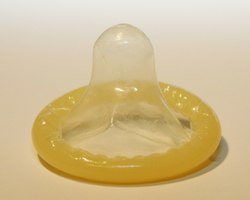
 A rolled-up condom | |
| Background | |
| Pronunciation | /ˈkɒndəm/ KON-dəm or UK: /ˈkɒndɒm/ KON-dom |
| Type | Barrier |
| First use | Ancient[1] Rubber: 1855[2] Latex: 1920s[3] Polyurethane: 1994 Polyisoprene: 2008 |
| Pregnancy rates (first year, latex) | |
| Perfect use | 2%[4] |
| Typical use | 18%[4] |
| Usage | |
| Reversibility | Yes |
| User reminders | Latex condoms are damaged by oil-based lubricants[1] |
| Advantages and disadvantages | |
| STI protection | Yes[1] |
| Benefits | No health care visits required and low cost[1] |
A condom is a sheath-shaped barrier device used during sexual intercourse to reduce the probability of pregnancy or a sexually transmitted infection (STI).[1][5] There are both external condoms, also called male condoms, and internal (female) condoms.[6][7]
The external condom is rolled onto an erect penis before intercourse and works by forming a physical barrier which limits skin-to-skin contact, exposure to fluids, and blocks semen from entering the body of a sexual partner.[1][8] External condoms are typically made from latex and, less commonly, from polyurethane, polyisoprene, or lamb intestine.[1] External condoms have the advantages of ease of use, ease of access, and few side effects.[1] Individuals with latex allergy should use condoms made from a material other than latex, such as polyurethane.[1] Internal condoms are typically made from polyurethane and may be used multiple times.[8]
With proper use—and use at every act of intercourse—women whose partners use external condoms experience a 2% per-year pregnancy rate.[1] With typical use, the rate of pregnancy is 18% per-year.[4] Their use greatly decreases the risk of gonorrhea, chlamydia, trichomoniasis, hepatitis B, and HIV/AIDS.[1] To a lesser extent, they also protect against genital herpes, human papillomavirus (HPV), and syphilis.[1]
Condoms as a method of preventing STIs have been used since at least 1564.[1] Rubber condoms became available in 1855, followed by latex condoms in the 1920s.[2][3] It is on the World Health Organization's List of Essential Medicines.[9] As of 2019, globally around 21% of those using birth control use the condom, making it the second-most common method after female sterilization (24%).[10] Rates of condom use are highest in East and Southeast Asia, Europe and North America.[10]
Medical uses
[edit]Birth control
[edit]The effectiveness of condoms, as of most forms of contraception, can be assessed two ways. Perfect use or method effectiveness rates only include people who use condoms properly and consistently. Actual use, or typical use effectiveness rates are of all condom users, including those who use condoms incorrectly or do not use condoms at every act of intercourse. Rates are generally presented for the first year of use.[11] Most commonly the Pearl Index is used to calculate effectiveness rates, but some studies use decrement tables.[12]: 141
The typical use pregnancy rate among condom users varies depending on the population being studied, ranging from 10 to 18% per year.[13] The perfect use pregnancy rate of condoms is 2% per year.[11] Condoms may be combined with other forms of contraception (such as spermicide) for greater protection.[14]
Sexually transmitted infections
[edit]
Condoms are widely recommended for the prevention of sexually transmitted infections (STIs). They have been shown to be effective in reducing infection rates in both men and women. While not perfect, the condom is effective at reducing the transmission of organisms that cause AIDS, genital herpes, cervical cancer, genital warts, syphilis, chlamydia, gonorrhea, and other diseases.[15] Condoms are often recommended as an adjunct to more effective birth control methods (such as IUD) in situations where STI protection is also desired.[16]
According to a 2000 report by the National Institutes of Health (NIH), consistent use of latex condoms reduces the risk of HIV transmission by approximately 85% relative to risk when unprotected, putting the seroconversion rate (infection rate) at 0.9 per 100 person-years with condom, down from 6.7 per 100 person-years.[17] Analysis published in 2007 from the University of Texas Medical Branch[18]and the World Health Organization[19] found similar risk reductions of 80–95%.
The 2000 NIH review concluded that condom use significantly reduces the risk of gonorrhea for men.[17] A 2006 study reports that proper condom use decreases the risk of transmission of human papillomavirus (HPV) to women by approximately 70%.[20] Another study in the same year found consistent condom use was effective at reducing transmission of herpes simplex virus-2, also known as genital herpes, in both men and women.[21]
Although a condom is effective in limiting exposure, some disease transmission may occur even with a condom. Infectious areas of the genitals, especially when symptoms are present, may not be covered by a condom, and as a result, some diseases like HPV and herpes may be transmitted by direct contact.[22] The primary effectiveness issue with using condoms to prevent STIs, however, is inconsistent use.[23]
Condoms may also be useful in treating potentially precancerous cervical changes. Exposure to human papillomavirus, even in individuals already infected with the virus, appears to increase the risk of precancerous changes. The use of condoms helps promote regression of these changes.[24] In addition, researchers in the UK suggest that a hormone in semen can aggravate existing cervical cancer, condom use during sex can prevent exposure to the hormone.[25]
Causes of failure
[edit]
Condoms may slip off the penis after ejaculation,[26] break due to improper application or physical damage (such as tears caused when opening the package), or break or slip due to latex degradation (typically from usage past the expiration date, improper storage, or exposure to oils). The rate of breakage is between 0.4% and 2.3%, while the rate of slippage is between 0.6% and 1.3%.[17] Even if no breakage or slippage is observed, 1–3% of women will test positive for semen residue after intercourse with a condom.[27][28] Failure rates are higher for anal sex, and until 2022, condoms were only approved by the FDA for vaginal sex. The One Male Condom received FDA approval for anal sex on 23 February 2022.[29][30]
Different modes of condom failure result in different levels of semen exposure. If a failure occurs during application, the damaged condom may be disposed of and a new condom applied before intercourse begins – such failures generally pose no risk to the user.[31] One study found that semen exposure from a broken condom was about half that of unprotected intercourse; semen exposure from a slipped condom was about one-fifth that of unprotected intercourse.[32]
Standard condoms will fit almost any penis, with varying degrees of comfort or risk of slippage. Many condom manufacturers offer "snug" or "magnum" sizes. Some manufacturers also offer custom sized-to-fit condoms, with claims that they are more reliable and offer improved sensation/comfort.[33][34][35] Some studies have associated larger penises and smaller condoms with increased breakage and decreased slippage rates (and vice versa), but other studies have been inconclusive.[36]
It is recommended for condoms manufacturers to avoid very thick or very thin condoms, because they are both considered less effective.[37] Some authors encourage users to choose thinner condoms "for greater durability, sensation, and comfort",[38] but others warn that "the thinner the condom, the smaller the force required to break it".[39]
Experienced condom users are significantly less likely to have a condom slip or break compared to first-time users, although users who experience one slippage or breakage are more likely to suffer a second such failure.[40][41] An article in Population Reports suggests that education on condom use reduces behaviors that increase the risk of breakage and slippage.[42] A Family Health International publication also offers the view that education can reduce the risk of breakage and slippage, but emphasizes that more research needs to be done to determine all of the causes of breakage and slippage.[36]
Among people who intend condoms to be their form of birth control, pregnancy may occur when the user has sex without a condom. The person may have run out of condoms, or be traveling and not have a condom with them, or dislike the feel of condoms and decide to "take a chance". This behavior is the primary cause of typical use failure (as opposed to method or perfect use failure).[43]
Another possible cause of condom failure is sabotage. One motive is to have a child against a partner's wishes or consent.[44] Some commercial sex workers from Nigeria reported clients sabotaging condoms in retaliation for being coerced into condom use.[45] Using a fine needle to make several pinholes at the tip of the condom is believed to significantly impact on their effectiveness.[12]: 306–307 [28] Cases of such condom sabotage have occurred.[46]
Use of multiple condoms ("double bagging")
[edit]"Double bagging", the practice of using two condoms at once, might increase or decrease the risk of sperm leaking through; expert opinions are divided, and it may depend on additional factors.[47] Using two condoms may increase the risk of slippage, though the condoms often become stuck together after use.[48][49] It may also increase the chance of tearing or breaking if there is friction between the condoms.[50] However, lubricant can be added between the condoms to decrease friction.[51] If multiple condoms are used, an exposure break only occurs if all of the condoms are broken.[49]
A literature review in Contraceptive Technology Update recommends that "When clinicians see women and men who have experienced multiple breaks or slippages, it would be wise to encourage them to use two condoms."[52] A literature review by Planned Parenthood concludes that "It seems that there is no evidence-based information to support advising against double bagging. On the other hand, the evidence to support double bagging is limited, but positive. It may be best to advise that if double bagging increases a person's sense of comfort and security, there is no harm in using more than one condom, and there may be benefits."[53]
With two latex condoms, heat and friction can cause them to disintegrate; however, layering a lambskin condom and a latex condom can be helpful if one of the partners is allergic to latex.[54] For sex workers, presenting clients with a leading question, such as the choice between one or two condoms, or between a male or a female condom, is often easier than directly requesting that they use a condom, and makes it more likely that a condom will be used.[55][56] Using multiple condoms, especially more than two, may decrease pleasure, prolong intercourse, and/or cause irritation to a woman's vagina.[55][56][57] The use of multiple condoms is a behavioral therapy for treating premature ejaculation, though it is not always sufficient.[58][59]
In summary, the consensus seems to be that using two condoms instead of one usually decreases risk if properly lubricated but increases risk if not, and that using more condoms generally results in less sexual stimulation for men.
Side effects
[edit]The use of latex condoms by people with an allergy to latex can cause allergic symptoms, such as skin irritation.[60] In people with severe latex allergies, using a latex condom can potentially be life-threatening.[61] Repeated use of latex condoms can also cause the development of a latex allergy in some people.[62] Irritation may also occur due to spermicides that may be present.[63]
Use
[edit]
External condoms are usually packaged inside a foil or plastic wrapper, in a rolled-up form, and are designed to be applied to the tip of the penis and then unrolled over the erect penis. It is important that the closed end or the teat of the condom is pinched when the condom is placed on the tip of the penis. This will ensure that air is not trapped inside the condom which could cause it to burst during intercourse. In addition, this leaves space for the semen to collect which reduces the risk of it being forced out of the base of the device. Most condoms have a teat end for this purpose. Soon after ejaculating and whilst the penis is still erect, the male should withdraw from his partner's body. This to avoid semen seeping from the condom as the penis becomes more flaccid. The condom should then be carefully removed from the penis away from the other partner. It is recommended that the condom be wrapped in tissue or tied in a knot, then disposed of in a trash receptacle.[64] Condoms are used to reduce the likelihood of pregnancy during intercourse and to reduce the likelihood of contracting sexually transmitted infections (STIs). Condoms are also used during fellatio to reduce the likelihood of contracting STIs.
Some couples find that putting on a condom interrupts sex, although others incorporate condom application as part of their foreplay. Some men and women find the physical barrier of a condom dulls sensation. Advantages of dulled sensation can include prolonged erection and delayed ejaculation; disadvantages might include a loss of some sexual excitement.[15] Advocates of condom use also cite their advantages of being inexpensive, easy to use, and having few side effects.[15][65]
Adult film industry
[edit]In 2012 proponents gathered 372,000 voter signatures through a citizens' initiative in Los Angeles County to put Measure B on the 2012 ballot. As a result, Measure B, a law requiring the use of condoms in the production of pornographic films, was passed.[66] This requirement has received much criticism and is said by some to be counter-productive, merely forcing companies that make pornographic films to relocate to other places without this requirement.[67] Producers claim that condom use depresses sales.[68]
Sex education
[edit]Condoms are often used in sex education programs, because they have the capability to reduce the chances of pregnancy and the spread of some sexually transmitted infections when used correctly. A recent American Psychological Association (APA) press release supported the inclusion of information about condoms in sex education, saying "comprehensive sexuality education programs ... discuss the appropriate use of condoms", and "promote condom use for those who are sexually active."[69]
In the United States, teaching about condoms in public schools is opposed by some religious organizations.[70] Planned Parenthood, which advocates family planning and sex education, argues that no studies have shown abstinence-only programs to result in delayed intercourse, and cites surveys showing that 76% of American parents want their children to receive comprehensive sexuality education including condom use.[71]
Infertility treatment
[edit]Common procedures in infertility treatment such as semen analysis and intrauterine insemination (IUI) require collection of semen samples. These are most commonly obtained through masturbation, but an alternative to masturbation is use of a special collection condom to collect semen during sexual intercourse.
Collection condoms are made from silicone or polyurethane, as latex is somewhat harmful to sperm.[72] Some religions prohibit masturbation entirely. Also, compared with samples obtained from masturbation, semen samples from collection condoms have higher total sperm counts, sperm motility, and percentage of sperm with normal morphology. For this reason, they are believed to give more accurate results when used for semen analysis, and to improve the chances of pregnancy when used in procedures such as intracervical or intrauterine insemination.[73][74] Adherents of religions that prohibit contraception, such as Catholicism, may use collection condoms with holes pricked in them.[12]: 306–307
For fertility treatments, a collection condom may be used to collect semen during sexual intercourse where the semen is provided by the woman's partner. Private sperm donors may also use a collection condom to obtain samples through masturbation or by sexual intercourse with a partner and will transfer the ejaculate from the collection condom to a specially designed container. The sperm is transported in such containers, in the case of a donor, to a recipient woman to be used for insemination, and in the case of a woman's partner, to a fertility clinic for processing and use. However, transportation may reduce the fecundity of the sperm. Collection condoms may also be used where semen is produced at a sperm bank or fertility clinic.[citation needed]
Condom therapy is sometimes prescribed to infertile couples when the female has high levels of antisperm antibodies. The theory is that preventing exposure to her partner's semen will lower her level of antisperm antibodies, and thus increase her chances of pregnancy when condom therapy is discontinued. However, condom therapy has not been shown to increase subsequent pregnancy rates.[75][76][77]
Other uses
[edit]

Condoms excel as multipurpose containers and barriers because they are waterproof, elastic, durable, and (for military and espionage uses) will not arouse suspicion if found.
Ongoing military utilization began during World War II, and includes covering the muzzles of rifle barrels to prevent fouling,[78] the waterproofing of firing assemblies in underwater demolitions,[79] and storage of corrosive materials and garrotes by paramilitary agencies.[80]
Condoms have also been used to smuggle alcohol, cocaine, heroin, and other drugs across borders and into prisons by filling the condom with drugs, tying it in a knot and then either swallowing it or inserting it into the rectum. These methods are very dangerous and potentially lethal; if the condom breaks, the drugs inside become absorbed into the bloodstream and can cause an overdose.[81][82]
Medically, condoms can be used to cover endovaginal ultrasound probes,[83] or in field chest needle decompressions they can be used to make a one-way valve.[84]
Condoms have also been used to protect scientific samples from the environment,[85] and to waterproof microphones for underwater recording.[86]
Types
[edit]Most condoms have a reservoir tip or teat end, making it easier to accommodate the man's ejaculate. Condoms come in different sizes and shapes.[87][88][89]
They also come in a variety of surfaces intended to stimulate the user's partner.[88] Condoms are usually supplied with a lubricant coating to facilitate penetration, while flavored condoms are principally used for oral sex.[88] As mentioned above, most condoms are made of latex, but polyurethane and lambskin condoms also exist.
Internal condom
[edit]
External condoms have a tight ring to form a seal around the penis, while internal condoms usually have a large stiff ring to prevent them from slipping into the body orifice. The Female Health Company produced an internal condom that was initially made of polyurethane, but newer versions are made of nitrile rubber. Medtech Products produces an internal condom made of latex.[90]
Materials
[edit]Natural latex
[edit]
Latex has outstanding elastic properties: Its tensile strength exceeds 30 MPa, and latex condoms may be stretched in excess of 800% before breaking.[91] In 1990 the ISO set standards for condom production (ISO 4074, Natural latex rubber condoms), and the EU followed suit with its CEN standard (Directive 93/42/EEC concerning medical devices). Every latex condom is tested for holes with an electric current. If the condom passes, it is rolled and packaged. In addition, a portion of each batch of condoms is subject to water leak and air burst testing.[23]
While the advantages of latex have made it the most popular condom material, it does have some drawbacks. Latex condoms are damaged when used with oil-based substances as lubricants, such as petroleum jelly, cooking oil, baby oil, mineral oil, skin lotions, suntan lotions, cold creams, butter or margarine.[92] Contact with oil makes latex condoms more likely to break or slip off due to loss of elasticity caused by the oils.[36] Additionally, latex allergy precludes use of latex condoms and is one of the principal reasons for the use of other materials. In May 2009, the U.S. Food and Drug Administration (FDA) granted approval for the production of condoms composed of Vytex,[93] latex that has been treated to remove 90% of the proteins responsible for allergic reactions.[94] An allergen-free condom made of synthetic latex (polyisoprene) is also available.[95]
Synthetic
[edit]The most common non-latex condoms are made from polyurethane. Condoms may also be made from other synthetic materials, such as AT-10 resin, and most polyisoprene.[95]
Polyurethane condoms tend to be the same width and thickness as latex condoms, with most polyurethane condoms between 0.04 mm and 0.07 mm thick.[96]
Polyurethane can be considered better than latex in several ways: it conducts heat better than latex, is not as sensitive to temperature and ultraviolet light (and so has less rigid storage requirements and a longer shelf life), can be used with oil-based lubricants, is less allergenic than latex, and does not have an odor.[97] Polyurethane condoms have gained FDA approval for sale in the United States as an effective method of contraception and HIV prevention, and under laboratory conditions have been shown to be just as effective as latex for these purposes.[98]
However, polyurethane condoms are less elastic than latex ones, and may be more likely to slip or break than latex,[97][99] lose their shape or bunch up more than latex,[100] and are more expensive.
Polyisoprene is a synthetic version of natural rubber latex. While significantly more expensive,[101] it has the advantages of latex (such as being softer and more elastic than polyurethane condoms)[95] without the protein which is responsible for latex allergies.[101] Unlike polyurethane condoms, they cannot be used with an oil-based lubricant.[100]
Lambskin
[edit]Condoms made from the intestines of sheep, labeled "lambskin", are also available. Although they are generally effective as a contraceptive by blocking sperm, studies have found that they are less effective than latex in preventing the transmission of sexually transmitted infections because of pores in the material.[102] This is because intestines, by their nature, are porous, permeable membranes, and while sperm are too large to pass through the pores, viruses—such as HIV, herpes, and genital warts—are small enough to pass.[100]
As a result of laboratory data on condom porosity, in 1989, the FDA began requiring lambskin condom manufacturers to indicate that the products were not to be used for the prevention of sexually transmitted infections.[103] The FDA cautions that while lambskin condoms "provide good birth control and a varying degree of protection against some, but not all, sexually transmitted diseases", people do not know what STIs a partner might have, and thus cannot assume that a lambskin condom will protect them.[103]
While lambskin condoms avoid triggering latex allergies, polyurethane condoms do as well, while also protecting more reliably against STIs.[104][105] As slaughter by-products, lambskin condoms are also not vegetarian. Pharmacist advice prepared by the Canadian Pharmaceutical Journal says that lambskin condoms "are generally not recommended" due to limited STI prevention.[106] An article in Adolescent Medicine advises that they "should be used only for pregnancy prevention".[105]
Spermicide
[edit]Some latex condoms are lubricated at the manufacturer with a small amount of a nonoxynol-9, a spermicidal chemical. According to Consumer Reports, condoms lubricated with spermicide have no additional benefit in preventing pregnancy, have a shorter shelf life, and may cause urinary tract infections in women.[107] In contrast, application of separately packaged spermicide is believed to increase the contraceptive efficacy of condoms.[14]
Nonoxynol-9 was once believed to offer additional protection against STIs (including HIV) but recent studies have shown that, with frequent use, nonoxynol-9 may increase the risk of HIV transmission.[108] The World Health Organization says that spermicidally lubricated condoms should no longer be promoted. However, it recommends using a nonoxynol-9 lubricated condom over no condom at all.[109] As of 2005[update], nine condom manufacturers have stopped manufacturing condoms with nonoxynol-9 and Planned Parenthood has discontinued the distribution of condoms so lubricated.[110]
Ribbed and studded
[edit]
Textured condoms include studded and ribbed condoms which can provide extra sensations to both partners. The studs or ribs can be located on the inside, outside, or both; alternatively, they are located in specific sections to provide directed stimulation to either the G-spot or frenulum. Many textured condoms which advertise "mutual pleasure" also are bulb-shaped at the top, to provide extra stimulation to the penis.[111] Some women experience irritation during vaginal intercourse with studded condoms.
Flavored
[edit]Flavored condoms are specialized condom products that have a flavor-coating and that are specially designed for an oral intercourse exclusively, and not for penetrative acts.[112] Originally flavored condoms used to be more of a novelty item, rather than for actual protection. However, now there are FDA approved flavored condoms on the market.[113] Some flavored condoms also have a flavor-specific scent added to them.[114]
Some concerns of using flavored condoms in vaginal penetration exist, since flavored condoms have some amounts of sugar on them, and inserting sugar to vagina can end up resulting in candidal vulvovaginitis or bacterial vaginosis.[115] People with latex allergy should avoid using flavored latex-material condoms, and instead use polyurethane or polyisoprene condoms.[116]
Other
[edit]The anti-rape condom is another variation designed to be worn by women. It is designed to cause pain to the attacker, hopefully allowing the victim a chance to escape.[117]
A collection condom is used to collect semen for fertility treatments or sperm analysis. These condoms are designed to maximize sperm life.
In February 2022, the U.S. Food and Drug Administration (FDA) approved the first condoms specifically indicated to help reduce transmission of sexually transmitted infections (STIs) during anal intercourse.[118]
Prevalence
[edit]The prevalence of condom use varies greatly between countries. Most surveys of contraceptive use are among married women, or women in informal unions. Japan has the highest rate of condom usage in the world: in that country, condoms account for almost 80% of contraceptive use by married women. On average, in developed countries, condoms are the most popular method of birth control: 28% of married contraceptive users rely on condoms. In the average less-developed country, condoms are less common: only 6–8% of married contraceptive users choose condoms.[119]
History
[edit]
Before the 19th century
[edit]Whether condoms were used in ancient civilizations is debated by archaeologists and historians.[120]: 11 In ancient Egypt, Greece, and Rome, pregnancy prevention was generally seen as a woman's responsibility, and the only well documented contraception methods were female-controlled devices.[120]: 17, 23 In Asia before the 15th century, some use of glans condoms (devices covering only the head of the penis) is recorded. Condoms seem to have been used for contraception, and to have been known only by members of the upper classes. In China, glans condoms may have been made of oiled silk paper, or of lamb intestines. In Japan, condoms called Kabuto-gata (甲形) were made of tortoise shell or animal horn.[120]: 60–1 [121]
_(BM_2012,3051.1).jpg)
In 16th-century Italy, anatomist and physician Gabriele Falloppio wrote a treatise on syphilis.[120]: 51, 54–5 The earliest documented strain of syphilis, first appearing in Europe in a 1490s outbreak, caused severe symptoms and often death within a few months of contracting the disease.[122][123] Falloppio's treatise is the earliest uncontested description of condom use: it describes linen sheaths soaked in a chemical solution and allowed to dry before use. The cloths he described were sized to cover the glans of the penis, and were held on with a ribbon.[120]: 51, 54–5 [124] Falloppio claimed that an experimental trial of the linen sheath demonstrated protection against syphilis.[125]
After this, the use of penis coverings to protect from disease is described in a wide variety of literature throughout Europe. The first indication that these devices were used for birth control, rather than disease prevention, is the 1605 theological publication De iustitia et iure (On justice and law) by Catholic theologian Leonardus Lessius, who condemned them as immoral.[120]: 56 In 1666, the English Birth Rate Commission attributed a recent downward fertility rate to use of "condons", the first documented use of that word or any similar spelling.[120]: 66–8 Other early spellings include "condam" and "quondam", from which the Italian derivation guantone has been suggested, from guanto, "a glove".[126]

In addition to linen, condoms during the Renaissance were made out of intestines and bladder. In the late 16th century, Dutch traders introduced condoms made from "fine leather" to Japan. Unlike the horn condoms used previously, these leather condoms covered the entire penis.[120]: 61

Casanova in the 18th century was one of the first reported using "assurance caps" to prevent impregnating his mistresses.[127]
From at least the 18th century, condom use was opposed in some legal, religious, and medical circles for essentially the same reasons that are given today: condoms reduce the likelihood of pregnancy, which some thought immoral or undesirable for the nation; they do not provide full protection against sexually transmitted infections, while belief in their protective powers was thought to encourage sexual promiscuity; and, they are not used consistently due to inconvenience, expense, or loss of sensation.[120]: 73, 86–8, 92
Despite some opposition, the condom market grew rapidly. In the 18th century, condoms were available in a variety of qualities and sizes, made from either linen treated with chemicals, or "skin" (bladder or intestine softened by treatment with sulfur and lye).[120]: 94–5 They were sold at pubs, barbershops, chemist shops, open-air markets, and at the theater throughout Europe and Russia.[120]: 90–2, 97, 104 They later spread to America, although in every place there were generally used only by the middle and upper classes, due to both expense and lack of sex education.[120]: 116–21
1800 through 1920s
[edit].JPG)
The early 19th century saw contraceptives promoted to the poorer classes for the first time. Writers on contraception tended to prefer other birth control methods to the condom. By the late 19th century, many feminists expressed distrust of the condom as a contraceptive, as its use was controlled and decided upon by men alone. They advocated instead for methods controlled by women, such as diaphragms and spermicidal douches.[120]: 152–3 Other writers cited both the expense of condoms and their unreliability (they were often riddled with holes and often fell off or tore). Still, they discussed condoms as a good option for some and the only contraceptive that protects from disease.[120]: 88, 90, 125, 129–30
Many countries passed laws impeding the manufacture and promotion of contraceptives.[120]: 144, 163–4, 168–71, 193 In spite of these restrictions, condoms were promoted by traveling lecturers and in newspaper advertisements, using euphemisms in places where such ads were illegal.[120]: 127, 130–2, 138, 146–7 Instructions on how to make condoms at home were distributed in the United States and Europe.[120]: 126, 136 Despite social and legal opposition, at the end of the 19th century the condom was the Western world's most popular birth control method.[120]: 173–4

Beginning in the second half of the 19th century, American rates of sexually transmitted infections skyrocketed. Causes cited by historians include the effects of the American Civil War and the ignorance of prevention methods promoted by the Comstock laws.[120]: 137–8, 159 To fight the growing epidemic, sex education classes were introduced to public schools for the first time, teaching about venereal diseases and how they were transmitted. They generally taught abstinence was the only way to avoid sexually transmitted infections.[120]: 179–80 Condoms were not promoted for disease prevention because the medical community and moral watchdogs considered STIs to be punishment for sexual misbehavior. The stigma against people with these diseases was so significant that many hospitals refused to treat people with syphilis.[120]: 176

The German military was the first to promote condom use among its soldiers in the later 19th century.[120]: 169, 181 Early 20th century experiments by the American military concluded that providing condoms to soldiers significantly lowered rates of sexually transmitted infections.[120]: 180–3 During World War I, the United States and (at the beginning of the war only) Britain were the only countries with soldiers in Europe who did not provide condoms and promote their use.[120]: 187–90
In the decades after World War I, there remained social and legal obstacles to condom use throughout the U.S. and Europe.[120]: 208–10 Founder of psychoanalysis Sigmund Freud opposed all methods of birth control because their failure rates were too high. Freud was especially opposed to the condom because he thought it cut down on sexual pleasure. Some feminists continued to oppose male-controlled contraceptives such as condoms. In 1920 the Church of England's Lambeth Conference condemned all "unnatural means of conception avoidance". The Bishop of London, Arthur Winnington-Ingram, complained of the huge number of condoms discarded in alleyways and parks, especially after weekends and holidays.[120]: 211–2
However, European militaries continued to provide condoms to their members for disease protection, even in countries where they were illegal for the general population.[120]: 213–4 Through the 1920s, catchy names and slick packaging became an increasingly important marketing technique for many consumer items, including condoms and cigarettes.[120]: 197 Quality testing became more common, involving filling each condom with air followed by one of several methods intended to detect loss of pressure.[120]: 204, 206, 221–2 Worldwide, condom sales doubled in the 1920s.[120]: 210
Rubber and manufacturing advances
[edit]In 1839, Charles Goodyear discovered a way of processing natural rubber, which is too stiff when cold and too soft when warm, in such a way as to make it elastic. This proved to have advantages for the manufacture of condoms; unlike the sheep's gut condoms, they could stretch and did not tear quickly when used. The rubber vulcanization process was patented by Goodyear in 1844.[128][129] The first rubber condom was produced in 1855.[130] The earliest rubber condoms had a seam and were as thick as a bicycle inner tube. Besides this type, small rubber condoms covering only the glans were often used in England and the United States. There was more risk of losing them and if the rubber ring was too tight, it would constrict the penis. This type of condom was the original "capote" (French for condom), perhaps because of its resemblance to a woman's bonnet worn at that time, also called a capote.
For many decades, rubber condoms were manufactured by wrapping strips of raw rubber around penis-shaped molds, then dipping the wrapped molds in a chemical solution to cure the rubber.[120]: 148 In 1912, Polish-born inventor Julius Fromm developed a new, improved manufacturing technique for condoms: dipping glass molds into a raw rubber solution.[130] Called cement dipping, this method required adding gasoline or benzene to the rubber to make it liquid.[120]: 200 Around 1920 patent lawyer and vice-president of the United States Rubber Company Ernest Hopkinson[131] invented[132] a new technique of converting latex into rubber without a coagulant (demulsifier), which featured using water as a solvent and warm air to dry the solution, as well as optionally preserving liquid latex with ammonia.[133] Condoms made this way, commonly called "latex" ones, required less labor to produce than cement-dipped rubber condoms, which had to be smoothed by rubbing and trimming. The use of water to suspend the rubber instead of gasoline and benzene eliminated the fire hazard previously associated with all condom factories. Latex condoms also performed better for the consumer: they were stronger and thinner than rubber condoms, and had a shelf life of five years (compared to three months for rubber).[120]: 199–200
Until the twenties, all condoms were individually hand-dipped by semi-skilled workers. Throughout the decade of the 1920s, advances in the automation of the condom assembly line were made. The first fully automated line was patented in 1930. Major condom manufacturers bought or leased conveyor systems, and small manufacturers were driven out of business.[120]: 201–3 The skin condom, now significantly more expensive than the latex variety, became restricted to a niche high-end market.[120]: 220
1930 to present
[edit]

In 1930 the Anglican Church's Lambeth Conference sanctioned the use of birth control by married couples. In 1931 the Federal Council of Churches in the U.S. issued a similar statement.[120]: 227 The Roman Catholic Church responded by issuing the encyclical Casti connubii affirming its opposition to all contraceptives, a stance it has never reversed.[120]: 228–9 In the 1930s, legal restrictions on condoms began to be relaxed.[120]: 216, 226, 234 [134] However, during this period Fascist Italy and Nazi Germany increased restrictions on condoms (limited sales as disease preventatives were still allowed).[120]: 252, 254–5 During the Depression, condom lines by Schmid gained in popularity. Schmid still used the cement-dipping method of manufacture which had two advantages over the latex variety. Firstly, cement-dipped condoms could be safely used with oil-based lubricants. Secondly, while less comfortable, these older-style rubber condoms could be reused and so were more economical, a valued feature in hard times.[120]: 217–9 More attention was brought to quality issues in the 1930s, and the U.S. Food and Drug Administration began to regulate the quality of condoms sold in the United States.[120]: 223–5
Throughout World War II, condoms were not only distributed to male U.S. military members, but also heavily promoted with films, posters, and lectures.[120]: 236–8, 259 European and Asian militaries on both sides of the conflict also provided condoms to their troops throughout the war, even Germany which outlawed all civilian use of condoms in 1941.[120]: 252–4, 257–8 In part because condoms were readily available, soldiers found a number of non-sexual uses for the devices, many of which continue to this day. After the war, condom sales continued to grow. From 1955 to 1965, 42% of Americans of reproductive age relied on condoms for birth control. In Britain from 1950 to 1960, 60% of married couples used condoms. The birth control pill became the world's most popular method of birth control in the years after its 1960 début, but condoms remained a strong second. The U.S. Agency for International Development pushed condom use in developing countries to help solve the "world population crises": by 1970 hundreds of millions of condoms were being used each year in India alone.[120]: 267–9, 272–5 (This number has grown in recent decades: in 2004, the government of India purchased 1.9 billion condoms for distribution at family planning clinics.)[135]

In the 1960s and 1970s quality regulations tightened,[136] and more legal barriers to condom use were removed.[120]: 276–9 In Ireland, legal condom sales were allowed for the first time in 1978.[120]: 329–30 Advertising, however was one area that continued to have legal restrictions. In the late 1950s, the American National Association of Broadcasters banned condom advertisements from national television; this policy remained in place until 1979.[120]: 273–4, 285
After it was discovered in the early 1980s that AIDS can be a sexually transmitted infection,[137] the use of condoms was encouraged to prevent transmission of HIV. Despite opposition by some political, religious, and other figures, national condom promotion campaigns occurred in the U.S. and Europe.[120]: 299, 301, 306–7, 312–8 These campaigns increased condom use significantly.[120]: 309–17
Due to increased demand and greater social acceptance, condoms began to be sold in a wider variety of retail outlets, including in supermarkets and in discount department stores such as Walmart.[120]: 305 Condom sales increased every year until 1994, when media attention to the AIDS pandemic began to decline.[120]: 303–4 The phenomenon of decreasing use of condoms as disease preventatives has been called prevention fatigue or condom fatigue. Observers have cited condom fatigue in both Europe and North America.[138][139][140] As one response, manufacturers have changed the tone of their advertisements from scary to humorous.[120]: 303–4
New developments continued to occur in the condom market, with the first polyurethane condom—branded Avanti and produced by the manufacturer of Durex—introduced in the 1990s.[120]: 32–5 Worldwide condom use is expected to continue to grow: one study predicted that developing nations would need 18.6 billion condoms by 2015.[120]: 342 As of September 2013[update], condoms are available inside prisons in Canada, most of the European Union, Australia, Brazil, Indonesia, South Africa, and the US states of Vermont (on 17 September 2013, the Californian Senate approved a bill for condom distribution inside the state's prisons, but the bill was not yet law at the time of approval).[141]
The global condom market was estimated at US$9.2 billion in 2020.[142]
Etymology and other terms
[edit]The term condom first appears in the early 18th century: early forms include condum (1706 and 1717), condon (1708) and cundum (1744).[143] The word's etymology is unknown. In popular tradition, the invention and naming of the condom came to be attributed to an associate of England's King Charles II, one "Dr. Condom" or "Earl of Condom". There is however no evidence of the existence of such a person, and condoms had been used for over one hundred years before King Charles II acceded to the throne in 1660.[120]: 54, 68
A variety of unproven Latin etymologies have been proposed, including condon (receptacle),[144] condamina (house),[145] and cumdum (scabbard or case).[120]: 70–1 It has also been speculated to be from the Italian word guantone, derived from guanto, meaning glove.[146] William E. Kruck wrote an article in 1981 concluding that, "As for the word 'condom', I need state only that its origin remains completely unknown, and there ends this search for an etymology."[147] Modern dictionaries may also list the etymology as "unknown".[143][148]
Other terms are also commonly used to describe condoms. In North America condoms are also commonly known as prophylactics, or rubbers. In Britain they may be called French letters[149][150] or rubber johnnies.[151] Additionally, condoms may be referred to using the manufacturer's name.
Society and culture
[edit] |
Some moral and scientific criticism of condoms exists despite the many benefits of condoms agreed on by scientific consensus and sexual health experts.
Condom usage is typically recommended for new couples who have yet to develop full trust in their partner with regard to STIs. Established couples on the other hand have few concerns about STIs, and can use other methods of birth control such as the pill, which does not act as a barrier to intimate sexual contact. Note that the polar debate with regard to condom usage is attenuated by the target group the argument is directed. Notably the age category and stable partner question are factors, as well as the distinction between heterosexual and homosexuals, who have different kinds of sex and have different risk consequences and factors.
Among the prime objections to condom usage is the blocking of erotic sensation, or the intimacy that barrier-free sex provides. As the condom is held tightly to the skin of the penis, it diminishes the delivery of stimulation through rubbing and friction. Condom proponents claim this has the benefit of making sex last longer, by diminishing sensation and delaying male ejaculation. Those who promote condom-free heterosexual sex (slang: "bareback") claim that the condom puts a barrier between partners, diminishing what is normally a highly sensual, intimate, and spiritual connection between partners.
Religious
[edit]The United Church of Christ (UCC), a Reformed denomination of the Congregationalist tradition, promotes the distribution of condoms in churches and faith-based educational settings.[152] Michael Shuenemeyer, a UCC minister, has stated that "The practice of safer sex is a matter of life and death. People of faith make condoms available because we have chosen life so that we and our children may live."[152]
On the other hand, the Roman Catholic Church opposes all kinds of sexual acts outside of marriage, as well as any sexual act in which the chance of successful conception has been reduced by direct and intentional acts (for example, surgery to prevent conception) or foreign objects (for example, condoms).[153]
The use of condoms to prevent STI transmission is not specifically addressed by Catholic doctrine, and is currently a topic of debate among theologians and high-ranking Catholic authorities. A few, such as Belgian Cardinal Godfried Danneels, believe the Catholic Church should actively support condoms used to prevent disease, especially serious diseases such as AIDS.[154] However, the majority view—including all statements from the Vatican—is that condom-promotion programs encourage promiscuity, thereby actually increasing STI transmission.[155][156] This view was most recently reiterated in 2009 by Pope Benedict XVI.[157]
The Roman Catholic Church is the largest organized body of any world religion.[158] The church has hundreds of programs dedicated to fighting the AIDS epidemic in Africa,[159] but its opposition to condom use in these programs has been highly controversial.[160]
In a November 2011 interview, Pope Benedict XVI discussed for the first time the use of condoms to prevent STI transmission. He said that the use of a condom can be justified in a few individual cases if the purpose is to reduce the risk of an HIV infection.[161] He gave as an example male prostitutes. There was some confusion at first whether the statement applied only to homosexual prostitutes and thus not to heterosexual intercourse at all. However, Federico Lombardi, spokesman for the Vatican, clarified that it applied to heterosexual and transsexual prostitutes, whether male or female, as well.[162] He did, however, also clarify that the Vatican's principles on sexuality and contraception had not been changed.
Scientific and environmental
[edit]More generally, some scientific researchers have expressed objective concern over certain ingredients sometimes added to condoms, notably talc and nitrosamines. Dry dusting powders are applied to latex condoms before packaging to prevent the condom from sticking to itself when rolled up. Previously, talc was used by most manufacturers, but cornstarch is currently the most popular dusting powder.[163] Although rare during normal use, talc is known to be potentially irritant to mucous membranes (such as in the vagina). Cornstarch is generally believed to be safe; however, some researchers have raised concerns over its use as well.[163][164]
Nitrosamines, which are potentially carcinogenic in humans,[165] are believed to be present in a substance used to improve elasticity in latex condoms.[166] A 2001 review stated that humans regularly receive 1,000 to 10,000 times greater nitrosamine exposure from food and tobacco than from condom use and concluded that the risk of cancer from condom use is very low.[167] However, a 2004 study in Germany detected nitrosamines in 29 out of 32 condom brands tested, and concluded that exposure from condoms might exceed the exposure from food by 1.5- to 3-fold.[166][168]

In addition, the large-scale use of disposable condoms has resulted in concerns over their environmental impact via littering and in landfills, where they can eventually wind up in wildlife environments if not incinerated or otherwise permanently disposed of first. Polyurethane condoms in particular, given they are a form of plastic, are not biodegradable, and latex condoms take a very long time to break down. Experts, such as AVERT, recommend condoms be disposed of in a garbage receptacle, as flushing them down the toilet (which some people do) may cause plumbing blockages and other problems.[64][170] Furthermore, the plastic and foil wrappers condoms are packaged in are also not biodegradable. However, the benefits condoms offer are widely considered to offset their small landfill mass.[64] Frequent condom or wrapper disposal in public areas such as a parks have been seen as a persistent litter problem.[171]
While biodegradable,[64] latex condoms damage the environment when disposed of improperly. According to the Ocean Conservancy, condoms, along with certain other types of trash, cover the coral reefs and smother sea grass and other bottom dwellers. The United States Environmental Protection Agency also has expressed concerns that many animals might mistake the litter for food.[172]
Cultural barriers to use
[edit]In much of the Western world, the introduction of the pill in the 1960s was associated with a decline in condom use.[120]: 267–9, 272–5 In Japan, oral contraceptives were not approved for use until September 1999, and even then access was more restricted than in other industrialized nations.[173] Perhaps because of this restricted access to hormonal contraception, Japan has the highest rate of condom usage in the world: in 2008, 80% of contraceptive users relied on condoms.[119]
Cultural attitudes toward gender roles, contraception, and sexual activity vary greatly around the world, and range from extremely conservative to extremely liberal. But in places where condoms are misunderstood, mischaracterised, demonised, or looked upon with overall cultural disapproval, the prevalence of condom use is directly affected. In less-developed countries and among less-educated populations, misperceptions about how disease transmission and conception work negatively affect the use of condoms; additionally, in cultures with more traditional gender roles, women may feel uncomfortable demanding that their partners use condoms.
As an example, Latino immigrants in the United States often face cultural barriers to condom use. A study on female HIV prevention published in the Journal of Sex Health Research asserts that Latino women often lack the attitudes needed to negotiate safe sex due to traditional gender-role norms in the Latino community, and may be afraid to bring up the subject of condom use with their partners. Women who participated in the study often reported that because of the general machismo subtly encouraged in Latino culture, their male partners would be angry or possibly violent at the woman's suggestion that they use condoms.[174] A similar phenomenon has been noted in a survey of low-income American black women; the women in this study also reported a fear of violence at the suggestion to their male partners that condoms be used.[175]
A telephone survey conducted by Rand Corporation and Oregon State University, and published in the Journal of Acquired Immune Deficiency Syndromes showed that belief in AIDS conspiracy theories among United States black men is linked to rates of condom use. As conspiracy beliefs about AIDS grow in a given sector of these black men, consistent condom use drops in that same sector. Female use of condoms was not similarly affected.[176]
In the African continent, condom promotion in some areas has been impeded by anti-condom campaigns by some Muslim[177] and Catholic clerics.[155] Among the Maasai in Tanzania, condom use is hampered by an aversion to "wasting" sperm, which is given sociocultural importance beyond reproduction. Sperm is believed to be an "elixir" to women and to have beneficial health effects. Maasai women believe that, after conceiving a child, they must have sexual intercourse repeatedly so that the additional sperm aids the child's development. Frequent condom use is also considered by some Maasai to cause impotence.[178] Some women in Africa believe that condoms are "for prostitutes" and that respectable women should not use them.[177] A few clerics even promote the lie that condoms are deliberately laced with HIV.[179] In the United States, possession of many condoms has been used by police to accuse women of engaging in prostitution.[180][181] The Presidential Advisory Council on HIV/AIDS has condemned this practice and there are efforts to end it.[181][182][183]
Middle-Eastern couples who have not had children, because of the strong desire and social pressure to establish fertility as soon as possible within marriage, rarely use condoms.[184]
In 2017, India restricted TV advertisements for condoms to between the hours of 10 pm to 6 am. Family planning advocates were against this, saying it was liable to "undo decades of progress on sexual and reproductive health".[185]
Major manufacturers
[edit]One analyst described the size of the condom market as something that "boggles the mind". Numerous small manufacturers, nonprofit groups, and government-run manufacturing plants exist around the world.[120]: 322, 328 Within the condom market, there are several major contributors, among them both for-profit businesses and philanthropic organizations. Most large manufacturers have ties to the business that reach back to the end of the 19th century.
Research
[edit]A spray-on condom made of latex is intended to be easier to apply and more successful in preventing the transmission of diseases. As of 2009[update], the spray-on condom was not going to market because the drying time could not be reduced below two to three minutes.[186][187][188]
The Invisible Condom, developed at Université Laval in Quebec, Canada, is a gel that hardens upon increased temperature after insertion into the vagina or rectum. In the lab, it has been shown to effectively block HIV and herpes simplex virus. The barrier breaks down and liquefies after several hours. As of 2005[update], the invisible condom is in the clinical trial phase, and has not yet been approved for use.[189]
Also developed in 2005 is a condom treated with an erectogenic compound. The drug-treated condom is intended to help the wearer maintain an erection, which should also help reduce slippage. If approved, the condom would be marketed under the Durex brand. As of 2007[update], it was still in clinical trials.[120]: 345 In 2009, Ansell Healthcare, the makers of Lifestyle condoms, introduced the X2 condom lubricated with "Excite Gel" which contains the amino acid L-arginine and is intended to improve the strength of the erectile response.[190]
In March 2013, philanthropist Bill Gates offered US$100,000 grants through his foundation for a condom design that "significantly preserves or enhances pleasure" to encourage more males to adopt the use of condoms for safer sex. The grant information stated: "The primary drawback from the male perspective is that condoms decrease pleasure as compared to no condom, creating a trade-off that many men find unacceptable, particularly given that the decisions about use must be made just prior to intercourse. Is it possible to develop a product without this stigma, or better, one that is felt to enhance pleasure?"[191] In November of the same year, 11 research teams were selected to receive the grant money.[192]
See also
[edit]References
[edit]- ^ a b c d e f g h i j k l m Hatcher RA, MD AL (2007). Contraceptive Technology. Ardent Media. pp. 297–311. ISBN 978-1-59708-001-9. Archived from the original on 18 September 2017.
- ^ a b Allen MJ (2011). The Anthem Anthology of Victorian Sonnets. Anthem Press. p. 51. ISBN 978-1-84331-848-4.
- ^ a b McKibbin R (2000). Classes and Cultures: England 1918–1951. Oxford University Press. p. 305. ISBN 978-0-19-820855-6.
- ^ a b c Trussell J (2011). "Contraceptive efficacy" (PDF). In Hatcher RA, Trussell J, Nelson AL, Cates W Jr, Kowal D, Policar MS (eds.). Contraceptive technology (20th revised ed.). New York: Ardent Media. pp. 779–863. ISBN 978-1-59708-004-0. ISSN 0091-9721. OCLC 781956734. Archived from the original (PDF) on 12 November 2013.
- ^ Weinstock SA, Lesser ML, Kassman LB (2006). "Condom—The need for predictable contraception". Sexuality, Reproduction and Menopause. 4 (2): 96–99. doi:10.1016/j.sram.2006.08.010.
- ^ World Health Organization (2009). Stuart MC, Kouimtzi M, Hill SR (eds.). WHO Model Formulary 2008. World Health Organization. p. 372. hdl:10665/44053. ISBN 978-92-4-154765-9.
- ^ Beksinska M, Wong R, Smit J (2020). "Male and female condoms: Their key role in pregnancy and STI/HIV prevention". Best Practice & Research Clinical Obstetrics & Gynaecology. 66: 55–67. doi:10.1016/j.bpobgyn.2019.12.001. PMID 32007451.
- ^ a b Speroff L, Darney PD (2011). A Clinical Guide for Contraception. Lippincott Williams & Wilkins. pp. 305–307. ISBN 978-1-60831-610-6. Archived from the original on 14 November 2016.
- ^ World Health Organization (2023). The selection and use of essential medicines 2023: web annex A: World Health Organization model list of essential medicines: 23rd list (2023). Geneva: World Health Organization. hdl:10665/371090. WHO/MHP/HPS/EML/2023.02.
- ^ a b "Contraceptive Use by Method: data booklet" (PDF). United Nations Department of Economic and Social Affairs. 2019. Archived (PDF) from the original on 13 December 2020. Retrieved 2 January 2021.
- ^ a b Hatcher RA, Trussel J, Nelson AL, et al. (2007). Contraceptive Technology (19th ed.). New York: Ardent Media. ISBN 978-1-59708-001-9. Archived from the original on 31 May 2008. Retrieved 26 July 2009.
- ^ a b c Kippley J, Kippley S (1996). The Art of Natural Family Planning (4th addition ed.). Cincinnati, OH: The Couple to Couple League. ISBN 978-0-926412-13-2.
- ^ Kippley J, Sheila Kippley (1996). The Art of Natural Family Planning (4th addition ed.). Cincinnati, OH: The Couple to Couple League. p. 146. ISBN 978-0-926412-13-2., which cites:
- ^ a b Kestelman P, Trussell J (1991). "Efficacy of the Simultaneous Use of Condoms and Spermicides". Family Planning Perspectives. 23 (5): 226–232. doi:10.2307/2135759. ISSN 0014-7354. JSTOR 2135759. PMID 1743276.
- ^ a b c "Condom". Planned Parenthood. 2008. Archived from the original on 20 August 2011. Retrieved 19 November 2007.
- ^ Cates W, Steiner MJ (March 2002). "Dual Protection Against Unintended Pregnancy and Sexually Transmitted Infections: What is the Best Contraceptive Approach?". Sexually Transmitted Diseases. 29 (3): 168–174. doi:10.1097/00007435-200203000-00007. PMID 11875378. S2CID 42792667.
- ^ a b c National Institute of Allergy and Infectious Diseases (20 July 2001). Workshop Summary: Scientific Evidence on Condom Effectiveness for Sexually Transmitted Disease (STD) Prevention (PDF). Hyatt Dulles Airport, Herndon, Virginia. pp. 13–15. Archived from the original (PDF) on 9 October 2010. Retrieved 22 September 2010.
- ^ Weller S, Davis K (2002). "Condom effectiveness in reducing heterosexual HIV transmission". The Cochrane Database of Systematic Reviews. 2012 (1) CD003255. doi:10.1002/14651858.CD003255. ISSN 1469-493X. PMC 8407100. PMID 11869658.
- ^ World Health Organization Department of Reproductive Health and Research (WHO/RHR) & Johns Hopkins Bloomberg School of Public Health/Center for Communication Programs (CCP), INFO Project (2007). Family Planning: A Global Handbook for Providers. INFO Project at the Johns Hopkins Bloomberg School of Public Health. p. 200. Archived from the original on 27 August 2009.
- ^ Winer RL, Hughes JP, Feng Q, O'Reilly S, Kiviat NB, Holmes KK, et al. (2006). "Condom Use and the Risk of Genital Human Papillomavirus Infection in Young Women". New England Journal of Medicine. 354 (25): 2645–2654. doi:10.1056/NEJMoa053284. PMID 16790697.
- ^ Wald A, Langenberg AG, Krantz E, Douglas JM, Handsfield HH, Dicarlo RP, et al. (2005). "The Relationship between Condom Use and Herpes Simplex Virus Acquisition". Annals of Internal Medicine. 143 (10): 707–713. doi:10.7326/0003-4819-143-10-200511150-00007. PMID 16287791. S2CID 37342783.
- ^ Villhauer T (20 May 2005). "Condoms Preventing HPV?". University of Iowa Student Health Service/Health Iowa. Archived from the original on 14 March 2010. Retrieved 26 July 2009.
- ^ a b Nordenberg T (March–April 1998). "Condoms: Barriers to Bad News". FDA Consumer. 32 (2): 22–5. PMID 9532952. Archived from the original on 8 March 2010. Retrieved 7 June 2007.
- ^ Hogewoning CJ, Bleeker MC, Van Den Brule AJ, Voorhorst FJ, Snijders PJ, Berkhof J, et al. (2003). "Condom use promotes regression of cervical intraepithelial neoplasia and clearance of human papillomavirus: A randomized clinical trial". International Journal of Cancer. 107 (5): 811–816. doi:10.1002/ijc.11474. PMID 14566832. S2CID 12065908.
- ^ "Semen can worsen cervical cancer". Medical Research Council (UK). Archived from the original on 4 August 2008. Retrieved 2 December 2007.
- ^ Sparrow MJ, Lavill K (1994). "Breakage and slippage of condoms in family planning clients". Contraception. 50 (2): 117–129. doi:10.1016/0010-7824(94)90048-5. PMID 7956211.
- ^ Walsh TL, Frezieres RG, Peacock K, Nelson AL, Clark VA, Bernstein L, et al. (2004). "Effectiveness of the male latex condom: Combined results for three popular condom brands used as controls in randomized clinical trials". Contraception. 70 (5): 407–413. doi:10.1016/j.contraception.2004.05.008. PMID 15504381.
- ^ a b Walsh TL, Frezieres RG, Nelson AL, Wraxall BG, Clark VA (1999). "Evaluation of prostate-specific antigen as a quantifiable indicator of condom failure in clinical trials". Contraception. 60 (5): 289–298. doi:10.1016/S0010-7824(99)00098-0. PMID 10717781.
- ^ Alison Hunt (23 February 2022). "FDA Permits Marketing of First Condom Specifically Indicated for Anal Intercourse". fda.gov. U.S. Food and Drug Administration. Archived from the original on 24 February 2022. Retrieved 25 February 2022.
- ^ Dress B (25 February 2022). "FDA approves first condom meant for anal sex". The Hill. Washington, DC. Archived from the original on 25 February 2022. Retrieved 25 February 2022.
- ^ Richters J, Donovan B, Gerofi J (1993). "How Often do Condoms Break or Slip off in Use?". International Journal of STD & AIDS. 4 (2): 90–94. doi:10.1177/095646249300400206. PMID 8476971. S2CID 40148918.
- ^ Walsh TL, Frezieres RG, Peacock K, Nelson AL, Clark VA, Bernstein L, et al. (2003). "Use of prostate-specific antigen (PSA) to measure semen exposure resulting from male condom failures: Implications for contraceptive efficacy and the prevention of sexually transmitted disease". Contraception. 67 (2): 139–150. doi:10.1016/S0010-7824(02)00478-X. PMID 12586324.
- ^ "For Condoms, Maybe Size Matters After All". CBS News. 11 October 2007. Archived from the original on 18 October 2008. Retrieved 11 November 2008.
- ^ "Next big thing, why condom size matters". Menstruation.com. 11 October 2007. Archived from the original on 18 October 2008. Retrieved 11 November 2008.
- ^ "TheyFit: World's First Sized to Fit Condoms". Archived from the original on 23 October 2008. Retrieved 11 November 2008.
- ^ a b c Spruyt AB (1998). "Chapter 3: User Behaviors and Characteristics Related to Condom Failure". The Latex Condom: Recent Advances, Future Directions. Archived from the original on 27 September 2011. Retrieved 8 April 2007.
- ^ World Health Organization Do (2004). The male latex condom: specification and guidelines for condom procurement 2003. Archived from the original on 9 August 2009.
- ^ Corina H (2007). S.E.X.: The All-You-Need-To-Know Progressive Sexuality Guide to Get You Through High School and College. New York: Marlowe and Company. pp. 207–210. ISBN 978-1-60094-010-1.
- ^ World Health Organization and The Joint United Nations Programme on HIV/AIDS. The male latex condom (PDF) (Report). Archived from the original (PDF) on 25 March 2009. Retrieved 18 August 2009.
- ^ Valappil T, Kelaghan J, MacAluso M, Artz L, Austin H, Fleenor ME, et al. (2005). "Female Condom and Male Condom Failure Among Women at High Risk of Sexually Transmitted Diseases". Sexually Transmitted Diseases. 32 (1): 35–43. doi:10.1097/01.olq.0000148295.60514.0b. PMID 15614119. S2CID 1218353.
- ^ Steiner M, Piedrahita C, Glover L, Joanis C (1993). "Can Condom Users Likely to Experience Condom Failure be Identified?". Family Planning Perspectives. 25 (5): 220–226. doi:10.2307/2136075. JSTOR 2136075. PMID 8262171.
- ^ Liskin L, Wharton C, Blackburn R (September 1991). "Condoms – Now More than Ever". Population Reports. H (8). Archived from the original on 18 September 2016. Retrieved 13 February 2007.
- ^ Steiner MJ, Cates W, Warner L (1999). "The Real Problem with Male Condoms is Nonuse". Sexually Transmitted Diseases. 26 (8): 459–462. doi:10.1097/00007435-199909000-00007. PMID 10494937.
- ^ "Childfree And The Media". Childfree Resource Network. 2000. Archived from the original on 12 March 2007. Retrieved 8 April 2007.
- ^ Beckerleg S, Gerofi J (October 1999). "Investigation of Condom Quality: Contraceptive Social Marketing Programme, Nigeria" (PDF). Centre for Sexual & Reproductive Health. pp. 6, 32. Archived (PDF) from the original on 14 June 2007. Retrieved 8 April 2007.
- ^ "Canadian man who poked holes in condoms to impregnate girlfriend loses appeal". New York Daily News. 7 March 2014. Archived from the original on 20 November 2014. Retrieved 15 August 2014.
- ^ Cantone J (14 October 2002). "Dispelling the myths: Experts go to task with medical lore: Using two condoms is safer than using one". The Daily Illini. Vol. 132. Quotes Kathie Spegal, Planned Parenthood's director of community services, and McKinley Health Center medical director Dr. David Lawrance. University of Illinois at Urbana-Champaign independent student newspaper; copyright Illini Media Co. p. 10. Newspapers.com 757347891.
- ^ Deshmukh V (16–19 February 2019). Paul A (ed.). "8 things sexologists wish you knew about sex: 6. Using two condoms is better than one". Bangalore Mirror; Pune Mirror; Mumbai Mirror; Ahmedabad Mirror. Bennett, Coleman & Company Limited. ProQuest 2181327530, 2181330078, 2181332946, 2182686310.
- ^ a b Rugpao S, Beyrer C, Tovanabutra S, Natpratan C, Nelson KE, Celentano DD, et al. (February 1997). "Multiple Condom Use and Decreased Condom Breakage and Slippage in Thailand". Journal of Acquired Immune Deficiency Syndromes and Human Retrovirology. 14 (2): 169–173. doi:10.1097/00042560-199702010-00011. ISSN 1077-9450. PMID 9052727. Scholars@Duke 1528341.
- ^ Kopa Z, Scafa R, Graziani A, Goulis DG, Ferlin A (October 2024) [First published 29 July 2024; online 20 September 2024]. "Male contraception: Focus on behavioral and barrier methods" (Review Article). Andrology. 12 (7): 1535–1540. doi:10.1111/andr.13722. eISSN 2047-2927. hdl:11577/3548731. ISSN 2047-2919. PMID 39075932.
- ^ Albert AE, Warner DL, Hatcher RA, Trussell J, Bennett C (November 1995). "Condom Use among Female Commercial Sex Workers in Nevada's Legal Brothels". American Journal of Public Health. 85 (11): 1514–1520. doi:10.2105/AJPH.85.11.1514. ISSN 0090-0036. PMC 1615688. PMID 7485663. EBSCOhost 9511201537. ProQuest 215103932, 215104349.
- ^ "Ask The Experts: What's the evidence for using two condoms?". Contraceptive Technology Update. January 2011. ISSN 0274-726X. ProQuest 818679650.
- ^ "The Truth About Condoms" (PDF) (Fact Sheet). New York, NY: Katharine Dexter McCormick Library, Planned Parenthood Federation of America. July 2011.
- ^ Boskey E (16 July 1993). Written at Evanston. "Condom safety". Voice of the people. Chicago Tribune. Vol. 147, no. 197. Chicago, IL. p. 18. ISSN 1085-6706. Newspapers.com 418343952, 418343686, 418342956, 418342407, 418342691. ProQuest 283575815, 1823678601, 1823675947, 1823678930.
- ^ a b Rugpao S, Tovanabutra S, Beyrer C, Nuntakuang D, Yutabootr Y, Vongchak T, et al. (October 1997). "Multiple Condom Use in Commercial Sex in Lamphun Province, Thailand: A Community-Generated STD/HIV Prevention Strategy". Sexually Transmitted Diseases. 24 (9): 546–549. ISSN 0148-5717. JSTOR 44967135. Journals@Ovid 00007435-199710000-00010.
- ^ a b Sokal D, Ankrah EM (October 1997). "Would You Like to Use One Condom or Two?". Editorial. Sexually Transmitted Diseases. 24 (9): 550–551. ISSN 0148-5717. JSTOR 44967136. Journals@Ovid 00007435-199710000-00011.
- ^ Wolitski RJ, Halkitis PN, Parsons JT, Gómez CA (August 2001). "Awareness and use of untested barrier methods by HIV-seropositive gay and bisexual men". AIDS Education and Prevention. 13 (4): 291–301. doi:10.1521/aeap.13.4.291.21430. ISSN 0899-9546. ProQuest 198007057.
- ^ Veettil Raveendran A, Agarwal A (25 January 2021). "Premature ejaculation - current concepts in the management: A narrative review". International Journal of Reproductive BioMedicine (IJRM). 19 (1): 5–22. doi:10.18502/ijrm.v19i1.8176. ISSN 2476-3772. PMC 7851481. PMID 33553999. ProQuest 2682809094.
- ^ Kemp K (April 1999). "The six best sex positions". Cosmopolitan. Vol. 226, no. 4. pp. 208–211. ISSN 0010-9541. EBSCOhost 1686917. Gale A54256531. ProQuest 199366853 (ProQuest Central, accession number 04208575).
- ^ "Phase III FIRST (MM-020/IFM 07-01) trial of REVLIMID (lenalidomide) plus dexamethasone in newly diagnosed multiple myeloma patients who are not candidates for stem cell transplant published in New England Journal of Medicine" (Press release). AAAS. Celgene Corporation. 4 September 2014. Archived from the original on 26 October 2014. Retrieved 10 October 2014.
- ^ Berek JS, ed. (2007). "Condoms". Berek & Novak's Gynecology. Lippincott Williams & Wilkins. p. 256. ISBN 978-0-7817-6805-4. Archived from the original on 14 January 2023. Retrieved 25 February 2022.
- ^ White M (1 October 2014). "Size Does Matter, When It Comes to Condoms". Huffington Post. Archived from the original on 6 October 2014. Retrieved 10 October 2014.
- ^ Woodhams E, Gilliam M (2014). "Barrier Methods". Contraception for Adolescent and Young Adult Women. pp. 63–76. doi:10.1007/978-1-4614-6579-9_5. ISBN 978-1-4614-6578-2.
- ^ a b c d "Environmentally-friendly condom disposal". Columbia University. 20 December 2002. Archived from the original on 20 October 2007. Retrieved 28 October 2007.
- ^ "Male Condom". Feminist Women's Health Center. 18 October 2007. Archived from the original on 21 November 2007. Retrieved 19 November 2007.
- ^ McGrath M (5 November 2013). Successful advocacy for condoms in adult films: from idea to ballot, how did we do it?. 141st Annual Meeting and Expo 2–6 November 2013, Boston, Massachusetts. Boston, Massachusetts: American Public Health Association. Paper no. 282652. Archived from the original on 23 November 2015. Retrieved 8 November 2015.
- ^ The Times Editorial Board (10 August 2014). "Editorial: condoms for porn actors: a statewide law isn't the answer". Los Angeles Times. Archived from the original on 3 June 2015. Retrieved 27 May 2015.
- ^ Hennessy-Fiske M, Lin II RG (12 October 2010). "Southern California – This Just In: Porn actor has tested positive for HIV; industry clinic officials confirm a quarantine is in effect". Los Angeles Times. Archived from the original on 13 October 2010. Retrieved 27 May 2015.
- ^ "Based on the research, comprehensive sex education is more effective at stopping the spread of HIV infection, says APA committee" (Press release). American Psychological Association. 23 February 2005. Archived from the original on 11 August 2006. Retrieved 11 August 2006.
- ^ Rector RE, Pardue MG, Martin S (28 January 2004). "What Do Parents Want Taught in Sex Education Programs?". The Heritage Foundation. Archived from the original on 10 August 2006. Retrieved 11 August 2006.
- ^ "New Study Supports Comprehensive Sex Ed Programs". Planned Parenthood of Northeast Ohio. 7 July 2007. Archived from the original on 18 October 2009. Retrieved 26 July 2009.
- ^ Organisation WH (1999). WHO Laboratory Manual for the Examination of Human Semen and Sperm-Cervical Mucus Interaction. Cambridge University Press. p. 5. ISBN 978-0-521-64599-7. Archived from the original on 29 August 2021. Retrieved 29 May 2020.
- ^ Sofikitis NV, Miyagawa I (1993). "Endocrinological, biophysical, and biochemical parameters of semen collected via masturbation versus sexual intercourse". Journal of Andrology. 14 (5): 366–373. doi:10.1002/j.1939-4640.1993.tb00402.x. PMID 8288490.
- ^ Zavos PM (1985). "Seminal parameters of ejaculates collected from oligospermic and normospermic patients via masturbation and at intercourse with the use of a Silastic seminal fluid collection device". Fertility and Sterility. 44 (4): 517–520. doi:10.1016/S0015-0282(16)48923-5. PMID 4054324.
- ^ Franken D, Slabber C (2009). "Experimental Findings with Spermantibodies: Condom Therapy (A Case Report)". Andrologia. 11 (6): 413–416. doi:10.1111/j.1439-0272.1979.tb02229.x. PMID 532982. S2CID 34730913.
- ^ Greentree LB (1982). "Antisperm antibodies in infertility: The role of condom therapy". Fertility and Sterility. 37 (3): 451–452. doi:10.1016/S0015-0282(16)46117-0. PMID 7060795.
- ^ Kremer J, Jager S, Kuiken J (1978). "Treatment of infertility caused by antisperm antibodies". International Journal of Fertility. 23 (4): 270–276. PMID 33920.
- ^ Ambrose SE (1994). D-Day, June 6, 1944: the climactic battle of World War II. New York: Simon & Schuster. ISBN 978-0-671-71359-1.[page needed]
- ^ Couch, D (2001). The Warrior Elite: The Forging of SEAL Class 228. ISBN 0-609-60710-3.[page needed]
- ^ OSS Product Catalog, 1944
- ^ "A 41-year-old man has been remanded in custody after being stopped on Saturday by customs officials at the Norwegian border at Svinesund. He had a kilo of cocaine in his stomach." Smuggler hospitalized as cocaine condom bursts Archived 14 November 2007 at the Wayback Machine
- ^ Applebaum A (2004). Gulag: A History. Garden City, N.Y.: Anchor. p. 482. ISBN 978-1-4000-3409-3.
- ^ Jimenez R, Duff P (1993). "Sheathing of the Endovaginal Ultrasound Probe: Is It Adequate?". Infectious Diseases in Obstetrics and Gynecology. 1 (1): 37–39. doi:10.1155/S1064744993000092. PMC 2364667. PMID 18476204.
- ^ "Decompression of a Tension Pneumothorax" (PDF). Academy of Medicine. Archived (PDF) from the original on 2 July 2007. Retrieved 27 December 2006.
- ^ Kestenbaum D (19 May 2006). "A Failed Levee in New Orleans: Part Two". National Public Radio. Archived from the original on 11 September 2006. Retrieved 9 September 2006.
- ^ Carwardine M, Adams D (1991). Last chance to see. New York: Harmony Books. ISBN 978-0-517-58215-2.[page needed]
- ^ Nelson AL, Woodward JA (2007). Sexually Transmitted Diseases: A Practical Guide for Primary Care. Springer Science & Business Media. p. 312. ISBN 978-1-59745-040-9. Archived from the original on 4 May 2021. Retrieved 11 September 2020.
- ^ a b c Male latex condom. Specification, prequalification and guidelines for procurement, 2010. World Health Organization. 2010. p. 127. ISBN 978-92-4-159990-0. Archived from the original on 27 September 2018. Retrieved 4 October 2020.
- ^ Corson SL, Derman RJ (1995). Fertility Control. CRC Press. p. 263. ISBN 978-0-9697978-0-7. Archived from the original on 4 May 2021. Retrieved 11 September 2020.
- ^ "The Female Condom". AVERT. Archived from the original on 28 December 2013. Retrieved 26 March 2009.
- ^ Program for the Introduction and Adaptation of Contraceptive Technology PIACT (1980). "Relationship of condom strength to failure during use". PIACT Prod News. 2 (2): 1–2. PMID 12264044.
- ^ Essentials of Contraceptive Technology > Chapter 11 Condoms Archived 8 August 2017 at the Wayback Machine From the Knowledge for Health Project, The Johns Hopkins Bloomberg School of Public Health. Retrieved July 2010.
- ^ "FDA Clearance for Envy Natural Rubber Latex Condom Made with Vytex NRL" (PDF) (Press release). Vystar. 6 May 2009. Archived from the original (PDF) on 7 October 2011. Retrieved 26 August 2009.
- ^ "How Vytex Works". Vystar. 2009. Archived from the original on 30 May 2010. Retrieved 26 August 2009.
- ^ a b c "Lifestyles Condoms Introduces Polyisoprene Non-latex" (Press release). HealthNewsDigest.com. 31 July 2008. Archived from the original on 23 August 2008. Retrieved 24 August 2008.
- ^ "Condoms". Condom Statistics and Sizes. 12 March 2008. Archived from the original on 25 May 2013. Retrieved 31 May 2012.
- ^ a b "Nonlatex vs Latex Condoms: An Update". The Contraception Report. 14 (2). September 2003. Archived from the original on 26 September 2006. Retrieved 14 August 2006.
- ^ "Are polyurethane condoms as effective as latex ones?". Columbia University. 22 February 2005. Archived from the original on 30 May 2007. Retrieved 25 May 2007.
- ^ "Prefers polyurethane protection". Columbia University. 4 March 2005. Archived from the original on 9 June 2007. Retrieved 25 May 2007.
- ^ a b c "Allergic to Latex? You Can Still Have Safer Sex". Planned Parenthood Advocates of Arizona. 2 May 2012. Archived from the original on 10 September 2012. Retrieved 2 May 2012.
- ^ a b "Polyisoprene Surgical Gloves". SurgicalGlove.net. 2008. Archived from the original on 18 September 2008. Retrieved 24 August 2008.
- ^ Boston Women's Health Book Collective (2005). Our Bodies, Ourselves: A New Edition for a New Era. New York, NY: Touchstone. p. 333. ISBN 978-0-7432-5611-7.
- ^ a b "FDA Consumer Investigative Reports - Condoms Relabeled for Accuracy". January 1992. Archived from the original on 4 May 2021. Retrieved 23 September 2019.
- ^ Taylor JS, Erkek E (24 August 2004). "Latex allergy: diagnosis and management". Dermatologic Therapy. 17 (4): 289–301. doi:10.1111/j.1396-0296.2004.04024.x. ISSN 1396-0296. PMID 15327474.
- ^ a b Kulig J (October 2003). "Condoms: the basics and beyond". Adolescent Medicine. 14 (3): 633–645, vii. doi:10.1016/S1041349903500494 (inactive 11 July 2025). ISSN 1041-3499. PMID 15122165.
{{cite journal}}: CS1 maint: DOI inactive as of July 2025 (link) - ^ Ruddock B (September 2004). "Condoms protect you: shield yourself from STIs". Canadian Pharmaceutical Journal. 137 (7): 42. ProQuest 221125941.
- ^ "Condoms: Extra protection". ConsumerReports.org. February 2005. Retrieved 26 July 2009.[dead link]
- ^ "Nonoxynol-9 and the Risk of HIV Transmission". HIV/AIDS Epi Update. Health Canada, Centre for Infectious Disease Prevention and Control. April 2003. Archived from the original on 29 September 2009. Retrieved 6 August 2006.
- ^ "Nonoxynol-9 ineffective in preventing HIV infection". World Health Organization. 2006. Archived from the original on 21 March 2011. Retrieved 26 July 2009.
- ^ Boonstra H (May 2005). "Condoms, Contraceptives and Nonoxynol-9: Complex Issues Obscured by Ideology". The Guttmacher Report on Public Policy. 8 (2). Archived from the original on 20 April 2007. Retrieved 8 April 2007.
- ^ Stacey D. "Condom Types: A look at different condom styles". Archived from the original on 19 December 2008. Retrieved 8 December 2008.
- ^ "Sex toys in Nepal". Condom Pasal. 15 May 2021. Retrieved 2 May 2022.[permanent dead link]
- ^ Anijar, Karen (2005). ISBN 978-0820474076 (Culture and the Condom). Peter Lang. ISBN 978-0-8204-7407-6. Retrieved 6 June 2021.
- ^ "Why Do Condoms Have Flavours?". Durex India. Retrieved 6 June 2021.
- ^ McGowan, Emma (21 February 2020). "A Sex Educator Reveals What You Should Know Before You Buy Flavored Condoms". Bustle. Retrieved 6 June 2021.
- ^ "What You Need to Know About Flavored Condoms". WebMD. Retrieved 6 June 2021.
- ^ "Rape-aXe: Questions and answers". Rape-aXe. 2006. Archived from the original on 3 May 2009. Retrieved 13 August 2009.
- ^
 This article incorporates text from this source, which is in the public domain: "FDA Permits Marketing of First Condom Specifically Indicated for Anal Intercourse". U.S. Food and Drug Administration (FDA) (Press release). 23 February 2022. Archived from the original on 24 February 2022. Retrieved 27 February 2022.
- ^ a b "Family Planning Worldwide: 2008 Data Sheet" (PDF). Population Reference Bureau. 2008. Archived (PDF) from the original on 11 September 2008. Retrieved 27 June 2008. Data from surveys 1997–2007.
- ^ a b c d e f g h i j k l m n o p q r s t u v w x y z aa ab ac ad ae af ag ah ai aj ak al am an ao ap aq ar as at au av aw ax ay az ba bb bc bd be bf bg Collier A (2007). The Humble Little Condom: A History. Amherst, NY: Prometheus Books. ISBN 978-1-59102-556-6.
- ^ Matsumoto YS, Koizumi A, Nohara T (October 1972). "Condom Use in Japan". Studies in Family Planning. 3 (10): 251. doi:10.2307/1964707. JSTOR 1964707. Condom Use in Japan,
- ^ Oriel JD (1994). The Scars of Venus: A History of Venereology. London: Springer-Verlag. ISBN 978-0-387-19844-6.
- ^ Diamond J (1997). Guns, Germs and Steel. New York: W.W. Norton. p. 210. ISBN 978-0-393-03891-0.
- ^ "Special Topic: History of Condom Use". Population Action International. 2002. Archived from the original on 14 July 2007. Retrieved 18 February 2008.
- ^ Youssef H (1 April 1993). "The history of the condom". Journal of the Royal Society of Medicine. 86 (4): 226–228. doi:10.1177/014107689308600415. PMC 1293956. PMID 7802734.
- ^ "Condom | Search Online Etymology Dictionary". Archived from the original on 18 January 2017. Retrieved 18 January 2017.
- ^ Fryer P. (1965) 'the Birth controllers', London: Secker and Warburg and Dingwall EJ. (1953) 'Early contraceptive sheaths' BMJ, 1 Jan: 40–1 in Lewis M. 'A Brief history of condoms' in Mindel A. (2000) 'Condoms', BMJ books
- ^ Reprinted from India Rubber World (31 January 1891). "CHARLES GOODYEAR—The life and discoveries of the inventor of vulcanized India rubber". Scientific American Supplement (787). Archived from the original on 25 December 2008. Retrieved 8 June 2008.
- ^ "The Charles Goodyear Story: The Strange Story of Rubber". Reader's Digest. January 1958. Archived from the original on 9 May 2008. Retrieved 8 June 2008.
- ^ a b "Rubbers haven't always been made of rubber". Billy Boy: The excitingly different condom. Archived from the original on 21 July 2006. Retrieved 9 September 2006.
- ^ "Ernest Hopkinson Residence - New York City". Archived from the original on 9 August 2022. Retrieved 16 June 2022.
- ^ U.S. patent 1423525A, U.S. patent 1423526A
- ^ "Chemical & Metallurgical Engineering 1930-02: Vol 37 Iss 2". Access Intelligence LLC. February 1930.
- ^ "Biographical Note". The Margaret Sanger Papers. Sophia Smith Collection, Smith College, Northampton, Mass. 1995. Archived from the original on 12 September 2006. Retrieved 21 October 2006.
- ^ Sharma AP (2006). Annual Report of the Tariff Commission (PDF) (Report). India government. p. 9. Archived from the original (PDF) on 19 June 2009. Retrieved 16 July 2009.
- ^ Collier, pp. 267, 285
- ^ Centers for Disease Control (CDC) (18 June 1982). "A Cluster of Kaposi's Sarcoma and Pneumocystis carinii Pneumonia among Homosexual Male Residents of Los Angeles and range Counties, California". Morbidity and Mortality Weekly Report. 31 (23): 305–307. PMID 6811844. Archived from the original on 24 February 2008. Retrieved 15 June 2008.
- ^ Adam BD, Husbands W, Murray J, Maxwell J (August 2005). "AIDS optimism, condom fatigue, or self-esteem? Explaining unsafe sex among gay and bisexual men". Journal of Sex Research. 42 (3): 238–248. doi:10.1080/00224490509552278. PMID 19817037. S2CID 5772698.
- ^ Walder R (31 August 2007). "Condom Fatigue in Western Europe?". Rupert Walder's blog. RH Reality Check. Archived from the original on 15 May 2008. Retrieved 29 June 2008.
- ^ Jazz. "Condom Fatigue Or Prevention Fatigue". Isnare.com. Archived from the original on 13 July 2011. Retrieved 29 June 2008.
- ^ Holly Richmond (18 September 2013). "Everybody wants condom vending machines". Grist. Archived from the original on 5 August 2017. Retrieved 19 September 2013.
- ^ "Condom Market Size, Share | Global Industry Growth Report, 2019-2026". www.grandviewresearch.com. Archived from the original on 18 January 2021. Retrieved 2 January 2021.
- ^ a b "condom, n.". Oxford English Dictionary (Online ed.). Oxford University Press. (Subscription or participating institution membership required.)
- ^ James S, Kepron C (March 2002). "Of Lemons, Yams and Crocodile Dung: A Brief History of Birth Control" (PDF). University of Toronto Medical Journal. 79 (2): 156–158. Archived from the original (PDF) on 13 October 2006. Retrieved 26 July 2009.
- ^ Thundy ZP (Summer 1985). "The Etymology of Condom". American Speech. 60 (2): 177–179. doi:10.2307/455309. JSTOR 455309.
- ^ Harper D (November 2001). "Condom". Online Etymology Dictionary. Archived from the original on 20 July 2011. Retrieved 7 April 2007.
- ^ Kruck WE (1981). "Looking for Dr Condom". Publication of the American Dialect Society. 66 (7): 1–105.
- ^ "Condom". Merriam-Webster Online Dictionary. Archived from the original on 24 April 2009. Retrieved 26 July 2009.
- ^ "French letter". Merriam-Webster Online Dictionary. Merriam-Webster. Archived from the original on 24 April 2009. Retrieved 26 July 2009.
- ^ "French letter, n.". Oxford English Dictionary (Online ed.). Oxford University Press. (Subscription or participating institution membership required.)
- ^ "rubber johnny, n.". Oxford English Dictionary (Online ed.). Oxford University Press. (Subscription or participating institution membership required.)
- ^ a b "United Church of Christ committee recommends condom distribution at churches". Catholic News Agency. 26 March 2009. Archived from the original on 17 March 2020. Retrieved 17 March 2020.
- ^ Pope Paul VI (25 July 1968). "Humanæ Vitæ". Archived from the original on 3 March 2011. Retrieved 23 July 2009.
- ^ Hooper J, Osborn A (13 January 2004). "Cardinal backs use of condoms". The Guardian. London. Archived from the original on 27 August 2013. Retrieved 26 August 2009.
- ^ a b Alsan M (April 2006). "The Church & AIDS in Africa: Condoms & the Culture of Life". Commonweal: A Review of Religion, Politics, and Culture. 133 (8). Archived from the original on 21 August 2006. Retrieved 28 November 2006.
- ^ Trujillo AC (1 December 2003). "Family Values Versus Safe Sex". Pontifical Council for the Family. Archived from the original on 28 July 2009. Retrieved 18 July 2009.
- ^ "Condoms 'not the answer to AIDS': Pope". World News Australia. SBS. 17 March 2009. Archived from the original on 18 June 2013. Retrieved 26 July 2009.
- ^ "Major Branches of Religions". adherents.com. Archived from the original on 15 March 2015. Retrieved 14 September 2006.
- ^ Karanja D (March 2005). "Catholics fighting AIDS". Catholic Insight. Archived from the original on 4 January 2008. Retrieved 23 December 2007.
- ^ Barillari J (21 October 2003). "Condoms and the church: a well-intentioned but deadly myth". Daily Princetonian. Archived from the original on 18 April 2009. Retrieved 23 December 2007.
- ^ Jonathan Wynne-Jones (20 November 2010). "The Pope drops Catholic ban on condoms in historic shift". The Telegraph. London. Archived from the original on 22 November 2010. Retrieved 20 November 2010.
- ^ Donadio R, Goodstein L (23 November 2010). "Vatican Confirms Shift on Condoms as AIDS Prevention". The New York Times. Archived from the original on 21 February 2017.
- ^ a b Gilmore CE (1998). "Chapter 4: Recent Advances in the Research, Development and Manufacture of Latex Rubber Condoms". The Latex Condom: Recent Advances, Future Directions. Archived from the original on 5 April 2007. Retrieved 8 April 2007.
- ^ Wright H, Wheeler J, Woods J, Hesford J, Taylor P, Edlich R (1996). "Potential toxicity of retrograde uterine passage of particulate matter". J Long Term Eff Med Implants. 6 (3–4): 199–206. PMID 10167361.
- ^ Jakszyn P, Gonzalez C (2006). "Nitrosamine and related food intake and gastric and oesophageal cancer risk: a systematic review of the epidemiological evidence". World J Gastroenterol. 12 (27): 4296–4303. doi:10.3748/wjg.v12.i27.4296. PMC 4087738. PMID 16865769.
- ^ a b DW staff (29 May 2004). "German Study Says Condoms Contain Cancer-causing Chemical". Deutsche Welle. Archived from the original on 11 March 2007. Retrieved 8 April 2007.
- ^ Proksch E (2001). "Toxicological evaluation of nitrosamines in condoms". Int J Hyg Environ Health. 204 (2–3): 103–110. doi:10.1078/1438-4639-00087. PMID 11759152.
- ^ Altkofer W, Braune S, Ellendt K, Kettl-Grömminger M, Steiner G (2005). "Migration of nitrosamines from rubber products—are balloons and condoms harmful to the human health?". Mol Nutr Food Res. 49 (3): 235–238. doi:10.1002/mnfr.200400050. PMID 15672455.
- ^ de Albuquerque Vita N, Rodrigues de Souza I, Di Pietro Micali Canavez A, Brohem CA, Cristine Marios Ferreira Pinto D, Schuck DC, et al. (1 November 2023). "The development and application of a novel hazard scoring tool for assessing impacts of cosmetic ingredients on aquatic ecosystems: A case study of rinse-off cosmetics". Integrated Environmental Assessment and Management. 19 (6): 1619–1635. Bibcode:2023IEAM...19.1619D. doi:10.1002/ieam.4765. ISSN 1551-3777. PMID 36919679.
- ^ "Using Condoms, Condom Types & Condom Sizes". AVERT. Archived from the original on 21 June 2009. Retrieved 26 March 2009.
- ^ Greenhalgh T, Hurwitz B (1999). "Narrative based medicine: Why study narrative?". BMJ. 318 (7175): 48–50. doi:10.1136/bmj.318.7175.48. PMC 1114541. PMID 9872892.
- ^ Hightower E, Hall P (March–April 2003). "Clean sex, wasteful computers and dangerous mascara – Ask E". E–The Environmental Magazine. Archived from the original on 27 December 2007. Retrieved 28 October 2007.
- ^ Hayashi A (20 August 2004). "Japanese Women Shun The Pill". CBS News. Archived from the original on 29 June 2006. Retrieved 12 June 2006.
- ^ Gomez CA, Marín (1996). "Gender, Culture, and Power: Barriers to HIV-Prevention Strategies for Women". The Journal of Sex Research. 33 (4): 355–362. doi:10.1080/00224499609551853. JSTOR 3813287.
- ^ Kalichman SC, Williams EA, Cherry C, Belcher L, Nachimson D (April 1998). "Sexual coercion, domestic violence, and negotiating condom use among low-income African American women". Journal of Women's Health. 7 (3): 371–378. doi:10.1089/jwh.1998.7.371. PMID 9580917.
- ^ Dotinga R. "AIDS Conspiracy Theory Belief Linked to Less Condom Use". SexualHealth.com. Archived from the original on 2 July 2010. Retrieved 26 March 2009.
- ^ a b "Muslim opposition to condoms limits distribution". PlusNews. 17 September 2007. Archived from the original on 3 October 2007. Retrieved 26 March 2009.
- ^ Coast E (2007). "Wasting semen: Context and condom use among the Maasai" (PDF). Culture, Health & Sexuality. 9 (4): 387–401. doi:10.1080/13691050701208474. PMID 17612958. S2CID 27950117. Archived (PDF) from the original on 24 September 2020. Retrieved 20 January 2019.
- ^ Kamau P (24 August 2008). "Islam, Condoms and AIDS". The Huffington Post. Archived from the original on 15 November 2009. Retrieved 26 March 2009.
- ^ Guza M (3 June 2018). "Condoms criminalized in Allegheny County prostitution cases". Trib Live. Archived from the original on 7 June 2018. Retrieved 6 June 2018.
- ^ a b KLEPPER D (27 April 2014). "NY bill would bar condoms as proof of prostitution". Associated Press. Archived from the original on 27 April 2014. Retrieved 27 April 2014.
- ^ Wurth MH, Schleifer R, McLemore M, Todrys KW, Amon JJ (24 May 2013). "Condoms as evidence of prostitution in the United States and the criminalization of sex work". Journal of the International AIDS Society. 16 (1) 18626. doi:10.7448/ias.16.1.18626. PMC 3664300. PMID 23706178.
- ^ Chanoff Y (7 October 2014). "City to cease using condoms as evidence in prostitution cases". San Francisco Bay Guardian. Archived from the original on 28 April 2014. Retrieved 27 April 2014.
- ^ Kulczycki A (4 December 2004). "The Sociocultural Context of Condom Use Within Marriage in Rural Lebanon". Studies in Family Planning. 35 (4): 246–260. doi:10.1111/j.0039-3665.2004.00029.x. JSTOR 3649633. PMID 15628783.
- ^ "India bans condom adverts during primetime TV" Archived 24 January 2018 at the Wayback Machine. The Guardian, 2017
- ^ Lefevre C (13 August 2008). "Spray-On Condoms: Still a Hard Sell". Time. Archived from the original on 23 May 2009. Retrieved 26 July 2009.
- ^ "Spray-On-Condom" (streaming video [Real format]). Schweizer Fernsehen News. 29 November 2006. Archived from the original on 6 December 2006. Retrieved 3 December 2006.
- ^ "Spray-On-Condom". Institut für Kondom-Beratung. 2006. Archived from the original on 11 December 2006. Retrieved 3 December 2006.
- ^ "Safety, Tolerance and Acceptability Trial of the Invisible Condom in Healthy Women". ClinicalTrials.gov. U.S. National Institutes of Health. August 2005. Archived from the original on 29 August 2006. Retrieved 14 August 2006.
- ^ "Condoms: Lifestyles Condoms". Lifestyles.com. Archived from the original on 9 January 2011. Retrieved 15 August 2012.
- ^ Jessica Chasmar (24 March 2013). "Bill Gates offers $100,000 grant for improved condoms". The Washington Times. Archived from the original on 4 May 2013. Retrieved 2 May 2013.
- ^ Weber P (21 November 2013). "Meet the 11 condoms of the future selected by Bill Gates". The Week. Archived from the original on 3 January 2020. Retrieved 7 January 2020.

External links
[edit]

- WHO fact sheet on condoms
- "Sheathing Cupid's Arrow: the Oldest Artificial Contraceptive May Be Ripe for a Makeover", The Economist, February 2014.
.svg)

| International | |
|---|---|
| National | |
| Other | |
