



Community hub
Recent from talks
Contribute something
Nothing was collected or created yet.
Thematic vowel
View on WikipediaIn Indo-European studies, a thematic vowel or theme vowel is the vowel *e[1] or *o from ablaut placed before the ending of a Proto-Indo-European (PIE) word. Nouns, adjectives, and verbs in the Indo-European languages with this vowel are thematic, and those without it are athematic. Used more generally, a thematic vowel is any vowel found at the end of the stem of a word.
Outside Indo-European, the term "thematic vowel" is also used in the grammar of Kartvelian languages (see Georgian verb paradigm for more information on thematic vowels).
Proto-Indo-European
[edit]PIE verbs and nominals (nouns and adjectives) consist of three parts:
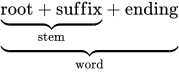
The thematic vowel, if present, occurs at the end of the suffix (which may include other vowels or consonants) and before the ending:
- *gʷʰér-mo-s 'heat' > Ancient Greek θέρμος (thérmos)
- *bʰér-e-ti '(he) bears' > Sanskrit bhárati, Gothic 𐌱𐌰𐌹𐍂𐌹𐌸 (baíriþ)
Athematic forms, by contrast, have a suffix ending in a consonant, or no suffix at all (or arguably a null suffix):[2]
- *ph₂-tér-s 'father' > English father
*h₁és-mi '(I) am' > English am
For several reasons, athematic forms are thought to be older, and the thematic vowel was likely an innovation of late PIE: Athematic paradigms (inflection patterns) are more "irregular", exhibiting ablaut and mobile accent, while the thematic paradigms can be seen as a simplification or regularisation of verbal and nominal grammar. In the Anatolian languages, which were the earliest to split from PIE, thematic verbs are rare or absent.[3] Furthermore, during late PIE and in the older daughter languages, a number of athematic forms were replaced by thematic ones, as in prehistoric Greek *thes- 'god' versus *thes-o- > Classical Greek θεός (theós).[4]
The thematic vowel technically belongs to the suffix and not the ending, as each suffix is inherently either thematic or athematic. It is also used in some cases to derive stems from roots directly, acting as a suffix in itself (as in the second example above). However, when considering endings which are different for thematic and athematic inflections, it is generally included in the endings as well; see the section on fusion below.
Verbs
[edit]In verbs, the thematic vowel is *e word-finally or when the following ending begins with a coronal obstruent (*t, *d, *dʰ or *s) and *o otherwise.[citation needed] Here is the present active indicative paradigm of *bʰer- 'carry':[5]
| Person | Singular | Dual | Plural |
|---|---|---|---|
| 1st | *bʰér-o-h₂ | *bʰér-o-wos | *bʰér-o-mos |
| 2nd | *bʰér-e-si | *bʰér-e-tes | *bʰér-e-te |
| 3rd | *bʰér-e-ti | *bʰér-e-tes | *bʰér-o-nti |
For comparison, here is an example of an athematic verb, *dewk- 'to draw'. The plural forms ablaut to zero-grade on the root and shift the accent to the ending:[6]
| Person | Singular | Dual | Plural |
|---|---|---|---|
| 1st | *déwk-mi | *duk-wós | *duk-mós |
| 2nd | *déwk-si | *duk-tés | *duk-té |
| 3rd | *déwk-ti | *duk-tés | *duk-énti |
(The first person singular ending is sometimes *-m(i) and sometimes *-h₂, depending on tense, voice and thematicity.)
Origin
[edit]The PIE verb is characterized by two distinct sets of endings: one found in the thematic present and the perfect, and another found in the aorist and the athematic present. The middle endings seem like a mixture of these two. The thematic conjugation was widespread in what Donald Ringe terms "Western Indo-European" (Western IE), i.e. IE excluding Tocharian and especially Anatolian. The biggest problem on the origin of PIE thematic inflection is that the thematic endings have more in common with the PIE perfect (which formally, though not functionally and lexically, corresponds to the ḫi-conjugation in Hittite and other Anatolian languages), and that the actual etymological cognates reconstructed of thematic presents are few among the verbs belonging to the Anatolian ḫi-conjugation. In fact, most of the verbs belonging to the ḫi-conjugation in Anatolian actually have lexical cognates that inflect as athematic verbs in Western IE.[7] All types of verbs belonging to the ḫi-conjugation in Hittite can be shown to have, or to originally have had the ablaut pattern with *o in the singular and the zero-grade in the plural, which is exactly the pattern of the Western PIE perfect.[8]
The thematic presents in Western PIE also do not have quantitative ablaut, which indicates their relatively recent origin. This all has caused some linguists to speculate that perfect and thematic present endings go back to a single Early PIE prototype. According to Matasović, the Early PIE stative (becoming the perfect) is responsible for the original form of the thematic suffix *-o-, while the e-grade form is secondary. Verbs forming the underived thematic presents are overwhelmingly bivalent/transitive, and there are no statives in the Late PIE thematic inflection since all the original Early PIE statives either remained athematic presents, or they became Western PIE perfects. It is also probable that some Early PIE middle verbs also became thematic in the Western PIE period, since they lack middle correspondences in Anatolian.[9]
Nouns
[edit]In nouns, the thematic vowel is almost always *o,[10] and only becomes *e when there is no ending or when followed by *h₂ in the neuter nominative/accusative plural. Here is an example paradigm for *h₂ŕ̥tḱos 'bear', a thematic animate noun, supplemented by the neuter *h₂érh₃trom 'plough' for the nominative/accusative:[10]
| Case | Singular | Dual | Plural |
|---|---|---|---|
| Nom. | *h₂ŕ̥tḱ-o-s | *h₂ŕ̥tḱ-o-h₁ | *h₂ŕ̥tḱ-o-es |
| Voc. | *h₂ŕ̥tḱ-e-∅ | *h₂ŕ̥tḱ-o-h₁ | *h₂ŕ̥tḱ-o-es |
| Acc. | *h₂ŕ̥tḱ-o-m | *h₂ŕ̥tḱ-o-h₁ | *h₂ŕ̥tḱ-o-ns |
| Nom./acc. neut. | *h₂érh₃-tro-m | *h₂érh₃-tro-ih₁ | *h₂érh₃-tre-h₂ |
| Gen. | *h₂ŕ̥tḱ-o-s? | *h₂ŕ̥tḱ-ō-m | |
| Abl. | *h₂ŕ̥tḱ-o-(h₂)at | *h₂ŕ̥tḱ-o-(i)bʰ- | |
| Dat. | *h₂ŕ̥tḱ-o-ei | *h₂ŕ̥tḱ-o-(i)bʰ- | |
| Instr. | *h₂ŕ̥tḱ-o-h₁ | *h₂ŕ̥tḱ-o-(i)bʰ- | |
| Loc. | *h₂ŕ̥tḱ-o-i | *h₂ŕ̥tḱ-o-isu |
Again, athematic nouns show ablaut and accent shifts, mainly between the "strong" cases (nominative and vocative in all numbers, and accusative singular/dual) and the "weak" cases (all others). A few endings are also different from the thematic paradigm; for example, the nominative/accusative neuter has *-∅ instead of *-m.[10] See Athematic accent/ablaut classes of PIE nouns for examples.
Origin
[edit]There are several theories about the rise of o-stems in PIE nominal inflection. Two are the most prominent:
- o-stems reflect an ergative system that existed in the prehistory of PIE, and
- o-stems arise from pronouns.
Ergative theory
[edit]Pedersen was the first to notice that the subject of the transitive verb looked as if it had the form of the genitive (a sigmatic case) if it were active, and as if it had the form of the instrumental case if it were inactive. Furthermore, the subject and object of intransitive verbs seemed to have the form of the absolutive (i.e. an asigmatic case).[11] This caused an asymmetry between the valencies of transitive and intransitive verbs, summarized in the table below:[12]
| Verb | Role | Nominative system | Ergative system |
|---|---|---|---|
| transitive | subject | nominative | ergative |
| object | accusative | absolutive | |
| intransitive | subject | nominative | absolutive |
This theory was further developed by Beekes and Kortlandt, who assumed that the nominative syntax of old Indo-European languages was formed later and that the case system of the PIE language was primarily based on the ergative syntax. The same ending shared by the nominative and accusative neuter, originally designating inactive nouns, originated from the originally absolutive case, while the ergative was used with the active subject. Beekes claims the sigmatic genitive-ablative developed from the ergative. After the transformation of the ergative system into the nominative system, the form reconstructed as *CC-R-ós became the nominative, a new case of subject. Later what was to become the thematic vowel *-o- spread to other cases as well, giving rise to o-stem inflection.[13]
Similar theories that assume the ergative past of the PIE syntax have been formulated by Gamkrelidze and Ivanov[14] and Schmalstieg.[15]
A related theory that also derives the thematic conjugation from an oblique case form was proposed by Ranko Matasović, who, however, identified the source form as the genitive. Matasović argued that the thematic o-stem nouns were the result of the nominalisation of adjectives, which in turn arose through the reinterpretation as nominative forms of original (attributively used) genitives of athematic (mostly deverbal) root-nouns. For example, the stem *(h)yug-o (cf. Latin 'iugum) was abstracted from *(H)yug-os, which was originally a genitive of a root noun *(H)yewg-s (cf. Latin coniūx).Thus, a phrase like *ukwsōn yug-os 'ox of yoking' was reinterpreted as 'yoked ox'. This theory, like the previous one, would explain why there is much evidence in favour of original syncretism of the nominative and genitive singular in the o-stems.[16]
Pronominal theory
[edit]According to Jean Haudry o-stems originated from pronouns with a determining function that were suffixed to a nominal base, playing the role of a postpositional article.[17] There exists a number of typological parallels for such a development:
- in Balto-Slavic, where definite adjectives are formed by suffixing the PIE relative pronoun *yo- / *yeh₂.
- modern Balkan and Scandinavian languages, which developed postpositional determination using demonstratives
- mimation and nunation in Semitic languages.
Developments from thematic and athematic paradigms
[edit]Thematic and athematic forms were passed on to the daughter languages of Proto-Indo-European. In the most ancient languages, such as Sanskrit and Ancient Greek, the distinction between athematic and thematic nouns and verbs is preserved. In later languages, the thematic versus athematic distinction in nouns was replaced by distinctions between various thematic ("vowel") and athematic ("consonant") declensions, and athematic verbs are typically regarded as irregular.
As a consequence of such language changes, the distribution of thematic and athematic words differs widely in Indo-European languages. Latin, for example, has only very few athematic verbs, while Sanskrit preserves a large number of these. Greek resembles both Sanskrit and Latin in different respects.
Fusion
[edit]Even in ancient languages, the thematic vowel is often indistinguishable from the case ending, because the two have fused together:
- Old Latin sax-o-is > Classical Latin sax-īs, dative plural of sax-u-m (Old Latin sax-o-m) 'stone'
- Homeric θε-ᾱ́-ων (the-ā́-ōn) > Attic θε-ῶν (the-ôn), genitive plural of θε-ᾱ́ (the-ā́) 'goddess'
In Latin, athematic verbs were lost, except for a few, which were considered irregular or adopted into one of the four thematic conjugations:[18]
- s-um, es, es-t, s-umus, es-tis, s-unt[19] (irregular) 'be'
- (ferō,) fer-s, fer-t, (ferimus,) fer-tis, fer-unt (irregular) 'carry'
- (dō,) dā-s, da-t, da-mus, da-tis, da-nt (first conjugation) 'give'
Thematic a
[edit]Although the a of the Greek and Latin first declension was not originally a thematic vowel, it is considered one in Greek and Latin grammar. In both languages, first-declension nouns take some endings belonging to the thematic second declension. An a-stem noun was originally a collective noun suffixed with *-eh₂, the ending of the neuter plural.
*bʰardʰ-éh₂-∅ (no case ending) > Proto-Italic *farβā > Latin barba 'beard'
Athematic vowels
[edit]Sometimes vowels near the end of a noun or verb, where one would expect a thematic vowel, are not actually thematic vowels. Either these vowels are placed after an e or o, or they are on their own.
In both Latin and Greek, there are athematic nouns whose stems end in i or u (with the allophones y or w before vowels). These include Latin nāvis 'ship' and Greek thesis 'placement'; Latin senātus 'council of elders' or 'senate' and Greek basileus 'king'. Because these vowels are not e or o, they are not thematic, and the nouns take the same endings as consonant-stem nouns.
- Latin nāvi-s, senātu-s · rēg-s 'king'
- Greek thesi-s, basileu-s · Arab-s (Araps) 'Arab'
In Latin, there are four conjugations depending on the vowel before the endings (which include the thematic vowel): a, e, none, i. Although all the verbs belonging to these conjugations are thematic, these four vowels are not the thematic vowel of the different declensions: the thematic vowel is an e/o that has either fused with the endings and conjugation vowel or changed to i/u.
In Greek, some of the Latin conjugations are represented by contracted verbs instead, in which the stem vowel contracts with the ending (which includes the thematic vowel). This results in different vowels in the ending from the non-contracted verbs.
- tīmaeis > tīmāis 'you honor'
Individual languages
[edit]Latin
[edit]In Latin, nouns of the first, second, fourth, and fifth declensions are considered thematic; the first declension has the theme vowel a, the second o, the fourth u, and the fifth e. Stems with i are treated together with athematic stems in the third declension, as they came to closely resemble one another. Latin verbs are subject to a similar classification: the first conjugation contains vowel stems with a, the second with e, and the fourth with i. There are no Latin verbs with o or u,[20] and very few are athematic, but they are considered irregular verbs.
For example, consider the noun endings of the Latin "first declension" singular of the word rosa 'rose':
| Nom. | rosa |
| Acc. | rosam |
| Gen. | rosae |
| Dat. | rosae |
| Abl. | rosā |
The vowel a is prominent in these case endings, so nouns like rosa came to be known as "a-stem" nouns, with a being the "theme vowel," and such a word was later analysed as having a stem containing a root plus a suffix. In fact, philologists now believe that the suffix in PIE was *-eh₂, with a laryngeal that usually became a in the daughter languages.
Sanskrit
[edit]Sanskrit grammar ordains a vikaraṇapratyaya (modificatory affix) between a verbal root and the tense-ending. Thematic verbal roots are those with an -a in the vikaraṇapratyaya, to wit, roots belonging to the 1st, 4th, 6th and 10th conjugation classes.
Among nominals, those with the prātipadika (stem) ending in -a would the thematic nominals by this definition.
Ancient Greek
[edit]Verbs
[edit]The distinction between thematic and athematic stems is especially apparent in the Greek verb; they fall into two classes that are marked by quite different personal endings. Thematic verbs are also called -ω (-ō) verbs in Greek; athematic verbs are -μι (-mi) verbs, after the first person singular present tense ending that each of them uses. The entire conjugation seems to differ quite markedly between the two sets of verbs, but the differences are really the result of the thematic vowel reacting (fusing) with the verb endings, apart from the first person singular which already had different endings for thematic and athematic verbs in PIE.[5] In classical Greek, the present tense active endings for athematic verbs are:
- -μι, -ς, -σι, -μεν, -τε, -ασι(ν)
- (-mi, -s, -si, -men, -te, -asi(n))
while the thematic verbs took the endings:
- -ω, -εις, -ει, -ομεν, -ετε, -ουσι(ν)
- (-ō, -eis, -ei, -omen, -ete, -ousi(n))
In Greek, athematic verbs, except for those that end in -νῡμι -nūmi, are a closed class of inherited forms from PIE.
Nouns
[edit]Greek preserves thematic nouns in the first (or alpha) declension and second (or omicron) declension, and athematic nouns in the third declension.
Declension of the athematic noun πούς (poús) 'foot':
| Attic form | Reconstructed form before δσ > σ (ds > s) | |
|---|---|---|
| Nom. | πούς (poús) | *πόδ-ς (*pód-s) |
| Gen. | ποδός (podós) | ποδ-ός (pod-ós) |
| Dat. | ποδί (podí) | ποδ-ί (pod-í) |
| Acc. | πόδα (póda) | πόδ-α (pód-a) < *πόδ-m̥ (*pód-m̥) |
| Voc. | πούς (poús) | *πόδ-ς (*pód-s) |
Declension of the thematic noun ἄνθρωπος (ánthropos) 'human':
| Nom. | ἄνθρωπ-ος (ánthrōp-os) |
| Gen. | ἀνθρώπ-ου (anthrṓp-ou) |
| Dat. | ἀνθρώπ-ῳ (anthrṓp-ōi) |
| Acc. | ἄνθρωπ-ον (ánthrōp-on) |
| Voc. | ἄνθρωπ-ε (ánthrōp-e) |
Other languages
[edit]Most other Indo-European languages have similar distinctions, or had them in their past. Marked contrasts between thematic and athematic verbs appear in Lithuanian, and Old Church Slavonic. In the Germanic and Insular Celtic languages, the theme vowels are often hard to perceive because of the loss of final vowels. However, their presence is still felt, in a manner that defines different ways of declining nouns or conjugating verbs, so philologists still occasionally speak of vowel stems and consonant stems in these languages as well.
While Old English still contrasted "vowel stems" (thematic) and "consonant stems" (athematic), this distinction is no longer a meaningful one in Modern English, as in other languages whose morphology has been drastically simplified by analogy.
Etymology
[edit]In the term thematic vowel, theme refers to the stem of a word. For example, in the Ancient Greek verb τέμνω (témnō) 'cut', tem- is the root, and temn- is the stem or theme for the present tense.[21] Hence, thematic vowel loosely means "stem vowel".
Notes
[edit]- ^ The asterisk * indicates that a form is not directly attested, but has been reconstructed on the basis of other linguistic material.
- ^ Fortson (2004:87, 108)
- ^ Fortson (2004:157)
- ^ Fortson (2004:77f)
- ^ a b Fortson (2004:89)
- ^ Fortson (2004:87)
- ^ Matasović (2012:18)
- ^ Kloekhorst (2008:137)
- ^ Matasović (2012:18–20)
- ^ a b c Fortson (2004:113)
- ^ Pedersen (1907:152)
- ^ Beekes (1995:193):
- ^ Beekes (1995:195):
- ^ Gamkrelidze & Ivanov (1984:267–291)
- ^ Schmalstieg (1997:401–407)
- ^ Matasović, Ranko. 2004. Gender in Indo-European. Heidelberg: Universitätsverlag Winter. P.187-188.
- ^ Haudry (1982:36–38)
- ^ Allen & Greenough (2006, sect. 174)
- ^ Allen & Greenough (2006, sect. 170 b)
- ^ The Shorter Latin Primer, Benjamin Hall Kennedy
- ^ "Theme (linguistics)". Oxford English Dictionary (Online ed.). Oxford University Press. (Subscription or participating institution membership required.)
References
[edit] | This article includes a list of general references, but it lacks sufficient corresponding inline citations. (January 2008) |
- Allen, J. H.; Greenough, James B. (2006), Kittredge, G. L.; Howard, A. A.; D'Ooge, Benj. L. (eds.), Allen and Greenough's New Latin Grammar, Dover Publications, ISBN 0-486-44806-1
- Beekes, Robert S. P. (1995), Comparative Indo-European Linguistics: An Introduction, Amsterdam: John Benjamins, ISBN 90-272-2150-2 ISBN 1-55619-504-4 (U.S.)
- Fortson, Benjamin W. IV (2004), Indo-European Language and Culture, Blackwell Publishing, ISBN 1-4051-0316-7
- Gamkrelidze, Tamaz; Ivanov, Vyacheslav (1984), Indo-European and the Indo-Europeans: a reconstruction and historical analysis, Berlin: Mouton de Gruyter
- Haudry, Jean (1982), Prehistoire de la flexion nominale indo-européenne (in French), Lyon: Institut d'études indo-européennes de l'Université Jean Moulin
- Kloekhorst, Alwin (2008), Etymological Dictionary of the Hittite Inherited Lexicon, Leiden: Brill
- Matthias Fritz, Michael Meier-Brügger: Indogermanische Sprachwissenschaft. Walter de Gruyter, Berlin 2021 (10., völlig neu bearbeitete Auflage), ISBN 978-3-11-059832-2
- Pedersen, Holger (1907), "Neues und nachträgliches", Zeitschrift für vergleichende Sprachforschung (in German), 40: 129–217
- Matasović, Ranko (2012), Clause alignment in Proto-Indo-European (PDF)
- Schmalstieg, William R. (1997), "The Origin of the Neuter Nominative-Accusative Singular In *-OM.", Journal of Indo-European Studies, 25: 401–407
Thematic vowel
View on GrokipediaEtymology and Definition
Etymology
The term "thematic vowel" derives from the Ancient Greek word théma (θέμα), meaning "proposition," "theme," or "that which is placed," which in linguistic contexts refers to the foundational stem or base of a word to which inflections are added.[6] This etymological root reflects the vowel's role as a structural "theme" linking the root to suffixes in word formation. In 19th-century comparative linguistics, the term was adapted to describe a specific vowel element in Proto-Indo-European (PIE) paradigms, distinguishing stems built around such vowels from others. Early comparative linguists like Franz Bopp laid groundwork for the concept in his Vergleichende Grammatik des Sanskrit, Zend, Griechischen, Lateinischen, Litthauischen, Gothischen und Deutschen (1833), where he analyzed connecting vowels in verb forms as pronominal elements that concretized abstract roots, such as transforming a root meaning "to love" into one implying "who loves."[7] However, Bopp did not yet employ the precise term "thematic vowel," instead treating these vowels as euphonic or derivational bridges without the thematic framing. The terminology evolved further through scholars like Georg Curtius, who in Das Verbum der griechischen Sprache (1873–1876) refined the notion by rejecting pronominal origins and viewing the vowel as a phonetic or stem-forming device, influencing English-language adoption. By the late 19th century, T. L. Papillon's A Manual of Comparative Philology (second edition, 1877) standardized "thematic vowel" in English, replacing "connecting vowel" to align with these Germanic philological insights (p. viii).[8] This marked its transition to widespread use in modern grammars, where it precisely identifies the ablauting -e/o- element. Distinct from "ablaut," which denotes internal vowel gradation (e.g., e : o : zero) within roots or suffixes for morphological purposes, the thematic vowel is a dedicated linking morpheme that remains relatively stable, though it participates in ablaut patterns.[9] "Stem vowel" serves as a broader synonym, but "thematic" etymologically highlights the contrast with athematic forms, where endings attach directly to the root without an intervening vowel, as in PIE mi-verbs versus thematic -e/o--stems. In PIE, thematic vowels underpin major classes of verbs and nouns, providing a foundational layer for inflection.[10]Definition
In Proto-Indo-European (PIE) morphology, a thematic vowel is a vowel suffix, typically realized as *e or *o, that is inserted between a root and an inflectional ending to form the stem, or "theme," of a word.[11] This element distinguishes thematic paradigms from athematic ones, in which endings attach directly to the root without an intervening vowel.[12] Thematic vowels appear in both verbal and nominal formations, serving as a connective morpheme that links the lexical root to grammatical markers.[11] The primary role of the thematic vowel in PIE morphology is to facilitate more regular and predictable patterns of conjugation and declension by creating a stable stem to which endings can uniformly attach.[12] In verbs, it forms the basis of thematic presents and other tenses, allowing for consistent inflection across persons and numbers.[11] Similarly, in nouns, it produces thematic stems that exhibit fixed accent and minimal ablaut variation, contrasting with the more irregular mobility in athematic forms.[12] A representative example of a thematic verbal form is PIE *bʰér-e-ti "he/she carries," where the root *bʰér- is followed by the thematic vowel *-e- and the third-person singular ending *-ti.[11] In contrast, the athematic verb *h₁és-ti "he/she is" attaches the same ending *-ti directly to the root *h₁és- without a thematic vowel.[11] Thematic vowels inherently participate in ablaut, alternating between *e and *o grades within a paradigm to signal grammatical distinctions, such as person or number, while the root may undergo its own vowel gradations independently.[11] For instance, the first-person plural form *bʰér-o-mesi "we carry" features the o-grade *-o- of the thematic vowel.[11]Proto-Indo-European
In Verbs
In Proto-Indo-European verbal morphology, thematic present stems are formed by appending an ablauting vowel *e/*o to the verbal root, creating a stable stem to which personal endings are attached. This thematic vowel, alternating between *e in strong positions and *o in weak positions according to ablaut patterns, ensures uniformity across the conjugation and distinguishes thematic verbs from other classes. A representative example is the root *bʰer- "carry," yielding the third singular present indicative *bʰér-e-ti, where the root is followed by the thematic *e before the ending *-ti.[13] Thematic verbs encompass several classes, including simple thematic formations as well as more elaborate types where the thematic vowel integrates with additional morphological elements. For instance, nasal-infix presents, such as *h₁ni-nékʷ-ti "he attains" from the root *h₁nekʷ-, incorporate a nasal infix -n(é)- that alternates with zero in non-present stems, with the thematic vowel facilitating the stem's cohesion in the present paradigm. Similarly, reduplicating types, like those built on roots with iterative or intensive nuance, integrate the *e/*o vowel post-reduplication to maintain stem integrity, as seen in reconstructed forms where the reduplicated syllable precedes the ablauting vowel before endings.[14] In contrast, athematic verbs, such as those in the mi-conjugation, lack this intervening vowel, with endings attaching directly to the root or stem, leading to variable root vocalism. The copula provides a clear example: *h₁és-mi "I am," where the root *h₁es- takes the first singular ending *-mi without a thematic element, resulting in ablaut directly within the root across persons (e.g., *h₁s-tí "you are"). This absence highlights the thematic vowel's role in providing a fixed buffer in thematic paradigms.[14] Reconstructed full conjugations for the present indicative active of a simple thematic verb, such as *bʰer- "carry," illustrate the thematic vowel's consistency: it appears as *e before singular endings and certain plural forms, shifting to *o elsewhere to follow ablaut rules, while preserving the root's integrity.| Person | Singular | Plural |
|---|---|---|
| 1st | *bʰér-ō | *bʰér-o-mes |
| 2nd | *bʰér-e-si | *bʰér-e-te |
| 3rd | *bʰér-e-ti | *bʰér-o-nti |
In Nouns
In Proto-Indo-European nominal morphology, thematic stems are formed by appending a thematic vowel, typically realized as *e or *o through ablaut, to the root, creating a stable base for attaching case endings. This structure contrasts with more archaic athematic forms by providing a uniform vowel buffer that simplifies inflectional patterns. A classic example is the masculine o-stem *h₁éḱw-os "horse," derived from the root *h₁éḱw-, where the thematic vowel appears in o-grade in the nominative singular *h₁éḱwos.[12] Thematic declensions are prominently distributed among o-stems, which predominantly denote masculine or neuter nouns, and ā-stems, which are chiefly feminine. For o-stems, the singular paradigm includes nominative *-os (e.g., *h₁éḱwos), accusative *-om (e.g., *h₁éḱwom), genitive *-osyo (e.g., *h₁éḱwosyo), dative *-ōi (e.g., *h₁éḱwōi), and instrumental *-eh₁ (e.g., *h₁éḱweh₁). In the plural, forms such as nominative *-ōs (e.g., *h₁éḱwōs) and accusative *-oms (e.g., *h₁éḱwoms) reflect the o-grade extension. Ā-stems follow a parallel pattern with long-vowel variants, as in the feminine *h₁ekw-éh₂ "mare" from root *h₁éḱw-, yielding nominative singular *h₁ekwéh₂, accusative singular *h₁ekwéh₂m, genitive singular *-eh₂es (e.g., *h₁ekwéh₂es), and plural nominative *h₁ekwéh₂es. These paradigms illustrate how the thematic vowel maintains stem integrity across cases.[15][16] Unlike thematic stems, athematic consonant stems, such as *wóyd-s "voice" (nominative singular from root *weyd-), or resonant-final stems, directly attach endings to the root without an intervening vowel, resulting in variable ablaut and accent shifts (e.g., genitive singular *weyd-és). Similarly, i- and u-stems like *bʰuH-ti-s "becoming" (nominative) exhibit suffix-final vowels but remain athematic, with paradigms showing zero-grade alternations (e.g., accusative *bʰuH-tím). This absence of a dedicated thematic vowel in athematic classes leads to more irregular forms, particularly in oblique cases.[12][16] The thematic vowel's primary role is to ensure consistent ending attachment, reducing irregularity and supporting clear distinctions in gender and number. O-stems typically signal masculine or neuter gender through their o-grade dominance (e.g., neuter nominative/accusative singular *-om), while ā-stems mark feminine gender via the long ā (e.g., plural *-éh₂es). In number, the vowel enables straightforward plural markers like *-ōs for animate o-stems, reinforcing grammatical categories without the ablaut complications of athematic nouns. This mechanism enhanced the productivity of thematic classes in late PIE.[12][16]Thematic and Athematic Paradigms
Characteristics
In Proto-Indo-European morphology, thematic paradigms are distinguished by the presence of a linking vowel, typically *e or *o, which separates the stem from the inflectional endings, creating more regular and uniform forms across cases or persons. This thematic vowel facilitates the attachment of endings in both nominal and verbal declensions and conjugations, resulting in invariant stems with fixed accent and minimal ablaut variation; for instance, in verbs, the 3rd singular present form *bhér-e-ti ('he bears') exemplifies the *e-grade vowel linking the root *bher- to the ending *-ti. In nouns, o-stems like *wĺkʷ-os ('wolf') similarly employ the *o-vowel for stability, with endings such as nominative singular *-os and accusative singular *-om.[13][17] Athematic paradigms, by contrast, lack this linking vowel, with endings attaching directly to the root or a stem ending in consonants, short vowels like *i or *u, or other elements, often leading to more irregular and variable forms. Verbal athematics, such as *h₁és-ti ('he is'), show direct root-ending junctions with prominent ablaut, where full-grade roots alternate with zero-grade in different persons (e.g., *es-mí in 1st singular vs. *s-énti in 3rd plural). Nominal athematics, including consonant stems like *pód-s ('foot'), exhibit mobile accent and complex ablaut patterns, such as o/e alternation (*pṓd-s nominative vs. *ped-és genitive), reflecting four accent classes (acrostatic, proterokinetic, hysterokinetic, amphikinetic) that correlate with stress shifts and vowel grades.[18][12][17] These structural differences carry morphological implications, with thematic paradigms enabling the formation of new words and derivations through suffixation while maintaining regularity, whereas athematics preserve older, inherited roots with intricate ablaut for semantic nuance. Thematically conjugated verbs often mark transitivity via objective flexion (e.g., 1sg. *-ō, 3sg. -e-ti), contrasting athematic subjective flexion (-mi, *-ti) suited to intransitives or archaic transitives. Productivity favors thematics in later PIE stages, comprising the majority of verbal and nominal forms—such as over 70% of reconstructed verbs—due to their adaptability for innovation, while athematics remain limited to a core of archaic items.[18][13][17]Origins and Theories
The origins of thematic vowels in Proto-Indo-European (PIE) remain a topic of debate among historical linguists, with theories focusing on their emergence as a productive morphological feature in the late stages of the language's development. Comparative evidence indicates that the thematic conjugation, characterized by the ablauting vowels *e and *o inserted between the root and inflectional endings, arose after the split of the Anatolian branch, which lacked a fully developed thematic system in verbs and nouns. This places the innovation in late PIE, approximately post-4000 BCE, as Anatolian divergence is dated to around 4200–3800 BCE based on archaeological and linguistic correlations.[13] The pronominal theory, advanced by Antoine Meillet, proposes that thematic vowels derived from pronominal or deictic elements attached to verbal and nominal stems. Specifically, Meillet argued that *e originated from forms akin to the *so- pronouns (e.g., *e- from *eso- or related particles), functioning initially as connectors in suffixed stems like *-ske/o- or *-ne/o-, before expanding analogically to broader paradigms. This view is supported by parallels in pronominal inflection across Indo-European languages, where similar vowel elements mark definiteness or reference. However, critics note that it fails to fully account for the consistent *e/o ablaut pattern in thematic forms, which appears more systematic than sporadic pronominal incorporations. In contrast, the ergative theory connects thematic vowels to an earlier ergative-absolutive alignment in PIE nominal morphology, particularly for animate nouns. Calvert Watkins suggested that the thematic *o served as a nominative (absolutive) marker distinguishing agentive roles in transitive constructions, evolving from a pre-PIE system where athematic stems handled inanimates and intransitives. Evidence includes residual ergative patterns in Hittite and Tocharian nominal cases, as well as the restriction of thematic *o to nominative singular in many reconstructions. This theory ties the vowels' rise to a broader syntactic realignment toward nominative-accusative structure in late PIE, but it faces critique for overemphasizing nominal origins while under-explaining the vowels' extension to verbal conjugation. Alternative theories attribute the thematic vowels to internal innovations via analogy or external substrate influences. One analogical model posits that thematic presents developed from denominative verbs derived from nominal stems, where *e/o- suffixes (originally marking derivation) were reanalyzed as inflectional connectors, spreading through paradigm leveling in late PIE. This is evidenced by the productivity of such forms in non-Anatolian branches like Indo-Iranian and Greek, without requiring external borrowing. Proposals involving pre-PIE substrates, such as influences from Caucasian or Neolithic European languages introducing vowel harmony or stem extension, have been suggested but critiqued for lacking verifiable cognates or reconstructive support; comparative phonology shows the *e/o pair as a core PIE feature unlikely to stem from wholesale substrate imposition. Overall, these theories highlight the thematic system's late development, with analogical expansion providing the most parsimonious explanation based on internal evidence.Developments in Daughter Languages
Fusion Processes
In the early stages of the daughter Indo-European languages, thematic and athematic paradigms underwent significant blending, primarily through analogical leveling that allowed athematic endings to be adopted into thematic stems and vice versa, leading to the partial merger of inflectional classes. This process was evident in pre-Greek and pre-Latin verbal systems, where athematic presents like PIE *sup-nés "sleeps" influenced thematic forms, resulting in innovations such as Greek *húpar "dream" and Latin *sopor "sleep," as athematic ablaut patterns were regularized under thematic *e/o- vowels.[19] Similarly, in nominal declensions, o-stem thematic nouns converged with athematic root nouns, with thematic endings from demonstrative pronouns (e.g., PIE *to-) extending to replace irregular athematic forms across branches.[19] A key aspect of this fusion involved the development of the thematic *ā vowel in feminine nouns, derived from PIE *-eh₂ suffixes that shifted to long *ā through laryngeal loss and analogical extension into thematic contexts. This marker, originally athematic, spread to thematic stems in branches like Italic and Indo-Iranian, as seen in PIE *gʷén-eh₂ "woman" evolving to Latin *fēmin-a, where the feminine ending *-a reflects the blended *-eh₂ > *ā outcome integrated into o-stem patterns.[19][20] In Tocharian, this extension from athematic to thematic stems further illustrates the scarcity of pure athematic *-eh₂ forms, with Proto-Tocharian *-å emerging uniformly and fusing with broader nominal morphology.[20] Athematic short vowels, such as those in i- and u-stems, persisted in some environments but often fused with thematic patterns through analogy, leading to the loss of distinct athematic classes in favor of hybrid forms. For instance, athematic i-stems like PIE *ph₂tḗr-es "fathers" (genitive) showed vowel persistence in ablaut, but analogical pressure from thematic o-stems regularized endings, reducing athematic irregularity in pre-daughter languages.[19] In verbal paradigms, athematic active endings (e.g., *-m, *-s, *-t) influenced the reinterpretation of thematic *-e- ~ *-o- alternations post-Anatolian split, as seen in the spread of *-o- to closed syllables in extra-Anatolian branches.[13] These fusion processes largely occurred during the 2nd millennium BCE, following the Anatolian divergence around the 4th–3rd millennia BCE, and were driven by a combination of analogical innovations and phonological changes like ablaut simplification and laryngeal vocalization.[19] The emergence of thematic conjugation itself, tied to shifts in semantic alignment toward nominative-accusative systems, further accelerated paradigm blending in non-Anatolian lineages.[21]Vowel Innovations
In the Anatolian branch, the Proto-Indo-European thematic vowels *e and *o underwent a merger into a single low vowel /a/, particularly in post-tonic open syllables before resonants, as evidenced in Hittite verbs where forms like *i̯e- developed into -i̯a- (e.g., pé-eš-ši-i̯a-mi 'I throw').[13] This change reflects an early Anatolian innovation, with no compelling evidence for a distinct *o in the active paradigm, leading to uniform -a- vocalism in thematic stems.[13] Ancient Greek shows a contrasting development, where the thematic vowels *e and *o were lengthened to ē and ō in specific morphological contexts, such as subjunctive and optative forms, driven by processes like svarita lengthening following the loss of a preceding vowel.[22] This lengthening, part of broader ablaut alternations emerging around 1500 BCE, enhanced paradigmatic distinctions in verbal stems.[22] In the Germanic languages, unstressed thematic vowels experienced reduction, typically to schwa [ə] or a centralized low vowel, due to the fixed initial stress pattern inherited from Proto-Germanic, which limited vowel contrasts in non-root syllables to primarily [ə]. This reduction affected the e/o alternation, often neutralizing it in endings while preserving fuller quality in stressed positions. Indo-Iranian innovated new thematic classes, notably for causative verbs, by productively employing the suffix *-éye/o- (reflected as -áya-/-áyi- in Sanskrit), which extended basic roots into factitive formations like Sanskrit vādayati 'causes to blow' from vā- 'blow'.[23] An additional labial-extended variant *-éyeh₂w- or *-ébʰe/o- emerged as a parallel causative strategy, further diversifying thematic presents beyond Proto-Indo-European inheritance.[23] Grimm's Law, while primarily a consonant shift in Proto-Germanic (e.g., PIE *p t k > f θ x), indirectly influenced thematic vowels through subsequent fixed stress, promoting reduction and mergers like *e > i before following *j in umlaut contexts, altering stem vocalism in verbs.[24] The centum-satem isogloss impacted *e quality indirectly via palatalization: in satem branches (e.g., Indo-Iranian, Balto-Slavic), velars before *e fronted to sibilants, creating environments that favored *e retention or slight centralization, whereas centum languages (e.g., Greek, Germanic) preserved labiovelars, allowing *e to interact differently with back vowels in ablaut.[25] Recent studies (post-2020) highlight Uralic substrate influences on Balto-Slavic, including potential contributions to vowel quantity distinctions and locatival case innovations, which may have reinforced thematic vowel stability through areal agglutinative pressures, though direct lexical loans show limited vowel-specific effects.[26][27]In Individual Languages
Latin
In Latin, the verbal system prominently features thematic presents in the first and second conjugations, where the thematic vowels have undergone significant regularization. The first conjugation uses a fixed thematic vowel -ā-, as seen in the verb amō "I love," formed from the present stem amā- to which personal endings are added. This conjugation typically includes verbs derived from noun or adjective stems, with the infinitive ending in -āre, such as amāre "to love." The second conjugation employs a fixed thematic vowel -ē-, exemplified by moneō "I warn" from the stem monē-, with infinitives in -ēre like monēre "to warn." These fixed long vowels result from contractions and sound changes that eliminated earlier variations, creating consistent paradigms across tenses within each conjugation. A key innovation in Latin verbs is the loss of ablaut, the Proto-Indo-European system of vowel gradation in the thematic vowel *e/o, leading to levelled, unchanging forms throughout the paradigm. For instance, in the first conjugation, the present indicative active of amō is conjugated as amō, amās, amat, amāmus, amātis, amant, without alternation in the stem vowel. Similarly, for monēre in the second conjugation: moneō, monēs, monet, monēmus, monētis, monent. This leveling extended to other thematic formations, such as causatives and iteratives, which adopted the -ē- of the second conjugation (e.g., docēre "to teach" from stem docē-). Such changes stabilized the system but reduced morphological distinctions inherited from earlier stages. In the nominal system, thematic o/ā-stems dominate the lexicon, forming the bulk of nouns in the first and second declensions. The second declension consists of o-stems, primarily masculine and neuter, such as servus "slave" (stem serv-o-), declined as servus, servī, servō, servum, servō, servō in the singular across cases. The first declension comprises ā-stems, mostly feminine, like porta "gate" (stem port-ā-), with singular forms porta, portae, portae, portam, portā, portā. An important innovation is the fixed ā in feminine ā-stems, resulting from the generalization of the long vowel without ablaut variation, as in the full paradigm for rosa "rose": rosa, rosae, rosae, rosam, rosā, rosā (singular). Neuter o-stems in the second declension, such as bellum "war" (stem bell-o-), show fusion with athematic patterns in their endings, blending thematic vowel support with consonant-stem influences in forms like bellum, bellī, bello, bellum, bello, bellō, though retaining the core o-stem structure. A full example of a second declension o-stem declension, illustrating the thematic vowel's role, is given below for servus:| Case | Singular | Plural |
|---|---|---|
| Nominative | servus | servī |
| Genitive | servī | servōrum |
| Dative | servō | servīs |
| Accusative | servum | servōs |
| Ablative | servō | servīs |
| Vocative | serve | servī |
Sanskrit
In Sanskrit, thematic vowels play a central role in both verbal and nominal morphology, deriving from Proto-Indo-European (PIE) ablaut patterns where *e/o alternated, though merged into a/ā in Indo-Iranian.[30] In verbs, thematic classes, particularly the first class, insert the vowel -a- between the root and personal endings, as seen in bhárati "he carries," formed from the root bher- (full grade) + -a- + -ti, preserving root ablaut while the thematic vowel remains stable in full grade.[31] Reduplication appears in related forms like the perfect babhāra "he has carried," where the thematic -a- follows the reduplicated root, maintaining the structure across tenses.[31] For nouns, thematic stems ending in -a (o-stems) are common for masculines, exemplified by deva- "god," which declines as deváḥ (nominative singular) to devébhyaḥ (dative plural), with the -a- vowel linking the stem to endings without significant alteration.[32] Feminine ā-stems, such as nadī- "river," follow a parallel pattern, yielding forms like nadī́ (nominative singular) and nadíbhyo (dative plural), where the long vowel -ā- reflects extended ablaut from PIE.[32] Athematic i-stems, like kaví- "poet," show partial fusion with thematic-like endings in later forms, such as kavím (accusative singular), blending consonant-stem irregularities with vowel extension.[32] Sanskrit innovations distinguish Vedic from Classical stages: Rigvedic texts preserve archaisms like variable accent affecting ablaut in thematic verbs (e.g., mobile stress in bhárati variants), while Classical Sanskrit regularizes paradigms through Pāṇinian rules, standardizing -a- insertion across classes.[31] Causative thematics employ the suffix -aya-, as in kārayati "he causes to make" from root kṛ, combining root + -a- + -ya- + ending to denote factitive action, a development prominent in both periods but more rigidly inflected in Classical usage.[31] Uniquely, Sanskrit retains PIE *o reflexes as -a- in thematic contexts without the qualitative distinctions seen in centum branches, aligning with satem vowel mergers yet preserving ablaut length as -ā- in strong positions.[33]Ancient Greek
In Ancient Greek, thematic vowels play a central role in both verbal and nominal morphology, inheriting the Proto-Indo-European distinction between thematic and athematic stems while undergoing dialect-specific innovations. In verbs, the thematic vowel alternates between short *e and *o, connecting the stem to personal endings in -ω verbs (thematic or omega verbs), as opposed to athematic -μι verbs. For example, the present indicative of φέρω "I carry" features the thematic vowel as ο in the first person singular (φέρω) and plural (φέρομεν), but ε in the second person singular (φέρεις) and third person singular (φέρει), reflecting a person-based alternation that facilitates smoother conjugation.[34] This pattern extends to the thematic aorist, where the vowel is added to the root's zero grade, as in the second aorist of δέρκομαι "I see" (ἔδρακον), emphasizing perfective aspect without the sigmatic marker of first aorists.[35] The augment, a prefix indicating past tense in the indicative, interacts notably with thematic verbs by lengthening or contracting the initial vowel in vowel-initial stems, such as ἤνεγκα from the aorist of φέρω, where the syllabic augment ἐ- or temporal lengthening (ē-) precedes the thematic vowel.[36] In non-indicative moods, the thematic vowel shows further adaptations: the optative employs secondary endings with -οι- in the active (e.g., φέροιμι "I might carry") and -αι- in the middle, derived from lengthened *ēh₂i or similar, while the dual number uses endings like -ετον for the present active dual (φέρετον "you two carry").[37] These forms highlight the vowel's role in marking modality and number, with the dual preserving an archaic Indo-European category often used for pairs. In some dialects, such as Aeolic, the thematic *e and *o sporadically diphthongize to ei and oi before certain endings, though Attic favors contraction.[38] Nominal thematics, primarily o-stems (second declension) and ā-stems (first declension), use the thematic vowel to form stems like ἄνθρωπος "man" (genitive ἀνθρώπου, from *o-stem), where *o alternates with zero in some cases, or τιμή "honor" (an ā-stem with thematic *ā). Contracted forms arise from fusion of the thematic vowel with endings or adjacent vowels, such as -εο- stems contracting to -εῖος (e.g., πορφύρεος "dark red" from πορφύρεος), or -ᾱο- to -ᾱ (e.g., Ἀθήνη from *Ἀθε-να-ια).[39] In the Ionic-Attic dialect group, unique shifts include the raising of Proto-Greek *ā to ē in ā-stems (e.g., *pherā > φερή "carrying," feminine participle), and compensatory lengthening where loss of a consonant like *w (digamma) lengthens a preceding *e to ē, as in Ionic πόλις (from *kó-t-i-s > *ko-wis, with *o > ō in some contexts, but *e > ē elsewhere). These changes distinguish Attic-Ionic from other dialects, affecting thematic paradigms without altering their core structure.[40][41]Germanic Languages
In Proto-Germanic, thematic vowels played a central role in the morphology of both verbs and nouns, evolving from Proto-Indo-European (PIE) -e/o- stems while undergoing sound shifts such as the consistent development of PIE *o to a in open syllables.[42] Thematic verbs were prominent, particularly in the weak verb classes, which formed the preterite using a dental suffix (-d- or *-t-) appended to a fully thematic stem; for instance, the weak verb *faihaną "to paint" (from PIE *peik̑- "to adorn") exemplifies a Class I weak verb with the thematic suffix *-janą-, yielding forms like infinitive *faihaną and preterite *faihtēdum.[42] Strong verbs, by contrast, largely retained athematic ablaut patterns inherited from PIE for tense formation but often featured thematic presents with suffixes like *-ō- or *-ai- in certain classes; a representative example is the Class I strong verb *stainą "to stone" (from PIE *steyH-), which shows e-grade ablaut in the present (*stainō) contrasting with o-grade in the preterite singular (*stān).[42] Weak verbs were entirely thematic and represented an innovation, comprising the majority of the verbal system and simplifying conjugation through the dental preterite.[43] For nouns, a-stems became the dominant thematic class, encompassing masculine and neuter o-stems as well as feminine ā-stems, where the thematic vowel *a (from PIE *o) separated the root from endings; Gothic *dags "day" (nominative singular masculine) illustrates an a-stem from PIE *dʰegʷʰ- "to burn", yielding *dʰogʷʰos.[42][44] These a-stems outnumbered other vowel-stem classes like i- and u-stems, reflecting a Germanic reorganization of PIE declensions.[42] Key innovations in Germanic thematic vowels included the pervasive effects of i-umlaut (i-mutation), a regressive assimilation where a following high vowel (*i or *j) fronted preceding back vowels or raised front vowels, impacting thematic elements in both verbs and nouns; for example, in weak verbs, umlaut could alter the stem vowel before *-janą-, as seen in the development from Proto-Germanic *salbōną "to anoint" to forms with fronted vowels in daughter languages. Strong verbs preserved athematic ablaut in their roots (e.g., zero-grade in the preterite plural) but integrated thematic vowels in present stems, while the fixed word-initial stress reduced unstressed thematic vowels to schwa (*ə), leading to syncope in later stages.[42] These changes, including vowel innovations like the raising of *e to *i in certain environments, further distinguished Germanic from other Indo-European branches. In daughter languages, these patterns persisted with variations. Gothic, the earliest attested, retained conservative thematic forms, such as the a-stem noun *dags "day" and the weak verb *dailjan "to divide" (Class I, with thematic *-jan), where the preterite *dailida shows the dental suffix attached to the thematic stem.[42] Old English mirrored this in nouns like *dæg "day" (a-stem, with umlaut affecting related forms) and weak verbs such as *weardian "to guard" (from *wardijaną), forming preterite *weardode.[42][45] Old Norse weak conjugations emphasized the thematic nature through suffixes like *-a- in Class I verbs, as in *kalla "to call" (preterite *kallaði), where i-umlaut influenced vowel quality in the plural.[46] Modern German continues the weak pattern in verbs like *spielen "to play" (preterite *spielte), with the thematic stem preserved and umlaut evident in strong verbs like *geben "to give" (from PGmc *gebaną).[47] Remnants of the Proto-Germanic thematic system survive in modern English primarily through weak verb conjugations, which form the past tense with -ed (from the dental suffix), as in painted (reflecting the Class I weak pattern of PGmc *faihijaną "to paint," though borrowed forms like create adopt similar endings); strong verbs like sing-sang-sung retain ablaut but show thematic influences in their infinitive forms.[42] These conjugations underscore the enduring legacy of thematic vowels in simplifying Germanic verbal morphology.[43]| Language | Example Noun (a-stem) | Example Weak Verb (Thematic) | Key Feature |
|---|---|---|---|
| Gothic | dags "day" | dailjan "divide" (pret. dailida) | Conservative retention of *-jan suffix[42] |
| Old English | dæg "day" | weardian "guard" (pret. weardode) | Umlaut in stem vowels[42] |
| Old Norse | dagr "day" | kalla "call" (pret. kallaði) | Dental suffix with *-a- theme[46] |
| Modern German | Tag "day" | spielen "play" (pret. spielte) | Thematic stem + -te ending[47] |
| Modern English | day | paint (pret. painted) | Weak -ed from dental preterite[42] |
Balto-Slavic Languages
In Proto-Balto-Slavic, thematic nouns were primarily organized into o/e-stems, inheriting the Proto-Indo-European system where the thematic vowels *o- and *e- alternated to link roots to case endings, as seen in the mobile accent paradigm of Lithuanian diẽvas "god" (from PIE *deiw-os), where stress shifts between the stem and endings reflect early Balto-Slavic accent mobility governed by laws like Hirt's and Pedersen's.[48] This mobility affected vocalic stems, with barytonesis (fixed initial stress) emerging in accusative singular forms like diẽvą, distinguishing them from athematic stems and preserving Indo-European ablaut patterns in o-stems.[48] In the verbal domain, Balto-Slavic languages retained thematic present formations, with Baltic examples like Lithuanian nešù "I carry" (from stem *neš- with thematic o/u extension in first person singular) illustrating primary thematic conjugation where the vowel grades with person endings to mark tense and aspect.[49] Slavic branches innovated further by associating thematic presents with perfective aspects, often using prefixes on athematic roots but extending e/o-vowel suffixes in derived forms; for instance, Russian infinitives in -at' (e.g., delát' "to do") derive from Proto-Slavic thematic -a-ti, where the a reflects generalized o before dental endings in imperfective derivations.[50] Latvian declensions similarly preserve traces of PIE o in o-stem masculines, as in dievs "god," where genitive -a continues merged o/a from Proto-Balto-Slavic, maintaining stem integrity against Slavic-level fusions. Key innovations in Balto-Slavic thematic vowels include the development of the yat (ę) vowel in Slavic from Proto-Indo-European *ē and *oi monophthongization, particularly in e-stem endings and diphthongal sequences (e.g., Old Church Slavonic sěděti "to sit" from *sed-ē-), which later split dialectally into i/e/a.[50] Nasal vowels arose from fusions of thematic e/o with nasals (*eN > ę, oN > ǫ), preserved in Polish and Czech (e.g., Polish ręka "hand" from ręk-ę with nasal ę in accusative), though denasalized in East and South Slavic; these changes often occurred in post-tonic positions during early Slavic vocalism shifts.[48] As a satem branch, Balto-Slavic thematic vowels were influenced by palatal developments from centum-satem split, subtly affecting vowel quality before palatals in stems like Lithuanian deĩvas.[48]Other Indo-European Languages
In the Anatolian branch, particularly Hittite, simple thematic presents are notably rare, with the mi-conjugation—corresponding to Proto-Indo-European athematic verbs—dominating the present system, while the hi-conjugation handles many inherited thematic functions but shows significant remodeling.[51] The thematic vowel in Hittite active paradigms appears as -a-, derived from Proto-Anatolian *e through a phonological shift to a in post-tonic open syllables before a consonant.[13] In Celtic languages, thematic o-stems are well-preserved, as seen in Old Irish nouns like fer "man," which follows the o-stem declension pattern inherited from Proto-Indo-European, with innovations such as initial lenition affecting consonants in certain cases (e.g., after articles or prepositions). Insular Celtic developments further modified these stems through vowel affection and syncope, leading to more uniform paradigms in modern descendants like Irish.[52] Armenian features thematic verbs alongside those with nasal infixes, where the nasal element often integrates with the thematic vowel to form classes like -ana- or -na-, reflecting both inherited Indo-European nasal presents and internal innovations.[53] In Albanian, thematic verb conjugation includes suffixes like -oj in the first class, derived from Proto-Indo-European *eje- extensions, which mark present stems and interact with ablaut patterns in Tosk and Gheg dialects.[54] Tocharian exhibits mixed verbal paradigms, with simple thematic presents being infrequent, but nominal a-stems—evolving from Proto-Indo-European o-stems via centum vowel mergers—prominently featuring in declensions, such as in Tocharian B meñe "moon."[55] These a-stems show fixed stress and reduced ablaut compared to athematic classes.[56] Recent studies since 2020 have explored substrate influences on thematic vowel developments in these peripheral branches, suggesting Uralic contact shaped Tocharian's vowel inventory and paradigm mixing, while potential pre-Celtic substrates contributed to alternations in o-stem vocalism. More recent works, such as Peyrot (2022) and analyses in Olander (ed.) (2023), further substantiate Uralic substrate influences on Tocharian's phonological and morphological profile, including vowel shifts relevant to thematic stems.[57][58][59][60]References
- https://en.wiktionary.org/wiki/Reconstruction:Proto-Germanic/dagaz
- https://en.wiktionary.org/wiki/Reconstruction:Proto-Germanic/wardijan%C4%85