


Community hub
Recent from talks
Contribute something
Nothing was collected or created yet.
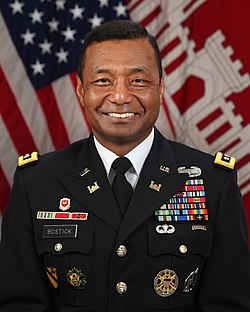
Thomas P. Bostick
View on Wikipedia |
Thomas Paul Bostick[1] (born September 23, 1956)[2] was the 53rd Chief of Engineers of the United States Army and Commanding General of the Army Corps of Engineers.[3][4] Since the creation of West Point in 1802 as the Nation's first engineering school, Bostick is the only African American graduate of the academy to serve as the Chief of Engineers and Commanding General of the U.S. Army Corps of Engineers.[3] Following his military career, Bostick served as the Chief Operating Officer and President of Intrexon Bioengineering (now Precigen). He serves on the Boards of CSX, Perma-Fix, Fidelity Investments' Equity and High Income Fund, HireVue, and Allonnia. He serves on the non-profit boards of Resilient Cities Catalyst and American Corporate Partners, a 501(c)(3) organization dedicated to assisting U.S. Veterans in their transition from the armed services to the civilian workforce. He is also a Forbes Contributor.
Key Information


Early life and education
[edit]Bostick was born on September 23, 1956, in Fukuoka, Japan and raised all over the world, in an Army family, as one of five children of Master Sergeant Sidney C. Bostick and Mrs. Fumiko M. Bostick. He graduated from the United States Military Academy (West Point) with a Bachelor of Science degree in June 1978. Bostick was the Captain of the 150-pound football team at West Point. He later earned a Master of Science degree in both civil and mechanical engineering from Stanford University in 1985. Bostick served as an associate professor of Mechanical Engineering at West Point. He also earned an MBA from Oxford University and a PhD from George Washington University in systems engineering in 2016. Bostick is a graduate of the Engineer Officer Basic and Advance courses, the U.S. Army Command and General Staff College, and the U.S. Army War College. He is a registered Professional Engineer in Virginia.
Career
[edit]Bostick was commissioned as a second lieutenant combat engineer officer after graduation from West Point. His initial assignment was to the 54th Engineer Battalion in Germany where he served as a Platoon Leader in A Company, as the Battalion Maintenance Officer, and as the B Company Commander. His company was selected as the company with the best maintenance program in the Army, and the company also won the US Army Europe Softball Championships. Bostick represented the Army in international competition as a member of the All-Army Powerlifting team in the 165-pound weight class.
Bostick served as an assistant professor of Mechanical Engineering at the United States Military Academy, as well as a White House Fellow, serving as a special assistant to the United States Secretary of Veterans Affairs. In 2015, Lt. General Bostick received the John W. Gardner Legacy of Leadership Award. This is the highest award presented by the White House Fellows Foundation and Association, given in recognition of proven leadership, dedicated public service, and sustained support to the White House Fellows Program. General Colin Powell, also a recipient of the Legacy of Leadership Award, presented the award to Lt. General Bostick at the 50th Anniversary of the White House Fellows program.

In 1990, Bostick served at the US Army Europe Headquarters in Heidelberg, Germany where he was responsible for helping to plan the drawdown of forces in Europe. He then served as the S3 of the 40th Engineer Battalion and later as the S3 of the 1st Armored Division Engineer Brigade. He served as the Executive Officer for the Chief of Engineers, Lt. General Arthur E. Williams, before assuming command of the 1st Engineer Battalion, 1st Infantry Division at Fort Riley, Kansas. His battalion fought fires in Idaho in 1994, and was considered to have one of the most successful performances for an engineer battalion at the National Training Center.
Bostick then commanded the Engineer Brigade in 1st Armored Division which included deployments to Bosnia and to Kosovo for some elements of the brigade. His brigade conducted the eleven ceremonies for the 55th Anniversary of the Normandy Invasion. Always encouraging his teams to compete and win, one of his companies won the Itschner Award as the Best Engineer Company in the Army, and the Sturgis Award for the best Engineer Non-Commissioned Officer in the Army.
He later served for two years as the Executive Officer of the Chief of Staff of the Army, General Eric K. Shinseki. Subsequently, he served in the National Military Command Center as a watch officer and was on duty for the September 11 attacks.
Assistant Division Commander (Maneuver and Support), 1st Cavalry Division
[edit]Bostick served as Assistant Division Commander for Maneuver and later as Assistant Division Commander for Support of the 1st Cavalry Division. He ensured the successful training and deployment into Iraq of more than 25,000 soldiers and their equipment.
Commander of the Gulf Region Division – Iraq
[edit]Subsequently, he commanded the Gulf Region Division in Iraq where he and his teams initiated over $11 billion of an $18 billion construction program in just one year. He formed successful teams where the USACE engineers were embedded with the combat maneuver units which greatly improved coordination and overall success.
Commander, U.S. Army Recruiting Command
[edit]After the Army failed its recruiting mission in 2005, Bostick was assigned as the Commanding General of U.S. Army Recruiting Command (USAREC). Through a number of innovative efforts Bostick made significant strategic changes in the command such as moving away from individual recruiting to team recruiting while focusing on the well-being of soldiers and families. He was part of the team that developed the new Army slogan, Army Strong. Army recruiting continued to achieve its mission for nearly the next decade.
Deputy Chief of Staff for Personnel (DCSPER), G-1, U.S. Army
[edit]As the Army's Chief Human Resources Officer, he was responsible for the policies that affected more than 1 million soldiers and 330 thousand civilians. He worked with the Army leadership on numerous key issues such as expanding opportunities for women, medical care for our returning troops, and religious accommodations for Sikhs. Bostick was also on the Comprehensive Review Group that made a recommendation to the Secretary of Defense and the President to allow gays and lesbians to serve openly in the military.
Chief of Engineers and Commanding General, U.S. Army Corps of Engineers
[edit]
As Chief of Engineers he led the management of over 3000 projects including: operations and maintenance of over $225B of water related infrastructure, large construction, and environmental and energy projects. He led over 34,000 employees in 43 Districts, seven Laboratories, and engaged in over 110 countries.
Bostick organized a highly talented and effective team after Superstorm Sandy completing projects as part of a $5B recovery program with all projects on time, under budget and of high quality.

In other projects, the Corps of Engineers obligated over $25B annually. During his tenure as Chief of Engineers, the Corps completed the $1.35B Inner Harbor Navigation Canal Borgne Surge Barrier in New Orleans. This was the largest design-build project in the 243-year history of the Corps, and it won the 2014 ASCE Most Outstanding Civil Engineering Achievement Award. Bostick worked with Congress, the Office of Management and Budget and the communities of Fargo-Moorhead to complete the first and only flood risk management Public Private Partnership.

Bostick has appeared on CNN, FOX News, CBS Evening News, CBS Sunday Morning, the Daily Show and more. He has spoken extensively on resilience including remarks at the United Nations, Risk Analysis World Congress in Singapore, and the National Academy of Sciences. In 2014, Bostick provided the commencement address at Tuskegee University, and he was awarded an honorary doctorate degree in engineering.
Post-military career
[edit].jpg)
Following his military career Bostick joined Intrexon Corporation serving as the Senior Vice President of the Environment Sector. In this role, Bostick oversaw the company's strategies and programs to deploy biologically based solutions for the protection and remediation of the environment. In November 2017, Intrexon announced the appointment of Bostick as Chief Operating Officer responsible for overseeing operations across the company's multiple technology divisions, driving efficiency and effectiveness in the application of the company's assets toward its development projects. In April 2019, Intrexon announced the appointment of Lt. General Bostick as the President of Intrexon Bioengineering. Intrexon Bioengineering seeks to address global challenges across food, agriculture, environmental, energy, and industrial fields by advancing biologically engineered solutions to improve sustainability and efficiency. Bostick departed Intrexon in February 2020 after helping to lead a major restructuring in the company.
In 2017, Lt. General Bostick was elected a member of the National Academy of Construction and the George Washington University School of Engineering and Applied Science Hall of Fame for his many contributions to engineering. He was also elected a member of the National Academy of Engineering in 2017 for development of new approaches to hurricane protection and for leadership of the US Army Corps of Engineers.

On February 12, 2021, Bostick was appointed to the Congressionally-mandated Commission on the Naming of Items of the Department of Defense that Commemorate the Confederate States of America or Any Person Who Served Voluntarily with the Confederate States of America.[5]
Bostick provided the 2023 commencement remarks at the George Washington University School of Engineering and Applied Science.
Awards and decorations
[edit]Bostick has been awarded the following decorations and badges:[3]
- Distinguished Service Medal
- Defense Superior Service Medal
- Legion of Merit (with two Oak Leaf Clusters)
- Bronze Star Medal
- Defense Meritorious Service Medal
- Meritorious Service Medal (with four Oak Leaf Clusters)
- Joint Service Commendation Medal
- Army Commendation Medal
- Army Achievement Medal (with Oak Leaf Cluster)
- Combat Action Badge
- United States Parachutist Badge
- Army Recruiter Badge
- Ranger Tab
- Joint Chiefs of Staff Identification Badge
- Army Staff Identification Badge
- Elected to the National Academy of Engineering (2017)
References
[edit]- ^ "Thomas Paul Bostick". West Point Association of Graduates. Retrieved April 16, 2022.
- ^ Register of Graduates and Former Cadets, United States Military Academy. West Point, New York: Association of Graduates U.S.M.A. 1989. p. 853. Retrieved April 16, 2022.
- ^ a b c "HEARINGS BEFORE THE COMMITTEE ON ARMED SERVICES UNITED STATES SENATE ONE HUNDRED TWELFTH CONGRESS SECOND SESSION ON NOMINATIONS OF ADM SAMUEL J. LOCKLEAR III, USN; LTG THOMAS P. BOSTICK, USA; HON. FRANK KENDALL III; HON. JAMES N. MILLER, JR.; HON. ERIN C. CONATON; MRS. JESSICA L. WRIGHT; MRS. KATHARINA G. McFARLAND; MS. HEIDI SHYU; DR. KATHLEEN H. HICKS; MR. DEREK H. CHOLLET; GEN. MARK A. WELSH III, USAF; LT.GEN. JOHN F. KELLY, USMC; LTG FRANK J. GRASS, ARNG; AND GEN. JOSEPH F. DUNFORD, JR., USMC" (PDF), NOMINATIONS BEFORE THE SENATE ARMED SERVICES COMMITTEE, SECOND SESSION, 112TH CONGRESS, 2013, S. HRG . 112–745, retrieved July 21, 2024
- ^ "Lieutenant General Thomas P. Bostick > Headquarters U.S. Army Corps of Engineers > Biography - Headquarters U.S. Army Corps of Engineers". Usace.army.mil. Archived from the original on May 30, 2012. Retrieved July 12, 2012.
- ^ Homan, Timothy R. (February 12, 2021). "Pentagon, Congress appoint panel members to rename Confederate base names". The Hill. Retrieved February 13, 2021.
External links
[edit]
Thomas P. Bostick
View on GrokipediaThomas P. Bostick (born September 23, 1956) is a retired United States Army lieutenant general and civil engineer who served as the 53rd Chief of Engineers and Commanding General of the U.S. Army Corps of Engineers (USACE) from 2012 to 2016.[1][2] A 1978 graduate of the United States Military Academy at West Point, Bostick earned master's degrees in civil and mechanical engineering from Stanford University and a PhD in systems engineering from George Washington University.[3] During his 38-year military career, Bostick held key leadership roles, including Director of Human Resources for the U.S. Army, where he managed personnel for over one million soldiers and civilians, and Commanding General of U.S. Army Recruiting Command, which introduced the "Army Strong" campaign to bolster enlistment efforts.[3] As Chief of Engineers, he directed a workforce of approximately 37,000 personnel executing a $25 billion annual program across civil works, military construction, and environmental missions in over 110 countries, including leading recovery efforts following Hurricane Sandy and achieving the first successful financial audit in USACE history.[3][4] Bostick, the only graduate of West Point to serve as Chief of Engineers of African descent, received decorations such as the Distinguished Service Medal and Legion of Merit for his contributions.[1][1] Following his retirement in 2016, Bostick transitioned to private sector executive positions, serving as Chief Operating Officer and President of Intrexon Bioengineering, where he oversaw restructuring and asset sales, and later as CEO of Bostick Global Strategies; he also holds board seats at companies including CSX Corporation and Perma-Fix Environmental Services.[3][5][6] Elected to the National Academy of Engineering, Bostick has been recognized for advancing engineering leadership and innovation in both public and private domains.[3]
Early life and education
Upbringing and family influences
Thomas P. Bostick was born on September 23, 1956, in Fukuoka, Japan, to a U.S. Army Master Sergeant father of African American descent and a mother of Japanese descent whom his father met after enlisting in the military.[7][8] As one of five children, Bostick grew up in a peripatetic Army family, relocating frequently across military installations worldwide, which exposed him to diverse cultural and operational environments from an early age.[7] His father's 26-year enlisted career, spanning from an era when military service offered African Americans pathways out of poverty and limited civilian opportunities, emphasized discipline, resilience, and commitment to national service as core family values.[8][9] This military household dynamic, marked by structured routines and paternal modeling of perseverance amid frequent transitions, cultivated Bostick's early appreciation for leadership and collective problem-solving, though his specific career motivations crystallized later in adolescence.[1]United States Military Academy and early academic roles
Bostick entered the United States Military Academy (USMA) at West Point, New York, where he underwent rigorous training in military discipline, leadership, and engineering fundamentals as part of the Army's officer commissioning program. He graduated in 1978 with a Bachelor of Science degree, commissioning as a second lieutenant in the U.S. Army Corps of Engineers.[4][1] Following his West Point graduation, Bostick advanced his engineering expertise through graduate studies, earning Master of Science degrees in both civil engineering and mechanical engineering from Stanford University in 1985. These degrees provided specialized knowledge in structural analysis, fluid dynamics, and systems design, aligning with the technical demands of military engineering roles.[2][1] In an early academic capacity, Bostick served as an associate professor of mechanical engineering at the USMA, where he instructed cadets on core principles such as thermodynamics, materials science, and mechanical systems. His tenure emphasized practical applications of engineering to military problem-solving, contributing to the academy's curriculum that integrates theoretical rigor with hands-on cadet training.[10][7]Military career
Initial assignments and combat engineering roles
Upon graduating from the United States Military Academy at West Point in 1978, Bostick was commissioned as a second lieutenant in the U.S. Army Corps of Engineers, specializing as a combat engineer officer.[1] His initial assignment was with the 54th Engineer Battalion in Germany, where he served in various operational roles including platoon leader, battalion maintenance officer, and company commander.[1][11] These positions focused on tactical combat engineering tasks, such as constructing mobility infrastructure, conducting route reconnaissance, and supporting armored maneuvers through obstacle breaching and fortification efforts in training and field exercises.[12] As he progressed through the ranks of captain and major, Bostick continued emphasizing combat engineering proficiency, managing engineer assets for rapid deployment and sustainment in European theater operations.[1] In 1990, he was assigned to U.S. Army Europe Headquarters in Heidelberg, Germany, contributing to planning the post-Cold War drawdown of U.S. forces across the continent.[1] He subsequently served as an engineer operations staff officer with the First Armored Division in Baumholder and Bad Kreuznach, Germany, where his responsibilities included coordinating engineer support for division-level maneuvers, enhancing tactical mobility, and preparing infrastructure for potential contingency operations amid rising tensions in the Middle East.[1] This role positioned him during the Gulf War era, as the division mobilized elements for Operations Desert Shield and Desert Storm, underscoring the integration of combat engineering in armored force projection and sustainment.[1]Division and regional command positions
Bostick served as Assistant Division Commander for Maneuver and Support of the 1st Cavalry Division at Fort Hood, Texas, where he integrated combat engineering operations into the division's maneuver elements to enhance mobility, countermobility, and survivability during training and operations.[2] In this role, he oversaw the synchronization of engineer assets with armored and infantry units, ensuring rapid obstacle breaching, route clearance, and fortification construction to support large-scale maneuvers.[13] During the division's deployment to Iraq in support of Operation Iraqi Freedom, Bostick acted as second-in-command, directing the movement of over 25,000 soldiers and their equipment into theater, which streamlined logistics flows and bolstered forward operating base defenses through prepositioned engineering resources.[3] This deployment coordination reduced transit vulnerabilities and enabled sustained maneuver operations across central Iraq, contributing to improved tactical responsiveness amid insurgent threats.[4] Following this assignment, Bostick commanded the Gulf Region Division of the U.S. Army Corps of Engineers in Iraq, overseeing a portfolio of reconstruction projects valued at approximately $18 billion amid persistent insurgency and logistical disruptions.[5] He restructured the division's faltering construction efforts, raising funding obligations from $1.5 billion to over $11 billion within one year, which accelerated infrastructure repairs including roads, bridges, and facilities critical for civilian stabilization and military sustainment.[3] These initiatives directly enhanced base security by fortifying perimeters and improved logistics through restored supply routes, mitigating ambush risks and enabling more efficient troop rotations.[14]Recruiting and personnel leadership
As commanding general of the U.S. Army Recruiting Command from August 2005 to July 2007, Bostick addressed a recruitment crisis amid the Iraq War, where the Army faced shortfalls of approximately 7,200 recruits (13 percent below target) as of July 2005.[15] Under his leadership, the Army implemented expanded recruiter networks and incentive adjustments, achieving the fiscal year 2006 active-duty enlistment goal of 80,000 soldiers after prior misses.[16] This marked a reversal from earlier deficits, with enlistments stabilizing through data-informed strategies targeting high school graduates and prior-service candidates, though challenges persisted in maintaining quality standards amid growing force size goals toward 74,000 additional soldiers by 2010.[17] Subsequently, as deputy chief of staff for personnel (G-1) from 2010 to 2012, Bostick oversaw human capital policies for 1.1 million soldiers and over 300,000 civilians, emphasizing talent management during post-surge drawdowns.[18] He directed the Qualitative Service Program, launched in 2012, to selectively retain high-performing non-commissioned officers and shape the force by identifying deployable talent, aiming to mitigate a projected non-deployable rate rising to 16 percent by 2012 in brigade combat teams.[19] [20] Bostick also contributed to the comprehensive review recommending repeal of the Don't Ask, Don't Tell policy, which Congress enacted in December 2010, facilitating integration of previously restricted personnel without reported disruptions to unit cohesion based on subsequent Army assessments.[8] These roles prioritized empirical metrics, such as enlistment fulfillment rates exceeding 100 percent in fiscal year 2008 for active components under lingering Recruiting Command influences, and retention enhancements through targeted evaluations that preserved experienced leaders amid reductions.[21] Overall, Bostick's oversight correlated with Army-wide improvements in accession quality, including higher Armed Forces Qualification Test scores post-reforms, though external factors like economic conditions contributed to rebounding volunteerism.[22]Tenure as Chief of Engineers
Organizational leadership and strategic initiatives
Lieutenant General Thomas P. Bostick assumed command as the 53rd Chief of Engineers and Commanding General of the U.S. Army Corps of Engineers (USACE) on May 22, 2012, succeeding Lieutenant General Robert L. Van Antwerp Jr.[23] In this role, he directed a workforce of approximately 700 soldiers and 35,000 civilians managing an annual program exceeding $25 billion across civil works, military construction, and operations in over 110 countries.[3] As the first graduate of the United States Military Academy at West Point to lead USACE as an African American, Bostick emphasized leveraging the organization's technical expertise to deliver engineering solutions for national challenges.[1][2] Bostick's strategic vision positioned USACE as a multifaceted national asset: enhancing public value through environmental stewardship, water resources management, and sustainable infrastructure; serving as a Department of Defense enabler for military facilities; and maintaining professional excellence via robust technical capabilities.[13] He outlined four core priorities—supporting warfighters, transforming civil works programs, reducing disaster risks, and preparing for future demands—to align with national security strategies and departmental goals.[13] This framework guided high-level direction for civil works modernization, military infrastructure support (including operations in Afghanistan and Central Command), and international engineering engagements.[13] Under Bostick's leadership, USACE pursued internal reforms to counter bureaucratic challenges, including the development of a comprehensive Strategic Vision and Implementation Plan to enhance organizational accountability and adaptability.[24] The FY 2013–2018 Campaign Plan further institutionalized these efforts, emphasizing performance metrics, strategic responsiveness, and streamlined processes to improve efficiency in regulatory and operational functions. Initiatives focused on transforming the civil works business model prioritized empirical measures of responsiveness, customer satisfaction, and resource allocation over entrenched procedures.[13] Bostick advanced innovation in resilient infrastructure by promoting energy security, efficiency, and renewable integration within engineering practices, while fostering talent development through targeted leader training and human capital strategies.[13] He underscored people as the Corps' core strength, implementing reforms that elevated employee satisfaction rankings, positioning USACE as the most improved federal agency in this metric during his tenure.[13][3] These efforts achieved milestones such as a successful agency-wide financial audit, a rarity among federal entities, demonstrating fiscal discipline and operational rigor.[3] Bostick retired from the position in 2014 after two years of service.[2]Infrastructure and environmental projects
As Chief of Engineers from May 2012 to June 2016, Thomas P. Bostick directed the U.S. Army Corps of Engineers (USACE) in advancing infrastructure projects that integrated flood control with environmental restoration, prioritizing engineered solutions to safeguard human settlements and economic assets against natural hazards. These efforts built on post-Hurricane Katrina (2005) lessons, reinforcing levees and coastal barriers to mitigate flood risks while restoring habitats, with empirical outcomes including preserved wetland acres that buffer storm surges and support navigation channels critical to commerce.[25][26] A flagship project under Bostick's oversight was the Louisiana Coastal Area (LCA) Barataria Basin Barrier Shoreline Restoration, for which he signed the Chief's Report in early 2013, authorizing restoration of approximately 2,839 acres of barrier islands, shorelines, dunes, and marshes across Jefferson, Lafourche, and Plaquemines parishes. This initiative aimed to rebuild eroded barriers eroded by storms and subsidence, providing natural flood defenses estimated to yield billions in annual economic value through wetland-mediated surge reduction and habitat support for fisheries. Construction features included sediment nourishment and vegetative planting, with causal benefits including diminished wave energy impacts on inland infrastructure, though the project's scale invited scrutiny over long-term sediment sourcing and maintenance costs exceeding initial projections.[27][25][28] In the Everglades, Bostick personally inspected the Tamiami Trail Modifications project on October 10, 2012, an $81 million component of the Modified Water Deliveries to Everglades National Park authorized under the Comprehensive Everglades Restoration Plan. The effort involved bridging 2.6 miles of U.S. Highway 41 (Tamiami Trail) and removing road embankments to restore pre-drainage sheetflow patterns, enabling over 300 cubic feet per second of additional freshwater into Shark River Slough and potentially rehabilitating 6,500 acres of wetlands by reducing hydroperiod disruptions. This engineering adjustment prioritized hydrologic restoration for ecological productivity while maintaining transportation corridors, yielding measurable gains in wading bird populations and sawgrass expansion as indicators of improved causal linkages between flow regimes and habitat viability, despite debates on unintended salinity shifts in downstream bays.[29][30] Bostick also stewarded Mississippi River flood control infrastructure through the Mississippi River and Tributaries (MR&T) Project, overseeing levee reinforcements, channel maintenance, and habitat initiatives like island construction in the Upper Mississippi River National Wildlife and Fish Refuge, completed during his tenure to enhance fish spawning and bird nesting while sustaining 500 million tons of annual commercial navigation tonnage. These measures, including backwater levee upgrades post-2011 floods, reduced projected flood damages by an estimated $13 billion over project lifetimes through risk-informed design, underscoring a pragmatic emphasis on resilient infrastructure that curtails economic disruptions over absolute ecological preservation.[31][32]Disaster response and resilience efforts
During his tenure as Chief of Engineers, Lieutenant General Thomas P. Bostick directed the U.S. Army Corps of Engineers' (USACE) immediate response to Hurricane Sandy, which struck the northeastern United States on October 29, 2012, causing widespread flooding and infrastructure damage estimated at over $65 billion. USACE teams, under Bostick's oversight, mobilized rapidly to support the Federal Emergency Management Agency (FEMA), deploying engineering personnel and equipment for emergency debris removal operations across New York and New Jersey, where storm surges generated millions of cubic yards of wreckage from homes, vehicles, and coastal structures.[33][34][35] Bostick emphasized forward-leaning coordination between military engineers and civilian agencies, visiting North Atlantic Division headquarters on November 3, 2012, to commend deployed personnel and ensure seamless integration under the National Response Framework. This effort included constructing temporary berms and reinforcing dunes along vulnerable New York and New Jersey shorelines to mitigate ongoing tidal threats and facilitate access for recovery teams, with initial contracts awarded for $92 million in New York debris management alone. Such measures contributed to averting additional economic losses by stabilizing critical areas, as evidenced by post-storm coastal projects that later demonstrated $1.3 billion in avoided damages through enhanced barriers.[36][37][38] Bostick advocated for resilience-building in recovery phases, co-hosting a 2013 Senior Leaders Seminar with FEMA Administrator Craig Fugate to refine interagency protocols for future crises, focusing on rapid asset deployment and predictive assessments of flood risks to minimize casualties and prolong-term disruptions. USACE's Sandy operations, including debris reuse and berm fortifications, exemplified causal effectiveness in reducing secondary hazards, with Bostick testifying in November 2013 that $5.35 billion in appropriations sufficed for comprehensive relief, underscoring data-driven modeling to quantify risk reductions in fortified zones.[33][39][38]Criticisms of Corps decisions and legal challenges
During Bostick's tenure as Chief of Engineers from 2012 to 2016, the U.S. Army Corps of Engineers (USACE) faced multiple lawsuits from environmental advocacy groups challenging its issuance of permits under the Clean Water Act for activities in wetlands, including those linked to oil and gas development. Critics contended that the Corps prioritized economic development over ecological protection by relying on nationwide and general permits that allegedly bypassed rigorous individual environmental reviews, potentially allowing cumulative degradation of sensitive habitats. For instance, in Atchafalaya Basinkeeper v. Bostick (filed 2014, appealed to the Fifth Circuit in 2015–2016), plaintiffs including Atchafalaya Basinkeeper and the Louisiana Crawfish Producers Association sued over the Corps' 2012 authorization of a general permit for a ring levee and access road in the Atchafalaya Basin wetlands, arguing it facilitated industrial access without sufficient analysis of impacts on hydrology, fisheries, and biodiversity under Section 404 of the Clean Water Act.[40][41] The U.S. District Court for the Eastern District of Louisiana denied the plaintiffs' motions for reconsideration and summary judgment in 2015, affirming the Corps' determination that the project qualified for streamlined permitting due to minimal individual and cumulative adverse effects after mitigation.[42] The Fifth Circuit's 2016 opinion upheld this, rejecting claims of arbitrary decision-making and emphasizing deference to the Corps' expertise in balancing wetland preservation with infrastructure needs.[40] Similarly, in Sierra Club v. Bostick (2015), environmental groups challenged the Corps' verification of Nationwide Permit 12 for segments of the Keystone XL pipeline crossing over 2,000 waterways, alleging violations of the National Environmental Policy Act and inadequate impact assessments.[43] The Tenth Circuit affirmed the district court's ruling in favor of the Corps, validating the use of nationwide permits for de minimis discharges and deferral of project-specific reviews where conditions ensured negligible harm.[43] These cases exemplified broader tensions, with environmental litigants highlighting risks to wetland ecosystems vital for flood control and biodiversity—evidenced by Louisiana's historical loss of over 1,900 square miles of coastal wetlands since the 1930s—while Corps defenders, supported by court deference, argued that permit frameworks incorporated empirical cost-benefit evaluations favoring resilient infrastructure for energy security and regional economies, with required mitigations like compensatory restoration offsetting localized impacts.[43] Outcomes across such challenges under Bostick largely upheld USACE decisions, indicating legal alignment with statutory standards, though critics persisted in asserting systemic underestimation of long-term ecological costs in favor of pragmatic engineering priorities.[40][43]Post-military career
Corporate executive positions
Following his retirement from the U.S. Army in July 2016, Bostick entered the private sector as Chief Operating Officer of Intrexon Corporation (NASDAQ: XON), a biotechnology firm specializing in synthetic biology and genetic engineering technologies.[44][3] In this role, he managed operations for three health-focused business units and oversaw the integration of advanced R&D capabilities to develop applications in industrial processes, defense-related materials, and therapeutic interventions.[3] Bostick advanced to President of Intrexon Bioengineering in 2019, directing six bioengineering and research divisions with a workforce exceeding 1,000 personnel, including approximately 700 holding Ph.D. or master's degrees.[3] His leadership emphasized scaling synthetic biology platforms from laboratory prototypes to commercial deployment, particularly for resilient supply chain solutions and engineered microbes tailored to defense and industrial needs, resulting in expanded patent portfolios and partnerships for technology transfer.[3] Drawing on his military background in large-scale engineering projects, Bostick implemented strategies for organizational agility, prioritizing talent retention and cross-functional innovation to navigate market volatility in the biotech sector. In parallel with his Intrexon tenure, Bostick founded Bostick Global Strategies LLC in June 2016, assuming the role of CEO to deliver executive coaching, strategic advisory, and engineering consulting services to corporate and government clients.[47][48] The firm focuses on enhancing operational resilience through customized programs in leadership development and infrastructure optimization, leveraging Bostick's expertise to drive measurable improvements in team performance and risk mitigation for clients in engineering-intensive industries.[48]Board memberships and advisory roles
Bostick serves as a director on the board of CSX Corporation, a major railroad and logistics company, where his engineering and infrastructure expertise informs strategic decisions on network investments and operational resilience.[44][6] Appointed leveraging his prior leadership in large-scale military infrastructure projects, he contributes to oversight of supply chain enhancements and environmental sustainability initiatives critical to rail transport efficiency.[44] In June 2020, Bostick joined the board of HireVue, an AI-driven talent assessment platform, advising on recruitment strategies informed by his experience managing Army personnel systems.[49] His input emphasizes skills-based hiring practices to match candidates' capabilities with organizational needs, drawing from federal and corporate talent acquisition challenges.[49] Bostick holds a position on the board of directors of American Corporate Partners, a nonprofit organization facilitating one-on-one mentoring pairings between corporate executives and transitioning military veterans to support career development in civilian sectors.[5][50] Through this role, he advances programs that leverage private sector guidance to address employment barriers faced by service members entering business environments.[5] The enduring influence of Bostick's governance contributions was acknowledged in 2024 with the West Point Association of Graduates' Distinguished Graduate Award, which recognizes alumni for exemplary post-commissioning leadership across public and private domains.[51]Publications and public advocacy
Bostick authored Winning After Losing: Building Resilient Teams in 2021, applying lessons from organizational challenges to foster adaptive leadership and empirical strategies for overcoming failures in team performance.[52] The book emphasizes data-informed talent allocation and resilience metrics, drawing on quantifiable outcomes from high-stakes environments to advocate scalable models for private-sector and institutional applications.[53] As a Forbes contributor focusing on business leadership and resilience, Bostick has published op-eds promoting policy reforms grounded in competitive realities. In "Regulatory Reform To Boost U.S. Innovation And National Security" on April 24, 2025, he critiqued overregulation's drag on biotechnology, citing the 20-year FDA delay for AquAdvantage Salmon despite 30+ studies confirming safety and nutritional equivalence to conventional salmon, arguing this cedes ground to adversaries like China pursuing rapid commercialization.[54] He called for streamlined approvals prioritizing empirical evidence over precautionary stasis to safeguard national security interests in critical technologies.[54] Bostick advocates talent management frameworks emphasizing meritocratic recruitment and measurable outcomes, extending Army-derived successes to civilian sectors. His July 6, 2025, Forbes article "How A Top Public School Develops STEM Talent And Leadership" highlighted the High School for Mathematics, Science and Engineering's model, where a selective admissions process yielding 100% college attendance and averages of 99th percentile SAT scores demonstrates the efficacy of rigorous, data-backed pipelines over generalized access initiatives.[55] On engineering resilience, Bostick's 2018 co-authored paper "Resilience Science, Policy and Investment for Civil Infrastructure" urged investments aligned with probabilistic risk modeling and empirical vulnerability data, rather than policy skewed by non-quantified ideological priorities, to optimize infrastructure against disruptions like natural disasters. This approach informs his broader commentary favoring causal, evidence-based sustainability in public works over unsubstantiated environmental mandates.[56]Personal perspectives
Encounters with institutional racism
In a July 10, 2020, opinion piece for CNN, retired Lt. Gen. Thomas P. Bostick recounted personal experiences of racial bias encountered during his 38-year career as an African American officer in the U.S. Army, emphasizing instances of unequal treatment that he attributed to institutional racism.[57] Bostick described being subjected to derogatory comments and skepticism about his qualifications based on race, including early in his career when superiors questioned his West Point pedigree and leadership potential solely due to his ethnicity, despite strong performance evaluations. He highlighted a specific pattern of slower promotion timelines for Black officers compared to white peers with similar records, noting that such disparities contributed to his own extended time in lower ranks before advancing to command positions.[57] These accounts were contextualized by Bostick within broader Army challenges, where empirical data from his era showed persistent underrepresentation of African Americans in senior officer roles; for instance, in 2013, only two Black officers were promoted to brigadier general across the entire Army, reflecting limited upward mobility despite integration efforts post-1948.[58] During Bostick's tenure in personnel-related roles, including as Assistant Deputy Chief of Staff G-1, the Army implemented reforms aimed at merit-based talent management to address these gaps, such as enhanced diversity training and objective evaluation criteria, which correlated with incremental increases in minority officer retention but not yet proportional promotions.[59] [48] Army demographics indicated African Americans comprised about 17% of enlisted personnel but only 11% of officers by the early 2010s, underscoring structural barriers that required exceptional merit to overcome for flag-rank advancement.[60] Bostick's trajectory—from platoon leader in the 1980s to commanding general of U.S. Army Europe in 2008 and Chief of Engineers from 2010 to 2016—demonstrated how rigorous performance and strategic assignments enabled breakthroughs amid these obstacles, as evidenced by his selection for high-visibility roles like the 1st Cavalry Division command in 2005, independent of affirmative action quotas. This merit-driven ascent counters narratives of systemic favoritism, as promotion boards prioritized quantifiable achievements like combat deployments and engineering expertise over demographic considerations, per Army personnel policies emphasizing leader competency. Reforms under his influence, including data-driven assessments, facilitated modest diversity gains without diluting standards, aligning with causal factors of individual excellence propelling select officers past institutional inertia.[2] [59]Philosophy on leadership and talent management
Bostick advocates building organizations around high-caliber individuals by prioritizing the recruitment, development, and retention of top talent to drive mission success and innovation. Drawing from his tenure as commander of U.S. Army Recruiting Command, where he oversaw significant growth in enlistments through targeted personnel strategies, he emphasizes that effective talent management requires embedding these principles throughout the organization rather than confining them to senior leaders.[61][59] In discussions on Army reforms, Bostick has endorsed talent management initiatives as essential for adapting to future challenges, though he notes implementation hurdles stemming from entrenched cultural norms that favor uniformity over individualized merit assessment.[62] Central to his approach is fostering resilience in teams, viewing leadership as the capacity to recover from setbacks by adapting rather than rigidly adhering to initial plans. In his 2021 book Winning After Losing: Building Resilient Teams, Bostick distills career-derived lessons on turning operational failures into strengths through empirical evaluation of outcomes, such as post-disaster recovery metrics in engineering contexts, rather than abstract ideological frameworks.[52] This philosophy extends to corporate roles, where he applied similar methods at Intrexon Bioengineering to streamline regulatory processes and accelerate biotech innovation by aligning skilled personnel with high-impact projects.[63] Bostick stresses meritocratic evaluation in talent decisions, arguing that retaining competent, innovative leaders hinges on performance-based incentives over generalized equity measures, as evidenced by his efforts to invest in adaptive personnel during Army Corps transformations.[64] He critiques overly bureaucratic systems that hinder agility, advocating streamlined approaches grounded in measurable results like recruitment yields and project delivery timelines to cultivate enduring organizational strength.[65]Awards and honors
Military decorations
Bostick's military decorations include the Distinguished Service Medal with one oak leaf cluster, awarded for exceptionally meritorious service in positions of great responsibility, including his tenure as Chief of Engineers.[66] He also received the Defense Superior Service Medal for superior performance in joint service roles.[66] Further awards encompass the Legion of Merit with two oak leaf clusters, recognizing outstanding leadership in command and staff positions; the Bronze Star Medal with two oak leaf clusters, earned for meritorious achievement during deployments including Operation Iraqi Freedom where he oversaw reconstruction efforts as commander of the Gulf Region Division from 2004 to 2006; the Defense Meritorious Service Medal; and the Meritorious Service Medal with four oak leaf clusters.[66][5] Additional decorations comprise the Joint Service Commendation Medal, the Army Commendation Medal with one oak leaf cluster, the Army Achievement Medal, along with various service ribbons and foreign awards reflecting combat support, engineering operations, and international cooperation.[66]Civilian and institutional recognitions
In 2024, Bostick was selected as one of six recipients of the Distinguished Graduate Award by the West Point Association of Graduates, an honor bestowed annually on alumni of the U.S. Military Academy who have rendered distinguished service to the nation in their post-commissioning careers.[67] The award, presented on May 21, 2024, at West Point, acknowledged Bostick's leadership in engineering innovation, resilience-building initiatives, and mentorship, which have influenced infrastructure policy and veteran support programs beyond his military tenure.[51] Bostick received the Gold de Fleury Medal, the highest recognition of the U.S. Army Engineer Regiment, in August 2025 during the U.S. Army Corps of Engineers' 250th anniversary gala.[68] Presented by Lt. Gen. William H. Graham, the 56th Chief of Engineers, the medal cited Bostick's 38-year career contributions to engineering resilience, infrastructure development, and institutional leadership, including measurable advancements in flood risk management and adaptive infrastructure strategies that informed post-retirement policy advocacy.[69] These recognitions underscore Bostick's sustained impact on engineering institutions and veteran networks, evidenced by his advisory roles in organizations like Blue Star Families, where his expertise has supported programs aiding military family resilience and transition, drawing on empirical outcomes from his prior command of large-scale infrastructure projects.[70]References
- https://www.[linkedin](/page/LinkedIn).com/in/bostickglobalstrategies
- https://www.[forbes](/page/Forbes).com/sites/thomasbostick/