
Hubbry Logo
Simultaneous equations modelSimultaneous equations modelMain
Open search
Simultaneous equations model
Community hub
Simultaneous equations model
logo
7 pages, 0 posts
0 subscribers
Be the first to start a discussion here.
Simultaneous equations model
from Wikipedia

Simultaneous equations models are a type of statistical model in which the dependent variables are functions of other dependent variables, rather than just independent variables.[1] This means some of the explanatory variables are jointly determined with the dependent variable, which in economics usually is the consequence of some underlying equilibrium mechanism. Take the typical supply and demand model: whilst typically one would determine the quantity supplied and demanded to be a function of the price set by the market, it is also possible for the reverse to be true, where producers observe the quantity that consumers demand and then set the price.[2]

Simultaneity poses challenges for the estimation of the statistical parameters of interest, because the Gauss–Markov assumption of strict exogeneity of the regressors is violated. And while it would be natural to estimate all simultaneous equations at once, this often leads to a computationally costly non-linear optimization problem even for the simplest system of linear equations.[3] This situation prompted the development, spearheaded by the Cowles Commission in the 1940s and 1950s,[4] of various techniques that estimate each equation in the model seriatim, most notably limited information maximum likelihood and two-stage least squares.[5]

Structural and reduced form

[edit]

Suppose there are m regression equations of the form

where i is the equation number, and t = 1, ..., T is the observation index. In these equations xit is the ki×1 vector of exogenous variables, yit is the dependent variable, y−i,t is the ni×1 vector of all other endogenous variables which enter the ith equation on the right-hand side, and uit are the error terms. The “−i” notation indicates that the vector y−i,t may contain any of the y’s except for yit (since it is already present on the left-hand side). The regression coefficients βi and γi are of dimensions ki×1 and ni×1 correspondingly. Vertically stacking the T observations corresponding to the ith equation, we can write each equation in vector form as

where yi and ui are 1 vectors, Xi is a T×ki matrix of exogenous regressors, and Y−i is a T×ni matrix of endogenous regressors on the right-hand side of the ith equation. Finally, we can move all endogenous variables to the left-hand side and write the m equations jointly in vector form as

This representation is known as the structural form. In this equation Y = [y1 y2 ... ym] is the T×m matrix of dependent variables. Each of the matrices Y−i is in fact an ni-columned submatrix of this Y. The m×m matrix Γ, which describes the relation between the dependent variables, has a complicated structure. It has ones on the diagonal, and all other elements of each column i are either the components of the vector −γi or zeros, depending on which columns of Y were included in the matrix Y−i. The T×k matrix X contains all exogenous regressors from all equations, but without repetitions (that is, matrix X should be of full rank). Thus, each Xi is a ki-columned submatrix of X. Matrix Β has size k×m, and each of its columns consists of the components of vectors βi and zeros, depending on which of the regressors from X were included or excluded from Xi. Finally, U = [u1 u2 ... um] is a T×m matrix of the error terms.

Postmultiplying the structural equation by Γ −1, the system can be written in the reduced form as

This is already a simple general linear model, and it can be estimated for example by ordinary least squares. Unfortunately, the task of decomposing the estimated matrix into the individual factors Β and Γ −1 is quite complicated, and therefore the reduced form is more suitable for prediction but not inference.

Assumptions

[edit]

Firstly, the rank of the matrix X of exogenous regressors must be equal to k, both in finite samples and in the limit as T → ∞ (this later requirement means that in the limit the expression should converge to a nondegenerate k×k matrix). Matrix Γ is also assumed to be non-degenerate.

Secondly, error terms are assumed to be serially independent and identically distributed. That is, if the tth row of matrix U is denoted by u(t), then the sequence of vectors {u(t)} should be iid, with zero mean and some covariance matrix Σ (which is unknown). In particular, this implies that E[U] = 0, and E[U′U] = T Σ.

Lastly, assumptions are required for identification.

Identification

[edit]

The identification conditions require that the system of linear equations be solvable for the unknown parameters.

More specifically, the order condition, a necessary condition for identification, is that for each equation ki + ni ≤ k, which can be phrased as “the number of excluded exogenous variables is greater or equal to the number of included endogenous variables”.

The rank condition, a stronger condition which is necessary and sufficient, is that the rank of Πi0 equals ni, where Πi0 is a (k − kini matrix which is obtained from Π by crossing out those columns which correspond to the excluded endogenous variables, and those rows which correspond to the included exogenous variables.

Using cross-equation restrictions to achieve identification

[edit]

In simultaneous equations models, the most common method to achieve identification is by imposing within-equation parameter restrictions.[6] Yet, identification is also possible using cross equation restrictions.

To illustrate how cross equation restrictions can be used for identification, consider the following example from Wooldridge[6]

where z's are uncorrelated with u's and y's are endogenous variables. Without further restrictions, the first equation is not identified because there is no excluded exogenous variable. The second equation is just identified if δ13≠0, which is assumed to be true for the rest of discussion.

Now we impose the cross equation restriction of δ12=δ22. Since the second equation is identified, we can treat δ12 as known for the purpose of identification. Then, the first equation becomes:

Then, we can use (z1, z2, z3) as instruments to estimate the coefficients in the above equation since there are one endogenous variable (y2) and one excluded exogenous variable (z2) on the right hand side. Therefore, cross equation restrictions in place of within-equation restrictions can achieve identification.

Estimation

[edit]

Two-stage least squares (2SLS)

[edit]

The simplest and the most common estimation method for the simultaneous equations model is the so-called two-stage least squares method,[7] developed independently by Theil (1953) and Basmann (1957).[8][9][10] It is an equation-by-equation technique, where the endogenous regressors on the right-hand side of each equation are being instrumented with the regressors X from all other equations. The method is called “two-stage” because it conducts estimation in two steps:[7]

Step 1: Regress Y−i on X and obtain the predicted values ;
Step 2: Estimate γi, βi by the ordinary least squares regression of yi on and Xi.

If the ith equation in the model is written as

where Zi is a (ni + ki) matrix of both endogenous and exogenous regressors in the ith equation, and δi is an (ni + ki)-dimensional vector of regression coefficients, then the 2SLS estimator of δi will be given by[7]

where P = X (X ′X)−1X ′ is the projection matrix onto the linear space spanned by the exogenous regressors X.

Indirect least squares

[edit]

Indirect least squares is an approach in econometrics where the coefficients in a simultaneous equations model are estimated from the reduced form model using ordinary least squares.[11][12] For this, the structural system of equations is transformed into the reduced form first. Once the coefficients are estimated the model is put back into the structural form.

Limited information maximum likelihood (LIML)

[edit]

The “limited information” maximum likelihood method was suggested by M. A. Girshick in 1947,[13] and formalized by T. W. Anderson and H. Rubin in 1949.[14] It is used when one is interested in estimating a single structural equation at a time (hence its name of limited information), say for observation i:

The structural equations for the remaining endogenous variables Y−i are not specified, and they are given in their reduced form:

Notation in this context is different than for the simple IV case. One has:

  • : The endogenous variable(s).
  • : The exogenous variable(s)
  • : The instrument(s) (often denoted )

The explicit formula for the LIML is:[15]

where M = I − X (X ′X)−1X ′, and λ is the smallest characteristic root of the matrix:

where, in a similar way, Mi = I − Xi (XiXi)−1Xi.

In other words, λ is the smallest solution of the generalized eigenvalue problem, see Theil (1971, p. 503):

K class estimators

[edit]

The LIML is a special case of the K-class estimators:[16]

with:
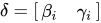
Several estimators belong to this class:

  • κ=0: OLS
  • κ=1: 2SLS. Note indeed that in this case, the usual projection matrix of the 2SLS
  • κ=λ: LIML
  • κ=λ - α / (n-K): Fuller (1977) estimator.[17] Here K represents the number of instruments, n the sample size, and α a positive constant to specify. A value of α=1 will yield an estimator that is approximately unbiased.[16]

Three-stage least squares (3SLS)

[edit]

The three-stage least squares estimator was introduced by Zellner & Theil (1962).[18][19] It can be seen as a special case of multi-equation GMM where the set of instrumental variables is common to all equations.[20] If all regressors are in fact predetermined, then 3SLS reduces to seemingly unrelated regressions (SUR). Thus it may also be seen as a combination of two-stage least squares (2SLS) with SUR.

Applications in social science

[edit]

Across fields and disciplines simultaneous equation models are applied to various observational phenomena. These equations are applied when phenomena are assumed to be reciprocally causal. The classic example is supply and demand in economics. In other disciplines there are examples such as candidate evaluations and party identification[21] or public opinion and social policy in political science;[22][23] road investment and travel demand in geography;[24] and educational attainment and parenthood entry in sociology or demography.[25] The simultaneous equation model requires a theory of reciprocal causality that includes special features if the causal effects are to be estimated as simultaneous feedback as opposed to one-sided 'blocks' of an equation where a researcher is interested in the causal effect of X on Y while holding the causal effect of Y on X constant, or when the researcher knows the exact amount of time it takes for each causal effect to take place, i.e., the length of the causal lags. Instead of lagged effects, simultaneous feedback means estimating the simultaneous and perpetual impact of X and Y on each other. This requires a theory that causal effects are simultaneous in time, or so complex that they appear to behave simultaneously; a common example are the moods of roommates.[26] To estimate simultaneous feedback models a theory of equilibrium is also necessary – that X and Y are in relatively steady states or are part of a system (society, market, classroom) that is in a relatively stable state.[27]

See also

[edit]

References

[edit]

Further reading

[edit]
[edit]
Revisions and contributorsEdit on WikipediaRead on Wikipedia
from Grokipedia
A simultaneous equations model (SEM) is a statistical framework in comprising a that jointly determine multiple endogenous variables, capturing interdependencies within economic systems such as interactions. Unlike single-equation models, SEMs account for mutual causation among variables, where explanatory factors include both exogenous variables and other endogenous ones, necessitating specialized estimation to address biases from correlated errors. The development of SEMs emerged from early 20th-century efforts to resolve identification challenges in estimating economic relationships, such as distinguishing supply from demand curves, as highlighted in works by agricultural economists like Holbrook Working in 1925. The formalization occurred during the and at the Cowles Commission, under leaders like Jacob Marschak and , who addressed stochastic simultaneity through foundational monographs introducing concepts like identification conditions and methods such as indirect (ILS), limited-information maximum likelihood (LIML), and full-information maximum likelihood (FIML). Pioneering applications include Lawrence Klein's Model I (1950), a Keynesian-inspired of six equations modeling U.S. fluctuations from 1921–1941 data, and the Klein-Goldberger model (1955) with 20 equations describing macroeconomic dynamics. These advancements shifted from purely correlational analysis to structural modeling of causal mechanisms. Central to SEMs is the identification problem, which ensures that structural parameters can be uniquely recovered from reduced-form s via order and rank conditions—for instance, an requires at least as many exclusions as endogenous variables minus one (order condition). Ordinary (OLS) fails due to endogeneity, yielding inconsistent estimates, prompting innovations like two-stage (2SLS), independently proposed by Henri Theil (1953) and R.L. Basmann (1957), which uses variables to purge correlations in the first stage before OLS application. Advanced techniques include three-stage (3SLS) for system-wide (Zellner and Theil, 1962) and simulation-based methods like maximum simulated likelihood for nonlinear extensions. While SEMs dominated mid-20th-century macroeconometric modeling—exemplified by large-scale systems like the Brookings-SSRC model (1965) with 150 s—their prominence waned by the late amid rises in vector autoregressions and nonlinear models, though they remain vital for in interdependent systems.

Introduction and Fundamentals

Definition and Basic Concepts

A simultaneous equations model (SEM) in econometrics is a system of linear equations where multiple endogenous variables are jointly determined by the interactions among them and a set of exogenous variables, capturing interdependencies that arise in economic systems. Unlike single-equation models that treat variables as independently determined, SEMs account for feedback effects, such as in a supply-demand framework where quantity and price are simultaneously set: the demand equation relates quantity demanded to price and exogenous factors like income, while the supply equation relates quantity supplied to price and exogenous factors like production costs, with both equations solving for equilibrium values. Applying ordinary least squares (OLS) to individual equations in an SEM leads to endogeneity because endogenous regressors are with the terms, violating the OLS assumption of exogeneity. Mathematically, this occurs due to omitted influences from other equations in the system; for instance, in the demand equation, price (an endogenous variable) with the demand through its linkage to the supply equation's shocks, causing OLS estimates to be inconsistent and toward over- or understating true parameters. The general notation for an SEM distinguishes endogenous variables, collected in the vector y\mathbf{y} (dimension G×1G \times 1, where GG is the number of endogenous variables), from exogenous variables in the matrix X\mathbf{X} (dimension T×KT \times K, with TT observations and KK exogenous variables). Coefficient matrices include B\mathbf{B} ( G×GG \times G, with zeros on the diagonal and off-diagonal elements representing inter-endogenous relationships) for endogenous effects and Γ\boldsymbol{\Gamma} ( G×KG \times K) for exogenous effects, while u\mathbf{u} denotes the error vector ( G×1G \times 1). The structural form is expressed as: By+ΓX=u\mathbf{B} \mathbf{y} + \boldsymbol{\Gamma} \mathbf{X} = \mathbf{u} This compact form encapsulates the system's behavioral relationships, where solving for y\mathbf{y} requires inverting B\mathbf{B} assuming it is nonsingular. SEMs differ from recursive models, which form a special case where the B\mathbf{B} is triangular (no feedback loops), allowing equations to be estimated sequentially from exogenous variables without simultaneity. In contrast, general SEMs feature contemporaneous correlations across errors and bidirectional causation, necessitating specialized to address the joint determination.

Historical Development

The origins of simultaneous equations models trace back to the early 1930s, when Norwegian economist and Dutch economist pioneered the integration of economic theory with statistical methods to analyze business cycles. , who coined the term "" in 1926, collaborated with , including founding the Econometric Society in 1930 to promote quantitative approaches in economics. They emphasized the need for mathematical models to represent economic interdependencies, laying the groundwork for systems where multiple variables influence each other simultaneously. A key milestone came in 1936 with Tinbergen's development of the first comprehensive macroeconometric model for the Dutch economy, consisting of several equations that captured simultaneous relationships among variables like , consumption, and . This model, initially applied to for the during the , was adapted and expanded for the League of Nations' studies, marking the practical application of simultaneous equations to national economies. In the , Norwegian economist Trygve Haavelmo advanced the theoretical foundations by introducing a probabilistic approach to , addressing the limitations of deterministic models in handling disturbances inherent in economic data. His 1943 paper highlighted the statistical implications of simultaneous equations, showing how interdependencies lead to biased ordinary estimates, while his 1944 monograph formalized the "probability approach," which treated economic models as joint probability distributions and became the basis for modern structural estimation. Haavelmo's work influenced the Cowles Commission for Research in Economics, where directed efforts in the late 1940s and 1950s to formalize structural econometrics through simultaneous equations frameworks. Under Koopmans' leadership, the Commission developed concepts like identification conditions to ensure parameters could be uniquely recovered from data, culminating in the 1950 monograph Statistical Inference in Dynamic Economic Models, which synthesized these advancements and promoted the shift from correlational to causal economic analysis. The 1950s saw the emergence of practical estimation methods for these models. Theodore W. Anderson and Herman Rubin introduced limited-information maximum likelihood (LIML) in 1949–1950, a technique for estimating individual equations within a without requiring full model specification, providing consistent estimates under identification assumptions. Meanwhile, Henri Theil proposed indirect in 1953 as a method to derive structural parameters from reduced-form estimates via inversion, applicable to exactly identified equations and influencing subsequent variable approaches. These developments profoundly shaped macroeconometric modeling, as exemplified by Lawrence Klein's work in the 1950s. Klein's Model I (1950), with six equations modeling the U.S. interwar economy, and the subsequent Klein-Goldberger model (1955), a 20-equation incorporating Keynesian principles, demonstrated the of simultaneous equations for and policy simulation, establishing them as standard tools in empirical economics.

Model Specifications

Structural Form

The structural form of a simultaneous equations model is a system of GG linear stochastic equations representing the theoretical relationships among endogenous and exogenous variables in an economic system. The general specification is Byt+Γzt=ut,t=1,,T,B \mathbf{y}_t + \Gamma \mathbf{z}_t = \mathbf{u}_t, \quad t = 1, \dots, T, where yt\mathbf{y}_t is a G×1G \times 1 vector of currently endogenous variables, zt\mathbf{z}_t is a K×1K \times 1 vector of predetermined variables (including exogenous variables and possibly lagged endogenous variables), BB is a G×GG \times G nonsingular coefficient matrix on the endogenous variables with the diagonal elements normalized to 1 to identify the dependent variable in each equation, Γ\Gamma is a G×KG \times K coefficient matrix on the predetermined variables, and ut\mathbf{u}_t is a G×1G \times 1 vector of structural disturbances with E(ut)=0E(\mathbf{u}_t) = \mathbf{0} and Var(ut)=Σ\text{Var}(\mathbf{u}_t) = \Sigma, a positive definite covariance matrix. This form captures the behavioral and institutional constraints of the economy, as developed in the Cowles Commission framework. Each equation in the system typically corresponds to a specific economic relation, such as a demand function, supply function, or accounting identity, with endogenous variables appearing on both sides to reflect their joint determination. The structural parameters in BB and Γ\Gamma embody the theory-driven coefficients that explain how variables interact. A key property of the structural form arises from simultaneity: the disturbances ut\mathbf{u}_t are generally correlated across equations (σgh=Cov(ugt,uht)0\sigma_{gh} = \text{Cov}(u_{g t}, u_{h t}) \neq 0 for ghg \neq h), as shocks in one relation propagate through the interconnected endogenous variables. Additionally, the may be classified as just-identified (exact number of independent restrictions to solve for parameters uniquely), over-identified (more restrictions than needed), or under-identified (fewer restrictions), based on the structure of exclusions in BB and Γ\Gamma. The structural parameters can be represented compactly by the matrix A=[B Γ]A = [B \ \Gamma], a G×(G+K)G \times (G + K) matrix such that A[ytzt]=utA \begin{bmatrix} \mathbf{y}_t \\ \mathbf{z}_t \end{bmatrix} = \mathbf{u}_t. This formulation derives directly from arranging the row coefficients for each equation: the first GG columns of AA collect the elements of BB, while the remaining KK columns collect those of Γ\Gamma, imposing the linear restrictions implied by economic theory on the full set of regressors. A representative example is a two-equation supply-demand model, where quantity QtQ_t ( y1ty_{1t}) and price PtP_t ( y2ty_{2t}) are endogenous, income X1tX_{1t} is an exogenous shifter for demand, and input costs X2tX_{2t} for supply. The structural equations are y1t=α1βy2t+γ1X1t+u1t(demand),y1t=α2+δy2t+γ2X2t+u2t(supply),\begin{align} y_{1t} &= \alpha_1 - \beta y_{2t} + \gamma_1 X_{1t} + u_{1t} \quad (\text{demand}), \\ y_{1t} &= \alpha_2 + \delta y_{2t} + \gamma_2 X_{2t} + u_{2t} \quad (\text{supply}), \end{align} with β>0\beta > 0 and δ>0\delta > 0 (slopes), rewritten in normalized form as y1t+βy2t=α1+γ1X1t+u1t,y1tδy2t=α2+γ2X2t+u2t.\begin{align*} y_{1t} + \beta y_{2t} &= \alpha_1 + \gamma_1 X_{1t} + u_{1t}, \\ y_{1t} - \delta y_{2t} &= \alpha_2 + \gamma_2 X_{2t} + u_{2t}. \end{align*} Here, B=[1β1δ]B = \begin{bmatrix} 1 & \beta \\ 1 & -\delta \end{bmatrix} and Γ=[γ100γ2]\Gamma = \begin{bmatrix} \gamma_1 & 0 \\ 0 & \gamma_2 \end{bmatrix} (ignoring intercepts for simplicity), illustrating how both equations determine the endogenous variables simultaneously.

Reduced Form

The reduced form of a simultaneous equations model represents a transformation of the structural form that expresses each endogenous variable solely as a of the exogenous variables and a composite term, thereby eliminating the interdependence among endogenous variables. This form is obtained by algebraically solving the of structural equations. Consider the structural form written in matrix notation as By=ΓX+uB \mathbf{y} = \Gamma \mathbf{X} + \mathbf{u}, where y\mathbf{y} is the vector of endogenous variables, X\mathbf{X} is the matrix of exogenous variables, BB is the G×GG \times G on the endogenous variables (with Bgg=1B_{gg} = 1 for normalization), Γ\Gamma is the G×KG \times K on the exogenous variables, and u\mathbf{u} is the vector of structural s. Assuming BB is invertible, premultiplying both sides by B1B^{-1} yields the : y=ΠX+v,\mathbf{y} = \Pi \mathbf{X} + \mathbf{v}, where Π=B1Γ\Pi = B^{-1} \Gamma is the G×KG \times K matrix of reduced-form coefficients and v=B1u\mathbf{v} = B^{-1} \mathbf{u} is the vector of reduced-form s. The reduced-form parameters Π\Pi are nonlinear combinations of the underlying structural parameters in BB and Γ\Gamma, capturing the overall effect of exogenous variables on endogenous ones through the system's interdependencies. The reduced-form errors v\mathbf{v} inherit properties from the structural errors u\mathbf{u}; specifically, the components of v\mathbf{v} are correlated across equations if the structural errors u\mathbf{u} exhibit such , due to the linear transformation imposed by B1B^{-1}. Even under the common assumption that structural errors are uncorrelated across equations, the off-diagonal elements of BB induce in v\mathbf{v}, reflecting the simultaneity in the model. A key advantage of the is that its parameters Π\Pi can be consistently estimated using ordinary least squares (OLS), as the exogenous regressors X\mathbf{X} are uncorrelated with the composite errors v\mathbf{v}, avoiding the simultaneity bias that plagues direct estimation of the structural form. This makes the reduced form particularly useful for forecasting endogenous variables based on observed exogenous shifts. Additionally, in dynamic extensions of simultaneous equations models, the serves as the foundation for (VAR) models, where functions trace the effects of exogenous shocks through the system over time. However, the has limitations: it does not directly recover the deep structural parameters in BB and Γ\Gamma, which are needed for causal interpretation and , as Π\Pi only provides aggregated effects. The derivation also requires the BB to be invertible, ensuring a unique solution for the endogenous variables. A classic illustration is the supply-and-demand model for a market, where QQ and PP are endogenous, MM shifts exogenously, and a is captured implicitly. The structural equations are : Q=α0+αPP+αMM+uQ = \alpha_0 + \alpha_P P + \alpha_M M + u (with αP<0\alpha_P < 0) and supply: Q=β0+βPP+vQ = \beta_0 + \beta_P P + v (with βP>0\beta_P > 0). Solving yields the : P=πP,0+πP,MM+εP,Q=πQ,0+πQ,MM+εQ,P = \pi_{P,0} + \pi_{P,M} M + \varepsilon_P, \quad Q = \pi_{Q,0} + \pi_{Q,M} M + \varepsilon_Q, where πP,0=α0β0βPαP\pi_{P,0} = \frac{\alpha_0 - \beta_0}{\beta_P - \alpha_P}, πP,M=αMβPαP\pi_{P,M} = \frac{\alpha_M}{\beta_P - \alpha_P}, πQ,0=β0αPα0βPβPαP\pi_{Q,0} = \frac{\beta_0 \alpha_P - \alpha_0 \beta_P}{\beta_P - \alpha_P}, πQ,M=βPαMβPαP\pi_{Q,M} = \frac{\beta_P \alpha_M}{\beta_P - \alpha_P}, and the errors εP=uvβPαP\varepsilon_P = \frac{u - v}{\beta_P - \alpha_P}, εQ=βPuαPvβPαP\varepsilon_Q = \frac{\beta_P u - \alpha_P v}{\beta_P - \alpha_P}. Here, changes in MM affect both and through the intersection of curves.

Theoretical Foundations

Core Assumptions

The simultaneous equations model relies on several foundational statistical and economic assumptions to ensure its validity and interpretability. These assumptions underpin the model's ability to represent interdependent relationships among variables while allowing for consistent and . Central to the framework is the distinction between endogenous variables, which are determined within the system, and exogenous variables, which are determined externally. A key statistical assumption is exogeneity, which posits that exogenous variables are uncorrelated with the error terms in the structural equations. Formally, this is expressed as E(Xu)=0E(X' u) = 0, where XX denotes the matrix of exogenous variables and uu the vector of error terms, ensuring that exogenous factors do not systematically influence unobserved disturbances. This assumption is crucial for avoiding bias in parameter estimates and traces back to early econometric formulations emphasizing the independence of predetermined variables from current shocks. The error structure is another core assumption, typically requiring that the disturbances are normally distributed, homoskedastic, and contemporaneously uncorrelated within each but potentially correlated across equations. This is captured by the E(uu)=ΣIE(u u') = \Sigma \otimes I, where Σ\Sigma is the G×GG \times G contemporaneous (with GG the number of equations) and II the of sample dimension, implying no serial correlation over time. Such facilitate the derivation of the and support maximum likelihood-based estimation methods. Rank conditions ensure the model's mathematical solvability, requiring that the coefficient matrices on endogenous and exogenous variables have full rank to guarantee invertibility and a unique solution for the endogenous variables. Specifically, the matrix BB of structural on endogenous variables must be nonsingular, preventing degeneracy in the system. Additionally, there is no perfect among the exogenous variables, a standard regression assumption that maintains the of individual effects without linear dependencies. For certain system-wide estimators, further restrictions on the error may be imposed, such as (equal variances and zero covariances) or a diagonal Σ\Sigma, which simplifies when equations are independent. On the economic side, the model assumes derivation from established , with variables accurately classified as endogenous or exogenous based on causal structures, such as interactions in market equilibrium. Violation of exogeneity, for instance, can lead to endogeneity , confounding .

Identification Conditions

In simultaneous equations models, the identification problem refers to the challenge of uniquely recovering the structural parameters from the observable parameters, as multiple distinct sets of structural parameters can generate the same and thus fit the observed data equally well. This ambiguity arises because the structural equations impose restrictions on the joint distribution of endogenous variables, but without sufficient a priori exclusions or constraints, the mapping from structure to is not invertible. Unique identification is essential for causal interpretation, as it ensures that the structural coefficients reflect the true economic relationships rather than mere correlations induced by simultaneity. To address this, two key conditions must hold for each structural equation: the order condition, which is necessary but not sufficient, and the rank condition, which is sufficient when combined with the order condition. The order condition for the gg-th equation states that the number of exogenous variables excluded from the equation must be at least as large as the number of endogenous regressors included on its right-hand side (excluding the constant term). Formally, if KK is the total number of exogenous variables in the system, kgk_g is the number of exogenous variables included in equation gg, and mgm_g is the number of right-hand side endogenous regressors in equation gg, then KkgmgK - k_g \geq m_g. This ensures a minimal number of instruments available to isolate the structural effects, but it is merely a counting rule and does not guarantee linear independence. The rank condition provides the substantive requirement for identification: the submatrix of the reduced form coefficient matrix Π\Pi, consisting of the coefficients linking the excluded exogenous variables to the included endogenous regressors, must have full column rank equal to mgm_g. In other words, rank(Π(j)g)=mg\text{rank}(\Pi_{(-j)g}) = m_g, where Π(j)g\Pi_{(-j)g} captures the influence of excluded exogenous variables on the mgm_g right-hand side endogenous variables via the . This condition verifies that the excluded instruments exert varying influences on the endogenous variables, allowing the structural parameters to be uniquely solved for from the . If both conditions hold with equality (Kkg=mgK - k_g = m_g), the equation is just (or exactly) identified; if the inequality is strict (Kkg>mgK - k_g > m_g), it is overidentified, providing extra restrictions that can be tested; if Kkg<mgK - k_g < m_g, it is underidentified and parameters cannot be recovered. A classic illustration is the supply and demand model for a market. Consider the demand equation Qd=α1βP+γY+u1Q_d = \alpha_1 - \beta P + \gamma Y + u_1 and supply equation Qs=α2+δP+θW+u2Q_s = \alpha_2 + \delta P + \theta W + u_2, where QQ is quantity, PP is price (endogenous), YY is income, and WW is weather (exogenous), with equilibrium Qd=Qs=QQ_d = Q_s = Q. For the demand equation, the excluded exogenous variable is WW (K=2K=2, kg=1k_g=1 for YY, mg=1m_g=1 for PP), so 21=112 - 1 = 1 \geq 1, satisfying the order condition with equality (just identified), and the rank condition holds if WW affects QQ but not directly PP in a linearly dependent way through supply. The supply equation is similarly just identified by excluding YY. If supply included an additional exogenous factor like input costs ZZ, then K=3K=3, kg=2k_g=2 (W,ZW, Z), mg=1m_g=1, so 32=113 - 2 = 1 \geq 1 (still just identified), but with further exclusions, it could become overidentified (e.g., 31=2>13 - 1 = 2 > 1). Identification can be global, meaning the structural parameters are uniquely determined across the entire parameter space, or local, meaning they are unique only in a neighborhood around the true values. In linear simultaneous equations models, satisfaction of the rank condition typically implies global identification under standard assumptions. For overidentified equations, the Σ\Sigma of the structural disturbances plays a role in refining identification, as the overidentifying restrictions impose testable implications on the reduced form , ensuring consistency with the structural error correlations.

Cross-Equation Restrictions for Identification

Cross-equation restrictions play a crucial role in achieving identification in simultaneous equations models (SEMs) by imposing constraints that link parameters or error structures across multiple equations, thereby resolving ambiguities in parameter estimation that arise from simultaneity. Unlike single-equation restrictions, these interdependencies leverage the system's overall structure to ensure that the structural parameters can be uniquely recovered from the reduced form. Common types include equality restrictions, where the same coefficient value is enforced across equations (e.g., a shared elasticity parameter), exclusion restrictions that span equations by omitting certain variables from one equation while including them in others to provide instrumental variation, and zero restrictions on cross-covariances in the error covariance matrix Σ\Sigma, assuming diagonal structure for uncorrelated disturbances across equations. These restrictions enhance identifiability by effectively increasing the number of available instruments and constraining the parameter space, as formalized in the Cowles Commission's foundational work on multi-equation systems. The role of cross-equation restrictions is particularly evident in the rank condition for identification, where they contribute to the full rank of the relevant matrices derived from the model's restrictions. For instance, exclusion restrictions across equations expand the set of effective excluded instruments; a variable excluded from one equation but included in another can serve as an instrument for the endogenous regressors in the former, satisfying the rank requirement that the submatrix of coefficients on included exogenous variables has rank equal to the number of right-hand-side endogenous variables. Mathematically, in the linear SEM y=By+Γx+u\mathbf{y} = \mathbf{B} \mathbf{y} + \mathbf{\Gamma} \mathbf{x} + \mathbf{u}, cross-equation exclusions modify the coefficient matrices B\mathbf{B} and Γ\mathbf{\Gamma}, ensuring the of the mapping from structural parameters to reduced-form coefficients has full column rank equal to the number of free parameters. Zero cross-covariances in Σ\Sigma further aid by simplifying the information matrix, allowing identification through variance-covariance structures alone in some cases. This framework, emphasizing the 's rank for local , extends the order condition (which counts excluded instruments) by verifying structural recoverability. A representative example is the classic labor supply and model, where (ww) and (LL) are endogenous. The equation might be L=α1w+β1Zd+udL = \alpha_1 w + \beta_1 Z_d + u_d, excluding supply shifters ZsZ_s (e.g., demographic factors), while the supply equation is L=γ1w+δ1Zs+usL = \gamma_1 w + \delta_1 Z_s + u_s, excluding shifters ZdZ_d (e.g., measures). The cross-equation exclusion of ZsZ_s from provides instruments to identify supply parameters, and vice versa, with the assumption of zero between udu_d and usu_s reinforcing . In extended multi-sector versions, equality restrictions imposing a shared elasticity across sectors (e.g., β1=γ1\beta_1 = \gamma_1) can further tighten identification by reducing free parameters, though this requires theoretical justification from uniform labor market assumptions. The Cowles Commission, in its 1940s-1950s , pioneered the use of such restrictions in multi-equation systems to address identification challenges in economic modeling, as detailed in Koopmans' of linear constraints spanning equations. These efforts established that cross-equation exclusions and assumptions were essential for empirical applicability, influencing subsequent developments in limited-information methods. However, over-restricting through invalid equality or exclusion assumptions can lead to misspecification, propagating biases across the system and invalidating estimates, as joint constraints limit flexibility in response to data. Researchers must therefore test restrictions rigorously to avoid such pitfalls.

Estimation Techniques

Indirect Least Squares

Indirect least squares (ILS) is an estimation method for parameters in a single equation of a simultaneous equations model when that equation is exactly identified. It involves first estimating the reduced form of the model using ordinary least squares (OLS) and then transforming those estimates into structural parameter estimates via algebraic inversion. This approach leverages the relationship between the structural and reduced forms to obtain consistent estimators without requiring additional instruments beyond the excluded exogenous variables. The procedure begins by estimating the coefficients, denoted as Π\Pi, for the endogenous variables in the system using OLS on the exogenous variables. For a just-identified structural yg=ΠgY+ΓgX+ugy_g = \Pi_g Y + \Gamma_g X + u_g, where ygy_g is the g-th endogenous variable, YY includes all endogenous variables, and XX the exogenous ones, the is Y=XΠ+VY = X \Pi + V. The OLS estimate Π^\hat{\Pi} is obtained from regressing each column of YY on XX. The structural coefficients for the g-th are then recovered as Γ^g=Π^g[Π^included]1\hat{\Gamma}_g = \hat{\Pi}_g [\hat{\Pi}_{\text{included}}]^{-1}, where Π^g\hat{\Pi}_g is the row of Π^\hat{\Pi} corresponding to ygy_g, and Π^included\hat{\Pi}_{\text{included}} comprises the columns of Π^\hat{\Pi} for the included exogenous variables in the structural . This linear transformation ensures a one-to-one mapping under exact identification. ILS relies on the assumption of exact identification, meaning the number of excluded exogenous variables equals the number of endogenous regressors in the structural equation, allowing unique recovery of parameters. It also assumes that all exogenous variables are uncorrelated with the structural disturbances, ensuring the reduced form errors are uncorrelated with regressors for valid OLS application. Under these conditions, the resulting estimators are consistent as sample size increases. The method's primary advantages include its simplicity, as it uses straightforward OLS in the first step followed by matrix inversion, and its consistency for exactly equations without introducing from misspecification of other equations. However, ILS is limited to exactly cases; it becomes infeasible for over-identified equations due to multiple possible transformations yielding the same . Additionally, it can be inefficient relative to other consistent estimators that exploit over-identification. A representative example is the estimation of a just-identified demand equation in a supply-demand model for a good, where quantity demanded qq depends on price pp and income yy, while supply depends on pp and input costs ww. The structural demand is q=α1p+β1y+u1q = \alpha_1 p + \beta_1 y + u_1, with ww excluded (instrument for supply shift). The reduced forms are p=π11y+π12w+v1p = \pi_{11} y + \pi_{12} w + v_1 and q=π21y+π22w+v2q = \pi_{21} y + \pi_{22} w + v_2. OLS yields π^ij\hat{\pi}_{ij}, and the demand slope is α^1=π^22/π^12\hat{\alpha}_1 = \hat{\pi}_{22} / \hat{\pi}_{12}, assuming π120\pi_{12} \neq 0 for identification. This recovers the structural parameter consistently if the exclusion restriction holds.

Two-Stage Least Squares (2SLS)

Two-stage least squares (2SLS) is an instrumental variables method designed for estimating the parameters of a single over-identified within a simultaneous equations model, addressing endogeneity by using exogenous variables as instruments. Independently proposed by Henri Theil and Robert L. Basmann in the mid-1950s, it extends indirect to cases with more instruments than endogenous regressors, providing consistent estimates without requiring full model specification. The procedure operates in two stages. In the first stage, each endogenous regressor XX in the structural is regressed via ordinary (OLS) on the complete set of exogenous variables ZZ from the system, which encompasses both included exogenous variables and excluded instruments, yielding fitted values X^=PZX\hat{X} = P_Z X, where PZ=Z(ZZ)1ZP_Z = Z(Z'Z)^{-1}Z' is the . In the second stage, the dependent variable yy is regressed via OLS on these fitted values X^\hat{X} along with the included exogenous variables, effectively using the exogenous components of the endogenous regressors to mitigate with the error term. The resulting 2SLS estimator for the structural parameters β\beta in the equation y=Xβ+uy = X\beta + u takes the closed form β^=(XPZX)1XPZy,\hat{\beta} = (X' P_Z X)^{-1} X' P_Z y, which explicitly incorporates the projection onto the exogenous instruments and ensures consistency provided the equation is identified. Under standard assumptions—including exogeneity of the instruments ZZ, relevance (full column rank of ZZ), correct model specification, and the order condition for identification—the 2SLS estimator is consistent, converging in probability to the true β\beta as the sample size grows. It is also asymptotically normally distributed, with variance that can be consistently estimated for hypothesis testing and confidence intervals. Moreover, under homoskedasticity of the errors, 2SLS attains asymptotic efficiency among all linear combinations of the instruments as instrumental variables estimators. To assess the validity of over-identifying restrictions, the Sargan test employs the statistic nR2n \cdot R^2 from an auxiliary OLS regression of the 2SLS residuals on the full set of instruments ZZ, which follows a χ2\chi^2 distribution with equal to the number of excess instruments under the of instrument validity. A representative example arises in estimating an over-identified supply in a market model, where quantity supplied QQ depends on PP (endogenous) and a supply shifter like input costs CC (included exogenous), with demand shifters such as II serving as excluded instruments. In the first stage, PP is regressed on CC and II to obtain P^\hat{P}; in the second stage, QQ is regressed on P^\hat{P} and CC, yielding consistent estimates of the supply elasticity with respect to . In relation to broader instrumental variables estimation, 2SLS emerges as the optimal linear IV estimator when using the full set of exogenous variables as instruments under homoskedasticity, as it minimizes the asymptotic covariance matrix among such estimators.

Limited Information Maximum Likelihood (LIML)

The Limited Information Maximum Likelihood (LIML) estimator is a method for estimating the parameters of a single structural equation within a simultaneous equations model, derived by maximizing the likelihood function under the constraints imposed by the reduced form of the entire system. Introduced by Anderson and Rubin, it focuses on the equation of interest while incorporating information from the reduced forms of the other equations only to the extent necessary for identification, without requiring full specification of the system. This approach yields a consistent estimator that is asymptotically efficient under standard assumptions of normality and fixed regressors. The estimation procedure involves maximizing the concentrated likelihood for the single equation, where the reduced form parameters for the excluded endogenous variables are treated as nuisance parameters and estimated via least squares projections onto the predetermined variables (instruments). LIML belongs to the broader k-class of estimators, which generalize instrumental variables methods; in this framework, ordinary least squares corresponds to k=0, two-stage least squares to k=1, and LIML to a data-dependent k given by the smallest eigenvalue of a matrix formed from the sample moments of the projected endogenous variables and residuals. Specifically, for an overidentified equation, k is computed as \hat{k} = 1 + \frac{\nu}{\hat{\chi}^2}, where \nu is the degrees of freedom from overidentification, and \hat{\chi}^2 is the overidentification test statistic derived from the LIML objective. The LIML estimator takes the k-class form: β^LIML=(XPZXk^XMZX)1(yPZXk^yMZX),\hat{\beta}_{\text{LIML}} = \left( X' P_Z X - \hat{k} \, X' M_Z X \right)^{-1} \left( y' P_Z X - \hat{k} \, y' M_Z X \right), where X includes the included exogenous and endogenous regressors, y is the dependent variable, Z are the instruments, P_Z = Z(Z'Z)^{-1}Z' is the projection matrix onto Z, and M_Z = I - P_Z is the annihilator. This formulation ensures invariance to the choice of normalization in the structural equation, a property shared with full-information methods but not with simpler instrumental variables approaches. LIML is consistent and asymptotically equivalent to two-stage least squares (2SLS), achieving the same efficiency as full-information maximum likelihood for the focused equation under correct specification. However, it exhibits reduced finite-sample bias compared to 2SLS, particularly in overidentified models with weak instruments, where 2SLS can suffer from excessive variability and bias toward OLS estimates. Simulations confirm LIML's superior performance in small samples and with many weak instruments, often providing coverage rates closer to nominal levels for confidence intervals. As a brief example, consider estimating an overidentified macroeconomic consumption in a Keynesian model, where consumption depends on (endogenous) and includes instruments like lagged and beyond the minimal set for identification. Applying LIML yields estimates that account for simultaneity while adjusting for overidentification, typically resulting in tighter standard errors than 2SLS when instruments are moderately weak, as demonstrated in empirical applications to systems.

Three-Stage Least Squares (3SLS)

Three-stage least squares (3SLS) is a full-information estimation method for simultaneous equations models that combines with to account for contemporaneous correlations in the error terms across equations, thereby improving efficiency over single-equation approaches. Developed by Zellner and Theil, it applies to linear systems where endogenous variables appear as regressors and disturbances are assumed to have a contemporaneous Σ with zero means and no serial correlation. The estimation procedure mirrors the first two stages of two-stage least squares (2SLS) but extends to a system-wide third stage. In stage 1, all endogenous variables in the system are regressed on the full set of exogenous instruments (typically all exogenous variables in the model) to obtain fitted values, denoted as W^\hat{W}, which replace the endogenous regressors to address endogeneity. In stage 2, each structural equation is estimated separately using 2SLS with these instruments, producing residuals u^\hat{u} from which the error covariance matrix Σ^\hat{\Sigma} is computed as the sample covariance of the residuals across equations. In stage 3, the entire system is stacked into a vector form y=(IGX)β+ϵy = (I_G \otimes X) \beta + \epsilon, where GG is the number of equations, and the parameters β\beta are estimated via feasible generalized least squares (FGLS) that incorporates Σ^\hat{\Sigma}, yielding consistent estimates that exploit cross-equation error correlations. The 3SLS estimator takes the form β^3SLS=[Z^(Σ^1IT)Z^]1Z^(Σ^1IT)y,\hat{\beta}_{3SLS} = \left[ \hat{Z}' \left( \hat{\Sigma}^{-1} \otimes I_T \right) \hat{Z} \right]^{-1} \hat{Z}' \left( \hat{\Sigma}^{-1} \otimes I_T \right) y, where yy is the GT×1GT \times 1 stacked vector of dependent variables, Z^\hat{Z} is the T×KT \times K matrix of instruments including exogenous variables and stage-1 fitted endogenous regressors (with TT observations and KK instruments), Σ^\hat{\Sigma} is the G×GG \times G estimated contemporaneous , and ITI_T is the T×TT \times T ; the asymptotic variance- of β^3SLS\hat{\beta}_{3SLS} is [Z(Σ1IT)Z]1\left[ Z' (\Sigma^{-1} \otimes I_T) Z \right]^{-1}. An iterative version refines Σ^\hat{\Sigma} using 3SLS residuals until convergence, though the non-iterative form is consistent under standard assumptions. Under the assumptions of correct specification, exogeneity of instruments, and rank conditions for identification, 3SLS produces consistent and asymptotically normal estimates; it achieves asymptotic efficiency for the full system when errors are contemporaneously correlated and no additional covariance restrictions are imposed, outperforming limited-information methods in finite samples by utilizing system-wide information. Compared to 2SLS, 3SLS offers efficiency gains by jointly estimating all equations and weighting by the inverse of Σ^\hat{\Sigma}, which accounts for cross-equation error correlations, and by incorporating cross-equation restrictions that further reduce variance; it also facilitates tests on these restrictions and overidentifying constraints across the . However, 3SLS is vulnerable to misspecification in any single equation, as biases propagate through the via the shared Σ^\hat{\Sigma} and instruments; it demands larger samples for reliable estimation and can be computationally demanding, with iterative variants risking non-convergence if starting values are poor. In a multi-vehicle household example using data from 1979, 3SLS of correlated equations for vehicle usage revealed that a doubling of prices reduces vehicle usage by 11.3% when accounting for within- substitution effects, compared to 12.9% in single-equation models, demonstrating efficiency gains from joint (Mannering, 1983). 3SLS serves as a to full-information maximum likelihood (FIML) under linearity and assumptions, sharing asymptotic equivalence while being computationally simpler.

Applications and Extensions

Economic Applications

In , simultaneous equations models are frequently applied to estimate market equilibrium, particularly in systems where prices and quantities are jointly determined. A prominent example is the analysis of agricultural markets, such as the and supply for chicken meat, where two-stage least squares (2SLS) addresses endogeneity between price and quantity. In a study using annual data from 1991 to 2015 for the Mexican market, the equation revealed elastic own-price , a positive cross-price elasticity with , and positive elasticity, while the supply equation showed relatively inelastic short-run own-price response influenced by factors like feed costs and exchange rates. These estimates allow for the identification of structural parameters essential for predicting market responses to shocks, such as changes in input costs or trade policies. In , simultaneous equations models underpin large-scale econometric systems for analyzing aggregate variables like GDP and , enabling simulations. The Klein-Goldberger model, an extension of Lawrence Klein's 1950 framework, consists of 20 simultaneous equations grounded in Keynesian theory, using U.S. time-series data from 1921 to 1941 to relate consumption, , wages, and prices through behavioral relations and identities. Estimated via methods like three-stage (3SLS) in later applications, it captures interdependencies such as how wage changes affect consumption and , informing early macroeconomic forecasting and the evaluation of fiscal multipliers. Similarly, modern large-scale models like the Board's FRB/US—as of 2024—incorporate simultaneous structures among its approximately 300 equations, with behavioral relations for output, , and interest rates estimated to simulate scenarios, incorporating hybrid adaptive and . Labor economics employs simultaneous equations to model the joint determination of wages and , accounting for interactions in labor markets. Structural approaches, akin to but extending Heckman's selection models, treat wages as endogenous to employment decisions, often using 2SLS or full information maximum likelihood to instrument for unobserved heterogeneity. For instance, a study of West German women from 1984 data estimated a simultaneous wage-hours model with spline functions, finding that hourly wages rise sharply beyond 15 hours per week but show lower marginal compensation for part-time jobs under 20 hours (no significant differential for 20-37 hours) and , varying by sector and ; this reveals how hours worked influence effective wage rates, with part-time penalties linked to unpaid components. Such models highlight bargaining dynamics and inform policies on minimum wages or work-hour regulations by tracing equilibrium effects on labor supply. A historical specific case is the Cowles Commission's analysis of the in the 1940s, which exemplified early simultaneous equations applications to dynamic agricultural markets, modeling lagged supply responses to prices via behavioral equations for hog production and . This work, building on Hanau's 1928 , used identification techniques to estimate cycles driven by farmers' adaptive expectations, demonstrating how simultaneity in price-quantity relations amplifies fluctuations; it influenced subsequent SEM development at Cowles, as detailed in their 1950 monograph on in dynamic models. In modern contexts, simultaneous equations appear in models, capturing bidirectional links between exports, growth, and capital flows; a 2023 study of 132 countries (2004-2019) using full information maximum likelihood found positive trade-growth effects in developing economies but negative in advanced ones, underscoring context-specific relationships. Empirical implementation of these models faces significant challenges, including stringent data requirements for valid instruments to achieve identification, as weak or correlated instruments lead to biased estimates in 2SLS or 3SLS. High-quality time-series or are essential to satisfy rank and order conditions, yet availability often limits applications to aggregate levels, complicating micro-level inferences. Policy implications are further complicated by the , which argues that parameters in simultaneous equations models, assuming behavioral invariance, may shift under policy regime changes due to rational expectations alterations, rendering traditional forecasts unreliable for counterfactuals like monetary tightening effects on . These models excel in informing counterfactual analyses, such as effects, by simulating structural responses across equations to isolate causal impacts. For example, in a supply-demand framework extended to fiscal shocks, a increase on inputs raises supply costs, shifting equilibrium prices and quantities; using estimated elasticities from SEMs, simulations predict welfare losses or feedbacks, as in trade-growth models where boosts yield marginal GDP growth due to offsetting pressures. This approach supports evidence-based policymaking, quantifying scenarios like reduced corporate taxes boosting by 0.5-1% in calibrated macro models, while highlighting limits from endogeneity.

Social Science Applications

In , simultaneous equations models have been employed to analyze and network effects, particularly in contexts involving endogenous selection where individuals' behaviors are mutually reinforcing. For instance, these models address peer effects in by jointly estimating how students' academic outcomes depend on both their own characteristics and those of their peers, while accounting for the endogeneity arising from self-selection into social groups. A seminal application is found in studies of dynamics, where simultaneous equations help disentangle direct peer influences from correlated unobservables, revealing that peer achievement can boost individual performance by up to 0.1 standard deviations in standardized tests. In , simultaneous equations models are crucial for modeling interdependent decisions such as voting and turnout, where strategic considerations create endogeneity between participation and choice. Researchers often use two-stage least squares (2SLS) to estimate these models, instrumenting turnout with factors like campaign mobilization efforts to identify causal effects on vote shares. For example, in analyses of systems, such models show that higher turnout increases support for extremist parties by 5-10 percentage points, as biases outcomes toward moderates. Identification strategies are key here for , ensuring that estimated effects reflect true strategic interactions rather than omitted variables. Psychological applications leverage simultaneous equations to capture reciprocal causation in attitudes and behaviors, especially within dynamics where bidirectional influences complicate causal direction. These models simultaneously estimate how parental behaviors affect outcomes and vice versa, using multilevel structures to handle nested from longitudinal family studies. A key example involves reciprocal parent-child effects on emotional , where findings indicate that improvements in parental reduce anxiety by 15-20%, while behaviors in turn enhance involvement over time. Such approaches highlight the cyclic nature of family interactions, with cross-lagged parameters showing lagged effects persisting up to two years. A prominent example of simultaneous equations in comes from Angrist and Pischke, who apply instrumental variables methods—rooted in simultaneous equations frameworks—to identify causal impacts of school inputs on achievement. In their analysis of reductions, 2SLS estimates using teacher-pupil ratios as instruments reveal that smaller classes improve test scores by 0.05-0.1 standard deviations, informing policies like those in Tennessee's experiment. This work underscores the model's role in overcoming endogeneity from unobserved sorting. Adaptations of simultaneous equations models in social sciences often incorporate panel structures to exploit time-series variation, enabling dynamic estimation of reciprocal effects while controlling for individual fixed effects. For instance, models extend 3SLS to multilevel settings, improving efficiency in estimating network dependencies across waves. Challenges persist with measurement error, particularly in survey-based variables like attitudes, where classical errors coefficients downward by 10-30%; solutions include bounding techniques or multiple indicators to recover true parameters. Interdisciplinary applications bridge and through migration models that jointly estimate flows of and regional economic changes. Spatial simultaneous equations capture feedback loops, such as how in-migration drives housing price growth, which in turn attracts further migrants. Empirical work on U.S. counties shows that a 1% increase in growth induces 0.5% net in-migration, with spatial lags amplifying effects by 20-30% across neighboring areas. These models integrate demographic variables like rates, revealing how economic opportunities alter distributions over decades.

Recent Developments and Challenges

Since the 2000s, Bayesian approaches have gained prominence in estimating simultaneous equations models, particularly through (MCMC) methods like , which facilitate inference in complex structural models with prior information. These techniques have been integrated into (DSGE) models, allowing for the incorporation of economic theory priors and handling of latent variables in high-dimensional settings. For instance, enables efficient posterior simulation in linear and nonlinear structural forms, improving parameter recovery in models with unobservable shocks. Nonlinear and dynamic extensions have addressed limitations of classical linear assumptions by incorporating time-varying parameters and regime-switching mechanisms, enhancing the model's adaptability to evolving economic conditions. Smooth transition simultaneous equation models, for example, generalize earlier nonlinear frameworks by allowing gradual shifts in relationships across regimes, useful for capturing structural breaks in macroeconomic data. In vector autoregressive structural equation models (VAR-SEMs), time-varying parameters estimated via splines or kernel methods reveal dynamic interdependencies, such as changing policy responses over time. Regime-switching extensions further model abrupt changes, as in nonlinear state-space formulations that extend traditional dynamic to simultaneous systems. Key contributions include the revival of causal frameworks from Imbens and Angrist (1994), which reinterpreted instrumental variables in simultaneous equations as local average treatment effects, influencing post-2000 identification strategies in structural models. Stock and Yogo (2005) advanced weak identification testing by proposing critical values for first-stage to detect instruments with low explanatory power, mitigating bias in IV estimators. Challenges persist, notably with weak instruments, where the Anderson-Rubin test provides robust inference by not relying on first-stage strength, ensuring correct size even under arbitrary weakness. In big data contexts, endogeneity exacerbates biases due to high dimensionality and omitted variables, complicating causal identification in simultaneous systems. hybrids, such as double/debiased methods, address this by using regularization to estimate high-dimensional nuisance parameters while preserving root-n consistency for structural effects. More recent advances as of 2025 include methods using for SEM coefficient , offering computational efficiency for large systems (2024). Evaluations of estimation methods across varying variability have highlighted robust alternatives like refined GMM for spatial simultaneous equations. Software implementations have evolved to support these advances, with 's gsem command enabling generalized for nonlinear, multilevel, and simultaneous systems via maximum likelihood. In , the lavaan package facilitates Bayesian and frequentist of dynamic extensions, including time-varying parameters in high-dimensional . These tools handle regime-switching and weak instrument diagnostics, though computational demands rise in applications. Criticisms highlight the over-reliance on in core simultaneous equations frameworks, which may fail to capture nonlinear interactions prevalent in real-world data, leading to misspecification. Alternatives like (SEM) in offer broader flexibility for latent variables and measurement error, often outperforming traditional econometric approaches in contexts with non-normal distributions.

References

Add your contribution
Related Hubs
User Avatar
No comments yet.
