Hubbry Logo
TigonTigonMain
Open search
Tigon
Community hub
Tigon
logo
8 pages, 0 posts
0 subscribers
Be the first to start a discussion here.
Tigon
Tigon
from Wikipedia

Tigon
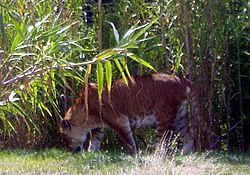
Tigon at National Zoo & Aquarium in Canberra, Australia
Scientific classification Edit this classification
Kingdom: Animalia
Phylum: Chordata
Class: Mammalia
Order: Carnivora
Family: Felidae
Subfamily: Pantherinae
Genus: Panthera
Species:

The tigon is a hybrid offspring of a male tiger (Panthera tigris) and a female lion, or lioness (Panthera leo).[1] They exhibit visible characteristics from both parents: they can have both spots from the mother (lions carry genes for spots – lion cubs are spotted and some adults retain faint markings) and stripes from the father. Any mane that a male tigon may have will appear shorter and less noticeable than a lion's mane and is closer in type to the ruff of a male tiger.

Tigons do not exceed the size of their parents' original species because they inherit growth-inhibitory genes from both parents, but they do not exhibit any kind of dwarfism or miniaturization; they often weigh around 180 kg (400 lb). It is distinct from the liger, which is a hybrid of a male lion and a female tiger, often weighing from 320 kg (710 lb) to 550 kg (1,210 lb). [citation needed]

Fertility

[edit]

Ligers and tigons were long thought to be sterile; in 1943, however, a 15-year-old hybrid between a lion and a tiger was successfully mated at the Munich Hellabrunn Zoo. The female cub was then raised to adulthood.[2] Like the liger, male tigons are sterile while the females are fertile.

At the Alipore Zoo in India, a tigoness named Rudhrani, born in 1971, was successfully mated to a male Asiatic lion named Debabrata. The rare, second-generation hybrid was called a litigon. Rudhrani produced seven litigons in her lifetime. Some of these reached impressive sizes - a litigon named Cubanacan weighed at least 363 kg (800 lb), stood 1.32 m (4 ft 4 in) at the shoulder, and was 3.5 m (11 ft) in total length.[3]

Coexistence of parental species

[edit]
Maude, a tigon displayed at Manchester Museum, England.

As with the liger, the tigon is found only in captivity,[2] because the habitats of the tiger and lion do not overlap. In the past, however, the Asiatic lion did coexist with the Bengal tiger in the wilderness of India, besides occurring in countries where the Caspian tiger had been, such as Iran and Turkey.[4][5] In India, there is a plan to shift some lions from their current home of the Gir Forest to Kuno Wildlife Sanctuary, which has some tigers,[6] but it has not been implemented as of December 2017, perhaps due to political reasons, as the Gujarat state government does not want any other state to have lions in the forests.[7][8][needs update]

See also

[edit]

References

[edit]
[edit]
Revisions and contributorsEdit on WikipediaRead on Wikipedia
from Grokipedia
![Maude the Tigon at Manchester Museum](./assets/Maude_the_Tigon_at_Manchester_Museum_(01) A tigon, also spelled tiglon, is a hybrid big cat born from the mating of a male tiger (Panthera tigris) and a female lion (Panthera leo). These hybrids occur almost exclusively in captivity, as the natural ranges of tigers and lions overlap minimally in the wild. Tigons typically display a blend of parental traits, including faint stripes over a tawny coat and partial mane development in males, but they remain smaller than both parent species due to inheriting growth-limiting genes from each. Average adult tigons measure 4 to 9 feet in length and weigh 200 to 500 pounds, often closer in size to lions. Male tigons are invariably sterile, while females possess fertility and can produce offspring—known as ti-ligons or li-tigons—when bred back to lions or tigers. Notable historical examples include Maude, a 19th-century tigon exhibited at Belle Vue Zoo in Manchester, whose taxidermied remains are preserved at the Manchester Museum. Other documented tigons emerged from zoos like Alipore in India, where breeding programs yielded specimens such as Rudrani in 1972, highlighting human-driven hybridization efforts despite associated health vulnerabilities in these animals.

Definition and Taxonomy

Hybrid Origin and Classification

The tigon is an interspecific hybrid big cat resulting from the or direct mating of a male (Panthera tigris) with a female (Panthera leo) in controlled environments such as zoos or circuses. These hybrids arise exclusively in captivity, as the natural ranges of tigers across Asian forests and lions in African savannas (with a Asiatic population in India's Gir Forest) exhibit minimal overlap, precluding spontaneous interbreeding. Taxonomically, the tigon is not recognized as a distinct species or subspecies but is classified as a hybrid within the genus Panthera of the family Felidae and subfamily Pantherinae. It is denoted scientifically as Panthera tigris ♂ × Panthera leo ♀ to indicate its parentage, reflecting the shared phylogenetic closeness of its progenitors, both members of the Panthera lineage that diverged approximately 3.7 million years ago. This notation underscores the tigon's status as a nothospecies, lacking independent evolutionary lineage or wild viability. Historical records indicate the first documented tigon was bred in in 1837, when a specimen was presented to by the Princess of , marking an early instance of deliberate big cat hybridization in the region where Asiatic lions and tigers coexisted historically. Subsequent breedings occurred sporadically in zoos worldwide, including notable examples at Alipore Zoo in during the , though tigons remain rare compared to their reciprocal hybrids, ligers.

Etymology and Naming

The term tigon (alternatively spelled tiglon) originated as a portmanteau blending "" and "," combining the prefix "ti-" from with the suffix "-gon" from to denote the specific hybrid offspring of a male (Panthera tigris) and a female (Panthera leo). This naming convention parallels that of the reciprocal hybrid, the liger, formed from "li-" of and "-ger" of , emphasizing the order of parental contribution with the sire's name preceding the dam's. In scientific for hybrids, the tigon is formally designated as Panthera tigris ♂ × Panthera leo ♀, adhering to the convention of listing the paternal species first, which underscores the directional mating required for its production and distinguishes it from other interspecific crosses. Early documentation of such hybrids, dating to the in zoos, predominantly referenced tigons before ligers gained prominence, though the portmanteau terms themselves appear to have been popularized in the mid-20th century amid increased efforts. The avoids ambiguity by excluding less precise descriptors like "tiger-lion hybrid," which could apply bidirectionally, ensuring clarity in genetic and zoological contexts.

Physical Characteristics

Morphology and Appearance

Tigons exhibit a blend of morphological characteristics from their tiger sires and lion dams, resulting in varied appearances across individuals. The coat typically features a pale to rust yellow-brown base color, more intense than that of s but paler than s, with tawny hues and underparts in many specimens. Tiger-like striping is present, ranging from faint shadow stripes to more distinct patterns, often combined with lion-like spots, particularly on the head, body, or abdomen. Male tigons generally develop a short mane or ruff, which emerges later in life and remains less prominent and dense than a lion's full mane, sometimes appearing as mere tufts or absent entirely. The head may favor a tiger-like elongated shape with longer , while the overall body build tends toward a lion's robust form, though less muscular than either parent species. Distinctive features include jet-black ears accented with tawny patches in some cases, and that can be short and lion-colored or longer and tiger-influenced.

Size, Growth, and Hybrid Vigor Absence

Tigons typically attain smaller sizes than either parent species, lacking the observed in ligers. male tigons generally measure 2.0 to 2.7 in total from to tip and weigh 90 to 227 kilograms, dimensions that align with or fall below those of lions (1.5 body , 120-180 kg) or smaller tiger subspecies like the (170-350 pounds). Female tigons are proportionally smaller, often not exceeding 150 kilograms. These measurements derive from captive specimens, as wild tigons do not occur, and reflect averages across documented cases rather than exceptional outliers. The absence of hybrid vigor, or , in tigons manifests as a failure to surpass parental body mass or stature, contrasting with ligers' overexpression of growth traits. Heterosis in hybrids usually enhances viability, size, or fertility through complementary gene interactions, but tigons inherit growth-inhibiting alleles from both parents, particularly reinforced by the lioness mother's contribution of regulatory genes that suppress excessive development. Tiger sires contribute limiting factors as well, preventing the unbounded postnatal growth seen in ligers, where paternal lion genes lack equivalent inhibition due to imprinting differences. This results in tigons reaching skeletal maturity at sizes akin to the smaller parent, without the disproportionate elongation or mass accumulation characteristic of hybrid enhancement. Growth patterns in tigons follow a more constrained trajectory, ceasing earlier than in tigers or s, often leading to dwarfism-like proportions in some individuals. Documented tigons exhibit no records of exceeding 250 kilograms, underscoring the suppressive genetic interplay; for instance, the growth dysplasia hypothesis posits unequal expression of genes, where maternal alleles dominate to curtail size. Empirical observations from breeding programs confirm tigons mature at 80-90% of expected hybrid potential, prioritizing metabolic efficiency over expansion, which may confer minor survival advantages in but highlights the directional asymmetry in feline hybrid outcomes.

Genetics and Inheritance

Parental Species Genetics

The (Panthera tigris) and (Panthera leo), the parental species of the tigon, both possess a diploid chromosome number of 38 (2n=38), consisting of 36 autosomes and a pair of (XX in females, XY in males). This identical facilitates chromosome pairing during in hybrid embryos, contributing to the viability of tigons despite interspecific differences. Genome assemblies indicate a tiger nuclear genome size of approximately 2.39 gigabases (Gb), while the lion genome measures about 2.41 Gb, reflecting high overall synteny and sequence conservation between the species. Comparative analyses reveal shared lineage features, such as expansions in gene families related to development and immune response, but with species-specific variations; for instance, tigers exhibit greater diversity in genes adapted to dense forest environments, whereas lions show adaptations in genes linked to and open-habitat foraging. These genetic profiles underscore the close phylogenetic relationship within the genus Panthera, with mitochondrial and nuclear divergence predating the Pleistocene but recent enough to permit hybridization under captive conditions, though natural is absent due to geographic separation and behavioral isolation. Subspecies-level variation exists, such as lower heterozygosity in Asiatic lions (approximately 25.8%) compared to some populations (around 22.7%), potentially influencing hybrid vigor or sterility patterns.

Hybrid Genetic Mechanisms

Tigons result from the fertilization of a lioness ovum by sperm, yielding offspring with a diploid complement of 38, comprising 19 autosomes and inherited equally from each parent , as both Panthera leo and tigris possess 38 chromosomes. The nuclear genome consists of approximately 50% -derived alleles and 50% -derived alleles, leading to intermediate phenotypic expression in traits such as pelage patterning, where faint stripes may overlay a tawny base coat influenced by dominant striping genes interacting with lion spotting modifiers. is maternally inherited from the lioness, potentially contributing to metabolic differences observed in hybrids compared to tigers. Sterility in male tigons adheres to , wherein the heterogametic sex (XY males) experiences greater hybrid incompatibility due to X-linked recessive lethals or meiotic disruptions from mismatched pairing during ; female tigons (XX), being homogametic, often retain partial fertility. This arises from Dobzhansky-Muller incompatibilities, where alleles co-adapted within each parental species fail to interact properly in the hybrid nucleus, disrupting and recombination, as evidenced by observed and reduced sperm viability in examined male hybrids. Genetic divergence between lions and tigers, accumulated over approximately 3.5 million years, exacerbates these epistatic conflicts without gross chromosomal rearrangements. Unlike ligers, tigons exhibit no hybrid vigor (heterosis) in somatic growth, attaining sizes comparable to or smaller than female (typically 100-160 kg for adults), attributable to parent-of-origin effects on (IGF2) and related imprinted loci. In tigons, the maternal genome expresses growth-suppressing alleles that limit body mass to align with social pride structures, overriding potential paternal contributions for larger stature; reciprocal ligers lack this maternal inhibition, enabling exaggerated growth. Empirical observations confirm this asymmetry, with no verified cases of oversized tigons despite multiple captive breedings since the early .

Reproduction and Fertility

Sterility Patterns

Tigons, as first-generation hybrids between male tigers (Panthera tigris) and female lions (Panthera leo), demonstrate a consistent pattern of sterility in males, while females exhibit fertility sufficient for with parental species. This disparity aligns with , which posits that in interspecies hybrids, the heterogametic sex—males (XY) in mammals—experiences greater sterility due to incompatibilities in sex-linked genes disrupting production. In tigons, male sterility arises from meiotic failures, such as improper chromosome pairing during , resulting from divergent evolutionary histories between tigers and lions, which diverged approximately 3.7 million years ago. Female tigons, possessing XX chromosomes, avoid these X-Y incompatibilities and retain ovarian function, enabling reproduction when mated with purebred lions or tigers. Documented cases include female tigons producing litters of li-tigons (with male lions) or ti-ligons (with male tigers), as observed in programs since the early . Fertility in females is not absolute; litter sizes are often reduced compared to s, and offspring viability can vary due to hybrid vigor limitations or recessive genetic issues. No verified instances of male tigon fertility exist, reinforcing the pattern as a post-zygotic reproductive isolating mechanism that prevents sustained hybridization in the wild. Genetic analyses indicate that sterility stems from regulatory gene mismatches rather than gross chromosomal differences, as both parental species share 38 chromosomes but differ in and imprinting. For instance, imprinted genes influencing gonadal development fail to coordinate properly in hybrids, leading to atrophied testes. This pattern mirrors other but contrasts with ligers (male lion-female tiger crosses), where female ligers also show fertility but exhibit hybrid vigor in size. Empirical evidence from zoos, such as those in and the U.S., confirms near-universal male sterility across dozens of documented tigons since 1920, with no successful .

Fertility Exceptions and Backcrossing

Female tigons represent a notable exception to the general pattern of hybrid sterility observed in male tigons, as they possess the capacity to produce viable when mated with lions or tigers. This fertility arises from the partial compatibility of inherited from the lioness parent, allowing to proceed despite chromosomal mismatches that render inviable in males. Post-mortem examinations of male tigons have consistently confirmed aspermia or , underscoring the absence of viable sperm production. Backcrossing of fertile female tigons with male lions yields ti-ligons (offspring with approximately 75% lion and 25% tiger genetic contribution), which exhibit increased lion-like traits such as and mane development in males. Alternatively, backcrossing with male tigers produces li-tigons (75% tiger, 25% lion), shifting morphology toward tiger characteristics like striping patterns and solitary tendencies. These backcross hybrids often display reduced hybrid vigor compared to first-generation tigons and may inherit health issues, including spinal deformities or organ underdevelopment, due to accumulated genetic incompatibilities. Documented cases, such as those from mid-20th-century zoo breeding programs, confirm that female tigons have successfully birthed litters in captivity, though survival rates for backcross offspring remain low without intensive veterinary intervention. Further generations of can theoretically purify traits toward one parental species, but declines progressively in male lineages, perpetuating reliance on hybrids for . No verified instances exist of male tigon , distinguishing tigons from some other where rare exceptions occur due to or genetic anomalies. These reproductive dynamics highlight the in action, where heterogametic sex (males in mammals) suffers greater sterility in hybrids.

History of Captive Breeding

Early Records and Development

The earliest documented instance of a tigon occurred in 1837, when a hybrid was presented to by the Princess of from an Indian state, marking the first recorded cross-breeding of a male and female in captivity. This event preceded widespread zoo breeding programs and reflected early experimentation in princely states where both species coexisted regionally. In the late , a touring circus in Britain produced multiple litters of tigons from a male and female lioness, with offspring exhibited to at Windsor, demonstrating initial success in hybrid propagation outside formal institutions. By the early , such breeding expanded to North American shows; in June 1902, cubs were born to a named Rajah and lioness Juliet at a facility in Manhattan Beach, New York, as reported contemporaneously. Similarly, in 1903, four tigon cubs resulted from a named Bob and African lioness Rose in the winter quarters of Walter L. Main's circus, highlighting the role of traveling menageries in hybrid development. Further advancement occurred in zoos during the 1920s and 1930s. In 1924, Prince Ranjitsinji of Nawanagar bred a male tigon named Ranji, which was donated to the London Zoo. European facilities followed, with Dresden Zoo producing the female tigon Maude and male Kliou in 1932 from a Manchurian tiger and African lioness; Maude later became a notable specimen preserved for study. These efforts established tigons as viable captives, though breeding remained sporadic due to challenges in interspecies compatibility and the absence of size-enhancing hybrid vigor observed in reciprocal .

Notable Examples and Modern Instances

One of the earliest documented tigons was Maude, a female born in 1932 at Dresden Zoo in Germany to a male Bengal tiger and a female African lion, who later resided at Belle Vue Zoo in Manchester, England, until her death in 1949. Her taxidermied mount, preserved with faint stripes and a tawny coat blending tiger and lion traits, remains on display at the Manchester Museum. Maude's sibling, a male named Kliou, was also exhibited during this period, highlighting early 20th-century interest in big cat hybrids at European zoos. ![Maude the tigon at Manchester Museum](./assets/Maude_the_Tigon_at_Manchester_Museum_0101 In the 1970s, Alipore Zoo in Kolkata, India, conducted systematic hybrid breeding, producing Rudrani, a female tigon born on October 13, 1972, from lioness Munni and tiger Bim; she grew to exhibit intermediate features like reduced striping and a lion-like mane tuft. Rudrani later gave birth to litigons, including Cubanacan on March 7, 1979, underscoring the zoo's multi-generational experiments despite ethical concerns over welfare and genetic viability. These efforts, spanning about 15 years, yielded few viable offspring amid high mortality rates. Modern instances remain scarce due to breeding restrictions and conservation priorities. In December 2000, Australia's National Zoo acquired accidental tigon twins, male Aster and female Tangier, from an unintended tiger-lioness pairing, both displaying hybrid morphology but limited public documentation on longevity. A tigon cub was reported born in March 2012 at Yancheng Wildlife Park in , noted for its rarity in state media. In 2016, Rhaja, an adult tigon rescued and housed at Big Cat Habitat in , exemplified ongoing private sanctuaries' roles, with estimates of fewer than 100 tigons worldwide at the time. Such cases often arise from accidental matings rather than deliberate programs, reflecting diminished institutional interest post-1980s.

Comparison to Liger

Morphological and Size Differences

Tigons typically attain a body size comparable to or smaller than that of their parental species, with adults weighing 150–200 kg and measuring around 2.5–3 meters in length from nose to tail tip, in contrast to ligers, which exhibit pronounced hybrid vigor and can exceed 400 kg in weight and 3.5 meters in length, making them the largest known felids. This size disparity arises from genetic mechanisms involving imprinted growth factors: in tigons (male tiger × female lion), paternal tiger genes suppress overall growth, limiting stature, whereas ligers (male lion × female tiger) inherit un抑pressed paternal lion growth-promoting alleles, leading to gigantism. Morphologically, tigons display a fusion of lion and tiger characteristics, including a tawny with faint, diffused tiger-like stripes over a predominantly -shaped body, shorter fur, and in males, a modest ruff or partial mane rather than the full mane of lions. Their and head proportions resemble those of a lion, with narrower jaws and smaller overall cranial dimensions compared to the broader, more massive heads of ligers, which contribute to a stronger bite force estimated at up to 1,000 psi versus around 400–600 psi for tigons. Ligers, by contrast, often feature bolder stripes on a larger lion-like frame, enhanced mane development in males, and elongated bodies that amplify their imposing presence, though both hybrids show variable trait expression due to limited breeding records. These differences underscore the reciprocal nature of the hybrids: tigons lack the overgrowth seen in ligers, resulting in a more compact build suited neither to exceed nor match the ecological niches of wild lions or tigers, while ligers' exaggerated morphology raises concerns about skeletal stress and in .

Reproductive and Genetic Contrasts

Tigons and ligers, as reciprocal hybrids of and , exhibit parallel reproductive sterility patterns governed by , wherein males are consistently infertile due to disruptions in from mismatched and meiotic pairing failures, while females retain partial through viable . Female ligers have demonstrated reliable in backcrosses, producing li-ligers (lion sire × liger dam) and ti-ligers (tiger sire × liger dam) across multiple facilities, with rates enabling sustained hybrid lineages in captivity. In comparison, female tigons display less frequently, with documented cases including Rudrani at Calcutta (born 1971), who produced seven li-tigons sired by an Asiatic male, and an unnamed female tigon that bore nine cubs across five litters from 1948 to 1950; a more recent instance involved a female tigon at China's Hainan Tropical Wildlife Park delivering two li-tigons. These rarer outcomes for tigons may stem from fewer breeding attempts, given their diminished public appeal and smaller stature, alongside potential viability constraints from absent hybrid vigor. Genetically, both hybrids maintain a diploid chromosome count of 38, matching parental species, but reciprocal parentage introduces distinctions: tigons carry mitochondrial DNA from the lioness dam, potentially influencing energy metabolism and hybrid vigor expression differently than the tiger mitochondrial DNA in ligers. Nuclear genomes blend evenly at 50% lion and 50% tiger alleles, yet parental origin effects—such as and X-chromosome inheritance from the dam—yield divergent phenotypes; tigons inherit growth-inhibiting alleles from the sire, suppressing size beyond parental averages and precluding the dysregulation that drives liger . These mechanisms underscore causal differences in hybrid outcomes, with tigons reflecting rather than the heterotic enhancement observed in ligers.

Behavior and Ecology

Coexistence of Parental Species

Lions (Panthera leo) and tigers (Panthera tigris) do not currently share overlapping ranges in the wild, with Asiatic lions confined to the Gir Forest in , , spanning approximately 1,412 km², while Bengal tigers occupy diverse habitats across central and eastern , such as the and central Indian tiger reserves, but excluding Gir. This separation results from historical human activities, including and hunting, which reduced lion populations to Gir by the early , while tigers persisted in forested regions unsuitable for lion prides. Historically, the two species coexisted across much of during the , including in , Persia, and , where their ranges overlapped in transitional biomes such as tropical dry deciduous forests and scrublands. Fossil and subfossil evidence, combined with historical records from the , indicate over extensive areas, with lions favoring open grasslands and woodlands for pride-based hunting, and tigers exploiting denser riparian forests and solitary ambushes. This partitioning minimized direct competition, as lions targeted group prey like deer in open terrain, while tigers focused on larger solitary ungulates in cover. Despite potential encounters in overlap zones, no verified instances of natural hybridization exist, attributed to behavioral barriers: lions' promotes intra-species mating within prides, whereas tigers' solitary nature limits inter-species interactions to agonistic ones, such as territorial disputes where individual tigers often prevail over single lions but avoid prides. Historical accounts from document rare fights, but ecological divergence—lions' diurnal pride activity versus tigers' nocturnal solitude—further reduces mating opportunities. Such adaptations enabled long-term without significant hybridization or one species displacing the other, contrasting with captive conditions where forced proximity yields tigons.

Captive Tigons' Behavioral Traits

Captive tigons exhibit behavioral traits influenced by the contrasting instincts of their tiger sires and lion dams, often resulting in conflicts between solitary tiger tendencies and social lion behaviors. These hybrids may experience confusion or depression, particularly after reaching sexual maturity, as the innate drive for pride formation clashes with preferences for isolation. Aggression is a prominent trait among captive tigons, frequently manifesting in interactions with conspecifics. For example, at Belle Vue Zoo in , sibling tigons Kliou and Maude, born in 1932 at Dresden Zoo and acquired in 1936, initially cohabited peacefully and engaged in repeated mating attempts despite Kliou's sterility; however, Maude's rejection led to fierce fights by 1939, requiring keeper intervention and permanent separation. Similar aggressive episodes have been noted in other tigons, attributed to failed mating cues or post-mating season tensions, where male tigers may overlook subtle lioness signals. Social dynamics in captivity often show mutual tolerance rather than deep affiliation when tigons are housed together, though temperaments vary individually. In a litter of tigons at Jungle Larry's, the female Maharani displayed a preference for her brother Rajah, highlighting potential for selective bonding amid broader hybrid uncertainties. Tigons may also inherit a tiger-like fascination with , engaging in or water play that confuses or distresses lioness mothers less inclined toward aquatic activities. Vocalizations blend species-specific calls, with tigons capable of both lion-like roars and tiger chuffs, potentially exacerbating communication challenges in mixed-instinct environments.

Ethical and Conservation Considerations

Breeding Ethics and Welfare Issues

Tigons frequently exhibit severe health complications inherent to interspecific hybridization, including sterility in males, neurological disorders, predisposition to cancer, , organ failure, and significantly reduced lifespans compared to their parental species. These issues arise from genetic incompatibilities between lions and tigers, which disrupt normal development and increase vulnerability to that can be inherited by fertile female offspring in subsequent generations. Unlike ligers, which may suffer from due to the absence of growth-inhibiting genes from the lion father, tigons often display reduced size and potential dwarfism-like traits, further compounding physical frailty and mobility limitations. Breeding tigons is widely criticized for prioritizing human curiosity or commercial exhibition over , as the process intentionally produces offspring predisposed to chronic suffering without any ecological or rehabilitative purpose. Conservation organizations emphasize that such hybridization diverts finite resources— including captive space, veterinary care, and funding—from efforts to bolster wild populations of tigers, classified as endangered, and lions, deemed vulnerable by the IUCN, neither of which naturally interbreed even in overlapping habitats. for bans on hybrid breeding, as petitioned to regulatory bodies like the USDA, highlights how these practices occur predominantly in unregulated or roadside facilities, exacerbating welfare risks through inadequate husbandry. While proponents occasionally claim educational value, underscores no substantive conservation benefit, rendering tigon production ethically untenable amid declining pure numbers.

Implications for Species Conservation

Breeding tigons offers no direct benefits to the conservation of lions or s, both of which face significant threats from habitat loss, poaching, and human-wildlife conflict. The (Panthera tigris), including the subspecies commonly used in hybridizations, is classified as Endangered on the , with global wild populations estimated at approximately 3,900 individuals as of recent assessments. The (Panthera leo persica), often paired with tigers for tigons, is also Endangered, with a wild population confined to fewer than 700 individuals in India's Gir Forest. African lions (Panthera leo leo), another source for lionesses in hybrid breeding, are Vulnerable, having declined by about 43% since the early . Hybrids like tigons cannot be reintroduced to wild habitats, as they lack the adaptive traits and genetic purity required for viable populations, and their production instead consumes slots that could bolster species-specific in accredited programs. Tigon breeding diverts limited resources—such as enclosure space, veterinary care, and funding—from conservation priorities, including protection and ex situ breeding for reintroduction. Male tigons are invariably sterile due to genetic incompatibilities between tiger and lion chromosomes, while fertile female tigons can produce backcross offspring (e.g., litigons or titigons), but these introduce hybrid traits that compromise long-term viability and do not address in pure lines. Conservation organizations, including and the Wild Cat Sanctuary, explicitly oppose hybrid breeding, viewing it as a form of exploitation that misleads the public on true numbers and undermines efforts to protect distinct taxa under laws like the U.S. Endangered Species Act, which excludes hybrids from protections afforded to parent . Furthermore, the practice risks reputational harm to genuine conservation by associating efforts with novelty-driven captive exhibits, potentially reducing donor support for field-based initiatives. No evidence supports claims of conservation utility from tigons, such as enhanced genetic resilience, as their smaller size and health vulnerabilities (e.g., organ or reduced ) reflect dysgenic outcomes rather than vigor beneficial to wild populations. Prioritizing pure-species breeding aligns with IUCN guidelines emphasizing genetic integrity for recovery plans, ensuring resources target root causes like rather than artificial crosses confined to .

References

Add your contribution
Related Hubs
User Avatar
No comments yet.