


Community hub
Recent from talks
Contribute something
Nothing was collected or created yet.
Tim Holt
View on Wikipedia
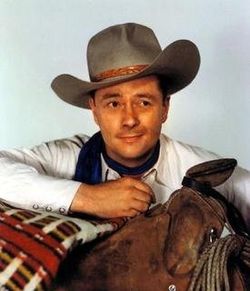
Charles John "Tim" Holt III (February 5, 1919 – February 15, 1973) was an American actor. He was a popular Western star during the 1940s and early 1950s, appearing in forty-six B westerns released by RKO Pictures.
Key Information


In a career spanning more than four decades, Holt is best remembered for his roles in the films The Magnificent Ambersons (1942), My Darling Clementine (1946) and The Treasure of the Sierra Madre (1948).
Early life
[edit]
Holt was born Charles John Holt III on February 5, 1919, in Beverly Hills, California, the son of actor Jack Holt and Margaret Woods.[1] During his early years, he accompanied his father on location, even appearing in an early silent film.[2] He was the inspiration for his father's book, Lance and His First Horse.
Holt was educated at Culver Military Academy in Culver, Indiana, graduating in 1936.[2] One of his classmates was Budd Boetticher who recalled Holt "used to walk around in our suite of rooms there…and he often had on his .38 revolvers and holster. He’d walk up and down the hall in his bathrobe and practice drawing his guns. He’d say, ‘I’m going to be a western star some day’."[3] Immediately after graduation he went to work in the Hollywood film business.[1]
His sister, Jennifer Holt, also appeared in B-westerns, notably opposite Johnny Mack Brown at Universal.[4]
Acting career
[edit]Walter Wanger
[edit]Holt was signed to a contract by producer Walter Wanger in January 1937.[5] Wanger was going to use him in Blockade, but that film was postponed.[6]
Instead he made his debut as Anne Shirley's suitor in Stella Dallas (1937) for Sam Goldwyn – the same role that another film star's son, Douglas Fairbanks Jr., had played in the 1925 version.[7] When told he was given the role his father Jack said, "Fine. Let's have one good actor in the family."[8] Wanger then cast him in I Met My Love Again (1938) and used him for a Technicolor Western, Gold is Where You Find It. In the latter the Los Angeles Times said Holt "confirms the favorable impression he gave" in Stella Dallas.[9]
RKO borrowed him for a western, The Renegade Ranger (1938), supporting George O'Brien, then a leading star of B-westerns. Wanger wanted to star Holt opposite Henry Fonda and Louise Platt in an adaptation of Vincent Sheean's Personal History; however after the problems Wanger had making Blockade he decided to postpone the project. (It was later filmed as Foreign Correspondent.) He lent Holt to Paramount to play the juvenile lead in Sons of the Legion[10] then RKO asked for him again in The Law West of Tombstone, supporting Harry Carey.
Wanger then used Holt in the role of young Lieutenant Blanchard in the 1939 classic Stagecoach. At Universal he appeared in a story of his old alma mater, Culver Military Academy, The Spirit of Culver.[11] His contract with Wanger expired. RKO signed Holt to a seven-year contract in December 1938.[12][13][14]
RKO Pictures
[edit]

RKO gave Holt his first lead in the B-film The Rookie Cop. It was popular, and RKO put him in The Girl and the Gambler opposite Leo Carrillo. He was then cast as the romantic lead for the studio's biggest star, Ginger Rogers, in 5th Avenue Girl (1939). It was popular and the Los Angeles Times said Holt "does unusually well in this",[15] although the New York Times thought he "seems a trifle young to be running a great corporation".[16] He was meant to play the eldest son in Three Sons (1939) with Edward Ellis,[17] but he was withdrawn and replaced by William Gargan.[18] He was also meant to star in a Western, Silver City, with Betty Grable, but it was not made.[19] In early 1940 it was announced Holt and Ginger Rogers would be reunited in an adaptation of The Enchanted Cottage.[20] The film was not made until several years later with different stars. Instead he was assigned to play Fritz Robinson in the studio's expensive adaptation of Swiss Family Robinson (1940). He also played the lead in Laddie (1940); the Los Angeles Times called him "engaging and capable".[21] Swiss Family Robinson was a financial failure and Laddie was not particularly popular.
Western star
[edit]During the late 1930s, actor George O'Brien had made a number of low-budget Westerns for RKO. Holt later recalled, "I believe George O’Brien quit over money so RKO needed another Western star and I was put forward."[22] In early 1940, RKO announced Holt would make six low-budget B-Westerns, starting with Wagon Train with Martha O'Driscoll.[23] O'Driscoll and Holt were meant to reteam in Sir Piegan Passes but it was not made.[24] Instead Holt appeared in The Fargo Kid. Universal borrowed him to play Charles Boyer's son in Back Street (1941). The Los Angeles Times said Holt had "some splendid scenes towards the end".[25] Then it was back to Westerns: Robbers of the Range (1941), Along the Rio Grande (1941), Cyclone on Horseback (1941) and Six-Gun Gold (1941). Holt usually played a cowboy who had one or two friends, who occasionally sang. From 1940 to 1942 he made 18 Westerns. His first sidekick was Ray Whitley, who was slightly older than Holt, and who would usually sing a song or two in each film. The other sidekick was a character "Whopper" played by Emmett Lynn and then Lee White. 1942 they were replaced by Cliff Edwards as Ike. Author Tom Stempel later recalled:
Holt, unlike many other B western stars, played characters not named Tim Holt. From his debut in 1934 Gene Autry always played "Gene Autry" and after 1941 Roy Rogers always played "Roy Rogers", but Holt's names varied, even if the basic character he played is the same... In these early films Tim's jobs were diverse. While Hopalong Cassidy was always the foreman of the Bar 20 Ranch, Tim played a cowboy, a Treasury agent, a Texas Ranger, or a number of other occupations. The characters were pretty much the same: Tim, with his boyish good looks, is drawn into situations where he must right some wrongs. Holt had a charming personality on the screen, which made him one of the top western stars from 1940 to 1943.[3]
The Westerns proved popular and Holt wound up making six more: The Bandit Trail (1941), Dude Cowboy (1941), Riding the Wind (1942), Land of the Open Range (1942), Come on Danger (1942) and Thundering Hoofs (1942).
The Magnificent Ambersons
[edit]
Holt's career received a boost in September 1941[26] when Orson Welles cast him as the lead in his second film, The Magnificent Ambersons (1942). "It was a lucky decision", Welles later said, calling Holt "one of the most interesting actors that's ever been in American movies".[27]: 113 The Washington Post thought Holt "gives an excellent account of himself". The New York Times said he "draws out all the meanness in George's character which is precisely what the role demands".[28][29] (In 1965 Welles wanted to reshoot the ending with those of the original cast still alive, including Holt, but it did not happen.[30])
RKO announced they had purchased two stories for Holt, Five of Spades (which became The Avenging Rider) and Adventures of Salt Valley. He was already announced for There Goes Lona Henry.[31] Holt was going to enter the army, so RKO quickly put him in six more Westerns: Bandit Ranger (1942), Red River Robin Hood (1942), Pirates of the Prairie (1942), Fighting Frontier (1943), Sagebrush Law (1943) and The Avenging Rider (1942).[32] His entry into the U.S. Army Air Forces was delayed long enough so that Holt could star in Hitler's Children (1943).[33] He was called to active duty during production.[34] The film proved to be one of RKO's most profitable during the war.
War service
[edit]Holt became a decorated combat veteran of World War II, flying in the Pacific Theatre with the United States Army Air Forces as a B-29 bombardier.[1] He was wounded over Tokyo on the last day of the war and was awarded a Purple Heart.[35] He was also a recipient of the Distinguished Flying Cross.[36][37]
Post-war
[edit]
Following the war, Holt returned to films and went back to RKO. According to his biographer David Rothel, "No more was he the callow, youthful cowboy with big, silly grin on his face. Now he exuded a steady, serious no-nonsense type of mature cowboy who was less impulsive, more contemporary, and somewhat ‘world weary."[3][38] Tom Stempel argues that "While Holt had lost his baby fat during the war, he still had a wonderful grin and cute dimples. He used the mixture of charm and seriousness very well."[3]
His post-war career began well when 20th Century Fox borrowed him to play Virgil Earp alongside Henry Fonda's Wyatt Earp in the John Ford western My Darling Clementine (1946). For RKO he appeared in a series of Zane Gray adaptations: Thunder Mountain (1947),[39] Under the Tonto Rim (1947) and Wild Horse Mesa (1947). He also made Western Heritage (1947), which was an original screenplay. The budgets were around $100,000 a film, making them among the more expensive B Westerns.[40]
The Treasure of the Sierra Madre
[edit]Holt was next borrowed by Warner Bros for the role for which he is probably best remembered — that of Bob Curtin to Humphrey Bogart's Fred C. Dobbs in John Huston's The Treasure of the Sierra Madre (1948), about two men who team up to prospect for gold, only to have greed tear apart their partnership. Holt's father also appeared in a small part. Tim Holt tended to be outshone in reviews by Bogart and Walter Huston, the latter winning an Oscar for Best Supporting Actor for his performance. However the Chicago Daily Tribune said he was "very likeable".[41] The Los Angeles Times said Holt "gives a rare and sincere impression of character in his performance".[42]
According to the Los Angeles Times, Holt's casting in Madre impressed RKO studio chief Dore Schary who announced "expanding plans" for the actor, looking to cast him in films other than Westerns. He also promised a bigger budget for Holt's Westerns such as The Arizona Ranger (1948), which cast him opposite his father.[43] However the films remained undistinguished: Guns of Hate (1948), Indian Agent (1948) and Gun Smugglers (1948).
His most frequent director was Lesley Selander and his sidekick in more than 25 of these movies was Richard Martin. Martin played Chito Jose Gonzales Bustamente Rafferty, a character created by writer Jack Wagner for the 1943 film Bombardier and who had appeared in some Robert Mitchum westerns before being put into Tim Holt films. Stempel:
The chemistry between Holt and Martin was immediate. Tim was entertained by Chito's constant pursuit of the ladies, which gave Holt a variety of reactions to play: amusement, surprise, slight irritation, bafflement at the hopelessness of Chito's attempted conquests. Unlike Hopalong Cassidy's young sidekick Lucky, who just mooned after girls, Chito was active, which was a lot more interesting to watch, especially with Tim's reactions. Chito was not just a lovesick fool, but he was also ready for action. As he explained his name, his mother was Spanish, and the Spanish is for loving, and his father was Irish, which is for fighting. Chito performed the crucial functions of a B western movie sidekick: he was somebody with whom the hero could discuss the plot, and he provided some comedy relief. In the 47–52 series, the comic relief is verbal rather than visual, and often a part of the story. The directors can shoot both Chito's flirting and Tim's reaction in one shot. Unlike other B westerns, such as those Holts with Cliff Edwards, the movie does not have to stop while the comic does his routine. It makes for much smoother flowing films.[3]
In 1948 Tim Holt also featured as the hero of a series of comic books[44]
However that year Brothers in the Saddle (1948) recorded a loss of $35,000[3] as the growth of TV and decline in cinema audiences started to cut into Holt's market.
Later movies
[edit]Dore Schary left RKO in 1948 and the new management was not keen to cast Holt in anything other than Westerns: Rustlers (1949), Stagecoach Kid (1949), Masked Raiders (1949), The Mysterious Desperado (1949) and Riders of the Range (1949). The latter lost $50,000.[45]
The Westerns continued: Dynamite Pass (1950), Storm over Wyoming (1950), Rider from Tucson (1950), Border Treasure (1950) and Rio Grande Patrol (1950). Law of the Badlands (1951) was the cheapest Tim Holt vehicle since the war years, made for $98,000, but still recorded a loss of $20,000.[46]
After Gunplay (1951), Saddle Legion (1951) had a higher quality female lead – Dorothy Malone – and then Holt unexpectedly appeared in an "A", supporting Robert Mitchum and Jane Russell in His Kind of Woman for director John Farrow.
In September 1950 it was announced Holt would support Montgomery Clift for director Nicholas Ray in The Flying Leathernecks (1951) but the film was made without either actor.[47]
Instead it was back to Westerns: Pistol Harvest (1951), Hot Lead (1951), Overland Telegraph (1951), Trail Guide (1952), Road Agent (1952), Target (1952), and finally Desert Passage (1952). The latter lost $30,000 so it was decided to end the series.[3]
He made a TV appearance for Chevron Theatre.
Later career
[edit]Holt had been to Oklahoma in 1947 with a rodeo, and met the woman who became his final wife. When his movie series ended he decided to move to Oklahoma for good. "I never did like Hollywood that much… there was nothing magical about it for me", he said.[22]
He was absent from the screen for five years until he starred in a horror film, The Monster That Challenged the World, in 1957, Holt said it "wasn’t too bad a picture at all".[22] Over the next 16 years, he appeared in only two more motion pictures as well as an episode of The Virginian. He was going to make a sequel to Treasure of the Sierra Madre with Nick Adams, but Adams died.[22]
However he kept busy managing theatres and making personal appearances.[1] He got a degree in animal nutrition from Iowa, worked as a builder, produced rodeos, staged and performed Western music jamborees, and worked as an advertising manager for a radio station from 1962 onwards.[14] Holt later said of this period:
Do you realize that this is the first time in my life that I can make my own decisions and do what I want to do? First it was my parents who told me what to do, then RKO told me what to do, then I went into the service and Uncle Sam told me what to do. I came back out and RKO still told me what to do. This is the first time I have not been under somebody's thumb in my life.[1] [3]
Personal life
[edit]Holt was married three times and had four children: three sons (one from his first marriage) and a daughter.
Tim Holt died from bone cancer on February 15, 1973,[48] in Shawnee, Oklahoma, where he had been managing a radio station. He was interred in the Memory Lane Cemetery in Harrah, Oklahoma. The street where he and his wife had lived in Harrah was subsequently renamed Tim Holt Drive in his honor.[1]
Legacy
[edit]Robert Mott of the Washington Post later said of Holt:
Holt was the hero, strong and silent and always more comfortable in the presence of boots and saddles, horses and he-men, than with the heroine – though he almost invariably ended up marrying her... Like many sons of famous entertainers, Tim Holt never achieved the stature of his father, and projected a bland image in contrast with the elder Holt's strong characterisation.[14]
In 1991, Tim Holt was inducted posthumously into the Western Performers Hall of Fame at the National Cowboy & Western Heritage Museum in Oklahoma City, Oklahoma. In 1992, the Golden Boot Awards honored Holt for his lifetime contributions to western cinema.
Filmography
[edit]- French Dressing (1927) (uncredited)
- The Vanishing Pioneer (1928) as John Ballard, Age 7
- History Is Made at Night (1937) as S.O.S. Radio Operator (uncredited)
- Stella Dallas (1937) as Richard Grosvenor
- I Met My Love Again (1938) as Budge Williams
- Gold Is Where You Find It (1938) as Lance Ferris
- The Renegade Ranger (1938) as Larry Corwin
- Sons of the Legion (1938) as Steven Scott
- The Law West of Tombstone (1938) as Ted aka The Tonto Kid
- Stagecoach (1939) as Lieutenant Blanchard
- The Spirit of Culver (1939) as Capt. Wilson
- The Rookie Cop (1939) as Clem Maitland
- The Girl and the Gambler (1939) as Johnny Powell
- Fifth Avenue Girl (1939) as Tim Borden
- Laddie (1940) as Laddie Stanton
- Swiss Family Robinson (1940) as Fritz Robinson
- Wagon Train (1940) as Zack Sibley
- The Fargo Kid (1940) as The Fargo Kid
- Back Street (1941) as Richard Saxel
- Along the Rio Grande (1941) as Jeff
- Robbers of the Range (1941) as Jim Drummond aka Curly Yantis
- Cyclone on Horseback (1941) as Stan Bradford
- Six Gun Gold (1941) as Don Cardigan
- The Bandit Trail (1941) as Steve Haggerty
- Dude Cowboy (1941) as Terry McVey
- Riding the Wind (1942) as Clay Stewart
- Land of the Open Range (1942) as Dave Walton
- Come on Danger (1942) as Jack Mason
- The Magnificent Ambersons (1942) as George Minafer
- Thundering Hoofs (1942) as Bill Underwood aka Bill Dawson
- Bandit Ranger (1942) as Clay Travers
- Red River Robin Hood (1942) as Jim Carey
- Pirates of the Prairie (1942) as Deputy Marshal Larry Durant
- Hitler's Children (1943) as Lieutenant Karl Bruner
- Fighting Frontier (1943) as Kit Russell
- Sagebrush Law (1943) as Tom Weston
- The Avenging Rider (1943) as Brit Marshall
- My Darling Clementine (1946) as Virgil Earp
- Thunder Mountain (1947) as Marvin Hayden
- Under the Tonto Rim (1947) as Brad Canfield
- Wild Horse Mesa (1947) as Dave Jordan
- The Treasure of the Sierra Madre (1948) as Bob Curtin
- Western Heritage (1948) as Ross Daggert
- The Arizona Ranger (1948) as Bob Morgan
- Guns of Hate (1948) as Bob Banning
- Indian Agent (1948) as Dave Taylor
- Gun Smugglers (1948) as Himself
- Brothers in the Saddle (1949) as Tim Taylor
- Rustlers (1949) as Dick McBride
- Stagecoach Kid (1949) as Dave Collins
- Masked Raiders (1949) as Himself
- The Mysterious Desperado (1949) as Himself
- Riders of the Range (1950) as Kansas Jones
- Dynamite Pass (1950) as Ross Taylor
- Storm Over Wyoming (1950) as Dave Saunders
- Rider from Tucson (1950) as Dave Saunders
- Border Treasure (1950) as Ed Porter
- Rio Grande Patrol (1950) as Kansas
- Law of the Badlands (1951) as Dave Saunders
- Saddle Legion (1951) as Dave Saunders
- Gunplay (1951) as Himself
- His Kind of Woman (1951) as Bill Lusk
- Pistol Harvest (1951) as Tim
- Hot Lead (1951) as Himself
- Overland Telegraph (1951) as Himself
- Trail Guide (1952) as Himself
- Road Agent (1952) as Himself
- Target (1952) as Himself
- Desert Passage (1952) as Himself
- Chevron Theatre (1953, TV series, "Adventure in Java")
- The Monster That Challenged the World (1957) as Lt. Cmdr. John 'Twill' Twillinger
- The Yesterday Machine (1963) as Police Lt. Partane
- The Virginian (1969 TV show, "A Woman of Stone") as Abe Landeen
- This Stuff'll Kill Ya! (1971) as Agent Clark (final film role)
Box office ranking
[edit]For a number of years Holt was voted by US exhibitors as among the most popular Western stars in the country.
References
[edit]- ^ a b c d e "Tim Holt". Movies & TV Dept. The New York Times. 2011. Archived from the original on February 5, 2011. Retrieved October 12, 2012.
- ^ a b "Tim Holt". B-Westerns. Retrieved October 12, 2012.
- ^ a b c d e f g h "Tim Holt and the B Western".
- ^ Wyatt, Tom and Greenland, David. "B Western Cowboys: Part I", Classic Images. September 2022
- ^ Graham, Sheilah (January 7, 1937). "Schulberg Casts Sylvia Sidney in Krasna Feature". Los Angeles Times. p. 8.
- ^ "Screen News Here and in Hollywood: Plans to Produce 'Personal History' Are Abandoned for the Present by Wanger – 'Tropic Holiday' to Open, Bob Burns and Martha Raye to Be Featured in Picture at Paramount This Morning Of Local Origin". New York Times. June 29, 1938. p. 15.
- ^ Schallert, Edwin (June 14, 1937). "James Foran, Brother of Dick, Will Make Debut as Comedy Star: John Howard Latest Choice for 'Drummond'". Los Angeles Times. p. 6.
- ^ "Star's Son Good Actor". Los Angeles Times. February 27, 1941. p. 12.
- ^ Lusk, Norbert (February 19, 1938). "Color Film Success at Box Office". Los Angeles Times. p. 8.
- ^ "SCREEN NEWS HERE AND IN HOLLYWOOD: Plans to Produce 'Personal History' Are Abandoned for the Present by Wanger TROPIC HOLIDAY' TO OPEN Bob Burns and Martha Raye to Be Featured in Picture at Paramount This Morning Of Local Origin". New York Times. June 29, 1938. p. 15.
- ^ Hopper, Hedda (February 19, 1939). "COMINGS AND GOINGS.... NEWS OF STAGE AND SCREEN: Culver Opus Given Expert Supervision Gen. Gignilliat, Head of Academy, Handling Technique". Los Angeles Times. p. C3.
- ^ Holt played young Lieutenant Blanchard in the 1939 classic Stagecoach.
- ^ "Screen News Here and in Hollywood: Dick Powell, Joan Blondell to Leave Warners – Miss Lindsay in Mystery Play – Two Foreign Films Today 'Little Flower,' Made in France, and the Italian, 'Amore in Quarantena,' Will Open, Miss Lindsay Gets Lead, Coast Scripts Of Local Origin". New York Times. December 12, 1938. p. 26.
- ^ a b c Mott, Robert (February 17, 1973). "Tim Holt, Actor in Western Films, Dies". The Washington Post. p. B6.
- ^ Schallert, Edwin (August 17, 1939). "FIFTH AVENUE GIRL' HITS HIGH SPOTS OF MIRTH, BUT UNEVEN". Los Angeles Times. p. 8.
- ^ FRANK S. NUGENT (August 25, 1939). "THE SCREEN: Slight Light Comedy Is RKO's Fifth Avenue Girl,' With Ginger Rogers, at the Radio City Music Hall". New York Times. p. 12.
- ^ Schallert, Edwin (June 15, 1939). "DRAMA: Betty Field Awarded New Paramount Lead". Los Angeles Times. p. 8.
- ^ DOUGLAS W CHURCHILL (July 15, 1939). "SCREEN NEWS HERE AND IN HOLLYWOOD: Universal to Start 'One Hour to Live,' 'Missing Evidence' and 'Rio' on Monday 'WATERFRONT' AT GLOBE 'To the Victor,' 'Orage' and 'La Kermesse Heroique' Among Films Listed for Today Raft Signs With Warner Spewaks to Write for McCarey". New York Times. p. 14.
- ^ DOUGLAS W CHURCHILL (September 12, 1939). "SCREEN NEWS HERE AND IN HOLLYWOOD: Three Pictures Are Placed on RKO Schedule—Cukor May Direct 'Susan and God' MAINTAIN FILM OUTPUT Columbia Studios Will Spend $5,000,000 More This Year on Production, Cohn Says Ruby Keeler Out of Film George Cukor May Direct". New York Times. p. 35.
- ^ Schallert, Edwin (January 4, 1940). "Americans to Sponsor Production in England: Durbin British Winner New Ameche, Faye Film Sandy's Sex 'Decided' Newcomer Awarded Role Gail Patrick Assigned". Los Angeles Times. p. 13.
- ^ G K (September 13, 1940). "'Laddie' Engaging Picture". Los Angeles Times. p. 21.
- ^ a b c d "Tim Holt Tuesday #2: John Brooker Interviews Tim Holt, 1970". November 12, 2013.
- ^ "53 FEATURE FILMS SCHEDULED BY RKO: 1940–41 Plans Announced at Sales Convention of Firm Now in Session Here 190 SHORTS ON PROGRAM Gallup Survey of the Audience Interest in Pictures Is Being Conducted for Company Plans Research Institute Film by Orson Welles".
- ^ "SCREEN NEWS HERE AND IN HOLLYWOOD: 'Kiss Me Again' Purchased by Ernst Lubitsch, Producer for United Artists 'GHOST BREAKERS' OPENING Paramount Attraction Starts Today--'Spies in the Air' Is Rialto Offering". New York Times. July 3, 1940. p. 15.
- ^ Schallert, Edwin (February 5, 1941). "Censor-Daring Theme Well Presented". Los Angeles Times. p. A10.
- ^ Schallert, Edwin (September 18, 1941). "Previews Reveal Fitful Start for New Season: 'Yank' Leads in Potency Welles Casts Tim Holt Costumes Tempt Power Good Things for Ginger Goldwyn Lot Hyphenated". Los Angeles Times. p. A11.
- ^ Welles, Orson; Bogdanovich, Peter; Rosenbaum, Jonathan (1992). This is Orson Welles. HarperCollins. ISBN 0-06-016616-9.
- ^ T.M.P.. (August 14, 1942). "'The Magnificent Ambersons,' Welles's Film From Novel by Tarkington, Opens at Capitol – 'The Big Street' at Palace". New York Times. p. 13.
- ^ "'Magnificent Ambersons' Suffer Decline at Keith's: New Orson Welles Film a Glorified Tragedy That Sacrifices Dramatic Power to New Photographic Splendor and Odd Technique". The Washington Post. July 17, 1942. p. 12.
- ^ "Alexander Signed for POW Movie". Los Angeles Times. December 10, 1965. p. d19.
- ^ Schallert, Edwin (January 7, 1942). "DRAMA: Welles to Act Turk Spy in 'Journey Into Fear' Paramount Signs McCrea 'Spitfire' Release Set Subjects Named for Holt Lindsay Slate Crowded Brent Returning Monday". Los Angeles Times. p. 8.
- ^ Richard Jewell & Vernon Harbin, The RKO Story. New Rochelle, New York: Arlington House, 1982. p175
- ^ "SCREEN NEWS HERE AND IN HOLLYWOOD: United Artists to Take Over 11 Finished Paramount Films and Distribute Them NEW PICTURE AT CARNEGIE 'Loves of Edgar Allan Poe' Will Open Today – 'You Can't Take It With You' Revived". New York Times. September 19, 1942. p. 9.
- ^ "HEDDA HOPPER Says: New Picture Brings Fame to Producer". Los Angeles Times. March 28, 1943. p. C2.
- ^ Hopper, Hedda (October 18, 1945). "Looking at Hollywood". Los Angeles Times. p. 10.
- ^ "Award of Distinguished Flying Cross". 39th.org. Retrieved March 13, 2024.
- ^ "Holt, Charles John, III, 1st Lt | TWS". airforce.togetherweserved.com. Retrieved August 20, 2016.
- ^ Rothel, David. Tim Holt (1994). Madison, North Carolina: Empire Publishing Company
- ^ Schallert, Edwin (October 2, 1946). "Ford Closes Four-Film Deal; 'Fugitive' First". Los Angeles Times. p. A3.
- ^ JOSEPH W TAYLOR (April 15, 1948). "Horse Operas Western Films Are Hollywood's Sure-Fire Financial Winners: Range From $40,000 'Oaters' To $1.5 Million 'Epics'; Are 25% of Film Output Action, Danger and Chase Horse Operas: Western Films Are Hollywood's Financial Winners". Wall Street Journal. New York. p. 1.
- ^ TINEE, MAE (March 19, 1948). "Hustons Do Superb Job in This Film: TREASURE OF THE SIERRA MADRE" THE CAST". Chicago Daily Tribune. p. a7.
- ^ Schallert, Edwin (January 15, 1948). "'Treasure' Manifests Adult Power". Los Angeles Times. p. 18.
- ^ Schallert, Edwin (October 11, 1947). "DRAMA AND FILM: Colbert Quits Capra Feature, Hepburn Cast". Los Angeles Times. p. A5.
- ^ Magers, Donna. "Tim Holt – Comic Book Cowboys, by Boyd Magers". www.westernclippings.com.
- ^ Richard Jewell & Vernon Harbin, The RKO Story. New Rochelle, New York: Arlington House, 1982. p240
- ^ Richard Jewell & Vernon Harbin, The RKO Story. New Rochelle, New York: Arlington House, 1982. p255
- ^ Scheuer, Philip K (September 5, 1950). "Tim Holt Leatherneck; Directors Pick Huston; King Bros. Celebrating". Los Angeles Times. p. A11.
- ^ "The Montreal Gazette – Google News Archive Search". The Montreal Gazette – via Google News Archive Search.
- ^ "WANTS PLASTER CAST OF GRABLE LEGS". The News. Adelaide. January 14, 1950. p. 8. Retrieved January 4, 2016 – via National Library of Australia.
- ^ Richard L Coe (December 29, 1951). "Public Pays Best For Escapist Fare". The Washington Post. p. 12.
- ^ "COMEDIANS TOP FILM STAR POLL". The Morning Bulletin. Rockhampton, Qld. December 27, 1952. p. 1. Retrieved January 4, 2016 – via National Library of Australia.
External links
[edit]


Tim Holt
View on GrokipediaEarly years
Birth and family background
Charles John Holt III, known professionally as Tim Holt, was born on February 5, 1919, in Beverly Hills, California.[4] He was the son of prominent silent film actor Jack Holt and his wife, Margaret Woods.[5] Holt grew up in a Hollywood family steeped in the film industry, with his father achieving stardom in silent cinema during the 1910s and 1920s. His younger sister, Jennifer Holt (born Elizabeth Marshall Holt in 1920), also pursued an acting career, appearing in numerous B-westerns alongside her brother.[6] As a child, Tim frequently accompanied his father to film locations and made brief uncredited appearances as an extra in several of Jack Holt's silent films, gaining early exposure to the world of motion pictures.[7] The Holt family's prominence in early Hollywood profoundly shaped Tim's path into acting, with his father's successful career serving as a primary inspiration and providing direct entrée into the industry.[7] This familial legacy positioned young Holt within the epicenter of silent-era filmmaking, fostering his initial interest in performance from an early age.[5]Education and early influences
Holt received his early education in Beverly Hills, California, attending local elementary schools before enrolling at Beverly Hills High School for one year.[5] Seeking a more structured environment with emphasis on physical discipline and equestrian skills, he transferred to Culver Military Academy in Culver, Indiana, a prestigious boarding school known for its military training and horsemanship programs.[5] There, Holt thrived under the academy's rigorous regimen, which instilled a strong sense of discipline and responsibility that would later define his professional demeanor.[8] At Culver, Holt developed a particular interest in Western themes through the school's renowned equestrian curriculum, where he excelled in polo and horseback riding, skills that aligned closely with the cowboy archetypes prevalent in Hollywood Westerns.[8] His roommate during much of his time there was Hal Roach Jr., son of the influential film producer Hal Roach, providing early exposure to the mechanics of the movie industry.[8] Another notable classmate was future director Budd Boetticher, who later recalled Holt's enthusiastic horsemanship, often riding energetically around the academy grounds.[9] Holt graduated from Culver in 1936 with honors, ranking 14th in a class of 115, which solidified his confidence and prepared him for future endeavors.[8][2] Growing up as the son of established actor Jack Holt, young Tim was profoundly inspired by his father's career, frequently accompanying him to film locations and gaining firsthand insight into the profession.[5] This exposure included early bit parts alongside his father.[10] These experiences, combined with the family's deep connections in Hollywood—stemming from Jack Holt's prominence in silent and sound Westerns—steered Tim away from alternative paths like professional polo and toward acting as his chosen vocation. After graduating from Culver, he returned to Hollywood and began pursuing an acting career through family connections, with his first screen appearance in 1929.[5][2]Acting career
Early roles and breakthroughs
Holt entered professional acting in 1937, leveraging his family connections as the son of established actor Jack Holt to secure a screen test that led to a contract with independent producer Walter Wanger in January of that year.[11] His first adult role was an uncredited appearance as the S.O.S. radio operator in the romantic drama History Is Made at Night (1937), directed by Frank Borzage.[12] This was followed by his credited debut in Stella Dallas (1937), where he portrayed Richard Grosvenor, the son of Barbara Stanwyck's character, a performance noted for its natural sincerity and emotional depth that marked him as a promising young talent.[13] Under Wanger's contract, Holt continued with supporting roles that showcased his youthful appeal, including the part of Ted, known as the "Tonto Kid," in the Western The Law West of Tombstone (1938), opposite Harry Carey.[14] A significant breakthrough came in John Ford's landmark Western Stagecoach (1939), where Holt played Lieutenant Blanchard, the disciplined cavalry officer leading the escort through Apache territory, a role that highlighted his clean-cut demeanor and helped elevate his visibility in major productions.[15] This appearance solidified his reputation as a reliable supporting player capable of conveying earnest integrity. In late 1938, as his Wanger contract expired, RKO Pictures signed Holt to a seven-year deal in December, transitioning him into a steady stream of B-movies and further supporting parts. His initial RKO effort was The Renegade Ranger (1938), a Western where he supported George O'Brien as Larry Corwin, a young rancher entangled in a border intrigue.[16] Over the next few years, Holt appeared in approximately 10 to 15 films, often embodying youthful, clean-cut characters—such as brothers, suitors, or junior officers—that built his foundation in Hollywood without yet confining him to leads. These early assignments, blending drama, comedy, and adventure, established his versatility and poised him for greater prominence.Rise as a Western star
In 1940, following his early contract with RKO Pictures, Tim Holt launched a prolific series of B-Westerns with the film Wagon Train, directed by Edward Killy and co-starring Cliff Edwards as sidekick Whiskey Joe and Richard Martin in an early role that foreshadowed his later prominence as Chito José.[17][18] This debut marked Holt's transition to leading man in the genre, capitalizing on his youthful appeal and riding skills to fill the void left by departing stars like George O'Brien.[13] From 1940 to 1952, Holt starred in 46 Westerns for RKO, producing fast-paced, low-budget "oaters" that typically ran under 60 minutes and featured Holt as a moral, heroic protagonist confronting frontier challenges.[19][20] These films emphasized straightforward narratives of ranchers defending their land against outlaws, with recurring themes of justice, loyalty, and redemption, often resolved through gunfights and chases in rugged Southwestern locales.[9] Key examples include Along the Rio Grande (1941), where Holt and sidekicks Ray Whitley and Emmett Lynn infiltrate a rustler gang for vengeance, and Riding the Wind (1942), in which he rallies ranchers against a corrupt water baron using legal and forceful means.[21][22] The series culminated in Desert Passage (1952), Holt's final RKO Western, depicting a perilous wagon train trek through hostile territory.[23] Holt's on-screen partnerships with comic-relief sidekicks added levity and camaraderie to the formulaic plots, evolving from varied duos like Edwards' folksy Whiskey Joe in early entries to the enduring teaming with Richard Martin as the irrepressible Chito José starting in the late 1940s, whose banter provided contrast to Holt's stoic heroism.[9] This dynamic, centered on themes of outlaw pursuits and ranch justice, resonated with audiences seeking escapist entertainment during the war years and beyond.[24] Holt's Westerns gained significant traction among theater exhibitors, consistently ranking him in the top ten Western stars in the Motion Picture Herald's annual polls throughout the 1940s whenever new films were released, underscoring his reliability as a draw for double bills and matinees.[9]Key dramatic roles
One of Tim Holt's most notable dramatic performances came in Orson Welles' 1942 adaptation of Booth Tarkington's novel, The Magnificent Ambersons, where he portrayed the spoiled and arrogant George Amberson Minafer.[25] Holt's depiction of the entitled youth, whose rigid worldview leads to personal downfall, was praised for effectively capturing the character's petulance and inner turmoil, with a New York Times review noting that he "draws out all of the meanness in George's character, which is precisely what the part demands."[26] This lead role marked a significant departure from his earlier supporting parts and highlighted his ability to handle complex emotional depth in a high-profile production. Following his World War II service, Holt delivered another standout performance in John Ford's 1946 Western-drama hybrid My Darling Clementine, playing Virgil Earp, the steadfast brother of Wyatt Earp (Henry Fonda).[25] As the reliable family member navigating the tensions of frontier justice in Tombstone, Holt added subtle layers of quiet resolve and vulnerability to the ensemble, contributing to the film's blend of historical drama and character-driven storytelling. Holt further demonstrated his range in other dramatic outings, such as his supporting role as Bill Lusk, a determined young man entangled in intrigue, in the 1951 film noir His Kind of Woman opposite Robert Mitchum and Jane Russell.[25] Earlier, in the 1939 Western-tinged drama The Girl and the Gambler, he starred as Johnny Powell, a young cowboy caught in a romantic and moral dilemma south of the border.[25] These roles showcased Holt's versatility, allowing him to portray flawed, introspective characters that contrasted sharply with his typical heroic cowboy persona in RKO Westerns. Critics and contemporaries recognized Holt's skill in these performances, often commending his transition from genre leads to more nuanced dramatic work, as seen in biographical accounts describing him as a "highly capable actor" capable of elevating ensemble pieces with authentic emotional nuance.[25] This acclaim briefly positioned Holt for greater A-list opportunities, enhancing his reputation before his military service interrupted his momentum.[25]World War II service
In 1942, Tim Holt enlisted in the U.S. Army Air Forces, though his entry into active duty was deferred to allow him to complete his contractual obligations with RKO Pictures, including the 1943 film Hitler's Children.[27] He underwent pilot training at Victorville Army Airfield but, due to a shortage of bombardiers, was reassigned and trained on the Norden bombsight, qualifying as a lead bombardier. During his training, Holt served as bombardier and executive officer for the top-secret Project X-Ray (Adams Plan), an experimental initiative to deploy incendiary devices attached to bats against Japanese targets.[6][28] Holt was commissioned as a second lieutenant and deployed to the Pacific Theater, where he served with the 62nd Bombardment Squadron of the 39th Bombardment Group, flying B-29 Superfortress bombers from bases on Guam.[29] Over the course of his service, he completed 22 combat missions against Japanese targets, including oil refineries and industrial sites such as those in Otaki and Isasaki, with his final mission occurring on August 14, 1945, during a bombing raid over Tokyo.[29] During this last flight, Holt was wounded by enemy fire, earning him the Purple Heart; he was also awarded the Distinguished Flying Cross for heroism in combat and the Air Medal with three oak leaf clusters.[29] Promoted to first lieutenant by April 1945, he flew not only as a bombardier but also took on piloting duties in various aircraft, including B-17s and B-25 Mitchells earlier in his training phases.[27] Holt was honorably discharged from active duty in January 1946 after approximately three years of service.[29] His military service significantly interrupted the momentum of his rising stardom in Western and dramatic films, yet it solidified his reputation as a war hero upon his return, enhancing his public image among audiences and peers.[27]Post-war career
Return to Westerns
Following his honorable discharge from the U.S. Army Air Forces in 1946, where he served as a bombardier and earned the Distinguished Flying Cross for his heroism, Tim Holt returned to RKO Pictures with renewed popularity that bolstered his status as a Western lead.[1] His first post-war film, Thunder Mountain (1947), marked the resumption of his B-Western series, retaining the popular sidekick dynamic with Richard Martin as the comic-relief Chito José Gonzalez y Ramirez while shifting toward more adult-oriented narratives, such as family feuds and moral dilemmas drawn from Zane Grey adaptations.[18] The early post-war entries benefited from elevated production values, including occasional use of Technicolor or Trucolor processes and larger budgets that allowed for expansive location shooting in Utah's Kanab region and stronger ensemble casts, as seen in films like Wild Horse Mesa (1947).[18] By the late 1940s and into the 1950s, examples such as Dynamite Pass (1950) exemplified this evolution, blending action with themes of infrastructure development and banditry in the post-Civil War West, though Holt occasionally transitioned to supporting roles amid ensemble-driven plots.[30] Over the series' run from 1947 to 1952, Holt starred in 29 films that sustained strong box-office performance among matinee audiences, yet diminishing innovation set in as RKO faced industry challenges, including the rapid rise of television competition that eroded demand for low-budget Westerns and prompted budget reductions.[18] This led to series fatigue, with repetitive formulas and stock footage becoming more prevalent by 1952, culminating in the final entry, Desert Passage, after which RKO discontinued the Holt Westerns.[1]Notable films and transitions
Following his World War II service, Tim Holt returned to acting with a standout supporting role as Bob Curtin in John Huston's The Treasure of the Sierra Madre (1948), portraying a disillusioned American seeking fortune in Mexico's gold fields alongside Humphrey Bogart's obsessive Fred C. Dobbs and Walter Huston's grizzled prospector Howard.[31] Holt's portrayal of the earnest, resilient Curtin provided a grounded counterpoint to the film's exploration of greed and moral decay, drawing praise for its authenticity and restraint in a cast of intense performances.[32] Building on his pre-war dramatic experience, this role represented a career pinnacle, with the film earning three Academy Awards, including Best Director for Huston, and solidifying Holt's reputation for credible ensemble work outside the Western genre.[33] As the post-war Hollywood landscape shifted, Holt ventured into new genres, notably leading as Lt. Cmdr. John "Twill" Twillinger in the science-fiction horror The Monster That Challenged the World (1957), where he investigates prehistoric mollusk creatures unleashed by an earthquake in California's Salton Sea.[34] Produced by Gramercy Pictures and distributed by United Artists, the film marked Holt's diversification into low-budget genre fare amid the era's growing interest in atomic-age monsters, blending procedural tension with modest special effects that were well-regarded for their era.[35] Critics noted the picture's efficient pacing and atmospheric dread, though it achieved only moderate commercial success, reflecting Holt's transition to supporting or lead roles in independent productions as major studio opportunities dwindled.[36] Holt's later films, such as the independent sci-fi The Yesterday Machine (1965), where he appeared as Police Lt. Partane in a time-travel conspiracy plot, exemplified his move from the fading studio system to smaller, self-financed ventures. These sporadic roles highlighted a fading stardom, with The Treasure of the Sierra Madre standing as his critical peak while post-1950s output became infrequent and lower-profile. The broader decline of the Hollywood studio system in the 1950s—driven by antitrust rulings, the rise of television, and the chilling effects of the blacklist era—severely limited opportunities for mid-tier actors like Holt, fostering a conservative production environment that prioritized safe, formulaic content over diverse dramatic roles.[37]Decline and final roles
By the early 1950s, Tim Holt's steady output of Western films at RKO had diminished, with Desert Passage (1952) marking his final contract picture for the studio and signaling the end of his prolific phase in the genre.[1] This role as the lead in a routine oater reflected the declining quality of B-movies that contributed to his growing disillusionment with Hollywood.[5] Approaching his mid-30s, Holt chose to step away from acting to prioritize family life, relocating to a ranch in Oklahoma with his third wife and children.[5] Holt's appearances became increasingly sparse over the next decade, influenced by the rise of television, which shifted audience interest away from low-budget theatrical Westerns, and his own preference for a quieter existence over the demands of the industry.[1] In the 1960s, Holt's work was limited to occasional television guest spots and low-budget features, with roles continuing sporadically into the early 1970s.[5] Notable among these was his role as Abe Landeen in the episode "A Woman of Stone" on The Virginian (1969), a Western series on NBC where he portrayed a supporting character in a story involving frontier justice.[38] He also appeared in the independent sci-fi film The Yesterday Machine (1965) as Police Lt. Partane and in the horror-comedy This Stuff'll Kill Ya! (1971) as Agent Clark, both minor productions that underscored the marginal nature of his late-career output.[10] Over his four-decade career, Holt appeared in around 50 films, predominantly Westerns, before his final screen role in 1971.[10]Later life and business ventures
Move to Oklahoma
Following the conclusion of his acting career in 1952 with the film Desert Passage, Tim Holt relocated from Hollywood to Oklahoma, seeking a quieter rural existence away from the industry's demands.[39] He had first visited the state in 1947 while touring with a rodeo, where he met Berdee Stephens, a local from Harrah; the couple married in 1952 and began building their family together.[40] Disillusioned by the decline of the studio system—particularly RKO's cessation of B-western production amid television's rise—Holt expressed a longstanding aversion to Hollywood's artificiality, stating in a 1970 interview, "I never did like Hollywood that much… there was nothing magical about it."[40] This shift aligned with his desire for post-war family stability, as he and Berdee prioritized raising their three children—sons Jack and Jay, and daughter Bryanna—in a more grounded environment reflective of the Western lifestyle he had portrayed on screen.[1] The Holts initially settled in Norman, Oklahoma, in 1957, before moving to Harrah in the early 1960s once their children reached school age.[41] There, they purchased a parcel of land near the town and established a ranch, embracing the agrarian pursuits that echoed Holt's upbringing on his father's Fresno ranch and his personal affinity for horses and rodeos.[39] This relocation marked a deliberate departure from the transient pressures of filmmaking, allowing Holt to focus on domestic life amid Oklahoma's open landscapes.[1] In Harrah, Holt quickly integrated into the close-knit community, earning admiration for his approachable and good-natured personality despite his celebrity past.[41] Residents "adopted" him as one of their own, leading to civic tributes such as the inaugural Tim Holt Day in 1975 and the naming of a local street in his honor, where his family continued to reside.[41] These gestures underscored his role as a beloved local figure, fostering a sense of belonging that contrasted sharply with his earlier Hollywood experiences.[41]Non-acting pursuits
After relocating to Oklahoma in the early 1950s, Tim Holt diversified into business and media ventures that capitalized on his cowboy image while emphasizing ranching and community involvement. Holt owned and operated the Holt Livestock and Supply Store near Harrah, Oklahoma, providing essential goods for local farmers and ranchers.[39] He also engaged in real estate development, collaborating with Midwest City developer Bill Atkinson on commercial projects and supporting Atkinson's unsuccessful gubernatorial campaigns in 1958 and 1962.[39] In broadcasting, Holt hosted the local television series The Tim Holt Western Theatre on KOCO-TV in Oklahoma City from 1959 to 1960, a Saturday morning program that showcased his classic Western films alongside segments involving children from the audience.[39] He later shifted to radio, working as sales manager first at KLPR and then at KEBC ("Keepin' Every Body Country") in Oklahoma City, where he helped promote country music programming until the early 1970s.[39][2] Holt produced and organized rodeo events, touring with the Jennings-Lamarr Rodeo company to leverage his on-screen expertise in Western activities.[39] These pursuits, combined with occasional television appearances, marked brief returns to entertainment, but his core commitment was to family ranching on the 1,400-acre ranch he managed near Harrah in the late 1950s, which offered financial security amid declining film opportunities.[6][39]Personal life
Marriages and family
Tim Holt's first marriage was to actress Virginia Ashcroft in December 1938.[1] The couple had one son, Lance Randolph Holt, born on January 15, 1940.[1] They divorced in 1944.[1] His second marriage, to Alice Harrison, took place on June 24, 1944, while Holt was serving in the U.S. Army Air Forces.[5] The marriage ended in divorce in 1952, and the couple had no children.[1] Holt's third marriage was to Berdee Stephens on September 4, 1952; they remained married until his death in 1973.[5] Together, they had three children: sons Jack and Jay, and daughter Bryanna.[42] After largely retiring from acting in the early 1950s, Holt settled with Berdee and their children on a ranch in Harrah, Oklahoma, where he focused on raising his family away from Hollywood.[1] His daughter Bryanna pursued interests in entertainment, including acting roles such as in the 2010 film Cactus Creek.[43] Holt also maintained ties to his extended family, including his sister Jennifer Holt, an actress known for her roles in B-westerns.[42]Health and death
In the early 1970s, while residing in Oklahoma, Tim Holt was diagnosed with bone cancer in August 1972.[10] His condition deteriorated rapidly over the ensuing six months, leading to his death on February 15, 1973, at the age of 54 in Shawnee Memorial Hospital, Shawnee, Oklahoma.[42][2] Holt's funeral was held on February 19, 1973, at the Harrah United Methodist Church in Harrah, Oklahoma, with no formal service conducted; his closed casket was draped with an American flag, honoring his World War II service.[42] He was interred that day at Memory Lane Cemetery in Harrah.[4][42] Holt was survived by his wife, Berdee Stephens Holt, sons Lance, Jack, and Jay, daughter Bryanna, and sister Jennifer Holt Cardinal.[42][2] The family received condolences from local Oklahoma community members during the two-hour visitation at the church, reflecting Holt's preference for a low-key life away from Hollywood.[42] While contemporary press coverage noted his passing with recaps of his film career, no major public tributes from Hollywood peers were reported at the time.[2]Legacy and recognition
Awards and honors
During his service in World War II as a lieutenant and bombardier with the U.S. Army Air Forces' 39th Bombardment Group, Tim Holt earned several decorations for valor and combat participation. He received the Distinguished Flying Cross for actions during a high-altitude incendiary bombing mission against the Yokohama urban industrial area on May 29, 1945, despite intense anti-aircraft fire.[44] Holt was also awarded the Purple Heart after sustaining wounds from enemy fire during a B-29 Superfortress raid over Tokyo on August 14, 1945—the final day of aerial combat in the Pacific Theater. In addition, he was presented with four Air Medals recognizing his overall contributions to multiple missions.[1][6] In the 1940s, Holt's popularity as a Western leading man was affirmed by industry professionals through annual exhibitor polls. He consistently ranked among the top ten Western stars in the Motion Picture Herald's Fame Poll from 1940 to 1943, reflecting his strong appeal to theater owners and audiences during RKO Pictures' series of B-Westerns. Holt did not receive any Academy Award nominations, though his supporting performances in Orson Welles's The Magnificent Ambersons (1942) and John Huston's The Treasure of the Sierra Madre (1948) contributed to those films' recognition by the Academy.[9][45] Following his death in 1973, Holt's legacy in Western films was honored posthumously. In 1991, he was inducted into the Hall of Great Western Performers at the National Cowboy & Western Heritage Museum in Oklahoma City, alongside actors such as James Drury and Chuck Connors, celebrating his enduring impact on the genre. The following year, in 1992, Holt received the Golden Boot Award from the Motion Picture & Television Fund's Western community event, recognizing his lifetime achievements in Western cinema as part of its In Memoriam honors.[46][47]Cultural impact
Tim Holt played a pivotal role in maintaining the popularity of B-Westerns during the World War II era, starring in eighteen films for RKO Pictures between 1940 and 1942 that showcased his youthful charm and action-oriented persona, helping to sustain audience interest in the genre amid wartime constraints.[9] His rankings in industry polls—sixth among cowboy stars in 1941 and 1943 by Motion Picture Herald, and fourth by Boxoffice in 1941 and 1942—underscored his contribution to the form's viability during this period.[1] Post-war, Holt's twenty-nine additional Westerns from 1947 to 1952, often featuring sidekick Richard "Chito" Martin, elevated the production values and narrative polish of B-Westerns, influencing the genre's transition to television formats in the 1950s, where similar heroic archetypes appeared in series like Gunsmoke.[9] Holt's career invited comparisons to his father, Jack Holt, a silent-era star known for over 200 films across genres, including Westerns like The Thundering Herd (1925); while Jack's roles spanned adventures and serials, Tim specialized in B-Westerns, embodying a purer dedication to the cowboy archetype that aligned closely with his father's rugged image but focused more exclusively on the form.[48] This focus positioned Tim as an exemplar of the 1940s heroic ideal: a morally upright, brave, and understated figure whose real-life service as a decorated Army Air Forces bombardier during the war added authenticity to his screen persona of quiet resolve and empathy.[9] His post-war films further reinforced this by depicting gender roles that evolved beyond stereotypes, with dynamic female characters such as ranchers, teachers, and even a doctor appearing alongside traditional dance-hall figures, often allowing women agency in plots while Holt's hero prioritized action over romance.[9] In film history, Holt's legacy extends to reevaluations of his dramatic work, particularly his portrayal of the spoiled George Minafer in Orson Welles's The Magnificent Ambersons (1942), where his performance as the film's antagonist has been praised for anchoring the narrative's emotional core despite the picture's troubled studio cuts.[49] Modern revivals, including airings on Turner Classic Movies alongside other B-Western icons, have highlighted his contributions, sustaining interest in his films as embodiments of mid-century American ideals. Additionally, Holt's later relocation to Oklahoma, where he managed a 1,400-acre dude ranch and operated the Holt Livestock and Supply Store near Harrah, tied his Western persona to regional heritage, promoting tourism through rodeo appearances and a short-lived television anthology series that evoked his cinematic roots.[39]Filmography and rankings
Selected filmography
Tim Holt's film career encompassed over 60 feature films, spanning dramas, adventures, and particularly Westerns, where he became a prominent B-movie star for RKO Pictures.[25] His selected filmography below highlights major roles in chronological order within key phases, emphasizing collaborations with renowned directors and co-stars that defined his contributions to cinema.[10]Early career (1937–1939)
This period marked Holt's transition from bit parts to supporting roles in notable productions, showcasing his youthful appeal in dramas and Westerns.| Year | Title | Role | Director | Notable Co-Stars/Notes |
|---|---|---|---|---|
| 1937 | Stella Dallas | Richard Grosvenor III | King Vidor | Barbara Stanwyck; early dramatic role in a classic tearjerker.[50] |
| 1938 | The Law West of Tombstone | Ted Rawlins | Glenn Tryon | Harry Carey; Holt's first lead in a Western. |
| 1938 | Gold Is Where You Find It | Lance Ferris | Michael Curtiz | Olivia de Havilland; supporting role in a Gold Rush drama. |
| 1939 | Stagecoach | Lt. Blanchard | John Ford | John Wayne, Claire Trevor; breakout supporting role in iconic Western. |
| 1939 | Fifth Avenue Girl | Tim Borden | Gregory La Cava | Ginger Rogers; comedic supporting part. |
Westerns (1940–1952)
Holt starred in dozens of RKO B-Westerns during this era, often playing rugged heroes alongside sidekick Chito José Gonzalez y Fernandez (Richard Martin), while also appearing in higher-profile films. Directors like John Ford and Lesley Selander frequently collaborated with him, blending action with character-driven narratives.| Year | Title | Role | Director | Notable Co-Stars/Notes |
|---|---|---|---|---|
| 1940 | Wagon Train | Tim | Richard Thorpe | As lead in RKO's first Holt Western series entry. |
| 1940 | Swiss Family Robinson | Fritz Robinson | Edward Ludwig | Thomas Mitchell, Edna Best; adventure adaptation. |
| 1941 | Along the Rio Grande | Tim | Edward Killy | Richard Martin; early RKO oater. |
| 1942 | The Magnificent Ambersons | George Amberson Minafer | Orson Welles | Joseph Cotten, Agnes Moorehead; pivotal dramatic lead in literary adaptation.[51] |
| 1942 | Thundering Hoofs | Bill Underwood | Lesley Selander | Richard Martin; action-packed RKO Western. |
| 1946 | My Darling Clementine | Virgil Earp | John Ford | Henry Fonda, Linda Darnell; key role in Ford's O.K. Corral epic.[52] |
| 1948 | The Treasure of the Sierra Madre | Bob Curtin | John Huston | Humphrey Bogart, Walter Huston; adventure-drama with Western elements.[31] |
| 1948 | Arizona Ranger | Bob Morgan | John Rawlins | Jack Holt (father); family collaboration in RKO Western. |
| 1949 | Brothers in the Saddle | Tim Taylor | Lesley Selander | Richard Martin; sibling rivalry plot. |
| 1950 | Riders of the Range | Kansas Jones | Lesley Selander | Richard Martin; late RKO series entry. |
| 1952 | Desert Passage | Tim Holt | William Berke | Richard Martin; final RKO Western. |
Post-war (1945–1960)
Following World War II service, Holt returned to lighter fare, including sci-fi and remaining Westerns, though his output decreased; this phase featured diverse genres with occasional genre-blending roles.| Year | Title | Role | Director | Notable Co-Stars/Notes |
|---|---|---|---|---|
| 1947 | Wild Horse Mesa | Dave Jordan | Wallace Grissell | Richard Martin; post-war RKO Western revival. |
| 1948 | Gun Smugglers | Tim Holt | Jean Yarbrough | Richard Martin; border action tale. |
| 1951 | His Kind of Woman | Bill Lusk | John Farrow | Humphrey Bogart, Jane Russell; film noir thriller. |
| 1952 | Target | Tim Holt | Stuart Gilmore | Richard Martin; RKO swansong Western. |
| 1957 | The Monster That Challenged the World | Lt. Cmdr. John "Twill" Twillinger | Arnold Laven | Audrey Dalton; lead in cult sci-fi horror.[34] |