


Community hub
Recent from talks
Contribute something
Nothing was collected or created yet.
Tintignac
View on Wikipedia
Tintignac is a hamlet near Naves in the Corrèze region of France. It is primarily known for the archaeological remains of a sanctuary where Gallic and Gallo-Roman artefacts have been found, including seven carnyces (war trumpets) and ornamented helmets.[1] The site is classified on the List of historic monuments of 1840.[2]
Key Information


Origins
[edit]The village has been known since the 12th century, using the Occitan spelling of Tintinhac. It is associated with Arnaut de Tintinhac, a troubadour and lord of Tintinhac who was born at Castle Tintignac, probably as a vassal of the Vicomte de Turenne of the House of La Tour d'Auvergne. Four of his poems have survived.[3]
Archeological site
[edit]The Gallic and Gallo-Roman site is located on the plateau of Naves, north of the towns of Naves and Tulle, in the foothills east of Puy l'Aiguille, west of the Peuch Redon summit. Around the sanctuary, researchers have discovered traces of dense occupation and activity.[citation needed]
The site was discovered in the 19th century and is ranked on the list of protected sites after review by the inspector general of historical monuments, Prosper Mérimée and Abel Hugo.
In September 2004, about 500 fragments of iron and bronze objects were discovered in a Gallic pit. The objects included a dozen swords and scabbards, iron spearheads, a shield, ten bronze helmets and an iron bird (a crane or swan is found on some lemovice items), 2 animal heads including a horse, one animal body in connection with the two hind legs, one foreleg, a cauldron, and seven carnyces (a wind instrument of the Iron Age Celts) and including an almost complete War Trumpet. The first such objects found in the context of a Gallic sanctuary. These unique military and religious objects are now being studied by the team led by Christophe Maniquet, chief scientist at the site of Tintignac. In 2009, an aqueduct was discovered, 2 metres high and feeding a well 13 metres deep.[citation needed]
Conservation
[edit]The items were restored by the Materia Viva laboratory in Toulouse and displayed in Tulle before embarking on a series of international exhibitions that began in Bern (Switzerland).[citation needed]
Objects
[edit]Objects found at Tintignac were exhibited at the 2012 exhibition Les Gaulois, une expo renversante (The Gauls, a stunning exhibition).
-
 A Carnyx found at Tintignac.
 -
 A Carnyx found at Tintignac.
 -
 A Carnyx found at Tintignac.
 -
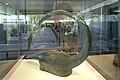 Casque in the shape the head of a bird, found at Tintignac.
 -
 Evocation of a Gallic ceremony in the sanctuary of Tintignac.


References
[edit]- ^ Dossier pour la science, Number 61, October 2008.
- ^ Base Mérimée: PA00099815, Ministère français de la Culture. (in French)
- ^ "The Monedieres" by Daniel Borzeix, published 2003, - Arnaut de Tintinhac,
Sources
[edit]- Christophe Maniquet, Le sanctuaire antique des Arènes de Tintignac, Culture et Patrimoine en Limousin, 2004, 123 p. (ISBN 978-2-911167-38-6)
- Christophe Maniquet, Comment les Gaules devinrent romaines : Le dépôt d'armes, d'instruments de musique et d'objets gaulois du sanctuaire de Tintignac à Naves, Paris, La découverte, 2010, 21 à 34 p.
External links
[edit]
- The official website of Tintignac-Naves (in English)
- (French) Archeo-Tintignac : toutes les nouvelles récentes (in French)
| International | |
|---|---|
| Geographic | |

Tintignac
View on GrokipediaLocation and Historical Context
Geographical Setting
Tintignac is an archaeological site located near the commune of Naves in the Corrèze department of Nouvelle-Aquitaine, central France.[8] Its precise coordinates are 45°20′00″N 01°45′28″E.[8] The site occupies a position on the plateau north of Naves and the nearby city of Tulle.[9] The surrounding landscape features a elevated plateau in the foothills east of Puy l'Aiguille and west of the Peuch Redon summit, characteristic of the region's rolling terrain in southern central France.[9] This setting places Tintignac at an approximate elevation of around 500 meters above sea level, contributing to its prominence within the local topography. The site's location along a proto-historic route that connected Brittany in the northwest to the Mediterranean in the southeast underscores its accessibility in antiquity.[3] Environmental factors, including the site's moderate elevation and strategic positioning near ancient trade and migration pathways, likely influenced its selection as a religious center, offering both visibility and connectivity for ritual gatherings.[3] This elevation provided a defensible yet open plateau suitable for communal activities, while proximity to routes facilitated interactions across broader networks.[9] In the regional context, Tintignac lies within the territory of the Gallic Lemovices people, a Celtic tribe inhabiting much of what is now the Corrèze area during the Iron Age.[3] This positioning highlights its role in Iron Age Gaul, where such elevated sites often served as focal points for tribal religious and cultural practices amid the diverse landscapes of pre-Roman central Europe.[3]Early Mentions and Origins
The locality of Tintignac, recorded in medieval sources as Tintinhac, first appears in historical documentation during the 12th century, associated with Arnaut de Tintinhac, a Gascon nobleman and troubadour who held lordship over the area near Naves in Corrèze. This reference in Occitan literary and feudal records underscores early medieval recognition of the site's geographical prominence, though without explicit archaeological context.[10] The sanctuary at Tintignac was founded around the 2nd century BC by Celtic groups of the La Tène culture, specifically the Lemovices tribe, whose territory encompassed much of modern-day Limousin. Positioned along ancient proto-historic routes, it emerged as a significant religious hub in central Gaul, reflecting the tribe's organized spiritual practices amid expanding Celtic settlements. Artifacts from the site's earliest phases, including bronze elements and iron weapons, confirm this timeline and the sanctuary's role as a focal point for Lemovices communities.[4][3][11] Dedicated to Gallic deities, the sanctuary primarily functioned as a ritual and communal center, where offerings of arms, instruments, and ceremonial items were deposited in structured pits and enclosures to honor martial and divine forces central to Celtic worldview. These practices, evidenced by deliberate hoards of over 490 metal objects, highlight its importance for tribal ceremonies, possibly invoking protection and prosperity for warriors and the community. The site's design, with palisades and open spaces, supported gatherings that reinforced social and religious cohesion among the Lemovices.[12][13] Following the Roman conquest of Gaul in the 1st century BC, the sanctuary underwent gradual decline as Roman cultural assimilation spread, supplanting indigenous rituals with imperial cults and urban developments. By the 3rd century AD, amid broader instability like the Crisis of the Third Century, the site was fully abandoned, likely due to these cultural shifts, marking the end of its pre-Christian significance.[4]Site Development and Use
Gallic Foundation and Sanctuary
The sanctuary at Tintignac, located in Naves, Corrèze, France, was established in the mid-2nd century BCE as a key religious center for the Lemovices tribe during the late La Tène period of the Iron Age.[14] Archaeological evidence indicates that construction began around this time, with the site featuring an initial wooden temple enclosed within a square palisade measuring approximately 14 meters on each side, along with open areas designated for ceremonial activities.[14] This layout reflects typical La Tène architectural practices, utilizing earth, wood, and post-built structures that left subtle traces in the soil, such as foundation pits and postholes.[15] The site's primary religious role was as a hub for Gallic worship, likely dedicated to local deities associated with protection and community prosperity, though specific divine identities remain unidentified due to the absence of inscriptions.[16] Rituals conducted there included communal ceremonies involving votive offerings, where participants deposited items as acts of devotion or desecration, evidenced by pits containing deliberately fragmented metal objects from the 4th to 1st centuries BC.[14] These practices underscore the sanctuary's function as a sacred space for spiritual expression in pre-Roman Gaul, integrating elements of sacrifice and renewal typical of Celtic religious traditions.[12] Architecturally, the Gallic phase emphasized impermanent materials suited to the La Tène culture, with a central temple structure rebuilt multiple times over the 2nd and 1st centuries BC, surrounded by processional zones and altar-like spaces inferred from spatial organization and ritual deposits.[15] No monumental stone elements were present during this period, distinguishing it from later developments; instead, the design prioritized accessibility for gatherings, with peripheral enclosures defining sacred boundaries.[14] Socially, Tintignac served as a vital gathering point for the Lemovices, fostering integration of religious rites with political assemblies and trade activities along regional routes connecting central Gaul to broader networks.[16] This multifunctional role highlights its importance in pre-Roman tribal society, where the sanctuary reinforced communal identity and social cohesion through shared rituals and interactions.[14]Transition to Gallo-Roman Period
The transition at Tintignac began in the late 1st century BC following the Roman conquest of Gaul in 52 BC, marking the shift from a purely Gallic sanctuary to a syncretic Gallo-Roman religious and civic complex.[14] This period of romanization saw the site evolve under the influence of the Lémovices tribe's integration into the Roman province of Aquitania, with archaeological evidence indicating continuity of ritual practices alongside the adoption of imperial administrative oversight.[12] Cultural changes reflected a blending of Gallic and Roman elements, including the incorporation of Roman deities such as Mars or aspects of the imperial cult into existing Celtic rituals, evidenced by diverse votive offerings that persisted into the 1st century AD.[14] By the 1st century AD, syncretism was evident in the site's religious activities, where traditional Gallic deposition rites coexisted with Roman-style ceremonies, highlighting elite Gallic adoption of Roman cultural norms without complete erasure of indigenous traditions.[12] Site modifications during the early 1st century AD involved replacing the original wooden Gallic temple with a more permanent stone fanum featuring two cellae, symbolizing increased Roman architectural influence and regional control.[14] Further expansions in the mid-2nd century AD included a semi-circular building, a tribunal structure, and a theater approximately 95 meters in diameter, alongside water management enhancements like a 12-meter-deep well and aqueduct, transforming the sanctuary into a larger urban hub.[14] The site's decline culminated in its abandonment by the late 3rd century AD, primarily triggered by an incendiary destruction of key buildings, as indicated by burn layers in the archaeological record.[12] This event aligned with broader disruptions in the Roman Empire during the Crisis of the Third Century, including economic instability and invasions, though no evidence points to Christianization as a direct factor at Tintignac.[14] Natural decay and reduced patronage likely contributed to the site's disuse thereafter, with no subsequent Roman constructions recorded.[12]Archaeological Excavations
Pre-20th Century Findings
The archaeological site at Tintignac, located near Naves in the Corrèze department of France, has been recognized since at least the 17th century, with early accounts indicating awareness of its ancient ruins among local inhabitants.[17] By the early 19th century, surface observations of the site's remains prompted formal acknowledgment, leading to its inclusion on France's inaugural list of historic monuments in 1840, which protected significant antiquities across the country.[18] This classification highlighted Tintignac as a notable Gallo-Roman ensemble in rural Limousin, based on visible structural elements and scattered artifacts visible on the surface, though systematic investigation was initially limited. Excavations at the site commenced shortly after its protection, with probes conducted between 1842 and 1884 by local antiquarians and scholars under the auspices of emerging archaeological interests. These early digs uncovered four principal structures: a fanum or temple with a double cella to the west, interpreted as a cult building; a central theater-like edifice; a theater to the east; and a southern storage facility, suggesting the complex served as a rural sanctuary along an ancient road network.[19] Limited surface collections during this period yielded pottery sherds and metal fragments, confirming the site's antiquity, but the efforts focused primarily on architectural features rather than comprehensive artifact recovery or contextual analysis.[18] Antiquarians identified the area as a potential ancient sanctuary, drawing parallels to other Gallo-Roman sites, yet the work remained exploratory without stratigraphic methods. The pre-20th century investigations faced significant challenges due to the absence of modern scientific techniques, resulting in incomplete documentation and the potential loss or damage of artifacts through improper handling or reburial. Many finds were not systematically cataloged, and the site's full extent, including underlying Gallic layers, was overlooked in favor of visible Roman elements.[19] Local reports from the period occasionally noted artifacts such as coins and tools turned up by agricultural plowing, as recorded in regional historical accounts, underscoring ongoing informal discoveries that preceded and complemented official efforts.[17] These limitations set the stage for more rigorous 20th-century approaches, highlighting the gaps in early knowledge about the site's layered history from Gallic origins to Roman adaptation.Modern Excavations and Discoveries
The site saw limited excavations in the 1950s, which rediscovered and partially explored the remains after a period of neglect following the 19th-century work.[4] Modern systematic archaeological excavations at the Tintignac site commenced in 2001, directed by teams from the Institut national de recherches archéologiques préventives (Inrap) in collaboration with local authorities in Corrèze, France.[16] These efforts built on earlier 19th-century findings but employed rigorous scientific methods to explore the Gallic and Gallo-Roman sanctuary systematically. Initial summer campaigns focused on mapping the site's layout and identifying undisturbed deposits, with major fieldwork intensifying between 2002 and 2004 under the leadership of archaeologist Christophe Maniquet.[12] The project utilized geophysical surveys, such as magnetic and electrical resistivity techniques, to detect subsurface anomalies across the approximately 25-hectare site, complemented by stratigraphic analysis to establish chronological layers.[12][20] Interdisciplinary collaboration involving archaeologists, conservators, and specialists in ancient metallurgy ensured comprehensive documentation and preservation during the digs.[16] A pivotal breakthrough occurred in September 2004 during the excavation of a small ritual deposit pit, revealing over 500 fragments of iron and bronze objects intentionally buried as offerings, dated to the 1st century BCE.[9] This hoard, consisting of approximately 492 artifacts including weapon components and ceremonial elements, provided unprecedented insights into late Iron Age ritual practices at the sanctuary.[21] The discovery was made through careful trowel work and sieving within a 30 cm-deep pit, highlighting the site's role as a key deposition area prior to the Roman conquest.[22] Excavations paused briefly after 2004 but resumed in July 2009 for a focused campaign from July 6 to 31, again led by Maniquet with a team of about 10 volunteers including students and retirees.[23] This phase targeted water management systems via targeted sondages (test pits) and well exploration, uncovering a 13-meter-deep well connected to an east-west aqueduct.[23] The aqueduct, practicable at 2 meters in height and traced for 10 meters eastward using canalized tiles, demonstrated advanced hydraulic engineering likely supporting sanctuary rituals and structures.[24] These findings, achieved through vertical profiling and horizontal clearing, underscored the site's evolution into the Gallo-Roman period and informed broader interpretations of its infrastructure.[23]Physical Features of the Site
Sanctuary Layout and Structures
The archaeological site at Tintignac encompasses a roughly 3-hectare complex centered on a sanctuary that evolved from Gallic origins to a Gallo-Roman fanum, featuring a central temple surrounded by open ritual spaces and access paths suggestive of processional avenues.[25] The layout reflects a deliberate spatial hierarchy, with designated zones for votive offerings, communal rituals, and possibly elite ceremonies, as evidenced by the positioning of deposit pits near sacred platforms and broader enclosures for gatherings.[14] In its initial Gallic phase during the 2nd century BCE, the sanctuary consisted of a square wooden enclosure measuring approximately 24 meters on each side, demarcated by a palisade whose foundation trenches have been identified through excavations.[25] At the center stood a wooden temple structure, rebuilt several times, with postholes indicating a simple, elevated platform for rituals; surrounding open areas within the enclosure facilitated offerings and ceremonies.[14] Nearby, a rectangular deposit pit (1.10 m x 1.10 m x 0.30 m deep) northeast of the platform served as a zoned area for ritual dedications, underscoring the site's organized sacred landscape.[14] Transitioning to the Gallo-Roman period from the 1st to 3rd centuries CE, the layout expanded with stone constructions enclosed by a péribole wall, centering on a fanum temple characterized by two adjoining square cellae (sacred chambers) flanked by a gallery and porticos.[14][17] The fanum, rebuilt in the 2nd century with marble elements and painted decorations, included altars and a tiled courtyard for sacrifices and banquets, adjacent to a large hearth; this arrangement created distinct zones for public and restricted access, reflecting evolving ritual practices.[14] Additional structures, such as a 95-meter-diameter hemicycle with 10 apses and a central hall, a 75-meter-long "tribunal" building with halls and apses, and a semi-circular theatre of 95-meter diameter featuring an elliptical arena and stone or wooden seating, bordered the core sanctuary, enhancing its hierarchical spatial use for communal and ceremonial functions.[25] Preservation of these features is partial, with surviving stone foundations, wall bases, and postholes from the wooden elements allowing reconstruction of the layout through excavation data from 2001–2005.[14] Many remains, including the fanum's masonry and the hemicycle's marble flooring, have been reburied for protection against weathering, while select exposed foundations are sheltered to maintain structural integrity.[25][17]Water Management Systems
The water management systems at the Tintignac sanctuary represent a sophisticated example of Gallo-Roman hydraulic engineering, integrating underground conduits to ensure a reliable supply for both practical and ritual purposes. Discovered during excavations in 2009, the primary aqueduct is an underground gallery approximately 1.90 meters high and 1 meter wide, carved directly into the bedrock and oriented east-west.[26] This structure features a central canal lined with tegulae (flat tiles) and U-shaped terracotta pipes sealed using hydraulic mortar, facilitating the gentle flow of water along a slight gradient toward the sanctuary complex.[26] The aqueduct likely drew from an upstream natural source, possibly the nearby "La Font de las Arenas" spring known for its purported curative properties, adapting Roman-inspired techniques to the local Gallic context to enhance site functionality.[14] Access to the aqueduct was provided through a well, initially identified in 2001 west of the sanctuary's semi-circular building and fully excavated by 2009, reaching a depth of 13.20 meters with a narrowing diameter from 3.60 meters at the top to about 1 meter at the base.[26] The well's walls include carved steps on the north and south sides, enabling descent, while a lateral gallery extends 10 meters eastward at around 11 meters depth, connecting directly to the aqueduct's entry point.[26] Although lacking formal stone lining beyond the bedrock excavation, the well was deliberately backfilled post-construction with limono-sandy sediments containing ceramic fragments, such as sigillata, dating the system to the 2nd century CE during the Gallo-Roman phase.[26] Two additional wells, uncovered in 2011 and spaced approximately 14.50 meters apart, suggest an extended network of vertical shafts linked to the same subterranean gallery, potentially for maintenance or ventilation.[27] These features indicate a transfer of advanced Roman engineering to the indigenous Gallic site, where the aqueduct and wells supported prolonged religious ceremonies by providing water for symbolic purification rites and daily maintenance, such as filling basins or a possible thermal structure equipped with a hypocaust system.[14] The well itself served primarily as a construction access shaft rather than for direct extraction, underscoring the system's design for sustainable, hidden conveyance over surface channels.[26] Overall, this infrastructure highlights the sanctuary's evolution into a more elaborate complex, blending practical hydrology with sacred symbolism in a remote rural setting.[14]Key Artifacts
Weapons and Protective Gear
The martial artifacts recovered from the Tintignac sanctuary primarily consist of iron sword blades and scabbards, spearheads, a shield boss, and bronze helmets, all deliberately fragmented as part of votive rituals characteristic of Gallic warrior dedications. These items, dating to the 2nd to 1st century BCE, exhibit high-quality craftsmanship typical of La Tène period metalworking, with iron blades forged for durability and bronze elements featuring decorative motifs.[14][12] Fragments from at least nine iron swords and an equal number of scabbards form a significant portion of the hoard, with over 148 pieces identified from the scabbards alone, many reduced to small, corroded segments due to intentional breakage. The blades, approximately 1 meter in length with rounded tips and wooden handles, were broken into two main parts before deposition, rendering them unusable for combat and symbolizing the surrender of warrior status to the divine. This practice aligns with broader Celtic customs of ritually "killing" weapons to transfer their power to the gods.[14][12][12] An assemblage of at least eight iron spearheads, along with a single large shield boss (umbo), complements the swords, suggesting a complete representation of offensive and defensive equipment in the offering. The spearheads, with their socketed designs for hafting, show evidence of similar mutilation, such as bending or crushing, to prevent reuse, while the umbo—likely from a wooden shield—bears signs of heavy deformation. These items underscore the site's role in commemorating martial prowess through structured dedications.[14][12] Ten helmets, nine crafted from bronze and one from iron, stand out for their elaborate parade-style designs, including cheek guards, neck protectors, and motifs such as swans or rings evoking elite status. Dated to the 1st century BCE, these helmets were severely damaged—some crushed flat—prior to burial, indicating they served ceremonial rather than practical battlefield purposes in their final ritual context. Discovered in a single deposit pit during modern excavations, the entire collection of weapons and gear reflects Gallic traditions of fragmenting arms in sanctuaries to honor deities like those associated with war and fertility.[14][12][12]Ceremonial Instruments
Among the most striking artifacts from Tintignac's Gallic sanctuary are seven carnyces, complete or near-complete bronze war trumpets dating to the 1st century BC, recovered from a single ritual deposit. These instruments, deliberately fragmented before burial as votive offerings, highlight the site's role in Gallic religious practices.[22][28] Each carnyx stands 1.8 to 2 meters tall, crafted from beaten bronze sheets forming an S-shaped tube that rises above the player's head, with the bell end shaped as an animal protome—typically a snarling boar's head for six examples, and a serpent-like beast for the seventh—to amplify sound and evoke symbolic ferocity in rituals or warfare. The boar's head design, with open jaws and protruding tongue, not only projected a harsh, piercing tone audible over crowds but also embodied protective and apotropaic qualities central to Celtic iconography. This shared deposit with weapons like swords and shields underscores their integration into ceremonial contexts.[29][2][22] The Tintignac find constitutes the largest known assemblage of carnyces, surpassing prior discoveries of only five fragmented examples across Europe and offering key evidence of Celtic musical traditions in signaling during battles, processions, and sacrifices. Unlike earlier isolated finds, this group reveals standardized production and ritual deposition patterns post-Roman conquest of Gaul.[28][29] These instruments link directly to La Tène artistic conventions, where animal motifs symbolized martial and spiritual power, and their use in sanctuary rites at Tintignac illustrates the carnyx's dual role in auditory intimidation and sacred invocation within Gallic society. The near-complete specimen, reconstructed from over 40 pieces, has enabled acoustic studies confirming its terrifying, resonant blast as described in classical sources.[30][31][2]Miscellaneous Objects
Among the miscellaneous objects unearthed at the Tintignac sanctuary, several bronze fittings depicting animal heads stand out as symbolic elements likely associated with ritual practices. These include at least four heads—such as those of a horse and an unidentified animal—crafted from cast or hammered bronze sheets, measuring up to 240 mm in length for boar variants with realistic features like open mouths and eyes possibly inlaid with black material such as jet or lignite. Additional boar heads, also in bronze, were found along the northern edge of the principal votive pit, suggesting their role as attachments to larger cult statues, standards, or ceremonial vessels rather than standalone items.[32] A notable ritual vessel from the same deposit is a complete cauldron, constructed from iron with bronze reinforcements, standing 140 mm high and 280 mm in diameter, equipped with suspension rings for handling. Discovered in a shallow pit near the enclosure ditch during the 2004 excavations, this vessel aligns with La Tène period cultic artifacts used for sacrifices or libations, as evidenced by comparable finds at other Gaulish sites. Complementing these are bronze body fragments and legs—up to six legs, including horse forms—made from rolled sheets, indicating the deliberate dismantling of larger animal representations before deposition, possibly for dedicatory rituals.[32][14] Other fragments recovered from the sanctuary include pottery sherds, such as five small pieces from coarse indigenous ceramics and amphorae dated to the 1st century BCE, alongside a single bronze fibula of La Tène type 1b2, serving as personal adornment or a votive offering. Iron tools like blacksmith tongs and a chisel or burin were also present, deposited amid the broader assemblage to signify diverse communal contributions. Seven large bronze discs, each approximately 250 mm in diameter with concentric grooves, may represent harness ornaments or phalerae, further highlighting the integration of equestrian and decorative elements in sanctuary activities.[32] These miscellaneous finds provide evidence of syncretic religious practices at Tintignac, where indigenous Gallic traditions—evident in the animal symbolism and ritual breaking of objects—blended with emerging Roman influences during the site's transition from a protohistoric sanctuary to a Gallo-Roman temple in the late 1st century BCE. The variety of materials and forms underscores everyday worship involving communal offerings, contrasting with more specialized martial or sonic artifacts elsewhere on the site.[12][33]Conservation and Legacy
Restoration and Preservation Efforts
Following the discovery of the Gaulish hoard in 2004, restoration efforts for the artifacts at Tintignac were led by the Materia Viva laboratory in Toulouse, beginning that year with the on-site deposition and initial conservation measures for the metal objects.[34] Over the subsequent 15 years, the laboratory coordinated the cleaning, reassembly, and corrosion prevention of more than 500 fragments, primarily of iron and bronze, yielding approximately 60 complete or reconstructed items such as swords, helmets, and carnyces.[35] Key techniques employed included X-ray-based analysis using scanning electron microscopy (SEM) coupled with energy-dispersive X-ray spectroscopy (EDS) to identify corrosion products like cuprite, cassiterite, and malachite on the bronze surfaces.[37] Chemical stabilization protocols addressed these corrosion layers through multi-analytical methods, including micro-Raman spectroscopy, to prevent further degradation influenced by metallurgical factors such as tin content and iron impurities.[37] Additionally, 3D modeling via image analysis software (e.g., Fiji-ImageJ) and digital restitution enabled precise reconstruction of fragmented pieces, estimating corroded layer thickness and sound metal percentages to guide reassembly.[37] These approaches were applied to the metallic artifacts to address corrosion issues. Site protection measures post-excavation involved reburying most vestiges under protective backfill to shield them from weathering, while select structures like the western part of the temple received lightweight shelters.[14] The site has been monitored continuously since its classification as a historic monument in 1840 by inspector Prosper Mérimée, ensuring compliance with French heritage regulations amid ongoing environmental assessments.[18] Preservation challenges arise from the artifacts' inherent fragility as metallic objects, requiring controlled storage environments to mitigate ongoing corrosion threats.[37]Exhibitions and Cultural Impact
The Maison du Patrimoine in Naves, inaugurated in June 2022, serves as the primary public venue for Tintignac's artifacts, showcasing four of the most precious restored Gallic objects, including carnyx fragments and ceremonial helmets, alongside interactive exhibits that immerse visitors in the site's archaeological narrative.[3][38] As of April 2025, construction was underway to create an additional dedicated space for the hoard within the museum.[39] This dedicated space highlights the exceptional preservation of these items, allowing educational engagement with the Gaulish sanctuary's history through multimedia displays and guided interpretations.[40] The Tintignac discoveries have significantly advanced scholarly understanding of Gallic religion and society during the late La Tène period, with the ritual hoard of over 490 iron and bronze items—deposited in a shallow pit around the 2nd or 1st century BCE—indicating structured warrior initiation ceremonies tied to sacred practices.[41] These finds, including deliberately damaged helmets and sword sheaths, reveal a complex interplay between warfare, spirituality, and community rituals, while the seven carnyx fragments provide concrete evidence of Celtic musical traditions, previously known mainly from Roman depictions, thus enriching ethnomusicological reconstructions of ancient aerophones.[42] Furthermore, the hoard's timing, post-sanctuary renovation, suggests early interactions with expanding Roman influence, offering insights into cultural transitions in pre-conquest Gaul.[41] In contemporary terms, Tintignac has elevated local tourism and education in the Corrèze region, drawing visitors to guided site tours that emphasize the artifacts' role in illuminating Celtic heritage, with annual attendance supporting heritage preservation initiatives.[43] The site's emblematic pieces, such as the swan-shaped helmet, exemplify preserved Celtic artistry and symbolism—potentially linking warriors to divine or otherworldly realms in ritual contexts—positioning Tintignac as a key example of La Tène elegance and its enduring appeal in public archaeology.[41] These elements have also featured in broader publications, fostering global awareness of Gaulish contributions to European prehistory.[42]References
- https://www.[researchgate](/page/ResearchGate).net/publication/281951060_The_Tintignac_celtic_warrior_hoard
- https://www.[researchgate](/page/ResearchGate).net/profile/Joel-Gilbert-5/publication/278806127_Acoustical_evaluation_of_the_Carnyx_of_Tintignac/links/5771243b08ae10de639dc678/Acoustical-evaluation-of-the-Carnyx-of-Tintignac.pdf