


Community hub
Transmittance
View on Wikipedia

Electromagnetic radiation can be affected in several ways by the medium in which it propagates. It can be scattered, absorbed, and reflected and refracted at discontinuities in the medium. This page is an overview of the last 3. The transmittance of a material and any surfaces is its effectiveness in transmitting radiant energy; the fraction of the initial (incident) radiation which propagates to a location of interest (often an observation location). This may be described by the transmission coefficient.
Surface Transmittance
[edit]Hemispherical transmittance
[edit]Hemispherical transmittance of a surface, denoted T, is defined as[2]

where
- Φet is the radiant flux transmitted by that surface into the hemisphere on the opposite side from the incident radiation;
- Φei is the radiant flux received by that surface.
Hemispheric transmittance may be calculated as an integral over the directional transmittance described below.
Spectral hemispherical transmittance
[edit]Spectral hemispherical transmittance in frequency and spectral hemispherical transmittance in wavelength of a surface, denoted Tν and Tλ respectively, are defined as[2]


where
- Φe,νt is the spectral radiant flux in frequency transmitted by that surface into the hemisphere on the opposite side from the incident radiation;
- Φe,νi is the spectral radiant flux in frequency received by that surface;
- Φe,λt is the spectral radiant flux in wavelength transmitted by that surface into the hemisphere on the opposite side from the incident radiation;
- Φe,λi is the spectral radiant flux in wavelength received by that surface.
Directional transmittance
[edit]Directional transmittance of a surface, denoted TΩ, is defined as[2]

where
- Le,Ωt is the radiance transmitted by that surface into the solid angle Ω;
- Le,Ωi is the radiance received by that surface.
Spectral directional transmittance
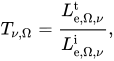
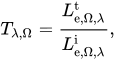
[edit]Spectral directional transmittance in frequency and spectral directional transmittance in wavelength of a surface, denoted Tν,Ω and Tλ,Ω respectively, are defined as[2]
where
- Le,Ω,νt is the spectral radiance in frequency transmitted by that surface;
- Le,Ω,νi is the spectral radiance received by that surface;
- Le,Ω,λt is the spectral radiance in wavelength transmitted by that surface;
- Le,Ω,λi is the spectral radiance in wavelength received by that surface.
Luminous transmittance
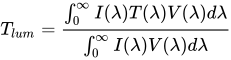
[edit]In the field of photometry (optics), the luminous transmittance of a filter is a measure of the amount of luminous flux or intensity transmitted by an optical filter. It is generally defined in terms of a standard illuminant (e.g. Illuminant A, Iluminant C, or Illuminant E). The luminous transmittance with respect to the standard illuminant is defined as:
where:
- is the spectral radiant flux or intensity of the standard illuminant (unspecified magnitude).
- is the spectral transmittance of the filter
- is the luminous efficiency function


The luminous transmittance is independent of the magnitude of the flux or intensity of the standard illuminant used to measure it, and is a dimensionless quantity.
Internal Transmittance
[edit]Optical Depth
[edit]By definition, internal transmittance is related to optical depth and to absorbance as

where
- τ is the optical depth;
- A is the absorbance.
Beer–Lambert law
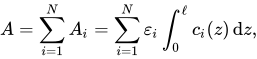
[edit]The Beer–Lambert law states that, for N attenuating species in the material sample,

where
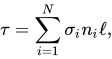
- σi is the attenuation cross section of the attenuating species i in the material sample;
- ni is the number density of the attenuating species i in the material sample;
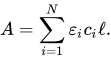
- εi is the molar attenuation coefficient of the attenuating species i in the material sample;
- ci is the amount concentration of the attenuating species i in the material sample;
- ℓ is the path length of the beam of light through the material sample.
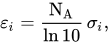
Attenuation cross section and molar attenuation coefficient are related by
and number density and amount concentration by

where NA is the Avogadro constant.
In case of uniform attenuation, these relations become[3]
Cases of non-uniform attenuation occur in atmospheric science applications and radiation shielding theory for instance.
Other radiometric coefficients
[edit]| Quantity | SI units | Notes | |
|---|---|---|---|
| Name | Sym. | ||
| Hemispherical emissivity | ε | — | Radiant exitance of a surface, divided by that of a black body at the same temperature as that surface. |
| Spectral hemispherical emissivity | εν ελ |
— | Spectral exitance of a surface, divided by that of a black body at the same temperature as that surface. |
| Directional emissivity | εΩ | — | Radiance emitted by a surface, divided by that emitted by a black body at the same temperature as that surface. |
| Spectral directional emissivity | εΩ,ν εΩ,λ |
— | Spectral radiance emitted by a surface, divided by that of a black body at the same temperature as that surface. |
| Hemispherical absorptance | A | — | Radiant flux absorbed by a surface, divided by that received by that surface. This should not be confused with "absorbance". |
| Spectral hemispherical absorptance | Aν Aλ |
— | Spectral flux absorbed by a surface, divided by that received by that surface. This should not be confused with "spectral absorbance". |
| Directional absorptance | AΩ | — | Radiance absorbed by a surface, divided by the radiance incident onto that surface. This should not be confused with "absorbance". |
| Spectral directional absorptance | AΩ,ν AΩ,λ |
— | Spectral radiance absorbed by a surface, divided by the spectral radiance incident onto that surface. This should not be confused with "spectral absorbance". |
| Hemispherical reflectance | R | — | Radiant flux reflected by a surface, divided by that received by that surface. |
| Spectral hemispherical reflectance | Rν Rλ |
— | Spectral flux reflected by a surface, divided by that received by that surface. |
| Directional reflectance | RΩ | — | Radiance reflected by a surface, divided by that received by that surface. |
| Spectral directional reflectance | RΩ,ν RΩ,λ |
— | Spectral radiance reflected by a surface, divided by that received by that surface. |
| Hemispherical transmittance | T | — | Radiant flux transmitted by a surface, divided by that received by that surface. |
| Spectral hemispherical transmittance | Tν Tλ |
— | Spectral flux transmitted by a surface, divided by that received by that surface. |
| Directional transmittance | TΩ | — | Radiance transmitted by a surface, divided by that received by that surface. |
| Spectral directional transmittance | TΩ,ν TΩ,λ |
— | Spectral radiance transmitted by a surface, divided by that received by that surface. |
| Hemispherical attenuation coefficient | μ | m−1 | Radiant flux absorbed and scattered by a volume per unit length, divided by that received by that volume. |
| Spectral hemispherical attenuation coefficient | μν μλ |
m−1 | Spectral radiant flux absorbed and scattered by a volume per unit length, divided by that received by that volume. |
| Directional attenuation coefficient | μΩ | m−1 | Radiance absorbed and scattered by a volume per unit length, divided by that received by that volume. |
| Spectral directional attenuation coefficient | μΩ,ν μΩ,λ |
m−1 | Spectral radiance absorbed and scattered by a volume per unit length, divided by that received by that volume. |
See also
[edit]References
[edit]- ^ "Electronic warfare and radar systems engineering handbook". Archived from the original on September 13, 2001.
- ^ a b c d "Thermal insulation — Heat transfer by radiation — Vocabulary". ISO 9288:2022. ISO catalogue. August 1, 2022. Retrieved February 12, 2025.
- ^ IUPAC, Compendium of Chemical Terminology, 5th ed. (the "Gold Book") (2025). Online version: (2006–) "Beer–Lambert law". doi:10.1351/goldbook.B00626
Transmittance
View on GrokipediaBasic Principles
Definition
Transmittance is a fundamental concept in optics and radiometry, defined as the fraction of incident radiant flux that is successfully transmitted through a sample, surface, or medium. It quantifies the effectiveness of the material or interface in allowing radiant energy to pass without being reflected or absorbed. This ratio is dimensionless and ranges from 0 (complete opacity) to 1 (perfect transparency).[7] In the context of radiometry, radiant flux represents the total power carried by electromagnetic radiation, measured in watts (W), encompassing the energy emitted, transferred, or received over time. The incident radiant flux is the power approaching the sample, while the transmitted radiant flux is the power emerging on the other side. The transmittance is mathematically expressed asMathematical Representation
Transmittance is conventionally denoted by the symbol $ T $, representing the fraction of incident radiant energy that is transmitted through a material or optical element. The radiant flux, denoted $ \Phi_e \Phi_{e,i} \Phi_{e,t} \Phi_{e,r} $).[11][12] The general mathematical expression for transmittance is given by the ratio of transmitted radiant flux to incident radiant flux:Surface Transmittance
Hemispherical Transmittance
Hemispherical transmittance quantifies the fraction of radiant flux that passes through a surface when the incident illumination originates from all directions within a hemisphere, integrating over the projected solid angle to account for the total energy transfer. It is defined as the ratio of the total transmitted radiant flux to the total incident radiant flux across the hemisphere, assuming uniform or diffuse incidence conditions.[11] In general, for non-uniform radiance distributions, it is expressed asDirectional Transmittance
Directional transmittance quantifies the transmission of radiant energy through an interface or medium for light incident and transmitted along specific directions, emphasizing the angular dependence that arises due to refraction and reflection at boundaries. It is particularly relevant in scenarios involving ray tracing or directional light propagation, where the overall energy transfer cannot be captured by angle-integrated measures. Unlike broader transmittance definitions, directional transmittance focuses on the ratio of radiance or irradiance in precisely defined incident and transmitted directions, governed by the geometry of the interface.[12] Mathematically, the directional transmittance is expressed asInternal Transmittance
Optical Depth
Optical depth, denoted as τ, serves as a logarithmic measure of the attenuation experienced by light propagating through a medium, specifically defined as the negative natural logarithm of the internal transmittance $ T_i $, where $ T_i $ represents the fraction of incident radiant power transmitted through the bulk material excluding losses due to surface reflection or refraction:Beer-Lambert Law
The Beer-Lambert law serves as the foundational model for calculating internal transmittance in dilute, homogeneous media, assuming no scattering or other losses beyond absorption. It expresses the internal transmittance $ T_i $ as $ T_i = e^{-\alpha \ell} $, where $ \alpha $ is the linear absorption coefficient (in units of inverse length) and $ \ell $ is the path length through the medium. An equivalent form, commonly used in chemical analysis, is $ T_i = 10^{-\epsilon c \ell} $, where $ \epsilon $ is the molar absorptivity (in liters per mole per centimeter), $ c $ is the molar concentration of the absorbing species, and the base-10 logarithm relates to the definition of absorbance $ A = -\log_{10} T_i = \epsilon c \ell $. This law quantifies how absorbed radiant power leads to exponential decay of transmitted intensity along the optical path.[26][27] The law's development traces back to Johann Heinrich Lambert's 1760 work Photometria, which established that light intensity diminishes exponentially with distance in an absorbing medium, independent of the incident angle for diffuse sources. August Beer extended this in 1852 by incorporating the effect of solute concentration in solutions, demonstrating that absorption scales linearly with both path length and concentration for dilute systems. Beer's contribution, published in Annalen der Physik und Chemie, merged Lambert's geometric optics insight with chemical principles, forming the modern Beer-Lambert law. This optical depth $ \tau = \alpha \ell $ directly corresponds to the exponent in the transmittance formula for uniform media.[26][28] The derivation starts from the infinitesimal attenuation of radiant flux $ \Phi_e $ due to absorption along a differential path $ ds $:Spectral and Luminous Transmittance
Spectral Transmittance
Spectral transmittance describes the fraction of incident radiant flux that is transmitted through a material or interface as a function of wavelength , denoted as . It is formally defined as the ratio of the differential spectral transmitted radiant flux to the differential spectral incident radiant flux , expressed asLuminous Transmittance
Luminous transmittance, denoted as , quantifies the fraction of incident luminous flux that passes through a material, weighted according to the human eye's sensitivity in the visible spectrum under photopic conditions. It is defined by the formula , where is the CIE photopic luminosity function, is the spectral transmittance of the material, and is the spectral power distribution of the light source; the constant lm/W represents the maximum luminous efficacy at 555 nm but cancels out in the ratio, yielding a dimensionless value tied to luminous flux in lumens.[36][37][11] Unlike radiometric transmittance, which treats all wavelengths equally, luminous transmittance accounts for the eye's peak sensitivity at 555 nm via , emphasizing green light while reducing the contribution from red and blue regions; in low-light scotopic conditions, a separate function with peak sensitivity at 507 nm applies, though photopic weighting dominates for typical daylight applications.[38][39] This perceptual weighting ensures reflects visible brightness rather than total energy, making it essential in photometry for assessing transparency in human vision contexts. In practical applications, luminous transmittance is critical for protective eyewear and vehicle glazing, where standards mandate minimum values to balance visibility and safety. For sunglasses, ANSI Z80.3 specifies categories based on ranges, such as 8–18% for general outdoor use to reduce glare while maintaining color perception.[40] Automotive windshields must achieve per Federal Motor Vehicle Safety Standard No. 205 to ensure driver visibility under normal conditions.[41] A representative example is neutral density filters, which exhibit nearly flat across the visible spectrum, allowing to approximate the uniform attenuation factor (e.g., an optical density of 0.3 corresponds to ) without spectral bias, ideal for photography and machine vision where consistent light reduction is needed.[42]Related Quantities and Applications
Other Radiometric Coefficients
In radiometry, transmittance is complemented by reflectance and absorptance, which together describe the interaction of radiant flux with a material. Reflectance $ R $ is defined as the ratio of the reflected radiant flux $ \Phi_e^r $ to the incident radiant flux $ \Phi_e^i $, expressed as $ R = \frac{\Phi_e^r}{\Phi_e^i} $. Absorptance $ a $ is similarly the ratio of the absorbed radiant flux $ \Phi_e^a $ to the incident radiant flux, given by $ a = \frac{\Phi_e^a}{\Phi_e^i} $. For non-scattering media, conservation of energy requires that the sum of transmittance $ T $, reflectance $ R $, and absorptance $ a $ equals unity: $ T + R + a = 1 $. These coefficients exhibit various forms depending on geometry and wavelength. Hemispherical reflectance accounts for reflection integrated over the hemisphere, while directional reflectance specifies the incident and reflected directions. Spectral variants, such as $ R_\lambda $ or $ T_\lambda $, describe wavelength-dependent behavior. The table below summarizes key radiometric coefficients related to transmittance.| Coefficient | Symbol | Definition | Common Variants |
|---|---|---|---|
| Transmittance | $ T $ | $ \frac{\Phi_e^t}{\Phi_e^i} $ | Hemispherical $ T $, directional $ T $, spectral $ T_\lambda $ |
| Reflectance | $ R $ | $ \frac{\Phi_e^r}{\Phi_e^i} $ | Hemispherical $ R $, directional-hemispherical $ R $, spectral $ R_\lambda $ |
| Absorptance | $ a $ | $ \frac{\Phi_e^a}{\Phi_e^i} $ | Spectral $ a_\lambda $ |
| Emissivity | $ \varepsilon $ | Ratio of emitted radiance to blackbody radiance | Spectral $ \varepsilon_\lambda = a_\lambda $ by Kirchhoff's law |