


Community hub
0 subscribers8 pages, 0 posts
Recent from talks
All channels
Be the first to start a discussion here.
Be the first to start a discussion here.
Be the first to start a discussion here.
Be the first to start a discussion here.
Contribute something
Welcome to the community hub built to collect knowledge and have discussions related to Tree tunnel.
Nothing was collected or created yet.
Tree tunnel
View on Wikipediafrom Wikipedia

A tree tunnel is a road, lane or track where the trees on each side form a more or less continuous canopy overhead, giving the effect of a tunnel.
The effect may be achieved in a formal avenue lined with trees or in a more rural setting with randomly placed trees on each side of the route.[1][2]
The British artist David Hockney has painted tree tunnels as a theme,[3] as especially illustrated at a 2012 solo exhibition of his work at the Royal Academy in London, England.[4] The English landscape artist Nick Schlee has used a tree tunnel as subject matter.[5]
Gallery
[edit]-

-
 New Orleans street, November 2000
 -

-

-
 Börnste hamlet, Kirchspiel, Dülmen, North Rhine-Westphalia, Germany
 -
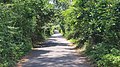 Tree tunnel in Srirampuram village, Rajamahendravaram, Andhra Pradesh, India


See also
[edit]

Wikimedia Commons has media related to Tree tunnels.
- Arbor (garden) – Outdoor garden feature forming a shaded walkway
- Dark Hedges – Avenue of trees in County Antrim, Northern Ireland
- Grove (nature) – Small group of trees
- Sunken lane – Road or track that is lower than the land on either side
- Tunnel of Love (railway) – Section of industrial railway in Ukraine
- Tunnel of Trees – State highway in Emmet County, Michigan, United States
- Vault (architecture) – Architectural term for an arched roof
References
[edit]- ^ Eaves, David (6 August 2009). "10 Enchanting Tree Tunnels". www.killerdirectory.com. Killer Directory. Retrieved March 4, 2012.
- ^ "12 Romantic Tree Tunnels". www.freedating.co.uk. UK: FreeDating.co.uk. Retrieved March 4, 2012.
- ^ Howgate, Sarah (25 October 2006). "The three David Hockneys". www.hockneypictures.com. Hockney Pictures. Retrieved March 4, 2012.
- ^ Nairn, Sarah (29 February 2012). "David Hockney RA: A Bigger Picture". www.creaturesofculture.com. Creatures of Culture. Archived from the original on 9 March 2012. Retrieved March 4, 2012.
- ^ "Nick Schlee — Green Tunnel". www.modernartistsgallery.com. Modern Artists Gallery. Retrieved March 4, 2012.
Tree tunnel
View on Grokipediafrom Grokipedia
A tree tunnel is a picturesque landscape feature formed by parallel rows of trees whose branches grow and interlock overhead to create a continuous, enclosed canopy along a road, path, or trail, evoking the sensation of passing through a verdant tunnel.[1] These formations can occur naturally through unmanaged growth or be intentionally planted for aesthetic, functional, or symbolic purposes in landscape design, often enhancing scenic drives, pedestrian routes, or entrances to estates and parks.[2]
Notable examples span the globe and vary in origin and species. In Northern Ireland, the Dark Hedges is an iconic avenue of beech trees (Fagus sylvatica), originally around 150 planted circa 1775 by the Stuart family to frame the approach to Gracehill House, with approximately 60-75 remaining as of 2025 due to age, storms, and safety removals, serving as both a dramatic landscape element and a later filming location for the "Kingsroad" in the television series Game of Thrones.[3][4] Similarly, the Cypress Tree Tunnel in Point Reyes National Seashore, California, features Monterey cypress (Cupressus macrocarpa) trees planted circa 1930 to define the entrance to a historic radio receiving station, now a protected signature feature with ongoing maintenance to ensure tree health.[2] Other renowned instances include the wisteria-draped tunnels at Kawachi Fuji Gardens in Japan, where flowering vines (Wisteria floribunda) transform the canopy into a seasonal spectacle, and the Tunnel of Love in Klevan, Ukraine, a railway line overarched by trees that has become a pilgrimage site for couples and photographers.[5]
Tree tunnels hold cultural and ecological significance, symbolizing harmony between human design and nature while providing habitat, shade, and biodiversity benefits in urban or rural settings.[6] However, many face threats from aging, storms, disease, and tourism pressures; for instance, several trees at the Dark Hedges have fallen or require removal due to their advanced age, prompting heritage organizations to balance preservation with safety.[7] These structures continue to inspire landscape architects, artists, and visitors, underscoring their enduring appeal as emblems of natural beauty integrated into the built environment.