Hubbry Logo
TribonianTribonianMain
Open search
Tribonian
Community hub
Tribonian
logo
8 pages, 0 posts
0 subscribers
Be the first to start a discussion here.
Tribonian
Tribonian
from Wikipedia

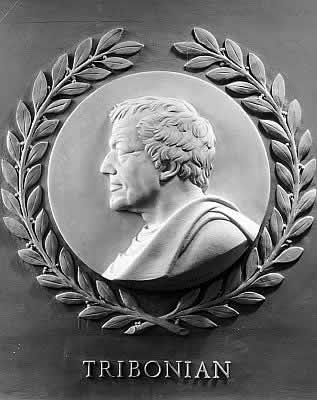
Tribonian (Greek: Τριβωνιανός [trivonia'nos], c. 485? – 542) was a jurist and advisor of the Eastern Roman Empire (Byzantine). During the reign of the Emperor Justinian I, he supervised the revision of the empire's legal code.[1] He has been described as one of the wisest collaborators of Justinian.[2]

Key Information

Tribonian was a Greek from Cyme, who studied law in Constantinople, where he became the most renowned legal scholar of his day. He was a close friend of Emperor Justinian, who appointed him to head the commission that compiled the Codex Justinianus and the Digest. Justinian also appointed Tribonian to high offices in the imperial administration, such as magister officiorum and quaestor sacri palatii, but at the beginning of the Nika riots he was forced to dismiss him on charges made by his enemies.[3] Tribonian died in 542 of a disease, perhaps the plague.[4]

Biography

[edit]

Tribonian was a Greek,[2][5][6] born in Cyme, in Pamphylia (modern Side),[7] around the year 485.[8] He may have been a pagan.[2][5][9] He was well educated and practiced law before the court of the praetorian prefect.[10] Justinian made Tribonian magister officiorum (Master of Offices), although it is not clear when,[11] and then appointed him quaestor sacri palatii in September 529.[12]

In 528, before he was appointed quaestor, Tribonian was named by Justinian as one of the commissioners charged with preparing the new imperial legal code, the Codex Justinianeus, which subsequently was issued on April 7, 529.[13] In 530, after Tribonian had become quaestor, it was natural for Justinian to put him in charge of the next major law reform project: compiling and harmonizing the writings of classical Roman jurists. Justinian's main objects in creating this harmonized compilation of juristic writings were to shorten litigation (by clarifying the law), and to create a syllabus to be used at the law schools in Berytus (Beirut) and Constantinople.[14] During the same period, Tribonian also was charged with carrying out another aspect of Justinian's reforms in legal education and codification — creating a textbook for first-year law students by updating the Institutes of Gaius. Both the Digest and the new Institutes of Justinian were promulgated in December of 533.[15] In 534, Justinian decided that so many new laws had been passed, and so many older ones harmonized, since the publication of his first Code in 529, a second edition was needed. Hence, the Codex repetitae praelectionis was published, entirely superseding the edition of 529, the text of which has been lost.[16]

In 532, Tribonian was removed as quaestor due to the charges of corruption made by his enemies during the Nika riots, but he continued to work on the codification.[17] He was restored to his post as quaestor in 535 and continued in that position until his death.[18] Tribonian continued to help draft new laws for Justinian; these new laws (Novellae Constitutiones) were later combined with the Codex Justinianus, the Digest and the Institutes to comprise the Corpus Juris Civilis.

Tribonian died in 542 of a disease, perhaps the plague.[4] Tribonian's career is summarized by his noted modern biographer, Tony Honoré, in this way: "...he was Justinian's minister for legislation and propaganda for nearly twelve years...In these years the three volumes of the Corpus Juris Civilis and most of the surviving legislation of Justinian's reign were produced. He drafted about three-quarters of the surviving constitutions of Justinian's reign. He planned and directed the work of the Second Law Commission, which produced the Digest, the Institutes and the Second "Codex Iustinianus."[19]

References

[edit]
Revisions and contributorsEdit on WikipediaRead on Wikipedia
from Grokipedia
Tribonian (Greek: Τριβωνιανός; c. 500 – c. 547) was a Byzantine jurist and high-ranking official who served as quaestor sacri palatii under Emperor Justinian I, directing the commissions that compiled core elements of the Corpus Juris Civilis, the systematic codification of Roman law that preserved classical jurisprudence for posterity. Appointed in 529 to oversee the initial Codex Justinianus, which consolidated imperial constitutions, Tribonian later led a team of sixteen scholars in excerpting and organizing excerpts from classical Roman jurists into the Digest (533) and co-authored the Institutes, an introductory textbook modeled on earlier works by jurists like Gaius. His efforts, authorized by Justinian to resolve contradictions and eliminate obsolete provisions, produced a unified legal framework that Justinian praised as divinely inspired and essential for imperial governance. Tribonian's tenure was marked by temporary dismissal in 532 amid the Nika riots, following senatorial accusations of venality and unauthorized legal alterations, though he was swiftly reinstated to complete the project, indicating Justinian's reliance on his expertise despite political pressures. Contemporary historian Procopius leveled charges of heresy, extortion, and plagiarism against him in the Secret History, portraying Tribonian as a Samaritan opportunist who distorted laws for personal gain; however, these allegations lack corroboration in Justinian's own edicts or neutral records and stem from a suppressed, vituperative tract reflecting Procopius' disillusionment with the regime. Tribonian's death, likely from plague in 542 or 547, preceded the addition of the Novellae constitutions to the Corpus, but his organizational methods—emphasizing concise synthesis over verbatim reproduction—ensured the work's enduring influence on continental European legal systems, from medieval glossators to modern civil codes.

Early Life and Background

Origins and Education

Tribonian was born around 500 CE in Side, a coastal city in (modern-day southern ), which had been established as a Greek colony by settlers from Cyme in during the BCE, reflecting its Hellenic cultural roots within the Roman provincial framework. This provincial origin underscored his non-aristocratic background, as Side lacked the senatorial elite networks of or , yet positioned him in a region blending Greek linguistic traditions with Roman administrative influence. He pursued legal studies at the renowned law school in (modern ), the preeminent center for Roman jurisprudence in the late antique East, where students engaged deeply with classical texts such as the works of and . There, Tribonian developed proficiency in both Latin—the language of —and Greek, enabling him to navigate the bilingual scholarly environment of the . This training transformed him into a skilled , practicing before magistrates' courts with notable success prior to gaining wider prominence. By the early , Tribonian had emerged as one of the era's leading legal scholars, recognized for his erudition in synthesizing and interpreting the fragmented corpus of classical Roman , though specific early teaching or advisory roles remain undocumented in surviving sources. His foundational expertise in these pre-Justinianic texts laid the groundwork for his later administrative roles, distinguishing him among contemporaries through rigorous textual analysis rather than hereditary privilege.

Rise in the Byzantine Administration

Appointment as Quaestor

Tribonian was appointed quaestor sacri palatii by Emperor in 530 CE, succeeding in this pivotal role that served as the emperor's primary legal counsel and drafter of imperial constitutions and legislation. The office, evolved from earlier Roman administrative positions under Constantine I, entailed advising on juridical matters, interpreting precedents, and ensuring new edicts aligned with established principles. Justinian selected Tribonian for the post due to his demonstrated mastery of classical Roman , honed through prior service in legal commissions, amid the emperor's urgent imperative to resolve the chaos of accumulated, often conflicting, imperial rescripts spanning centuries. This expertise was critical as the empire's legal apparatus suffered from redundancy and inconsistency, hindering administrative efficiency and judicial consistency across provinces. In his initial capacity as , Tribonian oversaw commissions tasked with scrutinizing and purging contradictory edicts from prior emperors, streamlining the corpus of active s to facilitate governance—a process that underscored his efficiency in distilling voluminous precedents without immediate recourse to expansive new compilations. This preparatory work advanced Justinian's vision of a cohesive legal framework, though Tribonian's precise methods drew on pragmatic synthesis rather than rigid adherence to every ancient text. In February 528, Emperor Justinian I established a ten-member commission via the constitution Hac quae necessario to review prior compilations of imperial constitutions, including the Theodosian Code and post-Theodosian novels, with the mandate to excise obsolete provisions, resolve contradictions, and streamline the accumulated body of Roman statutes into a coherent collection. Tribonian, already a prominent jurist, served as a key member of this body, contributing to the elimination of redundant and conflicting laws that had proliferated since Hadrian's era, thereby addressing the procedural chaos impeding judicial efficiency. The commission's work, completed in approximately 14 months, culminated in the promulgation of the first Codex Justinianus on April 7, 529, demonstrating Tribonian's organizational efficiency in executing a complex revision ahead of protracted timelines typical for such undertakings. Tribonian's role extended to advising on early legislative edicts during this period, including measures simplifying rules—such as granting a poor a quarter share of her husband's estate beyond her —and fiscal adjustments to clarify liabilities amid administrative reforms. These interventions prioritized practical resolution of empirical discrepancies in existing statutes over doctrinal innovation, reflecting a focus on causal efficacy in legal application to reduce litigation burdens. In parallel, procedural reforms targeted formalities, supplanting archaic fictitious rituals with straightforward declarations before magistrates, which expedited validations and curbed disputes rooted in evidentiary ambiguities. Such preparatory changes laid the groundwork for broader codification by purging inconsistencies, underscoring Tribonian's acumen in marshaling commissions for swift, targeted outputs rather than expansive theoretical overhauls.

Compilation of the Codex Justinianus

In February 528, Emperor established a commission of ten jurists, with Tribonian as a key member, to systematize imperial constitutions into a single, coherent code. This effort targeted the compilation of edicts from (r. 117–138) onward, incorporating materials from prior collections such as the Codex Gregorianus, Codex Hermogenianus, and , while integrating post-Theodosian enactments up to Justinian's own reign. The commissioners were instructed to excise obsolete, redundant, or contradictory provisions, reorganizing the selected texts thematically into books and titles to enhance accessibility and eliminate interpretive ambiguities. Tribonian's involvement ensured a rigorous editorial process, authorizing the team to rephrase constitutions for precision and alignment with contemporary imperial needs, rather than mere archival reproduction. This approach addressed the chaotic proliferation of over two millennia of decrees, which had rendered prior law unwieldy for practitioners. Completed in approximately 14 months, the Codex Justinianus was promulgated on 7 April 529, forming ten books in its initial edition (later expanded to twelve in the 534 revision). It served as the sole authoritative source of imperial legislation, superseding earlier codes and mandating their destruction to enforce uniformity. The compilation's scale involved sifting extensive rolls and codices preserved in imperial archives, prioritizing causal consistency in legal application—such as harmonizing fiscal, criminal, and civil rules—over exhaustive inclusion. This empirical method facilitated Justinian's vision of a streamlined corpus, influencing Byzantine by providing judges and officials with a unified reference free from antiquated discrepancies.

Development of the Digest

In 530, Emperor issued the Constitutio Deo Auctore, directing Tribonian to assemble a commission for compiling the Digest—a systematic collection of excerpts from classical Roman juristic writings to serve as authoritative . The commission comprised Tribonian and 16 other legal experts, primarily professors and practitioners, who were instructed to select, abridge, and organize materials without using abbreviations and to resolve any inconsistencies. This effort targeted the vast corpus of pre-Justinianian legal literature, spanning roughly 2,000 books and over three million lines from the works of approximately 39 classical jurists, including dominant figures like (whose excerpts constitute about one-third of the Digest) and . The compilation process followed a structured approach, dividing the source materials into three "masses" based on jurisprudential schools (, Sabinus, and ), reading them sequentially to extract relevant fragments on legal topics such as , contracts, and obligations. Where texts were verbose, the commissioners abridged them to essential points; conflicting opinions were reconciled by prioritizing the more persuasive or practical view, often favoring imperial utility over exhaustive preservation. These excerpts were then arranged topically into 50 , each divided into titles grouping related discussions, ensuring the Digest functioned as a concise, non-redundant rather than a verbatim archive. To adapt classical content to sixth-century realities, the editors incorporated interpolationes—deliberate modifications including updated terminology, eliminations of obsolete references, and alignments with Justinian's Christian orthodoxy and absolutist principles, such as emphasizing divine imperial authority over pagan elements. These changes, numbering in the thousands, are detectable via comparative comparing Digest passages to surviving classical fragments or parallel sources, revealing shifts like softened rhetoric or enhanced patriarchal norms consistent with Byzantine . Despite the scale, the project concluded efficiently, with the Digest promulgated on December 16, 533, via the Constitutio Tanta, establishing it as binding and demonstrating the commission's focus on pragmatic synthesis over completeness.

Creation of the Institutes

In 533, Emperor Justinian I directed Tribonian, then quaestor sacri palatii, to lead a commission comprising the law professors Theophilus and Dorotheus in compiling the Institutiones (Institutes), an introductory textbook intended to distill foundational Roman legal principles for students and practitioners. This effort followed the initial phases of the Codex and Digest projects, aiming to provide a concise, systematic primer that complemented the more comprehensive compilations by focusing on core doctrines rather than exhaustive juristic debates. The Institutes were structured in four books, mirroring the organizational schema of the second-century jurist : the first on persons (status and rights of individuals); the second on things ( and ); the third on obligations (contracts and delicts); and the fourth on actions (remedies and procedure). This division emphasized practical, elemental exposition, drawing from classical sources while incorporating recent imperial constitutions to ensure applicability in contemporary adjudication. The commission completed the draft with remarkable speed, reflecting Justinian's urgency to standardize amid administrative reforms. Promulgated on November 21, 533, alongside the Digest, the Institutes acquired the force of law through imperial constitution, supplanting prior elementary texts and mandating their use in legal instruction across the empire. Under Tribonian's supervision, the work aligned terminologically and substantively with the evolving Corpus Juris Civilis, prioritizing clarity and empirical utility over speculative interpretation to facilitate uniform application in courts and schools.

Political Challenges and Controversies

Accusations of Corruption and Heterodoxy

Tribonian was accused of by the court historian in his Anecdota (also known as the Secret History), a polemical text written circa 550 CE that bitterly critiques Justinian's administration and its officials. charged that, as sacri palatii, Tribonian accepted bribes to manipulate legal outcomes, thereby undermining the and exemplifying systemic corruption under Justinian. These claims portray Tribonian as prioritizing personal enrichment over impartiality, with alleging he sold favorable rulings to litigants, contributing to elite rivalries and . Procopius further criticized Tribonian's role in the legal codification, asserting that he introduced contradictions, obsolete provisions, and unauthorized interpolations into the compilations, effectively or fabricating elements to serve private interests rather than faithfully synthesizing prior . Such editorial practices, according to , corrupted the authoritative intent of Justinian's reforms, though no contemporary beyond his account corroborates specific instances of plagiarism. On religious , labeled Tribonian a —a sect viewed by Christians as schismatic and syncretistic with pagan elements—who adopted a Christian solely to retain power amid Justinian's purges of non- groups starting in 529 CE. This accusation implied latent pagan sympathies (hellenismos), contrasting sharply with the explicitly Christian preambles in the Codex Justinianus (529 CE) and Digest (533 CE), which invoke and align with imperial . No empirical records, such as condemnations or personal writings, substantiate ' claim of ; instead, Tribonian's oversight of codes enforcing Christian suggests alignment with Justinian's anti-heretical agenda. These allegations, disseminated posthumously in the Anecdota—a work concealed during his lifetime due to its inflammatory nature—reflect likely political motivations amid court intrigues and theological enforcements, where rival senators and officials weaponized charges of corruption and deviance. ' credibility is compromised by his shift from official histories to scandalous , possibly driven by personal grievances, rendering the accusations probable smears rather than verified facts. Tribonian's enduring role in codification, which bolstered Justinian's orthodox legal order, undermines notions of substantive or irredeemable .

Dismissal During the Nika Riots and Reinstatement

In January 532, as the erupted in , Emperor dismissed Tribonian from his role as quaestor sacri palatii on or about January 14, alongside John the Cappadocian and City Prefect Eudaemon, in a bid to placate the unified and factions. The rioters specifically targeted these officials for their association with unpopular fiscal exactions and rigorous enforcement of legal reforms, viewing them as symbols of administrative overreach. was appointed as interim quaestor to signal compliance with the demands. The riots, which began on and raged through , culminated in widespread and violence that claimed over 30,000 lives, according to contemporary historian , before being brutally suppressed by imperial forces under and Mundus on January 18. Tribonian's ouster served as a for broader factional grievances, though his legal innovations—such as streamlined judicial procedures—had fueled elite and popular discontent by challenging entrenched interests. Despite the temporary dismissal, Justinian reinstated Tribonian shortly after the riots' suppression, recognizing his unparalleled competence in jurisprudence as essential for ongoing codification efforts; this allowed Tribonian to continue directing the compilation of the Digest and Institutes, completed in December 533. He formally resumed the quaestorship sometime after 534, underscoring the emperor's prioritization of administrative efficacy over transient public clamor.

Final Years and Death

Continued Service Under Justinian

Upon his reinstatement as sacri palatii following the of January 532, Tribonian resumed his role as Justinian I's principal legal advisor, serving continuously from approximately 534 until his death in 542. In this capacity, he played a key part in the preparation and promulgation of the second edition of the Codex Justinianus, issued on November 16, 534, which integrated imperial constitutions enacted between the first edition of 529 and 534 to address evolving administrative and judicial needs. This revision, comprising 168 books, eliminated redundancies from the prior version and incorporated practical updates derived from eight years of legal practice, reflecting Justinian's emphasis on adapting law to contemporary realities rather than mere archival preservation. Tribonian's duties extended to drafting and advising on subsequent imperial novellae, the new constitutions issued after 534, many of which focused on procedural reforms such as simplifying judicial processes, standardizing evidence rules, and enhancing enforcement mechanisms across provinces to bridge gaps between codified theory and local application. For instance, these reforms targeted inefficiencies in provincial governance, including clearer delineations for magistrates' authority and measures to curb corruption in legal proceedings, drawing on Tribonian's experience in prior commissions to ensure causal alignment between legislation and empirical judicial outcomes. His involvement underscored Justinian's reliance on Tribonian's expertise for maintaining legal coherence amid military reconquests and internal stabilization efforts. Throughout this period, Tribonian faced no further significant dismissals or public accusations, indicating the emperor's prioritization of administrative competence in a where and results outweighed factional pressures, even as Justinian consolidated autocratic control. This stability allowed Tribonian to sustain influence over the empire's legal framework, contributing to the ' ongoing implementation without interruption from political intrigue.

Death in Military Context

Tribonian died in 542 CE from a disease widely identified as the during the initial wave of the , which originated in and spread rapidly through the empire's ports and armies. This outbreak devastated , claiming up to 10,000 lives daily at its peak, and extended to military fronts, decimating troops and logistics amid ongoing Sasanian Persian incursions under King . The plague's arrival exacerbated the empire's vulnerabilities following the Persian sack of Antioch in 540 CE and disrupted reinforcements, compelling Justinian to recall General from to the eastern theater in mid-542, though operations were severely curtailed by disease-related losses. As quaestor sacri palatii since 534 CE, Tribonian remained in administrative service, handling imperial edicts that indirectly supported wartime governance, such as legal provisions for taxation and recruitment strained by the crisis. No primary accounts, including those of Procopius, record his involvement in combat or field logistics, but high officials like him faced elevated risks from epidemic exposure in mobilized imperial centers. Aged around 60–67 at death, his passing concluded direct contributions to Justinian's legal reforms, with later Novels promulgated by successors amid persistent eastern threats.

Historical Assessment and Legacy

Achievements in Roman Law Preservation

Tribonian directed the commission responsible for the Digest (also known as the Pandects), a monumental compilation promulgated on , 533 CE, which preserved excerpts from the classical Roman jurists' writings that formed the intellectual core of . Tasked by Emperor via the Deo auctore in 530 CE, Tribonian and his team of sixteen collaborators systematically reviewed approximately 2,000 volumes by about 39 jurists—chiefly from the second and third centuries CE, such as , Paulus, and —and condensed them into 50 books organized by 432 topical titles, retaining over 9,500 extracts while omitting contradictions, repetitions, and obsolete provisions. This process safeguarded doctrines on , contracts, , and delicts against the era's decay and post-classical neglect, where many original texts were later destroyed or lost following the compilation's completion. The Digest's editorial method emphasized practical usability, subjecting fragmented sources to rigorous selection based on relevance to contemporary imperial needs, thereby countering the fragmentation that had rendered pre-existing law inefficient for adjudication across diverse regions. By resolving antinomies through contextual harmonization and excision of archaic elements—such as outdated republican customs unsuited to a centralized empire—the work enabled causal consistency in legal reasoning, reducing interpretive disputes that previously proliferated under ad hoc reliance on disparate edicts and responsa. The commission's efficiency, achieving this synthesis in under three years despite the source material's volume, outpaced earlier efforts like the Theodosian Code (438 CE), which omitted juristic literature and covered only imperial constitutions, thus failing to preserve the analytical depth of classical jurisprudence. Through the Digest and its integration into the broader Corpus Juris Civilis, Tribonian ensured the transmission of Roman law's foundational principles, providing a unified reference that stabilized governance in the Byzantine realm and laid the groundwork for millennia of legal continuity, with the preserved texts exerting influence traceable through medieval glossators to modern civil codes. This preservation effort empirically demonstrated the value of condensation over exhaustive archiving, as the streamlined corpus facilitated faster access and application, evidenced by its rapid adoption in imperial tribunals post-533 CE.

Criticisms of Editorial Methods and Interpolations

Tribonian's compilation of the Digest has drawn scholarly scrutiny for alleged interpolations that modified classical Roman juristic texts to incorporate post-classical interpretations, particularly those aligning with Justinian's doctrinal preferences. Critical editions, such as Theodor Mommsen's apparatus criticus to the Digestum Vetus, identify hundreds of suspected insertions, including phrases like "licet" clauses that harmonize disparate opinions or introduce imperial rationales absent in antecedent manuscripts, thereby potentially obscuring the original argumentative structure of authors like or . These alterations, estimated to affect up to 10-15% of the text based on comparative , raise questions about fidelity to source materials drawn from over 2,000 books by 39 jurists. The organizational methods employed under Tribonian's direction have been criticized for insufficient thematic coherence, with rubrics and titles occasionally grouping excerpts thematically at the expense of chronological or doctrinal sequence, leading to perceived haphazardness in cross-references. For instance, provisions on delicts (Digest 47-48) intermix republican-era fragments with later adaptations without explicit bridging, which some analysts argue disrupts causal chains in legal reasoning from classical precedents. Sixteenth-century humanists, exemplified by François Hotman's Antitribonian (1567), amplified these concerns by decrying a "barbarized" Latin style influenced by Byzantine Greek idioms, though subsequent linguistic studies caution against over-attributing stylistic shifts to deliberate degradation rather than translational necessities. Contemporary observer Procopius, in his Anecdota (c. 550 CE), portrayed the editorial process as lacking originality, attributing to Tribonian's commissions a rushed synthesis of vast repositories that prioritized expediency over exhaustive verification, potentially embedding Justinian-era biases into ostensibly classical content. While this reflects Procopius's broader animus toward the regime, textual evidence supports claims of pragmatic shortcuts, such as the omission of contradictory passages without notation. Defenders, however, contend that such interventions causally addressed irreconcilable inconsistencies—e.g., reconciling Sabinian and Proculian schools on contractual validity—enhancing the Digest's practical utility, with no manuscript anomalies suggesting intentional distortion beyond editorial license granted by the Deo auctore constitution of 530 CE. Empirical reviews of parallel sources, like the Codex Theodosianus, reveal analogous harmonizations predating Tribonian, indicating overreach critiques may undervalue the compilation's scale amid limited paleographic resources. The , compiled under Tribonian's oversight between 529 and 534 CE, formed the enduring foundation of legal administration in the , sustaining its application through successive dynasties until the Ottoman conquest of in 1453. This continuity integrated Roman principles with Orthodox Christian norms, shaping ecclesiastical and secular governance in Eastern Orthodox domains, where provisions on , , and imperial authority persisted in adapted forms. Such preservation evidenced adaptive evolution rather than wholesale rupture from , maintaining systematic legal reasoning amid political transformations. In the West, the Corpus experienced a resurgence in the late 11th century, with key manuscripts of the Digest—a core component edited by Tribonian—surfacing in northern Italy, particularly Bologna, prompting scholarly exegesis by the glossators from circa 1080 onward. These jurists, led by figures like Irnerius, annotated and reconciled the texts with contemporary needs, establishing the ius commune as a hybrid framework that fused Roman precepts with canon law and feudal customs, thereby influencing judicial practice across medieval Europe until the 16th century. This medieval reception transmitted foundational concepts in delicts, contracts, and property rights, which glossators and later commentators refined into a supranational legal idiom operative in ecclesiastical courts and secular tribunals. The Corpus's principles exerted causal effects on 19th-century codifications, notably informing the of 1804, which drew on its structured approach to obligations and civil rights, and the German (BGB) effective from 1900, which incorporated Roman-derived abstractions of will and fault in contractual liability. These codes propagated civil law systems—characterized by comprehensive statutory enumeration and judicial subsumption under general rules—ultimately rooted in the Corpus, across approximately 150 countries, encompassing , , and parts of and where colonial or reformist adoptions prevailed. Byzantine-mediated Roman law also intersected with Islamic administrative practices in frontier zones, influencing commercial norms and treaty frameworks in regions like and through shared Hellenistic-Roman substrates, though predominated in core . This multifaceted legacy underscores the Corpus's role in furnishing enduring causal mechanisms for legal systematization, prioritizing empirical codification over localized precedents.

References

Add your contribution
Related Hubs
User Avatar
No comments yet.