Hubbry Logo
TruncationTruncationMain
Open search
Truncation
Community hub
Truncation
logo
7 pages, 0 posts
0 subscribers
Be the first to start a discussion here.
Truncation
Truncation
from Wikipedia

In mathematics and computer science, truncation is limiting the number of digits right of the decimal point.

Truncation and floor function

[edit]

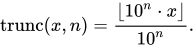
Truncation of positive real numbers can be done using the floor function. Given a number to be truncated and , the number of elements to be kept behind the decimal point, the truncated value of x is

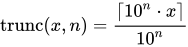
However, for negative numbers truncation does not round in the same direction as the floor function: truncation always rounds toward zero, the function rounds towards negative infinity. For a given number , the function is used instead

.

Causes of truncation

[edit]

With computers, truncation can occur when a decimal number is typecast as an integer; it is truncated to zero decimal digits because integers cannot store non-integer real numbers.

In algebra

[edit]

An analogue of truncation can be applied to polynomials. In this case, the truncation of a polynomial P to degree n can be defined as the sum of all terms of P of degree n or less. Polynomial truncations arise in the study of Taylor polynomials, for example.[1]

See also

[edit]

References

[edit]
[edit]
Revisions and contributorsEdit on WikipediaRead on Wikipedia
from Grokipedia
Truncation is the act of making something shorter or quicker, especially by removing the end or a less significant part of it. This process applies across various disciplines, where it serves to simplify complex structures while potentially introducing approximations or alterations. In and , truncation commonly refers to the error arising from approximating an infinite series, , or exact value with a finite representation, such as limiting places or terminating an iterative process early. For instance, truncating the decimal expansion of π to 3.14 discards subsequent digits, resulting in a that affects computational accuracy. This type of error is distinct from rounding error, as truncation simply discards excess digits without adjusting to the nearest value, and its magnitude typically decreases with finer approximations but can accumulate in iterative algorithms. In , truncation often involves cutting off beyond a specified precision or , such as in where numbers are stored with limited bits, leading to the loss of least significant digits. For example, representing 3.14159 as 3.14 in a system with two decimal places truncates the trailing digits, potentially impacting calculations in simulations or . Programmers must balance this with storage constraints, as truncation errors can propagate in chained operations, unlike which aims to minimize . In , truncation is a word-formation process that shortens words by omitting syllables or letters, often creating informal variants known as clippings, such as "prof" from "professor" or "ad" from "advertisement." This morphological strategy preserves core elements like the initial sounds or stressed syllables, facilitating efficient communication in casual speech or . Truncations can be initial (removing the start), final (removing the end), or medial, and they play a key role in language evolution, though they may alter or meaning subtly. In geometry, truncation denotes an operation on polyhedra or polygons that cuts off vertices at a uniform depth, replacing them with new polygonal faces while shortening the original edges. Applied to Platonic solids, this produces Archimedean solids like the , where vertices are excised to create regular polygons from the cuts. The process maintains but increases the number of faces, edges, and vertices, offering insights into polyhedral transformations and topological properties.

Mathematical Definitions

Core Definition

Truncation in is the process of approximating a xx by discarding its , thereby retaining only the component closest to zero without any adjustment. This operation effectively shortens the number by removing digits or terms beyond a specified precision, always directing the result regardless of the of xx. For example, truncating 3.7 results in 3, while truncating -3.7 results in -3. The truncation function is commonly denoted as trunc(x)\operatorname{trunc}(x) or, in some contexts, as the directed integer part 0_0, emphasizing the towards-zero behavior. This notation distinguishes it from other truncation variants, such as those in decimal expansions where digits after a certain place are simply omitted. In numerical contexts, truncation provides a straightforward method for limiting precision, though it introduces a systematic by consistently discarding the .

Relation to Floor Function

The floor function, denoted x\lfloor x \rfloor, is defined as the greatest less than or equal to a xx, directing the result toward negative . Truncation relates to the floor function by discarding the of xx toward zero, yielding equivalence for non-negative values: trunc(x)=x\mathrm{trunc}(x) = \lfloor x \rfloor when x0x \geq 0. For negative values x<0x < 0, truncation instead aligns with the ceiling function, defined as the smallest greater than or equal to xx, such that trunc(x)=x\mathrm{trunc}(x) = \lceil x \rceil. This distinction arises because truncation preserves the sign while removing the fractional component without directional bias beyond zero, expressible as trunc(x)=sgn(x)x\mathrm{trunc}(x) = \mathrm{sgn}(x) \cdot \lfloor |x| \rfloor, where sgn(x)\mathrm{sgn}(x) denotes the sign of xx (1 if x>0x > 0, -1 if x<0x < 0, and 0 if x=0x = 0). To illustrate the relationship, decompose any real xx as x=n+fx = n + f, where n=xn = \lfloor x \rfloor is the integer part and f=xnf = x - n is the satisfying 0f<10 \leq f < 1. For x0x \geq 0, trunc(x)=n\mathrm{trunc}(x) = n directly. For x<0x < 0 with f>0f > 0, the toward-zero operation yields n+1n + 1, as the fractional part pushes away from the more negative value. Examples confirm this: trunc(2.3)=2=2.3\mathrm{trunc}(2.3) = 2 = \lfloor 2.3 \rfloor, but trunc(2.3)=22.3=3\mathrm{trunc}(-2.3) = -2 \neq \lfloor -2.3 \rfloor = -3 and instead equals 2.3=2\lceil -2.3 \rceil = -2.

Distinction from Rounding

Truncation and rounding are both techniques used to approximate real numbers by discarding or adjusting fractional parts, but they differ fundamentally in their approach. Rounding methods, such as round half up or banker's rounding (also known as round half to even), evaluate the fractional part of a number and adjust the integer part accordingly to the nearest value, potentially adding or subtracting based on predefined rules. For instance, under round half up, a value like 3.7 is rounded to 4 by incrementing the integer part since the fractional part (0.7) exceeds 0.5, while banker's rounding for 3.5 would round to 4 (the nearest even integer) to minimize cumulative bias in repeated operations. The primary distinction lies in truncation's non-adjustive nature: it simply discards the fractional part without considering its value relative to 0.5 or other thresholds, always directing the result toward zero regardless of the sign or magnitude of the fraction. This contrasts with rounding's aim to select the closest representable value, which may introduce adjustments away from zero. For positive numbers, truncation yields the floor value, but for negatives, it avoids the downward shift that floor would impose, maintaining a consistent zeroward bias. To illustrate, consider the following comparison using common rounding (round half up for simplicity) versus truncation:
ValueTruncation (Toward Zero)Rounding (Half Up)
1.612
1.411
-1.6-1-2
-1.4-1-1
In this table, truncation consistently removes the decimal without alteration, while rounding adjusts based on the fractional part exceeding 0.5. This zero-directed behavior in truncation introduces a systematic bias toward smaller magnitudes, potentially accumulating errors in iterative computations, whereas symmetric rounding methods like nearest-even aim for unbiased approximations over multiple applications. In the IEEE 754 floating-point standard, truncation corresponds to the "round toward zero" mode, a directed rounding option distinct from nearest or infinity-directed modes, emphasizing its role as a subset of broader rounding strategies without nearest-value selection.

Numerical Analysis and Errors

Truncation Errors

Truncation error refers to the discrepancy introduced when an infinite or continuous mathematical process is approximated by a finite representation, such as limiting the number of terms in a series or digits in a number. This error is formally defined as the e=x\trunc(x)|e| = |x - \trunc(x)|, where xx is the exact value and \trunc(x)\trunc(x) is its truncated , and it is inherently bounded by the precision of the chosen representation. In decimal systems, this bound is often at most 0.5 units in the last place for rounding-like truncations, but for strict truncation (chopping), the error satisfies e<10n|e| < 10^{-n} when performed after nn digits, as the discarded portion cannot exceed the value of the next digit place. Truncation errors can be categorized into two primary types: representation truncation and algorithmic truncation. Representation truncation occurs when finite storage formats, such as floating-point representations, discard digits beyond a fixed precision limit, leading to inherent approximation in number storage. In contrast, algorithmic truncation arises from deliberately cutting off an infinite process, such as terminating an infinite series after a finite number of terms to approximate a function. For truncation after nn digits in decimal systems, the error bound is generally e<10n|e| < 10^{-n}, reflecting the maximum possible contribution from the omitted digits. A classic example of truncation error quantification appears in the approximation of functions via Taylor series expansions. When truncating the Taylor series of a function f(x)f(x) around 0 after nn terms, the remainder term Rn(x)R_n(x), which captures the truncation error, is given by the Lagrange form: Rn(x)=f(n+1)(ξ)(n+1)!xn+1R_n(x) = \frac{f^{(n+1)}(\xi)}{(n+1)!} x^{n+1} for some ξ\xi between 0 and xx. This expression bounds the error based on the higher-order derivative and provides a precise measure of the approximation's accuracy. In iterative numerical methods, truncation errors can accumulate over multiple steps, propagating and amplifying to cause significant loss of overall precision in the final result. This accumulative effect is particularly pronounced in long-running computations, where each iteration introduces a small error that compounds, potentially leading to divergent or unreliable outcomes unless controlled.

Causes in Computation

In digital computing, truncation frequently originates from fixed-precision storage formats, most notably binary floating-point arithmetic standardized by IEEE 754. This standard allocates a limited number of bits to the mantissa—23 for single-precision (32-bit) and 52 for double-precision (64-bit)—forcing the approximation of numbers whose binary representations are infinite or exceed these bit limits. For instance, the decimal value 0.1 converts to a repeating binary fraction (0.00011001100110011...₂), which is truncated to fit the 23-bit mantissa in single precision, yielding an inexact representation of approximately 0.10000000149011612. Similarly, computing 1 divided by 3 in single precision results in about 0.3333333432674408, a truncation of the repeating binary 0.010101010101...₂ that cannot be fully captured within the available bits. The historical development of these formats underscores truncation's roots in hardware evolution. Early computers in the 1940s, such as the ENIAC, relied on fixed-point arithmetic with 10-digit decimal registers to perform operations within constrained vacuum-tube technology, inherently truncating results to fit register capacities and avoid overflow. Although pioneers like Konrad Zuse introduced binary floating-point in the Z3 (1941) to handle wider dynamic ranges without manual scaling, most systems of the era stuck to fixed-point due to memory and complexity limitations. By the 1960s, floating-point became prevalent in scientific computing for its scalability, culminating in the IEEE 754 standard of 1985, which formalized truncation behaviors to ensure consistent representation across hardware. Algorithmic choices in software further induce truncation by design, often to achieve practical termination in otherwise infinite processes. For example, iterative methods like those for solving differential equations via finite differences approximate derivatives by truncating Taylor series expansions, as in the forward difference formula f(xi)f(xi+1)f(xi)hf'(x_i) \approx \frac{f(x_{i+1}) - f(x_i)}{h}, which discards higher-order terms for computational feasibility. In numerical integration, algorithms such as the trapezoidal rule sum over a finite number of subintervals, truncating the exact integral by approximating the function's curvature with linear segments and imposing loop limits based on desired precision or time constraints. Hardware constraints, particularly finite register sizes in processors, compel truncation to prevent overflow and optimize performance. Floating-point units typically process values in fixed-width registers (e.g., 32 or 64 bits), where intermediate results exceeding this width are truncated or rounded to fit, especially during operations like subtraction of nearly equal magnitudes that could otherwise lose significant digits without extra guard bits. This design choice balances speed and resource use but introduces implicit truncation, as seen in early architectures lacking extended precision registers, forcing developers to manage overflow risks through algorithmic scaling.

Mitigation Techniques

To mitigate truncation errors in numerical computations, higher precision arithmetic is a fundamental strategy, as it increases the number of bits available for mantissa representation, thereby reducing the relative magnitude of lost information during operations. For example, transitioning from single precision (approximately 7 decimal digits) to double precision (about 15 decimal digits) can substantially diminish truncation effects in iterative algorithms like numerical integration. Arbitrary-precision libraries further extend this capability; Python's decimal module, for instance, supports user-defined precision levels for decimal floating-point arithmetic, enabling exact representation of decimal fractions and avoidance of binary truncation artifacts common in standard floating-point systems. Error estimation techniques, such as compensated summation, address truncation by explicitly tracking and correcting the low-order bits discarded in each operation. The Kahan summation algorithm exemplifies this: it introduces a compensation variable that accumulates the error remainder from each addition, effectively restoring precision in sequential summations and reducing the total error from O(n ε) to nearly O(ε), where n is the number of terms and ε is the machine epsilon. This method is particularly effective in financial computations or statistical aggregations where small per-step losses accumulate. Alternative representations like interval arithmetic bound truncation errors by enclosing computed values within intervals that guarantee containment of the exact result, accounting for all possible rounding or truncation variations. Pioneered by Ramon E. Moore, interval methods propagate enclosures through operations, yielding verified bounds on errors without assuming specific truncation behaviors, which is valuable in safety-critical simulations such as aerospace trajectory predictions. Opting for rounding-to-nearest instead of pure truncation minimizes directional bias, as truncation systematically discards positive fractions for positive numbers (and vice versa), leading to underestimation, whereas rounding distributes errors symmetrically around zero. The mandates round-to-nearest-ties-to-even as the default rounding mode precisely to mitigate such biases in general-purpose computations. In matrix computations, truncation errors can propagate and amplify during factorization; with partial pivoting counters this by interchanging rows to select the largest possible pivot element at each elimination step, which bounds the growth factor of the process and ensures backward stability with error perturbations typically on the order of machine epsilon times the matrix norm. This technique maintains computational efficiency while preventing catastrophic error buildup in solving linear systems.

Applications in Algebra

Polynomial Truncation

Polynomial truncation refers to the approximation of a finite-degree polynomial p(x)=k=0nakxkp(x) = \sum_{k=0}^n a_k x^k by a lower-degree polynomial pm(x)=k=0makxkp_m(x) = \sum_{k=0}^m a_k x^k, where m<nm < n, achieved by discarding all terms of degree greater than mm. This process simplifies the polynomial for algebraic manipulation or computational purposes while retaining the leading terms that dominate behavior in certain domains. The error in this approximation is precisely the remainder term Rm(x)=p(x)pm(x)=k=m+1nakxkR_m(x) = p(x) - p_m(x) = \sum_{k=m+1}^n a_k x^k. For x<1|x| < 1, the magnitude of the error can be bounded by Rm(x)k=m+1nakxk|R_m(x)| \leq \sum_{k=m+1}^n |a_k| |x|^k, providing a conservative estimate based on the absolute values of the coefficients and the evaluation point. This bound is particularly useful in numerical contexts where convergence-like properties aid in assessing approximation quality without exact computation of higher terms. In applications, polynomial truncation facilitates the simplification of algebraic expressions, such as reducing complex forms for symbolic computation, and enhances numerical evaluation efficiency. A representative example is the truncation of the finite geometric series polynomial p(x)=1+x+x2++x5p(x) = 1 + x + x^2 + \cdots + x^5 to degree 2, yielding p2(x)=1+x+x2p_2(x) = 1 + x + x^2, which approximates the infinite geometric sum 11x\frac{1}{1-x} for x<1|x| < 1 with an error bounded by the discarded terms. Historically, polynomial truncation found early use in 18th-century interpolation techniques developed by , where lower-degree polynomials approximated tabular data through finite differences, laying foundational methods for numerical analysis.

Infinite Series Approximation

In the approximation of infinite series, truncation involves replacing the full sum k=0ak\sum_{k=0}^\infty a_k with the partial sum sn=k=0naks_n = \sum_{k=0}^n a_k, where the tail or remainder Rn=k=n+1akR_n = \sum_{k=n+1}^\infty a_k quantifies the error introduced by this finite approximation. The absolute truncation error is then Rn=k=n+1ak|R_n| = \left| \sum_{k=n+1}^\infty a_k \right|
Add your contribution
Related Hubs
User Avatar
No comments yet.