


Community hub
Recent from talks
Contribute something
Nothing was collected or created yet.
Taylor series
View on Wikipedia

| Part of a series of articles about |
| Calculus |
|---|
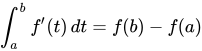
In mathematics, the Taylor series or Taylor expansion of a function is an infinite sum of terms that are expressed in terms of the function's derivatives at a single point. For most common functions, the function and the sum of its Taylor series are equal near this point. Taylor series are named after Brook Taylor, who introduced them in 1715. A Taylor series is also called a Maclaurin series when 0 is the point where the derivatives are considered, after Colin Maclaurin, who made extensive use of this special case of Taylor series in the 18th century.
The partial sum formed by the first n + 1 terms of a Taylor series is a polynomial of degree n that is called the nth Taylor polynomial of the function. Taylor polynomials are approximations of a function, which become generally more accurate as n increases. Taylor's theorem gives quantitative estimates on the error introduced by the use of such approximations. If the Taylor series of a function is convergent, its sum is the limit of the infinite sequence of the Taylor polynomials. A function may differ from the sum of its Taylor series, even if its Taylor series is convergent. A function is analytic at a point x if it is equal to the sum of its Taylor series in some open interval (or open disk in the complex plane) containing x. This implies that the function is analytic at every point of the interval (or disk).
Definition
[edit]The Taylor series of a real or complex-valued function f (x), that is infinitely differentiable at a real or complex number a, is the power series Here, n! denotes the factorial of n. The function f(n)(a) denotes the nth derivative of f evaluated at the point a. The derivative of order zero of f is defined to be f itself and (x − a)0 and 0! are both defined to be 1. This series can be written by using sigma notation, as in the right side formula.[1] With a = 0, the Maclaurin series takes the form:[2]


Examples
[edit]The Taylor series of any polynomial is the polynomial itself.
The Maclaurin series of 1/1 − x is the geometric series

So, by substituting x for 1 − x, the Taylor series of 1/x at a = 1 is

By integrating the above Maclaurin series, we find the Maclaurin series of ln(1 − x), where ln denotes the natural logarithm:

The corresponding Taylor series of ln x at a = 1 is

and more generally, the corresponding Taylor series of ln x at an arbitrary nonzero point a is

The Maclaurin series of the exponential function ex is
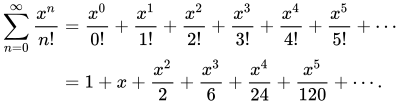
The above expansion holds because the derivative of ex with respect to x is also ex, and e0 equals 1. This leaves the terms (x − 0)n in the numerator and n! in the denominator of each term in the infinite sum.
History
[edit]The ancient Greek philosopher Zeno of Elea considered the problem of summing an infinite series to achieve a finite result, but rejected it as an impossibility;[3] the result was Zeno's paradox. Later, Aristotle proposed a philosophical resolution of the paradox, but the mathematical content was apparently unresolved until taken up by Archimedes, as it had been prior to Aristotle by the Presocratic Atomist Democritus. It was through Archimedes's method of exhaustion that an infinite number of progressive subdivisions could be performed to achieve a finite result.[4] Liu Hui independently employed a similar method a few centuries later.[5]
In the 14th century, the earliest examples of specific Taylor series (but not the general method) were given by Indian mathematician Madhava of Sangamagrama.[6] Though no record of his work survives, writings of his followers in the Kerala school of astronomy and mathematics suggest that he found the Taylor series for the trigonometric functions of sine, cosine, and arctangent (see Madhava series). During the following two centuries his followers developed further series expansions and rational approximations.
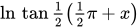
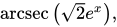
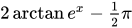
In late 1670, James Gregory was shown in a letter from John Collins several Maclaurin series ( and ) derived by Isaac Newton, and told that Newton had developed a general method for expanding functions in series. Newton had in fact used a cumbersome method involving long division of series and term-by-term integration, but Gregory did not know it and set out to discover a general method for himself. In early 1671 Gregory discovered something like the general Maclaurin series and sent a letter to Collins including series for (the integral of ), (the integral of sec, the inverse Gudermannian function), and (the Gudermannian function). However, thinking that he had merely redeveloped a method by Newton, Gregory never described how he obtained these series, and it can only be inferred that he understood the general method by examining scratch work he had scribbled on the back of another letter from 1671.[7]


In 1691–1692, Newton wrote down an explicit statement of the Taylor and Maclaurin series in an unpublished version of his work De Quadratura Curvarum. It was the earliest explicit formulation of the general Taylor series.[8][9] However, this work by Newton was never completed and the relevant sections were omitted from the portions published in 1704 under the title Tractatus de Quadratura Curvarum.
It was not until 1715 that a general method for constructing these series for all functions for which they exist was finally published by Brook Taylor,[10] after whom the series are now named.
The Maclaurin series was named after Colin Maclaurin, a Scottish mathematician, who published a special case of the Taylor result in the mid-18th century.
Analytic functions
[edit]
If f (x) is given by a convergent power series in an open disk centred at b in the complex plane (or an interval in the real line), it is said to be analytic in this region. Thus for x in this region, f is given by a convergent power series
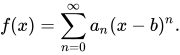
Differentiating by x the above formula n times, then setting x = b gives:
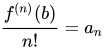
and so the power series expansion agrees with the Taylor series. Thus a function is analytic in an open disk centered at b if and only if its Taylor series converges to the value of the function at each point of the disk.
If f (x) is equal to the sum of its Taylor series for all x in the complex plane, it is called entire. The polynomials, exponential function ex, and the trigonometric functions sine and cosine, are examples of entire functions. Examples of functions that are not entire include the square root, the logarithm, the trigonometric function tangent, and its inverse, arctan. For these functions the Taylor series do not converge if x is far from b. That is, the Taylor series diverges at x if the distance between x and b is larger than the radius of convergence. The Taylor series can be used to calculate the value of an entire function at every point, if the value of the function, and of all of its derivatives, are known at a single point.
Uses of the Taylor series for analytic functions include:
- The partial sums (the Taylor polynomials) of the series can be used as approximations of the function. These approximations are good if sufficiently many terms are included.
- Differentiation and integration of power series can be performed term by term and is hence particularly easy.
- An analytic function is uniquely extended to a holomorphic function on an open disk in the complex plane. This makes the machinery of complex analysis available.
- The (truncated) series can be used to compute function values numerically, (often by recasting the polynomial into the Chebyshev form and evaluating it with the Clenshaw algorithm).
- Algebraic operations can be done readily on the power series representation; for instance, Euler's formula follows from Taylor series expansions for trigonometric and exponential functions. This result is of fundamental importance in such fields as harmonic analysis.
- Approximations using the first few terms of a Taylor series can make otherwise unsolvable problems possible for a restricted domain; this approach is often used in physics.
Approximation error and convergence
[edit]


Pictured is an accurate approximation of sin x around the point x = 0. The pink curve is a polynomial of degree seven:
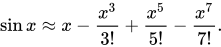
The error in this approximation is no more than |x|9 / 9!. For a full cycle centered at the origin (−π < x < π) the error is less than 0.08215. In particular, for −1 < x < 1, the error is less than 0.000003.
In contrast, also shown is a picture of the natural logarithm function ln(1 + x) and some of its Taylor polynomials around a = 0. These approximations converge to the function only in the region −1 < x ≤ 1; outside of this region the higher-degree Taylor polynomials are worse approximations for the function.
The error incurred in approximating a function by its nth-degree Taylor polynomial is called the remainder or residual and is denoted by the function Rn(x). Taylor's theorem can be used to obtain a bound on the size of the remainder.
In general, Taylor series need not be convergent at all. In fact, the set of functions with a convergent Taylor series is a meager set in the Fréchet space of smooth functions. Even if the Taylor series of a function f does converge, its limit need not be equal to the value of the function f (x). For example, the function
![{\displaystyle f(x)={\begin{cases}e^{-1/x^{2}}&{\text{if }}x\neq 0\\[3mu]0&{\text{if }}x=0\end{cases}}}](https://wikimedia.org/api/rest_v1/media/math/render/svg/ae050e61cde6a0fdeda1f237f75846465579462d)
is infinitely differentiable at x = 0, and has all derivatives zero there. Consequently, the Taylor series of f (x) about x = 0 is identically zero. However, f (x) is not the zero function, so does not equal its Taylor series around the origin. Thus, f (x) is an example of a non-analytic smooth function.
In real analysis, this example shows that there are infinitely differentiable functions f (x) whose Taylor series are not equal to f (x) even if they converge. By contrast, the holomorphic functions studied in complex analysis always possess a convergent Taylor series, and even the Taylor series of meromorphic functions, which might have singularities, never converge to a value different from the function itself. The complex function e−1/z2, however, does not approach 0 when z approaches 0 along the imaginary axis, so it is not continuous in the complex plane and its Taylor series is undefined at 0.
More generally, every sequence of real or complex numbers can appear as coefficients in the Taylor series of an infinitely differentiable function defined on the real line, a consequence of Borel's lemma. As a result, the radius of convergence of a Taylor series can be zero. There are even infinitely differentiable functions defined on the real line whose Taylor series have a radius of convergence 0 everywhere.[11]
A function cannot be written as a Taylor series centred at a singularity; in these cases, one can often still achieve a series expansion if one allows also negative powers of the variable x; see Laurent series. For example, f (x) = e−1/x2 can be written as a Laurent series.
Generalization
[edit]The generalization of the Taylor series does converge to the value of the function itself for any bounded continuous function on (0,∞), and this can be done by using the calculus of finite differences. Specifically, the following theorem, due to Einar Hille, that for any t > 0,[12]
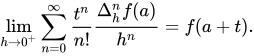
Here Δn
h is the nth finite difference operator with step size h. The series is precisely the Taylor series, except that divided differences appear in place of differentiation: the series is formally similar to the Newton series. When the function f is analytic at a, the terms in the series converge to the terms of the Taylor series, and in this sense generalizes the usual Taylor series.
In general, for any infinite sequence ai, the following power series identity holds:

So in particular,

The series on the right is the expected value of f (a + X), where X is a Poisson-distributed random variable that takes the value jh with probability e−t/h·(t/h)j/j!. Hence,

The law of large numbers implies that the identity holds.[13]
List of Maclaurin series of some common functions
[edit]Several important Maclaurin series expansions follow. All these expansions are valid for complex arguments x.
Exponential function
[edit]
The exponential function (with base e) has Maclaurin series[14]

It converges for all x.

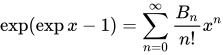
The exponential generating function of the Bell numbers is the exponential function of the predecessor of the exponential function:
Natural logarithm
[edit]The natural logarithm (with base e) has Maclaurin series[15]
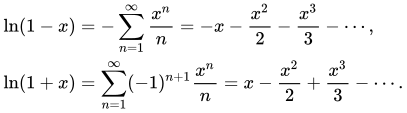
The last series is known as Mercator series, named after Nicholas Mercator (since it was published in his 1668 treatise Logarithmotechnia).[16] Both of these series converge for . (In addition, the series for ln(1 − x) converges for x = −1, and the series for ln(1 + x) converges for x = 1.)[15]

Geometric series
[edit]The geometric series and its derivatives have Maclaurin series
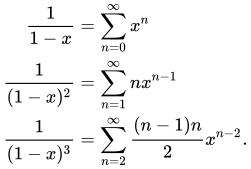
All are convergent for . These are special cases of the binomial series given in the next section.
Binomial series
[edit]The binomial series is the power series
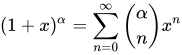
whose coefficients are the generalized binomial coefficients[17]

(If n = 0, this product is an empty product and has value 1.) It converges for for any real or complex number α.
When α = −1, this is essentially the infinite geometric series mentioned in the previous section. The special cases α = 1/2 and α = −1/2 give the square root function and its inverse:[18]

When only the linear term is retained, this simplifies to the binomial approximation.
Trigonometric functions
[edit]The usual trigonometric functions and their inverses have the following Maclaurin series:[19]
![{\displaystyle {\begin{aligned}\sin x&=\sum _{n=0}^{\infty }{\frac {(-1)^{n}}{(2n+1)!}}x^{2n+1}&&=x-{\frac {x^{3}}{3!}}+{\frac {x^{5}}{5!}}-\cdots &&{\text{for all }}x\\[6pt]\cos x&=\sum _{n=0}^{\infty }{\frac {(-1)^{n}}{(2n)!}}x^{2n}&&=1-{\frac {x^{2}}{2!}}+{\frac {x^{4}}{4!}}-\cdots &&{\text{for all }}x\\[6pt]\tan x&=\sum _{n=1}^{\infty }{\frac {B_{2n}(-4)^{n}\left(1-4^{n}\right)}{(2n)!}}x^{2n-1}&&=x+{\frac {x^{3}}{3}}+{\frac {2x^{5}}{15}}+\cdots &&{\text{for }}|x|<{\frac {\pi }{2}}\\[6pt]\sec x&=\sum _{n=0}^{\infty }{\frac {(-1)^{n}E_{2n}}{(2n)!}}x^{2n}&&=1+{\frac {x^{2}}{2}}+{\frac {5x^{4}}{24}}+\cdots &&{\text{for }}|x|<{\frac {\pi }{2}}\\[6pt]\arcsin x&=\sum _{n=0}^{\infty }{\frac {(2n)!}{4^{n}(n!)^{2}(2n+1)}}x^{2n+1}&&=x+{\frac {x^{3}}{6}}+{\frac {3x^{5}}{40}}+\cdots &&{\text{for }}|x|\leq 1\\[6pt]\arccos x&={\frac {\pi }{2}}-\arcsin x\\&={\frac {\pi }{2}}-\sum _{n=0}^{\infty }{\frac {(2n)!}{4^{n}(n!)^{2}(2n+1)}}x^{2n+1}&&={\frac {\pi }{2}}-x-{\frac {x^{3}}{6}}-{\frac {3x^{5}}{40}}-\cdots &&{\text{for }}|x|\leq 1\\[6pt]\arctan x&=\sum _{n=0}^{\infty }{\frac {(-1)^{n}}{2n+1}}x^{2n+1}&&=x-{\frac {x^{3}}{3}}+{\frac {x^{5}}{5}}-\cdots &&{\text{for }}|x|\leq 1,\ x\neq \pm i\end{aligned}}}](https://wikimedia.org/api/rest_v1/media/math/render/svg/158a0ae14d1c9e0d1dc21c268f7e2169b9066dc7)
All angles are expressed in radians. The numbers Bk appearing in the expansions of tan x are the Bernoulli numbers. The Ek in the expansion of sec x are Euler numbers.[20]
Hyperbolic functions
[edit]The hyperbolic functions have Maclaurin series closely related to the series for the corresponding trigonometric functions:[21]
![{\displaystyle {\begin{aligned}\sinh x&=\sum _{n=0}^{\infty }{\frac {x^{2n+1}}{(2n+1)!}}&&=x+{\frac {x^{3}}{3!}}+{\frac {x^{5}}{5!}}+\cdots &&{\text{for all }}x\\[6pt]\cosh x&=\sum _{n=0}^{\infty }{\frac {x^{2n}}{(2n)!}}&&=1+{\frac {x^{2}}{2!}}+{\frac {x^{4}}{4!}}+\cdots &&{\text{for all }}x\\[6pt]\tanh x&=\sum _{n=1}^{\infty }{\frac {B_{2n}4^{n}\left(4^{n}-1\right)}{(2n)!}}x^{2n-1}&&=x-{\frac {x^{3}}{3}}+{\frac {2x^{5}}{15}}-{\frac {17x^{7}}{315}}+\cdots &&{\text{for }}|x|<{\frac {\pi }{2}}\\[6pt]\operatorname {arsinh} x&=\sum _{n=0}^{\infty }{\frac {(-1)^{n}(2n)!}{4^{n}(n!)^{2}(2n+1)}}x^{2n+1}&&=x-{\frac {x^{3}}{6}}+{\frac {3x^{5}}{40}}-\cdots &&{\text{for }}|x|\leq 1\\[6pt]\operatorname {artanh} x&=\sum _{n=0}^{\infty }{\frac {x^{2n+1}}{2n+1}}&&=x+{\frac {x^{3}}{3}}+{\frac {x^{5}}{5}}+\cdots &&{\text{for }}|x|\leq 1,\ x\neq \pm 1\end{aligned}}}](https://wikimedia.org/api/rest_v1/media/math/render/svg/cda808c97562eca785bd172eb7739711b338730a)
The numbers Bk appearing in the series for tanh x are the Bernoulli numbers.[21]
Polylogarithmic functions
[edit]The polylogarithms have these defining identities:
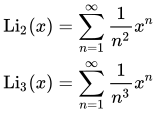
The Legendre chi functions are defined as follows:
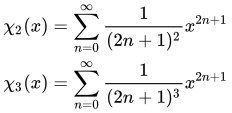
And the formulas presented below are called inverse tangent integrals:
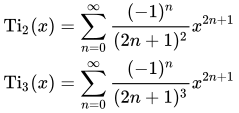
In statistical thermodynamics these formulas are of great importance.
Elliptic functions
[edit]The complete elliptic integrals of first kind K and of second kind E can be defined as follows:
![{\displaystyle {\begin{aligned}{\frac {2}{\pi }}K(x)&=\sum _{n=0}^{\infty }{\frac {[(2n)!]^{2}}{16^{n}(n!)^{4}}}x^{2n}\\{\frac {2}{\pi }}E(x)&=\sum _{n=0}^{\infty }{\frac {[(2n)!]^{2}}{(1-2n)16^{n}(n!)^{4}}}x^{2n}\end{aligned}}}](https://wikimedia.org/api/rest_v1/media/math/render/svg/41ef2ac15ffd8927e6037af64226d9fe96dcc4dc)
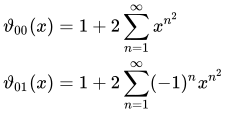
The Jacobi theta functions describe the world of the elliptic modular functions and they have these Taylor series:
The regular partition number sequence P(n) has this generating function:
![{\displaystyle \vartheta _{00}(x)^{-1/6}\vartheta _{01}(x)^{-2/3}{\biggl [}{\frac {\vartheta _{00}(x)^{4}-\vartheta _{01}(x)^{4}}{16\,x}}{\biggr ]}^{-1/24}=\sum _{n=0}^{\infty }P(n)x^{n}=\prod _{k=1}^{\infty }{\frac {1}{1-x^{k}}}}](https://wikimedia.org/api/rest_v1/media/math/render/svg/3c898219336ceb853f972d83f60a14049d671523)
The strict partition number sequence Q(n) has that generating function:
![{\displaystyle \vartheta _{00}(x)^{1/6}\vartheta _{01}(x)^{-1/3}{\biggl [}{\frac {\vartheta _{00}(x)^{4}-\vartheta _{01}(x)^{4}}{16\,x}}{\biggr ]}^{1/24}=\sum _{n=0}^{\infty }Q(n)x^{n}=\prod _{k=1}^{\infty }{\frac {1}{1-x^{2k-1}}}}](https://wikimedia.org/api/rest_v1/media/math/render/svg/fa5dd403c225903926ad0c45788a5f1a0a5fb67c)
Calculation of Taylor series
[edit]Several methods exist for the calculation of Taylor series of a large number of functions. One can attempt to use the definition of the Taylor series, though this often requires generalizing the form of the coefficients according to a readily apparent pattern. Alternatively, one can use manipulations such as substitution, multiplication or division, addition or subtraction of standard Taylor series to construct the Taylor series of a function, by virtue of Taylor series being power series. In some cases, one can also derive the Taylor series by repeatedly applying integration by parts. Particularly convenient is the use of computer algebra systems to calculate Taylor series.
First example
[edit]In order to compute the 7th degree Maclaurin polynomial for the function

one may first rewrite the function as

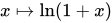
the composition of two functions and The Taylor series for the natural logarithm is (using big O notation)


and for the cosine function

The first several terms from the second series can be substituted into each term of the first series. Because the first term in the second series has degree 2, three terms of the first series suffice to give a 7th-degree polynomial:

Since the cosine is an even function, the coefficients for all the odd powers are zero.
Second example
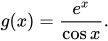
[edit]Suppose we want the Taylor series at 0 of the function
The Taylor series for the exponential function is

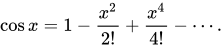
and the series for cosine is
Assume the series for their quotient is

Multiplying both sides by the denominator and then expanding it as a series yields

![{\displaystyle {\begin{aligned}e^{x}&=\left(c_{0}+c_{1}x+c_{2}x^{2}+c_{3}x^{3}+c_{4}x^{4}+\cdots \right)\left(1-{\frac {x^{2}}{2!}}+{\frac {x^{4}}{4!}}-\cdots \right)\\[5mu]&=c_{0}+c_{1}x+\left(c_{2}-{\frac {c_{0}}{2}}\right)x^{2}+\left(c_{3}-{\frac {c_{1}}{2}}\right)x^{3}+\left(c_{4}-{\frac {c_{2}}{2}}+{\frac {c_{0}}{4!}}\right)x^{4}+\cdots \end{aligned}}}](https://wikimedia.org/api/rest_v1/media/math/render/svg/9d611d36d8b3829c1dcf68a3528a744f602c17c5)
Comparing the coefficients of with the coefficients of



The coefficients of the series for can thus be computed one at a time, amounting to long division of the series for and :


Third example
[edit]Here we employ a method called "indirect expansion" to expand the given function. This method uses the known Taylor expansion of the exponential function. In order to expand (1 + x)ex as a Taylor series in x, we use the known Taylor series of function ex:

Thus,

Taylor series as definitions
[edit]Classically, algebraic functions are defined by an algebraic equation, and transcendental functions (including those discussed above) are defined by some property that holds for them, such as a differential equation. For example, the exponential function is the function which is equal to its own derivative everywhere, and assumes the value 1 at the origin. However, one may equally well define an analytic function by its Taylor series.
Taylor series are used to define functions and "operators" in diverse areas of mathematics. In particular, this is true in areas where the classical definitions of functions break down. For example, using Taylor series, one may extend analytic functions to sets of matrices and operators, such as the matrix exponential or matrix logarithm.
In other areas, such as formal analysis, it is more convenient to work directly with the power series themselves. Thus one may define a solution of a differential equation as a power series which, one hopes to prove, is the Taylor series of the desired solution.
Taylor series in several variables
[edit]The Taylor series may also be generalized to functions of more than one variable with[22]
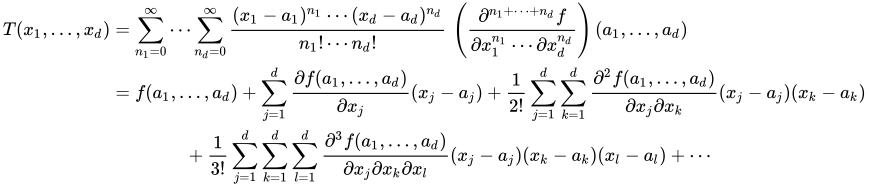
For example, for a function that depends on two variables, x and y, the Taylor series to second order about the point (a, b) is


where the subscripts denote the respective partial derivatives.
Second-order Taylor series in several variables
[edit]A second-order Taylor series expansion of a scalar-valued function of more than one variable can be written compactly as

where D f (a) is the gradient of f evaluated at x = a and D2 f (a) is the Hessian matrix. Applying the multi-index notation the Taylor series for several variables becomes
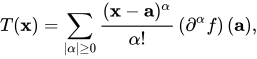
which is to be understood as a still more abbreviated multi-index version of the first equation of this paragraph, with a full analogy to the single variable case.
Example
[edit]
In order to compute a second-order Taylor series expansion around point (a, b) = (0, 0) of the function

one first computes all the necessary partial derivatives:
![{\displaystyle {\begin{aligned}f_{x}&=e^{x}\ln(1+y)\\[6pt]f_{y}&={\frac {e^{x}}{1+y}}\\[6pt]f_{xx}&=e^{x}\ln(1+y)\\[6pt]f_{yy}&=-{\frac {e^{x}}{(1+y)^{2}}}\\[6pt]f_{xy}&=f_{yx}={\frac {e^{x}}{1+y}}.\end{aligned}}}](https://wikimedia.org/api/rest_v1/media/math/render/svg/80a9f65e179df2db5256dc15097892be2ded7c6d)
Evaluating these derivatives at the origin gives the Taylor coefficients
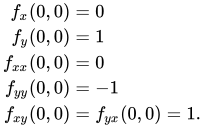
Substituting these values in to the general formula

produces

Since ln(1 + y) is analytic in |y| < 1, we have

Comparison with Fourier series
[edit]The trigonometric Fourier series enables one to express a periodic function (or a function defined on a closed interval [a,b]) as an infinite sum of trigonometric functions (sines and cosines). In this sense, the Fourier series is analogous to Taylor series, since the latter allows one to express a function as an infinite sum of powers. Nevertheless, the two series differ from each other in several relevant issues:
- The finite truncations of the Taylor series of f (x) about the point x = a are all exactly equal to f at a. In contrast, the Fourier series is computed by integrating over an entire interval, so there is generally no such point where all the finite truncations of the series are exact.
- The computation of Taylor series requires the knowledge of the function on an arbitrary small neighbourhood of a point, whereas the computation of the Fourier series requires knowing the function on its whole domain interval. In a certain sense one could say that the Taylor series is "local" and the Fourier series is "global".
- The Taylor series is defined for a function which has infinitely many derivatives at a single point, whereas the Fourier series is defined for any integrable function. In particular, the function could be nowhere differentiable. (For example, f (x) could be a Weierstrass function.)
- The convergence of both series has very different properties. Even if the Taylor series has positive convergence radius, the resulting series may not coincide with the function; but if the function is analytic then the series converges pointwise to the function, and uniformly on every compact subset of the convergence interval. Concerning the Fourier series, if the function is square-integrable then the series converges in quadratic mean, but additional requirements are needed to ensure the pointwise or uniform convergence (for instance, if the function is periodic and of class C1 then the convergence is uniform).
- Finally, in practice one wants to approximate the function with a finite number of terms, say with a Taylor polynomial or a partial sum of the trigonometric series, respectively. In the case of the Taylor series the error is very small in a neighbourhood of the point where it is computed, while it may be very large at a distant point. In the case of the Fourier series the error is distributed along the domain of the function.
See also
[edit]
- Asymptotic expansion
- Newton polynomial
- Padé approximant – best approximation by a rational function
- Puiseux series – Power series with rational exponents
- Approximation theory
- Function approximation
Notes
[edit]- ^ Banner 2007, p. 530.
- ^ Thomas & Finney 1996, See §8.9..
- ^ Lindberg 2007, p. 33.
- ^ Kline 1990, p. 35–37.
- ^ Boyer & Merzbach 1991, p. 202–203.
- ^ Dani 2012.
- ^
- Turnbull 1939, pp. 168–174
- Roy 1990
- Malet 1993
- ^ Edwards, C. Henry (1994). The Historical Development of the Calculus. Springer study edition. Springer. p. 289. ISBN 978-0-387-94313-8.
- ^ Rowlands, Peter (2017). Newton and the Great World System. World Scientific Publishing. p. 40. doi:10.1142/q0108. ISBN 978-1-78634-372-7.
- ^
- Taylor 1715, p. 21–23, see Prop. VII, Thm. 3, Cor. 2. See Struik 1969, pp. 329–332 for English translation, and Bruce 2007 for re-translation.
- Feigenbaum 1985
- ^ Rudin 1980, p. 418, See Exercise 13.
- ^
- Feller 2003, p. 230–232
- Hille & Phillips 1957, pp. 300–327
- ^ Feller 2003, p. 231.
- ^ Abramowitz & Stegun 1970, p. 69.
- ^ a b
- ^ Hofmann 1939.
- ^ Abramowitz & Stegun 1970, p. 14.
- ^ Abramowitz & Stegun 1970, p. 15.
- ^ Abramowitz & Stegun 1970, p. 75, 81.
- ^ Abramowitz & Stegun 1970, p. 75.
- ^ a b Abramowitz & Stegun 1970, p. 85.
- ^
- Hörmander 2002, See Eqq. 1.1.7 and 1.1.7′
- Kolk & Duistermaat 2010, p. 59–63
References
[edit]- Abramowitz, Milton; Stegun, Irene A. (1970). Handbook of Mathematical Functions with Formulas, Graphs, and Mathematical Tables. New York: Dover Publications. Ninth printing.
- Banner, Adrian (2007). The Calculus Lifesaver: All the Tools You Need to Excel at Calculus. Princeton University Press. ISBN 978-0-691-13088-0.
- Bilodeau, Gerald; Thie, Paul; Keough, G. E. (2010). An Introduction to Analysis. Jones & Bartlett Publisher. ISBN 978-0-7637-7492-9.
- Boyer, C.; Merzbach, U. (1991). A History of Mathematics (2nd ed.). John Wiley and Sons. ISBN 0-471-09763-2.
- Bruce, Ian (2007). "Methodus Incrementorum Directa & Inversa]". 17centurymaths.com.
- Dani, S. G. (2012). "Ancient Indian Mathematics – A Conspectus". Resonance. 17 (3): 236–246. doi:10.1007/s12045-012-0022-y. S2CID 120553186.
- Feigenbaum, L. (1985). "Brook Taylor and the method of increments". Archive for History of Exact Sciences. 34 (1–2): 1–140. doi:10.1007/bf00329903. S2CID 122105736.
- Feller, William (2003) [1971]. An introduction to probability theory and its applications. Vol. 2 (3rd ed.). Wiley. ISBN 9789971512989. OCLC 818811840.
- Greenberg, Michael (1998). Advanced Engineering Mathematics (2nd ed.). Prentice Hall. ISBN 0-13-321431-1.
- Hille, Einar; Phillips, Ralph S. (1957). Functional analysis and semi-groups. AMS Colloquium Publications. Vol. 31. American Mathematical Society.
- Hofmann, Josef Ehrenfried (1939). "On the Discovery of the Logarithmic Series and Its Development in England up to Cotes". National Mathematics Magazine. 14 (1): 33–45. doi:10.2307/3028095. JSTOR 3028095.
- Hörmander, Lars (2002) [1990]. "1. Test Functions §1.1. A review of Differential Calculus". The analysis of partial differential operators. Vol. 1 (2nd ed.). Springer. doi:10.1007/978-3-642-61497-2_2. ISBN 978-3-642-61497-2.
- Kline, M. (1990). Mathematical Thought from Ancient to Modern Times. New York: Oxford University Press. ISBN 0-19-506135-7.
- Kolk, Johan A.C.; Duistermaat, J.J. (2010). "Taylor Expansion in Several Variables". Distributions: Theory and applications. Birkhauser. doi:10.1007/978-0-8176-4675-2_6. ISBN 978-0-8176-4672-1.
- Lindberg, David (2007). The Beginnings of Western Science (2nd ed.). University of Chicago Press. ISBN 978-0-226-48205-7.
- Malet, Antoni (1993). "James Gregorie on Tangents and the "Taylor" Rule for Series Expansions". Archive for History of Exact Sciences. 46 (2): 97–137. doi:10.1007/BF00375656. JSTOR 41133959. S2CID 120101519.
- Roy, Ranjan (1990). "The Discovery of the Series Formula for π by Leibniz, Gregory and Nilakantha" (PDF). Mathematics Magazine. 63 (5): 291–306. doi:10.1080/0025570X.1990.11977541. Archived from the original (PDF) on 2023-03-14. Retrieved 2023-02-18.
- —— (2021) [2011]. Series and Products in the Development of Mathematics. Vol. 1 (2nd ed.). Cambridge University Press.
- Rudin, Walter (1980). Real and Complex Analysis. New Delhi: McGraw-Hill. ISBN 0-07-099557-5.
- Struik, D. J. (1969). A Source Book in Mathematics 1200–1800. Harvard University Press. ISBN 978-0-674-82355-6.
- Taylor, Brook (1715). Methodus Incrementorum Directa et Inversa [Direct and Reverse Methods of Incrementation] (in Latin). London.
- Thomas, George B. Jr.; Finney, Ross L. (1996). Calculus and Analytic Geometry (9th ed.). Addison Wesley. ISBN 0-201-53174-7.
- Turnbull, Herbert Westren, ed. (1939). James Gregory; Tercentenary Memorial Volume. G. Bell & Sons.
External links
[edit] Definitions from Wiktionary
 Media from Commons
 Textbooks from Wikibooks
 Resources from Wikiversity
 Data from Wikidata


- "Taylor series", Encyclopedia of Mathematics, EMS Press, 2001 [1994]
- Weisstein, Eric W. "Taylor Series". MathWorld.
| Integer sequences |
|  | ||||
|---|---|---|---|---|---|---|
| Properties of sequences | ||||||
| Properties of series |
| |||||
| Explicit series | ||||||
| Kinds of series | ||||||
| Hypergeometric series | ||||||

| International | |
|---|---|
| National | |
