Hubbry Logo
TureenTureenMain
Open search
Tureen
Community hub
Tureen
logo
8 pages, 0 posts
0 subscribers
Be the first to start a discussion here.
Tureen
Tureen
from Wikipedia
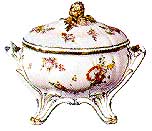
A Sèvres soup tureen and tray. Sèvres porcelain, National Gallery of Victoria, Australia
Silver-gilt tureen, Paris, 1769–70
An Émile Gallé (1846–1904) tureen

A tureen is a serving dish for foods such as soups or stews, often shaped as a broad, deep, oval vessel with fixed handles and a low domed cover with a knob or handle. Over the centuries, tureens have appeared in many different forms: round, rectangular, or made into fanciful shapes such as animals or wildfowl. Tureens may be ceramic—either the glazed earthenware called faience, or porcelain—or silver, and customarily they stand on an undertray or platter made en suite.[i]

Etymology

[edit]
Still Life (The Silver Tureen), Chardin, 1728 (Metropolitan Museum of Art)

The tureen as a piece of tableware called a pot à oille—a Catalan-Provençal soup—came into use in late seventeenth-century France. Alternative explanations for the etymology are that it is related to the earlier word terrine, a borrowing from the French for 'a large, circular, earthenware dish'[1] or that it is named to honour the French military hero Marshal Turenne.

History

[edit]

The tureen's prehistory may be traced to the use of the communal bowl, but during the reign of Louis XIV it was developed from a practical covered serving vessel into one of the most richly ornamented centerpieces of the formal apparatus of dining. This period also saw the old practice of dressing the dinner table with every dish at once (service à la française) superseded by the new practice of separate courses at meal time (service à la russe), each entrée entering from the kitchens with an air of ceremony.[2] Soup remained the first course of most meals, from the king's table to the peasant's, and the soup tureen on its serving platter provided the opening ceremony. Tureens naturally tended towards the impressive; the world's record auction price fetched for a single piece of silver was achieved by a silver tureen made in 1733 by the Parisian silversmith Thomas Germain, sold at Sotheby's New York, 13 November 1996: at US$10,287,500, tripling the former record.

Silver tureens

[edit]

Most seventeenth-century French silver tureens were melted down to finance the wars of Louis' late years and may be glimpsed only in paintings. The ornate silver tureens of that period figure in buffets—still life of silver and game—by artists such as Alexandre-François Desportes, or in more modest still life, such as the painting by Jean-Baptiste-Siméon Chardin (illustration), which is dated 1728 but depicts a silver tureen of Baroque form of the first decade of the century.

Eighteenth century

[edit]

During the mid-eighteenth century, tureens in appropriate naturalistic shapes, such as tureens in the form of a head of cabbage, were popular. The Chelsea porcelain manufactory produced tureens in the form of rabbits: a Chelsea sale catalogue of 1755 advertised a "Fine tureen in the form of a rabbit as big as life."[3]

Écuelles and saucières

[edit]
Écuelle and stand, Sèvres porcelain, 1776

Tureens are most practical for serving about six people. In eighteenth-century France, a small individual covered standing bowl on a small platter, essentially an individual tureen, was called an écuelle (also anglicised to ecuelle). It could be lifted by its twin handles and drunk from directly. The shape was used for other purposes; it is often found in toilet services, where its purpose is uncertain. Its modern descendant in tableware is the two-handled cream soup bowl on matching plate. A small covered dish for sauce, called a saucière, could also take the form of a small tureen; it might be integral with its platter (illustration right), for ease in handling and to contain drips.[4][failed verification]

Collections

[edit]

John T. Dorrance, a member of the family owners of Campbell's Soup, assembled, starting in 1966, the largest representative collection of soup tureens, which has been donated to the Henry Francis DuPont Winterthur Museum.[5]

See also

[edit]

Notes

[edit]

References

[edit]

Further reading

[edit]
Revisions and contributorsEdit on WikipediaRead on Wikipedia
from Grokipedia
A tureen is a deep, usually covered and often oval-shaped serving vessel designed for presenting and dispensing soups, stews, or similar foods at the table. The term derives from the French word terrine, originally meaning an or flat-bottomed dish made from clay, reflecting its roots in simple pottery containers for cooking and serving. First appearing in English around 1727, tureens evolved from practical earthen pots into ornate , particularly in early 18th-century where silversmiths like Thomas Germain crafted elaborate silver examples to accompany lavish feasts featuring stews and grosses entrées. By the early , tureens had become symbols of wealth and refinement in European aristocratic dining, often molded in naturalistic forms such as animals, , or to enhance the theatricality of meals. French potters perfected lidded designs in and during this period, mimicking silver prototypes while making them more accessible for the emerging . These vessels were typically paired with ladles and underplates, and their production spanned materials like for royalty—such as pieces commissioned for —and ceramics from factories in or . Tureens played a key role in formal service à la française, where multiple dishes were presented simultaneously, emphasizing abundance and hospitality. Their popularity peaked in the 18th and 19th centuries, influencing global tableware traditions, though they declined with the shift to individualized service à la russe in the late 19th century. Today, antique and reproduction tureens remain collectible for their artistic value, often featured in museum collections like those at and the .

Definition and Description

Physical Characteristics

A tureen is characteristically a broad, deep serving vessel, most commonly oval or round in form, engineered to contain liquids such as soups or stews while facilitating presentation at the table. This shape allows for efficient stirring and portioning, with depths typically reaching 6 to 10 inches to accommodate viscous contents without excessive height. The overall dimensions of a standard tureen span approximately 12 to 18 inches in length or , providing sufficient for communal meals serving 4 to 8 individuals. Fixed handles, positioned on opposite sides, enable secure transport from kitchen to dining area, often molded in ergonomic forms for grip. A low-domed , designed to trap heat and minimize spills, crowns the vessel and features a central knob or —such as a modeled or —for easy removal. For enhanced stability during serving, tureens are frequently paired with a matching underplatter or stand, which elevates the bowl slightly and catches any drips. Capacities generally fall between 2 and 4 quarts, balancing portability with the needs of formal group dining.

Components and Design Features

A tureen typically consists of a deep bowl-like body topped by a domed equipped with a central knob or handle for easy removal and serving. The 's dome shape aids in retaining heat while directing back into the vessel, and the knob—often sculpted in thematic forms such as fruits, flowers, or animal figures—enhances both functionality and aesthetic harmony with the overall design. In some designs, small vents are incorporated into the to allow steam to escape, preventing pressure buildup during reheating or transport. The handles on a tureen are essential for safe handling of its hot contents, usually positioned on opposite sides of the body in ergonomic forms such as scroll shapes, molded rings, or animal-head motifs like lions or griffins. These attachments are secured through soldered joints in metal examples or integrated molding in ceramics, ensuring stability without compromising the vessel's balance. Many tureens rest upon a base or stand, often a flat underplate or platter with raised edges to capture any drips or spills during serving, thereby protecting table linens and maintaining tidiness. This base may feature decorative borders, claw feet for elevation, or additional handles for mobility, elevating the tureen both literally and visually as a centerpiece. To safeguard against discoloration from acidic soups or stews, the interior of ceramic and porcelain tureens is coated with a glazing or lining, forming a smooth, impermeable glass-like surface that resists absorption and staining. This protective layer ensures longevity and hygiene, allowing repeated use without compromising the vessel's appearance or safety. Ornamentation plays a key role in a tureen's design, with techniques like pierced work creating intricate galleries or patterns for light diffusion and visual elegance, and embossing adding raised motifs such as floral swags, shells, or heraldic elements to the exterior without hindering practical use. These features blend utility with artistry, often drawing from period styles to elevate the tureen from mere serveware to a decorative object.

Etymology and Early Origins

Linguistic Origins

The word "tureen" derives from the French term terrine, which entered usage in the late to denote an dish used for serving pâtés, stews, or similar preparations. This French noun itself stems from terrin, an adjective meaning "earthen" or "made of earth," reflecting the material composition of the original vessels. The etymological roots trace further back to Latin terrenus, an adjective signifying "of the earth" or "earthen," derived from terra (""). This Latin term emphasized the terrestrial, clay-based nature of the containers, distinguishing them from metal or other materials. English speakers adopted the word around 1700–1710, initially in the form terrene, before it evolved into the modern spelling "tureen" by 1727, as recorded in the English Dictionary's earliest evidence from a furniture catalog. Over time, the term underwent a semantic shift from referring primarily to a cooking or pot—similar to the baked dish still called a terrine in —to a covered serving vessel for the dining table, highlighting its role in presentation rather than preparation. This distinction allowed "tureen" to specialize in the English for ornate, lidded bowls used at meals.

Pre-17th Century Precursors

In and , precursors to the tureen can be traced to krater-like vessels used for mixing and serving liquids, particularly wine diluted with during symposia and communal meals. These large, wide-mouthed terracotta bowls, such as the column-krater dating to around 550 BCE, facilitated the blending of beverages in social settings, emphasizing functionality for heat retention and shared consumption. While most kraters were open-topped, some related serving bowls incorporated simple covers to preserve warmth, reflecting early adaptations for liquid-based dishes in peasant and cuisines alike. During the medieval period in , particularly in Iberian regions, deep vessels known as ollas served as communal pots for preparing and sharing and soups, often called or similar broths with vegetables, meats, and herbs. These robust clay pots, designed for slow cooking over open fires, prioritized heat retention for hearty, everyday fare among rural communities, evolving from earlier Roman-influenced stewing traditions. By the , such vessels were staples in monastic and peasant kitchens, underscoring a focus on practical, lid-covered designs to maintain temperatures during long communal meals. The French term pot à oille, referring to similar pots, emerged in the 17th century as an adaptation of this tradition. In 16th-century , terrines emerged as covered clay pots specifically for forcemeats—mixtures of ground meats, fats, and seasonings—before transitioning toward table serving roles. These molds, rooted in medieval preparation techniques, allowed for even heat distribution during cooking, with simple lids to seal in flavors and juices. The term "terrine" derives from "terre," denoting the earthy material, and these pots represented a shift from purely cooking tools to proto-serving ware, though still lacking fixed handles or ornate embellishments characteristic of later designs. Simultaneously, Chinese export soup bowls began influencing European via maritime trade routes in the 1500s, introducing lidded, durable vessels for hot liquids that inspired adaptations in form and material. During the , potters produced bowls and serving dishes, often with covers, which arrived in and spread across , highlighting superior heat retention compared to local ceramics. These imports, valued for their translucency and strength, subtly shaped Western preferences for covered soup containers, though early European versions retained basic, handle-free structures suited to rustic cuisine.

Historical Development

17th Century Emergence

The tureen, referred to as a soupière in French, emerged in the late during the reign of (1643–1715), evolving from practical kitchen vessels into a sophisticated piece of dining central to formal banquets. This shift reflected the opulent court culture at Versailles, where silver tableware symbolized royal power and refinement. Previously utilitarian forms like the pot à oille—a stew pot used for communal soups—began transitioning to the dining room, aligning with the structured etiquette of aristocratic meals. Parisian silversmiths played a pivotal role in developing ornate silver soupières for Versailles banquets, crafting them to emphasize grandeur through chased and embossed decorations that complemented the era's Baroque aesthetic. These vessels were integral to the service à la française dining style, in which all dishes of a course were presented simultaneously on the table for guests to serve themselves. The elaborate grosses entrées—multi-course feasts featuring rich soups and stews—required durable, elegant communal serving pieces to maintain the meal's symmetry and visual splendor. Early soupières typically took the form of simple silver bowls with domed lids and fixed handles, designed for practicality while allowing hot soups to be served directly at the table. Made from high-purity silver alloyed with for strength, these pieces were sized for communal serving to multiple diners, in line with the communal nature of court dining. Their restrained yet luxurious design prioritized functionality for thick soups like potage, setting the stage for later elaborations. The dissemination of the tureen beyond accelerated after 1685, when Huguenot artisans—skilled Protestant silversmiths—fled following Louis XIV's revocation of the and brought their expertise to and . In , these refugees introduced refined French silver forms, including soupières, elevating local craftsmanship and integrating them into English aristocratic tables by the early . Similar influences spread to German courts, where Huguenot workshops adapted the oval tureen for regional banquets.

18th Century Advancements

The 18th century marked a pivotal era in tureen development, as European porcelain factories achieved breakthroughs in producing hard-paste porcelain that rivaled Chinese imports, expanding beyond the silver foundations established in the previous century. The Meissen porcelain factory in Germany, founded in 1710 under the patronage of Augustus II the Strong, pioneered the first true European hard-paste porcelain, enabling the creation of durable, translucent tureens with intricate designs that were previously unattainable in local materials. By the 1730s, Meissen was producing elaborate tureens featuring figural handles and lids, often modeled after natural forms to appeal to aristocratic tastes. In France, the Sèvres manufactory, relocated from Vincennes in 1756, further advanced this revolution by specializing in soft-paste porcelain tureens with vibrant colors and gilding, such as the royal "Terrine du roi" soup tureens that became hallmarks of opulent dining services. These innovations democratized access to high-quality porcelain tableware while maintaining exclusivity for the elite. Transitional influences from Dutch and Italian silversmiths also contributed to evolving forms across Europe. English porcelain contributions during the 1750s introduced whimsical animal-shaped tureens, particularly at the Chelsea factory, which utilized soft-paste to craft naturalistic forms like rabbits and hens that served both functional and decorative purposes. These designs, such as the rabbit tureen modeled life-size with detailed fur and ears forming the handles, reflected a growing fascination with l'oeil effects and were cataloged for export to affluent households. Complementing these forms, embellishments flourished across European tureens, incorporating gilded edges, intricate floral motifs, and figural finials like cherubs or fruits to evoke asymmetry and lightness on aristocratic tables. Sèvres and pieces often featured these ornate details, with applied over painted enamels to enhance their luxurious appeal in formal settings. The period also saw the standardization of saucières, smaller sauce tureens that emerged around as companions to main serving pieces, allowing for precise presentation of gravies and condiments in style. These lidded vessels, typically oval with attached stands, were produced in by factories like and mirrored the elaborate motifs of larger tureens while scaling down for use. An export boom further elevated tureens as status symbols, with and pieces reaching colonial America through networks, where they adorned the tables of wealthy as emblems of refinement. Similarly, shipments to , including services with floral and figural designs, catered to the imperial court and nobility, underscoring the global prestige of European craftsmanship.

19th and 20th Century Evolution

In the 19th century, the facilitated the mass production of tureens, making them accessible beyond elite circles. Josiah 's firm in pioneered affordable ceramic tableware using Queen's ware, a durable cream-colored that served as a cost-effective alternative to ; by the 1820s, Wedgwood was producing tureens like one decorated in the pattern, enabling middle-class households to adopt formal dining practices. Similarly, in , emerged as a hub for manufacturing after the discovery of kaolin clay in the late , with numerous factories exporting hand-painted tureens to and the by the mid-1800s, further democratizing these items for bourgeois homes. Stylistic shifts in the 19th century reflected broader aesthetic trends, transitioning from neoclassical restraint to Victorian elaboration while incorporating classical motifs. Post-1810 designs often featured simpler, symmetrical forms inspired by ancient Greek and Roman art, such as oval shapes with fluted edges and laurel wreaths, as seen in English earthenware sauce tureens by Davenport of Staffordshire around 1845–1860. By the Victorian era, these evolved into more ornate pieces with intricate engravings and gilded accents, exemplified by a London-made silver soup tureen from 1877 that evoked neoclassical grandeur through its domed lid and cast handles. The 1851 Great Exhibition in London highlighted this international innovation, showcasing tureens like Minton's bone china cream tureens in the Victoria pattern—purchased by Queen Victoria on the eve of the event—and majolica examples from various nations, which spurred global trade and design exchange. In the 20th century, tureen design incorporated modernist influences, with designers like Christopher Dresser introducing simplified, geometric forms in the late 19th and early 20th centuries that presaged Art Deco aesthetics. Dresser's 1880 electroplated silver tureen and ladle, produced by Hukin & Heath, emphasized clean lines, horizontal banding, and ivory handles inspired by Japanese metalwork, using affordable electroplating to blend functionality with contemporary style. Formal tureen use declined after World War II amid rising casual dining trends and a postwar emphasis on modernity, rendering elaborate serving pieces outdated in everyday American and European households. However, a revival occurred in the late 20th century, driven by renewed interest in gracious, formal entertaining and gourmet cooking, which reemphasized tureens as elegant centerpieces for sophisticated meals.

Materials and Production

Silver and Metal Tureens

Silver and metal tureens, primarily crafted from sterling silver or silver-plate, were highly valued in elite dining settings for their superior thermal conductivity, which helped retain heat in soups and stews during service. Sterling silver, an alloy of 92.5% pure silver and 7.5% other metals like copper, provided durability while maintaining the metal's innate ability to conduct heat efficiently, with silver exhibiting the highest thermal conductivity among pure metals at approximately 406 W/m·K. Silver-plate, involving a thin layer of silver over a base metal such as copper or nickel silver, offered a more accessible option without significantly compromising heat retention. These materials emerged alongside the tureen in 17th-century France as part of the service à la française dining style. Craftsmanship in silver tureens emphasized hand-hammering to shape the body, chasing to refine designs from the front, and for decorative details, techniques mastered by renowned . Hand-hammering involved striking the silver sheet over stakes to form the vessel's curved form, while chasing used punches and hammers to create intricate patterns like scrolls or shells. Paul de Lamerie, a prominent English Huguenot active in the 1720s, exemplified this artistry in his tureens, which featured elaborate and chased motifs influenced by French styles. Key advantages of silver tureens included their prestige and longevity, enhanced by hallmarks that verified purity and origin, such as the lion passant for in Britain. In the , the advent of techniques around the 1840s produced silver-plate tureens that were more affordable and accessible alternatives to . Iconic examples include Rococo-style tureens from Augsburg makers like Christian II Drentwett in the mid-1700s, such as a 1765–1767 two-handled soup tureen with bombé form, chased shellwork, and fruit handles, showcasing the era's ornate German silverwork. In wealthy households, maintenance involved regular polishing rituals performed by servants, using mild abrasives like or whiting on soft cloths to remove and restore luster, symbolizing the family's opulence and social standing. These practices, often a seasonal or pre-dinner routine, underscored silver's role as a display of .

Porcelain and Ceramic Tureens

Porcelain and ceramic tureens represent a significant evolution in materials, distinguished by their use of clay-based compositions that enable both functionality and artistic expression. , pioneered in at factories like in 1710, consists of kaolin clay combined with feldspathic rock (petuntse), yielding a translucent, high-strength body when fired. This contrasts with soft-paste porcelain, prevalent in early 18th-century and , which relies on a frit mixture of , white clay, and , often lead-glazed to achieve an opaque, creamy appearance. , a related tin-glazed , uses a coarser clay body coated with tin oxide for opacity and vibrancy, as seen in Dutch productions. The production process for these tureens begins with slip-casting or molding the clay paste into complex forms, a technique refined at where molds capture intricate details like animal shapes or ornate lids. The unfired pieces undergo bisque firing at 900–1,000°C to remove moisture and organics, creating a porous stage suitable for glazing; a subsequent glaze firing at 1,300–1,400°C fuses the surface, achieving full . Glazes, often transparent or colored, are applied by dipping or spraying, allowing for the integration of metallic oxides for hues like . These materials offer distinct advantages for table service: porcelain's lightweight construction—typically half the weight of comparable silver pieces—facilitates handling during meals, while its vitrified surface provides resistance to chipping in everyday use and a smooth canvas for intricate overglaze painting and with gold or . Key producers include , established in 1775, which specialized in blue-and-white tureens featuring fluted patterns inspired by Chinese exports, and Delft workshops producing tureens with molded motifs like fish or shells in vibrant . Early ceramic tureens faced challenges from inherent , which caused liquid absorption and , particularly in unglazed or low-fired . By the mid-18th century, European advancements in hard-paste formulations and higher temperatures enabled complete , sealing the body and eliminating porosity for hygienic, durable ware. Their widespread adoption in 18th-century reflected growing demand for affordable yet elegant alternatives to metal services.

Types and Variations

Standard Serving Tureens

Standard serving tureens are characterized by their oval or round bowl shapes, optimized for holding and serving liquids such as or chowder, with fitted lids that are typically plain or feature simple geometric designs to retain heat during meals. These vessels often include fixed handles for safe transport and a removable liner in some early examples to facilitate . Matching underplates or stands are a common feature, providing stability and protection for table linens while allowing excess liquid to be caught if needed. In terms of size, standard tureens vary to suit different occasions: larger models with capacities around one (approximately 3.8 liters) were designed for banquets to serve multiple guests, while medium-sized versions holding 2 to 3 quarts (1.9 to 2.8 liters) suited family meals. The minimal decoration on these tureens—often limited to subtle engravings or smooth surfaces—prioritizes the presentation of the food itself, ensuring the vessel complements rather than overshadows the soup or . In formal dining settings, standard tureens occupy a central position on the table as part of the first course, where the host or server ladles the contents directly into guests' bowls, aligning with European etiquette practices from the onward. This table-side service emphasized communal sharing and visual appeal in multi-course meals. The evolution of standard serving tureens began in the with silver as the predominant material in elite European households, exemplified by ornate yet functional pieces from makers like Parker & Wakelin in around 1760. By the 19th and into the 20th century, production shifted toward more accessible and norms, reflecting advances in and the of formal for middle-class use.

Novelty and Specialty Forms

Novelty and specialty tureens emerged in the as elaborate, themed vessels that prioritized aesthetic appeal and theatrical presentation over purely functional design, often molded in to mimic natural forms with intricate details. These pieces, produced by leading European manufactories, featured animal and vegetable shapes to enhance the visual drama of formal dining, serving as starters that blurred the line between and . Animal-shaped tureens were among the earliest novelty forms, capturing wildlife in lifelike poses to evoke whimsy and abundance. A prominent example is the Chelsea Porcelain Manufactory's tureen from circa 1755, crafted in soft-paste and painted naturalistically to simulate fur texture, with the depicted in a crouching position munching on . Similarly, produced tureens around 1745, modeling the birds with detailed feathers and naturalistic coloring to represent dishes in a playful manner. Vegetable motifs gained popularity in the , particularly in English , where tureens were shaped to resemble produce for a trompe l'oeil effect that delighted diners. potters created tureens, such as the Turner example from 1893, formed from molded leaves in green-glazed to mimic a head of . forms appeared earlier but persisted into the , with versions from Pottery around 1790 featuring segmented rinds and vine details. Specialty tureens adapted shapes to specific foods, emphasizing elongated or bulbous forms suited to their contents. tureens, fashionable from the , were elongated bundles of molded spears, often in , designed to hold asparagus soup or as a deceptive container for desserts. Marrow squash shapes, used for serving stews, replicated the vegetable's ribbed, elongated form in , providing a thematic vessel that complemented vegetable-based dishes. The primary purpose of these novelty tureens after was to introduce a surprise element into dining rituals, often appearing during or side courses to entertain guests through visual deception and thematic harmony with the meal. In the 20th century, Art Nouveau influences brought modern twists with flowing floral designs, as seen in American potters like Rookwood Pottery, whose early 1900s pieces incorporated organic motifs in glazed for decorative serving ware. Écuelles are small, two-handled covered s, typically measuring 6 to 8 inches (15 to 20 cm) in diameter, designed for the personal service of or light during meals. These vessels, common in 17th- and 18th-century , feature a broad, shallow with a domed and often include a matching or stand to catch drips, facilitating the consumption of hot bouillon directly from the bowl. Originating as a practical form for sipping thin, restorative broths between courses or as a standalone refreshment, écuelles evolved from earlier single-handled porringer designs into more elegant, symmetrical pieces suited to formal dining. Saucières, by contrast, are boat-shaped sauce tureens with attached underplates, emerging prominently in the 1750s for serving gravies and thickened sauces at the table. These elongated vessels, often with dual pouring spouts and a low profile for stability, allowed for the controlled dispensing of sauces over meats or , reflecting the growing emphasis on refined sauce presentations in mid-18th-century . Frequently crafted in Neoclassical silver during the late 18th century, saucières incorporated subtle engravings or chasing to complement larger service sets, underscoring their role as functional yet decorative elements. The primary distinctions between écuelles and saucières lie in their intended use and form: écuelles support a drinking-style consumption of or , with ergonomic handles for individual handling, whereas saucières facilitate pouring with integrated rests for ladles and spouts to prevent spills. This differentiation aligned with the structured etiquette of multi-course French meals, where broths were sipped personally and sauces were shared communally. Both forms were typically produced in materials matching the primary tureens of a service, such as silver or , with notable examples from the manufactory including écuelles in soft-paste dated to 1763 and sauce boats from the preceding period around 1756. These pieces, often gilded or painted to harmonize with the overall , served as essential accompaniments to larger tureens, enhancing the cohesion of elaborate dinners in aristocratic households.

Cultural Significance and Modern Uses

Role in Dining and Cuisine

In European formal dining traditions emerging in the early 18th century, the tureen served as a central element of the first course, particularly for soups and stews, where it was placed prominently on the table to facilitate among guests. This practice, rooted in the French-influenced service à la française, positioned the tureen as the opening dish, with its ornate design and placement underscoring the host's status and the meal's sophistication. By the mid-1700s, tureens had become symbols of elegant , crafted for royal and noble patrons to enhance the convivial atmosphere of gatherings. Culinary pairings highlighted the tureen's versatility, making it ideal for serving bisques, consommés, and , where the helped maintain optimal serving temperature during prolonged meals. In 18th-century contexts, it accommodated rich preparations like oille—a of meats such as or boar with and herbs—or simpler vegetable-based soups reflecting seasonal kitchen gardens. The vessel's capacity for communal sharing further emphasized its role in fostering social interaction at the table. In modern cuisine, soup tureens have seen a revival since the early . For home use, microwave-safe versions allow for easy reheating and serving of everyday dishes like chili or broths, blending functionality with aesthetic appeal. Cultural rituals continue to feature tureens prominently in holiday feasts, where they act as centerpieces symbolizing abundance and tradition.

Collections and Notable Examples

The Campbell Collection at the Winterthur Museum in , , comprises over 120 tureens and related soup service items, donated in 1996 from the Campbell Soup Company Museum and featuring examples in metal, , and earthenware from Europe, Asia, and America spanning 1720 to the . Among its highlights is a melon-form tureen and stand from , , dating to about 1760, exemplifying the period's whimsical vegetable-inspired designs in utilitarian ceramics. The in holds significant tureen examples, including a tureen with lid designed by in 1880, executed in electroplate by Hukin and Heath with ebony handles, embodying the designer's functionalist approach within the British Art Nouveau style through its undecorated, ridge-reinforced form. Another iconic piece is a soft-paste tureen and cover modeled naturalistically as a rabbit, produced by the around 1755 and painted in enamels, reflecting the era's trompe l'oeil zoomorphic trends inspired by prototypes. The British Museum's collection includes 18th-century porcelain tureens imitating Meissen designs, such as a partridge-form example from the circa 1755, featuring molded wings, tail, and nest in cream-colored with enamel decoration in pink, yellow, rust, brown, and green. Notable recent sales underscore the enduring value of historic tureens as collectibles; for instance, M.S. Rau Antiques offered a Georgian silver tureen by Paul de Lamerie, hallmarked 1741, in their inventory during the 2020s, with comparable Paul Storr pieces from the period fetching over $50,000, highlighting the market for neoclassical silver forms with gadrooned borders and cast handles. Preservation efforts for silver tureens focus on addressing through established conservation techniques, including mechanical polishing with mild abrasives like precipitated slurry to gently remove surface discoloration without abrasion; chemical dipping applied locally via swabs to dissolve layers, followed by rinsing; and electrochemical reduction by submerging in a solution with aluminum to reverse oxidation, all prioritized to retain and avoid damage to hollow or ornate structures. Since , major institutions have enhanced global access via digital catalogs, such as the V&A's online collections database enabling searchable high-resolution images and details for tureen holdings, and the British Museum's integrated platform documenting over 4 million objects including examples.

References

Add your contribution
Related Hubs
User Avatar
No comments yet.