



Community hub
Recent from talks
Knowledge base stats:
Talk channels stats:
Members stats:
Jin dynasty (266–420)
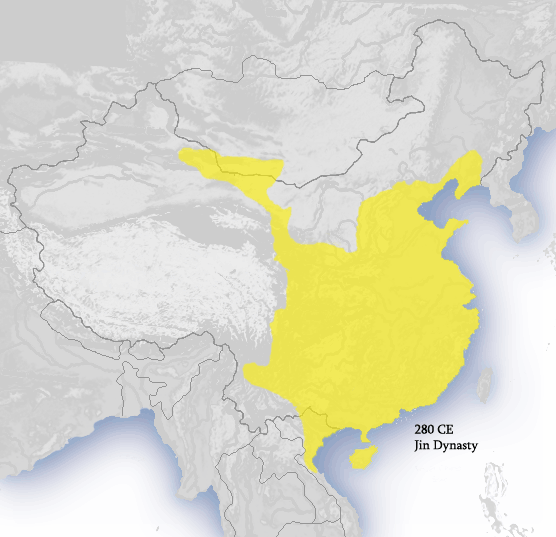
The Jin dynasty or the Jin Empire, officially Jin, sometimes distinguished as the Sima Jin or the Two Jins, was an imperial dynasty in China that existed from 266 to 420. It was founded by Sima Yan, eldest son of Sima Zhao, who had previously been declared the King of Jin. There are two main divisions in the history of the dynasty. The Western Jin (266–316) was established as the successor to Cao Wei after Sima Yan usurped the throne from Cao Huan. The capital of the Western Jin was initially in Luoyang, though it later moved to Chang'an (modern Xi'an). In 280, after conquering Eastern Wu, the Western Jin ended the Three Kingdoms period and reunited China proper for the first time since the end of the Han dynasty.
From 291 to 306, a series of civil wars known as the War of the Eight Princes were fought over control of the Jin state which weakened it considerably. In 304, the dynasty experienced a wave of rebellions by non-Han ethnicities termed by exonym as "Five Barbarians". The "barbarians" went on to establish nonpermanent dynastic states in northern China. This helped to usher in the Sixteen Kingdoms era of Chinese history, in which states in the north rose and fell in rapid succession, constantly fighting both one another and the Jin. Han-Zhao, one of the northern states established during the disorder, sacked Luoyang in 311, captured Chang'an in 316, and executed Emperor Min of Jin in 318, ending the Western Jin era. Sima Rui, who succeeded Emperor Min, then reestablished the Jin dynasty with its capital in Jiankang (modern Nanjing), inaugurating the Eastern Jin (317–420).
The Eastern Jin dynasty remained in near-constant conflict with its northern neighbors for most of its existence, and it launched several invasions of the north with the aim of recovering its lost territories. In 383, the Eastern Jin inflicted a devastating defeat on the Former Qin, a Di-ruled state that had briefly unified northern China. In the aftermath of that battle, the Former Qin state splintered, and Jin armies recaptured the lands south of the Yellow River. The Eastern Jin was eventually usurped by General Liu Yu in 420 replaced with the Liu Song dynasty. The Eastern Jin dynasty is considered the second of the Six Dynasties.
During the Three Kingdoms period, the Sima clan—with its most accomplished individual being Sima Yi—rose to prominence within the kingdom of Cao Wei that dominated northern China. Sima Yi was the regent of Cao Wei, and in 249 he instigated a coup d'état known as the Incident at the Gaoping Tombs, the Sima clan began to surpass the Cao clan's power in the kingdom. After Sima Yi's death in 251, Sima Yi's eldest son Sima Shi succeeded his father as regent of Cao Wei, maintaining the Sima clan's tight grip on the Cao Wei political scene. After Sima Shi's death in 255, Sima Shi's younger brother Sima Zhao became the regent of Cao Wei. Sima Zhao further assisted his clans' interests by suppressing rebellions and dissent.
In 263, he directed Cao Wei forces in conquering Shu Han and capturing Liu Shan (the son of Liu Bei), marking the first demise of one of the Three Kingdoms. Sima Zhao's actions awarded him the title of King of Jin, the last achievable rank beneath that of emperor. He was granted the title because his ancestral home was located in Wen County, on the territory of the Zhou-era state of Jin, which was centered on the Jin River in Shaanxi. Sima Zhao's ambitions for the throne were visible, but he died in 265 before any usurpation attempt could be made, passing the opportunity to his ambitious son Sima Yan.
The Jin dynasty was founded by Sima Yan, who was known posthumously as Emperor Wu (the "Martial Emperor of Jin"). After succeeding his father as the King of Jin and regent of Cao Wei in 265, Sima Yan declared himself emperor of the Jin dynasty in February 266 and forced the final Wei ruler Cao Huan to abdicate. Emperor Wu permitted Cao Huan to live with honour as the Prince of Chenliu, and buried him with imperial ceremony. Under Emperor Wu, the Jin dynasty conquered Eastern Wu in 280 and united China proper, thus ending the Three Kingdoms period. The period of unity was relatively short-lived, as the Jin state was soon weakened by corruption, political turmoil, and internal conflicts. Emperor Wu's son Zhong, posthumously known as Emperor Hui, was developmentally disabled.
Emperor Wu died in 290, and in 291 conflict over his succession caused the devastating War of the Eight Princes. The dynasty was greatly weakened by this civil conflict, and it soon faced more upheaval when the Upheaval of the Five Barbarians began in 304. During this unrest, the Jin capital Luoyang was sacked by Han-Zhao ruler Liu Cong in 311, and Jin emperor Sima Chi, posthumously known as Emperor Huai, was captured and later executed. Emperor Huai's successor Sima Ye, posthumously known as Emperor Min, was then also captured and executed by Han-Zhao forces when they seized Chang'an (present-day Xi'an) in 316. This event marked the end of the Western Jin. The surviving members of the Jin imperial family, as well as large numbers of Han Chinese from the North China Plain, subsequently fled to southern China. These refugees had a large impact on the lands they moved to—for example, they gave Quanzhou's Jin River its name upon their settlement there.
After the fall of Chang'an and the execution of Emperor Min of Jin, Sima Rui, posthumously known as Emperor Yuan, was enthroned as Jin emperor in 318. He reestablished the Jin government at Jiankang (modern Nanjing), which became the dynasty's new capital and marked the beginning of the Eastern Jin period. Since one of Sima Rui's titles was the prince of Langya, the newly established northern states, which denied the legitimacy of his succession, sometimes referred to his empire as "Langya".
Hub AI
Jin dynasty (266–420) AI simulator
(@Jin dynasty (266–420)_simulator)
Jin dynasty (266–420)
The Jin dynasty or the Jin Empire, officially Jin, sometimes distinguished as the Sima Jin or the Two Jins, was an imperial dynasty in China that existed from 266 to 420. It was founded by Sima Yan, eldest son of Sima Zhao, who had previously been declared the King of Jin. There are two main divisions in the history of the dynasty. The Western Jin (266–316) was established as the successor to Cao Wei after Sima Yan usurped the throne from Cao Huan. The capital of the Western Jin was initially in Luoyang, though it later moved to Chang'an (modern Xi'an). In 280, after conquering Eastern Wu, the Western Jin ended the Three Kingdoms period and reunited China proper for the first time since the end of the Han dynasty.
From 291 to 306, a series of civil wars known as the War of the Eight Princes were fought over control of the Jin state which weakened it considerably. In 304, the dynasty experienced a wave of rebellions by non-Han ethnicities termed by exonym as "Five Barbarians". The "barbarians" went on to establish nonpermanent dynastic states in northern China. This helped to usher in the Sixteen Kingdoms era of Chinese history, in which states in the north rose and fell in rapid succession, constantly fighting both one another and the Jin. Han-Zhao, one of the northern states established during the disorder, sacked Luoyang in 311, captured Chang'an in 316, and executed Emperor Min of Jin in 318, ending the Western Jin era. Sima Rui, who succeeded Emperor Min, then reestablished the Jin dynasty with its capital in Jiankang (modern Nanjing), inaugurating the Eastern Jin (317–420).
The Eastern Jin dynasty remained in near-constant conflict with its northern neighbors for most of its existence, and it launched several invasions of the north with the aim of recovering its lost territories. In 383, the Eastern Jin inflicted a devastating defeat on the Former Qin, a Di-ruled state that had briefly unified northern China. In the aftermath of that battle, the Former Qin state splintered, and Jin armies recaptured the lands south of the Yellow River. The Eastern Jin was eventually usurped by General Liu Yu in 420 replaced with the Liu Song dynasty. The Eastern Jin dynasty is considered the second of the Six Dynasties.
During the Three Kingdoms period, the Sima clan—with its most accomplished individual being Sima Yi—rose to prominence within the kingdom of Cao Wei that dominated northern China. Sima Yi was the regent of Cao Wei, and in 249 he instigated a coup d'état known as the Incident at the Gaoping Tombs, the Sima clan began to surpass the Cao clan's power in the kingdom. After Sima Yi's death in 251, Sima Yi's eldest son Sima Shi succeeded his father as regent of Cao Wei, maintaining the Sima clan's tight grip on the Cao Wei political scene. After Sima Shi's death in 255, Sima Shi's younger brother Sima Zhao became the regent of Cao Wei. Sima Zhao further assisted his clans' interests by suppressing rebellions and dissent.
In 263, he directed Cao Wei forces in conquering Shu Han and capturing Liu Shan (the son of Liu Bei), marking the first demise of one of the Three Kingdoms. Sima Zhao's actions awarded him the title of King of Jin, the last achievable rank beneath that of emperor. He was granted the title because his ancestral home was located in Wen County, on the territory of the Zhou-era state of Jin, which was centered on the Jin River in Shaanxi. Sima Zhao's ambitions for the throne were visible, but he died in 265 before any usurpation attempt could be made, passing the opportunity to his ambitious son Sima Yan.
The Jin dynasty was founded by Sima Yan, who was known posthumously as Emperor Wu (the "Martial Emperor of Jin"). After succeeding his father as the King of Jin and regent of Cao Wei in 265, Sima Yan declared himself emperor of the Jin dynasty in February 266 and forced the final Wei ruler Cao Huan to abdicate. Emperor Wu permitted Cao Huan to live with honour as the Prince of Chenliu, and buried him with imperial ceremony. Under Emperor Wu, the Jin dynasty conquered Eastern Wu in 280 and united China proper, thus ending the Three Kingdoms period. The period of unity was relatively short-lived, as the Jin state was soon weakened by corruption, political turmoil, and internal conflicts. Emperor Wu's son Zhong, posthumously known as Emperor Hui, was developmentally disabled.
Emperor Wu died in 290, and in 291 conflict over his succession caused the devastating War of the Eight Princes. The dynasty was greatly weakened by this civil conflict, and it soon faced more upheaval when the Upheaval of the Five Barbarians began in 304. During this unrest, the Jin capital Luoyang was sacked by Han-Zhao ruler Liu Cong in 311, and Jin emperor Sima Chi, posthumously known as Emperor Huai, was captured and later executed. Emperor Huai's successor Sima Ye, posthumously known as Emperor Min, was then also captured and executed by Han-Zhao forces when they seized Chang'an (present-day Xi'an) in 316. This event marked the end of the Western Jin. The surviving members of the Jin imperial family, as well as large numbers of Han Chinese from the North China Plain, subsequently fled to southern China. These refugees had a large impact on the lands they moved to—for example, they gave Quanzhou's Jin River its name upon their settlement there.
After the fall of Chang'an and the execution of Emperor Min of Jin, Sima Rui, posthumously known as Emperor Yuan, was enthroned as Jin emperor in 318. He reestablished the Jin government at Jiankang (modern Nanjing), which became the dynasty's new capital and marked the beginning of the Eastern Jin period. Since one of Sima Rui's titles was the prince of Langya, the newly established northern states, which denied the legitimacy of his succession, sometimes referred to his empire as "Langya".