


Community hub
Recent from talks
Contribute something
Nothing was collected or created yet.
Tyrone Willingham
View on Wikipedia
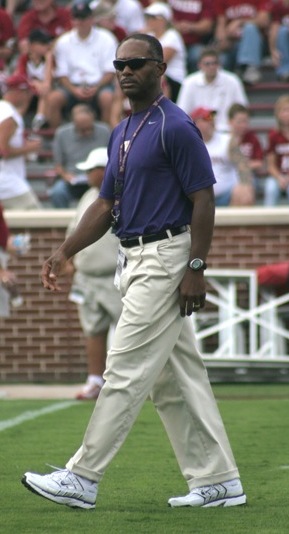
Lionel Tyrone Willingham (born December 30, 1953[2][3]) is an American former football player and coach. He was the head coach at Stanford University (1995–2001), the University of Notre Dame (2002–2004), and the University of Washington (2005–2008), compiling a career college football record of 76–88–1.
Key Information


Early career
[edit]Willingham attended Jacksonville Senior High School in Jacksonville, North Carolina and lettered in football, basketball, and baseball.[citation needed] He went on to Michigan State University, where he played football and baseball and graduated in 1977[4] with a degree in physical education. Willingham held assistant coaching positions at his alma mater (1977, 1980–82), Central Michigan University (1978–79), North Carolina State University (1983–85), Rice University (1986–88), and Stanford University (1989–91). When Stanford head coach Dennis Green was hired as the Minnesota Vikings head coach in 1992, Willingham followed him as running backs coach (1992–94).
Head coaching positions
[edit]Stanford
[edit]Following the 1994 season, despite having never been more than a position coach at any level, Willingham returned to Stanford as head coach, succeeding Bill Walsh. In his seven seasons (1995–2001) as coach, he led the Cardinal to a 44–36–1 record and four bowl game appearances. Notably, Willingham's teams went undefeated (7–0) against arch-rival California. In 2000, he was presented with the Eddie Robinson Coach of Distinction Award that is given annually to honor "an outstanding college football coach and role model for career achievement".[5]
His best team was the 1999 team, which won the school's first outright Pacific-10 Conference title in 29 years and appeared in the 2000 Rose Bowl. Willingham's 44 wins were the most by a Stanford coach since John Ralston, who left the school for the Denver Broncos of the NFL after the 1971 season.
Notre Dame
[edit]2002
[edit]On December 31, 2001, Willingham was hired as head coach at Notre Dame.[6] Willingham began the 2002 season by going 8–0, and went on to become the only first-year coach in Notre Dame history to win 10 games. For his efforts, he was named the SN Sportsman of the year, ESPN/Home Depot College Coach of the Year,[7] the Scripps College Coach of the Year, the Black Coaches Association Male Coach of the Year, and the George Munger Award College Coach of the Year by the Maxwell Football Club.[8]
In the 2002 regular-season finale, ND was blown out by arch-rival USC, 44–13, and was outgained 610–109—the worst such margin in school history.[9] That loss knocked ND from a likely Bowl Championship Series berth down to the 2003 Gator Bowl—where they were beaten by North Carolina State, 28–6.[10]
2003
[edit]The 2003 team finished 5–7 and was beaten badly in four of those losses, getting shut out twice in one season for the first time since 1960, including a 37–0 loss to Florida State and finishing with a point differential of 315-243 [11]—the worst of any Fighting Irish team since the 2–8 team of 1956.
2004
[edit]In 2004, Notre Dame posted a 6–5 record in the regular season, including a 41–16 loss to Purdue (the second-worst home loss ever to Purdue) and ending with Willingham's third consecutive loss to USC for his fifth loss by 30 points or more, and eighth by 22 points or more, in his three seasons. The following Tuesday, November 30, after an overall record in South Bend of 21–15 (an 8–0 start followed by a 13-15 finish), Notre Dame terminated Willingham as head coach.[12] Defensive coordinator Kent Baer served as acting head coach for the Insight Bowl, a 38–21 loss to Oregon State.
Washington
[edit]On December 13, 2004, Willingham was hired as the new head coach at Washington, succeeding Keith Gilbertson. The Huskies returned 19 of 22 starters from the previous season, in which they had gone 1–10 (0–8 in conference play).
Willingham's primary task was to change the program's image, which had been marred by off-the-field legal problems under Rick Neuheisel. He instituted a strict hair policy and was known to occasionally show up in his players' classes unannounced to make sure they were attending.[13]
2005
[edit]Willingham faced his former team on September 24, 2005. Notre Dame prevailed, 36–17. His first season at Washington ended with a 2–9 record (1–7 in conference play, tied for 9th place), capped by a scuffle after a close loss to Washington State.[14]
2006
[edit]His 2006 Washington team started October with a 4–1 record, with its most notable victory a stunning 29–19 upset over previously undefeated UCLA, before losing its next 6 games after starting quarterback Isaiah Stanback suffered a season-ending foot injury in a loss to Oregon State in their sixth game. The Huskies ended the season at 5–7 (3–6 in conference play, 9th place), this time defeating state rival Washington State (WSU) by three points. This win held WSU from defeating the Huskies for three consecutive seasons years, something that has never happened in the history of the century-long rivalry.
2007
[edit]The 2007 Washington Huskies football team faced what a preseason CBS Sports opinion piece called "the toughest schedule in the country" [15] Washington went on to a 4–9 record overall (2–7 in conference play, 10th place) with wins against Syracuse, Boise State, Stanford, and California. There was considerable debate after the season over whether Willingham should be fired as no other coach in the history of the program had ever tallied three straight losing seasons. Washington State won the Apple Cup again, making it three out of the last four.[16] In the end, it was decided that he would return for the upcoming season with the expectation that the team become more competitive.[17] Additionally, several boosters were pleased at Willingham's effort to clean up the program.[13]
2008
[edit]Willingham's stiff demeanor resulted in a somewhat acrimonious relationship with fans, boosters, and the Seattle media. The turning point came at the end of his third (losing) season when there was a big question as to whether he would be retained. However, President Emmert gave him a vote of confidence and he was retained for a fourth year.
The 2008 season started off inauspiciously with #21 Oregon defeating Washington 44–10. This marked the first time Oregon had ever beaten Washington five consecutive times in the history of the century-long rivalry.[18] The second game against #15 BYU was a nail biter and Washington scored the final touchdown in the final minute. The PAT would have tied the game, however an unsportsmanlike conduct penalty was called against quarterback Jake Locker who had thrown the ball up in the air in celebration after scoring the touchdown. This moved the PAT attempt to 35 yards which was blocked and the BYU escaped with a 28–27 victory. In the next game, the Huskies were dismantled 55–14 by the #3 Oklahoma Sooners, giving the overmatched Huskies their greatest margin of defeat at home since 1929.[19] In the fourth game, the Huskies lost to Stanford leaving them as the only winless team in a BCS conference. The Huskies were without a sack, leaving them as the only school without a sack at this point of the season.[20] It was the second 0–4 start in the last five years and only the fourth time ever in the history of the program. Starting quarterback Jake Locker was lost for the season, injuring his left hand during a block on a reverse.
In the fifth game, Arizona put Washington away early and the game ended with a 48–14 wipeout of the Huskies. This was the biggest margin of victory by Arizona over Washington ever, and started a watch of just how bad the team could get. The Huskies had a flat performance in their sixth game to lose to Oregon State 34–13. This was the fifth consecutive loss to the Beavers, something that had never happened in the long history of the series.[21] Game 7 was another loss versus his former team Notre Dame. The Huskies were nearly shutout in suffering a 33–7 loss that left them 0–7 and ineligible for a bowl game yet again. On October 27, 2008, seven games into the 2008 season, Willingham announced that his contract was being terminated and he would be leaving UW after the regular season.[22] Game 8 was a shutout by USC.
At 0–11, Washington was the only winless team in the FBS, and the owner of a 13-game losing streak stretching from the last season. Washington closed out the season with a loss at 1–10 Washington State in double-overtime, making it four of the last five, and with a season-ending loss at California. Willingham finished the season with an 0–12 record, the Huskies' first winless season in 119 years, as well as the only winless season in the PAC-10, PAC-12 era.
Post coaching career
[edit]In 2014, Willingham was named as a member of the College Football Playoff selection committee.[23] Willingham also volunteered as a coach on the Stanford women's golf team in 2011.[24] Willingham served as president on the American Football Coaches Association (AFCA) Board of Trustees in 2008.[25] On July 18, 2010, at the age of 56 and nearly two years after he had coached his last game, Willingham announced he was retired from coaching.[26]
Personal life
[edit]Willingham is married and has three children.[citation needed]
Head coaching record
[edit]| Year | Team | Overall | Conference | Standing | Bowl/playoffs | Coaches# | AP° | ||
|---|---|---|---|---|---|---|---|---|---|
| Stanford Cardinal (Pacific-10 Conference) (1995–2001) | |||||||||
| 1995 | Stanford | 7–4–1 | 5–3 | 4th | L Liberty | ||||
| 1996 | Stanford | 7–5 | 5–3 | 3rd | W Sun | ||||
| 1997 | Stanford | 5–6 | 3–5 | T–7th | |||||
| 1998 | Stanford | 3–8 | 2–6 | T–8th | |||||
| 1999 | Stanford | 8–4 | 7–1 | 1st | L Rose† | 24 | |||
| 2000 | Stanford | 5–6 | 4–4 | 4th | |||||
| 2001 | Stanford | 9–3 | 6–2 | T–2nd | L Seattle | 17 | 16 | ||
| Stanford: | 44–36–1 | 32–24 | |||||||
| Notre Dame Fighting Irish (Independent) (2002–2004) | |||||||||
| 2002 | Notre Dame | 10–3 | L Gator | 17 | 17 | ||||
| 2003 | Notre Dame | 5–7 | |||||||
| 2004 | Notre Dame | 6–5* | Insight* | ||||||
| Notre Dame: | 21–15 | *Fired before Insight Bowl | |||||||
| Washington Huskies (Pacific-10 Conference) (2005–2009) | |||||||||
| 2005 | Washington | 2–9 | 1–7 | 10th | |||||
| 2006 | Washington | 5–7 | 3–6 | 9th | |||||
| 2007 | Washington | 4–9 | 2–7 | 10th | |||||
| 2008 | Washington | 0–12 | 0–9 | 10th | |||||
| Washington: | 11–37 | 6–29 | |||||||
| Total: | 76–88–1 | ||||||||
| National championship Conference title Conference division title or championship game berth | |||||||||
| |||||||||
References
[edit]- ^ Hille, Bob (December 19, 2023). "History of The Sporting News' Athlete of the Year awards: Full list of past winners, 1968-2023". Sporting News. Retrieved December 16, 2025.
- ^ "Tyrone Willingham | Pro Football History.com". pro-football-history.com. Retrieved March 7, 2022.
- ^ "Ty Willingham". IMDb. Retrieved March 7, 2022.
- ^ "Tyrone Willingham". www.coacheshotseat.com. Retrieved March 7, 2022.
- ^ "Tyrone Willingham Presented Eddie Robinson Coach of Distinction Award". Stanford University Football. Stanford University. November 30, 2000. Archived from the original on March 18, 2012. Retrieved August 17, 2010.
- ^ "Tyrone Willingham Named Notre Dame Football Coach". UND.cstv.com. December 31, 2001. Archived from the original on November 14, 2007. Retrieved August 27, 2007.
- ^ "Tyrone Willingham Named Home Depot National Coach Of The Year". UND.cstv.com. December 9, 2002. Archived from the original on July 21, 2008. Retrieved August 27, 2007.
- ^ "Tyrone Willingham Wins George Munger Award for College Coach of the Year". UND.cstv.com. December 13, 2002. Archived from the original on March 2, 2008. Retrieved August 27, 2007.
- ^ "No. 7 Irish Fall To Trojans - UND.COM - University of Notre Dame Official Athletic Site". Und.cstv.com. November 30, 2002. Archived from the original on February 20, 2008. Retrieved October 7, 2012.
- ^ "No. 11 Irish Fall To No. 17 NC State In Gator Bowl, 28-6 - UND.COM - University of Notre Dame Official Athletic Site". Und.cstv.com. January 1, 2003. Archived from the original on February 16, 2008. Retrieved October 7, 2012.
- ^ "Notre Dame Game by Game Results". Archived from the original on October 23, 2008. Retrieved October 27, 2008.
- ^ "Statement From Director Of Athletics Kevin White". UND.cstv.com. November 30, 2004. Archived from the original on November 14, 2007. Retrieved August 27, 2007.
- ^ a b "Local News | Emmert: "You can win, and you can win properly" | Seattle Times Newspaper". seattletimes.nwsource.com. Archived from the original on June 4, 2011. Retrieved January 12, 2022.
- ^ "The Seattle Times: Search Results". archives.seattletimes.nwsource.com. Archived from the original on April 28, 2007. Retrieved January 12, 2022.
- ^ "NCAA Football - CBSSports.com".
- ^ "UW alum pledged $100K if Willingham were fired". ESPN.com. Associated Press. January 10, 2008. Retrieved May 17, 2025.
- ^ "Huskies | Willingham will return to coach Huskies | Seattle Times Newspaper". seattletimes.nwsource.com. Archived from the original on May 24, 2011. Retrieved January 12, 2022.
- ^ "Washington Game by Game against Opponents". Cfbdatawarehouse.com. Archived from the original on October 10, 2018. Retrieved October 7, 2012.
- ^ GREGG BELL, AP Sports Writer Sunday, Sep 14, 2008 (September 14, 2008). "Bradford's 6 TDs led No. 3 Oklahoma over UW 55-14 - College Football - Rivals.com". Rivals.yahoo.com. Retrieved October 7, 2012.
{{cite web}}: CS1 maint: multiple names: authors list (link) CS1 maint: numeric names: authors list (link) - ^ "Husky Football". The Seattle Times. Archived from the original on September 29, 2011.
- ^ "Washington Game by Game against Opponents". Cfbdatawarehouse.com. Archived from the original on October 10, 2012. Retrieved October 7, 2012.
- ^ Willingham to step down as Huskies coach at season's end, Associated Press, October 27, 2008, Accessed October 27, 2008.
- ^ Malinowski, Erik (September 5, 2014). "5 for Friday: Tyrone Willingham, Playoff Selection Committee member". FOX Sports. Retrieved December 16, 2025.
- ^ "College Football News, Videos, Scores, Teams, Standings, Stats | FOX Sports".
- ^ Staff (January 9, 2008). "Washington's Tyrone Willingham Named 2008 AFCA President". American Football Coaches Association. Retrieved August 17, 2010.[permanent dead link]
- ^ Kutsunis, Joe (July 20, 2010). "In case you were curious, yes, Tyrone is retired". SBNation. Retrieved August 17, 2010.
Tyrone Willingham
View on GrokipediaEarly life and playing career
Childhood and family
Lionel Tyrone Willingham was born on December 30, 1953, in Kinston, North Carolina, to parents Nathaniel and Lillian Willingham, with Nathaniel aged 48 at the time of his birth.[8] As the eldest of four siblings, he grew up in Jacksonville, North Carolina, during the early 1960s amid the racial tensions of the segregated South.[5][5] His father, a self-taught contractor and landlord known to family as exceptionally diligent, exemplified hard work and provided a foundational influence on Willingham's development.[9] The parents prioritized education and resilience, raising the children to dismiss segregation's discriminatory barriers rather than internalize them, which cultivated a capacity to persevere through societal challenges.[10] This familial approach extended to academic pursuit, as all four siblings obtained advanced degrees—Willingham's brother Jerome served as a city councilman in Jacksonville, while his sisters worked in Washington, D.C.[8]College athletics at Michigan State
Willingham arrived at Michigan State University as a walk-on in both football and baseball, earning three varsity letters in each sport from 1973 to 1976. Despite measuring 5 feet 7 inches and 140 pounds, he secured playing time across multiple positions, starting as a quarterback before shifting to wide receiver (flanker), defensive back, and return specialist. His progression from scholarship-less entrant to co-captain underscored a work ethic rooted in fundamentals and preparation, traits evident in his 36 rushing attempts for 25 yards as a freshman quarterback.[3][11] In 1973, Willingham started four games at quarterback, completing 10 of 19 passes for 124 yards, one touchdown, and three interceptions, which earned him a scholarship entering his sophomore year. Limited passing opportunities followed in 1974 (0 completions on 7 attempts, one interception) amid a transition to defensive contributions, including a rushing touchdown on 9 carries for 5 yards. By his senior season in 1976, he focused on receiving (14 catches for 133 yards) and special teams, leading the Big Ten in kickoff returns with 23 for 454 yards (19.7 average) and punt returns with 24 for 149 yards (6.2 average).[11][12] Defensively, Willingham earned second-team All-Big Ten honors as a defensive back, reflecting his coverage skills and tackling reliability in an era emphasizing physical play. As football co-captain that year, he exemplified leadership through consistent effort, amassing empirical versatility—1,087 all-purpose yards career-wide—that honed instincts for player evaluation and scheme adaptation later applied in coaching.[7][11] Balancing these demands, Willingham maintained academic eligibility, graduating in June 1977 with a Bachelor of Science in physical education. This dual commitment—athletic output yielding 1 touchdown passing, 1 rushing, and no fumbles lost—demonstrated disciplined time management, prioritizing verifiable preparation over raw athleticism.[13][14][11]Assistant coaching positions
Early roles in high school and college
Willingham began his coaching career immediately after graduating from Michigan State University in 1977 with a degree in physical education, serving as a graduate assistant at his alma mater under head coach Darryl Rogers.[5] This entry-level role provided foundational experience in program operations and player development, focusing on basic coaching techniques amid the Spartans' competitive environment.[5] From 1978 to 1979, he advanced to secondary coach at Central Michigan University, a Division I-AA program at the time, where he instructed defensive backs on coverage fundamentals, tackling mechanics, and zone defenses essential for building defensive backfield reliability.[5] His tenure emphasized drilling core skills to improve pass defense efficiency against Mid-American Conference opponents.[5] Willingham returned to Michigan State from 1980 to 1982 as secondary and special teams coach under head coach Muddy Waters, refining player techniques in man-to-man coverage, interception drills, and punt/kickoff return units.[3] These responsibilities honed his approach to discipline and execution in high-pressure scenarios, contributing to the Spartans' defensive preparations during a period of program transition.[3] In 1983, he moved to North Carolina State University as secondary and special teams coach, continuing to prioritize foundational defensive alignments and special teams blocking schemes through repetitive practice regimens tailored to Atlantic Coast Conference challenges.[5] Over these three seasons, Willingham's work laid groundwork in causal elements of secondary performance, such as reaction timing and pursuit angles, without yet involving broader offensive or coordinator duties.[5]Progression to major programs
Willingham advanced his coaching career by joining Rice University as defensive backs coach from 1983 to 1988, working within the Southwest Conference and refining defensive schemes against high-level competition. This role marked his entry into a major Division I program, building on prior secondary coaching at Michigan State and Central Michigan, where he emphasized coverage techniques and special teams discipline.[5] In 1989, Willingham transitioned to Stanford University under head coach Dennis Green, shifting to offensive responsibilities as running backs coach—a move that broadened his expertise from defense to offense.[15] Green's staff, including Willingham, engineered a program turnaround, improving Stanford's record from 3-8 in 1989 to 6-5 in 1990 (with an Aloha Bowl appearance) and 8-4-1 in 1991 (culminating in an Aloha Bowl victory over Georgia Tech on January 5, 1992).[1] Willingham contributed to running game efficiency, mentoring backs who supported balanced attacks that secured consecutive bowl berths for the first time in years.[16] Following Green's departure, Willingham joined him with the Minnesota Vikings as running backs coach from 1992 to 1994, gaining professional-level experience in the NFL.[3] There, he helped revitalize the Vikings' offense, aiding records of 11-5 in 1992 (playoff berth) and 10-6 in 1994 (another playoff appearance), while adapting college-honed strategies to pro talent demands.[7] This tenure under Green honed Willingham's program-building acumen, including structured communication and determination in high-stakes environments, as he later credited Green's influence for shaping his overall coaching philosophy.[16]Head coaching tenures
Stanford turnaround (1995–2001)
Willingham assumed the head coaching role at Stanford in December 1994, taking over a program that had endured back-to-back losing seasons, including a 3-7-1 finish in 1994 under Bill Walsh.[17] His arrival marked a shift toward disciplined fundamentals and player development, emphasizing accountability and preparation amid academic rigor at the university. In his debut 1995 season, Stanford achieved bowl eligibility with a Liberty Bowl appearance—the program's first postseason berth since 1992—earning Willingham Pac-10 Coach of the Year honors despite a 4-7 overall record marred by injuries.[18][13] The 1996 campaign solidified the turnaround, as Stanford posted a 7-5 record after a 38-0 shutout victory over Michigan State in the Sun Bowl—its first bowl win since 1972 and first shutout since 1974—securing back-to-back postseason trips and another Pac-10 Coach of the Year award for Willingham.[19][13] This success stemmed from improved defensive structure and opportunistic play, though the Cardinal struggled in subsequent years with 5-6 (1997) and 3-8 (1998) marks amid recruiting challenges and turnover. Willingham's emphasis on walk-on opportunities and under-the-radar talent helped cultivate key contributors like wide receiver Troy Walters, a two-time All-Pac-10 selection who amassed over 3,900 receiving yards and set school records under his guidance.[20][21] The pinnacle arrived in 1999, when Stanford surged to an 8-4 record and 7-1 conference mark, clinching its first Pac-10 title since 1971 and earning a Rose Bowl berth—the program's first since 1972—behind a balanced offense led by quarterback Todd Husak and Walters.[7] Though a 17-9 Orange Bowl loss to Florida followed a 5-6 regular season in 2000, Willingham's teams demonstrated resilience, reaching three bowls in the first four years and fostering a culture of competitiveness despite limited athletic department resources compared to rivals.[5] Over seven seasons through 2001, he compiled a 44-36-1 overall record and 32-25-1 in Pac-10 play, the most wins by a Stanford coach since John Ralston's departure in 1972, though three sub-.500 finishes highlighted ongoing inconsistencies in sustaining elite contention.[5][4]Notre Dame initial success and decline (2002–2004)
Following George O'Leary's resignation on December 15, 2001, after admitting to fabricating elements of his academic and coaching resume, the University of Notre Dame appointed Tyrone Willingham as head coach on January 1, 2002, seeking to restore stability amid the hiring scandal.[22][23] In 2002, Willingham's debut season produced a 10-3 overall record, including a 10-2 regular-season mark that propelled Notre Dame to 17th in the final AP poll.[2][24] The team averaged 22.3 points per game offensively and secured a berth in the Gator Bowl, where they fell 28-6 to North Carolina State on January 1, 2003.[24][25] This immediate turnaround validated the hire, as the Irish demonstrated defensive solidity and opportunistic play, amassing 201 first downs while limiting opponents to 16.7 points per game.[26] Performance regressed sharply in 2003 with a 5-7 record, failing to qualify for a bowl game, followed by a 6-6 mark in 2004 under Willingham's direction for the regular season.[2][27][28] Despite the installation of Brady Quinn—who enrolled in 2003 and assumed the starting quarterback role by 2004—the offense showed stagnation, averaging 20.2 points per game in 2003 before a marginal uptick to 24.1 in 2004 amid persistent turnover problems and inefficiency.[27][28] Recruiting efforts yielded a top-tier 2003 class but faltered thereafter, with subsequent groups ranked outside the elite tier by analysts, exacerbating talent gaps in a program with national championship expectations.[29][30] These metrics underscored a rigidity in schematic adjustments, as the team's inability to sustain early momentum highlighted challenges adapting to heightened scrutiny and roster evolution.[27][28]Washington struggles (2005–2008)
Willingham was appointed head coach of the Washington Huskies on December 13, 2004, inheriting a program hampered by lingering NCAA sanctions from prior violations under previous coach Rick Neuheisel, which had depleted talent and limited scholarships.[3] In his first season of 2005, the team finished 2–9 overall and 1–7 in the Pac-10, one of the program's worst performances and without a bowl berth.[2] The Huskies showed marginal improvement in 2006 (5–7 overall, 3–6 conference) and 2007 (4–9 overall, 2–7 conference), but still failed to achieve bowl eligibility amid ongoing talent deficiencies and adaptation challenges to the competitive Pac-10 environment.[2] Over four seasons, Willingham's teams compiled an 11–37 overall record (.229 winning percentage) and 6–29 in conference play, the lowest winning percentage in Washington history and without a single postseason appearance.[2] Critics attributed the struggles to inadequate in-state recruiting, as Willingham's classes ranked poorly nationally and failed to secure top Washington prospects, exacerbating the talent gap left by sanctions.[31] His deliberate, fundamentals-focused coaching style, successful at Stanford and initially at Notre Dame, was seen as slow to adapt to the speed and spread offenses dominating the Pac-10, contributing to consistent defensive and offensive inefficiencies.[32] The 2008 season culminated in disaster, with the Huskies going 0–12 overall—the program's first winless campaign in 119 years—and 0–9 in conference, prompting athletic director Scott Woodward to force Willingham's resignation on October 27 after a 0–7 start.[33] [34] Willingham coached the final five games but secured no victories, amid reports of strained relations with alumni, media, and fans over the program's decline.[35] The tenure highlighted difficulties in rebuilding amid inherited constraints, though detractors argued insufficient progress in player development and scheme evolution prolonged the downturn.[32]Controversies and performance critiques
Notre Dame firing and racial allegations
Tyrone Willingham was dismissed as head football coach at the University of Notre Dame on November 30, 2004, after three seasons with an overall record of 21–15, despite remaining under contract through 2008.[36][37] The firing followed a 6–6 regular season record in 2004, Notre Dame's second straight non-bowl campaign, with 14 losses across Willingham's final 25 games including three defeats to rival USC.[38] University athletic director Kevin White cited the program's failure to contend for national championships and bowl games as the primary rationale, emphasizing that expectations at Notre Dame demand sustained elite performance rather than mediocrity.[39] The decision drew comparisons to predecessor Bob Davie, a white coach fired after five seasons with a 35–25 record, including a 5–6 mark in 2001 that prompted his exit despite a longer tenure.[40][41] Willingham's teams had started strong with a 10–3 record and Insight Bowl appearance in 2002 but declined to 5–7 in 2003 and 6–6 in 2004, reflecting issues in recruiting, offensive output, and victories against top-25 opponents.[36] Notre Dame's history of merit-based evaluations—dismissing coaches like Davie and earlier figures such as Gerry Faust (30–26–1 over five years)—supported the view that the firing stemmed from results, not extraneous factors, as the program prioritizes restoring its tradition of national contention over patience with subpar outcomes.[42] As Notre Dame's first Black head coach, Willingham's dismissal prompted allegations of racial bias from some alumni, media commentators, and advocates who argued the three-year timeline was prematurely short for a minority hire facing unique institutional pressures.[30] These claims gained traction amid broader discussions of underrepresentation, with only two Black Division I-A head coaches at the time across 117 programs, but lacked direct evidence such as disparate treatment in evaluations or admissions of prejudice by decision-makers.[43] Willingham himself did not file a lawsuit or publicly endorse discrimination claims, instead expressing gratitude for the opportunity and focusing on future prospects in post-firing statements.[44] Critics of the bias narrative, including sports analysts, contended that attributing the firing to race excused accountability for on-field failures, potentially eroding standards and deterring hires of minority coaches by implying they require extended grace periods unavailable to others.[45] Empirical patterns at Notre Dame showed consistent application of high performance thresholds regardless of coach demographics, with Willingham's inability to sustain early momentum—evidenced by back-to-back seasons under .500 against conference independents and rivals—aligning causally with the outcome rather than invidious motives.[46] While hiring discrimination in college football remains a documented barrier, the evidence for Willingham's case pointed to performance deficits as the decisive factor, underscoring that exceptional results, not identity, drive retention in a program with 11 national titles.[43][42]Broader criticisms of coaching style and recruiting
Critics of Tyrone Willingham's tenure across programs have highlighted consistent underperformance in recruiting, particularly after his early success at Stanford, where classes ranked between 13th and 30th nationally by SuperPrep.[29] At Notre Dame, his 2004 recruiting class lacked any five-star prospects and included only three four-star recruits, ranking 32nd nationally per Rivals.com, a sharp drop that contributed to talent shortages in subsequent seasons.[47] Similarly, at Washington, his 2006 class ranked 35th by Rivals.com and 36th by Scout.com, reflecting limited appeal in securing elite national talent despite regional focus.[48] These recruiting shortfalls have been attributed by observers to Willingham's interpersonal style, characterized as reserved and less engaging in the high-touch recruitment process typical of top programs, leading to alienation of prospects and boosters.[49] For instance, reports noted his tendency to limit booster involvement and maintain distance from alumni networks, which hindered relationship-building essential for attracting high-caliber athletes in competitive cycles.[49] This pattern persisted beyond Stanford, where initial discipline-driven turnarounds masked underlying talent acquisition gaps, as only one of his first 10 head-coaching classes (Notre Dame's 2003) cracked the top 10 nationally.[29] Willingham's coaching style, emphasizing mental toughness and execution over schematic innovation, drew criticism for rigidity, particularly his adherence to a pro-style offense that demanded precise, NFL-level talent not always available amid recruiting inconsistencies.[50] This approach, while effective in Stanford's early resurgence through fundamentals, proved vulnerable to talent fluctuations, resulting in predictable play-calling and late-season fades, as Stanford teams routinely struggled in November when adaptability became crucial.[51] Analysts argued that the system's reliance on perfection rather than flexibility exacerbated losses against superior opponents, underscoring a causal mismatch between rigid schemes and the variable quality of college rosters built through middling recruiting.[51][50]Post-coaching activities
Roles in football organizations
Following his dismissal from the University of Washington after the 2008 season, Tyrone Willingham transitioned to administrative roles within college football governance. In 2014, he was appointed to the College Football Playoff (CFP) selection committee, where he evaluated team rankings and playoff qualifications through the 2017 season.[52] He was reappointed in July 2021 for a one-year term, replacing an outgoing member amid ongoing committee rotations. Willingham's continued involvement in the CFP process, as listed on the official roster, reflects his expertise in program evaluation drawn from three decades of coaching experience.[13] Willingham also maintained leadership ties with the American Football Coaches Association (AFCA), having served as its president in 2008 while concluding his head coaching tenure.[3] In this capacity, he advocated for initiatives enhancing coach welfare, including professional development and ethical standards amid evolving NCAA regulations.[53] His AFCA presidency emphasized collective bargaining on issues like contract stability and workload management, positions he reiterated in post-retirement interviews on coaching sustainability.[54] These efforts positioned him as a voice for long-term industry health beyond on-field results.Advocacy and publications
Willingham has advocated for recognizing the empirical contributions of early black players and coaches in college football integration, particularly crediting his Michigan State mentors such as quarterback Jimmy Raye, running back Sherman Lewis, and head coach Duffy Daugherty for pioneering desegregation efforts in the 1960s.[55] He learned from these figures, who facilitated the recruitment of black athletes via informal networks before formal civil rights advancements, enabling subsequent opportunities for minority coaches like himself.[55] In discussions around recent milestones for black coaches, such as Penn State's James Franklin and Notre Dame's Marcus Freeman reaching playoff semifinals, Willingham emphasized performance-driven leadership over identity-based narratives, stating that coaches must demonstrate "true colors as leaders" through on-field results to counter persistent scrutiny.[55] He noted, "Until you reach the ultimate success, people are always critical of you," prioritizing verifiable achievements like wins and program building as the primary metrics for evaluation rather than racial framing or external excuses.[55] This stance aligns with his broader commentary on coaching, where professionalism and results supersede victimhood claims, as evidenced in his support for successors proving themselves amid heightened expectations.[56] While Willingham has not authored major publications, he has been prominently featured in historical works on integration, including Tom Shanahan's 2025 book The Right Thing to Do: The True Pioneers of College Football Integration, which documents Michigan State's underrecognized role through data on player integrations, game outcomes, and coaching innovations from the era.[55] His input underscores an evidence-based approach, focusing on causal factors like strategic recruiting and competitive performance that enabled black athletes to excel, rather than retrospective identity politics.[55]Personal life and legacy
Family and personal background
Lionel Tyrone Willingham was born on December 30, 1953, in Kinston, North Carolina, to Nathaniel and Lillian Willingham, as the eldest of their four children.[8][57] His father, Nathaniel, was 48 years old at the time of his birth, and the family resided in the segregated South during the early 1960s.[8] Willingham's parents, described as progressive for their era— with his mother running for county office in Onslow County—emphasized ambition and resilience, instructing him from a young age to set high goals and overcome any barriers.[5][56] Willingham grew up in a disciplined household that valued perseverance amid limited opportunities in rural North Carolina, later attending Jacksonville High School in Jacksonville, where he lettered in football, basketball, and baseball.[7] These early experiences shaped his personal ethos of determination and structure, which he carried into adulthood.[5] Willingham married Kim in the 1970s; she worked as a television news anchor until after the birth of their first child.[8][57] The couple has three children: Cassidy (born January 10, 1984), Kelsey (born May 9, 1988), and Nathaniel (born July 9, 1990).[19] Cassidy pursued gymnastics at the University of Denver from 2003 to 2006.[58] The family maintained a low public profile, with Willingham crediting their support for sustaining his focus on professional commitments while upholding core values of discipline and family priority.[8]Impact on minority coaching representation
Tyrone Willingham served as the first African American head football coach at Stanford University from 1995 to 2001 and at the University of Notre Dame from 2002 to 2004, breaking racial barriers at two prominent programs historically led by white coaches.[55][5] His appointments were hailed as milestones for minority representation, with supporters arguing they demonstrated viability for Black coaches at elite institutions amid a landscape where African American head coaches comprised fewer than 5% of NCAA Division I-A programs in the early 2000s.[59] However, empirical data on subsequent hiring trends reveals limited systemic progress, as Black head coaches in Football Bowl Subdivision (FBS) programs hovered around 8-12% from 2005 to 2025, despite African American players constituting approximately 50% of rosters.[60][61] Willingham's 2004 dismissal from Notre Dame, following a 21-15 record over three seasons, sparked allegations of racial bias from critics, including claims that the university reversed progress by reverting to white hires like Charlie Weis and Brian Kelly.[62] This narrative, amplified by groups like the Black Coaches Association, prompted calls for diversity initiatives but coincided with stagnant minority hiring; for instance, only two of the five Black Division I-A coaches remained after a cluster of firings in late 2004, and programs rarely followed Black coaches with another minority hire.[63][64] Analyses of coaching turnover indicate Black coaches receive fewer second chances in Power Five conferences, with Willingham among only four rehired non-interims since 2000, suggesting that high-profile failures may reinforce skepticism about sustained minority leadership regardless of intent.[65][66] Critics contend that emphasizing racial framing over performance metrics post-Willingham has potentially hindered representation by deterring athletic directors wary of backlash or quota perceptions, favoring instead merit-based evaluations amid evidence that Black coaches' win percentages often lag due to recruiting and pipeline constraints rather than discrimination alone.[67] Willingham himself advocated expanding the minority candidate pool through American Football Coaches Association efforts, acknowledging structural barriers like limited access to quarterback coaching roles, which correlate with head coaching promotions.[68][69] By 2025, with just 12 Black FBS head coaches out of 136—yielding an 8.82% rate—his pioneering role underscored symbolic gains but highlighted persistent challenges in achieving proportional, performance-driven diversity.[61][70]Coaching record
Willingham's head coaching career in NCAA Division I FBS football spanned 14 seasons from 1995 to 2008 across three programs, yielding an overall record of 76–88–1.[2]| Year | School | Overall | Conference | Bowl Outcome |
|---|---|---|---|---|
| 1995 | Stanford | 7–4–1 | Liberty Bowl (L) | |
| 1996 | Stanford | 7–5–0 | Sun Bowl (W) | |
| 1997 | Stanford | 5–6–0 | None | |
| 1998 | Stanford | 3–8–0 | None | |
| 1999 | Stanford | 8–4–0 | 7–1–0 | Rose Bowl (L) |
| 2000 | Stanford | 5–6–0 | None | |
| 2001 | Stanford | 9–3–0 | Seattle Bowl (L) | |
| 2002 | Notre Dame | 10–3–0 | Gator Bowl (L) | |
| 2003 | Notre Dame | 5–7–0 | None | |
| 2004 | Notre Dame | 6–5–0 | None | |
| 2005 | Washington | 2–9–0 | 1–7–0 | None |
| 2006 | Washington | 5–7–0 | 3–6–0 | None |
| 2007 | Washington | 4–9–0 | 0–8–0 | None |
| 2008 | Washington | 0–12–0 | 0–9–0 | None |