Hubbry Logo
Most SNPMost SNPMain
Open search
Most SNP
Community hub
Most SNP
logo
8 pages, 0 posts
0 subscribers
Be the first to start a discussion here.
Most SNP
Most SNP
from Wikipedia

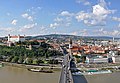
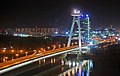
Most SNP[1] ("Bridge of the Slovak National Uprising"), commonly referred to as Most Slovenského národného povstania or the UFO Bridge, and named Nový most ("New Bridge") from 1993 to 2012, is a road bridge over the Danube in Bratislava, the capital of Slovakia. It is the world's longest bridge to have one pylon and one cable-stayed plane.

Key Information

Most SNP is an asymmetrical cable-stayed bridge with a main span length of 303 m (994 ft), a total length of 430.8 m (1,413 ft), a width of 21 m (69 ft), and a weight of 537 t (592 short tons). Its steel construction is suspended from steel cables, connected on the Petržalka side to two pillars. There are four lanes for motor traffic on the upper level and lanes for bicycles and pedestrians on the lower level. It is a member of The World Federation of Great Towers.[2]

History

[edit]

Since its construction in 1972 the bridge was called Most SNP ("Bridge of the Slovak National Uprising"), although locally it was simply called the New Bridge, being the second bridge to be built in the city over the river Danube. In 1993, its name was officially changed by Bratislava City Council to Nový Most ("New Bridge") to reflect general usage. However, another three bridges have been constructed since its opening, and so in 2012 the City Council voted to change the bridge's name back to Most SNP. The change took effect on 29 August 2012, the 68th anniversary of the Slovak National Uprising.[3]

The bridge was built between 1967 and 1972 under a project managed by A. Tesár, J. Lacko and I. Slameň.[4] It officially opened on August 26, 1972. A significant section of the Old Town below which included nearly all of the Jewish quarter, was demolished to create the roadway that led to it. On the other hand, the bridge improved access between Petržalka and the rest of the city. Parts of the historic city walls were unearthed during construction.

The SNP bridge was the central motif of Jean Michel Jarre's "Bridge from the Future" concert, which he performed on May 12, 2024.[5]

Restaurant and observation deck

[edit]

A special attraction is the flying saucer-shaped structure atop the bridge's 84.6 m (278 ft) pylon, housing an observation deck and a restaurant, which since 2005 has been called UFO (previously, Bystrica). The restaurant serves both traditional Slovak and international cuisine, describing its cuisine as "Mediterasian".[6] It received the Restaurant of the Year award in 2011.[7]

Both the restaurant and the observation deck offer panoramic views of Bratislava. They are reached using lifts located in the east pillar, accessed from the walking and cycling paths on either side of the bridge. Access to the lifts normally costs €11.90 as of January 2024, but this fee is deducted from the bill for restaurant guests.

The west pillar of the bridge tower houses an emergency staircase with 430 steps.

[edit]

See also

[edit]

References

[edit]
[edit]
Revisions and contributorsEdit on WikipediaRead on Wikipedia
from Grokipedia
![Pylon of the Bridge](./assets/Bratislava_-Most_SNPbb The Most SNP, officially the Bridge of the , is a single-pylon cable-stayed road bridge spanning the Danube River in , , distinguished by its asymmetric design and a prominent flying saucer-shaped pylon housing a and . Constructed between 1967 and 1972 under the direction of engineers including Arpád Tesár, Iľja Skoček, and Ivan Slameň, the bridge measures 431 meters in length and 21 meters in width, linking the historic Old Town to the residential district. Named in honor of the 1944 against Nazi occupation, it held the record as the world's longest bridge with a single pylon and single cable-stayed plane upon completion. The project's implementation required the demolition of portions of the medieval Devín Bank suburb, resulting in the loss of historic buildings and ongoing for prioritizing over cultural preservation during the communist era. Today, the bridge serves as an iconic landmark, offering panoramic views of and the city skyline from its elevated UFO structure at 95 meters above the river.

Design and Construction

Planning and Approvals

The planning for the Most SNP bridge emerged in the mid-1960s amid Czechoslovakia's socialist push to industrialize and urbanize , aiming to integrate the historic center with the expansive panel-housing development across the . This infrastructure project was prioritized to support rapid and vehicular access, reflecting the regime's focus on monumental engineering to symbolize technological advancement under . The design was developed by a team of Slovak professionals, including Ján Lacko, Ivan Slameň, and Arpád Tesár, who opted for an innovative asymmetrical cable-stayed with a single 95-meter pylon to span 303 meters while limiting footprint in constrained urban terrain. No open architectural competition was held; selections occurred through state-directed processes typical of the era's centralized . Approvals were granted by federal and Slovak state authorities, including the Ministry of Transport and the Slovak National Council, emphasizing efficiency over public input or heritage assessment—hallmarks of post-Stalinist planning that favored for . This process authorized the clearance of historic Podhradie buildings at Castle's base to route a high-speed motorway through the center, a step taken prior to finalizing bridge specifics and eliciting local opposition for cultural losses despite official narratives of necessity. commenced in 1967 following these clearances and project initiation around 1968.

Engineering Specifications

The Most SNP is an asymmetrical cable-stayed road bridge with a single pylon supporting a fan arrangement of stay cables in one plane, a design that was the longest of its kind upon completion in 1972. The structure features three spans: side spans of 74.8 meters and 54 meters flanking a central main span of 303 meters, yielding a total length of 431.8 meters. The continuous girder deck measures 21 meters in width and 4.6 meters in depth, with the side spans acting as cantilevers and the main span suspended from the pylon via cables anchored at three points along its length. The single pylon, constructed of , rises 84.6 meters above the ground and is skewed to accommodate the asymmetrical layout, with cables guided through it before anchoring into blocks on the bank. The main span is supported by 16 pairs of high-strength cables, enabling the bridge to span the without intermediate piers in the river. The double-deck configuration includes an upper level for four lanes of motor traffic and a lower level originally designed for trams and pedestrians, with walkways 3.5 meters wide. Engineering innovations included the integration of the pylon-top and (UFO structure) without compromising structural integrity, achieved through separate for the deck and the added mass atop the pylon. The steel framework was prefabricated and assembled using incremental launching techniques for efficiency, reflecting 1960s advancements in cable-stayed design under communist-era constraints. Load capacities support standard heavy vehicular traffic, with the structure demonstrating durability over 50 years, including resistance to seismic activity in the region.

Construction Timeline and Challenges

Construction of the Most SNP began in as part of Czechoslovakia's communist-era infrastructure expansion to improve connectivity between Bratislava's historic center and the developing district across the . The design team, comprising Slovak architects Arpád Tesár, Ján Lacko, and Ivan Slameň, oversaw the project, which involved fabricating and assembling a single-pylon cable-stayed with a main span of 440 meters. Key phases included foundation work in the Danube for the inclined pylon, cable installation in a configuration, and integration of the deck supporting vehicular, , and traffic. The bridge was completed and opened to the public in 1972, marking it as one of the longest single-pylon spans in the world at the time. A primary challenge was the bridge's alignment through densely built areas, necessitating the demolition of numerous historic structures in Bratislava's Old Town, including residential buildings and a , to clear space for approach ramps and embankments. This urban disruption, driven by state planning priorities favoring rapid modernization over preservation, eliminated significant pre-20th-century and altered the city's skyline, drawing criticism for prioritizing infrastructure over . Engineering hurdles included erecting the asymmetric 95-meter pylon amid ongoing river navigation, requiring temporary cofferdams and precise alignment to balance cable tensions across the uneven spans to the UFO pod and anchor points. Despite these obstacles, the project adhered to the five-year timeline, reflecting the centralized of the era, though long-term issues from the fabrication have since emerged.

Historical and Political Context

Origins in Communist-Era Infrastructure

The Most SNP emerged from the Czechoslovak communist regime's infrastructure initiatives, which emphasized rapid and industrialization to consolidate socialist economic structures. Following the 1948 communist coup and subsequent of industries, the government pursued centralized five-year plans that allocated resources to major projects, including River crossings in key cities like . By the mid-1960s, amid reforms under the Novotný administration, the capital's existing bridges—such as the pre-war Lafranconi and older trade-route spans—could no longer accommodate surging traffic from factory expansions and commuter flows, prompting state planners to prioritize a high-capacity, modern replacement. This aligned with broader policies promoting heavy construction to symbolize technological advancement and integrate peripheral districts into the socialist economy. Planning for the bridge formalized around 1965-1966 through the Slovak Ministry of Transport and state engineering institutes, reflecting the era's faith in monolithic infrastructure to drive progress without private market constraints. Engineers, led by architect alongside Ladislav Kušnír and Ivan Slameň, proposed an innovative single-pylon cable-stayed design to span 303 meters, surpassing contemporary capabilities and drawing on Soviet-influenced techniques adapted for steel suspension. The project received approvals amid the pre-Prague Spring thaw, with construction launching in 1967 under Doprastav, the state-owned builder responsible for much of Czechoslovakia's communist-era works. Funding derived from central budget allocations, underscoring the regime's top-down approach where individual property rights yielded to collective utility. Integral to these origins was the bridge's role in enabling the mass development of , a vast prefabricated on the Danube's southern bank, which housed over 100,000 residents by the as part of communist relocation policies from rural areas. The linked Bratislava's historic core to this new socialist suburbia, but planning disregarded heritage impacts, authorizing demolitions that erased medieval warehouses and synagogues to clear paths for ramps and boulevards. Such trade-offs exemplified causal priorities in communist : empirical needs for (projected to handle 40,000 vehicles daily) over cultural continuity, with state evaluations deeming old structures economically obsolete. Completed in after overcoming material shortages and engineering hurdles, the Most SNP thus embodied the regime's causal realism in pursuing connectivity as a prerequisite for proletarian mobility and industrial output.

Naming and Symbolic Role

The Most SNP, or Most Slovenského národného povstania, derives its name from the (Slovenské národné povstanie, SNP), an armed insurrection launched on August 29, 1944, against the Nazi-backed and German occupation forces during . The uprising involved Slovak military units, partisans, and civilians who briefly controlled central before being suppressed by German counteroffensives in October 1944, resulting in approximately 10,000 Slovak deaths and widespread reprisals. Completed and opened on September 26, 1972, the bridge's naming explicitly linked a major communist-era infrastructure project to this event, framing it as a commemoration of national resistance. Under the communist regime in Czechoslovakia, the SNP's legacy was systematically reinterpreted to emphasize the leading role of the , portraying the uprising as a proletarian, anti-fascist precursor to socialist revolution rather than a broader patriotic effort involving diverse political groups, including non-communists and the . This narrative served to legitimize the post-1948 communist government by associating it with anti-Nazi heroism and Soviet liberation, downplaying internal divisions such as conflicts between communist partisans and other factions over control of the resistance. The bridge's designation thus functioned as ideological infrastructure, symbolizing the regime's monopoly on interpreting Slovak history as a teleological path toward Marxism-Leninism, with the structure's futuristic design evoking progress under . After the 1989 Velvet Revolution, the bridge was renamed Nový most (New Bridge) in 1993 as part of efforts to excise overt communist symbolism from public spaces amid Slovakia's and in 1993. The original name was restored on March 22, 2012, reflecting a post-communist reclamation of the SNP as a non-partisan symbol of Slovak sovereignty and anti-fascist resilience, detached from , and aligning with broader cultural efforts to honor the event's role in without endorsing the prior regime's distortions. Today, the naming underscores the bridge's dual legacy: as a physical embodying mid-20th-century engineering ambition and as a contested emblem of historical memory, where empirical accounts of the uprising's multi-factional nature challenge earlier politicized accounts.

Urban Impact and Demolitions

The construction of the Most SNP, spanning 1967 to 1972, required the demolition of roughly one quarter of Bratislava's Staré Mesto (Old Town) to clear space for the bridge structure and its access roads, fundamentally reshaping the city's historic core. Over 100 buildings were razed in this process, including homes, commercial structures, a conservatory, and religious sites such as a in the Jewish quarter along Židovská Street, where all buildings on the eastern side and most on the western side were removed for freeway alignments. These demolitions targeted densely built areas of pre-20th-century , erasing much of the Jewish community's remaining footprint and other medieval-to-baroque elements, with decisions driven by communist priorities for rapid development over heritage preservation. The actions elicited some architectural and cultural protests, though suppressed under the , and later critiques highlighted the irreversible loss of urban continuity in favor of utilitarian connectivity. Urbanistically, the bridge's single-pylon design and 431-meter span introduced a scale alien to the Old Town's compact form, fragmenting sightlines, elevating flows above realms, and enabling transit to the housing estate but severing historical street networks. This transformation visually dominated landmarks like , altering the waterfront's perceptual enclosure and prioritizing vehicular efficiency—evident in the bridge's 21-meter width supporting four lanes—over the pre-existing low-rise fabric. Post-construction, the interventions contributed to a bifurcated , with the Old Town's revival in the post-communist era occurring amid the enduring shadow of elevated modernist .

Architectural and Structural Features

Bridge Design and Mechanics

The Most SNP is an asymmetric cable-stayed steel bridge spanning the River, characterized by a single inclined A-shaped pylon that rises 84.6 meters above the ground and supports the structure via stay cables arranged in a single plane. The bridge features a continuous system with three spans: 74.8 meters on the Old Town side, a central main span of 303 meters, and 54 meters toward , making the total length 431.8 meters. The deck, constructed as an orthotropic steel plate with a width of 21 meters and depth of 4.6 meters, carries four lanes of road traffic on the upper level, a lower level for trams and pedestrians, and integrated utilities. Mechanically, the cable-stayed configuration transfers vertical and horizontal loads from the deck directly to the pylon through multiple stay cables anchored at regular intervals along the main span and fanning out from the pylon's apex, with the designed as a fan arrangement in one plane. The asymmetric pylon placement, offset toward the shorter span, induces torsional moments and unbalanced forces, which are counteracted by the pylon's inclined geometry, backstay anchorage on the side, and the continuous girder's , ensuring stability under live loads, wind, and seismic activity. The pylon, fabricated from welded sections with a circular cross-section at the top housing the , compresses under cable tensions and transmits forces to its foundation via deep piles, while the cables—typically high-strength wires—are protected against and . This design, innovative for its era, achieved a world-record main span for single-pylon cable-stayed bridges upon completion in 1972, relying on precise cable tensioning to minimize deflections and .

Pylon and Cable-Stayed System

The Most SNP employs an asymmetrical cable-stayed design featuring a single pylon positioned on the bank of the , rising 84.6 meters above the water level. This inclined steel mast anchors the stay cables, enabling support for the entire 430.8-meter bridge length without additional piers in the main span. The pylon's construction integrates with the UFO observation deck at its summit, which adds to the overall height while serving non-structural functions. The cable-stayed system utilizes a single-plane fan arrangement, where steel stay cables extend from the pylon to the orthotropic steel box girder deck, forming the primary load-bearing mechanism. This configuration supports the 303-meter central span, establishing the bridge as the longest cable-stayed structure with one pylon and one cable plane at the time of its 1972 completion. The fan pattern distributes tensile forces efficiently across the 21-meter-wide double-deck, with the upper level dedicated to road traffic and the lower to pedestrians and utilities. Engineering analyses highlight the system's reliance on the pylon's rigidity and cable prestressing to counter dynamic loads from , traffic, and seismic activity in the region. The components were fabricated to withstand and , with the asymmetrical layout necessitating precise balancing to prevent differential settlement between the anchored pylon and the opposite . Over decades, inspections have confirmed the of this pioneering single-pylon approach, though periodic cable replacements address wear from environmental exposure.

UFO Observation Deck and Integration

The UFO observation deck forms the capstone of the Most SNP bridge's eastern pylon, a slender structure rising 84.6 meters above ground level before the addition of the deck assembly. This discoidal pod, evoking a in profile, extends the total elevation to 95 meters and integrates seamlessly with the pylon's apex through a reinforced mounting system that distributes loads back to the bridge's cable-stayed framework. Designed during the bridge's phase in the late , the UFO pod was engineered to house public amenities without compromising the pylon's primary role in supporting the 431-meter main span and its 1,152 suspension cables. Access to the deck occurs via a high-speed housed within the eastern pylon, ascending approximately 95 meters in 45 seconds from a ground-level entrance on the Bratislava riverfront. The pod itself comprises a circular with an outer of about 20 meters, featuring floor-to-ceiling glazing for unobstructed 360-degree vistas extending up to 100 kilometers on clear days, encompassing the Danube River, , the old town, and surrounding Carpathian foothills. Structurally, the deck's lightweight steel and glass enclosure—totaling around 500 tons—relies on the pylon's and ancillary bracing to withstand wind loads and seismic activity inherent to the region's . Beyond observation, the UFO integrates a and bar facility, operational since the bridge's completion on September 30, 1972, with the dining area accommodating up to 80 seated guests and the bar space for 60 more. The interior layout separates visitor circulation: a lower level for casual viewing and refreshments, with upper sections dedicated to formal dining amid rotating panoramic exposure. This multifunctional design reflects the communist-era emphasis on utilitarian that doubled as cultural landmarks, though records indicate periodic retrofits for glazing seals and elevator mechanics to ensure safety amid heavy tourist traffic exceeding 100,000 annual visitors.

Operational and Touristic Aspects

Restaurant and Public Amenities

The UFO structure atop the Most SNP's pylon integrates a restaurant, bar, and observation deck as key public amenities, opened in 1973 shortly after the bridge's completion. Situated at 95 meters above the Danube, these facilities provide 360-degree panoramic views encompassing Bratislava's Old Town, Bratislava Castle, St. Martin's Cathedral, and the river's expanse. Access is via high-speed elevators from the bridge deck, with the bar and restaurant fully reachable for visitors, though the open-air observation deck requires ascending 30 steps, rendering it partially inaccessible for wheelchair users. The specializes in , blending traditional Slovak elements with Mediterranean and Asian influences through modern culinary techniques and premium ingredients. It features a curated by head chef Jozef Masarovič, alongside options for children and accommodations for dietary restrictions with prior notice, in an elegantly furnished space seating up to 140 guests. Reservations for groups of up to nine are available online, while larger parties require direct coordination; no formal applies, though smart attire is recommended. Entry to the is free when a main course is ordered at the , otherwise subject to a separate fee. Complementing the dining, the bar offers cocktails and lighter fare with extended operating hours, enhancing the venue's appeal as a tourist destination. The overall amenities operate daily, with the and bar from 10:00 to 23:00, and the from 12:00 to 23:00, except for one closure day annually. Free parking is available for up to two hours, and the site is accessible by via the Most SNP stop or a short walk from the Old Town.

Accessibility and Visitor Facilities

Visitors reach the UFO observation deck and associated facilities via a high-speed elevator located at the base of the bridge's pylon on the Petržalka side of the Danube River. The elevator provides access to the restaurant and bar levels, which are suitable for immobile guests, while the observation deck itself requires ascending 30 steps, rendering it inaccessible for wheelchair users. Toilets at the site are also not wheelchair accessible. The bridge and its facilities are accessible quickly by foot or bus from Bratislava's Old Town. Pedestrians can approach by crossing the bridge's dedicated walkway, a short walk of several minutes. Public transportation options include or bus stops at "Most SNP" or "Pri sade," both within a few minutes' walk of the pylon entrance. For drivers, parking is available in nearby Danube-area lots, with up to two hours free at designated UFO facilities; paid options exist in regulated zones, though direct bridge parking is unavailable. Entry to the is complimentary when accompanied by a purchase at the on-site ; otherwise, a fee applies, typically €9 on weekdays and €12 on weekends or evenings as of recent reports, with day-and-night tickets available for multiple entries. Facilities operate daily from 10:00 to 23:00 for the deck and bar ( from 12:00), except for private events, with visibility extending up to 100 km on clear days. No additional amenities like guided tours or shops are standard, emphasizing the panoramic views and dining experience.

Maintenance and Safety Record

The Most SNP bridge has required ongoing maintenance since its completion in 1972 to address wear from heavy vehicular traffic, environmental exposure, and aging components. Inspections have periodically identified needs for corrosion protection, cleaning, and repainting, particularly within the box girder structure and on cable-stayed elements, as part of routine preservation efforts to maintain load-bearing capacity. In 2017, a major reconstruction of the bridge's flooring commenced on July 3, addressing deterioration in the asphalt surface to restore drivability and prevent further degradation. This was followed in 2018 by repairs to the pedestrian pavements, budgeted at €1.5 million and planned over four months, targeting gaps and surface damage that posed risks to users. Such interventions reflect standard practices for mid-20th-century cable-stayed bridges, focusing on surface renewal rather than foundational overhauls. The bridge's record remains strong, with no documented structural failures, collapses, or fatalities linked to or deficiencies over more than five decades of operation. It has handled daily volumes exceeding 50,000 vehicles without incident, underscoring the of its single-pylon, asymmetrical cable-stayed despite initial under resource-constrained communist-era conditions. Minor issues, such as localized in fasteners, have been promptly rectified following evaluations, preventing escalation. The absence of seismic events or major floods impacting the structure further contributes to this reliability in Bratislava's low-risk geophysical context.

Controversies and Criticisms

Destruction of Historic Sites

The construction of the Most SNP, initiated in 1967 and completed in 1972 under the Czechoslovak communist regime, required extensive demolitions in Bratislava's historic Old Town to facilitate the bridge's pylon placement and approach roadways. Approximately one-quarter of the Old Town's built fabric was razed, prioritizing rapid urban infrastructure development over heritage preservation during the era's centralized planning. This included the systematic clearance of dense medieval and early modern structures along the Danube's left bank, where the bridge's single pylon was anchored directly into the hillside below . The demolitions particularly devastated the Jewish quarter (Židovská ulica and surrounding blocks), which comprised nearly all of the city's pre-war Jewish heritage sites and resulted in the loss of over 100 buildings, including residential homes, a historic , and a conservatory. These structures dated primarily to the 18th and 19th centuries, with some roots in earlier Habsburg-era developments, and their removal eliminated a cohesive urban fabric that had survived intact. The Jewish quarter's annihilation was near-total, as approach roads supplanted entire blocks without archaeological salvage or relocation efforts, reflecting the regime's utilitarian approach to . Contemporary accounts and later analyses indicate that the demolitions provoked local protests and intellectual opposition, though these were suppressed amid the post-Prague Spring normalization period, which emphasized ideological conformity over cultural dissent. The loss extended beyond architecture to intangible heritage, erasing layers of multicultural history in a already scarred by wartime pogroms and deportations, with no comprehensive restitution or memorialization implemented at the time. Post-1989 efforts to reconstruct or commemorate affected sites have been limited, leaving the bridge's footprint as a permanent alteration to the skyline and urban morphology.

Architectural and Aesthetic Debates

The architectural design of the Most SNP, completed in , embodies the functionalist principles prevalent in Czechoslovak socialist-era , where structural and urban connectivity took precedence over ornamental harmony with the surrounding historic fabric. Architects I. Štramka, P. Kopčák, and A. Tesár, in collaboration with engineer J. Krcho, opted for an asymmetrical cable-stayed configuration with a single pylon to navigate constraints like shipping lanes and regulations, resulting in a 303-meter main span that prioritized load distribution over symmetrical aesthetics. This approach, while innovative, has fueled debates on whether the bridge's stark form and elevated "UFO" pod—intended as a multifunctional observation and dining structure—integrate effectively with Bratislava's predominantly and medieval skyline or impose a discordant modernist silhouette. Critics have characterized the bridge as an aesthetic mismatch, labeling it a "modernist intrusion" that overwhelms the delicate scale of the adjacent Old Town with its imposing 95-meter pylon and saucer-like , which some describe as "truly " or evoking brutalist coldness rather than contextual sensitivity. In the broader context of Eastern European , such designs often reflected state-driven priorities of rapid industrialization over visual cohesion, leading to perceptions of the Most SNP as visually unremarkable that dominates rather than complements heritage views, particularly from sites like . Conversely, proponents highlight the bridge's engineering elegance and symbolic as strengths, arguing that its single-plane cable-stayed system—the longest of its kind globally at the time—and the pod's sleek, spaceship-inspired profile confer status, transforming a utilitarian span into a distinctive urban marker that evokes sci-fi optimism amid the communist era's otherwise monotonous developments. This polarization is often summed up as "marmite ," where admirers value its bold departure from tradition as a testament to mid-20th-century , while detractors see it as emblematic of ideological overreach that scarred the city's aesthetic equilibrium. Ongoing discussions in Slovak architectural circles, particularly around preserving socialist , underscore these tensions, with some advocating recognition of the bridge's form as a legitimate evolution in bridge typology despite its visual assertiveness.

Economic and Social Costs

The construction of the Most SNP imposed substantial social costs on , chiefly through the extensive demolition of historic structures to clear space for the bridge and its access routes. Authorities razed an estimated 230 buildings in the Old Town, including parts of the Jewish quarter and a , erasing centuries-old architectural elements that formed the city's historical core. These demolitions disrupted longstanding community ties and urban cohesion, replacing organic neighborhoods with engineered infrastructure that many residents viewed as alienating. The loss extended beyond physical sites to , severing links to Bratislava's pre-communist identity and sparking protests against the prioritization of utilitarian transport over preservation. This reflected broader socialist-era policies favoring mass-scale projects, which often marginalized local sentiments and historical continuity in favor of ideological modernization. Economically, the bridge's development strained state resources during Czechoslovakia's centralized planning, as the ambitious cable-stayed design and integrated UFO pod required specialized and materials amid limited post-World War II recovery budgets. While precise construction expenditures from 1967 to 1972 remain undocumented in accessible records, the project's scale—spanning 430.8 meters with a 303-meter main span—diverted funds from competing needs like housing or alternative routing options that might have spared heritage sites. Ongoing maintenance of the structure's cables, pylon, and elevated adds recurrent costs, compounded by the need for periodic inspections in a harsh climate, though public data on these outlays is limited.

Legacy and Modern Significance

Renaming and Evolving Perceptions

The bridge, constructed between 1967 and 1972 during the Czechoslovak communist era, was officially named (Bridge of the ) upon its opening on September 5, 1972, honoring the 1944 anti-Nazi uprising that involved both partisan and regular army elements. This nomenclature reflected the regime's emphasis on wartime resistance narratives to legitimize its rule, though the project itself symbolized aggressive socialist modernization, including the of significant portions of Bratislava's historic Jewish quarter and medieval structures to accommodate its span over the . Public reception at the time was mixed, with state highlighting feats like its single asymmetric pylon—then the world's longest such span at 431.8 meters—while local residents and preservationists decried the irreversible loss of , estimating that up to a third of the old town's fabric was erased. Following the Velvet Revolution in and Slovakia's in 1993, the City Council renamed the structure Nový most (New Bridge) on January 1, 1993, aiming to depoliticize landmarks associated with communist-era symbolism and align with informal public usage that avoided ideological connotations. This shift mirrored broader post-communist efforts to rebrand infrastructure, as the original name evoked enforced historical interpretations rather than the uprising's cross-ideological roots. However, the change proved temporary; amid growing appreciation for the bridge's architectural uniqueness and its role in urban connectivity, public sentiment evolved, leading to a 2012 referendum and council decision to restore the Most SNP designation on August 28, 2012, reflecting a reclamation of national history detached from prior regime baggage. Over subsequent decades, perceptions transitioned from emblem of destructive to cherished modern landmark, bolstered by the 1995 addition of the UFO-shaped and restaurant atop the pylon, which drew over 100,000 visitors annually by the 2010s and transformed the site into a of Bratislava's resilient identity. Engineering analyses have since praised its innovative cable-stayed design under constraints like restricted Danube navigation clearance, fostering retrospective recognition of technical merits over initial controversies. Today, colloquial references as the "UFO Bridge" underscore its pop-cultural appeal, with data indicating it as a top attraction, evidencing a perceptual evolution from resented imposition to integrated civic pride amid Slovakia's integration and economic growth since 2004.

Tourism and Cultural Icon Status

The Most SNP serves as a prominent in Bratislava's , drawing tourists for its distinctive asymmetrical cable-stayed design and the UFO-shaped pylon housing an and restaurant. Completed in , the bridge's futuristic appearance has earned it the nickname "UFO Bridge," making it a recognizable symbol of the city's despite initial controversies over its construction. The structure spans the Danube River, connecting the historic Old Town with the district, and offers panoramic vistas that include , St. Martin's Cathedral, and the surrounding Carpathian landscape on clear days up to 100 kilometers away. Tourism to the bridge centers on the UFO at 95 meters height, accessible via elevator and stairs, where visitors enjoy 360-degree views through 50 windows. Entry fees are approximately €9 on weekdays and €12 on weekends as of 2025, with the site rated highly for its vistas by reviewers, averaging 4.1 out of 5 on platforms aggregating thousands of user experiences. The adjacent provides dining options with , enhancing the appeal for both daytime sightseers and evening visitors seeking illuminated cityscapes. Tourist buses frequently stop nearby on the embankment, facilitating access for organized groups exploring Bratislava's attractions. As a , the Most SNP was designated a national cultural monument on May 16, 2018, recognizing its engineering innovation as the world's longest single-pylon at the time of completion. It embodies Bratislava's urban development and has influenced similar bridge designs globally, while serving as a frequent subject in and media depictions of the city. The bridge's role in contributes to Bratislava's growing visitor numbers, with the highlighted as a must-visit for its unobstructed perspectives on the and urban expanse, though specific annual visitor statistics remain unpublished in official records. Its prominence in promotional materials underscores its status as a defining feature of Slovakia's capital, blending functionality with visual spectacle.

Engineering Influence and Comparisons

The Most SNP features an asymmetrical cable-stayed with a single pylon and one cable-stayed plane, supporting a main span of 303 meters, which established it as the holder for cable-stayed bridges upon its partial completion in 1969. Its superstructure, weighing 7,537 tons and spanning a total length of 430.8 meters with a width of 21 meters, is suspended via steel cables anchored to the pylon on the northern bank and a on the southern side, enabling efficient load distribution across spans of 75 meters, 303 meters, and 54 meters. This configuration minimized material use and construction complexity in an urban setting constrained by the River and historic terrain. Engineered by Arpád Tesár and Jozef Zvár, the bridge incorporated a continuous beam structure for the suspended central span, with the 95-meter-tall A-frame pylon rising asymmetrically to bear torsional and vertical loads through inclined cables. Construction from 1967 to 1972 employed prefabricated steel segments assembled on-site, reflecting Eastern Bloc engineering priorities for rapid infrastructure amid limited resources, yet achieving unprecedented span length via cable tensioning that pre-stressed the deck against dynamic river traffic and wind forces. Post-completion assessments, including 1980s inspections of flange imperfections and subsequent strengthening, confirmed deflections below those of comparable steel bridges, attributing durability to the cable-stayed system's inherent stiffness. In comparisons to contemporaries, the Most SNP surpassed early cable-stayed precedents like Germany's Severinsbrücke (1959, spans up to 58 meters) and Bonn-Nord Bridge (1966, 248-meter span) by leveraging a single-pylon for longer unsupported distances, a feat unmatched until later multi-pylon designs like France's Brotonne Bridge (1977, 320 meters). Its one-pylon innovation influenced niche applications in constrained sites, as evidenced by ongoing analyses of torsion and bimoments in box girders, which highlight its role in advancing shear-influenced load modeling for future asymmetrical stays. Unlike symmetric Western counterparts emphasizing , the SNP prioritized functional , yet its record demonstrated cable-stayed viability for spans over 300 meters in seismic-prone regions, informing regional designs in post-communist infrastructure upgrades.

References

Add your contribution
Related Hubs
User Avatar
No comments yet.