


Community hub
Recent from talks
Contribute something
Nothing was collected or created yet.
UVB-76
View on Wikipedia | This article may contain improper references to user-generated content. (March 2025) |
Key Information


UVB-76 (Russian: УВБ-76; , also known by the nickname "The Buzzer", is a shortwave radio station that broadcasts in upper sideband mode on the frequency of 4625 kHz (wavelength of 64.8 m).[1][2] It broadcasts a short, monotonous ⓘ, repeating at a rate of approximately 25 tones per minute, 24 hours per day.[1] Sometimes, the buzzer signal is interrupted and a voice transmission in Russian takes place.[3][4][5][6] Although the true nature of the transmission was never revealed, it is speculated to be related to the Dead Hand system, thus the transmission being sometimes referred to as the Doomsday Radio.[7]
Name and callsigns
[edit]The station is commonly known as "The Buzzer"[8] in both English and Russian (Russian: Жужжалка, romanized: Zhuzhzhalka). From its first voice transmission in 1997 to 2010, the station identified itself as UZB-76[9][10] (Russian: УЗБ-76). The callsign UVB-76 was never used by the station itself, but is rather a mistranscription of UZB-76.[2] However, the station is still often referred to by that name. In the following years of transmission, the main callsign of the station changed regularly.
| Callsign | Timespan used |
|---|---|
| UZB-76 (УЗБ-76) | 24 December 1997 – 7 September 2010 |
| MDZhB (МДЖБ) | 7 September 2010 – 28 December 2015 |
| ZhUOZ (ЖУОЗ) | 28 December 2015 – 1 March 2019 |
| ANVF (АНВФ) | 1 March 2019 – 30 December 2020 |
| NZhTI (НЖТИ) | 30 December 2020 – present |
In addition to these main callsigns, The Buzzer also uses other "side callsigns" which are being used less frequently than the main callsign. Whenever the main callsign changes, all previous side callsigns are also discarded.[1]
The station transmits using AM with a suppressed lower sideband (USB modulation), but it has also used full double-sideband AM (A3E). The signal consists of a buzzing sound that lasts 1.2 seconds, pausing for 1–1.3 seconds, and repeating 21–34 times per minute. Until November 2010, the buzz tones lasted approximately 0.8 seconds each.[1][11] One minute before the hour, the repeating tone was previously replaced by a continuous, uninterrupted alternating tone, which continued for one minute until the short repeating buzz resumed, although this stopped occurring in June 2010.[12]
Since the start of broadcasting, The Buzzer broadcasts as a repeating two-second pip.[13][14]
Voice messages
[edit]The buzzing sound is sometimes interrupted by the broadcast of voice messages. These messages are always given in Russian by a live voice, and follow three fixed formats:[2][1][15][16]
Monolith
[edit] UVB-76 in 1982 on YouTube UVB-76 in 1982 on YouTube | |
| UVB-76 in 1989 on YouTube |
A message in the Monolith format always consists of the following parts:
- Callsigns, each of which read out twice in the readout. A callsign always consists of four symbols, each symbol being either a Russian letter or a digit
- Five digit ID groups (number of items usually follows the number of callsigns)
- Message blocks, each consisting of one code word and eight digits
Example of a Monolith message sent on The Buzzer with exactly one callsign, one ID group and one message block (most common type):
NZhTI NZhTI 34 511 GOLOSOK 80 17 81 54[17]
Monolith messages can however contain any number of items from each part:
87OI 87OI A1JZh A1JZh 217O 217O DOTsU DOTsU MSZh7 MSZh7 02 189 44 871 71 132 13 155 27 420 VYMOKAN'Ye 18 97 35 87[18]
MTA3 OTQ2O Tg1NzM3 Mzk1ODE0NCAtP iAuLi0uIC 4tLi4gLi0g Li4uI C4uLi4g Li0uLi AuLiAtL S4gLi4uLiAt[19]
87OI 87OI 25 184 GOLOVChATYJ 31 10 33 40 VYeKShA 31 10 33 40[19]
Uzor
[edit]A message in the Uzor format always consists of the following parts:
- Callsigns, each of which read out twice in the readout
- Message blocks, each consisting of one code word and four digits
Example of such a message:
MDZhB MDZhB TsYeNTIM 61 51[20]
Nowadays, Uzor messages are rarely sent on The Buzzer.
Komanda
[edit]Komanda is the most uncommon type of voice message. Since it has not been heard for years, messages of this type are most likely not being sent on The Buzzer anymore. They consist of a callsign (read out twice), a codephrase (Russian: ОБЪЯВЛЕНА КОМАНДА, romanized: OB'YaVLYeNA KOMANDA, lit. 'command announced'), and a following number.
Example of such a message:
MDZhB MDZhB OB'YaVLYeNA KOMANDA 135[21]
Unusual transmissions
[edit]Distant conversations and other background noises have frequently been heard behind the buzzer; this suggests that the buzzing tones are not generated internally, but are produced by a device placed near a live and constantly open microphone. Because of the occasional fluctuating pitch of the buzzing tones, it is supposed that the tones are generated by a tonewheel as used in a Hammond organ. It is also possible that a microphone may have been turned on accidentally.[22] One such occasion was on 3 November 2001, when a conversation in Russian was heard:[11]
Я – 143. Не получаю генератор... идёт такая работа от аппаратной. (English: I am 143. Not receiving the generator [oscillator]... that stuff comes from hardware room.[23])
In September 2010, several unusual broadcasts were observed; these included portions of the buzzer being replaced with excerpts from Tchaikovsky's Swan Lake.[24]
Офицер дежурного узла связи "Дебют", прапорщик Успенская. Получила контрольный звонок от Надежды... поняла.[25] (English: "Officer of the duty station 'Debut', ensign Uspenskaya. Received a test call from Nadezhda... understood.")
On 15 May 2020, broadcasts from unknown French speaking persons were heard.[26]
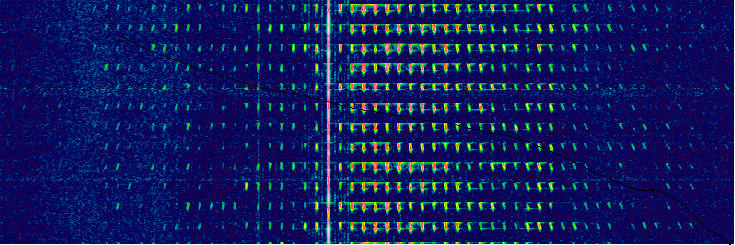
In January 2022, various signals with spectrogram-encoded images, visible through a spectrum analyzer, were broadcast on the same frequency.[27] There have also been reports of various songs airing on the station's frequency, many of which were connected to internet memes such as the 2012 K-pop song "Gangnam Style";[28][29] a Vice article attributed these broadcasts to pirates hijacking and spamming the frequency. The nationality of the pirates has also come into question by Vice in relation to the 2021–2022 Russo-Ukrainian crisis and Russian invasion of Ukraine.[28]
Only on very rare occasions have there been any external civilian communications—unless authorised by the Russian defence ministry—with UVB-76, given its status as a military radio. The most recent event occurred under irregular circumstances. During the night of 4 May 2024 at 21:38 (MSK),[30] an unknown Russian-speaking pirate infiltrated the frequency and attempted to contact the station whilst the buzzer was not active, if not on standby. The pirate subsequently asked a series of improvised questions to the station, briefly conversing with the station's operator:
Unknown pirate: А можно шутку рассказать? . . . Один «ррр» (звонок) – «да», два – «нет». (English: Can I tell a joke? One "rrr" [buzz] for "yes", two for "no".)
UVB-76 operator: [Two clear buzzes.]
Unknown pirate: Да за что?? . . . А музыку включить можно? (English: Well, what for? But can I turn on some music?)
UVB-76 operator: [Two clear buzzes.]
Unknown pirate: Почему!? . . . А за такие вопросы вам ничего не будет? (English: But why!? Are you going to get in trouble if you answer my questions?)
[UVB-76 buzzer starts.]
Unknown pirate: Да блин! (English: Well, damn!)
Other instances of deliberate hijackings are widely unreported. Another incident occurred one day prior to the above event. An unknown pirate—possibly the same one—attempted to subject the buzzer to interference, prompting the on-duty operator to immediately retaliate, taking preventative measures against the signal incursion. The UVB-76 operator combined three individual transmitters, with one above, one below and the other centre 4625 kHz transmitting MS-5 burst, along with CIS-12 modern audio as well as tones in several states, summarising together a highly dense spectral pattern with the upper-side band. Numerous noticeable transitions were witnessed over the 4625 kHz selected spectrogram section, as the operators frantically fought against the pirates. The incident occurred for around half an hour, until the operators ceased their tactics after the pirate abandoned attempts, as the buzzer was then reactivated.[31]
Location and function
[edit] | This section possibly contains original research. (January 2022) |

The purpose of the station has not been confirmed by government or broadcast officials. However, Rimantas Pleikys, a former Minister of Communications and Informatics of the Republic of Lithuania, has written that the purpose of the voice messages is to confirm that operators at receiving stations are alert.[12][32][33] Another explanation is that the broadcast is constantly being listened to by military commissariats.[34]
There is speculation published in the Russian Journal of Earth Sciences which describes an observatory measuring changes in the ionosphere by broadcasting a signal at 4,625 kHz, the same broadcast frequency as the Buzzer.[35]
One possible interpretation is that the voice messages constitute military communications. The possibility of the station being a numbers station for intelligence agencies, such as the FSB or the former KGB of the Soviet Union, is considered unlikely by some, since messages occur at seemingly unpredictable times. In addition, the static frequency of 4,625 kHz and the low transmitter power are likely unsuitable for reliable long-range communication. [original research?]
The buzzing functions as a "channel marker" used to keep the frequency occupied, thereby making it unattractive for other potential users.[1] The signature sound could be used for tuning to the signal on an old analogue receiver. The modulation is suitable to be detected by an electromechanical frequency detector, similar to a tuning fork. This can be used to activate the squelch on a receiver. Due to the varying emission properties on shortwave bands, using a level-based squelch is unreliable. This also allows a signal loss to be detected, causing an alarm to sound on the receiver.
Another theory, described in a BBC article, states that the tower is connected to the Russian 'Perimeter' missile system, and emits a "dead hand" signal that will trigger a nuclear retaliatory response if the signal is interrupted as a result of a nuclear attack against Russia.[8] This theory is also unlikely, given that the signal frequently breaks down or is routinely switched off for maintenance.[23]
There are two other Russian stations that follow a similar format, nicknamed "The Pip" and "The Squeaky Wheel". Like the Buzzer, these stations transmit a signature sound that is repeated constantly, but is occasionally interrupted to relay coded voice messages.[1]
The former transmitter was located near Povarovo, Russia,[1][36] at 56°5′0″N 37°6′37″E / 56.08333°N 37.11028°E which is about halfway between Zelenograd and Solnechnogorsk and 10 kilometres (6.2 mi) northwest of Moscow, near the village of Lozhki. The location and callsign were unknown until the first known voice broadcast of 1997.[37] In September 2010, the station's transmitter was moved to the nearby city of Saint Petersburg, near the village of Kerro Massiv (60°18′40.73″N 30°16′45.06″E / 60.3113139°N 30.2791833°E). This may have been due to a reorganization of the Russian military. Prior to 9 August 2015, the station is not transmitting from the Kerro Massiv transmitter site ("Irtysh") anymore, possibly due to a reorganization of the Russian military for the particular area which may cause the frequency to be used only in the Moscow Military District. At present, The Buzzer appears to be broadcast only from the 69th Communication Hub in Naro Fominsk, Moscow.[3] In 2011, a group of urban explorers claimed to have explored the buildings at Povarovo to find an abandoned military base and, in it, a radio log record confirming the operation of a transmitter at 4,625 kHz.[better source needed][38][39]
Other callsigns
[edit]Besides the main callsign, there have been transmissions containing different callsigns such as[citation needed]:
- LNR4 (Russian: ЛНР4)
- 87OI (Russian: 87ОИ)
- VM62 (Russian: ВМ62)
- A1JZh (Russian: А1ЙЖ)
- MSZh7 (Russian: МСЖ7)
- OMP4 (Russian: ОМП4)
- 7U8T (Russian: 7У8Т)
- VLHN (Russian: ВЛХН)
- 217O (Russian: 217О)
- ANVF (Russian: АНВФ)
- VZhCH (Russian: ВЖЦХ)
- LNRCh (Russian: ЛНРЧ)
- VShchCH (Russian: ВЩЦХ)
- 34ShchK (Russian: 34ЩК)
- YeDGShch (Russian: ЕДГЩ)
- 58Shch1 (Russian: 58Щ1)
- 5Ye27 (Russian: 5Е27)
- M4Z2 (Russian: М4З2)
- 'M4T (Russian: ЬМ4Т)
- 5PTsB (Russian: 5ПЦБ)
- LNTM (Russian: ЛНТМ)
- ZhD9S (Russian: ЖД9С)
- 28YA (Russian: 28ЫА)
- KhIZhJ (Russian: ХИЖЙ)
- 53AJ (Russian: 53АЙ)
- AMVS (Russian: АМВС)
- V'TD (Russian: ВЬТД)
- YeIYJ (Russian: ЕИЫЙ)
- ODVR (Russian: ОДВР)
- TsZhAP (Russian: ЦЖАП)
- ULVN (Russian: УЛВН)
- ULVN YeFUG (Russian: УЛВН ЯФУГ)
- VKhVS (Russian: ВХВС)
See also
[edit]
- Duga radar (the "Russian Woodpecker")
- Letter beacon
References
[edit]- ^ a b c d e f g h "The Buzzer". October 2014. Archived from the original on 12 February 2016. Retrieved 1 October 2014.
- ^ a b c "The Buzzer › Priyom.org". priyom.org. Retrieved 16 October 2021.
- ^ a b Savodnik, Peter (27 September 2011). "Inside the Russian Short Wave Radio Enigma". Wired. Retrieved 16 November 2020.
- ^ McLellan, Allison (November 2019). "Decoding Numbers Stations". QST. 103 (11). American Radio Relay League: 70–73. ProQuest 2311511307.
Perhaps the best-known is the Russian UVB-76, a misheard version of its first call sign, UZB-76. Transmitting on 4625 kHz, it was first noticed around the late 1970s, earning the nickname 'the Buzzer' because of its 24-hour droning hum.
- ^ "The Buzzer Primer" (PDF). Priyom.org. 25 March 2012. p. 1.
- ^ Harris, Shane (6 March 2016). "The Stupidly Simple Spy Messages No Computer Could Decode". The Daily Beast. The Newsweek–Daily Beast Company. ProQuest 1782923047.
For most of its existence, which has been traced back to an original airdate in 1976, it has transmitted a short, high-pitched buzz, every few seconds.
- ^ Hooper, Sarah (20 May 2025). "Mysterious Soviet 'doomsday radio station' broadcasts cryptic messages again".
- ^ a b Gorvett, Zaria (15 July 2020). "The ghostly radio station that no one claims to run". BBC. Retrieved 16 November 2020.
- ^ UVB-76 MDZhB [24.12.1997] [21:58 UTC] (180 08 BROMAL 74 27 99 14), 30 June 2014, archived from the original on 17 December 2021, retrieved 20 October 2021
- ^ "UVB-76 MDZhB [23.08.2010] [13:35] (93 882 NAIMINA 74 14 35 74)". YouTube. 5 July 2014. Archived from the original on 17 December 2021. Retrieved 16 November 2020.
- ^ a b Boender, Ary (January 2002). "Oddities". ENIGMA 2000 Newsletter – Issue 8. Archived from the original on 13 January 2020. Retrieved 16 November 2020.
- ^ a b "Russian HF Beacons". 24 December 2000. Archived from the original on 7 September 2019. Retrieved 16 November 2020.
- ^ "UVB". Youtube. 2 August 1976. Retrieved 25 December 2020.
- ^ Boender, Ary (1995). "Numbers & oddities: Column 1". Archived from the original on 25 January 2020. Retrieved 16 November 2020.
- ^ "El misterio de las emisiones de radio secretas". ABC (in Spanish). 26 August 2010. Retrieved 16 November 2020.
- ^ Turnbull, Alex (21 July 2009). ""The Buzzer" (UVB-76)". Googlesightseeing.com. Retrieved 16 November 2020.
- ^ The Buzzer/UVB-76(4625Khz) February 3, 2021 15:25UTC Voice message, 4 February 2021, archived from the original on 17 December 2021, retrieved 20 October 2021
- ^ UVB-76/The Buzzer(4625Khz) 11th December 2019 Message #10 9:51UTC, 11 December 2019, archived from the original on 17 December 2021, retrieved 20 October 2021
- ^ a b The Buzzer/UVB-76(4625Khz) Feb. 6th 2020 12:16UTC Voice message #6, 6 February 2020, archived from the original on 17 December 2021, retrieved 20 October 2021
- ^ UVB-76 MDZhB [26.01.2015] [05:59] (CENTIM 61 51), 26 January 2015, archived from the original on 17 December 2021, retrieved 20 October 2021
- ^ UVB-76 MDZhB [25.01.2013] [02:58] (OB'YaVLENA KOMANDA 135), 9 July 2014, archived from the original on 17 December 2021, retrieved 20 October 2021
- ^ "Mysteriózní rádio už 30 let vysílá záhadný signál a teď i tajnou šifru", Technet.cz, 27 August 2010 (English)
- ^ a b "The Unexplained Signals Of Russian Station UVB-76". Gizmodo Australia. 18 July 2016. Retrieved 17 November 2019.
- ^ "UVB-76 MDZhB [02.09.2010] Swan Lake". UVB-76 Activity Channel. 14 July 2014. Archived from the original on 17 December 2021 – via YouTube.
- ^ "Recording of the phone calls on UVB76". SoundCloud. 11 November 2010. Retrieved 18 May 2020.
- ^ "Strange Voices heard on UVB-76, On 15th May 2020". YouTube. 11 April 2021. Retrieved 6 April 2024.
- ^ JuEdWa (12 January 2022). Possible pirate on top of UVB-76 The Buzzer! – January / 11 / 2022 (RARE!). Retrieved 19 January 2022.
- ^ a b Rose, Janus; Cox, Joseph (20 January 2022). "Pirates Spammed an Infamous Soviet Short-wave Radio Station with Memes". Vice. Retrieved 20 January 2022.
- ^ mussyu226 (16 January 2022). UVB-76でカンナムスタイル流れてて笑うwww. Retrieved 27 January 2022.
- ^ "UVB-76 operator talking with a pirate". 4 May 2024. Retrieved 5 July 2024 – via YouTube.
- ^ "Russian Buzzer UVB-76 Operator Goes Ballistic Fighting Pirates | Signal Phantom". 4 May 2024. Retrieved 5 July 2024 – via YouTube.
- ^ "Single letter markers – posts from the SPOOKS and WUN listservers". 2000. Archived from the original on 25 November 2007. Retrieved 29 August 2008.
- ^ Pleikys, Rimantas (1998). Jamming. Vilnius, Lithuania: Rimantas Pleikys.
- ^ "Военная "Жужжалка" на частоте 4625 кГц. "Buzzer" UVB-76. – Страница 4". Radioscanner.ru. Retrieved 9 October 2012.
- ^ "Information-measuring complex and database of mid-latitude Borok Geophysical Observatory". 2008. Retrieved 10 February 2012.
- ^ Geere, Duncan (August 2010). "Mysterious Russian 'Buzzer' radio broadcast changes". WIRED.CO.UK. Archived from the original on 17 September 2010. Retrieved 12 September 2010.
- ^ "El misterioso zumbido de la estación de radio UVB-76" [The mysterious buzz of the UVB-76 radio station]. El Reservado (in Spanish). January 24, 2011. Archived from the original on January 27, 2011. Retrieved January 31, 2011.
- ^ wasd. "kwasd's blog " Небольшой фотоотчет с УВБ-76 ("The Buzzer", "Жужжалка")". Blog.kwasd.ru. Archived from the original on 10 September 2012. Retrieved 9 October 2012.
- ^ "Sample Buzzer Logbook" (PDF). 22 September 2014. Retrieved 3 July 2016.
Further reading
[edit]External links
[edit]
- Live Broadcasting on RadioABC
- History and Info on The Buzzer
- UVB-76 Listen live
- NPR's Lost and Found Sound, 2000-05-26: The Shortwave Numbers Mystery
- UVB76 Archived 7 September 2019 at the Wayback Machine at the Global Frequency Database Archived 30 March 2013 at the Wayback Machine
- Wired.co.uk 2011 article Archived 17 April 2016 at the Wayback Machine
- The ghostly radio station that no one claims to run, 15 July 2020, By Zaria Gorvett, BBC.
UVB-76
View on GrokipediaHistory
Early Detection and Soviet-Era Operations
The UVB-76 signal was first detected by shortwave radio listeners in the late 1970s, with the earliest preserved recording from 1982 capturing its repetitive tone on the 4625 kHz frequency.[1][7][3] Prior to widespread online documentation, the transmission drew attention from radio hobbyists monitoring Soviet-era shortwave bands, though its origin and operators remained unidentified at the time.[8] During the Soviet period, UVB-76 maintained near-continuous operations from a transmitter site near Povarovo, northwest of Moscow, as part of what was presumed to be military communications infrastructure.[4][3] The signal's format consisted of a high-pitched beep or pip emitted every two seconds until around 1990, after which it shifted to the distinctive buzzing tone repeated approximately 25 times per minute, a pattern that persisted without significant interruptions.[1][9] This monotonous broadcast likely served to occupy the frequency and deter unauthorized use, a common tactic in military radio protocols, though no official Soviet documentation has confirmed its exact role or command affiliation.[7] Voice transmissions were absent during the bulk of Soviet operations, with the station's output limited to the automated marker signal, underscoring its function as a low-maintenance standby channel rather than an active messaging system.[1][3] Speculation among early monitors linked it to broader Soviet strategic networks, potentially for wartime coordination or radar over-the-horizon systems, but such theories lack declassified evidence and stem from pattern analysis by enthusiasts rather than intercepted directives.[10] The station's reliability through the late Cold War era, including amid heightened tensions, suggests robust engineering tied to defense priorities.[11]Post-Soviet Changes and Relocations
Following the dissolution of the Soviet Union in December 1991, UVB-76 persisted in broadcasting its characteristic buzzing signal from the 143rd Communication Hub near Povarovo, Moscow Oblast, without immediate disruption, underscoring the continuity of Russian military shortwave infrastructure amid the transition to the Russian Federation.[1] The station's operations under the callsign UZB-76 aligned with the Moscow Military District, with voice messages remaining infrequent but consistent in format, typically consisting of phonetic codes and numbers read in Russian.[1] A major operational shift occurred in September 2010, when the transmitter was relocated southward to serve the newly established Western Military District, established through a Russian Ministry of Defense reorganization that consolidated districts for streamlined command.[1] This move, which included a brief outage and test transmissions such as "Swan Lake" music on September 2, 2010, shifted the primary signal origin to facilities near Saint Petersburg, including the Sudak communication hub in Agalatovo and the 60th Communication Hub (also known as "Irtysh" or "Vulcan").[12][1] Concurrently, the callsign changed to MDZhB, reflecting the district's administrative update, while activity levels increased to support broader geographic coverage.[1] Post-relocation, monitoring efforts identified additional redundant transmitter sites, such as the 69th Communication Hub ("Iskra") near Naro-Fominsk, allowing the station to switch frequencies or locations dynamically for operational resilience.[1] The Povarovo site was abandoned, as confirmed by urban explorers accessing the facility in 2011, who documented dismantled equipment and no active emissions.[3] These changes enhanced the station's adaptability but preserved its core function of maintaining a continuous marker tone interrupted only by coded voice inserts.[1]Activity in the 21st Century
The continuous buzzing signal of UVB-76 persisted throughout the early 2000s with minimal interruptions, maintaining its characteristic pattern of approximately 25 tones per minute on 4625 kHz, as monitored by international shortwave listeners.[4] Voice transmissions remained exceptionally rare prior to 2010, limited to occasional coded phrases that followed the established format of callsign recitation followed by phonetic alphabet words or numbers, without any publicly verified disruptions to the signal's reliability.[1] A marked increase in voice activity occurred in August and September 2010, coinciding with the station's relocation from the Povarovo site near Moscow to facilities in the Western Military District, such as near St. Petersburg. On August 23, 2010, multiple messages were logged, including sequences like "MDZhB 74 145 Boris Roman Olga Viktor Yakov" at around 13:35 UTC, followed by further transmissions over the subsequent days totaling over 20 verified voice interruptions that month.[3] [4] This period also saw the introduction of the new collective callsign МДЖБ (MDZhB), replacing the prior УЗБ76 (UZB76), reflecting operational changes possibly tied to expanded command-and-control coverage.[1] Subsequent years featured sporadic messages, with callsign shifts including ЖУОЗ (ZhUOZ) from late 2015 to 2019 and АНВФ/ВЖЦХ/217O variants until December 2020, when НЖТИ (NZhTI) became standard.[1] Activity spiked intermittently, such as four messages between January 13 and 27, 2020, and two on May 11, 2020, amid broader geopolitical tensions.[9] In December 2024, the station issued a record 24 voice messages on December 11 alone, consisting of coded names, numbers, and letters in Russian, marking the most verbose day in its observed history.[13] Into 2025, transmissions continued at an elevated rate relative to pre-2010 norms, with two messages broadcast on May 23, including phonetic codes, and additional bursts such as multiple on July 24 and September 8, often during Moscow daytime hours.[14] [15] On December 30, 2025, the buzzing signal was interrupted by pirate radio interference, replacing the buzz with excerpts from Tchaikovsky's Swan Lake, the Nazi-era march "Erika", and pro-war tracks.[16] These events, while still interrupting the buzz for mere seconds to minutes, have fueled ongoing monitoring by signals intelligence enthusiasts, though no official Russian confirmation of purpose exists beyond its military association.[1]Technical Specifications
Signal Characteristics and Frequency
UVB-76 transmits continuously on the shortwave frequency of 4625 kHz in upper sideband mode.[1][2] This frequency, corresponding to a wavelength of approximately 64.8 meters, enables long-distance propagation suitable for military communications.[1] The primary signal is a monotonous buzzing tone, generated by short bursts of audio repeating at a rate of about 25 tones per minute around the clock.[2][17] Each buzz lasts roughly 1.2 seconds, followed by a pause of 1 to 1.3 seconds, with the repetition rate varying between 21 and 34 cycles per minute depending on propagation conditions and equipment.[18] This pattern serves as a channel marker to maintain reservation of the frequency band.[1] The buzzing consists of a simple, unmodulated tone resembling a low-frequency hum or electronic buzz, audible across shortwave receivers tuned to the frequency.[3] Signal strength and clarity fluctuate with ionospheric conditions, solar activity, and time of day, often fading during daylight hours in certain regions due to shortwave propagation limits.[19] The continuous nature of the emission prevents other stations from occupying the slot, a common practice in numbers station operations.[1]Callsings and Identifiers
The UVB-76 station, commonly referred to as The Buzzer, utilizes phonetic callsigns in the preamble of its voice messages, broadcast in Russian using the NATO phonetic alphabet equivalent. These identifiers serve to designate the transmitting entity and have evolved in conjunction with documented relocations and reorganizations within the Russian military's communication network. The designation "UVB-76" itself is an informal Western appellation derived from early phonetic misinterpretations or frequency associations, rather than an official callsign used on-air.[1][20] The initial callsign, UZB-76 (УЗБ-76), was employed from the earliest verified voice transmissions on 24 December 1997 until 7 September 2010, during operations linked to the Moscow Military District from the Povarovo site. This period featured sporadic messages following the continuous buzzing marker, with the callsign recited as "U-Ze-Be 76" in Russian phonetics.[1][20] On 7 September 2010, coinciding with a transmitter relocation and the formation of Russia's Western Military District, the callsign shifted to MDZhB (МДЖБ), phonetically "Mikhail-Dmitri-Zhenya-Boris." This identifier persisted until 28 December 2015, appearing in increased message traffic, including multiple transmissions on that final day.[1][20] Subsequent changes included ZhUOZ (ЖУОЗ), introduced on 28 December 2015 and used until 1 March 2019, recited as "Zhenya-Ul Yan-Olga-Zhenya." From 1 March 2019 to 30 December 2020, the station adopted ANVF (АНВФ), phonetically "Anna-Nikolai-Vasily-Fyodor," alongside occasional variants like VZhTsKh (ВЖЦХ) and 217O in some messages. The current callsign, NZhTI (НЖТИ), effective from 30 December 2020 onward, is announced as "Nikolai-Zhenya-Tatyana-Ivan" and has been consistently monitored in recent transmissions, including those in 2025.[1][20]| Callsign | Russian | Phonetic Recitation | Usage Period |
|---|---|---|---|
| UZB-76 | УЗБ-76 | U-Ze-Be 76 | 1997–7 Sep 2010 |
| MDZhB | МДЖБ | Mikhail-Dmitri-Zhenya-Boris | 7 Sep 2010–28 Dec 2015 |
| ZhUOZ | ЖУОЗ | Zhenya-Ul Yan-Olga-Zhenya | 28 Dec 2015–1 Mar 2019 |
| ANVF | АНВФ | Anna-Nikolai-Vasily-Fyodor | 1 Mar 2019–30 Dec 2020 |
| NZhTI | НЖТИ | Nikolai-Zhenya-Tatyana-Ivan | 30 Dec 2020–present |
Transmissions
The Continuous Buzzing Signal
The continuous buzzing signal of UVB-76, commonly referred to as The Buzzer, transmits a short, monotonous buzz tone on 4625 kHz in upper sideband mode, repeating at a rate of approximately 25 tones per minute for 24 hours daily.[2] This pattern functions as a channel marker to occupy the frequency and deter interference.[1] Each buzz lasts roughly 1.2 seconds, followed by a brief interval of about 1-2 seconds before repetition, maintaining a steady rhythmic output.[2] The buzzing format emerged around 1992, supplanting prior beeps broadcast in the preceding decade, though the station's operations trace back to at least the late 1970s with initial detections reported in the early 1980s.[4][2] This unmodulated tone persists uninterrupted except during rare voice transmissions, ensuring constant presence on the band.[1] Observers note minor variations in tone pitch or repetition rate over time, potentially due to equipment adjustments or transmitter relocations, but the core buzzing characteristic remains consistent.[2] Technical analyses describe the signal's simplicity, with the buzz generated by a basic oscillator producing a harsh, broadband noise-like sound rather than a pure sine wave, aiding audibility amid shortwave propagation challenges.[1] The 4625 kHz allocation falls within the tropical bands designated for regional communications, aligning with its observed coverage primarily over European Russia.[2] Despite decades of monitoring by shortwave enthusiasts, no definitive public documentation from Russian authorities explains the signal's parameters or purpose.[1]
Voice Messages and Codes
Voice messages on UVB-76 interrupt the continuous buzzing signal sporadically, consisting of spoken Russian transmissions that include repeated callsigns, numeric sequences, codewords, and phonetic alphabet names. These broadcasts follow a standardized military format, typically aired during Moscow Time daytime hours on weekdays, and are often simulcast in Morse code on parallel frequencies such as 5779 kHz, 6810 kHz, 7490 kHz (daytime), and 4925 kHz (nighttime).[1][2] The callsign has evolved over time: UZB76 (pre-2010), MDZhB (September 7, 2010, to December 28, 2015), ZhUOZ (December 28, 2015, to early 2019), ANVF and variants (early 2019 to December 30, 2020), and NZhTI (December 30, 2020, to present).[1] Prior to 2010, voice messages were rare; activity increased thereafter, suggesting operational shifts possibly tied to Russian Western Military District command networks.[2] The format generally begins with the callsign repeated, followed by numbers, a codeword, additional numbers, and spelled-out names using the Russian phonetic alphabet (e.g., Boris for B, Roman for R) for clarity in transmission. Codewords like BROMAL, NAIMINA, TERKA, and AGATU appear to denote specific instructions or recipients, though their exact meanings remain undeciphered outside military contexts. Some messages exhibit distortion or background noise, indicating live operator involvement rather than prerecorded content.[2][21] Notable examples include:- December 24, 1997, 21:58 GMT: The first widely recorded voice message: "Ya UVB-76. 18008 BROMAL: Boris, Roman, Olga, Mikhail, Anna, Larisa. 742, 799, 14," preceded by beeps and repeated multiple times.[2][21]
- February 21, 2006, 07:57 GMT: "75-59-75-59. 39-52-53-58. 5-5-2-5. Konstantin-1-9-0-9-0-8-9-8-Tatiana-Oksana-Anna-Elena-Pavel-Schuka. Konstantin 8-4. 9-7-5-5-9-Tatiana. Anna Larisa Uliyana-9-4-1-4-3-4-8," featuring extensive name spellings distorted by interference.[2]
- September 21, 2006: Included names like Mikhail, Dmitri, Zhenya, Boris, followed by numbers such as 74 14 35 74, indicative of recipient-directed codes.[21]
- August 23, 2010, 13:35 UTC: "UVB-76, UVB-76. 93 882 NAIMINA 74 14 35 74. 9 3 8 8 2 Nikolai, Anna, Ivan, Mikhail, Ivan, Nikolai, Anna. 7 4 1 4 3 5 7 4."[2]
- January 25, 2013, 02:47 UTC: "MDZhB TERKA 0254 MDZhB TERKA 0254 MDZhB OBYAVLENA KOMANDA 135," introducing the MDZhB callsign and command phrasing.[2]
- December 15, 2015, 16:28 UTC: "Zhenya, Ulyana, Olga, Zinaida. Zhenya, Ulyana, Olga, Zinaida. 92, 002, AGATU, 56, 88, 48, 32," using repeated names and the ZhUOZ callsign.[2]