Hubbry Logo
Univers ZeroUnivers ZeroMain
Open search
Univers Zero
Community hub
Univers Zero
logo
8 pages, 0 posts
0 subscribers
Be the first to start a discussion here.
Univers Zero
Univers Zero
from Wikipedia

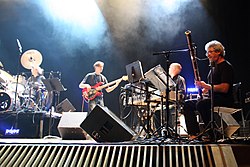
Univers Zero (also known as Univers Zéro and Univers-Zero[1]) are an instrumental Belgian band formed in 1974 by drummer Daniel Denis. The band is known for its dark style of progressive rock, heavily influenced by 20th-century chamber music.

Key Information

History

[edit]

In 1973, Claude Deron and Daniel Denis, both former members of Belgian Zeuhl band Arkham (which had disbanded the previous year), set up a new group, Necronomicon. By that time, apart from Deron (trumpet) and Denis (drums), the group consisted of Roger Trigaux (guitar), Guy Segers (bass guitar), Patrick Hanappier (violin) and John Van Rymenant (sax), and, later, Vincent Motoulle (keyboards). At the time, Guy Denis (percussion) took part in some shows and rehearsals and Jean-Luc Manderlier (keyboards) was present only during rehearsals. Necronomicon was renamed Univers Zero (after a book by Belgian novelist Jacques Sternberg) in 1974.

For a time, Univers Zero were part of a musical movement called Rock in Opposition (RIO), which strove to create dense, challenging music, a direct contrast to the disco and punk music being produced in the late 1970s. Obvious early influences were Béla Bartók and Igor Stravinsky, but the band also cited lesser-known composers such as Albert Huybrechts, who was also Belgian.

Whereas their early albums were almost entirely acoustic, featuring oboes, spinets, harmoniums and Mellotrons, their 1980s albums tended to rely more on synthesizer and electric guitar, sounding much more electric.

In 1977, they released their first eponymous album, Univers Zero, later remixed and renamed 1313. The album shows a heavy rock and roll approach despite the fact that the instrumentation was largely acoustic. This is mostly due to the use of drums and bass guitar. Two years later the album Heresie proved to be even darker. Subsequent albums lightened the sound only slightly but became ever more electric.

Despite these changes, their overall sound remained fairly consistent.

The group disbanded in 1987 but re-formed in 1999. In the interim, drummer Daniel Denis released two solo albums and joined Art Zoyd, a similar band from France. Since 1999, Univers Zéro have released five studio albums.

In 2003, Univers Zéro had retired from live performance with Daniel Denis saying that only something like a festival would make it financially worthwhile. Coincidentally soon after, they were invited to headline the first day of NEARfest in Bethlehem, Pennsylvania in June 2004. In 2011, they joined forces with Belgian groups Present and Aranis to form a 17-member ensemble called Once Upon a Time in Belgium. They premiered at the fourth edition of the Rock in Opposition festival held in Carmaux, France in September 2011, where they performed "New York Transformations", a work composed by Kurt Budé. Once Upon a Time in Belgium and Univers Zéro appear in the documentary film Romantic Warriors II: A Progressive Music Saga About Rock in Opposition.[2]

Discography

[edit]
  • 1977 : 1313 (originally titled Univers Zero)
  • 1979 : Heresie
  • 1981 : Ceux du dehors
  • 1981 : Triomphe des mouches (one-sided 7" single)
  • 1983 : Crawling Wind
  • 1984 : Uzed
  • 1986 : Heatwave
  • 1999 : The Hard Quest
  • 2002 : Rhythmix
  • 2004 : Implosion
  • 2006 : Live (live album)
  • 2008 : Relaps (Archives 1984/85/86) (live album)
  • 2010 : Clivages
  • 2014 : Phosphorescent Dreams
  • 2023 : Lueur

References

[edit]
[edit]
Revisions and contributorsEdit on WikipediaRead on Wikipedia
from Grokipedia
Univers Zero is an instrumental Belgian band renowned for its dark, atmospheric "chamber rock" style, which fuses elements of rock, , European folk, and . Formed in 1974 in by drummer and composer Daniel Denis, the group originated from an earlier ensemble called and drew its name from a novel by Jacques Sternberg. The band's music is characterized by complex, dissonant compositions that evoke tension and unease, heavily influenced by composers such as , , and Albert Huybrechts, alongside rock acts like and . Denis, the longstanding leader, has been joined by rotating members including bassist Guy Segers, bassist and oboist Michel Berckmans, guitarist Roger Trigaux, and more recent contributors like clarinetist Kurt Budé and pianist Antoine Guenet. Over its career, Univers Zero has experienced periods of activity and hiatus, disbanding in 1987 before reforming in 1999, and continuing to release music into the 2020s despite breaks, including reissues in 2025. Key albums highlight the band's evolution, with the self-titled debut Univers Zero (1977, reissued as 1313) establishing its brooding sound through tracks blending electric and classical motifs. Hérésie (1979) marked a breakthrough, featuring the epic 25-minute opener "La Faulx" that exemplifies their fusion of rock energy and orchestral dissonance, often cited as their most influential work. Ceux du dehors (1981) represented a peak of maturity with intricate arrangements, while later efforts like Uzed (1984) and Heatwave (1986) incorporated more rock-driven elements before the initial disbandment. Post-reformation releases, such as The Hard Quest (1999), Rhythmix (2002), and Lueur (2023), demonstrate ongoing innovation in their signature dark aesthetic.

History

Formation and early years (1974–1979)

Univers Zero was formed in Brussels, Belgium, in 1974 by drummer Daniel Denis and trumpeter Claude Deron, evolving from the short-lived group that the pair had co-founded the previous year following the dissolution of their prior band, . The name change to Univers Zéro reflected their ambition to explore a broader, more experimental sonic universe, drawing on Denis's compositional vision for intricate, dark-toned instrumental pieces. Early recruitment included bassist Guy Segers, guitarist Roger Trigaux—who co-led the band creatively during this period—and violinist Patrick Hanappier, forming a core lineup that emphasized acoustic textures with reed and string instruments alongside percussion and guitar. The band's initial activities centered on live performances across , beginning with shows in and nearby venues in 1974, such as at the and cultural centers in and . These early gigs allowed the ensemble to refine their chamber-like arrangements, often featuring extended improvisations and brooding atmospheres that set them apart from mainstream rock. By 1976, they had expanded their circuit to include festivals and clubs in cities like and , building a local reputation for avant-garde intensity despite limited resources. In 1977, Univers Zéro recorded and released their self-titled debut album, known catalog-wise as 1313 (EF 1313), in a limited vinyl edition on the independent Belgian label Eric Faes. The album showcased acoustic instrumentation in five tracks of dissonant, chamber-prog compositions, emphasizing dark, meticulous structures without electric amplification. The following year, their alignment with the burgeoning (RIO) movement—a collective of independent European acts resisting commercial music industry constraints, co-founded by British band —culminated in participation at the inaugural RIO festival on March 12, 1978, at the New London Theatre in , where they performed alongside Henry Cow, Stormy Six, Samla Mammas Manna, and Etron Fou Leloublanc, marking their international debut.

1980s activity and disbandment (1980–1987)

Following the release of their breakthrough album Hérésie in 1979, Univers Zero experienced a surge in recognition during 1980, performing extensively across as part of the Rock in Opposition (RIO) network, including tours in (such as at the Printemps de Bourges festival), , , and the . This period marked the band's rising profile, with Hérésie's dark, chamber-rock compositions earning critical acclaim for their emotional depth and precision. To enhance their sound, multi-instrumentalist Andy Kirk joined the lineup on keyboards, introducing electric elements like organ and , which began shifting the group's predominantly acoustic style toward a more amplified, rock-oriented approach. In 1981, Univers Zero released their third studio album, Ceux du dehors, which built on this evolution by incorporating Kirk's compositions and a fuller electric texture while retaining the band's signature brooding intensity. The album featured core members Daniel Denis (drums, percussion, vocals), Guy Segers (bass, clarinet, vocals), Michel Berckmans (, bassoon, English horn), and (harmonium, organ, piano, , vocals), reflecting a mature ensemble that balanced chamber complexity with emerging rock dynamics. That year, the band toured widely in , including stops in , the , , , , and , solidifying their presence within the RIO scene through collaborations and shared bills with like-minded experimental acts. However, financial difficulties soon forced a temporary halt to activities later in 1981, prompting further lineup adjustments, such as the addition of clarinetist Dirk Descheemaeker and violinist Alan Ward. The band reconvened in for their fifth album, Uzed, which emphasized a bolder rock aspect amid ongoing experimentation, with contributions from new members including Jean-Luc Plouvier (keyboards), André Mergen (cello, saxophone), and Christian Genet (bass). Tours followed in , , and , but internal tensions began to surface as creative visions diverged and commercial pressures mounted. By , Univers Zero released Heatwave, their sixth and final album of the era, featuring balanced compositions from Denis and Kirk that highlighted the group's enriched sonic palette, including electric guitars and synthesizers. The album received positive reception during promotional tours, such as performances in for the Année Européenne de la Musique and at the Festival. Despite these achievements, persistent challenges led to the band's disbandment in 1987. Creative differences, exacerbated by symptoms of overwork and fatigue, combined with financial instability and a lack of effective , made continuation untenable, as noted by and composer Daniel Denis. In the aftermath, Denis pursued solo projects, releasing albums that explored similar territories while other members scattered to various endeavors.

Reformation and later developments (1999–present)

After a twelve-year hiatus following the band's disbandment in 1987, Univers Zero reformed in 1999 under the leadership of drummer and composer Daniel Denis, who recruited bassist and woodwind player Michel Berckmans to revive the group's core sound. This reunion marked a return to their experimental chamber rock style, with the ensemble releasing The Hard Quest later that year, an album featuring contributions from Denis and Berckmans alongside guest musicians on and keyboards. The band followed with Rhythmix in 2002, exploring rhythmic complexities through acoustic and electric , and Implosion in 2004, which incorporated more electronic elements while maintaining their signature dark, angular compositions. These releases, issued primarily through Cuneiform Records, reestablished Univers Zero's presence in the avant-garde progressive scene and attracted renewed interest from international audiences. The reformed lineup participated in several tribute events and festivals, including their debut U.S. performance headlining the first day of NEARfest in , in 2004, where they showcased material from their classic era alongside newer works. In 2006, the band issued a live album documenting a 2005 concert at Les Halles de Schaerbeek in , capturing their intense stage dynamic with pieces like "La Faulx" and "Heresie." Activity continued with the 2010 studio album Clivages, a collaborative effort featuring compositions by Denis and others, emphasizing fractured rhythms and orchestral textures performed by a including Berckmans on . Following this, the band entered a period of reduced output and touring, influenced by logistical challenges in assembling the ensemble for live shows. In the 2020s, Daniel Denis has played a pivotal role in sustaining Univers Zero's legacy through solo projects, collaborations, and archival efforts, including drum demonstrations shared online during the early years to maintain fan engagement. The group saw reissues like Crawling Wind in 2024 and culminated in three significant 2025 releases via : the duo project - Superstitions by Denis and Alain Neffe in September, a remastered edition of the 1984 album Uzed in October, and Live at the Triton 2009 (CD and DVD) documenting a performance. These efforts highlight Denis's ongoing commitment to the band's dark experimental ethos, though live performances have remained sporadic amid broader industry disruptions.

Musical style and influences

Core characteristics

Univers Zero's music is characterized by predominantly compositions that blend chamber rock with progressive elements, creating dark atmospheres of tension and . These works evoke a sense of unease through brooding, dense textures that prioritize collective interplay over individual solos, resembling a rock in format. The band's sound often builds slow, ominous tension, incorporating minimalist repetition to heighten psychological intensity. Instrumentation plays a central role in defining this signature style, featuring acoustic instruments such as , , , and harmonium alongside bass, drums, and occasional guitar for rhythmic drive. Early emphasis on these woodwind and string elements contributes to a chamber-like intimacy, while later integrations of electric guitars, synthesizers, and percussion amplify the intensity and mechanical edge. This hybrid approach allows for a wide , from subtle, eerie sustains to explosive, angular outbursts. Rhythmically, Univers Zero employs complex, angular patterns influenced by traditions but rendered darker through frequent dissonance, odd time signatures, and syncopated passages. These elements create a propulsive yet disorienting momentum, often with polyrhythmic layers that underscore the music's unsettling quality. Thematically, the compositions draw on mechanical, , and surreal imagery, reflected in evocative titles and stark , as seen in the dystopian motifs of Hérésie. This focus reinforces an overarching narrative of sonic and .

Key influences and evolution

Univers Zero's musical style drew heavily from the Rock in Opposition (RIO) movement, which emphasized experimental and structures outside mainstream rock conventions. The band was one of the founding groups in RIO, alongside acts like and Samla Mammas Manna, whose influence is evident in Univers Zero's adoption of complex, dissonant compositions and ensemble interplay that prioritized innovation over commercial appeal. This collaboration fostered a shared of resistance to industry norms, shaping Univers Zero's early emphasis on intricate, non-repetitive forms. The genre, pioneered by , also profoundly impacted Univers Zero, particularly through direct connections in the early 1970s. Drummer Daniel Denis and keyboardist Jean-Luc Manderlier briefly joined after their band opened for the group, absorbing 's fusion of , rock, and symphonic elements. Univers Zero adapted this into a distinctly colder, more orchestral instrumental style devoid of vocals, creating a brooding chamber rock aesthetic that contrasted 's operatic intensity. Classical and traditions further informed the band's angular melodies and dynamic ensemble textures, with composers and serving as primary inspirations. Denis has cited their dissonant harmonies and rhythmic complexity as key influences discovered during his formative years, integrating these into Univers Zero's sound to evoke a sense of modernist unease. This classical foundation lent a timeless, almost cinematic quality to the music, distinguishing it within the progressive rock landscape. The band's sound evolved significantly across its phases, beginning in the with an acoustic chamber progressive style on albums like 1313, characterized by woodwinds and strings in a sparse, eerie framework rooted in and Zeuhl accents. By the 1980s, as heard on Uzed, the music shifted toward electric, synth-heavy rock, incorporating medieval and contemporary classical elements alongside Eastern influences for a denser, more aggressive texture. Post-reformation in 1999, works like Clivages embraced hybrid experimentalism, blending these foundations with sampling and broader sonic palettes. In later years, Univers Zero incorporated and , reflecting Denis's solo explorations in albums such as Les Eaux Troubles. These elements added rhythmic diversity and improvisational freedom, drawing from Eastern traditions and 1970s Miles Davis-inspired to expand the band's dark, orchestral core into more eclectic territories. More recent releases, such as Lueur (2023), continue this evolution by maintaining the chamber rock foundation while incorporating lighter progressive and experimental influences.

Band members

Core and current lineup

Univers Zero's core member and founder, Daniel Denis, has been the band's driving force since its inception in 1974, serving as the primary composer and on , keyboards, and percussion across all eras of the group's activity. His enduring presence provides continuity in the band's style, contributing to compositions that blend rhythmic complexity with atmospheric depth in both studio recordings and live performances. The current lineup, stable since the band's reformation and refined in recent years, features Kurt Budé on and , who joined in the and adds intricate woodwind counterpoints essential to the ensemble's chamber-rock texture. Guitarist Nicolas Dechêne, also active since the , brings electric and elements that enhance the group's modern sonic palette, particularly in live settings where dynamic interplay is key. Bassist Nicolas Denis, incorporating percussion and occasional vocals, has been part of the core since the , maintaining the foundational low-end drive while supporting the band's rhythmic intricacies in recordings like the 2023 album Lueur. This configuration, centered on Denis's leadership, has enabled Univers Zero to sustain touring and recording efforts into 2025, with the quartet delivering performances that emphasize acoustic precision and electronic nuances without major changes since the release of Lueur.

Former members and contributors

Guy Segers was a founding member of Univers Zero, serving from 1974 to 1977 and rejoining from 1978 to 1983, with a brief return in 1997 for a festival performance. His intricate bass lines were essential to the band's , chamber-rock on early s such as 1313 (1977) and Hérésie (1979), where he also contributed , , and vocals on the track "La Faulx." Segers composed "La Tête du Corbeau" for Ceux du Dehors (1981) and helped define the ensemble's rhythmic complexity. He departed in 1983 amid financial pressures and disagreements over the band's evolving direction, which led to his dismissal; following the 1997 reunion, creative tensions resulted in another exit. Guitarist and keyboardist Roger Trigaux co-founded Univers Zero in 1974 alongside drummer Daniel Denis, contributing from 1974 to 1975 and again from 1977 to 1979. As a key , Trigaux shaped the brooding, dissonant compositions on the debut 1313 and Hérésie, emphasizing angular guitar riffs and atmospheric keyboards that influenced the band's style. He left in 1979 to pursue creative independence, forming the related project Present, which explored similar chamber-rock territories with a more personal vision. Oboist and bassoonist Michel Berckmans joined in 1977 and remained a core member until around 2010, providing essential reed and woodwind textures that defined the band's classical-infused sound on albums from 1313 through Clivages (2010). Violinist Patrick Hanappier joined in 1976 and contributed through the early , providing essential string textures that enriched the orchestral depth of albums like Hérésie (1979) and Ceux du dehors (). His precise, eerie and viola work complemented the band's reed and percussion elements, contributing to the tense, cinematic atmospheres on tracks such as "Hérésie (Partie 1)." He departed amid lineup shifts in the early and did not rejoin later. Other early contributors included trumpeter Claude Deron, a co-founder who helped transition the group from in 1974 but exited before the first album, as brass elements faded from . Violinist Marcel Dufrane and harmonium player Emmanuel Nicaise also participated in the late sessions for 1313, adding classical inflections during the formative period. In the 1980s, amid creative realignments and financial strains that prompted several departures, guests such as guitarist Tim Hodgkinson from appeared on select tracks, infusing experimental improvisation into albums like Uzed (1984). These changes reflected broader shifts toward more electronic and jazz-inflected directions before the band's 1987 disbandment.

Discography

Studio albums

Univers Zero's studio discography spans over four decades, beginning with their raw, chamber-like debut and evolving through periods of intense experimentation and . The band's original releases were primarily self-produced or issued on independent labels aligned with the Rock in Opposition movement, before later works found a home with Cuneiform Records, which handled numerous reissues and new material. Early albums emphasize acoustic and orchestral elements with a dark, brooding atmosphere, while post-1999 efforts incorporate electric instrumentation and rhythmic complexity, blending the group's foundational style with contemporary production. The debut , 1313 (originally titled Univers Zéro), was recorded in August 1977 at Luigi Collu's studio in and released that year on the band's own imprint. This self-released LP captures Univers Zero's initial acoustic darkness through tracks like "Ronde" and "Doctor Petiot," emphasizing dissonance and chamber music motifs. The 's raw production marked the band's entry into the progressive rock scene, with later CD reissues by Cuneiform Records in 1993 and remastered editions in 2008 enhancing its clarity. In 1979, Univers Zero released the double album Hérésie on Crammed Discs (initially under the band's Atelier Rock label), recorded at Sunrise Studio in . This ambitious work features extended suites such as "La Traversée de la Porte" and "Suite pour Lié," showcasing orchestral progressive elements with meticulous arrangements for strings, reeds, and percussion. Critics praised its epic scope and dark intensity, hailing it as a cornerstone of avant-prog for its fusion of classical influences and rock energy; it received widespread acclaim upon reissue by in 1990 and a remastered version in 2010. Ceux du dehors, issued in 1981 on Recommended Records, represents a shift toward electric instrumentation while retaining the band's intricate compositions. Recorded in , the album includes standout tracks like "Dense" and "," which highlight contributions from bassoonist Michel Berckmans and emphasize tense, narrative-driven structures. This release solidified Univers Zero's reputation for complex, atmospheric prog, with notable reissues on in 1992 and vinyl editions in later years. The 1984 album Uzed, released on , features shorter, more intense pieces such as "Présage," reflecting the band's experimentation with denser textures and electronic hints. Produced amid lineup changes, it maintains the dark, chamber-rock core but with heightened urgency; reissued it on CD in 1998, preserving its experimental edge. Heatwave (1986), released on Records, continued the band's exploration of electric elements and Middle Eastern influences, with tracks blending rock dynamics and dissonant arrangements during their pre-disbandment phase. Following a hiatus, Univers Zero reformed and released The Hard Quest in 1999 on Records, recorded at Unsafe Studio in between 1998 and 1999. This album blends the band's classic ominous tones with folk-infused rhythms and modern production, marking a successful return that bridged their early acoustic roots and evolving sound. Rhythmix, a 2002 release, further explores post-reformation dynamics with rhythmic emphasis and collaborative compositions, incorporating electric guitars and keyboards to create layered, propulsive tracks that echo the band's historical intensity while introducing fresh melodic elements. Implosion, issued in 2004 by , was recorded and mixed in 2003 at Studio Harryson in . It delves into dense, implosive structures with tracks emphasizing percussion and reed-driven tension, continuing the blend of old and new that characterized the band's revival era. The 2010 Clivages, released on , features compositions split among core members and guests, maintaining Univers Zero's avant-garde legacy through intricate, clashing textures that reflect ongoing evolution up to the mid-2010s. No major reissues of this title occurred by 2025, though it remains a key entry in their catalog. Phosphorescent Dreams (2014), issued on , was performed by a new lineup including keyboards and guitars, continuing the dark aesthetic with atmospheric compositions that highlight the band's adaptability. Lueur (2023), released on , represents the band's latest studio effort as of 2025, featuring tracks that sustain their signature chamber rock with contemporary production and improvisational elements.

Live and compilation releases

Univers Zero's live and compilation releases offer a window into the band's dynamic performances and lesser-known material, often emphasizing their capacity for and the evolution of their sound beyond the studio environment. These outputs, primarily issued by labels like Cuneiform Records and , capture the group's chamber rock intensity in concert settings and aggregate rarities that highlight transitional periods in their career. One of the earliest compilation-style releases is Crawling Wind (2001 CD reissue by Cuneiform Records), originally a limited 1983 Japanese EP that included a live recording of "La Faulx" from a 1982 in Haine-Saint-Pierre, , alongside studio tracks influenced by Eastern motifs. The expanded edition adds unreleased live and studio pieces from the early , filling the gap between the band's acoustic Ceux du Dehors (1981) and electric Uzed (1984), and underscoring their experimental shift during a period of lineup changes. The archival compilation Relaps (Archives 1984-1986) (2009, Cuneiform Records) gathers live recordings from four concerts during the band's Japanese and European tours, featuring early versions of compositions like "Présage" and "" with prominent improvisational flourishes on , , and percussion. This release preserves the raw energy of Univers Zero's electric phase, where the group incorporated more rock-oriented dynamics and Middle Eastern-inspired elements, differing from the precision of their studio work. Following the band's in 1999, Live (2006, Records) documents performances from their 2004–2005 European tours, blending reformed lineup interpretations of classics such as "Xtantaya" (from Hérésie, 1979) with newer pieces like "Electronika Mambo Musette." Recorded across multiple venues, it highlights the group's renewed vitality and ability to adapt their intricate arrangements to live , particularly in extended suites that evoke their roots. A more recent live release, Live at the Triton 2009 (2025, ), captures a full at the jazz club Le Triton, featuring the core ensemble of Daniel Denis on drums, Michel Berckmans on bassoon, and guests including Andy Kirk on saxophone and percussion. The setlist draws heavily from the band's catalog, with improvisational extensions on tracks like "Kermesse Atomique," demonstrating Univers Zero's enduring commitment to live spontaneity even in intimate settings. In the , Cuneiform's retrospective reissues of Univers Zero's catalog, such as expanded editions of Hérésie (2011) and Uzed (2014), incorporated bonus live tracks and unreleased archival material, effectively functioning as mini-compilations that contextualize the band's development without full box sets. These efforts, alongside the live releases, reveal how Univers Zero's concerts often amplified their dark, angular compositions through on-stage freedom, contrasting the meticulous control of their studio recordings and affirming their influence in the avant-prog scene.

References

Add your contribution
Related Hubs
User Avatar
No comments yet.