


Community hub
Recent from talks
Contribute something
Nothing was collected or created yet.
Valide sultan
View on Wikipedia
| Valide Sultan of the Ottoman Empire | |
|---|---|
| Residence | |
| Formation | 30 September 1520 |
| First holder | Hafsa Sultan |
| Final holder | Rahime Perestu Sultan |
| Abolished | 1 November 1922 |

Valide Sultan (Ottoman Turkish: والده سلطان, lit. "Sultana Mother") was the title held by the mother of a ruling sultan of the Ottoman Empire. The Ottomans first formally used the title in the 16th century for Hafsa Sultan (died 1534), mother of Sultan Suleyman I (r. 1520–1566), superseding the previous epithets of valide hatun ("lady mother"), mehd-i ulya ("cradle of the great").[1][2]
Normally, the living mother of a ruling sultan held this title; mothers who died before their sons' accession to the throne never received it. In special cases, there were grandmothers, stepmothers, adoptive mothers and sisters of the ruling sultans who, although not officially holding the title, assumed the role of valide sultan, like Mihrimah Sultan the most powerful and influential Ottoman princess, and Rahime Perestu Sultan.
Term
[edit]The word valide (والده) literally means 'mother' in Ottoman Turkish, from Arabic wālida. The Turkish pronunciation of the word valide is [vaː.liˈde].
Sultan (سلطان, sulṭān) is an Arabic word originally meaning 'authority' or 'dominion'. By the beginning of the 16th century, this title, carried by both men and women of the Ottoman dynasty, was replacing other titles by which prominent members of the imperial family had been known (notably hatun for women and bey for men). Consequently, the title valide hatun (title for living mother of reigning Ottoman sultan before 16th century) also turned into valide sultan. This usage underlines the Ottoman conception of sovereign power as family prerogative.
Western tradition knows the Ottoman ruler as sultan, but the Ottomans themselves used padişah (emperor) or hünkar to refer to their ruler. The emperor's formal title consisted of sultan together with khan (for example, Sultan Suleiman Khan). In formal address, the sultan's children were also entitled sultan, with imperial princes (şehzade) carrying the title before their given name, with imperial princesses carrying it after. For example, Şehzade Sultan Mehmed and Mihrimah Sultan were the son and daughter of Suleiman the Magnificent. Like imperial princesses, the living mother and main consort of reigning sultans also carried the title after their given names, for example, Hafsa Sultan, Suleiman's mother and first valide sultan, and Hürrem Sultan, Suleiman's chief consort and first haseki sultan. The evolving usage of this title reflected power shifts among imperial women, especially between the Sultanate of Women, as the position of main consort eroded over the course of 17th century, the main consort lost the title sultan, which replaced by kadïn, a title related to the earlier khatun. Henceforth, the mother of the reigning sultan was the only person of non-imperial blood to carry the title sultan.[3]
Role and position
[edit]
Valide sultan was, in most cases, the most important position in the Ottoman Empire after the sultan himself. As the mother to the sultan, by Islamic tradition ("A mother's right is God's right"),[4] the valide sultan would often have a significant influence on the affairs of the empire. She had great power in the court and her own rooms (always adjacent to her son's) and state staff.[1] The valide sultan had quarters within the New Palace, where the Sultan himself resided, beginning in the 16th century.
As the Valide sultan (Sultana mother), who had direct and intimate access to the Sultan's person, often influenced government decisions bypassing the Imperial Council and the Grand Vizier altogether or the grille-covered window from which the Sultan or Valide sultan could observe Council meetings. This left her at the heart of the political ongoings and machinations of the Ottoman Empire. valide sultan also traditionally had access to considerable economic resources and often funded major architectural projects, such as the Atik Valide Mosque Complex in Istanbul. Many valide sultans undertook massive philanthropic endeavors and buildings, as this was seen as one of the main ways to demonstrate influence and wealth. Valide sultans were also conveniently one of the few people within the empire with the station and means to embark on these expensive projects. Nurbanu Sultan's daily stipend as valide sultan to her son, Murad III, was 2000 aspers, an extraordinary sum for the time, which revealed the highly influential position she held at court.
The valide sultan also maintained special privileges that other harem members could not participate in. A valide sultan was not subject to sole seclusion within the confines of the palace. She had mobility outside of the harem, sometimes through ceremonial visibility to the public or veiled meetings with government officials and diplomats. Additionally, the valide sultan spearheaded one of the most crucial elements of diplomacy within the Ottoman Empire’s court: marriages of royal princesses. The most powerful and influential valide sultans had multiple daughters, with whom they forged crucial alliances through by marriage.[5] During the 17th century, in a period known as the Sultanate of Women, a series of incompetent or child sultans raised the role of the valide sultan to new heights. Two Valide sultans acted as regents for their sons, assuming the vast power and influence the position entailed. The Valide sultans cannot appear in the political arena, command the army, or personally preside over the council, yet she accompanied her son to important meetings and on several occasions spoke from behind her curtained sitting place, and she can change those (that is, the grand viziers) who govern. From within the confines of the inner palace, in the name of her young son, she receives governmental reports and petitions, and issues her orders through personal letters or sealed decrees in the sultan’s name.
Nevertheless, executive power lies in the hands of the Grand Vizier. He stands at the head of administrative and political affairs, reads and interprets the decrees, and conveys them to the governors and state offices. The bureaucracy, the treasury, the army, and the channels of communication are all under his control.
Every letter passes through his filter; he can shape the meaning of orders, delay or hasten their execution, and even determine their legitimacy. Every report and petition, before reaching or leaving the Valide sultan, passes through the Grand Vizier’s hands. Thus, although the Sultan’s mother rules from behind the curtain, it is the Vizier who in practice holds the instruments of power.[2]
The most powerful and well-known of all valide sultans in the history of the Ottoman Empire were Nurbanu Sultan,[5] Safiye Sultan, Kösem Sultan, and Turhan Sultan.
Nurbanu Sultan became the first of the great valide sultans during the sixteenth century, as haseki as well as legal wife to Sultan Selim II. Nurbanu’s influential career as valide sultan established the precedent of valide sultan maintaining more power than her nearest harem rival, the haseki, or favorite concubine of the reigning sultan. The following influential valide sultans, Safiye Sultan, Kösem Sultan and Turhan Sultan, maintained this precedent and occupied positions of extreme power within the Ottoman imperial court. These positions helped them solidify their own power within the imperial court and ease diplomatic tensions on a broader, international scale.[5]
Most harem women who were slaves were never formally married to the sultans. Nevertheless, their children were considered fully legitimate under Islamic law if recognized by the father.[6]
List of Valide Sultans
[edit]The list does not include the complete list of mothers of the Ottoman sultans. Most who held the title of valide sultan were the biological mothers of the reigning sultans. The mothers who died before their sons' accession to throne, never assumed the title of valide sultan, like Hürrem Sultan, Mahfiruz Hatun, Muazzez Sultan, Mihrişah Kadın, Şermi Kadın, Tirimüjgan Kadın, Gülcemal Kadın and Gülistu Kadın. In special cases, there were grandmothers, stepmothers, adoptive mothers and sisters of the reigning sultans who, although not officially holding the title, assumed the role of valide sultan, like Mihrimah Sultan the most powerful and influential imperial woman in the Ottoman Empire, and Rahime Perestu Sultan.
| Appearance | Name | Maiden name | Origin | Became valide | Ceased to be valide | Death | Sultan(s) |
|---|---|---|---|---|---|---|---|

|
Hafsa Sultan حفصه سلطان |
Christian slave of unknown origin | 30 September 1520 son's ascension |
19 March 1534 | Suleiman the Magnificent (son) | ||
| Nurbanu Sultan نور بانو سلطان |
Cecilia Venier-Baffo[7] or Rachel[8] or Kale Karatanou |
Venetian or Jew or Greek | 15 December 1574 son's ascension |
7 December 1583 | Murad III (son) | ||

|
Safiye Sultan صفیه سلطان |
Albanian | 15 January 1595 son's ascension |
22 December 1603
son's death |
January/April 1619 | Mehmed III (son) | |
| Handan Sultan خندان سلطان |
unknown | Bosnian[9] | 22 December 1603 son's ascension |
9 November 1605 | Ahmed I (son) | ||
| Halime Sultan حلیمه سلطان |
unknown | Abkhaz | 22 November 1617 son's ascension (first tenure) |
26 February 1618 son's deposition (first tenure) |
After 1623 | Mustafa I (son) | |
| 19 May 1622 son's reinstatement (second tenure) |
10 September 1623 son's deposition (second tenure) | ||||||

|
Kösem Sultan ماه پیکر كوسم سلطان |
Anastasia (?) | Greek. Born on Tinos, Republic of Venice (?) | 10 September 1623 son's ascension |
8 August 1648 son's deposition |
2 September 1651 | Murad IV (son) Ibrahim (son) |

|
Turhan Sultan
ترخان خدیجه سلطان |
Russia[10] | 8 August 1648 son's ascension |
4 August 1683 | Mehmed IV (son) | ||
| Saliha Dilaşub Sultan
صالحه دل آشوب سلطان |
unknown[11] | unknown | 8 November 1687 son's ascension |
4 December 1689 | Suleiman II (son) | ||

|
Gülnuş Sultan
رابعه گلنوش سلطان |
Eugènie[12] | Greek | 6 February 1695 son's ascension |
6 November 1715 | Mustafa II (son) Ahmed III (son) | |

|
Saliha Sultan
صالحه سلطان |
unknown | unknown,[11] Serbian or Greek[13][verification needed] | 20 September 1730 son's ascension |
21 September 1739 | Mahmud I (son) | |
| Şehsuvar Sultan
شهسوار سلطان |
unknown | Russian[11] or Serbian[14] | 13 December 1754 son's ascension |
27 April 1756 | Osman III (son) | ||
| Mihrişah Sultan
مهر شاه سلطان |
Agnes[15][verification needed][page needed] | Daughter of Georgian Orthodox priest[16] | 7 April 1789 son's ascension |
16 October 1805 | Selim III (son) | ||
| Sineperver Sultan
سینه پرور سلطان |
Bulgarian[17][page needed] | 29 May 1807 son's ascension |
28 July 1808 son's deposition |
11 December 1828 | Mustafa IV (son)[18] | ||

|
Nakşidil Sultan
نقش دل سلطان |
unknown | Georgian | 28 July 1808 son's ascension |
22 August 1817 | Mahmud II (son) | |
| Bezmiâlem Sultan
بزم عالم سلطان |
unknown | Georgian or Circassian[14] | 2 July 1839 son's ascension |
2 May 1853 | Abdülmecid I (son) | ||

|
Pertevniyal Sultan
پرتو نهال سلطان |
Besime | Kurd or Romanian or Circassian[13] | 25 June 1861 son's ascension |
30 May 1876 son's deposition |
5 February 1883 | Abdülaziz I (son) |
| Şevkefza Sultan شوق افزا سلطان |
Circassian[19] | 30 May 1876 son's ascension |
31 August 1876 son's deposition |
17 September 1889 | Murad V (son) | ||
| Perestu Sultan رحيمه پرستو سلطان |
Rahime Hanim | Ubykh
adoptive daughter of Esma Sultan |
31 August 1876 step-son's ascension |
11 December 1904 | Abdul Hamid II (adoptive son)[20][21] | ||
Büyük valide sultans
[edit]The title of Büyük Valide Sultan (Senior Valide Sultan) or Büyükanne Sultan (Grandmother Sultana) was created by Kösem Sultan and officially used only by her during the reign of her grandson Mehmed IV, thus limiting the power of Turhan Sultan who was deemed too young to fulfill the title of Valide Sultan.
The official and unofficial Büyük Valide Sultans that lived in the reign of their grandsons are:
| Appearance | Name | Maiden name | Note | Became Büyük valide | Ceased to be Büyük valide | Death | Sultan(s) |
|---|---|---|---|---|---|---|---|
|
|
Safiye Sultan صفیه سلطان |
Sofia | She was never called Büyük Valide Sultan officially, but she lived during the reign of her two grandsons (Ahmed and Mustafa) and the reign of her great-grandson (Osman) | (unofficial) 22 December 1603 – her death | January/April 1619[22] | Ahmed I (grandson) Mustafa I (grandson) Osman II (great-grandson) | |
|
|
Kösem Sultan ماه پیکر كوسم سلطان |
Anastasia | Following Mehmed IV's accession, she proclaimed herself as Büyük Valide Sultan | 8 August 1648 – her death | 2 September 1651 | Mehmed IV (grandson) | |
See also
[edit]
References
[edit]- ^ a b Davis, Fanny (1986). "The Valide". The Ottoman Lady: A Social History from 1718 to 1918. Bloomsbury Academic. ISBN 0-313-24811-7.
- ^ a b Peirce, Leslie P., The Imperial Harem: Women and Sovereignty in the Ottoman Empire, Oxford University Press, 1993, ISBN 0-19-508677-5 (paperback)
- ^ Peirce, Leslie P. (1993). The Imperial Harem: Women and Sovereignty in the Ottoman Empire. New York: Oxford University Press, Inc. ISBN 0-19-507673-7.
- ^ "Muslims can celebrate Mothers Day because honoring your mother comes right after worshipping God". Beliefnet.com. 17 February 2011. Retrieved 15 May 2015.
- ^ a b c Peirce, Leslie P. (1993). The Imperial Harem: Women and Sovereignty in the Ottoman Empire. Oxford University Press. ISBN 9780195086775.
- ^ Montgomery-Massingberd, Hugh, ed. (1980). "The Imperial Family of Turkey". Burke's Royal Families of the World. Vol. II: Africa & the Middle East. London: Burke's Peerage. p. 238. ISBN 978-0-85011-029-6.
- ^ Godfrey Goodwin, The Private World of Ottoman Women, Saqi Book, ISBN 0-86356-745-2, ISBN 3-631-36808-9, 2001. page 128
- ^ Valeria Heuberger, Geneviève Humbert, Geneviève Humbert-Knitel, Elisabeth Vyslonzil (ed.), Cultures in Colors, page 68. ISBN 3-631-36808-9, 2001
- ^ Börekçi, Günhan (2020). "A Queen-Mother at Work: On Handan Sultan and Her Regency During the Early Reign of Ahmed I". The Journal of Southeastern European Studies (34): 45–92. doi:10.26650/gaad.20213403. S2CID 236832964., pp. 45 and 53–54
- ^ Sakaoğlu, Necdet (2007). Famous Ottoman women. Istanbul: Avea. ISBN 978-975-7104-77-3. OCLC 472256214.
- ^ a b c A. D. Alderson, The Structure of the Ottoman Dynasty, Oxford: Clarendon, 1956, p.83
- ^ A Queen Mother and the Ottoman Imperial Harem: Rabia Gülnuş Emetullah Valide Sultan (1640-1715). In Concubines and Courtesans: Women and Slavery in Islamic History, ed. Matthew S. Gordon- Kathryn A. Hain. Oxford University Press, 2017 p.208
- ^ a b Akyıldız, Ali (1 April 2016). "Müsrif, Fakat Hayırsever: Pertevniyal Valide sultan". Osmanlı Araştırmaları. 47 (47): 307–352. doi:10.18589/oa.583206. ISSN 0255-0636.
- ^ a b Kemal., Meram, Ali (1977). Padişah anaları : resimli, belgesel tarih romanı. Öz Yayınları. OCLC 23697956.
{{cite book}}: CS1 maint: multiple names: authors list (link) - ^ Osman., Horata (1998). Esrâr Dede : hayatı, şiir dünyası ve dı̂vânı. T.C. Kültür Bakanlığı. ISBN 975-17-1954-2. OCLC 42858154.
- ^ Y. İzzettin Barış (2002). Osmanlı padişahlarının yaşamlarından kesitler, hastalıkları ve ölüm sebepleri. Bilimsel Tıp Yayınevi. p. 184. ISBN 978-975-6986-17-2.
Selim'in annesi olan Mihrişah, Gürcistan'dan kaçırılan bir papazın kızıydı
- ^ Sakaoğlu, Necdet (2015). Bu mülkün kadın sultanları : valide sultanlar, hatunlar, hasekiler, kadinefendiler, sultanefendiler. ISBN 978-605-171-079-2. OCLC 961810963.
- ^ Yavuz Bahadıroğlu, Resimli Osmanlı Tarihi, Nesil Yayınları (Ottoman History with Illustrations, Nesil Publications), 15th Ed., 2009, page 387 & 395, ISBN 978-975-269-299-2
- ^ Dolphin., Alderson, Anthony (1982). The structure of the Ottoman dynasty. Greenwood Press. ISBN 0-313-22522-2. OCLC 643105131.
{{cite book}}: CS1 maint: multiple names: authors list (link) - ^ Brookes, Douglass Scott, The Concubine, the Princess, and the Teacher, p.287. University of Texas Press, 2008. ISBN 0-292-71842-X
- ^ "Sultan II. Abdülhamid Han". Republic of Turkey Ministry of Culture and Tourism. Archived from the original on 2 April 2012. Retrieved 6 February 2009.
- ^ Tezcan, Baki (2007). "The Debut of Kösem Sultan's Political Career". Turcica. Éditions Klincksieck: 351–352.
Further reading
[edit]- Leslie P. Peirce (1993). The Imperial Harem: Women and Sovereignty in the Ottoman Empire. Oxford University Press. ISBN 978-0-19-508677-5.
External links
[edit].svg)
Valide sultan
View on GrokipediaThe Valide Sultan (Ottoman Turkish: valide sultan, lit. 'sultan mother') was the title accorded to the mother of the reigning sultan in the Ottoman Empire, conferring upon her preeminent authority within the imperial harem and often substantial sway over state affairs.[1][2] As head of the harem-i hümayun, she supervised the education and upbringing of the sultan's heirs, managed household finances, and mediated between the secluded sultan and external political actors, leveraging her position to influence appointments, diplomacy, and even military decisions.[3][4] The role's formal prominence emerged in the 16th century, coinciding with the abolition of fratricide and the confinement of princes to the kafes (gilded cage), which augmented the valide sultan's control over dynastic succession and palace intrigues.[5] During the era dubbed the Sultanate of Women (roughly 1534–1683), certain valide sultans—such as Hürrem, Nûrbânu, Safiye, Kösem, and Turhan—exercised de facto regency, orchestrating coups, negotiating treaties, and commissioning grand architectural projects like mosques and aqueducts that symbolized Ottoman imperial might.[1][6] Their ascent from concubine origins to power brokers underscored the harem's transformation into a parallel political institution, where maternal loyalty to the sultan intertwined with ruthless elimination of rivals to safeguard the throne's stability.[3][4] Though their influence waned after the 17th century amid administrative reforms and sultanic reassertion, the valide sultan's legacy endures as a testament to the pivotal, often covert mechanisms of Ottoman governance.[2]
Terminology and Title
Etymology and Meaning
The title Valide Sultan (Ottoman Turkish: والده سلطان) derives from valide, an Ottoman Turkish term for "mother" borrowed from the Arabic wālida (والدة), and sultan, signifying "ruler" or "sovereign authority" from the Arabic sulṭān, yielding a literal translation of "Mother Sultan" or "Sultan Mother."[7][2] This compound honorific encapsulated the maternal preeminence of the reigning sultan's legal mother, privileging her role through direct biological connection to the Ottoman sovereign in a patrilineal dynasty. Formalized in the 16th century, the title supplanted prior designations like Valide Hatun ("Lady Mother"), marking an elevation that mirrored the empire's linguistic fusion of Arabic, Persian, and Turkic influences alongside Islamic cultural norms, where mothers of rulers historically provided counsel in caliphal and dynastic contexts.[2] Unlike Haseki Sultan, reserved for the sultan's chief consort or favorite regardless of offspring, Valide Sultan uniquely denoted motherhood to the throne's occupant, anchoring its significance in verified parentage rather than concubinage or favor.[8]Historical Usage and Variations
The title Valide Sultan, denoting the mother of the reigning Ottoman sultan, emerged formally in the 16th century, with Ayşe Hafsa Sultan, consort of Selim I and mother of Suleiman the Magnificent (r. 1520–1566), recognized as the first to bear it upon her son's accession in 1520. Prior to this, mothers of sultans were typically accorded lesser designations such as Valide Hatun, reflecting their elevated status within the harem but without the imperial Sultan honorific that connoted full dynastic equivalence to male rulers. This formalization under Suleiman elevated the queen mother's position, aligning it with the broader conferral of Sultan titles to imperial women during his reign.[6] Variations in the title arose to distinguish seniority or extended familial roles, particularly Büyük Valide Sultan (Grand Valide Sultan), applied to grandmothers exercising influence during a grandson's rule, as with Kösem Sultan (d. 1651) under Mehmed IV (r. 1648–1687). A corresponding Küçük Valide Sultan (Junior Valide Sultan) occasionally denoted the reigning sultan's mother in contrast. Post-deposition, dowager mothers retained the Valide Sultan title honorifically, though their active authority often ceased with the loss of their son's throne.[9] Following the peak of the "Sultanate of Women" in the 17th century, the title's exclusivity waned as Ottoman administrative reforms and stronger sultans reduced harem-based regencies, yet it persisted symbolically for the mothers of subsequent rulers until the sultanate's abolition on November 1, 1922. By the 19th century, Valide Sultans held more ceremonial roles amid the empire's modernization efforts and declining absolutism.[9]Historical Origins and Development
Pre-Formal Period (14th–15th Centuries)
In the nascent Ottoman beylik of the 14th century, maternal roles were constrained by the polity's nomadic warrior ethos and emphasis on territorial expansion through gaza warfare, with influence stemming primarily from consort alliances rather than formalized harem structures. Nilüfer Hatun, a Byzantine convert of Greek origin who wed Sultan Orhan around 1320–1330, gave birth to Murad I in 1326 and lived until approximately 1388, outlasting her husband and witnessing her son's accession in 1362. Recognized posthumously as the inaugural Valide Hatun during Murad's reign, she exemplified early maternal precedence without institutional power, her legacy preserved through endowments like the İznik imaret complex funded from her estates for public welfare.[10] Her non-Turkic background underscored how early Ottoman mothers bolstered legitimacy via interfaith diplomacy amid conquests in Anatolia and the Balkans, though chronicles attribute no direct regency or policy sway to her, reflecting the era's decentralized tribal confederations.[11] This pattern persisted with Gülçiçek Hatun, a Bithynian Greek concubine of Murad I who bore Bayezid I circa 1360 and served as Valide Hatun from 1389 until her death in 1400. Amid Bayezid's rapid campaigns, including the 1396 Nicopolis Crusade victory, she exercised modest patronage by endowing a Bursa mosque, mausoleum, and soup kitchen via vakıf revenues, signaling piety and local economic ties but not political command.[12] Her role mirrored Seljuk precedents of advisory motherhood without seclusion, as Ottoman courts remained mobile and integrated with ghazi retinues, prioritizing male kin networks over maternal intermediaries.[11] Dynastic upheavals in the early 15th century, notably the 1402 Ankara defeat by Timur that triggered the 11-year Interregnum, exposed ad hoc maternal involvement in succession amid fraternal rivalries among Bayezid's sons. Mehmed I (r. 1413–1421), born 1390 to Devlet Hatun—a Germiyanid noblewoman linked to Sufi lineages—drew legitimacy from her Anatolian princely heritage during his Amasya-based resistance against siblings like Süleyman and İsa, yet no evidence indicates her orchestration of alliances or regency, with power vesting in viziers and beylik supporters.[13] These episodes foreshadowed precedents for maternal brokerage in crises but lacked the harem-centric mechanisms that later amplified valide authority, as the empire's survival hinged on reconquering fragmented territories rather than palace intrigue.[13]Formalization and Rise (16th Century)
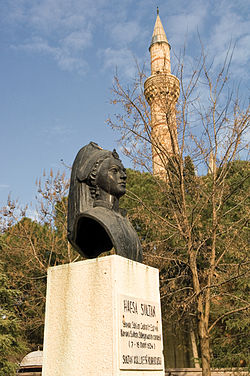
![Bust of Ayşe Hafsa Sultan]float-right The formal adoption of the Valide Sultan title occurred in 1520 with the accession of Suleiman I (r. 1520–1566), marking the institutionalization of the Ottoman queen mother's role amid the empire's centralizing administrative reforms. Ayşe Hafsa Sultan (d. 1534), Suleiman's mother and a former concubine, became the first to hold this designation, transitioning from the earlier "Valide Hatun" to "Valide Sultan," signifying her elevated status as head of the imperial harem.[14] This change reflected the growing integration of the harem into state structures, with the Valide overseeing concubines often sourced from slave backgrounds akin to the devşirme system of elite recruitment.[15] This formalization coincided with the expansion of the harem quarters in Topkapı Palace during the mid-16th century, transforming it into a centralized institution housing hundreds of women and serving as a parallel administrative apparatus to the dynastic court. The harem's growth, from smaller provincial setups to over 400 rooms by Suleiman's era, necessitated structured maternal authority to manage daily operations, education of princes, and internal hierarchies.[16] Empirical evidence from imperial records indicates rising stipends for the Valide, such as Hafsa's allocation exceeding 1,000 aspers monthly prior to 1520, underscoring her financial empowerment tied to harem administration.[17] A key causal factor was the evolution away from immediate fratricide upon succession, a policy peaking in the 16th century but moderated under Suleiman, who permitted multiple sons to reach adulthood rather than executing them at birth. This shift, diverging from Mehmed II's legal framework, heightened palace intrigues and required maternal oversight for heir rearing in provincial sanjaks or the harem, positioning the Valide as a stabilizing force amid potential rivalries.[18][19] Prolonged sultanic minorities and extended reigns further amplified this role, as seen in firman-granted audiences and endowments that formalized the Valide's advisory influence on succession dynamics without direct political office.[20]Peak Influence during the Sultanate of Women (17th Century)
The Sultanate of Women, extending from approximately 1533 to 1656, witnessed the zenith of valide sultan influence in the 17th century, as mothers of sultans assumed regency roles during periods of imperial governance instability.[21] This era's power dynamics arose from structural voids in sultanic authority, including the ascension of underage heirs—such as Murad IV in 1623 at age 11 and Mehmed IV in 1648 at age 6—and the erratic rule of Ibrahim I from 1640 to 1648, characterized by seclusion and personal excesses that undermined effective leadership.[1] [22] Institutional vacuums prompted valide sultans to function as de facto co-rulers, leveraging the harem's parallel administrative apparatus to mediate with the Imperial Council (divan) through appointed grand viziers and eunuchs, thereby directing policy without direct assembly attendance.[20] Regencies formalized this authority, with valide sultans like Kösem exercising control from 1623–1632, 1640–1648, and into Mehmed IV's early reign, and Turhan Hatice succeeding in 1651, marking the only instances of official female regencies in Ottoman history.[22] [1] Their involvement extended to foreign diplomacy, where they influenced ambassadorial audiences and treaty negotiations to stabilize alliances amid European pressures.[23] Empirical indicators of expanded valide purview include heightened patronage of architectural projects, such as mosque complexes, which numbered over a dozen major commissions tied to valide oversight in the early-to-mid 17th century, often funded via imperial waqfs amid fiscal deficits from military campaigns and inflation.[24] These activities, alongside trade concessions granted through harem networks, reflected adaptive responses to empire-wide strains rather than autonomous expansions of female-led governance.[21] By 1656, accumulating janissary unrest and maturing sultanic rule curtailed this phase, restoring male-dominated hierarchies.[23]Role and Powers
Harem Hierarchy and Administration
The Valide Sultan held the position of supreme authority within the Ottoman imperial harem, overseeing its internal hierarchy and serving as the primary manager of daily operations among its residents, which numbered in the hundreds to over a thousand, encompassing concubines, odalisques, female servants, and eunuchs.[25] [26] As the sultan's mother, she enforced strict protocols for discipline, including punishments for infractions such as breaches of etiquette or intrigue among consorts, while allocating resources like food stipends, clothing, and living quarters based on rank and service duration, as documented in surviving Ottoman privy purse registers (defters).[6] [27] This role emphasized preservation of order and seclusion rather than personal gain, with the Valide acting as a stabilizing force amid the harem's competitive dynamics. In collaboration with the Kızlar Ağası (Chief Black Eunuch, or kapı ağası), who managed the eunuch guards and external communications, the Valide supervised key administrative functions, such as the education of young princes (şehzades) in Quranic studies, courtly manners, and basic governance principles within the harem's confines before their transfer to provincial posts.[28] [29] She also mediated disputes among consorts and attendants to prevent factionalism that could disrupt household harmony, enforcing rules of isolation that prohibited unauthorized interactions and upheld the harem's impermeable boundaries.[25] These duties were grounded in the harem's self-contained structure, where the Valide's oversight ensured compliance with Islamic norms of segregation and dynastic continuity. Ottoman financial defters from the 16th and 17th centuries reveal the Valide's direct control over harem budgets, including allocations for personnel salaries and maintenance, underscoring her administrative autonomy within the palace.[6] [27] European traveler accounts, such as those cross-referenced in scholarly analyses, corroborate this internal governance, noting the Valide's role in quelling rivalries without external political extension, though such observers often exaggerated intrigue due to limited access and cultural biases.[30] This evidence highlights the Valide's focus on routine enforcement and resource equity as essential to harem functionality.Political and Diplomatic Influence
The valide sultan wielded political influence primarily through advisory channels to the reigning sultan, often conveying recommendations on key appointments and military strategies via trusted intermediaries such as the harem's kahya (steward) or direct appeals during private audiences. This brokerage extended to indirect oversight of Divan proceedings, where the valide could monitor deliberations through a latticed window in the Topkapı Palace, enabling subtle guidance on contentious issues like provincial governorships or campaign mobilizations without formal presence. For example, during regencies for young or absent sultans, valides like Kösem Sultan shaped responses to existential threats, including the orchestration of multiple expeditions between 1624 and 1638 to reclaim Baghdad from Safavid Persia after its fall in 1624, leveraging her networks to align viziers and janissary leaders behind prolonged offensives amid internal revolts.[22] In diplomatic affairs, valide sultans facilitated external relations by initiating or mediating correspondence with foreign courts, particularly in alliance-building or peace negotiations, as documented in European archival reports. Safiye Sultan, valide to Mehmed III, exemplified this by exchanging letters with Queen Elizabeth I of England from 1593 to 1599; Elizabeth dispatched jeweled portraits and textiles as gestures of amity, prompting Safiye's reciprocal gifts and overtures that bolstered Anglo-Ottoman trade pacts against shared Iberian rivals, bypassing male-dominated channels for discreet female diplomacy. Venetian baili, embedded in Istanbul, frequently noted such interventions, attributing lulls in hostilities—such as temporary truces in the Long Turkish War (1593–1606)—to valide advocacy for de-escalation through familial ties or prisoner exchanges, though these accounts reflect the envoys' strategic incentives to highlight harem leverage for republic dispatches.[31][32] Influence's efficacy hinged on the sultan's temperament and age, diminishing under resolute rulers like Murad IV (r. 1623–1640), who curtailed maternal meddling to consolidate autocracy, as evidenced by his execution of advisors perceived as valide proxies. Ottoman chroniclers, including those in the vein of Mustafa Naima, critiqued valide-driven patronage of favorites for amplifying factional strife, where promotion of aligned grand viziers or aghas eroded merit-based governance and precipitated coups, such as the 1622 deposition of Osman II amid Kösem-orchestrated janissary unrest—outcomes rooted in causal overreliance on kin loyalty over institutional competence rather than inherent gender dynamics.[1]Economic, Architectural, and Charitable Patronage
Valide sultans exercised significant economic influence through the administration of waqfs (pious endowments), which generated substantial revenues from properties such as agricultural lands, shops, and mills across the Ottoman Empire, enabling funding for public infrastructure and sustaining imperial prestige. These endowments, documented in vakıf registers, created economic multipliers by channeling income into self-perpetuating systems where constructed facilities—like bazaars adjacent to mosques—produced ongoing yields to support maintenance and expansion.[33] For instance, Pertevniyal Valide Sultan (d. 1880), mother of Sultan Abdülaziz, established landed waqf çiftliks (endowment farms) in Thessaly during the mid-19th century, leveraging agricultural output to finance charitable and architectural projects while integrating into broader Ottoman land regimes. Architecturally, valide sultans commissioned multifunctional complexes that combined religious, educational, and commercial elements, enhancing urban landscapes and generating prestige-linked revenues. Kösem Sultan (d. 1651), valide to sultans Murad IV and Ibrahim, funded the Çinili Mosque (Tiled Mosque) in Üsküdar, completed between 1640 and 1648, renowned for its extensive Iznik tilework and integrated külliye (complex) features including a sıbyan mektebi (primary school).[34] Similarly, Nurbanu Sultan (d. 1583), mother of Murad III, patronized the Atik Valide Mosque complex in Üsküdar, initiated in 1577 under architect Mimar Sinan and finished by his apprentice Davud Ağa in 1583, encompassing a mosque, madrasa, hospital, and hostels that blended piety with practical utility.[35] These projects, often termed "Valide mosques," not only served devotional purposes but also stimulated local economies through attached revenue-producing shops and baths.[36] Charitable initiatives via waqfs extended valide influence into social welfare, funding provisions for the needy that underscored the endowments' role in imperial support systems beyond elite luxury. Nurbanu Sultan, noted as one of the empire's foremost philanthropists, directed waqf resources toward public amenities and aid distribution, as evidenced by the expansive charitable scope of her Üsküdar complex.[35] Kösem Sultan similarly endowed facilities like pilgrim hostels and soup kitchens tied to her mosques, with vakıf deeds specifying allocations for the poor and travelers, fostering community resilience through sustained, endowment-backed relief mechanisms.[36] Such efforts, rooted in Islamic endowment traditions, prioritized verifiable communal benefits over personal opulence, as waqf structures ensured perpetual operation independent of state budgets.[37]List of Valide Sultans
Chronological Enumeration
- Ayşe Hafsa Sultan (Crimean Tatar origin) held the position of Valide Sultan during the reign of her son Suleiman I from 1520 until her death in 1534, marking the first formal use of the title.[6]
- A gap occurred during the reign of Selim II (1566–1574), as his mother Hürrem Sultan had died in 1558 prior to his ascension.[6]
- Nurbanu Sultan (Venetian origin) served as Valide Sultan to her son Murad III from 1574 until her death in 1583.[6]
- Another gap existed from 1583 to 1595, during the early years of Mehmed III's reign before his mother's formal role solidified, and including short tenures like that of Handan Sultan (mother of Ahmed I, 1603–1605) and Halime Sultan (mother of Mustafa I, 1617–1618 and 1622–1623), often disputed in duration due to political instability.[6]
- Safiye Sultan (Venetian origin) was Valide Sultan to her son Mehmed III from 1595 until his death in 1603.[6]
- Kösem Sultan (Greek origin) acted as Valide Sultan successively for her sons Murad IV (1623–1640) and Ibrahim I (1640–1648), and briefly for her grandson Mehmed IV until her death in 1651.[6][1]
- Turhan Hatice Sultan (Ukrainian origin) succeeded as Valide Sultan to Mehmed IV from 1651 until her death in 1683.[6][1]
- Subsequent Valide Sultans included Emetullah Rabia Gülnuş Sultan (Circassian origin), mother to Mustafa II (1695–1703) and Ahmed III (1703–1715); later examples featured mothers of predominantly Circassian or Abkhazian slave origins during reigns with living maternal figures, such as Mihrişah Sultan (Georgian, for Selim III, 1789–1805), Bezmialem Sultan (for Abdulmejid I, 1839–1853), and Pertevniyal Sultan (for Abdulaziz, 1861–1876).[38]
- Gaps persisted during reigns of sultans whose mothers had predeceased them or who ascended as adults without active maternal oversight, as recorded in Ottoman genealogical sources like the şecere-i sultaniye, limiting the title's continuity to cases of verified maternal survival and influence.[6]
Patterns and Statistical Overview
The ethnic origins of valide sultans were predominantly non-Turkic, with approximately 74% deriving from slave concubines of European or Balkan backgrounds between 1400 and 1700, reflecting the Ottoman harem's systematic incorporation of converts from captured or traded non-Muslim populations to foster undivided loyalty to the dynasty. Genealogical analyses of 19 valide sultans in this period identify Turkish origins in 26% of cases, contrasted with Venetian (16%), Polish (11%), Greek (11%), Serbian (11%), Albanian (11%), Bosnian (11%), and Russian (5%) lineages, underscoring the empire's reliance on the devşirme-adjacent slave trade for harem recruitment rather than free Muslim women, which minimized external familial allegiances and enabled cultural assimilation through Islam.[39] This pattern persisted into later centuries, with increasing representation from Caucasian groups like Georgians and Circassians, though quantitative breakdowns for the full span remain limited by incomplete records.[40]| Ethnic Origin | Number | Percentage |
|---|---|---|
| Turkish | 5 | 26.3% |
| Venetian | 3 | 15.8% |
| Polish | 2 | 10.5% |
| Greek | 2 | 10.5% |
| Serbian | 2 | 10.5% |
| Albanian | 2 | 10.5% |
| Bosnian | 2 | 10.5% |
| Russian | 1 | 5.3% |
Büyük Valide Sultans
Definition and Criteria
The Büyük Valide Sultan, or "Grand Valide Sultan," referred to the grandmother (or exceptionally, a senior maternal figure) of a reigning Ottoman sultan who held elevated precedence in the imperial harem over the current Valide Sultan (the sultan's mother). This title formalized a hierarchical adjustment recognizing cross-generational maternal authority, distinct from the standard Valide Sultan role limited to the immediate mother.[41][42] Criteria for attaining Büyük Valide status centered on the woman's survival and sustained influence extending into her grandson's rule, typically requiring exceptional longevity—often beyond 50–60 years in an era of high mortality—or prior regency experience as mother to the previous sultan. This was evidenced by imperial firmans or protocols explicitly reordering harem seating, processions, and decision-making privileges to place her above the junior Valide, as seen in 17th-century precedents amid the Sultanate of Women.[41] The designation served a practical function in stabilizing harem governance, where overlapping maternal claims could erode authority; by codifying seniority based on generational depth, it mitigated rivalries and preserved dynastic continuity in successions prone to fratricide and rapid turnover, with sultans averaging reigns of 10–20 years from the 16th century onward.[43]Notable Cases and Implications
Kösem Sultan exemplified the transition to Büyük Valide status following the deposition and execution of her son Sultan Ibrahim on August 8, 1648, which elevated her seven-year-old grandson Mehmed IV to the throne. As Büyük Valide, Kösem assumed a supervisory regency role alongside the new Valide Sultan, Turhan Hatice, her daughter-in-law, maintaining significant influence over palace administration and state affairs during Mehmed's minority until 1651.[44][22] Contemporary Ottoman chronicles, such as those by Evliya Çelebi, document her continued command of the harem's black eunuchs and efforts to control access to the young sultan, intensifying internal hierarchies.[20] This dual Valide structure amplified risks of intrigue and factionalism, as competition between Kösem and Turhan for proximity to Mehmed IV escalated, culminating in Kösem's assassination on September 2, 1651, orchestrated by Turhan's allies who strangled her in her apartments amid fears of a counter-coup.[45][22] The event, unprecedented in Ottoman history for the murder of a former Valide, underscored how overlapping maternal authorities could destabilize regencies, empirically correlating with heightened harem conspiracies during the Sultanate of Women.[20] Such Büyük Valide regencies became exceedingly rare after the 17th century, reflecting the broader contraction of harem political influence as sultans increasingly acceded as adults and centralized reforms diminished dynastic women's institutional roles.[44]
Achievements and Criticisms
Positive Contributions to Stability and Culture
Valide Sultans frequently assumed regency roles during sultans' minorities, providing continuity and averting factional strife that could escalate into broader conflicts. Turhan Hatice Sultan, acting as regent for her son Mehmed IV from 1648 onward, navigated palace intrigues and external pressures to maintain imperial governance. In September 1656, she orchestrated the appointment of Köprülü Mehmed Pasha as grand vizier, granting him unprecedented authority including security of tenure, which enabled decisive reforms against corruption and military indiscipline, thereby bolstering Ottoman administrative stability for over two decades.[46] Through extensive waqf endowments, Valide Sultans patronized cultural and educational institutions, channeling revenues from properties into sustainable support for scholarship and public welfare. Collectively, Ottoman imperial women established 2,309 waqfs, with Valide Sultans like Nurbanu Sultan funding comprehensive complexes including hospitals (darüşşifas) that integrated medical care with religious and educational facilities, fostering long-term societal resilience. Kösem Sultan, for instance, erected the Valide Sultan Mosque and associated structures in Istanbul during the 1660s, whose agricultural and commercial yields sustained madrasas and ulema, promoting literacy and theological discourse amid 17th-century upheavals.[47][48] In diplomacy, Valide Sultans leveraged personal networks to secure alliances preserving Ottoman borders. Safiye Sultan, Valide to Mehmed III, conducted direct epistolary exchanges with Queen Elizabeth I starting in the 1590s, reciprocating gifts such as an organ and coach while aligning against shared Habsburg threats, which reinforced naval cooperation and deterred potential invasions. Her Venetian heritage and ongoing relations with the Republic of Venice similarly facilitated intelligence-sharing and truce negotiations, mitigating Mediterranean hostilities during a period of European-Ottoman tensions.[31][49]