Hubbry Logo
BorescopeBorescopeMain
Open search
Borescope
Community hub
Borescope
logo
8 pages, 0 posts
0 subscribers
Be the first to start a discussion here.
Borescope
Borescope
from Wikipedia
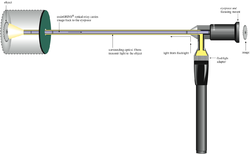
Schematic view of a rigid borescope
Borescope in use, showing typical view through the device

A borescope (occasionally called a boroscope, though this spelling is nonstandard) is an optical instrument designed to assist visual inspection of narrow, difficult-to-reach cavities, consisting of a rigid or flexible tube with an eyepiece or display on one end, an objective lens or camera on the other, linked together by an optical or electrical system in between. The optical system in some instances is accompanied by (typically fiberoptic) illumination to enhance brightness and contrast. An internal image of the illuminated object is formed by the objective lens and magnified by the eyepiece which presents it to the viewer's eye.

Rigid or flexible borescopes may be externally linked to a photography or videography device. For medical use, similar instruments are called endoscopes.

Uses

[edit]

Borescopes are used for visual inspection work where the target area is inaccessible by other means, or where accessibility may require destructive, time consuming and/or expensive dismounting activities. Similar devices for use inside the human body are referred to as endoscopes. Borescopes are mostly used in nondestructive testing techniques for recognizing defects or imperfections.

Borescopes are commonly used in the visual inspection of aircraft engines, aeroderivative industrial gas turbines, steam turbines, diesel engines, and automotive and truck engines. Gas and steam turbines require particular attention because of safety and maintenance requirements. Borescope inspection of engines can be used to prevent unnecessary maintenance, which can become extremely costly for large turbines. They are also used in manufacturing of machined or cast parts to inspect critical interior surfaces for burrs, surface finish or complete through-holes. Other common uses include forensic applications in law enforcement and building inspection, and in gunsmithing for inspecting the interior bore of a firearm. In World War II, primitive rigid borescopes were used to examine the interior bores (hence "bore" scope) of large guns for defects.[1]

Flexible versus rigid

[edit]

The traditional flexible borescope includes a bundle of optical fibers which divide the image into pixels. It is also known as a fiberscope and can be used to access cavities which are around a bend, such as a combustion chamber or "burner can", in order to view the condition of the compressed air inlets, turbine blades and seals without disassembling the engine. Traditional flexible borescopes suffer from pixelation and pixel crosstalk due to the fiber image guide. Image quality varies widely among different models of flexible borescopes depending on the number of fibers and construction used in the fiber image guide. Some high-end borescopes offer a "visual grid" on image captures to assist in evaluating the size of any area with a problem. For flexible borescopes, articulation mechanism components, range of articulation, field of view and angles of view of the objective lens are also important. Fiber content in the flexible relay is also critical to provide the highest possible resolution to the viewer. Minimal quantity is 10,000 pixels while the best images are obtained with higher numbers of fibers in the 15,000 to 22,000 range for the larger diameter borescopes. The ability to control the light at the end of the insertion tube allows the borescope user to make adjustments that can greatly improve the clarity of video or still images.

Rigid borescopes are similar to fiberscopes but generally provide a superior image at lower cost compared to a flexible borescope. Rigid borescopes have the limitation that access to what is to be viewed must be in a straight line. Rigid borescopes are therefore better suited to certain tasks such as inspecting automotive cylinders, fuel injectors and hydraulic manifold bodies, and gunsmithing. Criteria for selecting a borescope are usually image clarity and access. For similar-quality instruments, the largest rigid borescope that will fit the hole gives the best image. Optical systems in rigid borescopes can be of three basic types: Harold Hopkins rod lenses, achromatic doublets, and gradient index rod lenses. For large-diameter borescopes (over 12 millimetres (0.47 in)), the achromatic doublet relays work quite well, but as the diameter of the borescope tube gets smaller the Hopkins rod lens and gradient index rod lens designs provide superior images. For very small rigid borescopes (under 3 millimetres (0.12 in)), the gradient index lens relays are better.

Video borescopes

[edit]
Camera head of an inexpensive ($15) hobby video borescope camera. It contains six small LEDs for illumination. The other end is connected to the computer's USB socket
A video borescope used to inspect the jet engine of an F/A-18E fighter

A video borescope, videoscope, or "inspection camera" is similar to the flexible borescope but uses a miniature video camera at the end of the flexible tube. The end of the insertion tube includes a light which makes it possible to capture video or still images deep within equipment, engines and other dark spaces. As a tool for remote visual inspection the ability to capture video or still images for later inspection is a huge benefit. A display at the other end shows the camera view, and in some models the viewing position can be changed via a joystick or similar control. Because a complex fiber optic waveguide in a traditional borescope is replaced with an inexpensive electrical cable, video borescopes can be much less costly and potentially better resolution (depending on the specifications of the camera). Easy-to-use, battery-powered video borescopes, with 75 mm (3 in) LCD displays of 320×240 pixels or better, became available c. 2012 from several manufacturers and are adequate for some applications. On many of these models, the video camera and flexible tube is submersible. Later models offered improved features, such as better resolution, adjustable illumination or replacing the built-in display with a computer connection, such as a USB cable.

References

[edit]
Revisions and contributorsEdit on WikipediaRead on Wikipedia
from Grokipedia
A borescope is an optical device designed for visual examination of internal components within narrow or inaccessible cavities, such as those in engines, , and machinery, without requiring disassembly. It consists of a tube—either rigid or flexible—equipped with lenses, , or a miniature camera at the insertion end, connected to an , monitor, or recording system at the viewing end to transmit images or video. The origins of the borescope trace back to the early , when pioneers like George S. Crampton developed early rigid models for industrial applications, establishing companies focused on their production for global use in engineering inspections. Advancements in the mid-20th century, particularly through fiber optics, were driven by researchers such as Narinder Kapany, an Indian-American often called the "Father of Fiber Optics," who contributed to flexible designs in the and , enabling broader capabilities. Borescopes are classified into several types based on and functionality, including rigid borescopes for straight-line inspections in precise environments like welded and castings, flexible fiber optic borescopes for navigating curves in pipes or engines, and video borescopes that integrate digital cameras for high-resolution and recording on displays. These tools are essential in non-destructive testing (NDT) across industries such as for turbine blade checks, automotive for inspections, for , and plumbing or HVAC for internal diagnostics, allowing detection of defects like cracks, , or foreign objects with minimal intrusion.

Overview

Definition and Purpose

A borescope is an optical device, often described as an industrial , consisting of a rigid or flexible tube equipped with an objective lens, camera, or fiber optic system at the insertion end and an or digital display at the viewing end, designed for remote of hard-to-reach or inaccessible areas without requiring disassembly of the inspected object. This instrument enables (NDT) by capturing real-time or recorded visual data of internal structures, including cavities, pipes, engines, and other confined spaces, to identify defects such as cracks, , foreign objects, or blockages that could compromise or performance. The core operational principle relies on the transmission of light and images through relay lenses, coherent fiber optic bundles, or electronic sensors, which relay the view from the distal tip back to the operator without direct line-of-sight access. While medical endoscopes prioritize sterile, biocompatible materials and features like articulation for biological navigation, industrial borescopes emphasize rugged durability and precision, with many advanced models also incorporating articulation for complex inspections. Early applications included inspecting rotors in 1921, with significant military use during to inspect the interiors of large gun barrels for wear and defects.

Historical Development

The development of borescopes traces its roots to 19th-century medical , where precursors like simple periscopes and early viewing devices laid the groundwork for remote . In 1879, German physician Max Nitze invented the cystoscope, an instrument using a wire for illumination and lenses to examine the urinary bladder, marking a significant advancement in internal visualization that later influenced industrial adaptations for non-medical viewing. These early medical tools demonstrated the feasibility of peering into confined spaces, inspiring engineers to adapt similar principles for inspecting machinery without disassembly. The formal invention of the industrial borescope occurred in the early 20th century, credited to American ophthalmologist and inventor George S. Crampton. In 1921, Crampton developed the first borescope for Westinghouse Electric to inspect flaws in turbine rotors, utilizing a rigid tube with mirrors and lenses for remote viewing. By the 1930s, his Lenox Instrument Company produced custom models for applications like gun barrels and small-diameter tubes, establishing borescopes as essential tools in power generation and manufacturing. During World War II, rigid borescopes saw widespread military adoption by Allied forces for non-destructive inspection of rifle bores and aircraft engines, spurring mass production and technological refinements that accelerated post-war industrial use. Post-war innovations in the 1950s revolutionized borescope flexibility through fiber optics. British physicist Harold Hopkins, collaborating with Narinder Kapany, pioneered coherent fiber bundles in 1954, enabling image transmission via flexible glass fibers and paving the way for bendable models suitable for complex geometries. In the 1960s, Hopkins' rod-lens system enhanced image brightness and resolution, while the first commercial fiberoptic endoscopes—adaptable to borescopes—emerged around 1960, with widespread commercialization by 1964 via instruments like the gastrocamera. The 1980s marked a shift to electronic integration, as cameras, invented in but matured for practical use, were incorporated into video borescopes, allowing real-time imaging on external displays and reducing reliance on eyepieces. This transition lowered costs, improved documentation, and expanded accessibility across industries. By the 2010s, USB-enabled digital borescopes proliferated, offering plug-and-play connectivity to computers and smartphones for high-resolution, portable inspections, further evolving the technology from specialized tools to everyday diagnostic aids.

Design and Construction

Key Components

A borescope consists of several essential physical and functional components that enable remote of hard-to-reach areas. These include the insertion tube, objective lens system, relay optics, or display, illumination system, and various accessories, each designed to ensure , clarity, and . The insertion tube serves as the primary sheath that houses the optical and illumination elements, allowing insertion into confined spaces. Typically hollow or flexible, it features diameters ranging from 1 to 10 mm and lengths up to several meters to accommodate diverse needs. Materials such as , braided cable, or polymers provide protection against environmental hazards while enhancing maneuverability. At the distal end, the objective lens system captures the using front-end , such as achromatic lenses, to form a clear image. This system supports a (FOV) up to 120 degrees and a from 1 mm to infinity, enabling detailed observation across varying distances without frequent refocusing. Relay optics transmit the captured image from the objective lens along the length of the insertion tube to the proximal end, minimizing for reliable . Common configurations include rod lenses for rigid designs or coherent fiber bundles in flexible ones, comprising 10,000 to 30,000 individual fibers with diameters of 50 to 100 μm each to maintain high-resolution transmission. The or display at the proximal end allows the operator to view the relayed image, featuring levels of 10 to 30 times along with focusing mechanisms for sharp visualization. Many models include adapters for connecting cameras or digital displays to facilitate recording and . Illumination is critical for visibility within dark cavities, provided by sources such as , LED, or units that deliver light via guides to the tip, achieving intensities of 10,000 to 65,000 . These guides ensure even distribution without overheating the probe. Accessories enhance functionality and , including articulation controls for up to 4-way tip bending of 180 degrees to navigate curves, seals achieving IP67 ratings for submersion up to 1 meter, and cleaning ports to maintain and .

Rigid versus Flexible Designs

Rigid borescopes consist of straight, inflexible tubes that employ rod-lens systems to transmit high-resolution images over distances, achieving high-resolution images through precisely coated rods that minimize and light loss. These designs excel in providing superior image sharpness and detail compared to fiber-based alternatives, making them ideal for applications requiring precise without compromise on optical fidelity. Additionally, rigid borescopes offer enhanced durability due to their robust construction, which withstands harsh industrial environments, and they are generally more cost-effective, with prices ranging from $500 to $5,000 depending on length and features. However, their inflexibility limits them to straight-line access paths, and they typically feature larger probe diameters of 3 to 12 mm, which may restrict entry into narrow or confined spaces. In contrast, flexible borescopes, often referred to as s, utilize coiled or articulated tubes containing coherent fiber-optic bundles to convey images, enabling navigation around curves and bends up to 180 degrees for access to complex geometries. This flexibility comes at the expense of resolution, typically limited to 10,000 to 22,000 pixels, resulting in visible that can obscure fine details in high-precision tasks. Their advantages include smaller diameters from 1 to 6 mm, allowing insertion into tight openings, but they are more fragile due to the delicate fiber arrays and command higher costs, often $2,000 to $10,000, owing to the intricate manufacturing of the optic bundles. Hybrid designs bridge these approaches by incorporating semi-rigid sections, such as gooseneck or Nitinol-sheathed probes with limited articulation via hinged or shape-retaining elements, providing moderate flexibility while retaining some rigidity for stability in semi-confined paths. These configurations offer a compromise for inspections requiring both maneuverability and structural support, though they may not fully match the extreme resolution of pure rigid systems or the full articulation of flexible ones. Selection between rigid and flexible designs hinges on the inspection's access path—straight trajectories favor rigid for optimal clarity, while curved or obstructed routes necessitate flexible for reach—alongside required resolution for detail detection and environmental factors, such as rigid models' tolerance for elevated temperatures up to 200°C in heat-intensive settings. Maintenance differs significantly: rigid borescopes are simpler to sterilize through autoclaving or chemical methods and easier to repair by replacing individual rod lenses or tubes, whereas flexible fiberscopes are prone to fiber breakage from excessive or impact, requiring specialized optic bundle reconstruction that increases downtime and expense.

Types and Technologies

Optical Borescopes

Optical borescopes form images through a system where an objective lens at the distal end collects from the inspection area, relaying it via specialized optical components to an or viewer at the proximal end. In rigid designs, this relay typically employs the rod-lens system, consisting of short glass rods separated by small air gaps that facilitate to transmit the image with minimal loss of brightness and resolution. The air gaps between rods act as simple lenses, enabling efficient propagation over longer distances while reducing compared to earlier lens relay systems. Alternatively, gradient-index (GRIN) lenses can be used, where the varies continuously across the lens material to focus without discrete surfaces, minimizing aberrations in compact configurations suitable for smaller-diameter probes. In flexible optical borescopes, image transmission relies on coherent fiber-optic bundles, which consist of thousands of individual optical fibers arranged in a fixed to preserve spatial coherence and relay the image point-for-point from the objective to the . Incoherent fiber bundles, by contrast, are dedicated to illumination, light uniformly without maintaining image structure, and are often integrated alongside coherent bundles to provide . The effective resolution is determined by the number of fibers in the coherent bundle, with typical bundles containing 3,000 to 30,000 fibers. Light transmission efficiency is typically 50-70% due to factors like fiber cladding absorption and losses. The field of view (FOV) in optical borescopes is established by wide-angle objective lenses, commonly ranging from 90° to 120° to capture broader areas in confined spaces, though this introduces barrel distortion where straight lines appear curved outward at the edges. Distortion correction is achieved through elements or relay system design that compensates for radial magnification variations, ensuring more accurate visual assessment. (DOF), the range of distances over which the image remains acceptably sharp, is influenced by the , wavelength of , and , highlighting trade-offs between size, , and focus range in low-light environments. Optical borescopes are susceptible to limitations from environmental factors, such as , which can cause misalignment of rod lenses or fiber bundles, leading to image blurring or loss of focus during inspections in dynamic settings. Moisture exposure poses additional risks, as ingress can degrade fiber-optic claddings through or , reducing light transmission and resolution over time. To mitigate these issues, calibration involves pre-use alignment checks to verify focus sharpness and probe straightness, often using test patterns or reference targets to adjust the optical train and ensure straight-line imaging without deviation. These procedures confirm the integrity of the relay system before deployment, particularly in rigid and flexible variants for precise inspections.

Video and Digital Borescopes

Video and digital borescopes represent an electronic evolution in inspection technology, utilizing miniature image sensors positioned at the probe tip to capture and transmit visuals directly, thereby eliminating the need for fiber-optic relay systems. These devices typically employ compact (Complementary Metal-Oxide-Semiconductor) or CCD (Charge-Coupled Device) sensors, often sized around 1/4 to 1/2 inch, which convert light into digital signals for immediate processing. Resolutions range from 640x480 pixels in basic models to 4K in advanced units, enabling detailed imaging without the pixelation artifacts common in traditional fiber-optic systems. Outputs occur via USB or interfaces, delivering real-time video feeds that can be viewed on connected displays or computers. Key advantages of video and digital borescopes over purely optical variants include seamless in formats such as or MJPEG, facilitating easy storage and playback for and analysis. Digital zoom and enhancement features allow inspectors to magnify and clarify views post-capture, improving defect detection without physical adjustments. Since around 2012, these systems have become notably cost-effective; by 2025, entry-level models are priced between $50 and $300, owing to advancements in sensor affordability and integration, making them accessible for a wider range of industrial applications. In contrast to fiber-optic designs, which offer flexibility through light transmission but limit quality, digital sensors provide sharper, distortion-free visuals. Illumination in video and digital borescopes is integrated directly into the tip, commonly using arrays of LEDs for standard viewing or UV LEDs for fluorescence-based inspections, such as detecting cracks via penetrant dyes. These LEDs typically output 10-100 lumens, sufficient to illuminate confined spaces up to several deep, with many models featuring automatic brightness control to optimize visibility and prevent overexposure in varying light conditions. This built-in lighting enhances low-light performance, supported by sensors achieving signal-to-noise ratios greater than 40 dB. Advanced features further expand their utility, including wireless connectivity options like or , enabling video transmission over ranges of 10-50 meters to smartphones or tablets for remote monitoring. Articulating tips, controllable in 2-4 directions with up to 90-180° deflection, allow around bends and obstacles in complex structures. Accompanying software often includes tools for image , such as defect measurement and annotation, streamlining reporting processes. Resolutions commonly reach at 30 frames per second, balancing clarity and smooth motion for real-time inspections. As of 2025, advancements include AI-assisted image for automated defect detection and resolutions up to 8K in high-end models. The technology has evolved significantly from analog video borescopes introduced in the 1980s, which relied on basic CCD sensors for rudimentary live feeds, to modern digital iterations in the featuring USB connectivity compatible with smartphones and portable devices for enhanced portability and integration. This progression has shifted focus toward compact, power-efficient designs that reduce heat generation and enable longer inspection sessions.

Applications

Industrial Inspections

Borescopes play a critical role in (NDT) within industrial settings, enabling inspectors to examine hard-to-reach internal components of machinery and structures without disassembly, thereby minimizing downtime and operational disruptions. In sectors such as power generation and , they are routinely used to detect wear, (FOD), and in turbines, engines, and pipelines. For instance, in gas turbines, borescopes allow visualization of blade erosion or debris accumulation that could lead to if undetected. In aviation maintenance, borescopes are mandated by the (FAA) particularly for periodic inspections of jet engines, and in specific cases for certain components as required by airworthiness directives. High-resolution video borescopes facilitate the identification of microcracks, pitting, or thermal damage on critical parts like the GE90 engine blades, where even minor defects can compromise safety. These inspections, often conducted during scheduled maintenance intervals, have been shown to extend engine life by identifying issues early. The employs borescopes for diagnosing internal components, including cylinder heads for scoring or carbon buildup, and transmission systems for gear . In environments, they support by inspecting weld seams for voids, castings for internal flaws, and assembly lines for foreign materials, with applications in cleanrooms to verify contamination-free processes and on offshore oil rigs to examine internals under high pressure. Standard procedures for borescope (NDT), such as those outlined in ISO 22527-1, emphasize systematic inspection protocols, including probe insertion techniques, illumination standards, and digital documentation for traceability and reporting. These guidelines ensure consistent results across inspections, with recorded videos and images used to track asset degradation over time. Historically, borescope technology evolved from World War II-era applications in checking rifle bores for fouling to modern programs, where integration with data analytics has saved industries millions in downtime costs.

Specialized and Emerging Uses

Borescopes play a crucial role in forensic investigations by enabling non-invasive examination of inaccessible areas at scenes. agencies utilize these devices to inspect vehicles for hidden compartments, such as those potentially concealing or , allowing detection without structural damage. In ballistics analysis, forensic scientists employ borescopes to scrutinize barrels, assessing patterns, wear, and residue to match bullets to weapons, thereby supporting linkage in criminal cases. In archaeology and cultural restoration, facilitate the gentle inspection of delicate artifacts and structures, preserving historical integrity. Archaeologists deploy endoscopic cameras, akin to borescopes, to explore tombs, cavities, and buried sites without excavation, as demonstrated in examinations of ancient Egyptian mummies and chambers. Specialized 360° borescopes have been used to document narrow spaces, capturing detailed imagery with minimal site disturbance. These tools also aid in viewing paintings and building interiors, revealing hidden features for conservation efforts. Military and security operations leverage borescopes for surveillance in confined or hazardous spaces, enhancing operational safety. Tactical snake cameras, a type of flexible borescope, allow personnel to peer into walls, vehicles, or enclosures during reconnaissance or threat assessment. Explosion-proof variants are essential for inspecting improvised explosive devices (IEDs) and ordnance disposal, minimizing risks in explosive environments. Integration with unmanned aerial vehicles (UAVs) extends borescope capabilities for aerial surveillance of remote or inaccessible areas, supporting military intelligence gathering. Environmental monitoring benefits from borescopes in assessing impacts on ecosystems. These devices inspect and sewers to identify sources, such as leaks or blockages contributing to water contamination, thereby aiding and remediation. Push-rod cameras, similar to borescopes, enable unobtrusive observation of habitats in hard-to-reach natural settings, supporting ecological studies without disturbing . Regulatory standards govern borescope applications in high-stakes sectors like , ensuring reliable remote visual examinations (RVE). Compliance with frameworks such as ASTM E1212 for quality management supports inspections in nuclear , where borescopes verify component while adhering to protocols. These standards emphasize radiation-resistant designs and precise to minimize exposure during RVE of reactor internals. Emerging uses integrate borescopes with for operations in extreme hazardous environments. In , robotic crawlers equipped with borescope-like inspection cameras navigate underwater pipelines and seabeds, detecting or debris without human intervention. NASA's applications include borescope inspections of components, such as fuel feedlines and thermal protection systems, to identify cracks or in inaccessible areas during post-flight analysis. This robotic synergy extends to orbital servicing, where miniaturized visual tools enhance safety in vacuum or radiation-heavy conditions.

Advancements

Technological Improvements

Building on the foundations of video borescopes, post-2010 advancements have significantly enhanced imaging capabilities through higher resolution sensors and advanced processing techniques. Modern borescopes now incorporate 4K and even 8K UHD sensors, providing ultra-high-definition visuals that capture intricate details in confined spaces. These sensors, often paired with (HDR) imaging, improve contrast by combining levels into a single frame, revealing details in both brightly lit and shadowed areas during inspections. Additionally, 3D stereoscopic views achieved via dual-lens systems enable and precise measurements, facilitating accurate assessments of surface irregularities. Miniaturization efforts have led to micro-borescopes with diameters as small as 0.35 mm, leveraging technology to enable inspections in nanoscale environments. These compact designs maintain optical integrity while fitting into extremely tight spaces, such as microchannels in applications. Durability has been upgraded with tungsten-braided outer tubes, which provide robust protection against high-pressure environments up to 10,000 psi, elevated temperatures reaching 350°C, and exposure to harsh chemicals. This construction ensures reliable performance in demanding industrial settings, reducing the risk of probe failure during extended use. Portability has improved through battery-powered, wireless models that integrate with and Android apps for , real-time viewing, and cloud-based storage of inspection data. These features allow inspectors to operate untethered and share findings instantly via mobile devices. Software advancements include built-in AI algorithms for automated defect detection, such as methods that identify cracks and anomalies with up to 95% accuracy in real-time analysis. These tools streamline workflows by flagging potential issues without manual intervention, enhancing efficiency and reducing . Cost reductions have been driven by of CMOS sensors, enabling entry-level consumer borescope models to retail below $100 by 2025, making advanced inspection tools more accessible for non-professional use. The integration of (AI) and (ML) into borescope systems is poised to enable real-time using neural networks, allowing for automated identification of defects such as micro-cracks and corrosion during inspections. For instance, lightweight unsupervised models applied to aero turbine borescopes have demonstrated high accuracy in detecting anomalies without , enhancing efficiency in complex environments. , often integrated with (IoT) sensors, will further support proactive maintenance by analyzing inspection data to forecast component failures, reducing downtime in industries like and power generation. Augmented reality (AR) advancements are expected to overlay digital measurements and annotations directly onto live borescope feeds, facilitating guided inspections through AR-enabled devices such as glasses or tablets. This capability will improve accuracy and by providing inspectors with real-time visualizations of potential issues, as seen in emerging AR-assisted remote (RVI) systems. Enhanced connectivity through networks will support remote borescope operations, enabling low-latency video transmission for expert oversight from distant locations, similar to applications in robotic where facilitates precise, real-time control. Wireless borescopes with integration are projected to expand remote collaboration, particularly in hazardous or inaccessible areas. Sustainability efforts in borescope design include the adoption of eco-friendly LEDs for energy-efficient lighting and recyclable components to reduce e-waste, aligning with broader industry pushes for sustainable lifecycle management. These developments will support inspections in green energy sectors, such as turbines and solar panels, where borescopes enable non-invasive assessments to maintain renewable efficiency. Ongoing research addresses challenges like in AI-enabled borescopes, emphasizing secure handling of to comply with regulations, and standardization for AI accuracy through frameworks such as ISO/IEC 42001, which provides guidelines for AI management systems in technical applications. These efforts aim to ensure reliable, ethical deployment amid growing adoption.

References

Add your contribution
Related Hubs
User Avatar
No comments yet.