Hubbry Logo
search
logo
2100758

Viewfinder

logo
Community Hub0 Subscribers
Read side by side
from Wikipedia
Miniature Speed Graphic, early 1940s,[1] 2¼ × 3¼ inch format, with focal plane shutter and four different viewfinding means: a spring back with ground glass under a flip-up cover, simple optical viewfinder on top, Kalart rangefinder on side, and sports finder consisting of flip-up wire at lensboard and flip-up peepsight on top

In photography, a viewfinder is a device on a camera that a photographer uses to determine exactly where the camera is pointed, and approximately how much of that view will be photographed. A viewfinder can be mechanical (indicating only direction and approximate view), with simple optical components, with precision optics and optical functions, or a digital accessory device used with digital cameras.

View camera

[edit]
A Sanderson 'Hand' camera dating from circa 1899. The image was viewed on a ground glass at the back, under a flip-up cover. The flexible side shades helped seeing the dim image.

These cameras had no separate viewfinder. The exact image (although upside-down and reversed left-right) was viewed on a ground glass installed either in a replaceable plateholder, or in a spring back where springs hold the ground glass at the focus plane until a photographic plateholder is slid in front of it. Spring backs usually had a flip-up cover protecting the ground glass. A black focusing cloth was used with larger models.

Mechanical finders

[edit]

Later referred to as "sports finders", for many sports and newspaper applications optical viewfinders gave too small an image and were inconvenient to use for scenes that were changing rapidly. For these purposes a simple arrangement of two wire rectangles, a smaller one nearer the eye[citation needed] and a larger one further away, was used, without optics; the two rectangles were aligned so the smaller one was centered in the larger, and the larger rectangle would give an indication of what would be included. Cameras with sportsfinders usually had optical viewfinders also.

Simple optical viewfinders

[edit]

A single divergent (plano-concave) lens, in front of a frame, when close to the eye, acts as a viewfinder. Adding a convergent (plano-convex) lens makes a very short reversed Galilean (upright image) telescope. For movie camera or others with changeable lenses, outline marks on one of the viewfinder lenses could show the different fields of view for the different camera lenses.

Waist level (reflecting) viewfinders

[edit]

Simple reflecting viewfinders, known also as "brilliant finders", comprised a small forward-looking lens, a small mirror at 45° behind it, and a lens at the top; the user held the camera at waist level and looked down into the lens, where a small image could be seen. Such viewfinders were integrated into box cameras, and fitted to the side of folding cameras. These viewfinders were fitted to inexpensive cameras.


Twin-lens reflex viewfinders

[edit]

Twin-lens reflex (TLR) cameras use a viewfinding lens with the same focal length as the camera lens, so it has the same field of view and focus properties. With a mirror, of similar size to the film, held at 45°, it projects an upright image onto a focusing ground glass screen viewable from above. The camera can be then be held steady at waist level. Although the viewfinder lens was similar to the camera lens, the optical quality was less important and so the cost is reduced. TLR viewfinders do not have the interrupted viewing and shutter lag of the SLR type and so is preferred for dance photography.[2] Reinhold Heidecke cited his experience with periscope focusing from the German trenches in 1916 as the inspiration for the Rolleiflex line in 1929.[3] Some similar-looking cameras are actually simple box cameras with a waist-level viewfinder.

Single-lens reflex viewfinders

[edit]
Hasselblad
Mamiya 645 1000s AE finder

Single-lens reflex (SLR) cameras use the camera lens itself, to completely eliminate parallax, the significant field-of-view error for close subjects caused by the offset distance between the viewfinder's lens and the camera's lens. Early SLRs were plate cameras, with a mechanism to insert a mirror between the lens and the film which reflected the light upwards, where it could be seen at waist level on a ground glass screen. When ready to take the picture, the mirror was pivoted out of the way (without moving the camera). Later SLR still cameras had a mechanism which flipped the mirror out of the way when the shutter button was pressed, opened and closed the shutter, and then moved the mirror back. The Zeiss Ikon Contax S was the first SLR camera to allow easy eye-level viewing by using a roof pentaprism to laterally reverse the inverted camera image (the reflex mirror had already vertically reversed the image).[citation needed] SLR movie cameras used a beamsplitter partial mirror to split the camera image between the shutter and film, and the viewfinder.[citation needed] A major advantage of SLR viewfinders is that any change of camera lens did not affect the viewing accuracy, and accurate camera focus did not depend on correct linking or calibration.

Rangefinders

[edit]

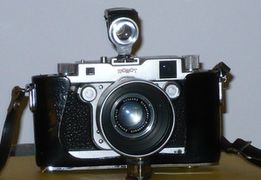
Some sophisticated 20th century cameras with direct viewfinders had coincidence (split-image) rangefinders, initially with separate windows from the viewfinder, later integrated with it; they were called rangefinder cameras. Cameras with interchangeable lenses had to indicate the field of view of each lens in the viewfinder; more usually, interchangeable viewfinders to match the lenses were used.[4]


Contemporary viewfinders

[edit]
Built-in viewfinder of a Nikon D90

Viewfinders can be optical or electronic. An optical viewfinder is simply a reversed telescope that displays what the camera sees. It has many drawbacks, but it also has advantages; it consumes no power, it does not wash out in sunlight, and it has "full resolution" (i.e. the resolution of the photographer's eye). Modern electronic viewfinders (EVF) are LCD or OLED based display devices. In addition to its primary purpose, an electronic viewfinder can be used to replay previously captured material, and as an on-screen display to browse through menus.

A still camera's optical viewfinder typically has one or more small supplementary LED displays surrounding the view of the scene. On a film camera, these displays show shooting information such as the shutter speed and aperture and, for autofocus cameras, provide an indication that the image is correctly focussed. Digital still cameras will typically also display information such as the current ISO setting and the number of remaining shots which can be taken in a burst. Another display which overlays the view of the scene is often provided. It typically shows the location and state of the camera's provided auto-focus points. This overlay can also provide lines or a grid which assist in picture composition.

Typical film SLR viewfinder information
View through a Pentax K20D viewfinder (without lens)

It is not uncommon for a camera to have two viewfinders. For example, a digital still camera may have an optical viewfinder and an electronic one. The latter can be used to replay previously captured material, has an on-screen display, and can be switched off to save power. A camcorder may have two viewfinders, both electronic. The first is viewed through a magnifying eyepiece, and due to a rubber eyepiece it can be viewed perfectly even in bright light. The second viewfinder would be larger, of a higher resolution, and may be mounted on the side of the camera. Because it consumes more power, a method is often provided to turn it off to save energy.

In late 2010, Fujifilm announced hybrid viewfinder of optical viewfinder and electronic viewfinder in one viewfinder for its highend compact cameras. There is a half mirror prism that reflect data from LCD to the optical viewfinder, so we can see both the shooting frame and the shooting data. A button can change the hybrid function to electronical viewfinder by blocking the image through the optical viewfinder with moving a half mirror prism to be a straight up mirror.[5]

Viewfinders are used for virtually all cameras whether still or movie, film, electronic analog (Television) or digital. Many digital sensor cameras do not have a separate viewfinder. For those cameras, the electronic image is shown on a small accessory screen for composition and focusing purposes.[6] CCTVs and webcams do not need any viewfinding device.

See also

[edit]

References

[edit]
Revisions and contributorsEdit on WikipediaRead on Wikipedia
from Grokipedia
''Viewfinder'' most commonly refers to a device on a camera used in photography and cinematography. For the 2023 video game, see ''Viewfinder (video game)''. A viewfinder is a camera component that allows the photographer or cinematographer to view the scene, compose the image, and sometimes focus before capturing it. It shows the field of view and approximate framing that the lens will record, helping to account for factors like parallax in non-SLR designs.[1][2] Viewfinders have evolved significantly since the early days of photography. Initial designs included simple frame finders and ground-glass screens on view cameras in the 19th century. By the 20th century, more advanced optical systems emerged, such as waist-level finders, twin-lens reflex (TLR) viewfinders, and single-lens reflex (SLR) mechanisms that provide a through-the-lens view. Modern cameras often incorporate electronic viewfinders (EVFs), which display a digital preview of the image, including exposure and focus aids. Hybrid systems combine optical and electronic elements for enhanced functionality.[3][4][5]

Basic Concepts

Definition and Purpose

A viewfinder is a subsystem integrated into cameras that enables photographers to preview and compose the intended frame of a scene prior to capturing the image, without exposing the film or sensor to light.[2] This device provides an approximate representation of the subject area that will be recorded, allowing for precise alignment and creative decision-making during the shooting process.[6] The historical purpose of viewfinders traces back to the mid-19th century, when they were developed for early plate cameras to assist in aligning subjects and selecting appropriate viewpoints and lenses.[6] Emerging in the 1850s, these initial designs addressed the challenges of large-format photography, where direct observation through the lens was impractical without wasting sensitive materials.[6] By the late 19th century, viewfinders had become standard features, evolving from simple frames to more sophisticated optical aids that supported the growing accessibility of photography.[6] Key functions of viewfinders include framing the composition to match the photographer's vision, previewing focus in advanced configurations such as ground-glass screens, estimating exposure through integrated meters, and providing guidance for camera orientation relative to the subject.[4] These capabilities streamline the workflow, enabling adjustments in real time to achieve the desired aesthetic and technical outcomes.[4] While viewfinders offer a reliable preview, the image they display often differs from the final photograph due to variations in lens coverage, where the taking lens may capture a slightly wider or narrower field than seen through the finder.[7] This discrepancy can introduce parallax error, a common limitation in non-single-lens reflex designs, requiring photographers to compensate manually for accurate results.[6]

Parallax and Framing Considerations

Parallax in camera viewfinders refers to the apparent displacement of the subject between the image observed through the viewfinder and the actual image captured by the lens, arising from the spatial offset between the two optical paths.[8] This misalignment primarily affects the edges of the frame, leading to compositional inaccuracies where elements intended to be included or excluded shift unexpectedly.[9] The magnitude of parallax error is determined by several key factors: the baseline distance, or physical separation between the viewfinder's optical center and the taking lens, which establishes the inherent offset; the subject's distance from the camera, with errors becoming more pronounced at closer ranges due to the increased angular disparity; and the lens focal length, where longer focal lengths can amplify the linear shift in the image plane relative to the field of view.[8][9] For instance, in scenarios with a typical 20-30 mm vertical offset and standard lenses, parallax remains negligible beyond 2-3 meters but escalates rapidly at nearer distances.[10] To mitigate parallax, optical viewfinders often incorporate correction marks—etched or projected lines within the finder that guide users to offset their composition for close subjects, typically effective within 1-1.5 meters.[11] In digital systems, automatic adjustments are achieved through live view modes on rear LCD screens or electronic viewfinders, which display the lens's actual output in real-time, eliminating offset-based errors.[12] The impact on composition is particularly severe in macro photography, where subjects are often within 0.3-0.5 meters; without correction, parallax can significantly displace frame edges, potentially cropping critical details or including unwanted elements, thus undermining precise subject isolation.

Early Optical Viewfinders

Mechanical and Frame Finders

Mechanical and frame finders represent the earliest forms of non-optical sighting devices in photography, emerging in the mid-19th century as simple aids for aligning subjects without the need for lenses or mirrors. These devices typically consisted of a front rectangular frame—often made of thin wire or etched metal—and a rear sighting hole or post, held at arm's length to approximate the camera's field of view. By framing the subject between the wires or edges, photographers could achieve rough alignment for basic compositions, particularly useful in the era of large, cumbersome plate cameras where precise optics were impractical.[6] The introduction of mechanical finders on cameras occurred around the late 1880s and 1890s, coinciding with the rise of more portable folding and box designs that demanded lightweight sighting solutions. These evolved from hand-held accessories like the Adams View-meter (1894), an adjustable aluminum frame for estimating angles of view across different formats, to integrated mechanisms such as the Heywood-McKellen Finder (1898), a mahogany and brass device suited for quarter-plate and half-plate cameras with lenses from 4 to 11 inches. Often termed "sports finders" by the early 20th century due to their utility in capturing fast-moving subjects like athletes or wildlife from a distance, these finders featured flip-up or folding wire frames mounted atop the camera body, allowing quick deployment without obstructing the view. Their design prioritized speed and simplicity, making them ideal for newspaper and action photography where small optical viewfinders proved too constricting.[6][13] A notable historical example is the Kodak Baby Brownie, introduced in 1934, which incorporated a simple folding frame finder on its molded plastic body for eye-level composition—a departure from the waist-level brilliant finders of earlier box models. This affordable camera, designed by Walter Dorwin Teague, used the frame to line up subjects on 127 roll film, exemplifying how mechanical finders democratized snapshot photography for amateurs. However, these devices suffered from significant limitations, including a lack of precision in low-light conditions where the thin wires became difficult to discern, and inherent parallax errors arising from the offset between the finder and the actual lens axis, which distorted framing at close ranges.[14][15] Despite these drawbacks, mechanical and frame finders offered key advantages in their era: they were exceedingly lightweight, requiring no glass elements or complex mechanics, thus reducing camera weight and cost while enabling rapid setup in fieldwork. Their open construction provided an unobstructed, life-sized view of the scene, better suited to distant subjects than early telescopic alternatives, though they offered no magnification or detailed preview of exposure effects. By the mid-20th century, as optical technologies advanced, these rudimentary finders largely gave way to more sophisticated designs, but they laid the foundational principle of auxiliary framing in portable photography.[6][13]

Simple Telescopic Finders

Simple telescopic finders represent an early advancement in optical viewfinder technology, employing basic lens or prism arrangements to provide a magnified preview of the scene for improved framing accuracy over non-optical designs. These finders typically utilize a reverse Galilean configuration, consisting of a diverging objective lens at the front and a converging eyepiece lens at the rear, which together produce an erect virtual image of reduced size for the user to observe. This setup, akin to viewing through a small telescope in reverse, allows for eye-level composition while maintaining a compact form suitable for portable cameras. The design emerged as a direct evolution from simpler frame finders, offering modest magnification to enlarge the viewed field without the complexity of reflex or focusing mechanisms.[16][17] The reverse Galilean finder's field of view generally spans 40 to 50 degrees, enabling photographers to approximate the camera's framing within a broad angular scope while accounting for minor parallax shifts between the viewfinder and taking lens axes. Historical roots trace back to the Newtonian finder, an optical adaptation of Isaac Newton's 1660s prism-based principles for telescopes, which was modified for photographic use in the 1890s by incorporating a plano-concave lens to create a wide-angle preview without magnification. This early form laid the groundwork for telescopic finders, providing undistorted scene observation in compact devices. By the early 20th century, such designs appeared in Leica prototypes developed by Oskar Barnack in the 1910s and 1920s, where the Galilean telescope served as the integrated eye-level viewfinder for 35mm rangefinder cameras, influencing the Leica I's production model in 1925.[18][19][20] Among the variants, brilliant finders incorporated reflective prisms in the 1920s to enhance brightness and image clarity, directing light through a series of mirrors or prisms to form an upright, laterally reversed view suitable for waist-level use in folding and box cameras. These prism-based systems improved visibility in low-light conditions compared to basic lens-only setups, though they remained fixed in magnification. A significant innovation was the Albada finder, patented in 1923 by Lieuwe Evert Willem van Albada for Carl Zeiss, which superimposed bright frame lines onto the viewed scene via semi-reflective coatings on the objective lens, allowing precise alignment of the composition without external masks. This technique addressed framing inconsistencies by projecting illuminated boundaries directly into the optical path, becoming a staple in mid-20th-century compact cameras.[6][21] Practical features of simple telescopic finders include fixed or adjustable zoom magnification ranging from 0.4x to 1x, providing subtle enlargement to aid detailed composition without overwhelming the natural perspective. To mitigate parallax errors—arising from the offset between the viewfinder's optical axis and the camera lens—many designs incorporated parallax correction marks, such as graduated lines or symbols visible in the eyepiece that shift with estimated subject distance for manual adjustment. These elements ensured reliable previewing for handheld photography, particularly in the pre-war era when portability demanded lightweight, non-coupled optics.[18][22]

Reflected and Ground-Glass Viewfinders

Waist-Level Finders

Waist-level finders employ a ground-glass screen positioned at the camera's focal plane, where light from the taking lens forms an image that is reflected upward by a fixed mirror for viewing from above. This reflected view offers a direct, real-time preview of the scene as it will appear on film, though the image is erect but laterally reversed, requiring photographers to mentally adjust for left-right orientation. Typically integrated with a folding hood to block ambient light and a flip-up loupe providing 2x to 4x magnification, the design facilitates precise manual focusing by enlarging the central portion of the screen.[8] The concept saw significant historical adoption in the 1920s through the twin-lens reflex (TLR) cameras of Franke & Heidecke, notably the Rolleiflex introduced in 1929, which utilized a waist-level finder to deliver a 100% accurate framing view via the upper viewing lens. Invented by Reinhold Heidecke as an evolution of wartime periscope designs, this finder enabled discreet, waist-height shooting that became a hallmark of mid-century photojournalism and portraiture.[23] Common accessories include Fresnel lenses incorporated into the ground-glass screen to collimate light rays and boost brightness, making the image more visible under varied conditions, alongside the built-in magnifier for critical focus assessment through observable film grain. These finders excel in providing an intuitive, life-like composition experience with immediate depth-of-field visualization, yet they present challenges such as dim illumination in low-light scenarios due to light loss at the screen and the ergonomic demand of a waist-level posture. Parallax can arise in designs where the viewing path does not coincide exactly with the taking lens, though it is generally minimal in reflex configurations.[8]

View Camera Ground-Glass Screens

In view cameras, the ground-glass screen consists of a removable frosted glass plate positioned precisely at the rear film plane, where it captures the inverted image projected by the lens for direct composition and focusing. This setup allows photographers to preview the exact framing and focus that will be recorded on film or plate, a practice dating back to the Daguerreotype process introduced in 1839, when early cameras used ground glass to compose scenes before inserting the light-sensitive plate.[24][25] Viewing occurs from behind the camera, typically under a dark cloth draped over the rear to exclude ambient light and brighten the inherently dim projected image, facilitating accurate assessment in various lighting conditions.[26][27] The screen plays a central role in applying camera movements for perspective control, enabling adjustments to the front lens standard and rear film standard while observing real-time changes on the glass. Tilt and swing movements align the plane of sharp focus with tilted or angled subjects—such as foreground elements in landscapes—via the Scheimpflug principle, allowing selective depth of field without altering aperture.[28][29] Shift movements, applied vertically or laterally, correct converging lines in architectural shots by displacing the lens relative to the film plane, previewing distortions and ensuring parallelism before exposure.[30] These manual adjustments demand iterative focusing on the ground glass to minimize focus spread across the image, providing unparalleled control over geometric and optical effects in large-format work. Historically, the ground-glass screen's design reached a pinnacle of refinement in the Linhof Technika series during the 1950s, with models like the Technika IV offering robust standards and precise scales that made it indispensable for professional studio portraiture and expansive landscape photography.[31][32] This era underscored the screen's enduring value in demanding applications where exacting composition outweighed portability concerns. Focusing on the ground glass presents challenges inherent to manual operation, including reliance on etched distance scales for initial setup, which require verification through visual inspection and can introduce errors if the glass is misaligned or warped.[33][34] The screen lacks built-in magnification, necessitating an external loupe for critical sharpness assessment, particularly in low-contrast scenes or with stopped-down lenses that dim the view further.[27][35] Reflected viewing on this larger-scale screen shares similarities with waist-level finders but accommodates extensive movements for format flexibility.

Reflex Viewfinders

Twin-Lens Reflex Systems

Twin-lens reflex (TLR) systems employ two parallel objective lenses of identical focal length mounted on the front of the camera body, with the upper lens dedicated to viewing and the lower to image capture. Light entering the viewing lens strikes a fixed 45-degree mirror positioned at the base of the upper lens assembly, reflecting the image upward onto a ground-glass focusing screen located at the top of the camera. This setup allows for waist-level viewing through a folding hood that magnifies and protects the screen, providing a bright, laterally reversed image for composition and focusing. The ground-glass screen relies on basic reflection principles to form a real image that can be observed directly or with a loupe for critical sharpness assessment.[36] To ensure precise focus matching between the viewing and taking lenses, TLR systems incorporate a mechanical synchronization via geared linkages or a shared focusing mount, such that adjusting the focus ring on one lens simultaneously moves both optical elements forward or backward relative to the film plane. Early prototypes of this design emerged in the 1880s, with rudimentary TLR-like cameras featuring separate viewing and taking lenses, but the concept remained experimental until the interwar period. The system was popularized in the 1920s through innovations by engineers like Reinhold Heidecke, who refined the TLR for practical photography after developing aerial cameras during World War I.[37][36] A seminal example is the Rolleiflex, introduced by Franke & Heidecke in 1929, which established the TLR as a professional standard for medium-format roll-film photography with its compact, high-quality construction and Tessar lenses. However, the fixed focal length of the paired lenses limited versatility to a single perspective, typically around 75mm for 6x6cm format, without interchangeable options in early models. To mitigate the inherent parallax error caused by the offset between the viewing and taking lenses—most noticeable at close distances—many TLRs featured adjustable frame lines or indicators on the ground-glass screen that shifted with focus distance, aligning the viewed frame more closely with the captured image.[23][38] Over time, TLR viewfinders evolved to include accessory sports finders integrated into the hood, offering a simple eye-level framing option via a secondary peep sight and frame for faster action shooting, though the waist-level ground-glass remained the primary viewing method. The Voigtländer Superb of 1933 exemplified this progression with its advanced self-erecting hood and optional parallax adjustments, influencing subsequent designs until the rise of single-lens reflexes in the mid-20th century.[39][40]

Single-Lens Reflex Mechanisms

The single-lens reflex (SLR) viewfinder mechanism utilizes a hinged mirror placed at a 45-degree angle immediately behind the camera's taking lens, directing incoming light upward onto a ground-glass focusing screen to form a real-time image preview. A pentaprism, a five-sided optical prism, then reflects this image through the viewfinder eyepiece, correcting the orientation to provide an eye-level, laterally correct, and often 100% coverage view of the scene as captured by the lens. This design ensures precise framing and composition without parallax discrepancies. The Contax S, introduced by Zeiss Ikon Dresden in 1949, marked the first production 35mm SLR with an integrated pentaprism, establishing the foundational eye-level reflex viewing system that became standard in modern cameras.[41] To facilitate continuous viewing during operation, the quick-return mirror innovation allows the mirror to rapidly flip upward out of the optical path just before exposure and instantly return to its viewing position afterward, minimizing disruption. Asahi Optical pioneered this mechanism in the Asahiflex IIB in 1954, significantly improving the practicality of SLR cameras for sequential shooting. Focusing accuracy on the ground-glass screen is enhanced by specialized aids, such as split-image rangefinders that divide the central image into two offset halves aligning only at perfect focus, or surrounding microprism collars that produce a distinctive sparkle when out of focus. Aperture preview is achieved via a stop-down lever, which manually closes the lens diaphragm to the selected f-stop, revealing the effective depth of field in the viewfinder. These features, refined through the 1950s, provided photographers with intuitive tools for precise manual control.[42][43][44] Key historical advancements include the Canon F-1, launched in 1971, which introduced a modular system with interchangeable focusing screens tailored to specific lenses or applications, such as matte fields for macro work or grid patterns for architecture.[45] However, the mechanical nature of SLR viewfinders introduces limitations, notably vibration from the mirror's rapid movement—known as mirror slap—which can introduce blur in images at shutter speeds around 1/30 to 1/60 second, particularly on tripods. Additionally, the viewfinder blacks out completely during exposure as the mirror retracts, interrupting real-time monitoring in fast-paced scenarios. Unlike twin-lens reflex designs, the SLR's shared optical path eliminates parallax but relies on these mechanical trade-offs.[46]

Coupled and Distance-Measuring Viewfinders

Rangefinder Principles

Rangefinder principles rely on the coincidence method, an optical technique that enables simultaneous framing and focusing by superimposing two images of the subject, which align precisely when the lens is set to the correct focus distance. Light from the subject enters the system through two separate paths: a fixed path via the primary viewfinder window providing the main framing image, and a secondary path through a dedicated rangefinder window that reflects light off a movable mirror linked mechanically to the lens focus ring. This secondary image, often appearing as a central patch, is projected into the viewfinder via a semi-silvered beam splitter or similar optic, creating a composite view where the two images overlap but are initially offset due to parallax. As the focus ring turns, the movable mirror pivots, adjusting the angle of the secondary path until the patch coincides with the main image, indicating sharp focus.[47][48] The underlying mechanism derives from triangulation geometry, where the distance to the subject is determined by the baseline—the fixed separation between the two optical paths—and the parallax angle between them. The effective base length (EBL), which is the physical baseline multiplied by the viewfinder magnification, determines the focusing accuracy. In typical photographic rangefinders, the physical baseline measures 37-70 mm, such as the 69 mm in Leica M-series cameras. The subject distance $ d $ is approximately $ d \approx \frac{b}{\theta} $ for small parallax angles $ \theta $ in radians (equivalent to $ d = \frac{b}{\tan \theta} $ since $ \tan \theta \approx \theta $), where $ b $ is the physical baseline. This yields focusing precision on the order of centimeters to decimeters at common working distances like 3-10 meters, depending on the system's EBL, magnification, and the user's visual acuity.[49][50][51][48] These principles evolved from early 20th-century stereo rangefinders used in surveying and military applications, where coincidence optics allowed precise distance measurement via similar triangulation. The adaptation to photography culminated in the Leica II of 1932, the first 35 mm camera with a built-in coupled rangefinder, building on accessory units available for the Leica I since 1925.[48][52] Limitations include reduced sensitivity beyond approximately 10 meters, where the parallax angle becomes too small to discern misalignment clearly, and the images coincide from the hyperfocal distance to infinity due to the lens's depth of field, complicating precise adjustments for distant subjects. Additionally, in bright light, the superimposed patch can exhibit ghosting or flare from internal reflections, making alignment harder to perceive. These rangefinder optics are often integrated briefly with simple telescopic viewfinders for combined framing and focusing.[48][53]

Integrated Rangefinder Designs

Integrated rangefinder designs in compact 35mm cameras integrate the rangefinder mechanism directly into the viewfinder, projecting bright-line frames that correspond to specific focal lengths, typically adjustable between 28mm and 135mm, to outline the field of view. These frame lines are mechanically linked to the lens helicoid, allowing them to shift automatically with focus adjustments for parallax compensation, ensuring the viewed composition aligns closely with the captured image at various distances.[54][55] The Leica M series, launched in 1954 with the M3 model, pioneered this approach in bayonet-mount cameras, featuring automatic frame line illumination for paired focal lengths such as 35mm/135mm or 50mm/75mm, with the lines moving slightly during focusing to correct for parallax.[55][56] Voigtländer Bessa cameras, revived in the late 1990s by Cosina Voigtländer, adopted a similar Leica M-mount compatible design, incorporating projected bright-line frames for focal lengths like 35mm and 50mm, along with parallax adjustment mechanisms suited for interchangeable lenses.[57] These integrated systems provide silent mechanical operation without mirrors or shutters that slap audibly, and their compact bodies—often slimmer than SLRs—facilitate discreet street photography by minimizing bulk and noise.[58][59] Following World War II, Japanese production peaked in the 1950s, with Canon introducing models like the IV S2 (1952) and Nikon the S2 (1958), both featuring coupled rangefinders with adjustable frame lines inspired by Leica designs, dominating the market for affordable 35mm rangefinders.[60][61] The legacy persists in modern digital implementations, such as the Leica M10 released in 2017, which maintains the traditional optical rangefinder viewfinder with projected frame lines and helicoid coupling alongside a full-frame sensor for hybrid analog-digital shooting.[62][63]

Modern and Electronic Viewfinders

Electronic Viewfinders

Electronic viewfinders (EVFs) serve as digital displays in mirrorless and compact cameras, supplanting conventional optical paths by presenting a live feed from the image sensor directly to the user's eye. These devices employ compact LCD or OLED microdisplays, typically 0.5 to 1 inch in diagonal size and offering resolutions between 2 and 5 million pixels, to render high-fidelity previews of the captured scene. The sensor data is processed in real time, enabling seamless integration with the camera's imaging pipeline for accurate composition and adjustment.[64][65][66] Key features of EVFs include real-time exposure simulation, which previews the final image brightness and color before capture; focus peaking, highlighting in-focus edges with color overlays for precise manual focusing; and overlaid histograms for tonal analysis. Unlike optical viewfinders, EVFs deliver 100% field-of-view accuracy, eliminating parallax discrepancies between the viewing and taking lenses. These capabilities enhance usability in diverse shooting conditions, from studio setups to dynamic environments.[67][68][69] The historical trajectory of EVFs traces back to late 1980s prototypes, including early work by Epson in 1988 that laid groundwork for compact display integration in imaging devices.[70] Adoption accelerated in the late 2000s with digital SLRs and compacts, though widespread popularity surged alongside mirrorless systems; the Panasonic Lumix DMC-G1 in 2008 exemplified early efforts in sensor-centric design that paved the way for EVF dominance. Advancements culminated in high-resolution OLED implementations, such as the 9.44 million-dot EVF in the Sony α1 released in 2021, which supports 240 fps refresh rates for fluid motion rendering. In 2025, Leica introduced the M EV1, the first rangefinder-style camera with a built-in 5.76 million-dot EVF, blending electronic capabilities with classic design.[71][72][73] Compared to optical viewfinders, EVFs offer distinct advantages, including built-in video monitoring for hybrid shooters and amplified brightness in low-light scenarios through sensor gain adjustments, allowing visibility where optical systems dim. However, they introduce minor drawbacks, such as display lag typically under 20 milliseconds in modern implementations, which can subtly affect fast-action tracking, and reliance on eye sensors for automatic activation, which may occasionally misfire in bright conditions.[74][75]

Hybrid Optical-Electronic Systems

Hybrid optical-electronic systems in viewfinders integrate traditional optical pathways with electronic components to provide photographers with the advantages of both analog clarity and digital augmentation. These designs typically employ an optical tunnel that delivers a direct, real-time view of the scene through lenses and prisms, while incorporating an LCD or OLED overlay for displaying critical shooting information such as frame lines, exposure parameters, and focus aids. A key element is the use of a semi-transparent half-mirror prism, which fuses the optical image with the electronic data by reflecting overlaid information onto the viewing path without obstructing the primary optical feed. In electronic fallback mode, the prism can function as a full mirror to redirect light from the camera's sensor, enabling a complete electronic viewfinder (EVF) experience when needed.[76] The Fujifilm X100 series, introduced in 2010, exemplifies this hybrid approach in premium compact cameras, combining a reverse Galilean optical viewfinder with integrated EVF elements. The system allows seamless switching between optical and electronic modes via a dedicated lever, where the optical path maintains parallax-corrected frame lines projected electronically to match the lens's field of view. This design not only preserves the bright, lag-free viewing of pure optics but also overlays digital enhancements directly in the optical finder, such as battery status, shutter speed, and aperture settings. Subsequent iterations, like the X100V and X100VI, refined this by incorporating higher-resolution EVF panels (up to 3.69 million dots) for sharper electronic previews while retaining the core hybrid mechanism.[77] The primary benefits of these hybrid systems lie in balancing optical purity with digital utility, offering no perceptible lag in the optical mode for fast-paced shooting while providing electronic overlays for precise composition. Photographers gain access to features like electronic leveling grids to ensure horizon alignment, real-time face and eye detection indicators for portrait work, and exposure simulations that preview the final image tone—all without compromising the expansive, unfiltered scene visibility of an optical finder, which extends slightly beyond the frame for contextual awareness. This fusion enhances usability in varied conditions, from bright daylight where optical clarity excels to low-light scenarios where EVF fallback delivers amplified visibility. In premium compacts, such as the latest X100VI models, these systems continue to evolve with improved fusion optics, supporting advanced autofocus cues and reducing eye fatigue through brighter, more efficient overlays.[77][78]

References

User Avatar
No comments yet.