


Community hub
Recent from talks
Contribute something
Nothing was collected or created yet.
Vladimir Heavy Draft
View on Wikipedia
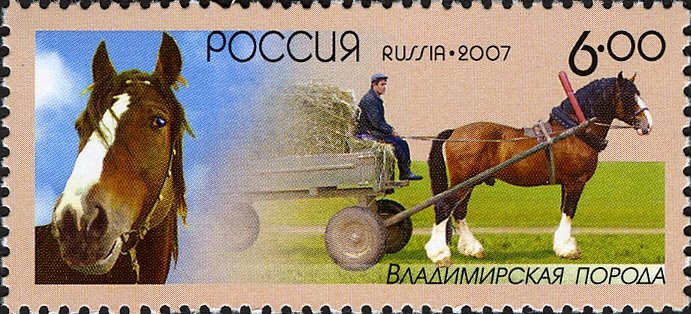
 On a Russian stamp | |
| Conservation status | FAO (2007): not at risk[1]: 99 |
|---|---|
| Other names | |
| Country of origin | USSR |
| Use | draught, meat[3]: 511 |
| Traits | |
| Weight |
|
| Height | |
The Vladimir Heavy Draft is a Russian breed of heavy draught horse. It was bred in the early twentieth century in farms and collectives in Ivanovo Oblast and Vladimir Oblast, to the east of Moscow. The most important influence on the development of the breed was from three Clydesdale stallions foaled between 1910 and 1923. The Vladimir was officially recognised in 1946.
History
[edit]The Russian Empire had no indigenous breeds of heavy draught horse. The Vladimir was created at about the same time as the development of the Russian Heavy Draught in Ukraine.[5]: 277
The foundations of the Vladimir breed were laid between 1886 and 1924.[2] Initial breeding began at the stud farm of Gavrilov Posad, in Ivanovo Oblast, where local horses were cross-bred with imported Clydesdale stock, with some limited influence from Cleveland Bay, Percheron and Suffolk Punch.[3]: 511 [5]: 276 Some use was made of Shire mares between 1919 and 1929.[5]: 276 [4]: 327 The three foundation stallions of the breed were all Clydesdales. Two of these – Border Brand and Lord James – were foaled in 1910, while Glen Albin was born in 1923.[5]: 276
The amount of cross-breeding was progressively reduced during the 1920s, and over the next twenty years the character and type of the breed were fixed. Official recognition came in 1946.[5]: 276
Characteristics
[edit]The Vladimir is a draught horse of medium power, with energetic and active gaits.[4]: 327 It is more solidly built than the Clydesdale, and unusually deep in the girth – thoracic circumference may reach 2.07 m. It is usually clean-legged, though feathering can occur. Bay is the most usual colour,[5]: 276 with white markings to the face and legs.[4]: 327
Use
[edit]The Vladimir was bred for agricultural draught work. It may be reared for meat.[3]: 511 It is fast-growing: at six months, foals may reach a weight of 200 kg.[4]: 327 Because of its lively trot movement, it is found suitable for pulling the three-horse troika of the region.[5]: 276
References
[edit]
- ^ Barbara Rischkowsky, Dafydd Pilling (editors) (2007). List of breeds documented in the Global Databank for Animal Genetic Resources, annex to: The State of the World's Animal Genetic Resources for Food and Agriculture. Rome: Commission on Genetic Resources for Food and Agriculture, Food and Agriculture Organization of the United Nations. ISBN 9789251057629. Archived 23 June 2020.
- ^ a b Vladimirskaya Tyazhelovoznaya/Russian Federation. Domestic Animal Diversity Information System of the Food and Agriculture Organization of the United Nations. Accessed June 2017.
- ^ a b c Valerie Porter, Lawrence Alderson, Stephen J.G. Hall, D. Phillip Sponenberg (2016). Mason's World Encyclopedia of Livestock Breeds and Breeding (sixth edition). Wallingford: CABI. ISBN 9781780647944.
- ^ a b c d e f g N.G. Dmitriev, L.K. Ernst (1989). Animal genetic resources of the USSR. FAO animal production and health paper 65. Rome: Food and Agriculture Organization of the United Nations. ISBN 9251025827. Archived 13 November 2009. Also available here, archived 29 September 2017.
- ^ a b c d e f g Elwyn Hartley Edwards (1994). The Encyclopedia of the Horse. London; New York; Stuttgart; Moscow: Dorling Kindersley. ISBN 0751301159.
Vladimir Heavy Draft
View on GrokipediaHistory
Origins
The Vladimir Heavy Draft breed originated in the Vladimir and Ivanovo regions of central Russia during the 1920s and 1930s, as part of Soviet agricultural initiatives aimed at improving local horse stocks for mechanized farming and transport needs.[1] These efforts focused on state farms and collectives in areas such as Yuryev-Polsky and Suzdalsky districts, where breeders sought to adapt heavy draft capabilities to the region's diverse terrain and economic demands.[1] Breeding began with crosses between hardy local Russian mares and imported stallions from established heavy draft breeds, including the Percheron and Suffolk Punch in initial phases, followed by Clydesdales between 1919 and 1929, and Shires thereafter; additional influences came from Ardennes bloodlines.[1][3] The program emphasized selecting for a balanced type that combined moderate strength with enhanced speed, overcoming the slower pace and bulkier frames of pure heavy drafts like the Belgian or Shire, to better serve Soviet transport and agricultural tasks.[1] Key to these foundational efforts was the Gavrilovo-Posad breeding station in the Ivanovo region, which has operated for over a century in stock selection and refinement, establishing core lineages that would later contribute to the breed's formal recognition in 1946.[1][4]Development and Recognition
Following the initial regional crosses in the Vladimir and Ivanovo areas, intensive selective breeding of the Vladimir Heavy Draft began in 1919 and continued through 1929 at state farms, incorporating Percheron, Suffolk Punch, Clydesdale, and later Shire influences to enhance draught power and speed.[1] This period focused on refining selected lines from crossbred stock, with key efforts at the historic Gavrilovo-Posad breeding station, which had operated for over a century.[5] By the 1930s, these programs had stabilized the breed's core traits, establishing a uniform type suitable for Soviet agricultural needs.[2] In 1946, Soviet authorities officially recognized the Vladimir Heavy Draft as a distinct breed, coinciding with the establishment of a national studbook to document and regulate its lineage.[2] This formal acknowledgment solidified its status within the USSR's equine improvement initiatives, emphasizing its role as a medium-draught horse with balanced strength and endurance.[1] The recognition enabled structured propagation across collective farms, marking a pivotal step in its institutionalization.[3] The mid-20th century represented a "golden age" for the breed, with widespread expansion in numbers and use for agricultural work and transport throughout the Soviet Union, driven by state-sponsored programs.[2] During this era, four distinct breeding lines were formalized to preserve genetic diversity and adapt to regional demands, further entrenching the breed's prominence in mechanization-limited rural economies.[1] By the late 20th century, the breed experienced a significant decline due to the rapid mechanization of agriculture, which reduced demand for draught horses across the USSR and its successor states.[2] Preservation efforts, however, persisted through dedicated state studs, notably the Yuryev-Polski facility, which maintained purebred lines and supported limited breeding to safeguard the breed's heritage.[1]Characteristics
Physical Description
The Vladimir Heavy Draft is a medium-sized draft horse breed, characterized by its sturdy yet relatively compact build suited to agricultural work. Stallions typically stand at an average height of 160 cm at the withers, while mares average 157 cm, with an overall height range of 155–165 cm. Body length measures approximately 165 cm for stallions and 162 cm for mares, with chest girth averaging 196 cm in stallions and 188 cm in mares. The cannon bone girth is 24 cm for stallions and 23 cm for mares, contributing to a balanced frame that supports weights between 650–800 kg.[3][6][2] In terms of conformation, the breed exhibits a long head with a broad, expressive profile that is straight or slightly convex, featuring a strong jaw and expressive eyes. The neck is elongated, muscular, and slightly arched, leading to pronounced withers and a slightly dipped back that transitions into a short, broad loin. The chest is broad with somewhat flat ribs, while the croup is long and sloping, providing a powerful hindquarter. Legs are correctly set and of good length, with strong, well-muscled fore and hind limbs ending in large, round, hard, and well-shaped hooves ideal for draft tasks. The breed's feathering on the legs provides protection but can contribute to a predisposition to chronic lymphedema. This structure emphasizes functionality, with heavy bone and developed musculature particularly in the shoulders, chest, and hindquarters.[3][6][2] The coat is predominantly bay, though chestnut/sorrel, black, brown, and roan variations occur less frequently, often with common white markings such as a star or blaze on the face and white on the legs. The breed features an abundant mane and tail, along with notable feathering on the lower legs, which provides protection in harsh conditions while maintaining a clean, harmonious silhouette.[3][6][2] Overall, the Vladimir Heavy Draft presents a stocky, muscular build that is leaner and more compact than heavier drafts like the Clydesdale, yet with a notably well-developed chest for power and endurance.[6][2]| Measurement | Stallions | Mares |
|---|---|---|
| Height at withers | 160 cm | 157 cm |
| Body length | 165 cm | 162 cm |
| Chest girth | 196 cm | 188 cm |
| Cannon bone girth | 24 cm | 23 cm |
| Weight range | 650–800 kg | 650–750 kg |