Hubbry Logo
Volute springVolute springMain
Open search
Volute spring
Community hub
Volute spring
logo
8 pages, 0 posts
0 subscribers
Be the first to start a discussion here.
Volute spring
Volute spring
from Wikipedia

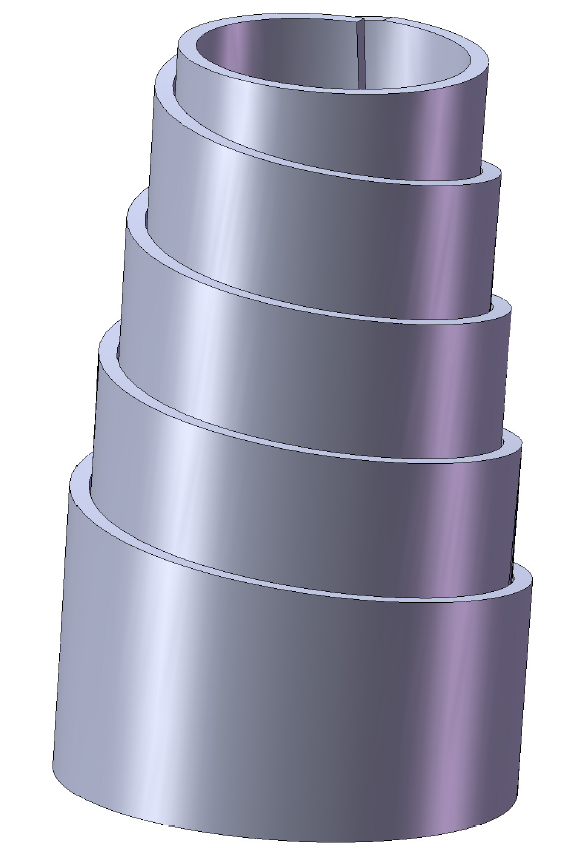
A volute spring, also known as a conical spring, is a compression spring in the form of a cone (somewhat like the classical volute decorative architectural ornament). Under compression, the coils slide past each other, thus enabling the spring to be compressed to a very short length in comparison with what would be possible with a more conventional helical spring.

There are two typical types of volute spring:

  • The first has a shape for the initial spring steel (or other material for the wound spring) as a "V", with one end wider than the other
  • The second is the double volute, having two "V" shapes facing away from each other, which forms a distorted cylinder having a wider diameter at the centre than at the ends, forming symmetric attachment points

Double volute springs can frequently be found as a component of garden pruning shears. Short posts anchored in each side of the handles, and inserted into each narrow end of the spring, keep the spring in position.

However, the applications of volute springs are not limited to such light-duty purposes as gardening shears. For example, volute springs are used to cushion the impact between railway cars and as a core element of the suspension system of Sherman tanks. A volute spring buffer device for railway cars was invented by John Brown in 1848.[1]

See also

[edit]

References

[edit]
Revisions and contributorsEdit on WikipediaRead on Wikipedia
from Grokipedia
A volute spring is a conical compression spring manufactured by winding a wide, thin rectangular strip of or other resilient material into a spiral configuration, with the coils designed to overlap and nest together under load. This construction enables the coils to slide past one another during compression, achieving a solid height equivalent to the material's thickness while providing a long deflection stroke relative to its compressed profile. Unlike traditional helical springs, volute springs exhibit a progressive load-deflection characteristic, initially linear and transitioning to nonlinear behavior as the coils bottom out, which distributes stress more evenly and enhances stability under axial forces. Volute springs are valued in mechanical engineering for their high load-bearing capacity, resistance to buckling, and damping properties, making them suitable for applications involving shock absorption and heavy compression. Common uses include automotive suspension systems, clutch assemblies, and bumper mechanisms in vehicles, where their compact design and ability to handle large forces without lateral deflection are critical. In specialized contexts, such as , they serve in launch restraint assemblies for deployables, offering reliable performance across extreme temperatures and vibrations. Recent developments include the use of fiber-reinforced composites and applications in (UAV) mechanisms, such as adjustable antennas. Additionally, their friction-inducing overlap provides inherent energy dissipation, beneficial for tools like garden shears and industrial cutters. Design considerations for volute springs emphasize —typically high-carbon for durability—and precise winding to ensure uniform coil nesting and stress distribution. While more expensive to produce than wire-based springs due to the flat stock and complexity, their advantages in progressive loading and compactness justify their use in demanding environments.

Introduction

Definition and Function

A volute spring is a conical compression spring formed from a flat rectangular strip of material, wound into overlapping coils that decrease in diameter from the base to the apex. This creates a compact, tiered structure where the coils fit inside one another, distinguishing it from traditional helical springs. In function, a volute spring serves as an and absorption device under axial compression loads. During compression, the overlapping coils slide past each other, starting from the largest base coil and progressively engaging inner coils, which provides a variable rate of resistance—increasing from linear to more exponential as deflection advances—and enables high load capacity within a small . This progressive behavior allows the spring to handle significant efficiently, with the solid height limited to the strip's width rather than stacked coils. Volute springs typically feature configurations suited to compression, such as open-coil setups for general use or closed-end variants with a dead coil for enhanced guidance and stability in precise applications. Their distinctive spiral shape, evoking a , imparts unique structural traits including self-centering alignment and inherent lateral stability, as the overlapping coils radially guide one another during operation, reducing risk without external supports.

Comparison to Other Springs

Volute springs differ structurally from other common spring types in their use of flat metal strips wound into a conical or spiral configuration, where the overlapping coils provide self-guiding action during compression. In contrast, cylindrical helical compression springs are fabricated from round wire formed into uniform cylindrical coils, while springs consist of layered flat plates arranged in a semi-elliptical or shape, and disc springs (also known as Belleville washers) are individual or stacked conical discs. Torsion springs, meanwhile, feature helical or spiral geometries optimized for twisting motion rather than axial compression. This flat-strip, conical design in volute springs enhances lateral stability under off-axis loads compared to the more prone-to-buckling behavior of traditional helical springs. In terms of performance, springs excel in compactness for high-load applications over leaf springs, which, while resilient, tend to be bulkier and require more space for equivalent load-bearing capacity. However, they offer less versatility than torsion springs for storing and releasing rotational energy, as volute springs are primarily suited for axial compression with linear or progressive force-displacement characteristics. Volute springs also demonstrate superior life and force repeatability under repeated cycling, attributes that surpass many helical designs in demanding environments. Regarding suitability, volute springs are particularly well-adapted to space-constrained, high-impact scenarios where helical compression springs might buckle or deform laterally, thanks to their self-supporting coil overlap that minimizes kinking. They fill a niche for robust shock absorption in compact forms, though they lack the precision for linear extension tasks better handled by extension springs, which resist pulling forces with hooked ends. Overall, the primary spring categories encompass helical (coiled wire for versatile compression or tension), leaf (flat plates for heavy-duty support), disc (stacked washers for high-load stacking), and volute (spiral flat strips for guided compression). Their energy absorption role aligns with helical springs but proves more efficient in tightly packaged designs requiring minimal height when compressed.

History

Invention and Early Applications

The volute spring, a conical compression spring designed to store energy by absorbing shocks, was patented by British industrialist and steelmaker John Brown in specifically as a buffer device for railway carriages. This invention addressed the need for a more robust mechanism to cushion impacts during coupling and collisions, surpassing earlier buffer designs that relied on less efficient materials like rubber or simple coil springs. The development of the volute spring occurred amid the Industrial Revolution's explosive growth in railway networks across Britain, where expanding freight and passenger traffic demanded innovative solutions for shock absorption to enhance safety and reduce wear on . Prior to this, railways often used rudimentary buffers prone to failure under heavy loads, exacerbating accidents in an era of rapid infrastructure buildup from the onward. Brown's expertise in Sheffield's industry enabled the precise of the spring's conical shape from high-quality , marking a pivotal advancement in mechanical resilience for transport systems. Initial applications of the volute spring were concentrated in buffers and drawbar couplings on British lines, where it effectively mitigated collision forces by progressively compressing under load. Adoption began immediately after the patent, with Brown supplying and North Western Railway and other major operators, but its use remained limited to heavy industrial rail settings due to the era's challenges, including the difficulty of producing uniform conical coils without defects in quality or tempering. By 1853, production had scaled to 150 sets per week, supplied to most principal British companies, demonstrating rapid integration into core . This post-1848 proliferation in British railways not only standardized springs in buffer assemblies but also influenced early practices, establishing benchmarks for spring durability and load distribution in heavy-duty applications. The invention's success underscored the interplay between metallurgical innovation and transport demands, paving the way for refined standards in during the mid-19th century.

Evolution and Modern Adoption

The evolution of volute springs accelerated in the early with their introduction in military applications during , where they were employed in tank suspensions such as the British Mark I to manage rugged terrain challenges at the in 1916. Building on earlier 19th-century railway buffer designs dating to 1848, this milestone marked a shift toward more compact, high-energy-absorption systems capable of handling heavy loads in dynamic environments. By the mid-20th century, advancements in design methodologies further refined volute springs for broader engineering use, particularly in automotive contexts. In 1943, the Society of Automotive Engineers (SAE) published standardized design methods that addressed variable spring rates and stress distribution, enabling more precise load handling and adaptation to vehicle suspensions. These protocols improved reliability and performance, facilitating integration into diverse mechanical systems beyond initial military roles. Post-World War II, volute springs saw widespread adoption in heavy machinery during the 1950s, driven by the transition from wartime production to industrial applications like shock absorption in and mining equipment. This era's growth was supported by enhanced manufacturing scalability, evolving into contemporary testing for applications in the 2020s, such as deployable mechanisms where volute springs provide controlled release in launch restraint assemblies. Key drivers of this modern adoption include material advancements, such as high-strength alloys for greater durability under extreme conditions, and computer numerical control (CNC) manufacturing techniques that allow precise coiling and customization for applications ranging from railroads to . These innovations have enabled volute springs to scale effectively across industries while maintaining their core advantages in and compactness.

Design and Construction

Geometry and Dimensions

A volute spring features a core geometry consisting of a conical spiral formed by winding a flat strip of material, resulting in coils that decrease in diameter from a large base radius (R2) to a small apex radius (R1). This configuration allows the coils to overlap and slide against each other during compression. Key dimensions of a volute spring include the number of active coils (Na), the strip thickness (t), and the strip width (w), which is proportional to the mean coil radius to maintain structural integrity. The solid height (Hs) under full compression is approximately Na multiplied by t, plus adjustments for end configurations, providing the minimum axial length when coils nest. Volute springs exhibit variations such as open or nested coil arrangements, where nested designs stack multiple volutes for increased load capacity within the same envelope. Attachment terminations commonly include eye-ends or hooks to secure the spring to mating components. Design prerequisites for volute springs emphasize space constraints and sufficient coil overlap, which are essential for the spring to function effectively under compression without excessive lateral expansion. Design often follows guidelines from the Society of Automotive Engineers (SAE).

Materials and Manufacturing

Volute springs are primarily fabricated from materials that provide high elasticity and durability under compressive loads. High-carbon spring steel strips are commonly used for standard applications due to their balance of strength and cost-effectiveness. For environments requiring corrosion resistance, stainless steels like SUS304 or SUS316 are selected, offering superior protection against rust in humid or chemical-exposed conditions. In specialized cases involving high-cycle fatigue, such as electrical contacts or precision instruments, phosphor bronze or beryllium copper alloys are employed for their enhanced endurance under repeated loading. Key material properties include high tensile strength, which enables the spring to withstand significant deformation without permanent set, and a of approximately 79 GPa for variants, ensuring efficient and release. Fatigue resistance is critical, as these materials must endure millions of cycles without failure, with selection often tailored to the operating environment—for instance, oil-tempered is preferred in automotive settings for its improved sag resistance and thermal stability. Manufacturing begins with forming the spring from flat strip, where the choice of hot or cold processes depends on the material thickness and precision needs; hot forming at 800–1000°C is used for thicker sections exceeding 5 mm to allow malleability, while cold coiling on CNC-controlled mandrels produces precise shapes for thinner stock under 5 mm. Following coiling, the springs undergo , including in oil and tempering at 400–500°C to enhance and relieve internal stresses. is then applied to induce beneficial compressive residual stresses on the surface, further improving fatigue life by mitigating crack initiation. Quality assurance involves rigorous testing to verify . Dimensional ensures adherence to specified , such as strip width and thickness, using tools like and optical comparators. compresses the spring to 1.5 times its rated capacity to confirm structural integrity without yielding, while fatigue cycling subjects samples to 10^5 to 10^6 repetitions at operational loads to assess long-term durability.

Mechanics

Working Principle

The working principle of a volute spring centers on its conical, spiral-wound configuration from a flat strip of material, which enables efficient absorption through controlled deformation under axial compression. When an axial is applied, typically to the smaller-diameter eye at the apex, the overlapping coils begin to slide relative to one another, starting from the outer (larger) coils and progressing inward toward the apex. This sliding converts the linear input motion into a combination of frictional contact between coils and elastic deformation, dissipating some as while storing the majority as in the material. The conical taper facilitates this progressive engagement, with the larger coils, having a lower inherent due to their increased , activating first to provide an initial soft response that stiffens as smaller coils toward the apex become involved. Unlike helical compression springs, which primarily store energy through torsional shear in round wire, volute springs rely on bending of the flat strip, where the primary stresses are tensile on the outer fibers and compressive on the inner fibers of each coil segment. As the load increases, the centerline of the spring strip bends downward, allowing the coils to nest closely without buckling, as the overlapping design maintains radial stability and guides the motion axially. This nesting prevents lateral deflection, ensuring the spring remains self-guiding even under dynamic loads, with the energy storage capacity enhanced by the ability to achieve a high force in a compact solid height equal to the strip's initial thickness. The progressive rate characteristic arises from this sequential coil involvement, resulting in a load-deflection curve that starts linearly but becomes increasingly nonlinear (exponential) as outer, softer coils bottom out and inner stiffer coils contribute more to the resistance. In operation, the frictional sliding between coils introduces , which aids in vibrations by converting into thermal losses, making volute springs suitable for shock-absorbing roles. However, if overloaded beyond the design limits, excessive friction can lead to coil , where adjacent turns bind together, prematurely halting deflection and potentially causing structural or inaccurate force transmission. This mode underscores the importance of proper load to avoid binding near the solid height.

Load-Deflection and Stress Analysis

The load-deflection behavior of a spring is characterized by its spring rate kk, defined as the ratio of applied load PP (in newtons) to corresponding deflection δ\delta (in millimeters), expressed as k=Pδk = \frac{P}{\delta}. For design purposes, an approximate expression for the spring rate treats the volute as a beam model, yielding kEwt36L3k \approx \frac{E w t^3}{6 L^3}, where EE is the of the material, ww is the strip width, tt is the strip thickness, and LL is the developed length of the strip along the coil path. This model assumes linear elastic behavior prior to coil bottoming, with the rate increasing progressively as outer coils contact inner ones during compression. Deflection under load is derived from beam theory applied to the volute's coiled strip, with the total axial deflection δ\delta obtained by integrating the local contributions along the developed length, accounting for varying moments and geometry across coils. This results in a nearly linear load-deflection relationship until the largest coil bottoms out. Stress analysis in volute springs focuses on the maximum , as the primary loading mode is flexural rather than torsional. The maximum tensile stress σ\sigma occurs at the outer fibers and is calculated as σ=M(w/2)I\sigma = \frac{M (w/2)}{I}, where M=PRM = P R is the with RR as the mean coil radius, and I=tw312I = \frac{t w^3}{12} is the . are applied for effects, incorporating a factor of approximately 1+(t2R)21 + \left( \frac{t}{2R} \right)^2, and for the pitch angle α\alpha via a cosα\cos \alpha term to adjust for helical inclination. These ensure accurate prediction of stress distribution, which varies along the strip due to differing coil radii. While some analyses use equivalent for design, the fundamental stresses are from . The solid height HsH_s, representing the fully compressed state, is determined as Hs=HfδmaxH_s = H_f - \delta_{\max}, where HfH_f is the free height and δmax\delta_{\max} is the maximum allowable deflection before complete bottoming of all coils. The elastic stored in the spring under load is given by U=12PδU = \frac{1}{2} P \delta, assuming linear behavior within the working range.

Applications

Transportation and Automotive

Volute springs have been employed in applications since their in 1848 specifically for use in buffers, where they absorb shocks during and decoupling of cars. These conical compression springs, made from wound flat wire, provide compact energy absorption for high-impact scenarios in rail systems, including buffers that cushion forces between freight and cars. In modern freight cars, nested volute springs are integrated into buffer systems to handle substantial loads, typically ranging from 100 to 500 kN over deflection travels of 100 to 200 mm, ensuring safe operation during shunting and transport. This configuration leverages the springs' ability to stack multiple volutes for enhanced load distribution and progressive resistance, critical for heavy-haul rail networks. Their high load capacity stems from the conical , which allows coils to slide without binding under compression. Within automotive contexts, volute springs find application in mechanisms of heavy trucks, where they deliver precise engagement force and vibration damping to support high-torque transmissions. In off-road vehicles, particularly designs from the 1940s, (VVSS) systems were adopted for superior shock absorption over rugged terrain, as seen in scout cars and half-tracks with capacities supporting 50-100 kN per axle assembly. For example, the utilized vertical volute springs in its rear suspension to manage tracked propulsion loads during operations. In transportation, volute springs serve as launch restraints in deployables, with designs tested in for during rocket ascent to protect sensitive components. Specific adaptations enhance their suitability for these vibrating environments, such as using oil-tempered for improved resistance and under cyclic stresses. Additionally, integration with hydraulic dampers in automotive suspensions enables progressive ride control, where the volute's variable rate complements damping to optimize handling and comfort across load variations.

Industrial and Specialized Uses

Volute springs are widely employed in heavy machinery clutches and couplings, where their robust supports substantial loads up to 500 kN while maintaining stability under high compression. Horizontal volute springs, in particular, facilitate gripping actions in clamps by delivering precise, space-efficient force in applications requiring secure workpiece retention. In hand tools and gardening devices, volute springs provide the essential cutting force in secateurs, enabling clean and efficient of branches and stems. Their conical structure ensures consistent pressure without coil , making them ideal for repetitive, high-cycle operations in such equipment. For specialized applications, volute springs have been tested for use in deployable mechanisms, with HEGONG conducting evaluations in 2022 to verify their in launch restraint assemblies that secure and release components in . These springs offer reliable and release in conditions, contributing to the precise deployment of antennas and solar arrays. Adaptations of volute springs enhance their versatility in demanding settings; variants provide superior resistance to in harsh industrial environments, such as chemical processing or marine-exposed machinery. Custom configurations, including tailored geometries for variable load rates, are designed for specialized tooling to achieve progressive deflection suited to dynamic gripping or buffering tasks.

Advantages and Limitations

Key Advantages

Volute springs offer a compact that enables high load capacities, typically handling forces from 100 to 500 kN in compact dimensions, making them suitable for space-constrained applications. This configuration provides 2-3 times the of traditional helical springs due to the nested coil structure, which maximizes and release in a smaller volume. The conical geometry of volute springs enhances lateral stability by self-centering the load, as the overlapping coils guide each other radially during compression, significantly reducing the risk of under off-axis forces. This inherent stability eliminates the need for additional guides or supports, simplifying assembly and improving reliability in dynamic environments. Volute springs exhibit progressive loading characteristics, where the spring rate increases with deflection as coils sequentially contact, providing softer initial response followed by stiffer resistance—ideal for controlled shock absorption. They demonstrate strong durability derived from their tensile mechanics. Additional benefits include through inter-coil friction, which dissipates energy effectively during operation. Once tooling is established, volute springs are cost-effective for high-volume production due to efficient flat-strip forming processes.

Limitations and Challenges

Volute springs present several design and operational constraints that limit their applicability in certain scenarios. Manufacturing these springs requires specialized processes, such as winding for smaller sizes using pretempered or annealed carbon or strips, and hot winding for larger sizes from carbon or low-alloy steels, which demand precise control to achieve the conical shape and overlapping coils. This complexity, including the need for custom tooling and limited availability of capable vendors, results in significantly higher production costs compared to helical compression springs, often making volute springs less economical for high-volume or standard applications. The deflection characteristics of volute springs are inherently nonlinear, with the load-deflection curve transitioning to an increasing rate as coils progressively bottom out, which can restrict the usable travel range and pose risks of over-compression or bottoming out in applications requiring extended stroke. Additionally, stress distribution is nonuniform, with higher tensile stresses occurring at the inner coils due to the geometry and torsion, potentially up to 1.5 times the mean stress in certain configurations, which reduces fatigue life in high-cycle environments unless mitigated by treatments like peening. Intercoil friction during compression exacerbates this by causing galling and localized stress concentrations, further compromising durability in dynamic uses. Volute springs are also sensitive to misalignment, as improper end configurations can lead to instability, , and uneven wear across coils, accelerating failure under load. poses further challenges; while thicknesses can range from less than 1 mm for small precision components, achieving very small overall dimensions (<1 mm) is difficult due to winding precision limits, and ultra-large sizes (>500 mm in height or diameter) require extensive hot forming that compromises accuracy and increases costs. These factors make springs less suitable for extreme size ranges compared to more versatile helical designs.

References

  1. https://commons.wikimedia.org/wiki/Category:Buffers_with_volute_springs_at_the_National_Railway_Museum
Add your contribution
Related Hubs
User Avatar
No comments yet.