


Community hub
Recent from talks
Contribute something
Nothing was collected or created yet.
Volvo 440/460
View on Wikipedia| Volvo 440/460 | |
|---|---|
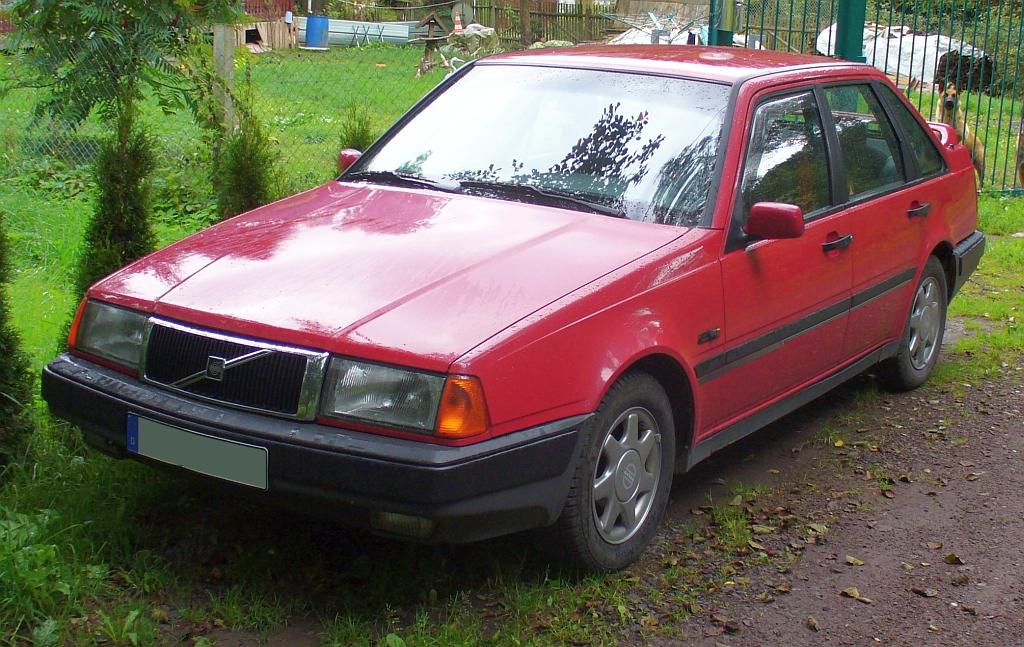
 Pre facelift Volvo 440 | |
| Overview | |
| Manufacturer | Volvo Cars |
| Production | June 1988 – September 1996 |
| Assembly | Netherlands: Born (NedCar) |
| Designer | Peter van Kuilenburg |
| Body and chassis | |
| Class | Small family car (C) |
| Body style | |
| Layout | Front-engine, front-wheel-drive |
| Related | Volvo 480 |
| Powertrain | |
| Engine | |
| Transmission | |
| Dimensions | |
| Wheelbase | 2,503 mm (98.5 in) |
| Length | 4,312 mm (169.8 in) (440, 1986–1994) 4,405 mm (173.4 in) (460, 1986–1994) 4,345 mm (171.1 in) (440, 1994–1996) 4,435 mm (174.6 in) (460, 1994–1996) |
| Width | 1,686 mm (66.4 in) |
| Height | 1,390 mm (54.7 in) |
| Curb weight | 993–1,069 kg (2,189–2,357 lb) |
| Chronology | |
| Predecessor | Volvo 300 Series |
| Successor | Volvo S40/V40 |
The Volvo 440 and 460 are versions of a small family car produced by the Swedish manufacturer Volvo between June 1988 and September 1996. The 440 was a five-door hatchback and the 460 a four-door saloon which followed in 1989. They were built at the NedCar factory in Born, the Netherlands and were only offered with front-wheel drive.
They shared many components with the earlier Volvo 480 coupé, including floorpan, front and rear suspension, engines from Renault, transmissions, and braking systems.
Design and styling
[edit]_01.jpg)
The Volvo 440/460 Series models were designed to fit in below Volvo's bigger saloon and estate cars as a replacement to the 340/360 Series, to compete with the likes of the Ford Sierra.
Development of the 440/460/480 started in 1978, as part of the "Galaxy Project" which was to create two lines of front-wheel drive cars to replace the 300- and 200-series. The smaller line was called G1, while the larger G2 was to become the new Volvo 850. The first G1 mule, designed by Jan Wilsgaard and called the G4, was completed in September 1980 and looked largely identical to the finished Volvo 440. The G1 project was split into three branches, the G13 becoming the 480, the G14 the 460, and the G15 the 440.[1] In 1982, the entire project was sold by Volvo to Volvo Car B.V. in the Netherlands (the successor company to DAF), who started work on the 480 coupé version. As was Volvo's tradition, a new line of cars was always introduced with the most expensive and lowest selling model first, allowing Volvo time to iron out any problems before starting volume production.[2]
The 480 had a lot of problems in its first year of production, and the Dutch office did not have the manpower to complete the G15 (440).[2] A lot of the work was thus subcontracted to two English companies. With the project being shifted to the Netherlands, then partially shifted to England, and further held up by the troubled gestation and initial production of the 480, the 440 looked rather dated by the time it was introduced. While the actual design is credited to Peter van Kuilenburg, Gothenburg had laid down a lot of design provisions since this was to be a volume product for the company, and the final result looked near identical to Wilsgaard's 1980 design.[2] A station wagon was never offered, to avoid competing directly with the larger 240 and 740 wagons. This did not stop independent suppliers ASC and Heuliez from designing station wagon models and presenting them to Volvo, while the Dutch company Toncar sold a bolt-on conversion which replaced the 440's tailgate with an add-on station wagon structure.[2]
First generation 400 series cars resemble the bigger 940, whilst the facelifted example bore a resemblance to the Volvo 850 to increase sales. The interiors of the 400-series variants were designed by British Volvo designer Peter Horbury.
Safety
[edit]Safety has always been an issue of primary importance to Volvo,[3] who have developed many features since adopted widely throughout the car industry. Crumple zones were carried on from the previous 300 series into the design of 400 series cars. This aided by the addition of optional seatbelt pre-tensioners and airbags both for driver and front passenger in early 1991.[4]
Other safety items included a high level brake light; a 'bulb blown' warning system; 'door open' warning light; a seatbelt reminder/warning light: all of which all came as standard on all models throughout the range.
Safety was further improved on models from 1993 onward with the introduction of Side Impact Protection System (or SIPS).[5] This was virtually unheard of at the time, and was provided (again as standard) by the forerunner of the SIPS system used on all modern Volvo cars. United Kingdom models also included daytime running lights as standard, although these could be disabled by the dealer at the owner's request.
The original advertising campaign for the 400 range centred on occupant safety. A family of crash test dummies appeared to 'survive' intact after driving the car through a plate glass office window some storeys up. Various other scenarios simulating crashes were employed in addition, all of which ended with the family walking away relatively unharmed — only to be used again in further crash tests.
Continuously Variable Transmission (CVT) option
[edit]At launch, Volvo decided to offer a four-speed ZF conventional style automatic transmission, even as they spent a few more years redesigning the DAF-derived constantly variable transmission (CVT) to work with engines with more torque than the ones used in the Volvo 340. The majority of automatic 440/460s thus had a conventional four-speed automatic.
The CVT transmission, as fitted to the last generation 440/460 Series, used steel belts (as opposed to the rubber belts used in the 300 Series) and was known as Transmatic, although cars equipped with this auto box were marketed HTA (short for High Tech Auto).
The Transmatic differs greatly in its construction, and apart from the basic CVT principle of belts running in expanding pulleys, it has nothing in common with the Variomatic CVT used in the earlier 300 Series.
Whilst the Variomatic system was completely exposed to the elements at the rear of the car and used dry rubber belts, Transmatic was mounted transversely in the front of the car, and featured steel belts running in oil within a sealed gearbox casing. Subsequent CVT transmissions (such as Audi's Multitronic), have continued to use this configuration.
The HTA gearbox was subsequently used in Rover's Metro redesigned model (last generation) and carries the VT-1 model component number.
Standard specifications
[edit]The specifications of most models of 440 and 460 were relatively high when compared with similarly priced alternatives. The list of options included as 'standard' grew and changed regularly throughout the lifespan of the car, varying from country to country and later also differing according to trim level. Furthermore, various 'special editions' were also introduced with equipment differing from that found as standard on all other models; making any more general comparison difficult.
Heated front seats were found across the entire range, as was a five speed gearbox; adjustable seatbelt with pre tensioners; folding two thirds split rear seats; lockable glovebox with light; and boot and ashtray lights.
Options listed as standard on later models include anti-lock brakes (ABS); traction control; front fog lights; separate reading lights for passengers in the back (located in the rear grab handles and cleverly shielded from the driver's view); Radio/cassette player with six high fidelity Blaupunkt stereo speakers; tinted UV blocking windows; Map reading lights; Graduated sun visor; Self-supporting (propless) bonnet; rear window wash/wipe; lumbar support; electric windows/mirrors; heated wing mirrors; central locking; tachometer. The driver's console on all models housed an array of warning lights, a rheostat and a lambda sensor monitor.
There were two generations of 440/460: the facelift model replaced the original model in the autumn of 1993, for the 1994 model year. Changes included a new bonnet and nose, new rear light clusters, body coloured bumpers, a different grille and numerous new options of engine, spec. level and equipment. The changes made the cars resemble the very successful Volvo 850 model more closely.[6]
Engines
[edit]Both 440 and 460 had a 1.7 litre Renault engine at launch, carried over from the Volvo 300 Series; this was available between 1988 and 1992 in two different versions with a carburettor, 79 PS (58 kW; 78 hp) and 128 N⋅m (94 lb⋅ft) or 87 PS (64 kW; 86 hp) and 130 Nm, multipoint fuel injection in two different versions with either 95 PS (70 kW; 94 hp) and 140 N⋅m (103 lb⋅ft) or 106 PS (78 kW; 105 hp) and 140 N⋅m (103 lb⋅ft) in the early GLT models and with multipoint fuel injection and no catalytic converter. The simplest, carburetted version was not immediately available.[7]
The standard, fuel injected and catalyzed 1,721 cc powerplant produced 102 PS (75 kW; 101 hp) and a claimed top speed of 185 km/h (115 mph), which was marginally superior to some of its contemporary counterparts, such as the Volkswagen Passat and the Opel Vectra, as their 1.8 litre engines only had 90 bhp. The turbocharged version offered 120 PS (88 kW; 118 hp), and a claimed top speed of 200 km/h (124 mph). This kind of performance put it on par with higher end 1.8 litre engines, or contemporary 2.0 litre engines, but at a significant cost increase. In August 1991, the lower cost 440/460 DL now became equipped with a somewhat larger, 1,794 cc with single-point fuel injection and 90 PS (66 kW; 89 hp). Thanks to the slight displacement increase, however, torque remained nearly identical.[8]
From 1992, the engines offered were substantially different, with the range now including a 1.6i with 83 PS (61 kW; 82 hp) as well as the 1.8 from the DL and a 2.0i with 110 PS (81 kW; 108 hp). The naturally aspirated 1.7-litre was discontinued but the turbo option from the pre-facelift version remained unchanged. The 1.6 was equipped with multi point fuel injection; the 1.8 engine had single point injection, and the 2.0 came with a choice of single point and multi point injection units, the older 1.7 turbocharged version however had more power.
From 1994, the engines became slightly more powerful. Diesel versions also became available: a 1.9-litre Renault turbodiesel option with 90 PS (66 kW; 89 hp) was offered, badged as either TD or Turbo Diesel depending on which European market the car was sold in. Volvo also released a limited market 1.8 HTA, the "High Tech Auto", using a much improved electric belt assisted CVT auto transmission, but it was short lived and slow selling.
-
 Pre facelift Volvo 440 GL (the Netherlands)
 -
 Pre-facelift Volvo 460 GLE (Portugal)
 -
 Facelift Volvo 440 SE (Australia)
 -
 Facelift Volvo 460
.jpg)
.jpg)
_02.jpg)

Trim levels
[edit]In the United Kingdom, equipment levels were different from mainland Europe. Early cars were available in L, GL, GLE, GLEi, GLT and Turbo trims. The L and GL trim levels were basic; GLE was plush and along with the GL model offered split rear seats compared to the fixed one piece rear bench on the L model; the GLT was a well equipped, mildly sporting trim level. GLT and Turbo were externally similar, both featuring lowered sports suspension and a large rear spoiler. Other trim levels were gradually phased in, such as limited edition Si and Xi, and Turbo later became simply an engine variant, rather than a full trim variant. In early 1991, the black plastic rear view mirrors were replaced by body colored ones.[4]
From 1992, the range was the same for a year and a half. As a result of the facelift of 1994, the range altered drastically. Trim levels were now: base, S (which was intended as a "family" variant), Si (intended as a "sports" variant), SE ("business" variant), GLT ("performance" variant) and CD ("luxury" variant) trims. An Li model also appeared in 1994, offering base spec with the addition of power steering (and, on later models, a sunroof).
From at least 1995 onwards, all engine choices were available with all trim levels. The later Si models and all GLT models were easily distinguishable from the rest of the range, due to the additions of sports suspension (making the car ride visibly lower) and a large rear spoiler. The GLT's specification was, however, significantly higher in featuring part leather upholstery, alloy wheels, ABS, traction control and an uprated stereo system as standard equipment.
The SE was also slightly more distinguishable, having a small rear spoiler which it shared only with the limited edition ES pack model. The ES pack could be added to cars of any engine variant from late 1995. It featured sports suspension, 15" alloy wheels, metallic paint, door sill decals, electric front windows, electric heated mirrors, front and rear armrests, ABS and immobiliser in addition to the small spoiler and an uprated stereo unit.
The S model was also notable, having two foldout child booster seats integrated into the car's rear seat, a dustbin incorporated in the dashboard and rear headrests. However unlike all the 300 Series, the 440 had, at last split rear seats fitted, though only the basic models lacked a split.
Specification of all later cars was high, with many featuring air conditioning – particularly as a result of a special offer operated by Volvo in the United Kingdom in 1995, where £100 deleted the standard electric glass sunroof from the car's specification in favour of air conditioning and 15" alloy wheels, identical to those fitted to Volvo 850 CD models, albeit with lower-profile tyres.
The luxury CD trim came particularly well-specified especially on the later, facelifted cars, with features such as heated black leather seats, interior burr walnut fascia trim, Air-conditioning, electrically operated & heated door mirrors, remote central locking, electric windows (front and rear), electric aerial, premium Volvo RDS radio cassette, thick pile carpeting, alloy wheels as well as ABS. The CD trim level could be optioned with any engine with the exception of the 1.9 Turbo Diesel, where the GLT was the highest available trim line.
The line up was reduced (for example, the Si and GLT models were replaced by the GS, which had all of the Si's equipment and some of the GLT's, such as ABS) prior to production ceasing in late summer 1996, when the Volvo S40/V40, which shared its platform with the Mitsubishi Carisma, replaced the 440/460 Series.
Mainland Europe
[edit]In most European markets, the original trim levels consisted of GL, GLE, GLT, and Turbo. The lower cost DL model, while announced for some markets from the beginning, arrived a little bite later as the carburetted engine was not initially ready for sale.[7] In some markets, such as Sweden, this model only arrived in August 1991 (for the 1992 model year).[8]
References
[edit]
- ^ ter Huurne, Rob (July 2011). "History Volvo 850". Volvotips. Archived from the original on 2019-12-15.
- ^ a b c d ter Huurne, Rob. "History 440 460 480". Volvotips. Archived from the original on 2019-12-15.
- ^ "VOLVO history". autoevolution. Retrieved 2009-11-08.
- ^ a b Johansson, Claes, ed. (1991-03-07). "Airbag i lilla Volvo" [Airbag for the little Volvo]. Teknikens Värld (in Swedish). Vol. 43, no. 5. Stockholm, Sweden: Specialtidningsförlaget AB. p. 18.
- ^ "VOLVO 440". autoevolution. Retrieved 2009-11-08.
- ^ "VOLVO 440 1993 - 1996". autoevolution. Retrieved 2009-11-08.
- ^ a b Tomadesso, Nino, ed. (1988-06-24). "Volvo gaat door op duurdere automarkt" [Volvo continues to enter the more expensive end of the market]. Limburgs Dagblad (in Dutch). p. 10.
- ^ a b Söderlind, Alrik, ed. (1991-09-05). "Säkrare 900, billigare 400" [Safer 900, cheaper 400]. Teknikens Värld (in Swedish). Vol. 43, no. 17. Stockholm, Sweden: Specialtidningsförlaget AB. p. 18.
Volvo 440/460
View on GrokipediaDevelopment and Production
Development History
The development of the Volvo 440/460 originated as part of the Galaxy Project, initiated by Volvo in 1978 to create a new family of front-wheel-drive vehicles amid the oil crisis and shifting market demands for more compact, fuel-efficient cars. This initiative aimed to replace the aging Volvo 300 Series (340/360), with the G1 platform specifically designated for a small family hatchback and sedan to enter the competitive C-segment. The project encompassed multiple variants, including the sporty G13 (which became the Volvo 480 coupe) and the family-oriented G15 (Volvo 440) and G14 (Volvo 460), emphasizing shared components for cost efficiency and modular engineering.[3][4] In 1982, the G1 portion of the Galaxy Project was transferred from Volvo's Swedish operations to its Dutch subsidiary, Volvo Car B.V., for SEK 128.5 million, allowing specialized development in the Netherlands while leveraging proximity to the planned production site in Born. The design for the Volvo 440 was led by Peter van Kuilenburg at Volvo Car B.V., drawing significant influences from the earlier G4 prototype and the ongoing Volvo 480 project, including its front-wheel-drive architecture and transverse engine layout to optimize interior space and handling. Key engineering decisions focused on adopting front-wheel drive for better packaging efficiency and sharing suspension, drivetrain, and safety components with the 480 to reduce development costs and accelerate time-to-market, marking Volvo's strategic shift toward more accessible family vehicles.[3][5] Development faced delays primarily due to production and quality issues with the Volvo 480, which launched in 1986 and encountered electrical and assembly problems that Volvo prioritized resolving before introducing the 440. The first G4 prototype, testing core front-wheel-drive functions, was completed in September 1980, but specific G15 prototypes for the 440 followed in the mid-1980s as refinements were made. The project received final approval around 1983 following the Dutch acquisition, enabling focused engineering on family practicality. Market introduction occurred in June 1988 with the five-door 440 hatchback, followed by the 460 sedan in 1989, positioning the models as Volvo's entry into the small family car segment with shared platform technology from the 480.[3][4]Production Details
The Volvo 440 and 460 were assembled exclusively at the NedCar plant (formerly operated by DAF NV) in Born, Netherlands, a facility Volvo acquired through its 1975 purchase of DAF's passenger car division.[6] Production began in June 1988 with the 440 five-door hatchback and concluded in September 1996 for both models.[3] The 460 four-door sedan joined the lineup in 1989, marking a phased rollout that allowed Volvo to refine manufacturing processes based on initial 440 output.[7] Overall production totaled approximately 385,000 units of the 440 and 238,000 units of the 460, contributing to the broader 400 series' cumulative output of nearly 700,000 vehicles.[8] A mid-cycle facelift entered production in 1994, featuring revised exterior elements and minor mechanical adjustments while maintaining the core assembly workflow at Born.[9] Volvo opted for Dutch manufacturing to achieve cost efficiencies through the existing Born infrastructure and to capitalize on DAF's established proficiency in compact car production, origins traceable to the collaborative Galaxy Project between Volvo and DAF in the early 1980s.[10] This arrangement enabled Volvo to expand its small-car portfolio without major investments in new Swedish facilities.[3]Design and Body Styles
Exterior Styling
The Volvo 440 and 460 were offered exclusively in two body styles: a five-door hatchback for the 440 model and a four-door sedan for the 460, both built on a shared front-wheel-drive platform derived from the Volvo 480.[11] This configuration emphasized practicality and compact dimensions, with the 440 providing versatile cargo access through its rear hatch and the 460 offering a more traditional notchback sedan profile.[12] Introduced in 1988, the initial exterior design featured boxy, angular lines with a high roofline to maximize interior space, drawing stylistic influences from Volvo's larger 740 and 760 models but scaled down for a smaller family car segment. Key elements included a steeply sloping nose, vertical bar grille, large rectangular headlights, and color-coordinated wraparound bumpers, creating a classical Volvo aesthetic with an aerodynamic wedge shape that contributed to stability at highway speeds and a quiet cabin.[11] The hatchback variant achieved a drag coefficient of 0.34, aiding fuel efficiency without sacrificing the model's upright, functional proportions.[13] A significant facelift arrived for the 1994 model year, introducing softer, more rounded frontal styling to modernize the appearance, including a revised bonnet, integrated grille, sleeker headlights, and a smoother bumper with an incorporated spoiler. Rear updates comprised new taillight treatments and slimmer protective side mouldings, while fresh wheel designs and two additional body colors—Indigo Blue and Burgundy Pearl Metallic—rounded out the changes.[12] Volvo opted not to develop a wagon variant for the 440/460 series, citing potential sales overlap with the more spacious 740 Estate and concerns over profitability in a market already saturated with estate options from the brand.[3] This decision limited the lineup to hatchback and sedan configurations, focusing production resources on these core styles built at the NedCar facility in the Netherlands.[11]Interior Design
The Volvo 440/460 offered a spacious C-segment interior designed to seat five passengers comfortably, with ample headroom and legroom facilitated by a high roofline and efficient packaging. The 440 hatchback model included asymmetrically split-folding rear seats (one-third/two-thirds), enabling versatile configurations for passengers or cargo while maintaining a flat load floor when folded.[14][15] The dashboard featured analog gauges in a straightforward layout that prioritized driver visibility and intuitive operation, with controls grouped in a cockpit-style console angled toward the driver for enhanced ergonomics. This design ensured that essential functions, such as the twin column stalks for lights and wipers, could be accessed without removing hands from the steering wheel.[11][15] Interior materials emphasized durability and practicality, with standard cloth upholstery available alongside optional leather in higher trims, paired with robust plastics throughout the cabin. Select higher trims incorporated wood trim accents on the dashboard and door panels to elevate the premium feel. Standard equipment included a height-adjustable steering wheel and manual climate control, while mid-level trims added power windows for front occupants.[11][16] Luggage capacity measured 330 liters in the 440 with seats up, expanding to 1,028 liters when folded, while the 460 sedan provided 453 liters of trunk space. These figures supported the models' reputation for practical family use in a compact footprint.[15][11]Chassis and Mechanical Components
Chassis and Suspension
The Volvo 440/460 was built on the Galaxy (G1) transverse front-wheel-drive platform, a modular architecture developed under Volvo's Project Galaxy initiative to support compact family vehicles with efficient packaging and shared components across models.[5] This platform featured a front-engine, front-wheel-drive layout with the transaxle integrated behind the engine, promoting a balanced design that contributed to the car's nimble handling. The chassis employed a welded steel unibody construction, incorporating a reinforced floorpan and approximately 50 kg of high-strength steel to enhance overall rigidity and structural integrity, forming a safety cage with crumple zones at the front and rear.[11] Suspension was independent at the front and semi-independent at the rear, utilizing MacPherson struts with coil springs, lower wishbones, and an anti-roll bar upfront, while the rear setup included a constant-track beam axle with coil springs, a Panhard rod, longitudinal Watt linkage, and twin-tube hydraulic dampers.[11][17] This configuration was tuned for a comfortable ride quality suitable for daily driving, prioritizing compliance over aggressive sportiness, yet providing stable roadholding inherited from the related Volvo 480 coupé.[18] The wheelbase measured 2,503 mm, which supported balanced handling aiding in predictable dynamics during cornering and straight-line stability.[17] Standard tire sizes were 175/65R14 for base models like the GL, with sportier GLE and Turbo variants upgrading to 185/60HR14 on light-alloy wheels, allowing for improved grip without compromising the suspension's ride-focused calibration.[11] Post-1994 facelift models featured refined suspension tuning for improved ride quality. Overall, the chassis and suspension design emphasized Volvo's engineering philosophy of safety and practicality, resulting in a vehicle that handled European roads with poise while maintaining passenger comfort.[3]Brakes and Steering
The braking system of the Volvo 440/460 featured front ventilated disc brakes with a diameter of 260 mm, providing effective heat dissipation during prolonged use, while rear brakes varied by model: drums on base and many standard models, or solid discs on certain higher trims and turbo variants.[19] The dual-circuit hydraulic setup operated in a diagonal split configuration, ensuring balanced stopping power even if one circuit failed, and anti-lock braking system (ABS) was available as an option starting in 1989, utilizing the Alfred Teves Mk II system with dual microprocessors for enhanced control on slippery surfaces.[20][11] Steering employed a rack-and-pinion mechanism, which contributed to precise handling, with power assistance standard on GLE and Turbo variants and optional on GL models via a speed-dependent system that reduced effort at low speeds while maintaining feedback at highway paces.[11] This setup delivered light steering effort for urban maneuvering and good road feel overall, complemented by a turning circle of 10.15 meters between curbs, making it maneuverable in tight spaces.[11] Base models with rear drum brakes included self-adjusting mechanisms to maintain consistent shoe-to-drum clearance over time, simplifying routine maintenance. The brakes and steering integrated seamlessly with the front-wheel-drive suspension layout, promoting stability during cornering by minimizing understeer and supporting predictable weight transfer.[11]Safety Features
Passive Safety Systems
The Volvo 440/460 incorporated front and rear crumple zones as deformable structures designed to absorb and dissipate impact energy in collisions, thereby reducing forces transmitted to the occupant compartment. These zones were a continuation of Volvo's established safety philosophy, originally pioneered in the 1960s and integrated into the 400 series body design from its 1988 launch.[5] The vehicle's body structure emphasized integrity through the use of high-strength steel in critical areas, including the A-pillars, roof, and B-pillars, to create a rigid safety cage that preserved habitable space during impacts. Additional reinforcements included stronger hinges and locks, as well as enhanced connections between the B-pillar and floorpan, contributing to overall structural stability. Doors featured thicker panels with integrated honeycomb energy-absorbing materials and side-impact door bars for improved protection against lateral collisions.[12] Three-point seatbelts were standard equipment across all seating positions from the model's introduction in 1988, providing effective restraint in the event of a crash. Optional seatbelt pre-tensioners, which tighten the belts upon impact detection, were introduced for the front seats starting with the 1991 model year and became standard in 1994.[5] Driver's side airbags became available as an option from the 1991 model year and were standardized across the range in 1994 as a 67-liter supplemental restraint system, deploying in severe frontal collisions to complement the seatbelts. Passenger airbags were not available on these models during production. Volvo's Side Impact Protection System (SIPS), which included reinforced doors and energy-absorbing side structures, was introduced in 1994 to enhance protection for children and adults in lateral impacts. ISOFIX child seat anchors were not fitted during the production run (ending 1996), as the system was standardized later in the industry.[5][12]Active Safety and Testing
The Volvo 440/460 featured several active safety technologies designed to prevent or mitigate collisions. A high-mounted third brake light was standard equipment across all models from launch in 1988, positioned to enhance visibility to trailing vehicles and reduce the risk of rear-end impacts by alerting drivers earlier during braking. Optional anti-lock braking system (ABS) became available starting in 1989, improving steering control and stopping stability on slippery surfaces, particularly beneficial for the model's front-wheel-drive layout.[5] Traction control was also offered on turbocharged variants from the mid-1990s, helping manage wheel spin during acceleration in low-grip conditions to maintain directional stability.[16] In 1994, with the Phase II facelift (model year 1994), Volvo introduced the Side Impact Protection System (SIPS) on the 440/460, incorporating reinforced side beams in the doors and additional structural enhancements to better distribute crash forces away from occupants during lateral collisions.[3][12] This system marked an early adoption of advanced side protection in the compact class, complementing the vehicle's overall rigid body structure. Volvo's internal safety program for the 440/460 emphasized real-world scenario testing, including simulations of varied road conditions and impact angles, which informed design refinements and contributed to the model's reputation for safety.Powertrain
Engines
The Volvo 440 and 460 were equipped with a range of inline-four-cylinder petrol and diesel engines, all mounted transversely at the front and featuring single overhead camshaft (SOHC) designs with eight valves. Initial powerplants were derived from Renault, carried over from the Volvo 300 series, while later models incorporated Volvo-developed units for improved integration and performance. All engines utilized electronic fuel injection systems starting from the model's 1988 launch, with multi-point injection on higher-output variants and single-point on base models to meet evolving emissions requirements.[21][13][22] The entry-level petrol engine was the 1.7-liter Renault-sourced B18K, producing 82 PS (80 hp) at 5,000 rpm and 128 Nm of torque (with tunes ranging 79–106 PS available), available from 1988 to 1992. A turbocharged variant, the B18FT, offered 120 PS (118 hp) and 175 Nm, providing stronger mid-range pull for performance-oriented trims like the GLT. These Renault engines were known for their durability but required regular maintenance, particularly the timing belt, which needed replacement every 70,000 miles (112,000 km) or five years to prevent catastrophic failure in this interference design.[13][23][24] From 1991, Volvo phased in its own engines, starting with the 1.6-liter B16F, delivering 83 PS (82 hp) and 128 Nm, aimed at fuel-efficient base models. The 1.8-liter B18FP followed, with 90 PS (89 hp) and 140 Nm, offering a balance of economy and refinement. The top petrol option was the 2.0-liter B20 series, available in a naturally aspirated form at 110 PS (109 hp) and 165 Nm. These later engines complied with Euro 1 emissions standards introduced in 1992, featuring catalytic converters and lambda sensors, with some 1996 models meeting early Euro 2 requirements through refined injection mapping.[21][25][26][27] Diesel power arrived in 1994 with the 1.9-liter Renault F8Q turbodiesel (code D19T), generating 90 PS (89 hp) at 4,000 rpm and 196 Nm of torque, paired with indirect injection for smoother operation. This unit met Euro 1 norms and provided superior low-end torque for highway cruising, though it was noisier than petrol counterparts. Like the petrol engines, it used a timing belt requiring replacement at similar intervals to maintain reliability.[28][29][23]| Engine Code | Displacement | Type | Power (PS/hp) | Torque (Nm) | Years Available | Notes |
|---|---|---|---|---|---|---|
| B18K | 1.7 L | Petrol, NA SOHC 8v | 82 / 80 | 128 | 1988–1992 | Renault-derived, single-point FI; tunes up to 106 PS available |
| B18FT | 1.7 L | Petrol, Turbo SOHC 8v | 120 / 118 | 175 | 1988–1992 | Renault-derived, intercooled |
| B16F | 1.6 L | Petrol, NA SOHC 8v | 83 / 82 | 128 | 1991–1996 | Multi-point FI, Euro 1 compliant |
| B18FP | 1.8 L | Petrol, NA SOHC 8v | 90 / 89 | 140 | 1991–1996 | Single-point FI initially |
| B20F | 2.0 L | Petrol, NA SOHC 8v | 110 / 109 | 165 | 1990–1996 | Multi-point FI |
| F8Q/D19T | 1.9 L | Diesel, Turbo SOHC 8v | 90 / 89 | 196 | 1994–1996 | Indirect injection, Euro 1 |
Transmissions
The Volvo 440/460 models utilized a front-wheel-drive layout exclusively, with no all-wheel-drive variants available throughout their production run.[31] The standard transmission was a 5-speed manual gearbox, designed with gear ratios optimized for fuel efficiency and everyday driving.[30] An optional 4-speed automatic transmission was introduced from 1989 onward, providing smoother operation for urban and highway use.[32] Later iterations of this automatic featured electronic controls for improved shift precision and responsiveness.[33] From 1990, a continuously variable transmission (CVT), known as the DAF Transmatic and utilizing steel belts for durability, became available as an alternative to the stepped automatics.[34] This variator-based system offered seamless ratio changes without discrete gear shifts, particularly suited for low-power applications compatible with 1.7-liter and 1.8-liter engines, and was praised for its smooth performance in city driving despite requiring more frequent maintenance.[30] The CVT's effective ratio range spanned from approximately 27.5:1 in low-speed scenarios to 0.425:1 at higher speeds, enabling constant engine optimization.[35]Specifications
Dimensions and Capacities
The Volvo 440/460 models measured 4,312 mm in length for the pre-1994 440 hatchback variant and 4,345 mm post-facelift, while the 460 sedan was 4,405 mm pre-1994 and 4,435 mm post-facelift, with a consistent width of 1,686 mm and height of 1,390 mm across most configurations.[25][17] The wheelbase was 2,503 mm for both body styles, providing a balanced stance, while the front track width stood at 1,416 mm and the rear at 1,426 mm.[17][36] Facelifts introduced minor adjustments to these dimensions, including the lengthening noted above, but overall proportions remained stable.[27] Curb weights varied by engine and equipment, ranging from 993 kg to 1,069 kg, reflecting the compact design's efficiency.[37] The gross vehicle weight rating (GVWR) was approximately 1,580 kg, allowing for a payload capacity of up to 590 kg including passengers and cargo.[26][38] Key capacities included a fuel tank holding 60 liters, sufficient for the era's efficiency standards, and engine oil volumes of 4 to 5 liters depending on the specific powerplant, such as the 1.7-liter or 2.0-liter units.[39][17] The 440 hatchback provided more versatile cargo space with a 330-liter trunk that could expand to 1,028 liters by folding the rear seats, compared to the 460 sedan's 453-liter boot expandable to 948 liters.[27][36][11]| Specification | 440 Hatchback | 460 Sedan |
|---|---|---|
| Length | 4,312 mm (pre-1994) – 4,345 mm (1994-1996) | 4,405 mm (pre-1994) – 4,435 mm (1994-1996) |
| Width | 1,686 mm | 1,686 mm |
| Height | 1,390 mm | 1,390 mm |
| Wheelbase | 2,503 mm | 2,503 mm |
| Front Track | 1,416 mm | 1,416 mm |
| Rear Track | 1,426 mm | 1,426 mm |
| Curb Weight | 993–1,069 kg | 993–1,069 kg |
| GVWR | ~1,580 kg | ~1,580 kg |
| Fuel Tank | 60 L | 60 L |
Performance Data
The performance of the Volvo 440/460 varied significantly across its engine options, reflecting its positioning as a practical family car with optional sportier capabilities. Base models equipped with the 1.6-liter inline-four engine delivered modest acceleration, reaching 0-100 km/h in approximately 13 seconds, while the 1.7-liter naturally aspirated variant improved this to 11-12 seconds. The turbocharged 1.7-liter engine, producing 120 hp, offered the quickest response among petrol options at 9-9.5 seconds to 100 km/h, providing a more engaging drive without excessive power. Top speeds ranged from 170-180 km/h for entry-level petrol engines to 190 km/h for the 2.0-liter version and up to 200 km/h for the turbo model, positioning the 440/460 competitively against contemporaries like the Ford Sierra or Volkswagen Passat in highway cruising.[40][41][42][24] Fuel efficiency was a strong suit, particularly for the era, with combined consumption figures for petrol variants typically falling between 7-8.5 L/100 km under European test cycles, equivalent to about 28-33 mpg (US) or 33-40 mpg (UK). The 1.9-liter turbodiesel, introduced later in production, achieved better economy at 5.5-6.5 L/100 km combined (around 36-43 mpg US), making it appealing for long-distance travel and contributing to the model's reputation for low running costs. Real-world figures often aligned closely with these estimates, though urban driving could push petrol models toward 9-10 L/100 km.[43][44][45] In terms of handling, the 440/460 benefited from a front-wheel-drive layout with MacPherson strut front suspension and a torsion beam rear, delivering precise steering and stable cornering that surprised reviewers accustomed to Volvo's larger, more sedate offerings. Contemporary tests noted good body control and road manners, with the turbo variant exhibiting responsive dynamics suitable for spirited driving on twisty roads. Braking was reliable, supported by ventilated front discs and solid rears, though specific stopping distances from 100 km/h were generally in the 38-42 meter range depending on tire condition and load, aligning with class standards for the period.[46][28]| Engine Variant | 0-100 km/h (seconds) | Top Speed (km/h) | Combined Fuel Economy (L/100 km) |
|---|---|---|---|
| 1.6L Petrol | 13 | 170 | 8.0 |
| 1.7L Petrol | 11.5 | 180 | 7.5 |
| 1.7L Turbo Petrol | 9.0 | 200 | 8.5 |
| 2.0L Petrol | 10.0 | 190 | 8.0 |
| 1.9L Turbodiesel | 12.5 | 175 | 5.8 |