


Community hub
Recent from talks
Contribute something
Nothing was collected or created yet.
Volvo 300 Series
View on Wikipedia
| Volvo 300 Series | |
|---|---|
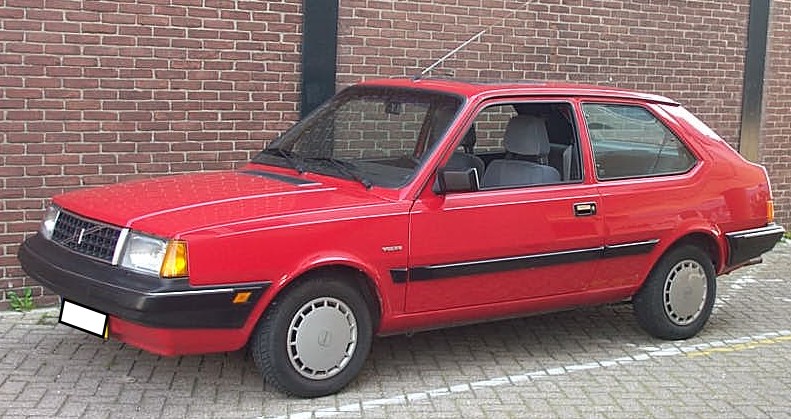
 1990 Volvo 340 GL | |
| Overview | |
| Manufacturer | Volvo Cars |
| Production | 1976–1991 |
| Assembly |
|
| Designer | John de Vries[1] |
| Body and chassis | |
| Class | Compact car / Small family car (C) |
| Body style | |
| Layout | FR layout |
| Powertrain | |
| Engine | |
| Transmission |
|
| Dimensions | |
| Curb weight |
|
| Chronology | |
| Predecessor | none |
| Successor | Volvo 400 Series |
The Volvo 300 Series is a rear-wheel-drive small family car sold from 1976[2] through 1991, both as a hatchback and (from 1984) as a conventional notchback saloon.
It was launched in the Netherlands shortly after Volvo acquired a significant stake in the passenger car division of DAF in 1973. The series consisted of the Volvo 340 (previously 343/345) and the later Volvo 360.
Origins
[edit]
After building a series of compact cars, DAF sought a partner to bring its new larger model, codenamed P900, intended to become the DAF 77, to market in 1970. Several manufacturers were approached, including Audi, BMW and Volvo.
Due to the cost, Volvo was not initially interested, but it was later persuaded by DAF's access to Renault engines. This helped Volvo expand its model lineup without the enormous expenditures of developing a new model. Building cars in the Netherlands also helped the Swedish Volvo to access the markets of the European Community, of which Sweden was not yet a member, and it was also because it was not economically viable for Volvo to build a compact model sold at a lower price point in its Swedish plants with the high cost of labour.
Volvo purchased a one-third share in DAF in 1973, increasing to a three-quarters stake in 1975; the DAF company's name was changed to Volvo Car BV that year. Free of its passenger car division, the commercial vehicle division, DAF Trucks, has continued to operate under the ownership of Paccar since 1996.
Design
[edit]DAF had begun the development of this car in 1970 as Project P900, initially meant as a replacement for the DAF 66 and due to launch in 1975, probably as DAF 77. In 1971, four designs were presented anonymously to DAF employees: one by Bertone, one by Michelotti, and two by DAF in-house designers. The design by DAF's designer John de Vries (who would later win a similar contest for the Volvo 480 design) was chosen. In 1972, Volvo bought a stake in DAF, followed by a takeover in 1975, and the design was gradually adapted to Volvo's standards, though there were a lot of quality concerns.[1]
The 300 series was unusual in having the gearbox mounted to the De Dion tube rear axle as a transaxle, with the 2 L models having the driveshaft enclosed in a "torque tube". The rear-mounted gearbox helped with weight distribution, but resulted in an unusually large transmission tunnel, especially by comparison with the contemporary front-wheel drive competitors, such as the Mk. III Ford Escort and the Opel Kadett E/Mk. II Vauxhall Astra.
Overall, the 300 series was considered heavy and often underpowered, but reliable and safe by the standards of its day.[3] However, the 360 GLT versions were well regarded by more enthusiastic drivers, with the unusual gearbox location ensuring good weight distribution, balance, and traction.[4] The fuel tank was located ahead of the rear axle, straddling the rear-mounted transmission, the safest possible location and one that ensured consistent handling characteristics whether the tank is full or empty.[5]
Model chronology
[edit]
The Volvo 343 was introduced on 19 February 1976. The introduction model was fitted with a 71 PS (52 kW; 70 hp) 1.4 L[6] Renault Cléon-Fonte engine in the front and DAF's radical Variomatic continuously variable transmission unusually mounted in the rear, helping weight distribution. The engine was an enlarged version of those fitted to the DAF 55 and 66. To add to the car's appeal and boost its sales, Volvo adapted the M45 manual transmission from the 200 series to fit in place of the CVT, and sold the manual version alongside the CVT models from 1979. Volvo had also by this point substantially redesigned the interior with a much higher quality dashboard; also new seats, steering wheels and various fittings derived from the larger 200 Series model - addressing the heavy criticism of the DAF-designed interior of the early cars. A five-door model, the 345, was added in August 1979 for the 1980 model year. The extra doors added 30 kg (66 lb); other modifications included better brakes, a slightly larger track due to wider wheels, and interval wipers.[7] During 1980 larger wrap-around bumpers were introduced. In 1981, another engine option was added to the range, the Volvo designed B19, which was only available in GLS specs with the manual transmission.
A facelift in summer 1981 for the 1982 model year featured a revised bonnet, grille, front lamp arrangement, and slightly different bumpers. The interior was revised, and the cars received a new dashboard more aligned with other Volvo models. Overall length was increased to 4,300 mm (169 in).

The third digit designating the number of doors was dropped from model designations starting with the 1983 model year. The rear seat also gained a little more space thanks to a shallower seat pad and a flatter plate beneath it.[4] The more powerful 360 arrived that year with two 2.0 L engine choices, Volvo's 95 PS (70 kW) B19A (360 GLS) and the fuel injected 115 PS (85 kW) B19E. The B19A was also available in the 340 DL.[8] The more powerful 360 GLT was only available with a five-speed manual and the engine came equipped with a breakerless ignition system and velour interior, amongst other comfort details. The 360 GLT can be recognized by its front spoiler with integrated extra lights, a rear spoiler, and by being 1.5 cm (0.59 in) lower.[8] The 360s were four-cylinders and not sixes as implied by the name; the "360" name was used to "give the new model a stronger profile in the Volvo range."[9] This 2.0 L 360 model was available in five-door and three-door hatchback form, with four-door "notchback" saloon models added in 1984. Trim levels were GL, GLE, or GLT, depending on output and specifications.
In 1985, the 300 Series received a significant facelift. Other changes were (optionally body-coloured) wrap-around bumpers with integrated turn signal lights. The taillights were also redesigned. Instrumentation changed from Smiths units to VDO. The older Volvo "redblock" engines in the 360 were upgraded to the low-friction B200 unit. Capacities and outputs remained much the same. The carburetor version was designated B200K, and the Bosch LE-Jet fuel-injected version is known as the B200E.
A famous advertisement for the 300 series in the late 1980s saw a crash test dummy "come alive", and drive a 340 out of a second-floor factory window, nose-diving into the concrete ground.
From 1987 on, incremental improvements in features and emissions control were made. The newly designed power steering from the new Volvo 480 became available as an option for the 1988 model year, while rust protection was improved with the increased use of galvanised steel.[10] Production of the 360 came to an end in 1990, while the 340 was discontinued in 1991, despite the fact it had supposedly been replaced by the Volvo 440 in 1987. The last car of the Volvo 300 series (a white Volvo 340) rolled off the production line on 13 March 1991, three years after the launch of the 400 series.
Engines
[edit]The 300 Series had a choice of three petrol engines: a 1.4, 1.7, and a 2.0 L. The 1.4 L B14 was a 72 PS (53 kW; 71 hp) Renault C-series OHV pushrod unit, and for the 360 there was the B200 (originally the earlier B19 version) 2.0 L engine taken from the Volvo 240 with outputs varying from 95 bhp (71 kW) to 118 PS (87 kW; 116 hp). A new Renault F-series 82 PS (60 kW; 81 hp) 1.7 L petrol engine (designated the B172) was introduced in the 340 during the summer of 1985,[11] following the range facelift, along with a 340 version of the saloon, which was only available with the new engine. There was also a catalyzed version (B172K) available later on, with 75 PS (55 kW; 74 hp).[11]

A diesel engine for the 340 developing 54 PS (40 kW), was only available in select export markets and was added to the 340 models in 1984. This diesel was a Renault F-series (like the petrol 1.7), and was available with a 1.6 L naturally aspirated engine only - called the "D16" in Volvo's internal jargon. While these diesel models were never offered in the UK, they were marketed with right-hand drive in Ireland. In 1985, a 360 diesel with the same mechanics was made available. The diesel was discontinued in 1989, when a 1.3 L "tax special" was introduced for Finland, Italy, and Belgium. Volvo also experimented with LPG tanks, a feature available in 1979 with the Volvo 343 and 345, but with limited LPG availability, sales were negligible.
Sales
[edit]The 300-series was a strong seller for Volvo. Sales began at a low level, not helped by the absence of a manual transmission option and an early reputation for poor build quality. Still, sales gradually increased as the lineup expanded with manual transmission and a 5-door body style, and the initial quality issues were solved - by redesigning the interior and dashboard. 300-series cumulative production broke 100,000 units on 12 December 1983, with the total reaching 102,000 before the end of the year.[12][13] The 100,000th car, finished in white, was donated to the Dutch Red Cross.
In 1988, 12 years after its introduction, the one-millionth 300 was built. Finished inside and out in red, it ended up in the DAF museum in Eindhoven. Eventually, the production of the 300 series ended in 1991 after 1.14 million units, averaging 76,000 vehicles per year.
While the car was fundamentally robust, the vehicle was rushed to production too early. In particular the first (1976) model year 343 suffered from teething problems,[14] with unsubstantiated claims that Volvo ordered its dealer network to scrap early model year cars that were traded in, to remove them from circulation. As a result, few 1976 and 1977 cars survived. The build quality gradually improved, but was never up to the same standard as Volvo's larger models.[15] Due to this bad reputation, the car was not popular in Sweden. Sales of the 340 with Variomatic in Sweden were down to 200 per year in the late 1980s.[16] The 300's sales were also limited because the price of a 2.0 L 360 was more than a base 240 in the home market.[17]
Markets
[edit]While not a major sales success, the Volvo badge ensured that the car had a strong middle-class following (often as a second car) in some places, particularly in the UK in the 1980s. It regularly made it onto Britain's top annual 20 sales tables for that decade and was the best-selling import car at several points in the early 1980s.[18] They are robust and mechanically simple (and therefore easy to maintain). Variomatic transmissions are reliable if given proper care. The rust protection was poorer than that of other Volvos, but the engines were durable. In February 2016, it was reported that 627 examples of the 300 Series were still in use on Britain's roads.[19]
.jpg)
Up to 1982, sales of the 300-series were almost entirely limited to Western Europe. In the years following, exports to other parts of the world slowly expanded with 4% of total sales in 1984. In 1985, CKD-kits of the Volvo 340 GL were sent to Indonesia and CKD-kits of the Volvo 360 GLE were sent to Malaysia for assembly.[20][21]
The Volvo 300-series was not sold in North America. Only the 360GLT was introduced in Australia and New Zealand in 1984 and exported until 1988.
Models and special editions
[edit]The 300 series was available in different trim levels throughout its production. There were also special editions.
Phase 1 343s and 345s were available in DL, GL, DLS, and GLS trim levels, while Phase 2 and 3 340s and 360s were available in the following range of trim levels: 340; 340DL; 340GL; 340GLE; 340 DLS; 340GLS; 340 Blueline; 340 Redline; 360; 360GL; 360DLS; 360GLS; 360GLE; 360GLT. No market received all models.
One such variation on a theme was the 1981 343 R-Sport. This was intended as a sporty offering to the lineup, pre-dating the introduction of the 360GLT by some two years. Only 100 cars were produced based on the DLS and GLS trim levels and featuring sporting additions such as self-adhesive 'R-Sport' decals, rev counter, front and rear spoilers, as well as some featuring body-coloured bumpers and alloy wheels. The B19A engine also featured some modifications, including twin Solex carburetors. Power was increased from a quoted 95HP to 122HP (90 kW).
A similar model was the 1979 343 Oettinger. This model was based on the standard 343 DL, with the 1397 cc capacity increased to 1596 cc. It was modified by the VW Group tuning company Oettinger and released in 1979. The 343 Oettinger was available in red or silver metallic. A total of 125 cars were produced.

A van version also entered production. The van was essentially a five-door 340, but the rear doors were replaced with full body-coloured metal pieces, and the rear seats were removed. A glazed version was also available. The 1,200-litre (42 cu ft) cargo compartment has a flat floor and a metal bulkhead behind the front seats to protect occupants from moving loads.[22] It was called "Volvo 345 Van" and was developed for commercial use at the behest of the Dutch Postal Services, who preferred a Dutch-made vehicle. It was first presented at a commercial vehicle show in Amsterdam in February 1982 and offered to the public. The only engine was the petrol B14, combined with either the CVT or a four-speed manual.[22]
The Millionaire edition was introduced in 1988 to commemorate the production of the one-millionth car in the 300 series. This edition featured all options on both the 340 GLE and 360 GLE/T, including air conditioning, electric front windows and mirrors, alloy wheels, and a leather interior.
Prototypes
[edit]
There are variations of the Volvo 300 series that never made production:
The Volvo 340 estate and a convertible were built for design studies, but neither was produced. The convertible version of the Volvo 340 was mooted and only exists as a clay model.
The 363 CS was short for 'Competition Services', to indicate a high-performance version. The 1977 363 CS was based on the three-door bodyshell and fitted with the B27F 2.7 L V6 PRV engine used in the Volvo 260 series. The gearbox was a five-speed Alfa Romeo unit, as Volvo did not have a suitable unit to fit a transaxle design. One prototype was built, painted in metallic silver with black and orange stripes down both sides. Flared wheel arches and orange-painted, multi-spoke alloy wheels were also added.
At the 1979 Geneva Motor Show, Bertone presented a three-door hatchback coupé concept on 343-basis called the Volvo Tundra. The angular design was by Marcello Gandini and continued the themes developed for the Reliant (Anadol) FW11.
In motorsport
[edit]The 300-series was campaigned in motorsport. A heavily modified version using Alpine/Gordini cross-flow engines bored out to 1770 cc was driven by Per-Inge Walfridsson to win the European Championship of Rallycross in 1980. The cars gained homologation for rallying in Sweden's Standard-B class (minimum weight of 15 kg/ps) in the spring of 1977, with some minor modifications to the engine and gearing.[23] In the UK, several Volvo 360 GLT models can be seen in action on road-rally events.
The Volvo 360 GLT also participated in a 24-hour endurance record-breaking run at the Surfers Paradise raceway in Queensland, Australia, to showcase the introduction of the model in Australia in 1984.[24] This same Volvo 360 GLT was later converted to rallying specifications and participated in many Australia rally events and is still running in 2009 as a rally car.
References
[edit]- Matras, John (1993). Illustrated Volvo Buyer's Guide. Motorbooks International. ISBN 0879387130.

- ^ a b Moberger, Henrik (April 2004). Volvo in Born, a history. Volvo Personvagnar. pp. 20–26. ISBN 9163153076.
- ^ "1970-1979: A historical review". media.volvocars.com (Press release). 8 January 2001. Retrieved 21 September 2015.
- ^ Autocarriage & Performance Drivercar, March 1986.
- ^ a b Sundfeldt, Björn (8 September 1982). "Vässad men inte vass" [Honed but not sharp]. Teknikens Värld (in Swedish). Vol. 34, no. 19. Stockholm, Sweden. p. 13.
- ^ Hogsten, Dag E. (17 November 1982). "Flygande holländaren äntligen flygfärdig" [The Flying Dutchman has finally fledged]. Teknikens Värld (in Swedish). Vol. 34, no. 22. Stockholm, Sweden. p. 31.
- ^ 1975 Volvo 343
- ^ Johansson, George, ed. (17 August 1979). "Volvo 1980: Lill-Volvo med fem dörrar - men lika slö som förut" [Baby-Volvo with five doors - but as lethargic as before]. Teknikens Värld (in Swedish). Vol. 31, no. 17. Stockholm, Sweden. pp. 16–17.
- ^ a b Alnaeus, Inge (25 August 1982). "Nytt nedifrån och upp" [New from bottom to top]. Teknikens Värld (in Swedish). Vol. 34, no. 18. Stockholm, Sweden. p. 18.
- ^ "360 Sedan". Heritage: Volvo. US. Archived from the original on 14 September 2017.
- ^ Svallner, Björn (19 August 1987). "Premiär: Volvo 1988" [Presenting: Volvo 1988]. Teknikens Värld (in Swedish). Vol. 39, no. 18. Stockholm, Sweden. p. 10.
- ^ a b Büschi, Hans-Ulrich, ed. (9 March 1989). Automobil Revue 1989 (in German and French). Vol. 84. Berne, Switzerland: Hallwag. p. 594. ISBN 3-444-00482-6.
- ^ de Jong, Nico, ed. (24 December 1983). "Autokrant" [Car Gazette]. Autovisie (in Dutch). Vol. 28, no. 26. Hilversum, Netherlands. p. 14.
- ^ Visart, Etienne, ed. (19 April 1984). "Infos". Le Moniteur de l'Automobile (in French). Vol. 35, no. 793. Brussels, Belgium. p. A 25.
- ^ Moberger, Henrik (April 2004). Volvo in Born, a history. Volvo Personvagnar. p. 28. ISBN 9163153076.
- ^ Dietl, Thomas (25 September 1981). "Skräckbilarna: Risk för ruin, chans till fynd" [The Horror Cars: Risk of Ruin, Chance For a Bargain]. Teknikens Värld (in Swedish). Vol. 33, no. 20. Stockholm, Sweden. p. 27.
- ^ Söderlind, Alrik (21 January 1987). "Rapport från en surhink" [Report from Anhedonia]. Teknikens Värld (in Swedish). Vol. 39, no. 3. Stockholm, Sweden. p. 51.
- ^ Hogsten (17 November 1982), p. 30
- ^ Isakson, Börje, ed. (6 October 1982). "Volvo 300 värst i England" [Volvo 300 biggest in England]. Teknikens Värld (in Swedish). Vol. 34, no. 21. Stockholm, Sweden. p. 54.
- ^ Braithwaithe-Smith, Gavin (23 September 2016). "100 popular cars vanishing from our roads". Motoring Research.
- ^ page 33 of "Craftsmanship is our daily routine", company presentation of Volvo Car BV, Helmond, Netherlands, 10-1985
- ^ Het levensverhaal van de Volvo 300 Serie Volvo 300 club (in Dutch)
- ^ a b Nyblad, Fredrik (May 2018). "Blå skåpet" [The blue box]. Klassiker (in Swedish). Vol. 15, no. 5. Stockholm, Sweden: OK Förlaget. p. 43.
- ^ Hogsten, Dag E., ed. (16 February 1977). "343:an klar för rally" [The 343 is ready for rallying]. Teknikens Värld (in Swedish). Vol. 30, no. 4. Stockholm, Sweden. p. 9.
- ^ "360 Racing in Australia". people.physics.anu.edu.au. 24 April 1984. Retrieved 9 October 2010.[permanent dead link]
Volvo 300 Series
View on GrokipediaOrigins and Development
Acquisition of DAF
In the early 1970s, Volvo sought to expand its model lineup into the compact car segment to address the gap below its mid-size 140 Series vehicles, leading to strategic interest in the Dutch automaker DAF, known for its innovative Variomatic continuously variable transmission and efficient small cars. Negotiations began in 1972 when Volvo acquired a 33 percent stake in DAF's passenger car operations, motivated by the opportunity to leverage DAF's engineering expertise and production facilities amid growing demand for smaller, fuel-efficient vehicles in Europe.[4][5] Volvo gradually increased its ownership, reaching a majority share in DAF Car B.V. by early 1975, effectively acquiring the passenger car division and the Born assembly plant in the Netherlands, which became a key production hub for Volvo's smaller models. This acquisition, led by Volvo's CEO Pehr G. Gyllenhammar, allowed the Swedish company to integrate DAF's ongoing projects without developing a new platform from scratch, while DAF refocused on trucks and commercial vehicles. The deal included the transfer of DAF's workforce and intellectual property, ensuring continuity in operations at the Born facility, later renamed Volvo Car B.V. in 1976.[6][7][8] A pivotal aspect of the acquisition was the incorporation of DAF's Project P900, a front-engine, rear-wheel-drive compact car platform initiated in 1970 as a successor to the DAF 66 and originally slated for launch in 1975 as the DAF 77. Volvo adapted this 2.4-meter wheelbase design, evolved from the DAF 55 and 66 platforms, to create the foundation for its 300 Series, filling the small car void and enabling quicker market entry compared to an in-house development. The project utilized a front-engine layout with rear transaxle for balanced weight distribution and packaging efficiency.[9] DAF's pre-existing collaboration with Renault, established in the late 1960s for supplying compact engines like the 1.3-liter unit used in the DAF 66, was inherited by Volvo, providing cost-effective powertrains that aligned with the era's emphasis on economy without requiring immediate redesigns. This arrangement facilitated the front-engine adaptations in the P900-derived models, as Renault's inline-four engines could be mounted longitudinally at the front, maintaining the platform's compact footprint and driving dynamics. The engine supply deal proved instrumental in accelerating the 300 Series' development, allowing Volvo to prioritize integration over full re-engineering.[10][11]Project Planning and Initial Design
Following the acquisition of a one-third stake in DAF in 1972, Volvo initiated deeper involvement in the Dutch manufacturer's ongoing small-car project, originally designated as the P900 and intended as a successor to the DAF 66. By 1974, with full oversight approaching amid DAF's financial challenges, Volvo formally launched the 343 project under chief designer Jan Wilsgaard, who evaluated and selected from existing DAF proposals while incorporating Volvo-specific refinements to align with the company's engineering philosophy.[12][3] A key design decision was to retain DAF's established front-engine, rear-wheel-drive layout with a rear-mounted transaxle and the innovative Variomatic continuously variable transmission (CVT), which provided seamless shifting and contributed to an approximate 50/50 weight distribution for enhanced handling stability. Although Volvo traditionally favored front-engine configurations in its passenger cars, the retention of this setup was deemed essential to leverage DAF's proven mechanical architecture, avoiding costly redesigns while adapting it for broader market appeal. This choice also facilitated integration of a Renault-sourced 1.4-liter inline-four engine (the B14 unit from the Cléon-Fonte family), sourced through an existing Volvo-Renault partnership that emphasized efficient powertrain sharing across European manufacturers.[13][3] Initial prototypes, constructed primarily at DAF's Born facility, underwent extensive testing in 1975 to validate the hybrid design's viability. Engineers addressed early reliability issues inherited from DAF's production methods, including suboptimal rust protection on body panels and variable build quality in assembly tolerances, through targeted improvements like enhanced galvanization and stricter quality controls. Volvo also mandated modifications to meet its rigorous safety standards, incorporating features such as a padded instrument panel, collapsible steering column, and reinforced crumple zones in the chassis structure, ensuring the vehicle aligned with the brand's reputation for occupant protection despite its compact dimensions.[3][14]Design and Engineering
Body and Chassis
The Volvo 300 Series employed a steel unibody construction derived from the DAF P900 project platform, originally developed by the Dutch manufacturer as a successor to the DAF 66 and acquired by Volvo after its 1972 takeover of DAF's passenger car division. This platform provided a rigid structure with integrated side impact protection in the doors, emphasizing occupant safety through a strong passenger compartment. The design retained DAF's innovative rear-wheel-drive configuration with a rear-mounted transaxle gearbox, which positioned the transmission and differential at the rear axle to optimize weight distribution and achieve a low center of gravity for enhanced handling stability, along with a De Dion rear axle. However, this layout also contributed to a relatively higher curb weight, typically ranging from 959 kg for base models to around 1,100 kg for higher-output variants, reflecting the robust build and rear drivetrain components.[15][14][16] Key dimensions included a wheelbase of 2,395 mm and an overall length of approximately 4,190 mm for the initial three-door hatchback, allowing for a compact footprint suitable for urban driving while offering practical interior space. The unibody's steel panels were initially treated with basic anti-corrosion coatings, but early production models from 1976 to 1980 suffered notable rust issues, particularly in wheel arches and sills, due to exposure to road salt in northern European markets. Volvo addressed these vulnerabilities through progressive improvements starting in 1980, incorporating galvanized steel in select body panels and enhanced underbody wax coatings to extend durability.[17][18] Facelifts refined the exterior aesthetics and functionality without altering the core chassis. The 1981 update replaced the original round headlights with rectangular units and substituted heavy steel bumpers for lighter plastic ones, reducing weight and improving impact absorption. By 1985, further revisions smoothed the body lines for better aerodynamics, including integrated rear spoilers and revised front air dams to lower drag coefficients and enhance high-speed stability, aligning with evolving safety and efficiency standards. These changes maintained the series' distinctive angular styling while bolstering its reputation for solid engineering.[19]Interior and Safety Features
The Volvo 300 Series provided a roomy cabin for its compact class, comfortably seating five passengers with ample legroom and headroom, particularly in the five-door 345 variant introduced in 1979. The interior layout emphasized practicality, with a simple yet functional design that reflected Volvo's focus on everyday usability in a small family car. Higher trim levels, such as the 360 GL, offered optional enhancements like air conditioning and power steering to improve driver and passenger comfort during longer journeys.[20][21] The dashboard adopted an ergonomic layout centered around analog gauges for speed, fuel, and temperature, ensuring clear visibility and ease of use without distracting digital elements. Later iterations, including the 360 models from 1983, incorporated updated interior elements like improved upholstery and additional storage compartments for enhanced convenience. Central locking became available on upscale variants in the mid-1980s, simplifying access and security.[21] Safety features aligned with Volvo's longstanding ethos, prioritizing occupant protection in a compact package. From its 1976 debut, the series equipped all five seats with three-point seatbelts, building on the design Volvo pioneered in 1959 and made freely available to the industry. The reinforced passenger compartment, combined with deformable front and rear crumple zones, helped absorb crash energy and maintain structural integrity, contributing to Volvo receiving a gold medal from the Swedish Automobile Association that year for its safety features. While airbags were absent, period evaluations highlighted the model's robust performance in impact scenarios, with padded dashboards and energy-absorbing steering columns further mitigating injury risks.[22][23][3] The hatchback configuration delivered practical cargo space, with a base luggage capacity of 376 liters behind the rear seats, expandable to 1,161 liters via fold-flat rear benches that created a level load floor for versatile use. This design facilitated easy loading through the large tailgate, making the 300 Series suitable for family outings or small hauls without compromising interior comfort.[24]Model Chronology
Early Hatchback Models (343 and 345)
The Volvo 343 was launched in February 1976 as Volvo's first compact hatchback, developed from the DAF P900 project following Volvo's acquisition of the Dutch automaker.[25][26] This 3-door model featured a rear-wheel-drive layout with a transaxle system, a 1.397-liter inline-four OHV engine producing 70 horsepower, and was initially offered exclusively with DAF's Variomatic continuously variable transmission (CVT) as standard equipment.[27][14] Designed for practicality, it included a spacious interior for its class and a large rear tailgate with an integrated spoiler, targeting budget-conscious buyers in Europe. Initial annual production was targeted at around 20,000 units, though actual output in the debut year reached 5,206 vehicles due to production ramp-up at the Born facility in the Netherlands.[28][29] To expand the lineup's appeal to families, the 5-door Volvo 345 was introduced in autumn 1979 for the 1980 model year, sharing the 343's underpinnings but incorporating revised rear door designs for improved accessibility and a total weight increase of about 30 kg.[30][31] This variant retained the same 1.4-liter engine and transmission options, emphasizing the model's flexible luggage compartment and roomy cabin to compete in the growing small family car market. The 345 quickly proved popular, with 28,655 units produced in its first year, contributing to the series' strengthening position in several European countries.[28] An early update in 1978 addressed initial criticisms of the 343 and 345, including the addition of a 4-speed manual transmission as an alternative to the standard CVT, which broadened market acceptance beyond CVT enthusiasts.[32][14] Build quality issues, such as inconsistent assembly and minor reliability concerns stemming from the rushed transition from DAF production standards, were targeted through refinements in manufacturing processes at the Born plant.[9] By late 1979, cumulative production of the early hatchbacks approached 100,000 units, a milestone reflecting growing demand despite early challenges.[33] Overall, approximately 189,000 early 343 and 345 hatchbacks were produced from 1976 to 1980, laying the foundation for the 300 Series' long-term success with total volumes exceeding 400,000 units for these initial variants by the early 1980s.[28]Later Models and Saloon (340 and 360)
The Volvo 360 was launched in 1982 as an upgraded performance-oriented variant of the 300 Series, featuring a 2.0-liter B19 four-cylinder engine in the GLT trim level for enhanced power output, and offered in both three-door and five-door hatchback configurations.[34] The GLT specification included fuel injection on the B19E variant, delivering 115 horsepower to appeal to buyers seeking spirited driving dynamics while maintaining the series' reputation for reliability.[35] In 1983 for the 340 and 1984 for the 360, Volvo expanded the lineup with the introduction of a four-door saloon body style, built on the same platform as the hatchbacks but adopting a conventional notchback design to provide a more formal aesthetic. This saloon variant was positioned to attract executive and family buyers preferring the added rear door accessibility and upright rear profile for improved practicality in professional settings.[1] A significant facelift arrived in 1983, featuring revised taillights with a more integrated appearance, an updated interior with enhanced materials and ergonomics, and refinements to the suspension for better handling and ride comfort across all later models, along with rebranding to 340/345 designations. Production of the 360 concluded in 1990, while the 340 and 345 variants continued until 1991, marking the end of the 300 Series run.[1] Overall, late production of the 340 and 360 models from 1983 to 1991 totaled approximately 800,000 units, with the saloon body style accounting for about 150,000 of those, reflecting sustained demand in European markets for these compact, rear-wheel-drive offerings.[36]Powertrain
Engines
The Volvo 300 Series primarily utilized Renault-sourced inline-four petrol engines in its base configurations, reflecting the model's origins from the DAF collaboration. The initial 1.4-liter Renault Cléon-Fonte OHV unit produced 70 PS (52 kW) at 5,500 rpm and 108 Nm of torque at 2,500 rpm, and was fitted from 1976 to 1980 across early 343 and 345 models.[37] This engine offered modest performance, with 0-100 km/h acceleration around 16.5 seconds and a top speed of approximately 150 km/h, while achieving combined fuel economy of about 8.5 L/100 km. Succeeding it was the 1.6-liter Renault OHV engine delivering 78 PS (57 kW) at 5,500 rpm and 120 Nm at 2,500 rpm, used from 1980 to 1983 in 345 and early 340 variants.[37] It improved slightly on the predecessor, posting 0-100 km/h in about 13.5 seconds and a top speed near 160 km/h, with fuel consumption in the 8-9 L/100 km range under mixed conditions. From 1983 onward, the range adopted the 1.7-liter Renault SOHC engine, which output 82 PS (60 kW) at 5,500 rpm and 135 Nm at 2,750 rpm until production ended in 1991.[37] This unit provided balanced efficiency, accelerating to 100 km/h in roughly 12.5 seconds with a top speed of 165 km/h and average fuel use of 7.5-8.5 L/100 km. Higher-performance models from 1983 featured Volvo's own B19 and later B200 inline-four SOHC petrol engines, both 2.0-liter displacements with 95-118 PS (70-87 kW) depending on tuning and market.[37] Introduced in the 360 GLT, the carbureted B19 initially produced 111 PS (82 kW) at 5,800 rpm and 155 Nm at 3,800 rpm, transitioning to fuel-injected B200E variants from 1985 that reached up to 118 PS (87 kW) at 6,000 rpm and 162 Nm at 4,000 rpm.[38] These engines enabled stronger dynamics, such as 0-100 km/h in 11 seconds and a top speed of 180 km/h for the GLT, alongside combined fuel economy of 8-9 L/100 km.[39] A Renault-sourced 1.6-liter J8S diesel engine, an indirect-injection inline-four rated at 54 PS (40 kW) at 4,500 rpm and 102 Nm at 2,250 rpm, was offered from 1984 to 1991 exclusively in select markets including the Benelux region and Italy.[40] It prioritized economy with 0-100 km/h times around 17 seconds, a top speed of 150 km/h, and fuel consumption as low as 6-7 L/100 km in highway driving, though its availability was limited due to emissions and demand constraints.[41]Transmissions
The Volvo 300 Series primarily utilized the DAF-developed Variomatic continuously variable transmission (CVT) as its standard gearbox on early models like the 343, introduced in 1976. This belt-driven system featured two variable-diameter pulleys connected by a steel-reinforced rubber belt, enabling seamless ratio changes for smooth acceleration without discrete gear shifts. The CVT offered an overall ratio range of approximately 12:1 at low speeds to 5.6:1 at high speeds, integrating directly with the rear-wheel-drive layout via a rear-mounted design that shared the platform's transaxle configuration.[42][43] Manual transmissions were added as options starting in September 1978 to address demand for more conventional shifting, beginning with a 4-speed unit (Volvo M45 R) available on the 340 and 345 models. This rear-mounted gearbox provided direct mechanical linkage to the differential, compatible with the series' Renault-sourced and later Volvo B-series engines. From 1983, the higher-output 360 models received an upgraded 5-speed manual (Volvo M47 R), which improved fuel efficiency and highway cruising compared to the 4-speed, becoming standard on GLT trims with the 2.0-liter engine.[44][12] A conventional 4-speed automatic transmission, sourced from Aisin-Warner (AW), was introduced in 1980 for higher trims like the 345 GL, offering fixed gear ratios and torque converter operation as an alternative to the CVT. This rear-mounted unit maintained the platform's unique drivetrain packaging, with electronic controls in later variants for smoother shifts, and was paired selectively with 1.6- and 2.0-liter engines to enhance market appeal in regions favoring stepped automatics. While the Variomatic CVT was praised for its innovative smoothness, reliability concerns arose from belt and clutch wear, often requiring replacement every 60,000–80,000 km under normal use, which increased maintenance costs and contributed to a preference for manual options in later production years.[42] The manual and AW automatic transmissions proved more durable overall, with fewer reported failures in long-term surveys.[43]Production and Sales
Manufacturing Sites and Figures
The Volvo 300 Series was exclusively manufactured at the Volvo Car B.V. plant in Born, Netherlands, a facility originally developed by DAF and acquired by Volvo following its majority stake in the company in 1975.[15] This location served as the sole production site for the entire series from its launch in 1976 until cessation in 1991, leveraging DAF's expertise in compact rear-wheel-drive vehicles.[19] Production peaked at approximately 100,000 units annually during the mid-1980s, reflecting improved efficiency and market demand after initial slow uptake.[44] Overall, a total of 1,006,401 units were produced across all variants, with detailed breakdowns as follows:| Model | Production Total |
|---|---|
| 343 | 472,434 |
| 345 | 358,024 |
| 360 | 176,023 |